
Leaderboard

Popular Content
Showing content with the highest reputation on 04/29/2026 in all areas
-
As part of the Golden Week display of Sanchōmō they were running a shuttle bus today to the old Nakazaki-Tei in Fukuoka Village next to Osafuné. Spread over three rooms were a display of Koshiraé (no blades), a display of Tsuba, a case full of Tōsōgu, and a display of Bizen guns and accessories, etc. The latter was my allotted corner. Not expecting anyone to visit our humble exhibition, I was surprised to see more than *a hundred people come through during the day, from all over Japan. *Later confirmed as a daily record for that residence, at 110 guests. What pleased me particularly (apart from the obvious interest shown by the visitors) was that I was asked to provide some Koshiraé, and everything that I had brought with me got added to the display. Seven Koshiraé! This is the very first time that my pieces have been considered worthy of their displays. No negative comments, all silently accepted. Made me all warm and fuzzy inside, it did.5 points
-
bit better image from Brit Museum Find it here: https://www.britishmuseum.org/collection/object/A_1952-0211-42 One for sale with papers? https://world-seiyudo.com/product/tu-070924/ The rotund guy has a slightly terrified look. May have sold? https://www.seiyudo.com/tu-070924.htm One "tsuba?" from the British Museum that probably shouldn't be there! https://www.britishmuseum.org/collection/object/C_2003-0909-2

 5 points
 -
Just a short follow up, I agreed with Samurai Museum Berlin to display the blade for two more years (until June 2028) in there so that you all have the chance to see it .5 points
-
萬延元庚申年日 – Man’en 1st Kanoe-Saru year (1860) 鈴木鉄造典直迮之 – Suzuki Tetsuzo Norichika/Norinao made this.5 points
-
Thanks for your articles Alexander . The thought that items that I now own have passed through the hands of previous collectors ,who have also treasured them , has always interested me . One minor correction. In your article on Walter Behrens you perpetuate the myth that Henri Joly was Belgian . He was born on the 24th of Feb 1878 at Chartres France . His 1901 and 1911 census entries confim that he was French . The attached tsuba is one of two I have that were once part of Henri Joly's collection .
 4 points
 -
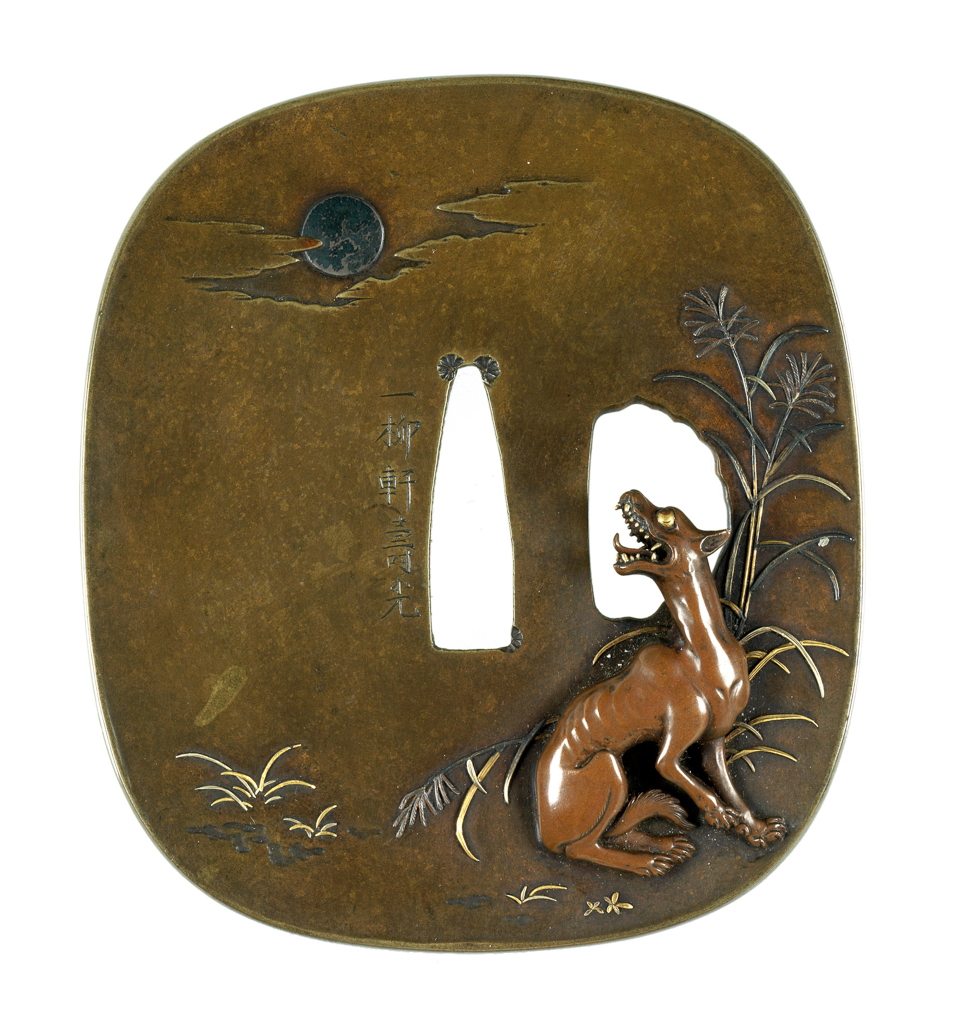
Hello all, I recently visited the samurai exhibition at rhe British Museum. Although the actual exhibit was only okay, this tsuba did stand out to me and to put it in simple terms - it made me happy and smile, so I think I've found my new favourite genre of tsuba. The exhibit didn't go into detail about the tsuba, just that it was "a tsuba, late edo" so I'd like to find out more about it if possible to direct me towards similar examples on the theme. Anyway here it is, apologies for the terrible photo quality it was the best I could get in low lighting behind glass. I just love that it's a fella exclaiming enthusiastically at a cat or racoon dog shaped teapot because it's exactly how I'd react, to both the tea and the teapot! Rob.
 3 points
 -
As per previous advice, kick up a HUGE storm. Email everyone from the CEO down. Emphasize that this is a unique, one of a kind item and is a cultural item, and that you are going to have to warn Japanese dealers against using USPS. Ask them who you put down as the person to contact since you will be opening a case with the police. Remind them that the Nihonto community is close, and that there have been a spate of these lately. Really go all out. It is my personal experience that the more you shake up the guys at top, the more change the item is "suddenly found" You have nothing to lose.3 points
-
Don’t despair just yet Gerry. You have to understand you’re dealing with USPS. I had a sword that went almost 3 weeks without a scan after it arrived in Indy in December. I would not be concerned after only 9 days. Hope it turns up soon!3 points
-
Augie, there are different ways. In case you were really interested in the subject of Japanese swords, you would buy books and read and learn. Another way would be to see swords in exhibitions, sword shows, and collections, and compare. Looking at swords online is often helpful as you have possibilities of enlarging an image and see details. But maybe the easiest way is to go to one of the meetings of a sword club, and as you are luckily in California, there are good possibilities ( https://www.ncjsc.org/ or san-francsisco-Japanese-sword-society ). These experts will certainly help you. Please read here on NMB on handling and maintenance of Japanese swords, so no damage occurs to your - possibly - valuable item! You cannot certify your sword; this is done in Japan.3 points
-
"Dignified" generally means the same as "noble" - a long, tapering sugata, typically koshi-zori which was closely linked to the court nobles of the Heian and early Kamakura period. The wider, stouter or generally more "aggressive" a sword is, the less "dignified".3 points
-
Suishinshi Masahide had a message - Edo period and everything associated with it was bad, it was better before and way better in late Kamakura. That was not unusual thinking towards Bakumatsu, whether the subject was economy, governance or sex life. How realistic is it when applied to swords is difficult to say. Overall Japanese ones are much harder than European and conversely are very prone to chipping. Great cutters with exceptionally short lifetime. You can chop a dozen iron nails with a saber and all you are going to get is the edge being shinier in places. But saber is not going to do nearly the same damage as Japanese sword. If what you want is a cut from above against say human target, I would go with shinto. More consistent steel content and grain size distribution. More weight for the same size is not going to hurt you but makes the technique more forgiving. Will shinto be more prone to fatal damage under such conditions - this is not my experience and I have an issue finding any concrete evidence confirming it is so. Early soshu is just as hard at the edge as Sukehiro. But early Soshu was battle proven... Its a big statement with not a lot of known quantities. Battle proven (very) often means we have X money, Y people and therefore we are going to make the weapons to fit the bill, nevermind all other considerations. Or it can mean we have one guy who survived a famous encounter 20 years ago and we continue making weapons according to his vision, until 20 years later people start believing in something else... And if you are an actual weapon designer, being guided by soldiers is not going to yield a fantastic weapon. There are many reasons, including soldiers not realizing the tradeoffs between performance, reliability, cost and manufacturability, while navigating those is the key to being great weapon designer. A LOT of them will have memories of the fighting itself distorted to the point of being completely unrealistic. Or driven by a single event which drove them nuts. So you are looking for a feedback of someone experienced, intelligent, calm minded, objective with knowledge of how the technology works. How many such people exist, especially since everyone who really fights rather than participates runs the risk of being killed which if not 50% then at least 10% Back to swords, frankly speaking they all have nearly the same effectiveness, +/- 15%. Its not the kind of technology or environment where you kill 100 people and then elaborate on how it felt with say Bizen versus Soshu. In this case, "fashion" becomes important. Somebody with influence likes o-kissaki - everyone tries to copy and be cool. Then another guy says - its all hubris, traditional sugata is better, and in 10 years - nothing changed on the battlefield but we are back to shapes from 100 years ago.3 points
-
On the wakizashi, 國安 - Kuniyasu3 points
-
勝正 - Katsumasa3 points
-
It’s signed Nobumasa and dated October 1943. There is a stamped “80” and also potentially a “na” stamp on the mei side. You should add "NLF" to your username - "NLF Swords.” You still throw that term around in literally every translation request you post even though it’s incorrect. These are Army swords….3 points
-
What have you got against gold? AI-enhanced comparison image:
 3 points
 -
Since we are showing off our early documented tsuba, here is one from the Mosle' collection. This one is described as number 804. TSUBA, thin iron, with two circular perforations, shigure-yasuri-me. Unsigned work of Prince Hosokawa Tadaoki (Sansai-Ko). 32. Higo province. Plates LX-LXIV Background on the Mosle Collection “Alexander Mosle’ (1862-1946) during several stays in Japan from 1884 to 1907 representing Gruson Werke, a subsidiary of Krupp, put together the core of his collection through Amiya with the advice and teachings of Akiyama Kyusaku. Back in Europe, he exhibits his collection in Berlin in 1909 (he will continue to buy until 1920). His collection was made of about 1600 pieces among which a unique group of some 300 Goto works, a number of which had the origami issued by Goto masters in works attributed to their ancestors before they were in the habit of signing. “(from 100 Selected Tsuba from European Public Collections, by Robert Haynes and Robert Burawoy)” Mentors of Mosle’ as listed in his 1914 catalog include: Paul Vautier (put together the Oeder collection) Wada Tsunahiro (put together the Furukawa collection) Akiyama Kyusaku Ogura Soemon (Amiya) “Mosle’ was one of the few devotees who actually lived in Japan (1884 -1907) during this historic period and had through his position as armament representative to Japan from the Gruson/Krupp company and as acting consul of Belgium to Japan access to experts in his fields of interest of the highest order. He counted as personal friends the likes of Tokugawa Iesato and General Nogi and mingled with the aristocracy of Japan. From this he was able to access information rarely accorded anyone, not to mention non-Japanese, and with his scholastic mind was able to document much research in these fields. (historic information has been taken from the catalog, ‘Japanese Sword Fittings from the Alexander G. Mosle’ Collection, Mosle’ and His Collection’, Sebastian Izzard LLC, 2004).
 2 points
 -
For what it is worth, I also read it as Katsumasa.2 points
-
Let's not get too carried away, it's clearly the number "8" used as an assembly mark.2 points
-
Word on niku (meat) in general. To keep up. https://japaneseswordindex.com/niku.htm2 points
-
I mean the thing is the whole "mt fuji" hamon thing is very much a generalization. Not all Shinto smiths focused on pure aesthetics. In fact ohmura even makes note of this, pointing at that for the most part blades made in kyushu seemed to perform rather well. For example, take a shodai tadayoshi blade and compare it to a tadayoshi 8: yeah the shodai will have nice jigane and may have cleaner lines, but the overall sugata and features of the blade are almost identical. Same can be said with ishido smiths. Are there exceptions? Of course, there always are, but the blanket statement that all of them were made for art isn't really true. They were still carried regularly, and tons of people relied on them for personal defense. The priorities shifted. It's like taking a modern pietta Colt single action army and comparing it to the original: they're made for completely different purposes. Also I'm in the camp that Japanese swords are primarily designed with unarmored or lightly armored targets in mind to begin with. Yeah there are swords that may be more robust, but at the end of the day it's a sidearm. Like owning a Glock 17 and expecting it to do the work of an ar15. Yeah there were definitely flaws with the cutting tests, but there were also destructive tests done. I'm sure you've read the sesko writeup on the masao vs naotane test.2 points
-
Not so sure about the swinging sabers at nails statement lmao but yeah I agree pretty much with everything else you said. The Japanese sword in general lends itself more effectively towards a proficient user rather than a random grunt who will try to use the kissaki to pry at stuff.2 points
-
The thing is you can't really quantify what type of blows caused kirikomi, so even that is hardly scientific. Obviously if a blade survived with multiple deep kirikomi, it did its job well, but I guess the main point I was getting at is there isn't really a solid way to tell besides time travel whether something like an onizuka Yoshikuni or kunihiro would perform just as well in such a situation. Also, people like to waive around random mumei swords they own with kirikomi as if that is some sign of them surviving battle, but as a kenjutsu practitioner I can guarantee that at least some of those kirikomi could've been caused by martial arts use. This is different of course if a blade has solid documentation showing it saw usage however.2 points
-
下原住正長 - Shitahara ju Masanaga2 points
-
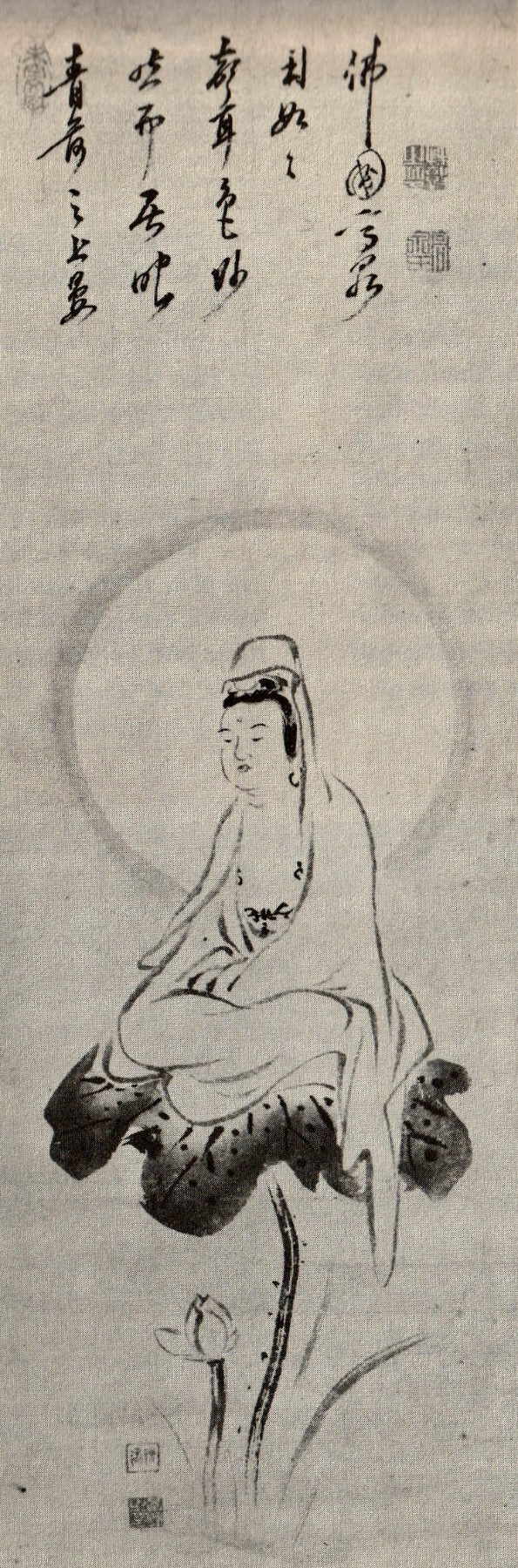
Thanks, Hiro. I have found additional evidence that Tokuho was not just a minor Obaku monk disciple of Kosen. As you have shown, he had two dharma heirs of his own. Here is another simplified lineage chart in Stephen Addiss' exhibit catalog "Obaku: Zen Painting and Calligraphy." In this volume of works belonging to American collections, another Kannon collaboration by Kosen/Tokuho is also featured. Here Kannon is depicted on a lotus rather than an outcropping above water. The translation is: Up on a green leaf, Kannon is quiet and peaceful, With eyes that hear sounds and ears that see colors-- How marvelous, how useful! Kosen's seals from this painting and two others in the catalog are shown here along with their translations.


 2 points
 -
Not enough gold! AI will be the death of us! You will never be able to trust any image ever again! Personally I prefer a tartan texture!

 2 points
 -
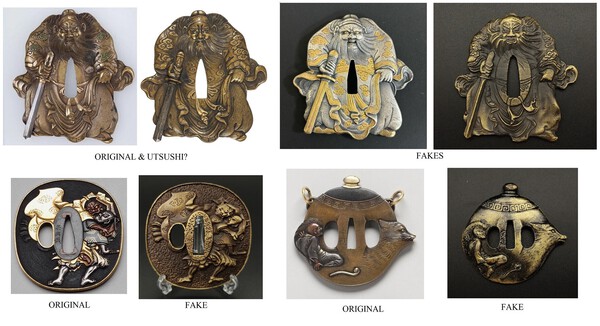
This example from a still active company with hundreds of faked/copied designs, operating out of Osaka https://www.jauce.com/user/9sBuThXpTqPVk2Hk6fEs19XhMiFkU?&search=tsuba&n=100&page=1 I did toy with the idea of doing a catalogue with the fakes and the original piece they are based on - but it might end up being a very very thick book!
 2 points
 -
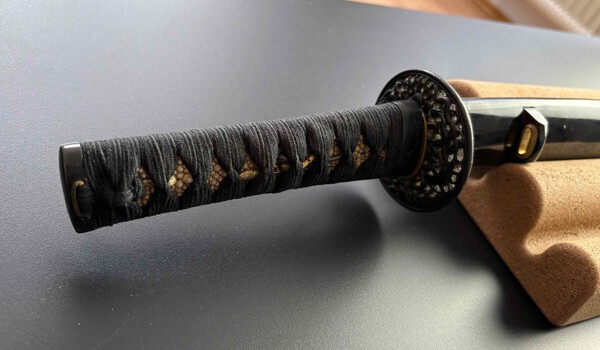
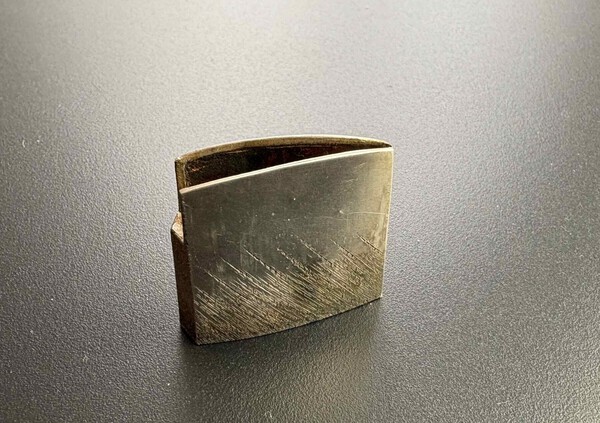
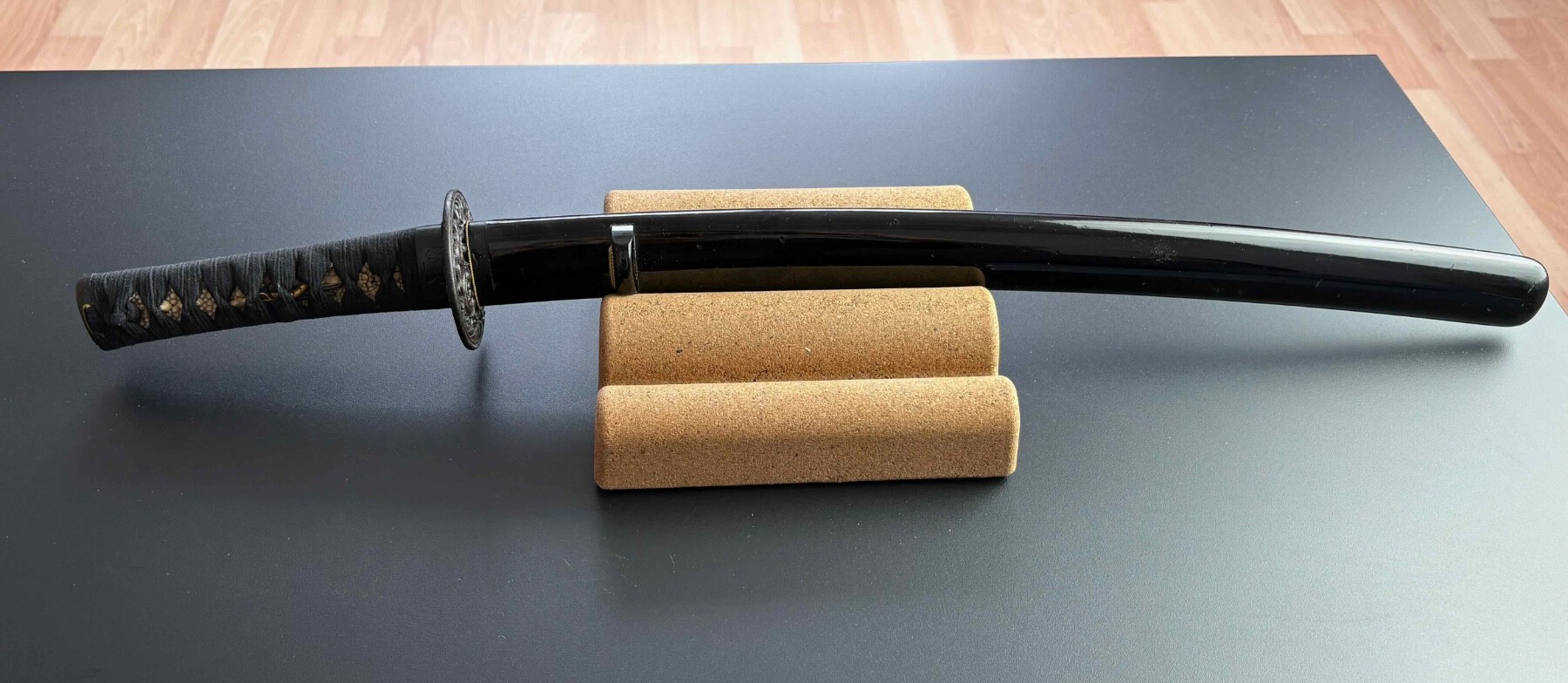
Hi, for sale is a wakizashi in mountings from Nankai Tomotaka. About the smith: TOMOTAKA (朝尊), Tenpō (天保, 1830-1844), Yamashiro – “Tomotaka” (朝尊), “Tomotaka tsukuru” (朝尊造), “Yamashiro no Kuni Nishijin-jū Tomotaka” (山城国西陣住朝尊), “Tosa no Kuni-jūnin Gonnokami Tomotaka” (土佐国住人権守朝尊), “Nankai Tarō Tomotaka” (南海太郎朝尊), “Morioka Tomotaka saku” (盛岡朝尊作), “Yamashiro no Kuni Hataeda-gū Tomotaka” (山城国幡枝寓朝尊), Tarō Tomotaka tsukuru” (太郎朝尊造), “Ichijō Horikawa-jū Nankai Tarō Tomotaka” (一条堀川住南海太郎朝尊), real name Morioka Tomotaka (森岡朝尊), “Nankai Tarō” was his pseudonym, he was born in the third year of Bunka (文化, 1806) in Kuroiwa (黒岩) in Tosa´s Takaoka district (高岡郡), he signed his name Tomotaka first with the characters (友朝), during the Bunsei era (文政, 1818-1830) he moved to Kyōto where he took care of a later generation Iga no Kami Kinmichi (伊賀守金道) and supported the court noble Chigusa Arikoto (千種有功, 1796-1854) in forging swords, during the Tenpō era (天保, 1830-1844) he worked temporarily also in Edo´s Yushima-Tenjin (湯島天神), Tomotaka was a follower of the fukkōtō movement and on par with Suishinshi Masahide when it comes to the theoretical aspect of the Japanese sword, he wrote philosophically-inspired works like Tōken Gogyō Ron (刀剣五行論, “The Five-Elements Theory at Swords”) or the Zōtō Shinki Hō (造刀心気法, about “The Integration of Emotions at Forging Swords”), but he also compiled oshigata collections like the Shintō Meishū Roku (新刀銘集録), he died in the second year of iō (慶応, 1866) in Kyōto at the age of 61, we know date signatures from the fifth year of Tenpō (1834) to the second year of Genji (元治, 1865), there are katana, wakizashi and tantō extant, some also in kanmuri-otoshi-zukuri, his blades have mostly a magnificent sugata with a wide mihaba and an elongated kissaki, Bizen-style blades have a more elegant sugata with a relative short nagasa, his hamon is mostly a ko-chōji-midare in nioi-deki which reminds of Ōei-Bizen, sometimes also an ō-midare, hitatsura, or suguha in nie-deki is seen, when he worked in the Yamashiro tradition, he hardened a chū-suguha in ko-nie-deki in combination with a beautifully forged masame mixed with ko-mokume, in rare cases he also hardened a hitatsura, some blades show elaborate horimono, the signature is quite angular and he also signed with an additional kaō, jō-saku This Wakizashi is made in Bizen-den style and was made in Bunsei 13. Signature is: heian kujo-ju tomotaka. Measurments: Nagasa: 45.2cm Sori: 1.3cm Moto-Haba: 2.84cm It comes with Mountings, Bag and Tokubetsu Hozon Papers. Price 3000 Euro (including shipping inside EU) For offers or questions please send me a PM, Thanks Oliver

 1 point
 -
Bishu Osafune Sukesada Papers: NBTHK Tokubetsu Hozon Country(Kuni)・Era(Jidai): Bizen(Okayama)・Late Muromachi period - August, 1567 (Eiroku 10th year) Blade length(Cutting edge): 71.5cm Curve(SORI): 2.5cm Width at the hamachi(Moto-Haba): 3.22cm Thickness at the Moto-Kasane: 0.77cm Wide at the Kissaki(Saki-Haba): 2.55cm Thickness at the Saki-Kasane: 0.60cm Habaki: oneo part, gold foil Habaki Sword tang(Nakago):Unaltered, Kattesagari file pattern Rivet Holes(Mekugiana): 1 Shape(Taihai): Shinogizukuri, Iorimune, Chu-kissaki Dated and has a wide width and thickness. Hamon is Gunome and Choji with Tobiyaki. Jigane is Itame and Mokume. Nakago is Ubu. Asking: $12,000 Payment: Bank transfer Shipping: Free for continental USA (you pay elsewhere) - but if you want to return it I need to deduct it from the refund This will be going onto Nihonto Antiques soon if it is not picked up here first. Excellent condition, polish is in sashikomi with a very beautiful "light behind the clouds" effect. Strong sugata.1 point
-
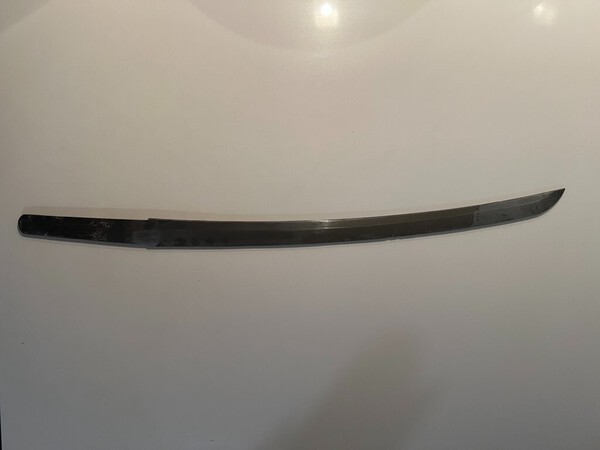
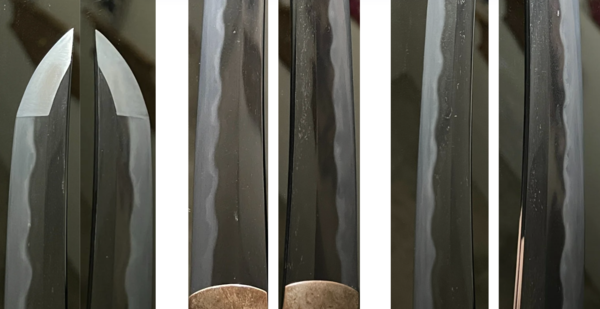
Hello Everyone. Hope that you are having a great week and making a nice cup of matcha while researching your next Nihonto purchase. I have an unidentified wakizashi I am struggling with, as it is mumei and exhibits features of Mino and or Bizen. The hamon and overall sugata is similar to Bizen school, closest I found in geometry and hamon was the Sukesada line or Oei Bizen. What confuses me is the toriizori curve, which is generally a Mino feature. The hada is mokume, kissaki is chu-kissaki and the boshi is hakikake. I place this wakizashi to mid to late Muromatchi period based on the overall patina on the nakago and the features within the steel. A beautiful gunome midare hamon with a slight fumbare which both give me the sense of great elegance, stability and power. Any additional information on this wakizashi will help a long way, Japanese swords are a long time passion of mine, and I am so glad to have the opportunity for this particular one to find me. After your careful assessment and review of the photos I would make a decision on whether to take it to Shinsa or not. Warm Regards, Gordon S

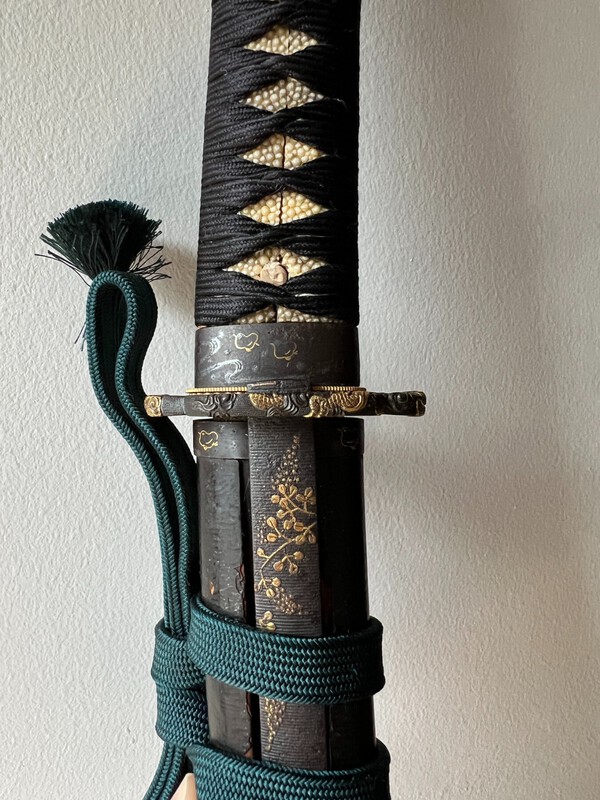 1 point
 -
i talked to my local Postmaster and he got me with postal inspectors, i think registered may have helped but they did investigate eventually it showed up, don't think anything they did helped, but i was told they were actively searching for it1 point
-
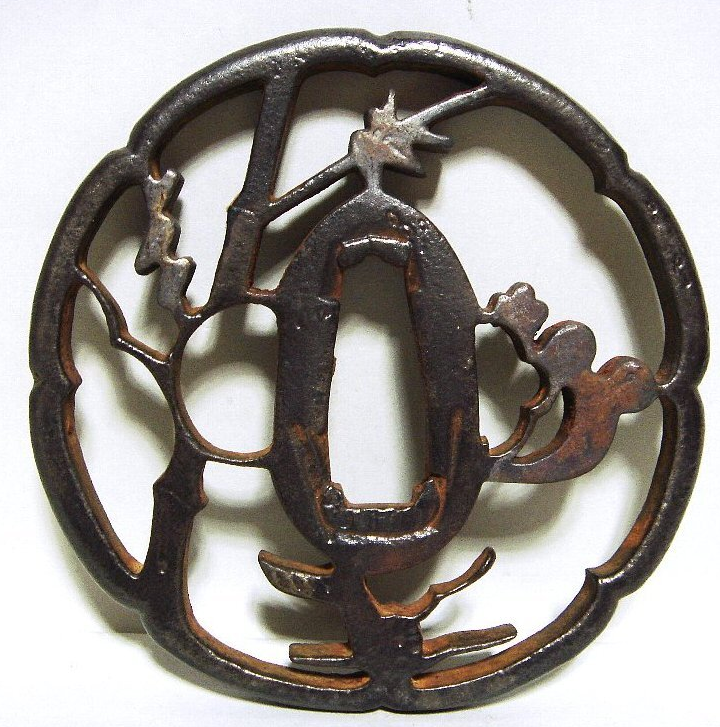
Alex, I absolutely share your opinion. I am an 'iron guy', but to my surprise, in some cases, a little gold does not hurt. The below shown typical TEIMEI TSUBA (one of the "underrated" styles/schools) has a fine gold decoration which is rarely seen on these. How do you find that?
 1 point
 -
I admit being partial to a bit of gold decoration here and there but totally appreciate the presence and atmosphere imparted by each style to be really quite different in impact. For me, zogan application seems to add levity to the “weight” and seriousness of plain iron, but I’m familiar with the opinion that it is distasteful to add “makeup” to an iron tsuba. (Last one, I promise 😂)
 1 point
 -
I think John is correct. It's just a number 8. That said, if one were superstitious and could pick a number to stamp into their sword, then why not pick the number 8. But that's probably all there is to it. John C.1 point
-
Thanks Brian!1 point
-
Minamoto Kiyomaro1 point
-
Just a reminder to all, when you copy/paste a link from eBay, you can cut aaaaaalll those extra tracking cookie and sid and other data after the item number, then the link is very simple. Edited the one above.1 point
-
Nah .. all photos taken by Mike in downtown Melbourne. This sword has been in Australia since the serviceman brought it home from the Pacific Campaign.1 point
-
What are your thoughts on this one: https://www.jauce.com/auction/u1227971547 It feels off to me. The sekigane look fake, the sloppy execution of the bamboo(?) and other bits, the too small kogai ana, along with the dusting of rust all make me feel that it is more than a little suss…
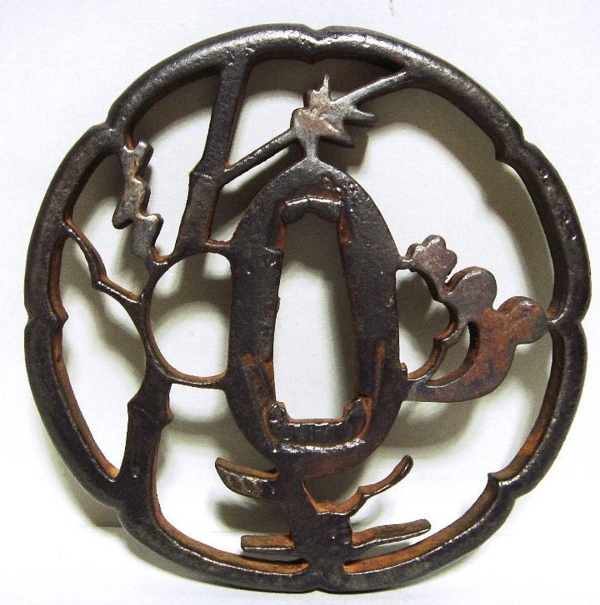 1 point
 -
Augie, the signature reads KUNIYASU, not kaniyasu. To identify a swordsmith, you have to compare the work (in the blade) with certified examples. You need to see the blade (in good traditional polish) in-hand for that. The signature is the final factor of evidence in this comparison.1 point
-
mr kojima talked a bit about koto steel a bit in this article: http://www.ksky.ne.jp/~sumie99/Masamune.html the last paragraph, regarding a masamune.... "But still I have a question, if such a blade is good as weapon. Of course I know that, soft and tough edge is better than sharp and brittle edge in some situation." so it seem that between koto and shinto blades, it is less about the difference in quality, but a difference in use and therefore a difference in structure.1 point
-
Thank you for the pictures and report Gerry.1 point
-
Alex, I absolutely share your opinion. Coming back to the title of this thread, I am often more impressed by the inherent craft in a TSUBA than by its artistry. I can admire the work in a gorgeous and opulent 19th century KINKO TSUBA, but for owning one, I would choose a genuine KACHUSHI TSUBA with a well-made DOTE MIMI. But they are no longer underrated and now sold for big money!
 1 point
 -
This one sticks in the memory from a dealer’s fb page a few years ago. T’was beyond my means, but I still think about it occasionally. Hats off to whoever picked it up.
 1 point
 -
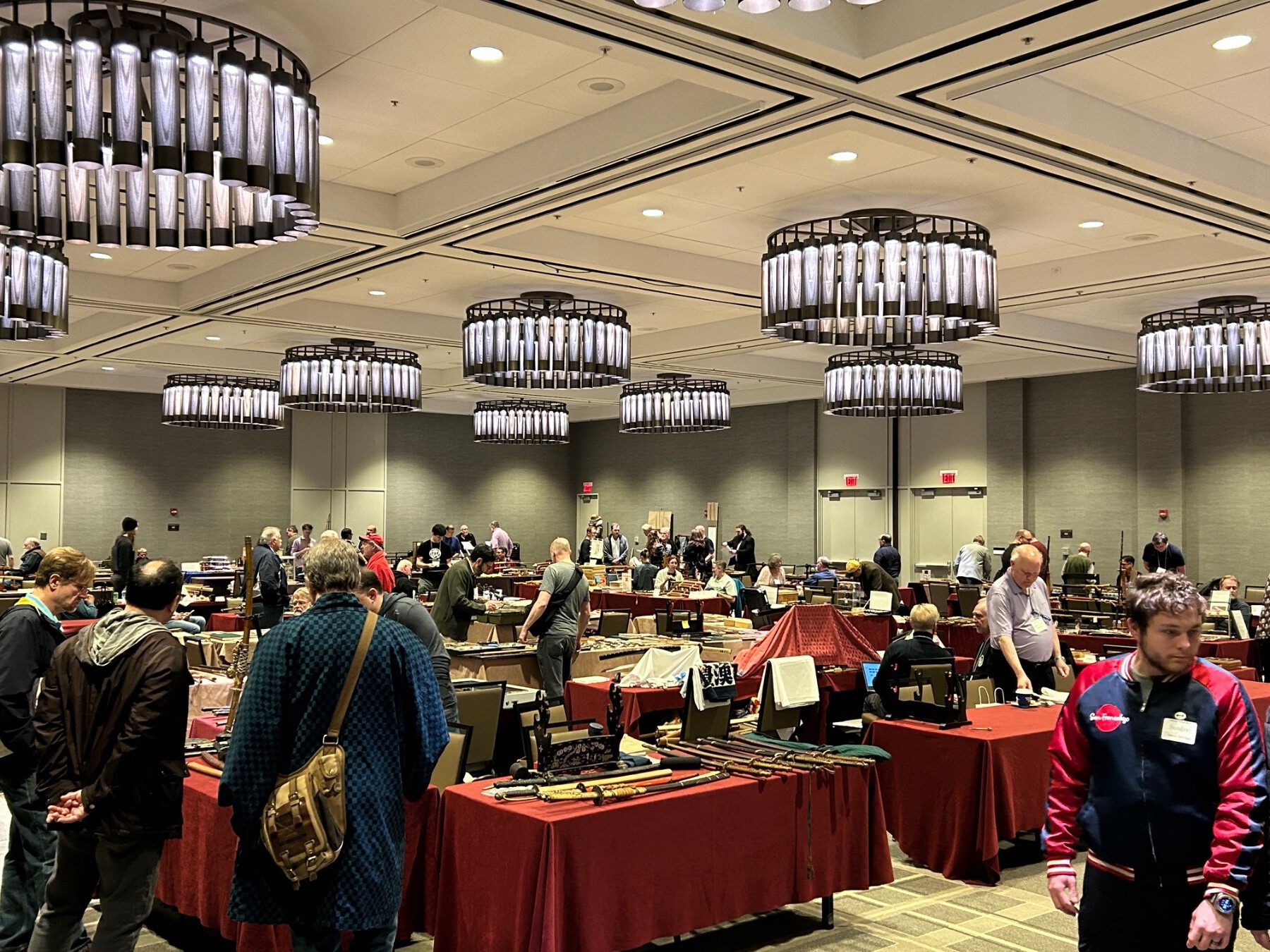
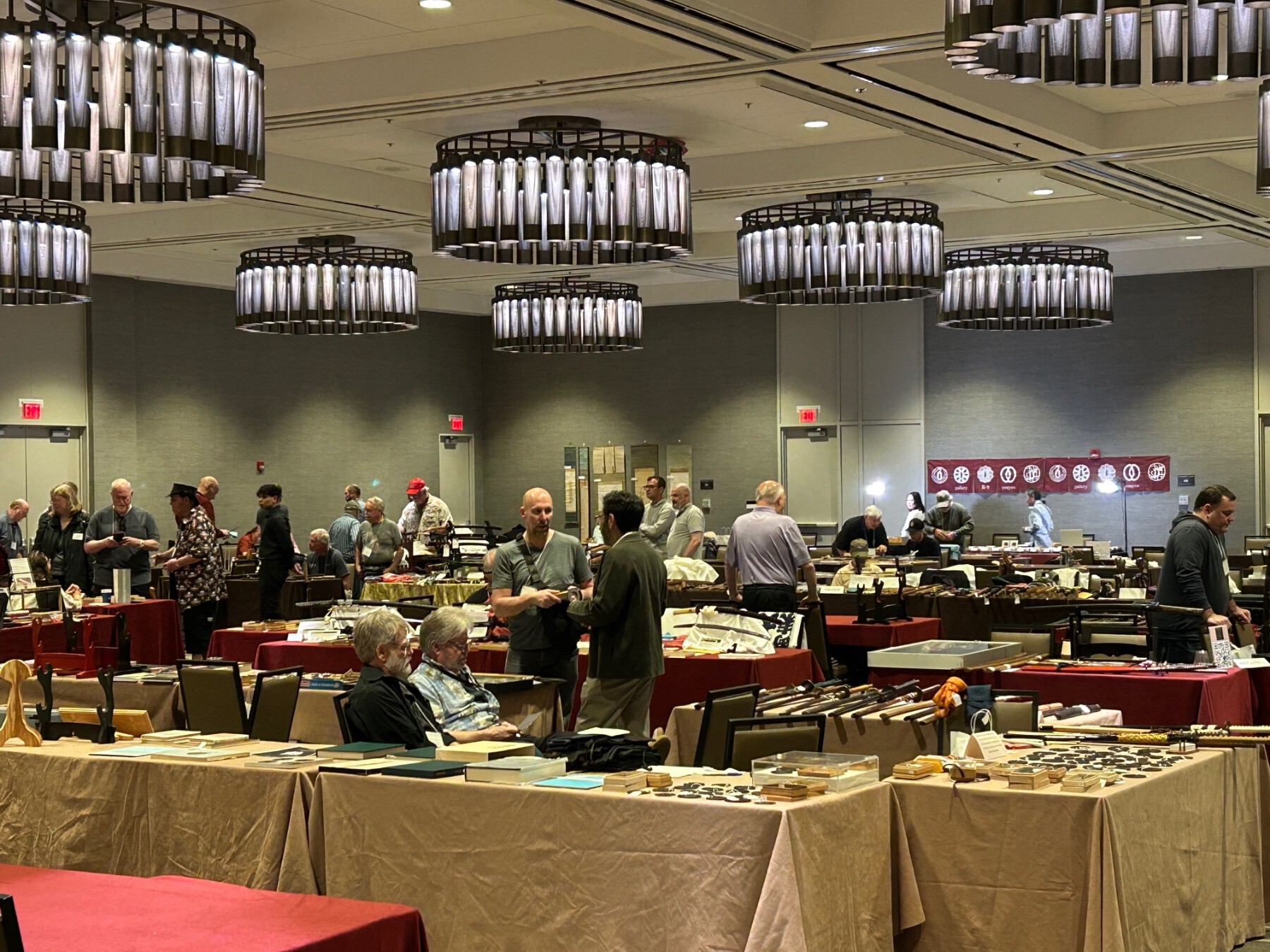
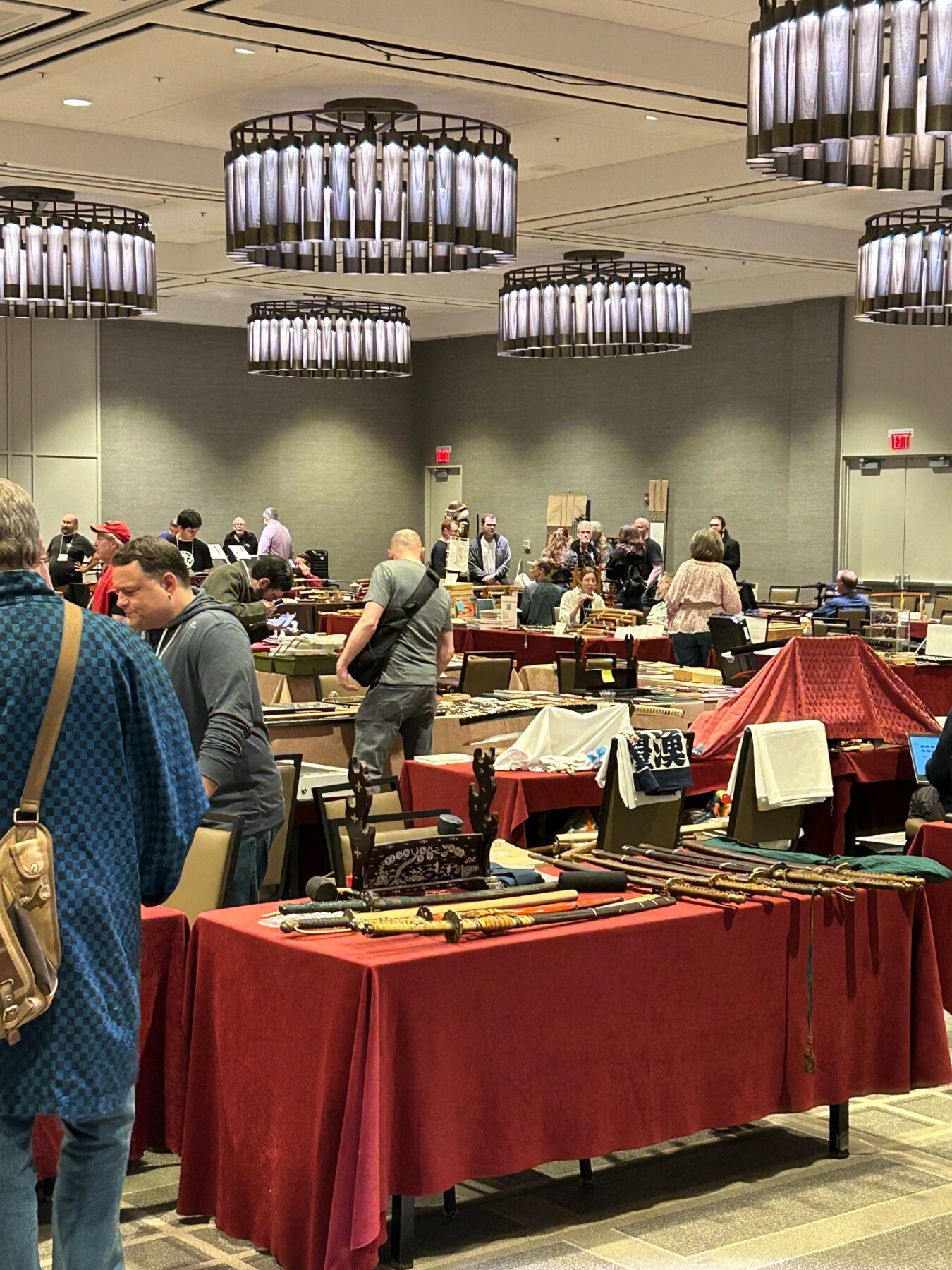
Just a few pictures from the show. This was from Sunday. Saturday was much busier! As always, Mark and family put on a great show! Lots of great items to see and had the chance to meet up with old friends.

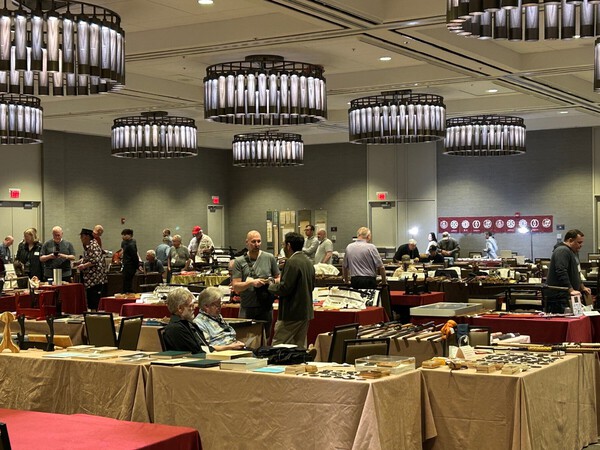

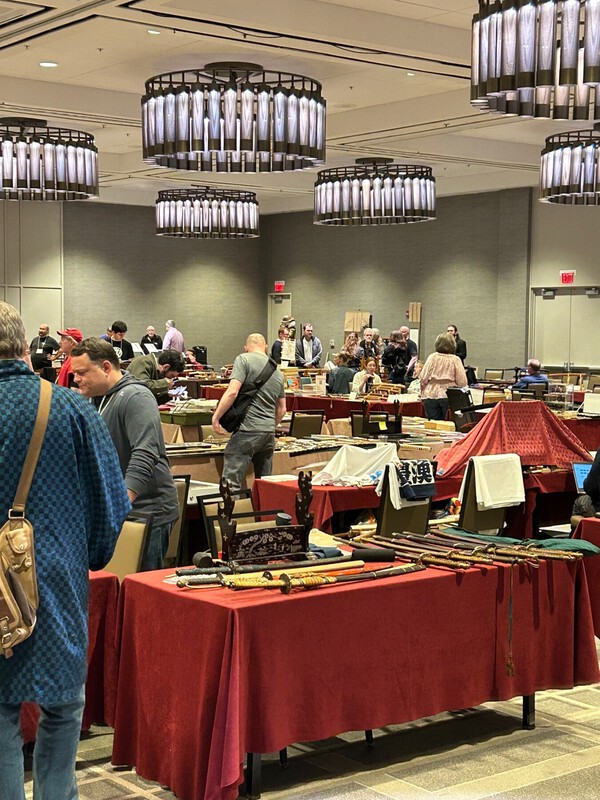 1 point
 -
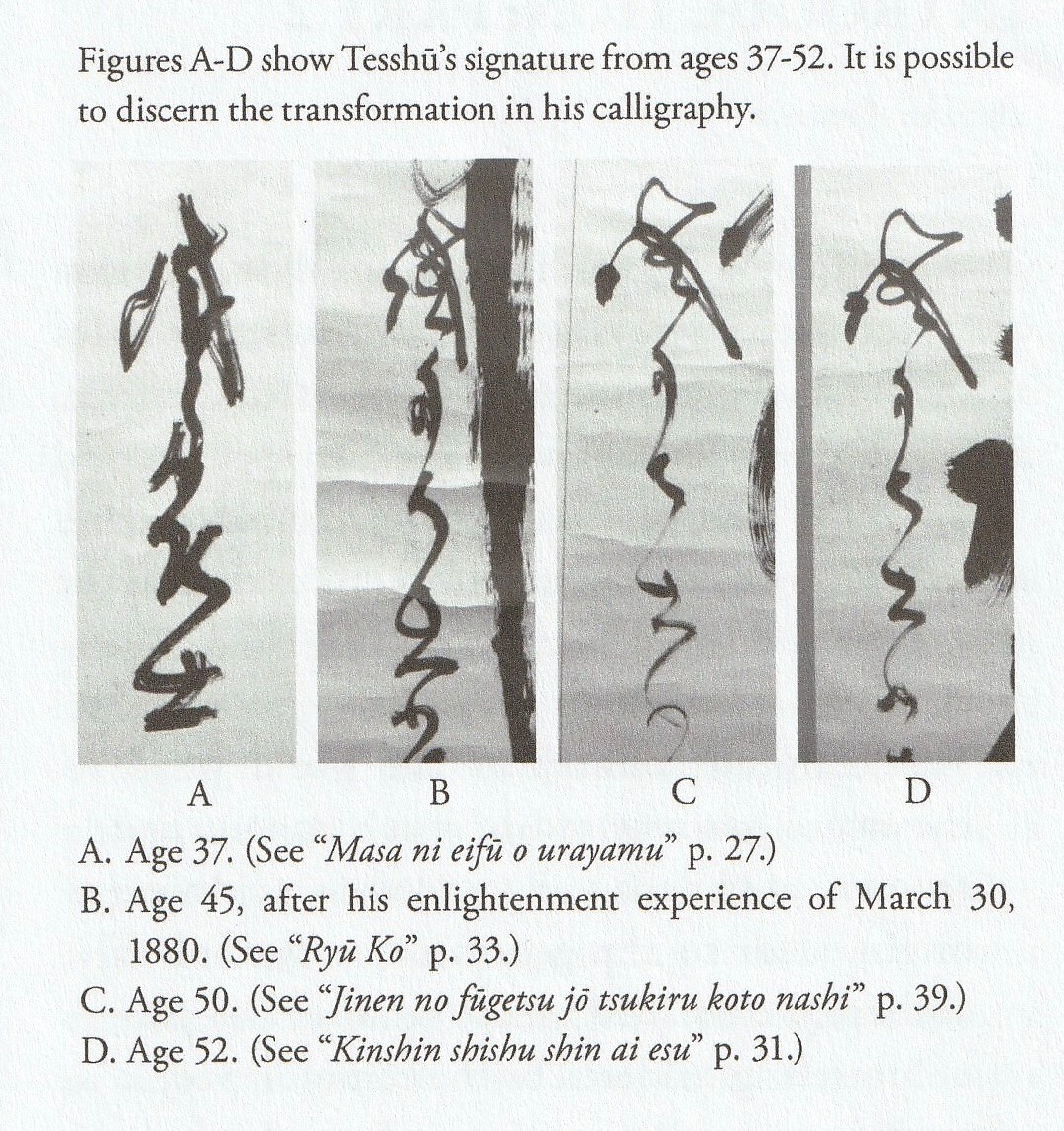
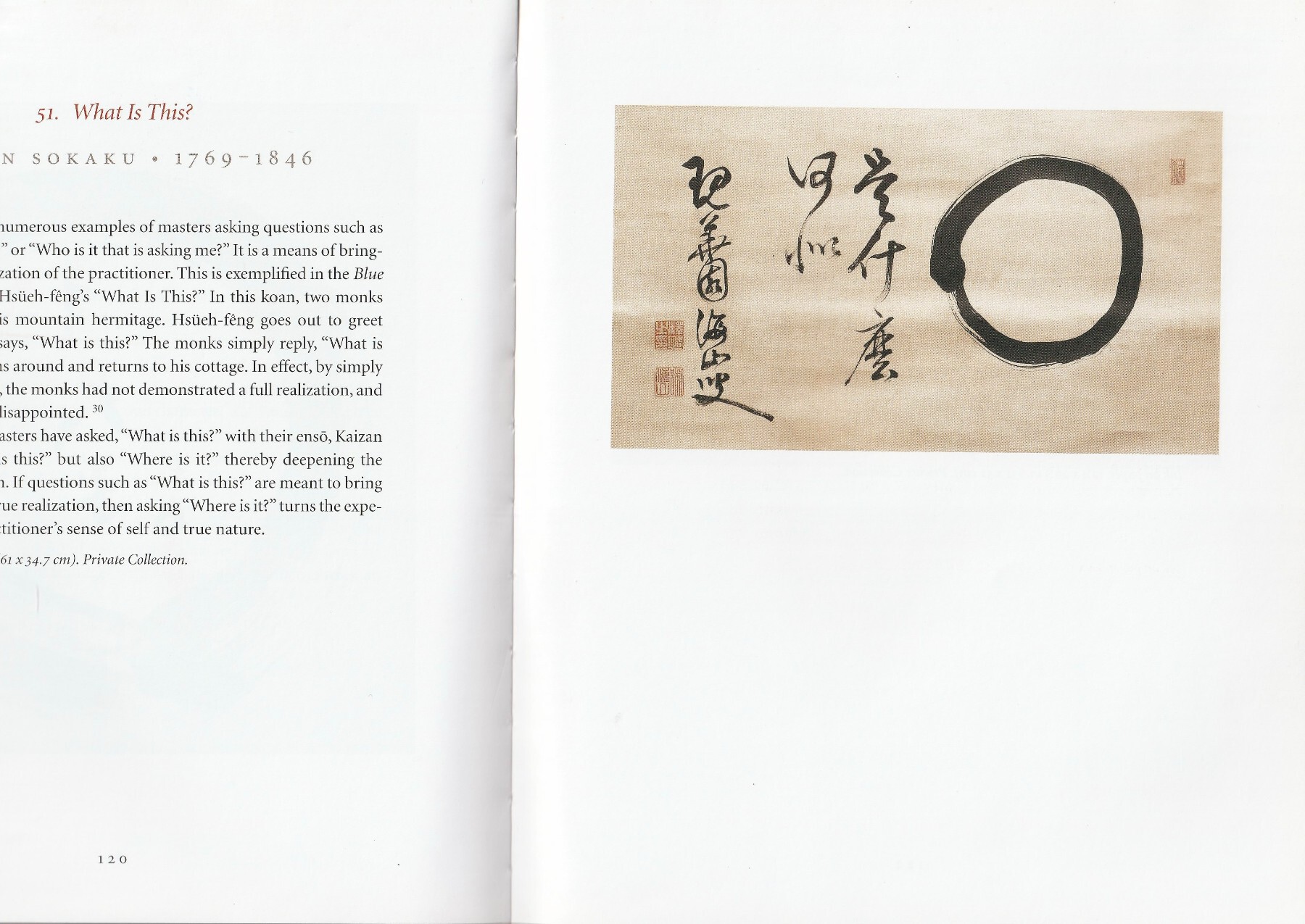
Absolutely. One of the concepts I have been taught is that what we paint evolves as our minds evolve, becoming truer as we discover the depths of our True Self/Original Nature--like a spiritual diary. I have seen motifs rendered before and after Zen masters had their enlightenment experiences; they often brush the same motif hundreds or thousands of times during their lives. There is greater and greater clarity. Keep at it!! If you would like to see examples of Enso painted by Zen masters through the ages, you should get the book "Enso--Zen Cirecles of Enlightenment" by my friend Audrey Seo. Here is my Kaisan Sokaku included in this lovely book. Compare Yamaoka Tesshu's mei from age 37-52 as his enlightenment deepened. They have even done an analysis of the ink grains in his strokes to show the complete absence of hesitation when the grains line up in one direction. He brushed more than 1 million works, as part of his practice, but also as a means of raising funds for a temple and providing for lay Zen practitioners. Yamaoka literally wanted to save all of the souls in Japan living in his time. I have works by him across this timeline. He died at age 52 of stomach cancer. It is said that he is the only known case of a Zen master from the Meiji who died upright in meditation.

 1 point
 -
I like this one. mei Ichiiriuku Hisamitsu
 1 point
 -
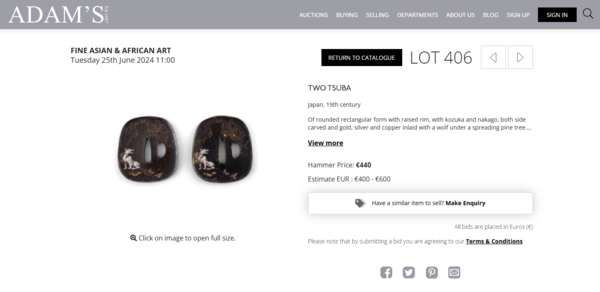
The same ones from 2024 ??
 1 point
 -
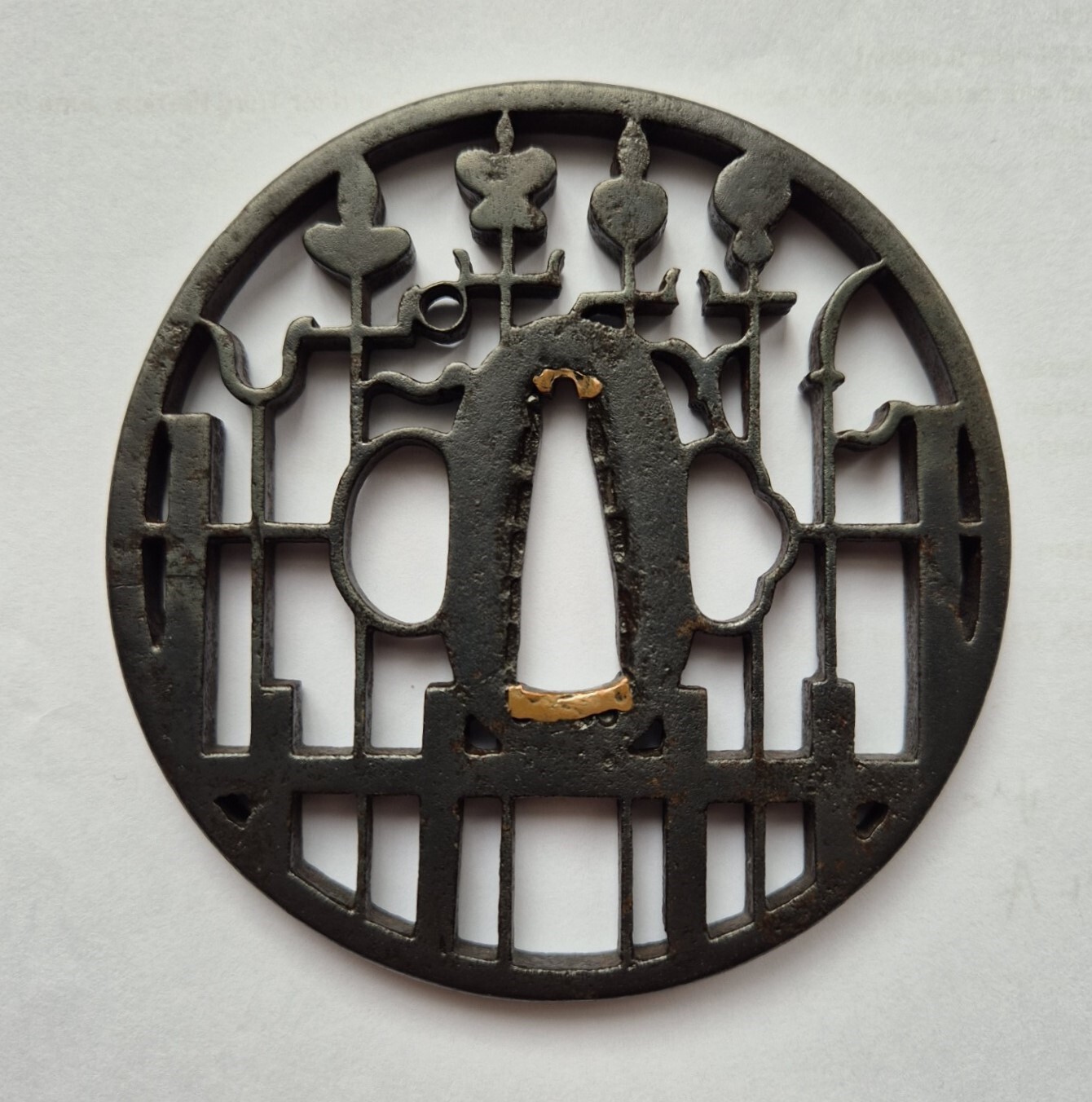
Alexander I also did a four volume book series on the A.H.Church collection - the unpublished Koop catalogue in book form with the addition of both views of the guard, which unfortunately the museum's online resource does not have.

 1 point
 -
Thank you for the explanation. Makes sense. The rough part of getting old for me is the mind still thinks its 22 when I could run a sub-4 minute mile. A few steps to the mailbox reminds me I'm now on social security!! John C.1 point


























This leaderboard is set to Johannesburg/GMT+02:00