
Leaderboard



Popular Content
Showing content with the highest reputation on 01/02/2026 in all areas
-
Hello Richard, As far as the tanto is concerned: The jihada makes a rough and rustic appearance in hadadachi-style. With this lack of elegance I would not consider it an old Yamato-work. The jigane is open and flowing itame with some mokume interspersed. Masame is basically visible in the point-area. Without seeing the blade in hand and shooting from the hip I recommend to search further in the area of Etchu Uda. reinhard6 points
-
Hello Shane, It’s signed - 濃州住木村祐正作 (Nōshū-jū Kimura Sukemasa saku (made by)) I found the sword on the eBay listing and it looks like the seller translated it correctly.. This is a Showa period (WW2) sword. The red paint on the other side of the nakago would have been sub-assembly numbers sometimes used to tie the sword its fittings during assembly (tsuba, scabbard, seppa, etc).3 points
-
Hi, I wrote about this sword here. The sword was twisted, and as a result of repair, these shinae appeared. Best Hoshi3 points
-
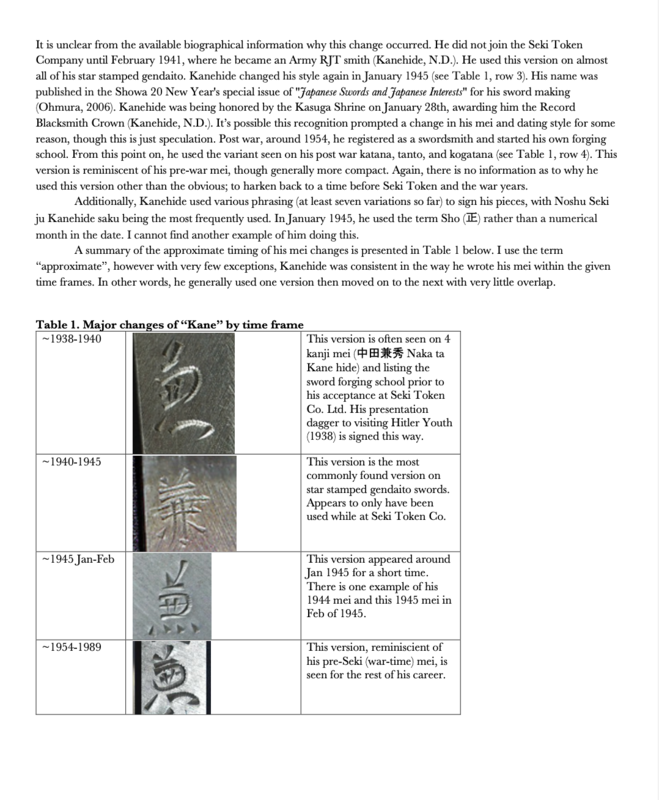
Hello everyone: As many know, swordsmiths change their mei for a variety of reasons over time. RJT smith Kanehide was no exception. But since there has been no readily available study on these changes, I've compiled as many examples of Kanehide's mei as I could find - 76 to be exact. That's not to say there aren't others, however I believe the sample is large enough to paint a definitive picture of his changes and when those changes took place. I'm including the first two pages of the study here in (low res format) for those interested in just the conclusion. The entire study, which includes an extended biographical background and all of the collected samples plus references, has been submitted to Brian for approval and inclusion in the downloads. In the meantime, if you are a fan of Kanehide, have a general interest in RJT smiths, or are just interested in smith mei changes, please enjoy the short read. Respectfully, John C.

 3 points
 -
The kanji with three horizontal strokes is ju (住), which wouid typically be followed by the swordsmith artname, clan + artname, etc. The name itself is not shown here, but unless it is an unlisted smith this is likely Bushu Kanenaga or Bushu Kanetsune (one of two generations). Even if the inscription is corroded , it is still worthwhile to try and show us a photo of the entire inscription top to bottom in one vertical image. Sometimes just a couple of strokes can distinguish between one or another possible craftsmen (in this case, determining if it may be Kanenaga or Kanetsune). Not making any guarantees, but as you are asking for assistance with a translation it is helpful for us to try and evaluate everything. And one additional note, please don't do anything on your own to try to make the inscription more readable (no chalk or cleaning). This may seem obvious and I am sorry to mention it, however I've seen a number of cases where new collectors have tried some amount of cleaning to improve readability on an inscription that was already readable, removing the natural patina and destroying the originality of the mei in the process.3 points
-
Samurai did not fight from behind. That is against the chivalrous spirit Scene set: a cold and misty Moor in March..... The thoughts of one young man......... Hmm.....That one there on the Horse, he's in armour, I'm wearing a three day old Fundoshi which is fresher than my last meal, and all I've got is a pointed stick and a pet rock................ But so are the rest of us at the back, who were pressed into service by our various Lords............... Here's an idea lads: 下克上 Gekokujō !!!!!!!!!!!!!!! Kinoshita Tōkichirō (木下 藤吉郎) aged 17................ AKA not so very much later as Toyotomi Hideyoshi Happy New Year Katchu Bunnies3 points
-
Hi folks, I recently purchased a large collection of Nihonto books. Here is a list of some of them with links to them on my website, where you will see a bunch of pictures and a short description for each. You can access all new stock by clicking on Books in Store Categories and scrolling through the top 2 pages. There will be more to be listed in coming days. If something catches your eye please contact me through my site, not here with Personal Message; I need your emails to keep track of business. Thanks, Grey B474. All 59 issues of English Token Bijutsu. $1,295. https://japaneseswordbooksandtsuba.com/store/book/sword-books/b474-token-bijutsu-english-edition-all-59-issues/ B590. Mino To Taikan by Tokuno. $275. https://japaneseswordbooksandtsuba.com/store/book/sword-books/b590-mino-to-taikan-by-tokuno/ B868. Shosoin no Token. $200. SOLD B645. Issues of Juyo Token Nado Zufu by NBTHK. $50 each. https://japaneseswordbooksandtsuba.com/store/book/sword-books/b645-juyo-token-nado-zufu-volumes-1-to-19/ B241. Early issues of Tokubetsu Juyo Token Nado Zufu. $60 each. https://japaneseswordbooksandtsuba.com/store/book/sword-books/b241-tokubetsu-juyo-token-nado-zufu-various-issues/ B628. Kotetsu Taikan. $225. https://japaneseswordbooksandtsuba.com/store/book/sword-books/b628-kotetsu-taikan-by-dr-s-homma-sato-2/ B735. 8 Volume set of Toso Kodogu Koza. $375. https://japaneseswordbooksandtsuba.com/store/book/sword-books/b628-kotetsu-taikan-by-dr-s-homma-sato-2/ B724. Shumi no Menuki. $85. https://japaneseswordbooksandtsuba.com/store/book/fittings-books/b724-shumi-no-menuki/ B782. Mon The Japanese Family Crest. $125. SOLD B992. Nihon no Hinawaju. $50. https://japaneseswordbooksandtsuba.com/store/book/other-books/b992-nihon-no-hinawaju-1-2/ B331. Hizento Taikan. $200. SOLD B364. Nihonto: Swords of Japan A Visual Glossary. $175. https://japaneseswordbooksandtsuba.com/store/book/sword-books/b364-nihonto-swords-of-Japan-a-visual-glossary-Japanese-volume/ B639. Choshu no Tsuba. $175. https://japaneseswordbooksandtsuba.com/store/book/fittings-books/b639-choshu-no-tsuba-by-murakami/ B119. Inoue Shinkai Taikan. $200. https://japaneseswordbooksandtsuba.com/store/book/sword-books/b119-inoue-shinkai-taikan-by-nakajima/ B654. Nihonto Koza translation. Koto Part 1. $200. https://japaneseswordbooksandtsuba.com/store/book/sword-books/b119-inoue-shinkai-taikan-by-nakajima/ B939. Niihonto Koza translation. Koto Part 3. $225. https://japaneseswordbooksandtsuba.com/store/book/sword-books/b939-nihonto-koza-as-translated-by-watson-koto-part-3/ B656. NIhonto Zuikan. Koto Hen. $550. https://japaneseswordbooksandtsuba.com/store/book/sword-books/b656-nihonto-zuikan-koto-by-kataoka/ B394. Masamune: A Genius Swordsmith and His Lineage. $50.https://japaneseswordbooksandtsuba.com/store/book/sword-books/b394-masamune-a-genius-swordsmith-and-his-lineage/ B880. Illustrated Catalogue: Sword Guards. $100. https://japaneseswordbooksandtsuba.com/store/book/fittings-books/b880-illustrated-catalogues-of-tokyo-national-museum-sword-guard/ B678. Minamoto Kiyomaro. $150. https://japaneseswordbooksandtsuba.com/store/book/sword-books/b678-minamoto-kiyomaro/ And others.2 points
-
I did a little searching on the internet and I looked in Markus Sesko’s Swordsmiths of Japan and could not find an exact match to a smith named Kimura Sukemasa. Tell tale signs it was made during the WW2 period is the style of the signature, red painted sub assembly numbers, and from the pictures in the ebay listing, it looks to be an oil-quenched blade. If you can post your own photos of the blade, it could confirm the last point I made.2 points
-
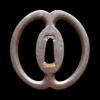
Hello all, First and foremost...Happy New Year!! I hope you all have a fulfilling year ahead. I picked up this piece because it has an unusual shape/motif. It is signed on both sides, one side being "Echizen ju Myochin Yoshihisa saku" and the other side is a complete mystery to me. I've seen other Yoshihisa pieces signed with his age at time of making, but I don't think that's what this is. I would appreciate any help. I've done my best to get clear images. Many thanks Damon
 2 points
 -
I cannot decipher all characters either. 水戸士 – Retainer of the Mito clan 高山千□造 – Takayama …… made.2 points
-
My impression from admittedly shallow experience is that shinaé manifest across, not along, the blade.2 points
-
A friend left a pile of Daruma magazines with me to help pass the time (!!), You guessed it, Nos 46 and 47 were missing... I do have a colour laser copy 'somewhere' of I guess what might be No. 47. I'll look for it and if anyone would like a per tem scan of it I'd be delighted to oblige - PM please. Happy New Year to all. BaZZa.2 points
-
And Masamune. grok_video_2026-01-01-11-41-27.mp4
 2 points
 -
From the limited pictures of the Hamon it has a twinge of Ishido school, perhaps the cut off character could be the top of "是" for Korekazu?2 points
-
Bishu ju Masayasu saku, dated 1942. https://www.google.com/search?q=mano+masayasu+site%3Amilitaria.co.za&rlz=1C1YTUH_enUS1164US1164&oq=mano+masayasu+site%3Amilitaria.co.za&gs_lcrp=EgZjaHJvbWUyBggAEEUYOTIHCAEQIRiPAjIHCAIQIRiPAjIHCAMQIRiPAtIBCDYwNDVqMGo3qAIAsAIA&sourceid=chrome&ie=UTF-81 point
-
There was another Kimura Sukemasa mei on this forum a few years ago if you wanted to compare yours:1 point
-
Hello Conway, thank you for your speedy reply, yes the seller did say it was a Showa period sword, but just wanted to make sure the seller was correct, and it is what the seller says it is,1 point
-
1 point
-
Hi Shane, @shanel82 welcome to the forum! Well done on the photo and orienting it correctly on a dark background. That helps legibility a lot. I am going to relocate your post to the "translation assistance" section, becasue I think you will get a faster reply there. Is there anything on the other side of the nakago? All the best, -Sam1 point
-
It's in the downloads section too, did it yesterday...thanks again John.1 point
-
Just a wild guess from a distance, but the surface steel seems to suffer from lenghtwise cracks appearing when a bent blade is straightened again. reinhard
 1 point
 -
I looked on a different screen, and it does look like 兼常 (Kanetsune). 武州神田住藤原兼常 (Bushū Kanda ju Kanetsune)1 point
-
The nakago itself is slightly suriage (the end has been reduced) however the mei is fully present. There appear to be two kanji after 'ju'. The first is definitely 'Kane'. The last kanji is unclear as it is been washed out with the light. I would suggest trying different lighting conditions so that the glare is not so intense in that area.1 point
-
Taima would tend to have fine itame, here jigane is coarse masame and o itame. Shikkake would have periodic gunome, this one has none. Nie activity in hamon is strong, which typically argues against Mihara, Hokke and other Yamato-derived schools. Kaeri is quite short, which would argue against Muromachi period, sue-Tegai tends to have long kaeri. On the other hand if kasane is thick this could be Tosa Yoshimitsu, whose Muromachi generations can have shorter kaeri. Maybe Yamato Tegai, earlier, or Tosa Yoshimitsu, later...1 point
-
My humble opinion would be to talk to several dealers (especially any that might be close to you -- moreso if it can be within driving distance) and find a piece that you like a lot. Then appreciate it in person, and finally work towards a price that you can live with. Setting out with a price in mind first is good for the wallet, but may not be as good for satisfaction with what you might end up with. A signed and papered Muromachi katana in old polish is a possibility. But a new polish alone with most polishers these days runs for a lot more than just 2k. The little to no flaws part is also a big factor in this case; as most lower condition blades of that eras will have flaws from being polished down. For example, I have an attributed Den Oshu Hoju katana in shirasaya in old polish for $2200 but if someone asked me for what you're looking for at that price level, I would politely decline even an effort to search for them. There is just nothing left at that price point to make the search worth the effort. At the price level you're looking at, you're probably going to have to accept a less than optimal polish or a blade with a fair few flaws or both. Its nothing personal to you, it is just how the market is. I would also probably be acceptive that it is almost certainly going to be in shirasaya, rather than koshirae. Since even minimally appropriate koshirae adds more than 1k value to a blade. My best advice would be to try to approach I suggested at the start of my post. You should end up with something that you'll enjoy a lot more and have a more solid resale value when you decide to move it on!1 point
-
三善長道上□ - Miyoshi Nagamichi shortened (this?)1 point
-
Threw the Hon'Ami Kojo image of the Tenka-Sansaku into AI to try bring them back to life. Just a little fun. grok_video_2026-01-01-11-45-05.mp4
 1 point
 -
Here we have Gō Yoshihiro. grok_video_2026-01-01-11-33-22.mp4
.jpg.af10323f11138dbe622908b429140a48.jpg) 1 point
1 point -
Do anything you can to avoid auctioneers. With their massive buyers premium and sellers commission they will keep between 40-50% of what someone pays and you will probably have to do all the descriptions anyway or risk their lack of expertise ruining results. The advice above re trying to work with a trusted dealer is good advice. You might even find one to buy the whole collection but choose carefully.1 point
-
Thank you Piers, perhaps the first obscured character is Fuji 藤?1 point
-
No. 2 is Hara/wara (Gen) 原 No. 3 is… Gei/Kujira??? 鯨1 point
-
Lewis, This style of shikoro is called a manju or o-manju, which was mainly used in the late Muromachi/early Momoyama (although of course, there are Edo examples too). It was in the Momoyama that the hineno jikoro came into being, with the shikoro having a more downward slant and the last lame being shaped to the shoulders, which ostensibly offered better protection. I also agree that Pier's observation is another partial explanation - the kabuto probably sits a bit higher than normal. This armour is a very well-known and often published example - it's a high level armour (as is evidenced by its being on display at the TNM).1 point
-
Museum displays sometimes need a little tweaking here and there. This is a high zunari. The kabuto pole section is usually adjustable, and in this case maybe could be lowered a notch, or they have inserted too much stuffing in support of the ukebari. (Possibly they've lifted the kabuto higher to give visitors a better view of the menpo.)1 point
-
dont listen to him, DONT strip that apart. the tsuka is deformed and the wood liner is most likey damaged. meaning re-assemble maybe troublesome, you dont need to see the nakago its a machine made blade. you dont need to run the risk of devaluing it evan more. the photos are good enough for this type of sword. i have sold plenty of type 95s on the NMB including the copper handles. you can see everything needed to sell1 point
-
With such strong nie Naminohira excluded. This is most likely Uda. I would say Yamato Shizu or Shikkake are distant, but possible. Timewise I would lean towards early Muromachi. There is also possibility its early Kaga Fujishima, which is basically other way to interpret Uda features.1 point
-
Hoshi this was probably the best thing I have ready all week - certainly made me smile - great write up. Thank you so much for taking the time out to share your hard earned knowledge. I woudl say you did Darcy proud!1 point
-
Hi, I am bothered by this blade and I am not too keen comment, but I will do it to honor Darcy's memory. A newcomer to this hobby will inevitably have his perception shaped by Aoi's offerings, which as one comes to learn, are arbitrage opportunities for blades that do not make it in Japan, with few exceptions. One must learn from great blades first and foremost, and such a sword is an experience that teaches the wrong things. Some context: I find it irresponsible of Shinsa to make a call to "Den Masamune" on such a sword. One could argue that they've hedged it with "Den" - and unfortunately this is a misrepresentation. All Masamune without Kinzogan or Kiwame by the best Hon'ami judges or featured as Meibutsu are "Den" with only very few calls diverging from this pattern historically. Some of the Masamune blades without "Den" are shakier than the ones with Den, and so forth. It is not a simple attribution, and calls for deep contextualization. Then inevitably comes the unorthodox positions that Masamune doesn't exist, that he's unneeded, that this is evidence that his work is not that great, and so on, and so forth. I don't want to go there, I find it silly. Then there is the absurd claim by Aoi that "Choshiki was one of the most respected judges..." - Darcy used to say that an attribution by Choshiki means anything but. Since Tanobe sensei's departure from the Shinsa panel, the NBHTK is more swayed by Choshiki judgements than in the past. If you are really deep into this field, you know that since 2022, it is a good time to target blades with Choshiki attributions for Shinsa. There is only one "Den Masamune" in the Juyo record with a Choshiki attribution, and the setsumei states that this is the work of Shizu. Now, when faced with such a TH blade, there is no context on the attribution, and this absence of context is damaging. This absence of context is why Den Yukimitsu, Den Norishige, or Den Shizu are much safer harbors at TH and have been traditionally preferred before going so far as to calling it Masamune. Back to the blade in question. It is tired and has been extensively repaired. This sword has suffered a tragic accident in the past: it was twisted. Someone repaired it, and by untwisting it created a plethora of shinae, or bend marks. These shinae appear as ware/fukure along the ji. Some of these ugly openings have been filled with umegane. Choshiki calls attention to this fact in his Sayagaki, which has conveniently been left untranslated. While it is true that the extensive jinie of the blade, and the angular chickei and inazuma are characteristics of Masamune, this is all there is to it. And before people bring up "Ogiba" and other arcane Hon'ami things, just don't bother, no, this is not relevant anymore since the mid-20th century and the great cleanup of inflated Edo attribution. The sword is missing Masamune's defining trait: the highest class of nie executed in a nie kuzure that leaves no visible nioiguchi demarcation line. Masamune's nie unfolds in layer to the light, with different nie sizes reflecting light at different angles, leading to a kaleidoscopic effect which can only truly be experienced in hand. Unaffected Yubashiri emerge from the interplay at the hamon, fading in and out of existence when swiveling the blade. The deposits of nie form clouds of diamond dust. The contrast between ji and the ha is the brightest amongst all the Soshu Joko. The hamon is formed out of overlapping clouds of nie. It's unlike anything else. What "Masamune" means We don't have a time machine. At the end of the day, "who made it" remains an open question. While we know that Masamune existed historically (it is proven by pre-edo sources), we can never be sure that a particular hand made a particular swords, especially when the corpus of blades contains such a paucity of signed examples. Are the best works of Yukimitsu, Norishige, and others, likely to be absorbed in the Masamune attribution? Certainly, but this is true elsewhere as well. Within the Masamune attribution group, there is indeed great variety. Some have a distinct Ko-Bizen flair, others are veritable storms of inazuma crossing in and out of the ji with violent angular formations, and the last group are masterworks of such virtuosity that they truly defy understanding and fit absolutely nowhere else in the Soshu corpus due to the quality of their nie. All these blades have in common nie kuzure, unaffected yubashiri, and the feeling that the nie diffuses out into the ji as china ink spreading on paper. Masamune is a snowstorm over the ocean painted in sumi-e ink. Blades that leave you wondering if a human could have made it. Swords that stand in pure defiance to the laws of metallurgy. Masamune means perfection of nie-deki. Best, Hoshi1 point
-
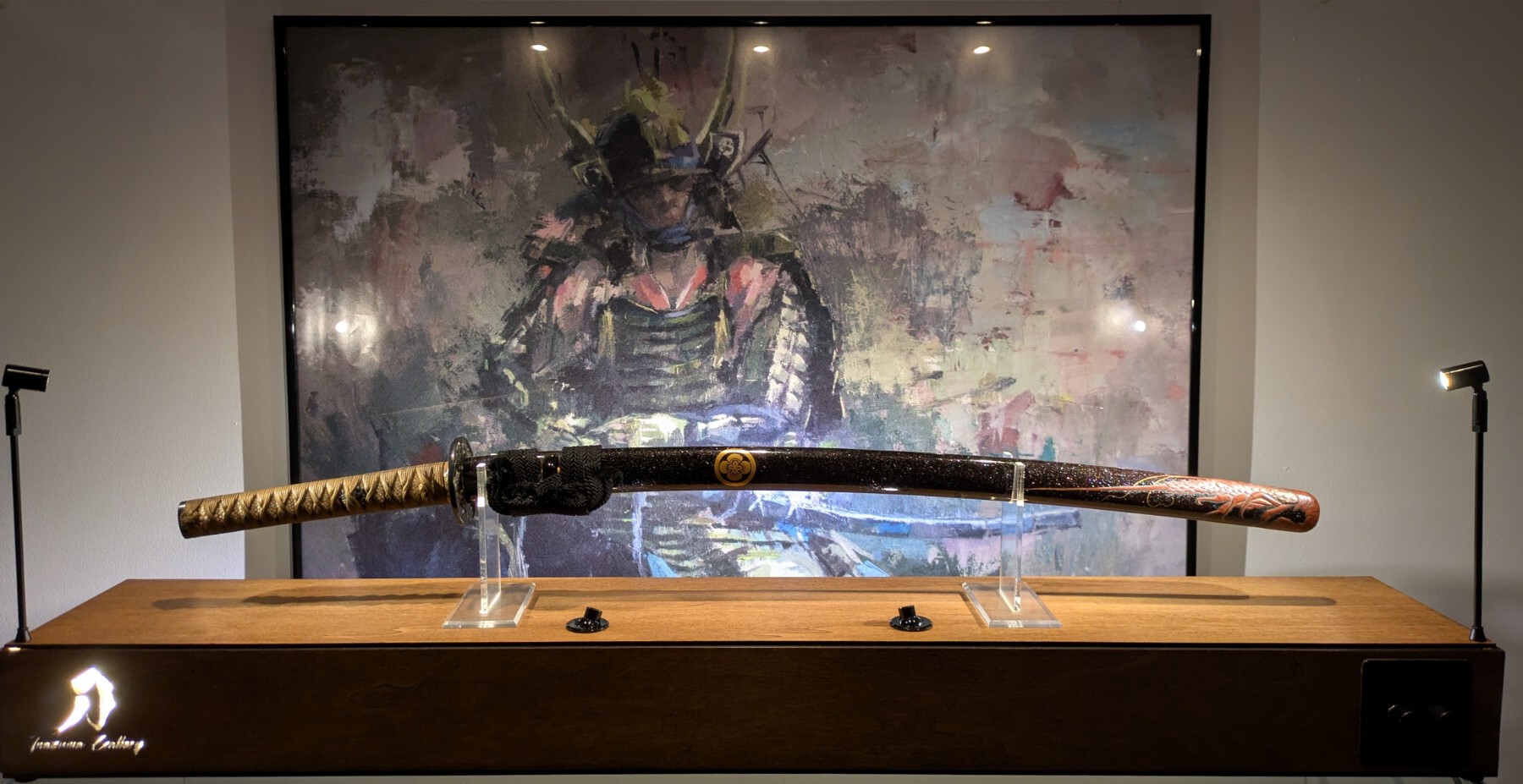
Hi , this is my next project. Please underestand this is a protoype and it's unfinished. It's a cabinet with 4 led dimmable focus, If someone wants to follow the project I leave my instagram account, thanks : @inazuma_gallery

 1 point
 -
Maybe looks like 鯨 恒 dont know how to read , but its not about whales!0 points












This leaderboard is set to Johannesburg/GMT+02:00