
Leaderboard


Popular Content
Showing content with the highest reputation on 07/06/2024 in all areas
-
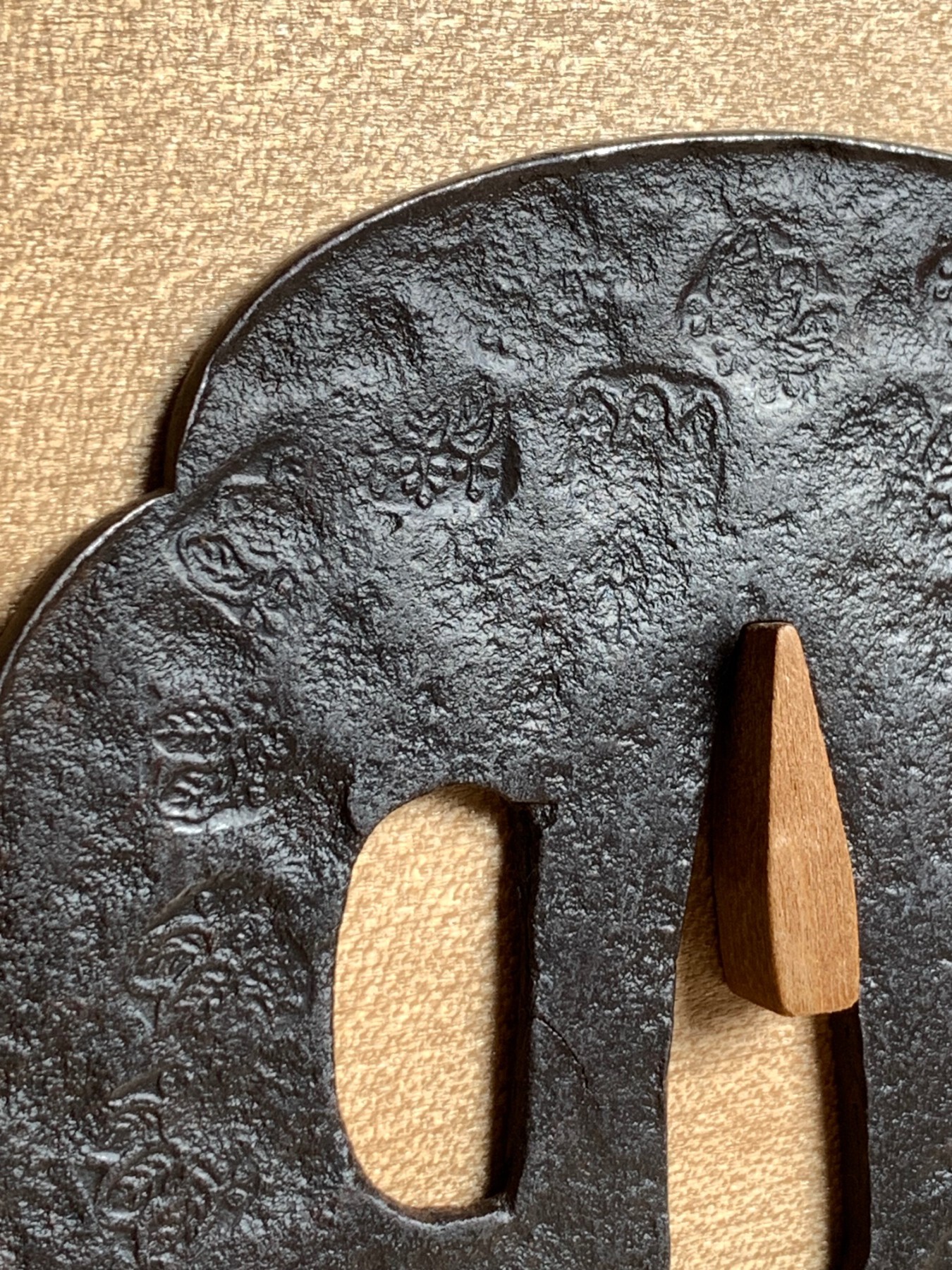
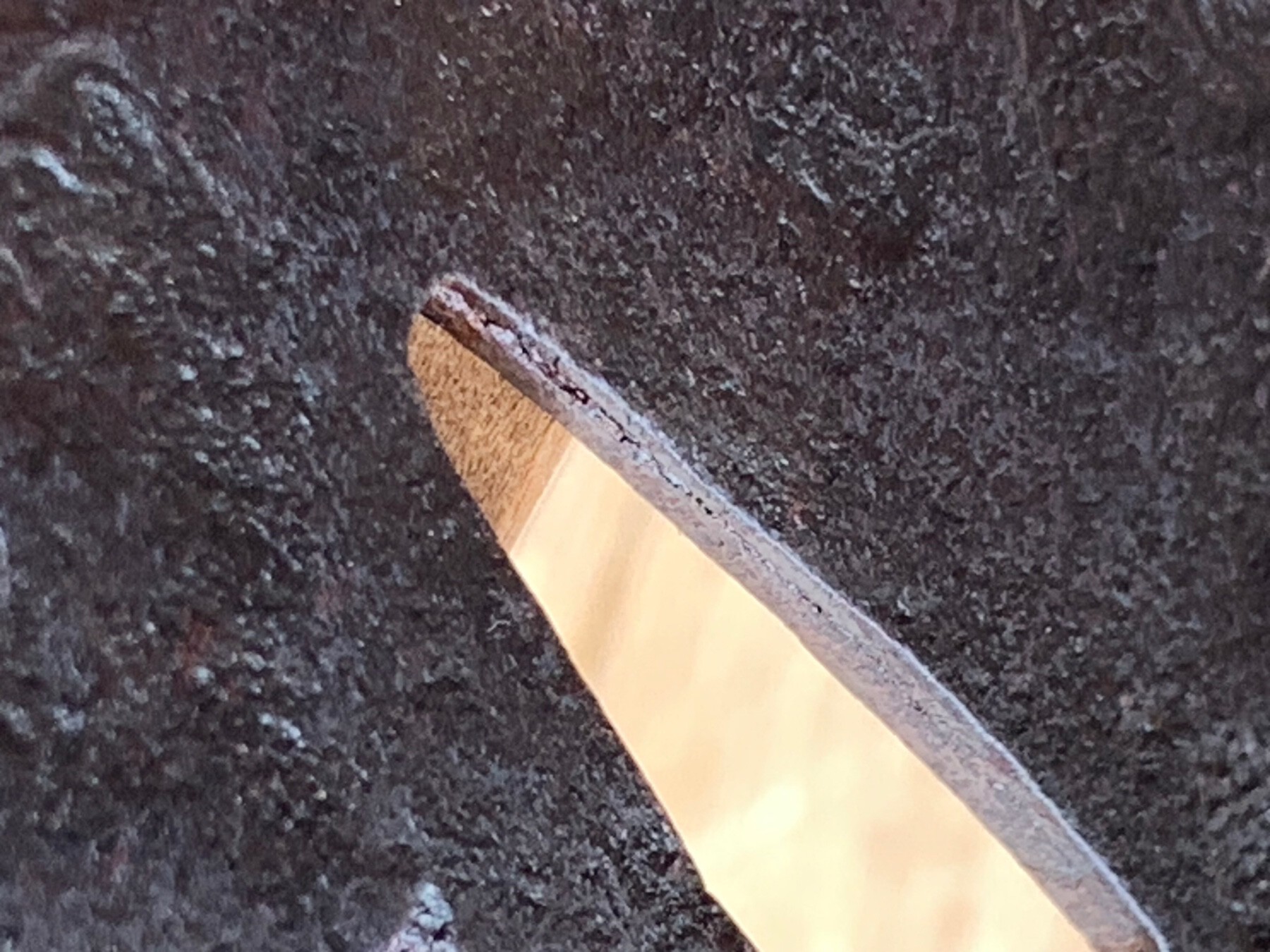
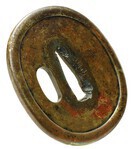
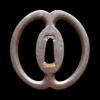
Dear all I would like to part with a nice early Tempo/Tembo/Tenpo tsuba. The kokuin stamp used to create the surface pattern has a kiri design. The quality of the iron is good and the lamination can be seen in the nagako and hitsu-ana. Finally, the tsuba has a Sukidashi-mimi. If you want to learn more about Tempo tsuba, there is a well written article about Tempo Tsuba by Malcolm E. Cox available in the Download Section. Dimensions: Tsuba: 8.09 cm x 8.16 cm x 0.3 cm Nakago-ana: 3.36 cm x 1.01 cm (widest point) Asking price: EUR 170.00 Shipping costs including tracking and insurance are: Germany EUR 6.99 EU EUR 16.49 UK EUR 26.99 Worldwide EUR 47.99 Best Chris


 2 points
 -
Hello! My name is Jan, I am from Prague and I would like to introduce myself a bit before making some posts. I'm new to the world of nihonto and till now I have no specific preferences except one - I started with koto. I have felt an affinity to Japanese culture for a long time. As a hobby I do pottery and for some reason it often appears to be in Japanese style... For my first nihonto I started from what I liked visually, what I could afford, I picked a shop I could trust, a sword with certification and I bought it. I am 47 and I already, more or less, know my taste (The sword that arrived even overcome my expectations. It's so nice!) And than I started to looking up information about the smith, the school and the origin of its style and tradition. I found many useful websites about nihonto, among them this site. I learned a lot from here, thanks! I know that what I did is the absolute opposite from what is recommended, but I am really glad I did it this way. After a few months of learning more and more about the complicated world of nihonto I am sure I would be much more confused about what to buy... ... but anyway, I bought one more sword, now it's on the way and I am researching about new school and smith. I am already caught in the trap! Thank you all for this great source of information and help. Have a nice day! Jan L
 2 points
 -
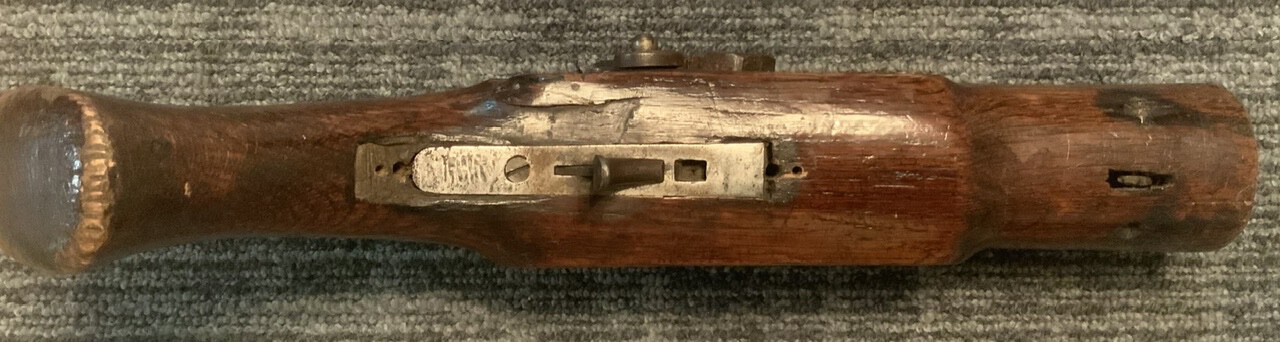
What an amazing assembly. European flintlock mechanism altered to percussion cap? The stock and the barrel were married in later life. I have seen weapons cobbled together like this which come from the late Edo Satsuma Rebellion in Kyushu. The term ‘hiyazutsu’ was applied to smallish cannon which fired 火矢, ‘hiya’ or flaming bolts, but the small bore on your pistol does not really fit such a definition.2 points
-
Bruce here is one i just picked up Mark Jones


 2 points
 -
2 points
-
Hello all I have a strange, at least to me, what I think may be a Hiya -Zutsu fire arrow weapon. The barrel is made of brass or bronze, it measures 7” from the plug end to the front of the bore. The bore measures approximately.45. The bulb at the end of the barrel measures approximately 1-3/4”. The hex section measures approximately 1-5/8”. The stock is pretty crude and definitely from something else but it functions. Please see the attached pictures. Thank you in advance. MikeR


 1 point
 -
Dear RJ. Can we have a first name please? This might be Bishu Osafune Sukesada. If you think this is in good condition then don't buy anything yet. Compare here, https://www.toukenko...&katana_A030320.html and in many other places. The hadori, if it is even that, on the sword you posted is at best amateurish, the shape of the nakago is odd and the boshi needs looking at. Does this sword have papers? If so then let's have a look. Personally I would walk away from this one. No, actually I would run. I see I have been beaten to it. All the best.1 point
-
Bishu Osafune Sukesada is the signature I think though the last two kanji are worn. (Made at) Osafune in the province of Bizen (by) Sukesada. There were around 50 smiths with this signature knocking out swords to feed the 16th century wars in Japan. So it’s pre 1600 and a real samurai sword, but probably not rare or precious.1 point
-
OK - this paper is from Shimizu Tōru. He was president of the Tokyo Art Club's "sword appraisal" section. He died in 1980. The other papers are from Hon'ami Kōson, and are from 1942. The sayagaki is from Kōson as well.1 point
-
@Bruce Pennington I’ll add some photos of the fuchi, handle, and scabbard to build a complete picture of the sword.1 point
-
Can we get a better picture of the seals? It's not Hon'ami, but I can't read the name. Its from June, 1979. So this particular paper isn't going to be very trustworthy or valuable - especially considering the big name attached to the sword.1 point
-
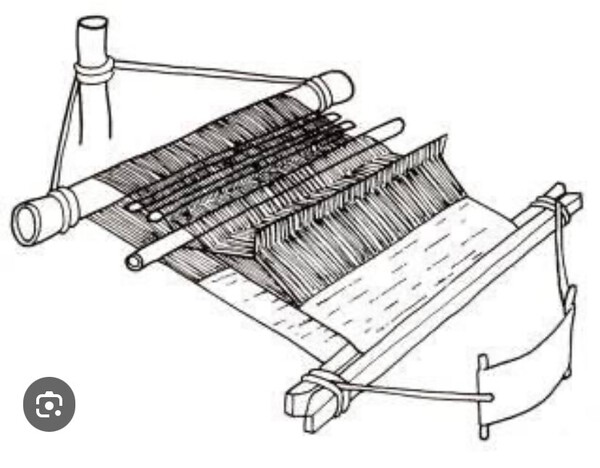
Google “jibata back strap loom”. This menuki would only be a couple parts of it, but maybe???
 1 point
 -
the above translated……… I find it incredible to fool the world by putting an estimate between $2,000 to $4,000 where does this estimate come from so high for something that is worth practically nothing and some will be willing to spend a large amount on this thing Long live you all.......and may the samurai be in you.1 point
-
https://www.jauce.com/auction/m1143410685 nice looking pair.1 point
-
Piers, thank you very much for the information and quick response. It is definitely different. MikeR1 point
-
I would have to agree with Nobody - the everyday soldier would be employed to dig trenches and dry moats as well help with castle construction - so reminiscent of a workingman samurai... -t1 point
-
1 point
-
1 point
-
This is just a shot in the dark. 畚 (mokko) – a straw basket [for carrying earth]

 1 point
 -
Embroidered fabric tsuba patches. https://bladeandbeam.com/search?q=tsuba&options[prefix]=last
 1 point
 -
1 point
-
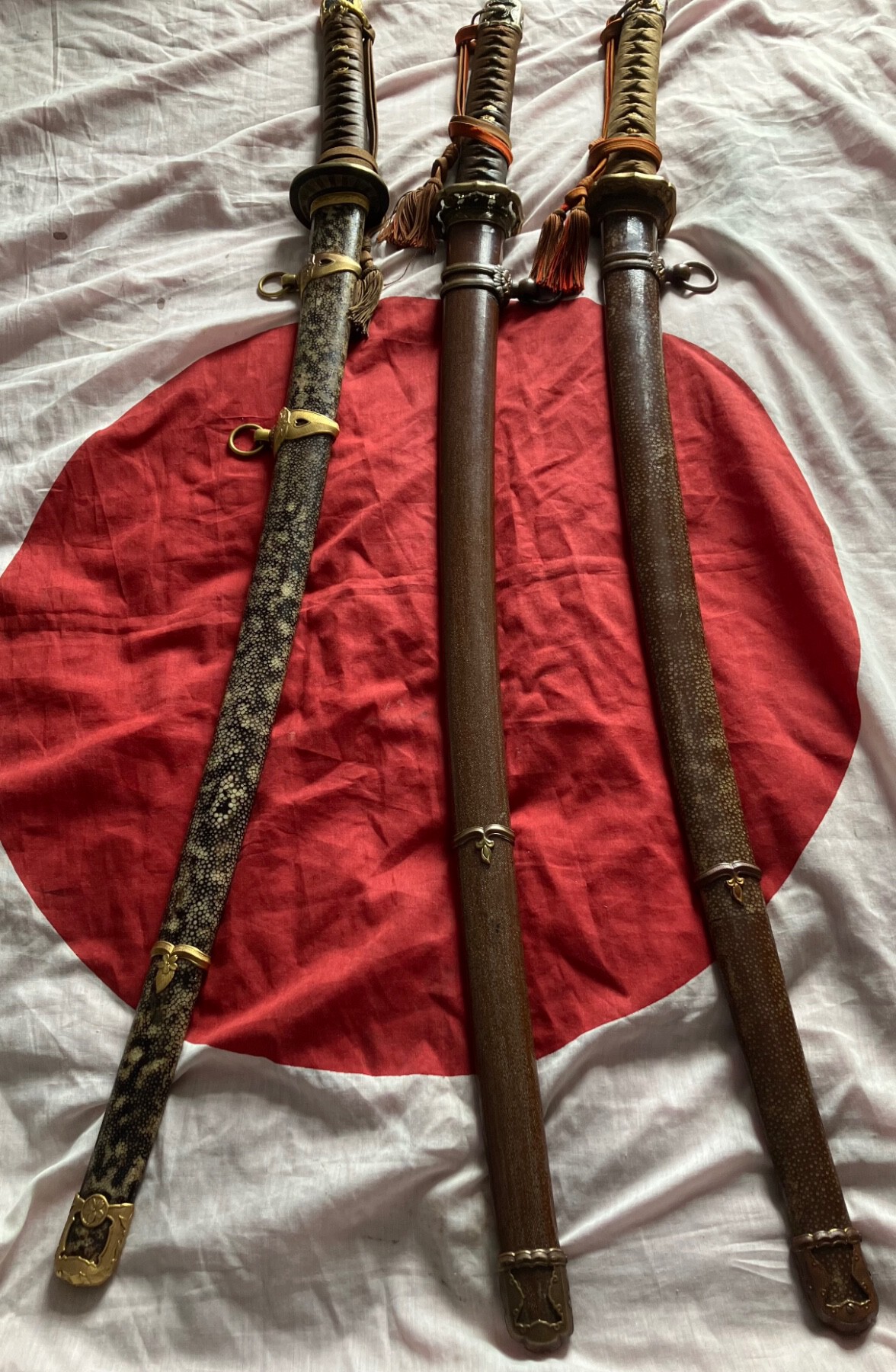
As promised a pic of my three Sami covered sayer swords together one Navy and two Army both the Navy and one Army have been posted before but never the three together .. Thanks Gareth
 1 point
 -
Perhaps you first ask yourself the following question: what makes a good weapon? The adjective "good" as a collective term for various characteristics. And that doesn't require complicated thinking. In relation to a sword: it has to do its job, of course. It should be as sharp as possible and hold its edge for a long time. It should be robust and not bend or break. If it is damaged, it should be easy to repair and the blade should be easy to resharpen. Overall, the weapon should be balanced and easy to handle. But what good is all this if the weapon is too expensive, the production is complicated and takes a long time, and it is difficult to get hold of the required raw materials? That's why the sword must also be cheap and quick to produce. As a warlord, larger quantities must be available in a short space of time. The raw materials for production should be available to me or be cheap to buy. All these points, and certainly more, are what make a good weapon in the first place. I can afford it, I can handle it well, it does what it is supposed to do. Everything that goes beyond that: that my own wishes and ideas are incorporated into the weapon, that higher quality raw materials are used, that more complex technologies and manufacturing processes are used, which in turn require better trained and experienced craftsmen and much more - here we come to arts and crafts, yes, even to real works of art! Of course, these swords are then more expensive. They are no longer available to the masses of warriors, but to elites. Yes, they even deliberately set themselves apart with these artfully crafted weapons. They appreciate and admire the visible qualities associated with the high-quality materials and elaborate production. The weapons became status symbols, became family possessions and were passed down through the generations. Although they basically only stab and cut, can get nicks and rust, like any simple sword. But the latter are lost over time because their focus is as a tool, which eventually wears out and is replaced accordingly. Just one example: some Americans will be surprised, but here in Germany it is not at all common to own a firearm. There are only a few exceptions, which are associated with high requirements. One of these is being a hunter (here, too, extensive tests are necessary and required). Be that as it may, I am currently looking for a hunting rifle. Should it be an inexpensive, international product, uncomplicated, robust, with a synthetic stock? Or would I prefer a rifle from a small German manufacturer, with a few extra features and a beautiful wooden stock? Well - what I can definitely rule out is going to a gunsmith to have a custom-made gun made for me. The latter is simply too expensive for me and is disproportionate to my hunting needs. All three rifles go "bang!" and make holes with the required precision at huntable distances. But the factory rifle will no longer exist in 30 years. The rifle from the small manufactory will certainly still find enthusiasts and be used from time to time. The rifle from the gunsmith will certainly become part of a collection in mint condition. Ironically, the best gun will probably be used the least. But stop! Is it really the best gun? Or was it the factory rifle that has been used many times and has many thousands of rounds behind it? Nobody will argue about which of the three guns is the most beautiful and artistic. And one more thing: it doesn't make sense to approach Japanese art with the Western understanding of art. The Western understanding of art has a completely different evolution. There is also no real distinction between "arts and crafts" and "art" in Japan. In Japan, an object that has been reduced to its plain and functional simplicity can be considered beautiful and artistic. Functionality is a basic requirement. In Japan, art has much more to do with aesthetic perception, which is why Japanese art terms such as mono no aware, yugen, wabi, iki are linked to sensations. On the other hand, many Japanese swords today are polished to a level that they were not polished at all a few hundred years ago because they were simply weapons. No one thought about any properties of the steel or the hardening because they were not visible. I don't mean to disparage certain blades that are often posted here for identification. But it should perhaps be kept in mind. The Japanese sword is a very subtle arts and crafts. You have to get very close to see and judge the quality. You can't see everything at the same time like with a sculpture. You have to tilt a blade to the light at different angles in order to be able to see and judge even very small areas. So it's an art to be able to see, understand and judge a Japanese blade. Everything else follows from this...1 point
-
Just from a quick look.... It's not anything mindblowing or top level. Doesn't have a ton of hataraki or a big name behind it. But it seems to be in decent condition and polish, and nice to have koshirae and a shirasaya. If it has papers, and you aren't looking for a bigger name, then it seems to be a decent deal at the price, and if that's your budget then I can't find anything too concerning. In other words, you could do a lot worse imho.1 point
-
I thought sekigane were necessary regardless of newness, to protect the steel of the nakago. Maybe it's the craftsman style? or lack of it? In the introduction video, they said he was a carpenter before falling in love with tsuba. So it's possible he is self taught and goes with the flow, so to speak.1 point
-
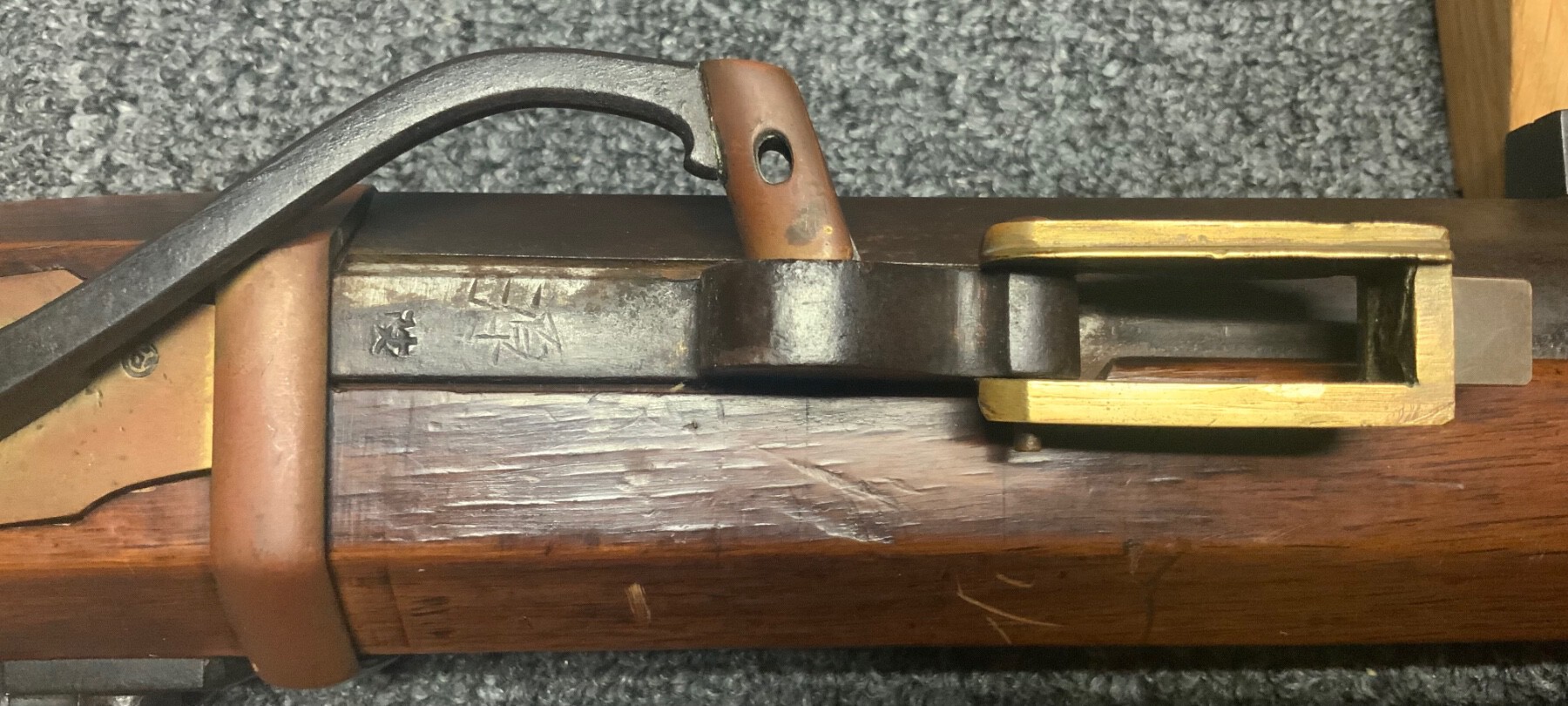
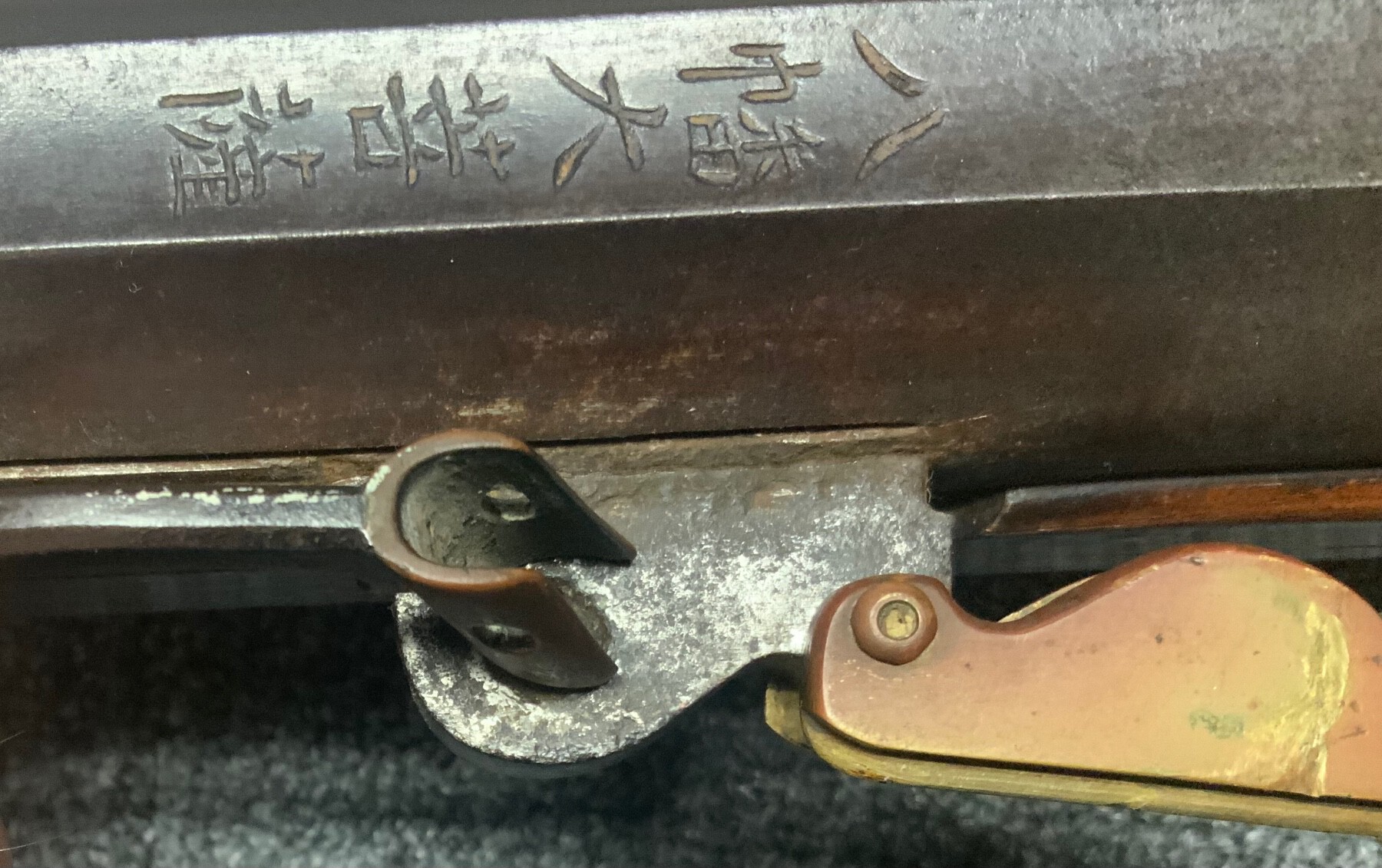
Thank you both very much. Piers the bore looks to be about .73” or 1.85 centimeters. Jan I added some pictures of the pan and cover, with some other marks by the pan. Also a picture or the marking on the bottom of the stock, in front of the trigger guard. If either of you need any other pictures please ask. I am going to start another post with what I think may be a form of Hiya zutsu (? ) that you might find interesting and any information on that would be greatly appreciated. Thank you both again. MikeR


 1 point
 -
To add, there is an order. From Ohmura's site. Note the larger seppa are on the blade side.
 1 point
 -
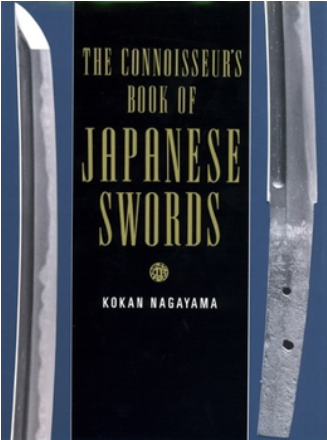
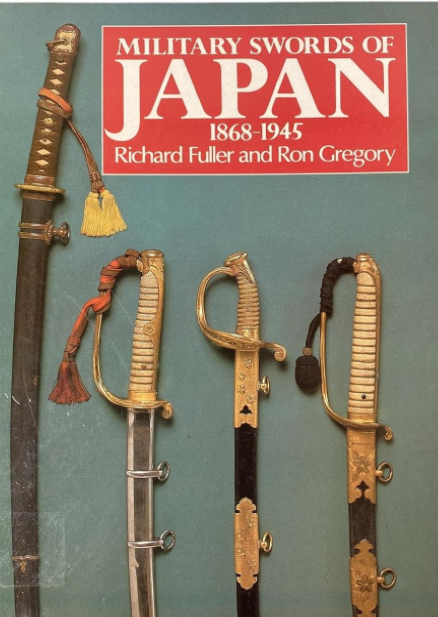
If you are looking for books on antique (pre-WW2) swords, the best one in my opinion is Connoisseur's Book of Japanese Swords. Slightly expensive. Maybe you can find a cheap, used one in good condition. I'm developing a slightly heretical view of this book. It is one of the best out there, but it can be daunting for beginners. And it is in need of some updating, particularly the illustrations. If you are looking specifically for books on WW2 swords, Fuller & Gregory's seems to be the one most recommended. There is a difference in collecting antique swords and militaria (though some happily collect both). The military swords tend to be non-traditionally made, they are still mostly unable to be traded or registered in Japan (with exceptions becoming more and more frequent), and with militaria you are mostly looking for a blade in good condition with complete set of furnishings if available. With older swords that are traditionally-made, you are also looking for good condition, but "condition" doesn't just mean "not rusty", it means how skilled the smith was in manipulating the metal, and to some extent it means how skilled the polisher was. The complete set of furnishings isn't too important, as these parts are made independent of the swordsmith, and they decompose over time and are often replaced. Of course an old sword in an excellent set of furnishings is always nice to have. But a fabulous sword will be fabulous regardless of the bling. WW2 swords tend not to be "fabulous" because the steel and the technique involved in the manufacture was more geared towards mass production, rather than exquisite beauty of the steel.
 1 point
 -
Piers is of course correct. This is a Yonezawa zutsu with all the bells and whistles. To be honest I don’t think I’ve ever seen a Yonezawa in better condition. Would love to see a closeup of the pan. A signature would tell us which smith it was that made it. There’s a handfull to chose from that was active during the first half of the 1800s when this iconic matchlock was made. Jan1 point
-
This is Jan Pettersson’s speciality, stylistically all the typical features of a rather rare Yonezawa gun. Looks to be in pristine condition. Is there a 米 mark in the stock underneath, forward of the trigger? The writing on the barrel is an invocation, 八幡大菩薩 Hachiman DaiBosatsu (There may also be a Mei when you remove the barrel.) What is the diameter of the barrel bore, about 1.8 or 1.9 cm?1 point
-
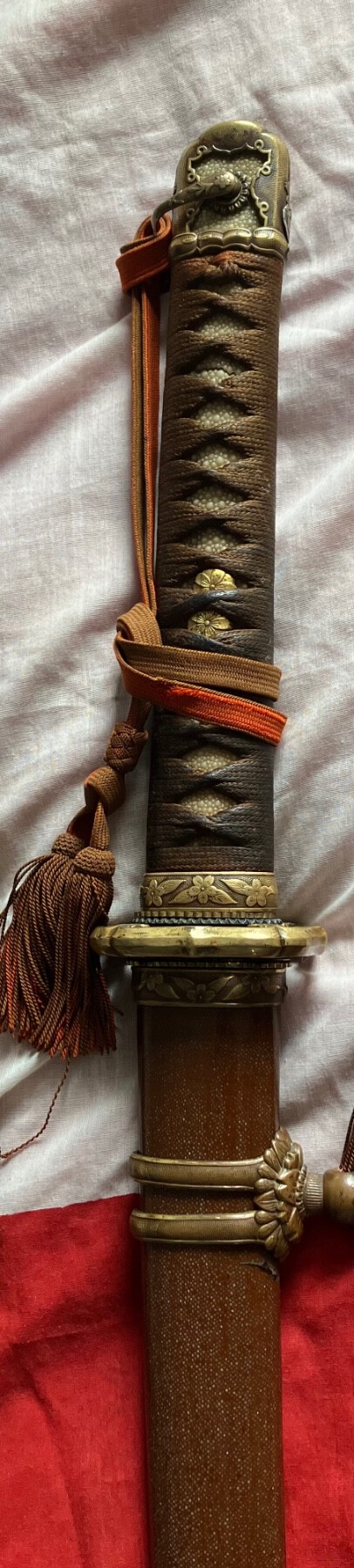
I'd like to chime in if you don't mind. Since the sword has a seki stamp it actually cannot be imported into Japan even if you wanted to, so you can rest easy owning it since they definitely don't want it back. It's still a very nice sword with fittings in excellent condition, I'd be glad to own it if I were in your shoes. It's definitely closer to a piece of militaria than a piece of art though (which I guess is probably its intended purpose).1 point
-
I do not think "Art sword" is a really good word to describe good swords. I would rather just use good sword, and also if the sword is famous then it can be famous sword. Historical provenance etc. Also plays a big role. Also I have now understood what my heart wants and what is right for me personally. It is not traditionally "correct" sword appreciation but it hits me. I have seen so many top items of Japanese designations on this trip. Now this might sound crazy but several of the Kokuhō or Jūyō Bunkazai items did not evoke any feelings in me. Sure they were of excellent craftsmanship... but show me a rusty ōdachi or a big naginata with battle damage and I am bursting with joy. I am not an Art sword connoisseur, I like what I like and my feelings just get stronger every year. Now I do feel it is very important to study the best possible items and get understanding of what that work is like. I admit my eyes are not nearly trained enough to understand the fine points of sword appreciation, maybe I never will fully understand quality.1 point
-
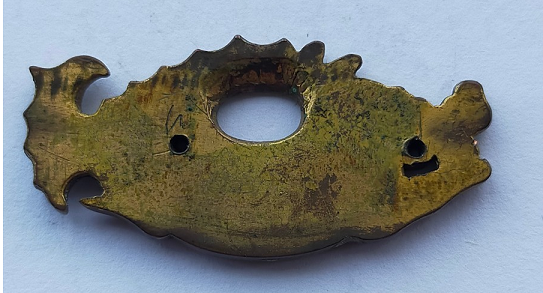
thick metal, not like the thin metal often found on tobacco ornaments, but some wear on the oval hole as if it fits a clasp?
 1 point
 -
This is an interesting topic, and probably a topic that some western collectors aren't that familiar with. But it's something worth investigating, you may be shocked with some of the high level of work that's been created since WWII. I'm going to take this thread as meaning who were the best tosho during this period, not the most famous, as they're two very different things. I probably have a rather unique view of this period, during my time in Japan I got to work on swords by Miyairi Yukihira, Amata Akitsugu, Sumitani Masamine, Gassan Sadaichi, Gassan Sadakatsu, Tsukamoto Okimasa, Tanigawa Moriyoshi, Yoshihara Shoji, Kanbayashi Tsunehira, Ozawa Masatoshi... to name a few. And even though I've seen a good number of gendaito and shinsakuto, I haven't seen them all, so of course this is just my opinion, based on the best works I recall by these tosho and trying to objectively judge on quality rather than personal taste. For me the best tosho since WWII in no particular order are: - Amata Akitsugu: Ningen Kokuho, he worked in Bizen, Soshu & Yamashiro-den, and was excellent in all of these traditions, a genius tosho. Even in his final years he was still making his own oroshigane and experimenting in new forging techniques. He passed away 5 years ago but already his work is reaching Tokubetsu Hozon level - http://iidakoendo.com/6200/ (click on the blue numbers) - http://www.katana-Japan.com/?page_id=27 - Sumitani Masamine: Ningen Kokuho, Bizen-den, his chojiba became famous for it's thick nioi-guchi, with nie & nioi filling the entire yakiba all the way to the hasaki. https://www.aoijapan.net/katana-sanryu-masamine/ - Kawachi Kunihira: Mukansa, Bizen-den & Soshu-den, a few years ago I got to see the sword he won the Masamune-sho with, it was one of the best shinsakuto I've ever seen. http://kako.nipponto.co.jp/swords/KT118748.htm http://kako.nipponto.co.jp/swords2/KT218582.htm - Ozawa Masatoshi: Soshu-den, probably unknown to most western collectors, he has made some modern-day masterpieces. https://www.aoijapan.net/dai-sho-shomaru-toge-ju-ozawa-masatoshi-saku/ - Ono Yoshimitsu: Mukansa, Bizen-den, we've all seen his Yamatorige utsushimono, the clarity and control he achieves in his chojiba is incredible. https://yuhindo.com/ono-yoshimitsu-daisho/ - Tanigawa Moriyoshi: Mukansa, mainly Kiyomaro utsushimono, he was so passionate about his work he would often sleep next to his favourite swords, bare blades straight from the forge! https://www.seiyudo.com/541.htm - Kubo Yoshihiro: Mukansa, he's currently producing some fantastic Aoe utsushimono, probably the best/most consistent utsuri I've seen on anything in the last 100 years. Cheers.1 point
-
Best vs. most famous will yield different answers. Many of the top smiths who worked after the war did produce swords during the war as well, including Tsukamoto Okimasa, Gassan Sadaichi and Tanigawa Moriyoshi. My opinion is that Tsukamoto Okimasa is the overall best from the Showa period. I personally love the work of Moriyoshi and would rank him at the top as well, but he did not receive the fame of some equal or lesser smiths. I believe that Seiho Sumitani was considered to be the best by Dr. Homma.1 point
-
An udon roller with onigiri mat?0 points
-
Sorry Jaykob. I didn't mean to lowball you. I have PTSD and a survivor of a scary marry-go-round incident when I was in the American revolution in France with the freedom fighters of Madagascar.0 points
-
So you like them subtle and low-key then Pete?0 points
























.thumb.jpg.bc10b59027a00aa142dce0349f3ba9e0.jpg)
This leaderboard is set to Johannesburg/GMT+02:00