


SteveM
-
Posts
4,362 -
Joined
-
Last visited
-
Days Won
97
Content Type
Profiles
Forums
Events
Store
Downloads
Gallery
Everything posted by SteveM
-
You are right, it is a fire-watchman. 盛光 (Morimitsu) for the mei, and 火之用心 (hinoyōjin) "beware of fire" for the words on the figure. Occasionally some neighborhoods, even in Tokyo, still organize night patrols where fire-watchmen walk the neighborhoods clapping the sticks together. A nice holdover from a different time, like the sweet-potato vendors that come out this time of year.
-
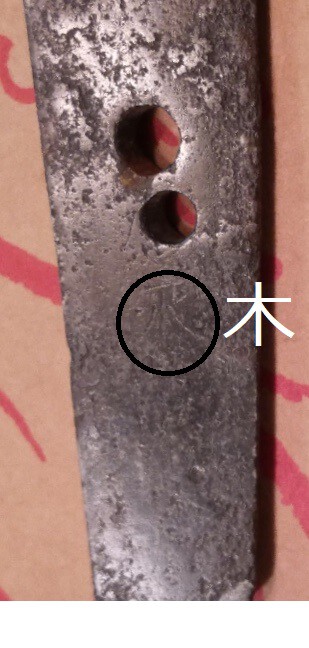
Ahh, that makes much more sense. What I attributed to 木 could well be the 永 of Oei. I see the hint of something on the other side; something right under the mekugi-ana, but I can't make it out.
-
I can only make out 木 (ki). I can't see anything resembling Bishu Osafune "Oei ni ju" wouldn't make any sense. Bishu Osafune Ju, with some variation, would make sense, but not Oei ni Ju. Oei as an era name (応永) would make sense, but it wouldn't be followed by "ni ju".
-
In red 第六十八? 68th something or other. Not an era. 鉄???? 耳亀甲形毛彫 信家 It doesn't say Myōchin anywhere on the box, although it does say Nobuie. It doesn't say Tenmon 天文 anywhere on the box. Very deceptive for someone to be telling you this box says Tenmon 10 (1541). Even a Japanese person without any experience in hakogaki or antiques can tell this red writing doesn't say 天文十年.
-
I think its a dedication for the person who commissioned the sword. On the far left side (寛)文十二年壬子四月十七日 (Kan)bun 12, zodiac year "Mizunoene" (1672), April 17th I am taking a leap of faith with Kanbun. The habaki is covering up what should be the first kanji of the era name, but year number is indeed 12, and there were only a few eras which spanned at least 12 years during the Yoshimichi lineage, and of these Kanbun seems the most plausible (edit: not to mention it corresponds correctly with the zodiac year). I can't quite make out the kanji after the zodiac year, but I think its April 17th. Edit: I just noticed the picture of that part without the habaki. It looks like that part of the sword has been polished to the point where that kanji is no longer visible.
-
Hello Bruce, You should pop the swordsmith's name into a search engine, because that usually provides results with some background info on the smith (birthdate, maybe where he was from or who he studied under), and if the smith is famous or prolific enough, you might find other swords by the same smith that you can use to compare against your sword. The seki stamp tells you the sword was made in a military arsenal. There is a site dedicated to Japanese war-era swords at the link below that has a lot of information. http://ohmura-study.net/900.html Your pics just identify the sword as a handsome war collectible. The fittings are a bit distressed, but the sword looks good.
-
And... the date is unusual 昭拾九年五月 Shō 19, May. Presumably this is supposed to mean Shōwa 19 (1944), but the wa is missing. It should be 昭和拾九年. I have never seen 昭和 reduced this way on a sword, so for me it is another flaming red flag.
-
萬壽國満作 Banjū Kunimitsu saku I can't find any swordsmith by this name, so one has to be a bit suspicious of the authenticity of the signature, and possibly of the sword itself. When I put this name into the search engine, the first and only exact match that pops up is an entry on reddit that was made recently.
-
Hello new poster, Norimichi 法道 See this entry and the one following it https://nihontoclub.com/smiths/NOR8 I cannot comment on the authenticity of the signature. I will say it is misleading for the seller to list this as unsigned. Unsigned should mean unsigned, and shouldn't have to be second-guessed as a judgement on the existing signature. Note the forum rules that require people to sign with a real name.
-
Agree. I think the theme is eboshi sukashi zu (烏帽子透かし図). Compare with the tsuba in the top picture on the attached site. http://saisoku.2-d.jp/katana/2016/05/31.html
-
Really Love This Blade, But Need Help With Kanji
SteveM replied to mareo1912's topic in Translation Assistance
slight correction: 源清麿 -
Hōitsu, I think. https://en.wikipedia.org/wiki/Sakai_H%C5%8Ditsu
-
Takayama is the name of a naval officer who developed or designed these stainless steel swords. The actual smith of your sword is Ishihara Masanao. Forget about the prison theory. Seems to be a recurring red-herring, but as far as I know these swords have nothing to do with a prison.
-
My take: 謹作高山刀 刀匠石原正直 研師日比野健蔵 Kinsaku Takayama-tō Tōshō Ishihara Masanao Kenshi Hibino Kenzō
-
The flower is a variation of the paulownia crest, a common motif in Japan. It was the family crest of the Toyotomi clan, and is now used as the official crest for the government of Japan https://en.wikipedia.org/wiki/Government_Seal_of_Japan https://www.google.co.jp/search?q=paulownia+crest&tbm=isch&tbo=u&source=univ&sa=X&ved=0ahUKEwiV4qSqmPHWAhXKbbwKHZeMAxcQsAQILg&biw=1280&bih=590
-
松 (matsu) ? edit: actually that would be second-to-last... the very last one is a mystery. I'm not even very confident with matsu.
-
The certificate says the writings on the tsuba are a famous saying or aphorism (格言 kakugen), but it doesn't say exactly what the aphorism is, and the few kanji I can pick out and plug into the search engine aren't helping me.
-
The two kanji characters on your sword are 寶 and 壽. (Hō + ju). Together they are pronounced Hōju. This is the name of the swordsmith who made your sword. The information posted above is from an English compendium of most known swordsmiths, and gives a brief outline of what we know about Hōju. The individual meanings of the kanji are not especially important, as they are meant to be read together as a name. However, just to give you the complete picture, the first kanji (寶) means treasure, and the second (壽) means felicitations or long life. Note that it isn't the real name of the swordsmith; its his "artists name". His real, or birth name is Katō Sukeshirō, as is mentioned above. Typically swordsmiths adopt an "art name" as they emerge from apprenticeship and begin forging swords on their own. As above, Hōju was a swordsmith active in the 19th century. The scabbard and other mounts in your pictures are not war or military mounts, and they look like they predate the 1900s. The broken tip on the sword is a slight problem, but it should be repairable if you are willing to pay the $1000 or so to go down that route. Other than that I cannot help you with valuation. Normally this requires a good, long look by an expert: to judge the quality of the sword, and to determine if the signature is authentic (not necessarily in that order) Hope this helps. Also note the forum rules that ask you to sign with a real name so we know what to call you.
-
Hello Gordon Here you go http://www.mfa.org/collections/object/shunkan-the-ascetic-of-hossh%C3%B4-ji-temple-hossh%C3%B4-ji-sh%C3%BBgy%C3%B4-shunkan-from-the-series-characters-from-the-chronicle-of-the-rise-and-fall-of-the-minamoto-and-taira-clans-seisuiki-jinpin-sen-533825
-
Section 2 - 熱田社宝物 蘭陵王面 Atsuta-sha treasure (reference to Atsuta Jinja in Nagoya, is my guess https://en.wikipedia.org/wiki/Atsuta_Shrine) Ranryō-ō men (Character mask from Gagaku https://ja.wikipedia.org/wiki/%E8%98%AD%E9%99%B5%E7%8E%8B_(%E9%9B%85%E6%A5%BD)) Probably the design is influenced by (or a copy of) a mask in the treasury of Atsuta Shrine. Section 4 bears the date 久安元年十二月八日 (Kyūan 1, December 8th). This is 1145 on the Gregorian calendar. Section 6 bears the date 弘安四年八月日 (Kōan 4, August), which is 1281 on the Gregorian calendar. These are the easy pickings.
-
The artist for the top one should be Gountei Sadahide (Utagawa Sadahide) 五雲亭貞秀 (歌川貞秀) I see "Takechi Mitsuhide" (武智光秀), which is a reference to Akechi Mitsuhide, so this likely represents a Sengoku-era scene.
-
The middle photograph (sword on black cloth) has the correct orientation, and I can make out the kanji for a location name 阿波 (Awa), which is the name for an old province name in Shikoku. On the right side, it looks like 於大中, which implies another place name, but I can't read the kanji clearly. The two top photographs are oriented in reverse, i.e. the kanji are showing up mirrored. Directly under the mekugi ana looks to be 武藝嘱 (bugeishoku), maybe a martial arts-related term. 藝 is the old form of 芸. The last symbol on the right side looks vaguely like an Om (sanskrit) symbol ω The mekugi ana is a later addition since it is obscuring the first kanji.
-
Top left: 浜田? Hamada something, as Robert said. Middle right: 研上 研ぎ上げ polish Bottom center: hard to decipher, but I'm thinking it says 上三寸 top three sun (unit of measurement) ニ願い ? and is therefore instructions to polish the top three sun of whatever was inside this shira-saya? I don't have great confidence in the 三寸 reading. It also vaguely looks like 上寺 which could be someone's name. In either event, it does look like polishing instructions, or post-polishing delivery instructions.
-
Here are some other examples http://www.touken-sato.com/event/katana/2013/03/T-muneyoshi-01.html http://nihontou.jp/choice03/toukenkobugu/katana/527/00.html
-
United Cutlery... a company in China.

