
Leaderboard



Popular Content
Showing content with the highest reputation on 05/04/2026 in all areas
-
From Hiroshima - the lights do flicker a bit in the room!
 4 points
 -
Personally, when I see a photo of a kanteisho with the left side obscured (online auctions), I tend to be very cautious. The second key point is whether the torokusho details (Prefecture, number, era, and date) match with what is written on the kanteisho, and whether that section shows any signs of alteration (corrections, strike-throughs, etc.). Third, the nagasa listed on the kanteisho should match both the blade and the torokusho. I have seen cases where the torokusho and blade matched, but the kanteisho differed by as much as 8 cm. Finally, if something feels off, it is best to walk away.3 points
-
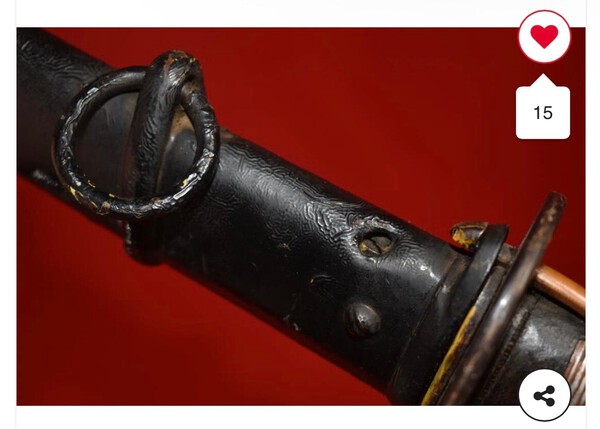
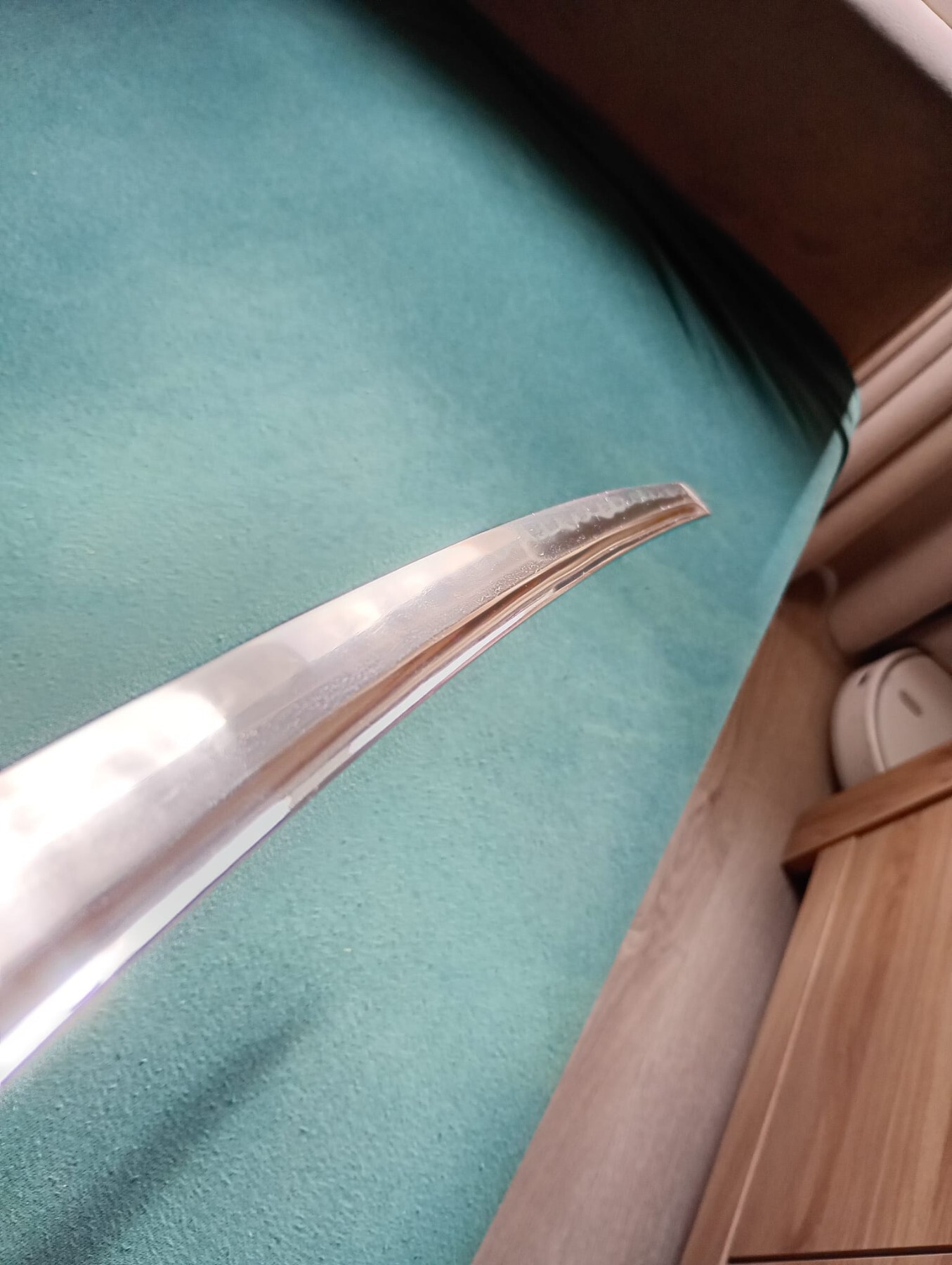
Nco 95, another angle direct shot.

 3 points
 -
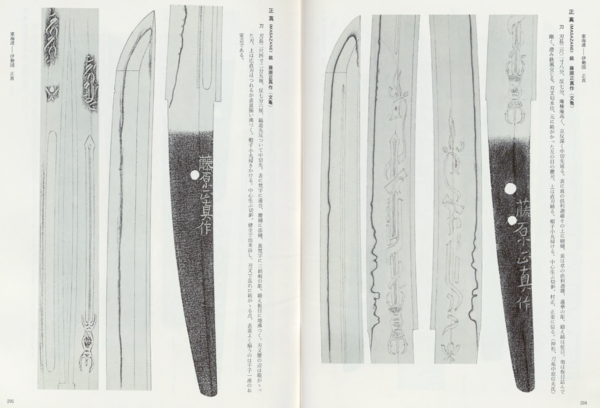
Huh, how odd! I was just looking for info about masamune these few days and got about 70 swords' worth of data purely online, not including other Sengo swordsmiths or any sword in the books. although I do read Japanese, so a lot of them might not be helpful, but I did read this fruitful 20,000-word article yesterday on nihonto.com almost exclusively about Masazane (https://nihonto.com/tonbo-giri/), perhaps that would be a good read? It's really an in-depth analysis of nine whole swords of Masazane. The picture quality is not ideal, so I would like to repost Oshigatas of two of the best works in there, one with Sankoken and one with two kinds of Kurikara, both from one of my favorite books, Random Thoughts on Japanese Swords by Kataoka Ginsaku sensei. I'm also waiting for my copy of Ise No Toko, excited to see what's in there. Oh and do feel free to ask me to translate texts that interest you as long as they are not way too long, I would say a Tanobe sensei's sayagaki is the maximum, longer than that then I could only give out a rough gist of the text orz
 3 points
 -
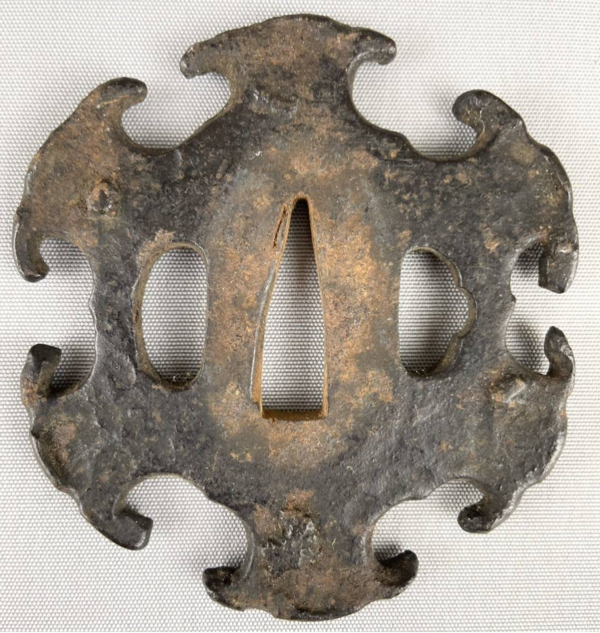
Just for fun, I took some measurements of my collection using two different Geiger counters. I noticed that the old *tsuba* actually registered slightly elevated radiation levels. One Tsuba from the Muromachi period, featuring gold inlay, really started clicking away. Everything is still well within the safe range — but where does it come from?2 points
-
Ishido Teruhide - Ishido Mitsunobu numbered "751"- non-traditional? Kai-gunto. @Bruce Penningtondo blade signed mitsunobu used to have "showa" stamp?; I don't see clearly in this photo and article states mitsunobu mei means showa-to. https://www.liveauctioneers.com/item/231250379_ishido-teruhide-signed-type-97-officer-kai-gunto-tallahassee-fl Mei type "E" - Mitsunobu with Kao, blade is in bad shape. https://japaneseswordindex.com/teruhide.htm


 2 points
 -
Hi! This reads 江村作 (Emura Saku).2 points
-
Dear Sebuh, I'm sympathetic to the request, but I'm convinced a feature like this would cause more harm than good to the community — let me explain why. The root problem is that quality isn't a legible characteristic through dealer photos. Paper levels are the best proxy we have, but they're a coarse one. Within a single designation, there are "barely Juyo" Norishige and "Tokuju-in-waiting" Norishige, and in Japan those are completely different items value-wise. The overseas market tends to get offered the "barely Juyo" tier with open price, because the "Tokuju-in-waiting" pieces get deemed "too expensive for Juyo" by Western buyers and stay in Japan or are marked as "ask". So the average Juyo Norishige price an aggregator like this would surface is already a biased signal. It doesn't reflect the artist's realized market price, it reflects items that make it online with a revealed asking price. The deeper concern is what happens once that metric exists. Collectors will (rationally) optimize against the legible signal: lowest possible price-to-name ratio. That, in turn, creates an incentive for dealers to source cheaper and cheaper items attributed to master smiths (rationally). We've already seen a flood of big names with recent TH papers at prices that feel too good to be true, and the uncomfortable answer is that they're too good to be true. The market is responding to exactly the pressure this kind of metric would amplify. I think the better direction is to help prospective buyers understand what constitutes truly great work within an artist's oeuvre, so quality becomes more legible, not just price-per-name. How to do this, however, is not so obvious, but I have some ideas down the line. Hope this helps, Hoshi2 points
-
梵鐘・仏像・銅像・寺院仏具の 老子製作所 | 梵鐘(釣鐘)・寺院仏具・仏像・銅像の老子製作所は、伝統工芸高岡銅器と共に 鐘の専門メーカーとして、寺院仏具金物や洋鐘、カリヨン、モニュメント等の鋳物製品を製造しています Although Lao Tsu or Laozu is spelt like this, the Buddhist manufacturer of bronze bells is called "Oigo" (Old Child) 老子 with these characters, so presumably that is how they would like it to be read. Their blurb says that they made/make objects in the spirit of Laotsu. 老子青銅作品 - 検索2 points
-
Fred W. has this one up on his site:2 points
-
Hi @Sukaira, Thanks for the report, it helps. It will be fixed shortly. Let me know if you see any other anomalies in the data, feel free to shoot me PMs or reply to the thread, whatever is more convenient. Glad you're enjoying NW! Can you think of any feature you wish existed? Best, Hoshi2 points
-
東神正国作 – Toshin Masakuni saku 昭和十九年三月日 – Showa 19th year (1944), 3rd month2 points
-
I can give you both. I quoted the Bensons above, but here it is again, in addition to Moses. Bensons: Moses: So basically the same evaluation2 points
-
Did you purchase it from a FUKUSHIMA or HIROSHIMA located collector?2 points
-
Jeff, You have a Type 98 officer sword. You can read up on them here: Commissioned Officer Sword - 1938; Ohmura Care and cleaning tips: Japanese Sword Care - Japaneseswordindex.com2 points
-
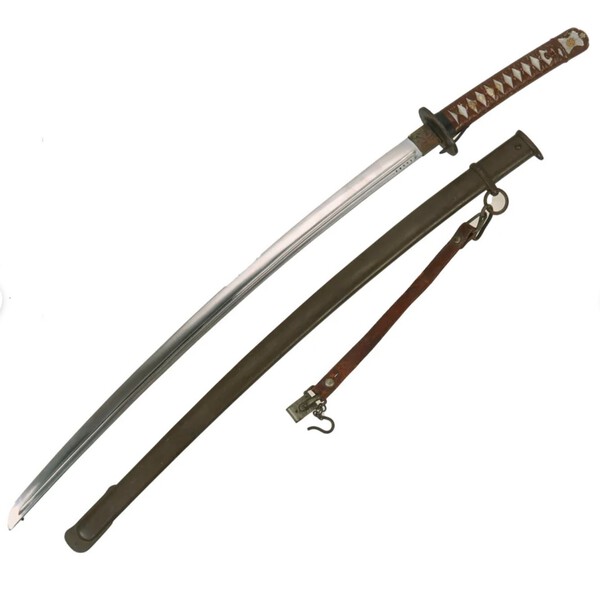
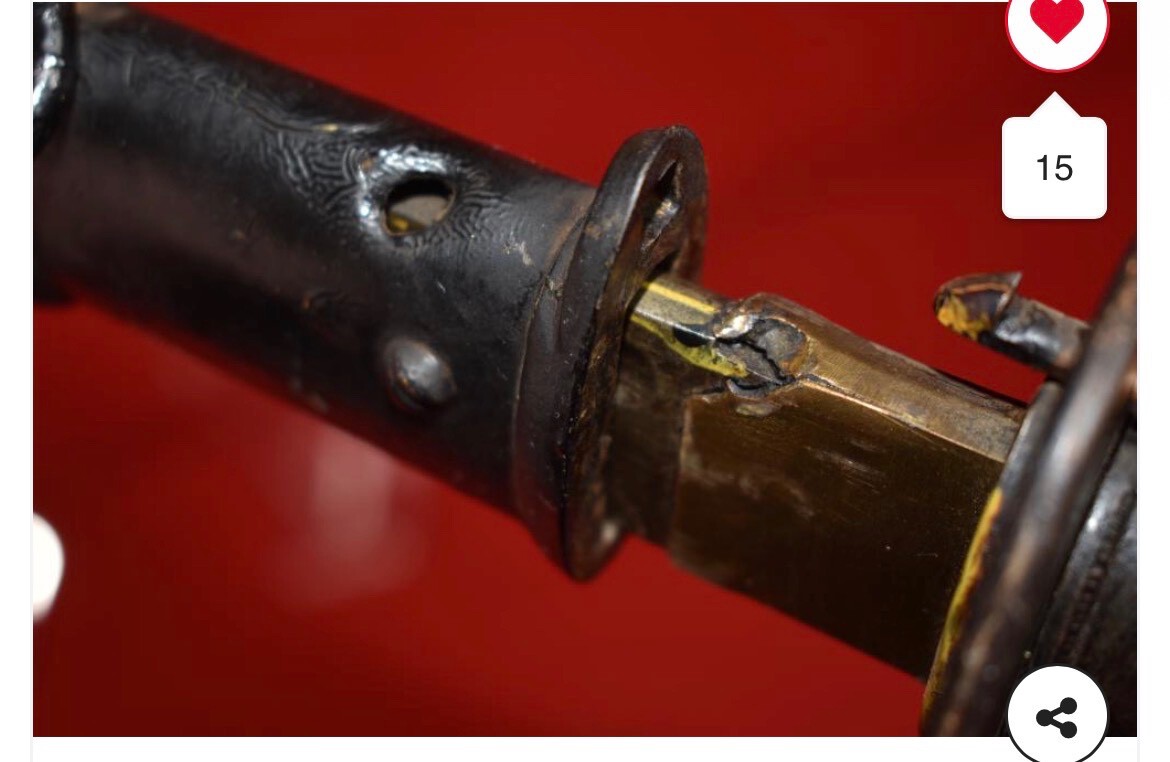
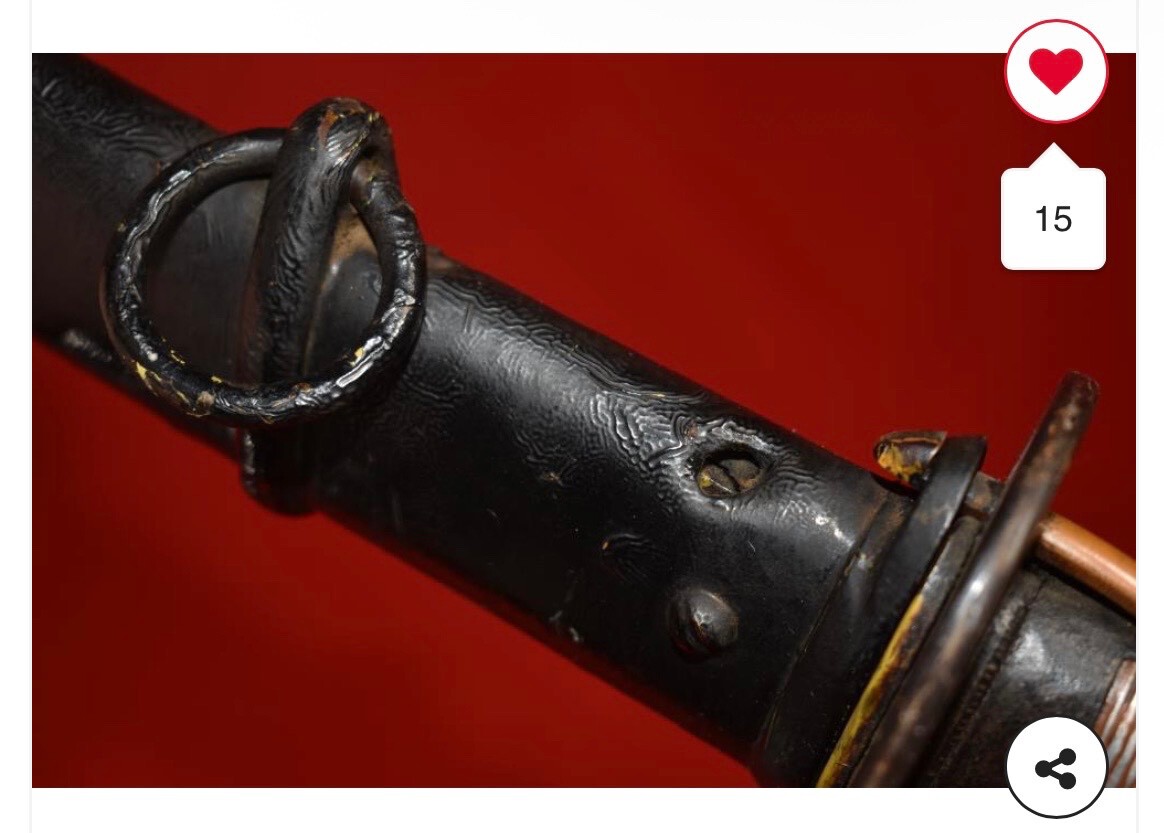
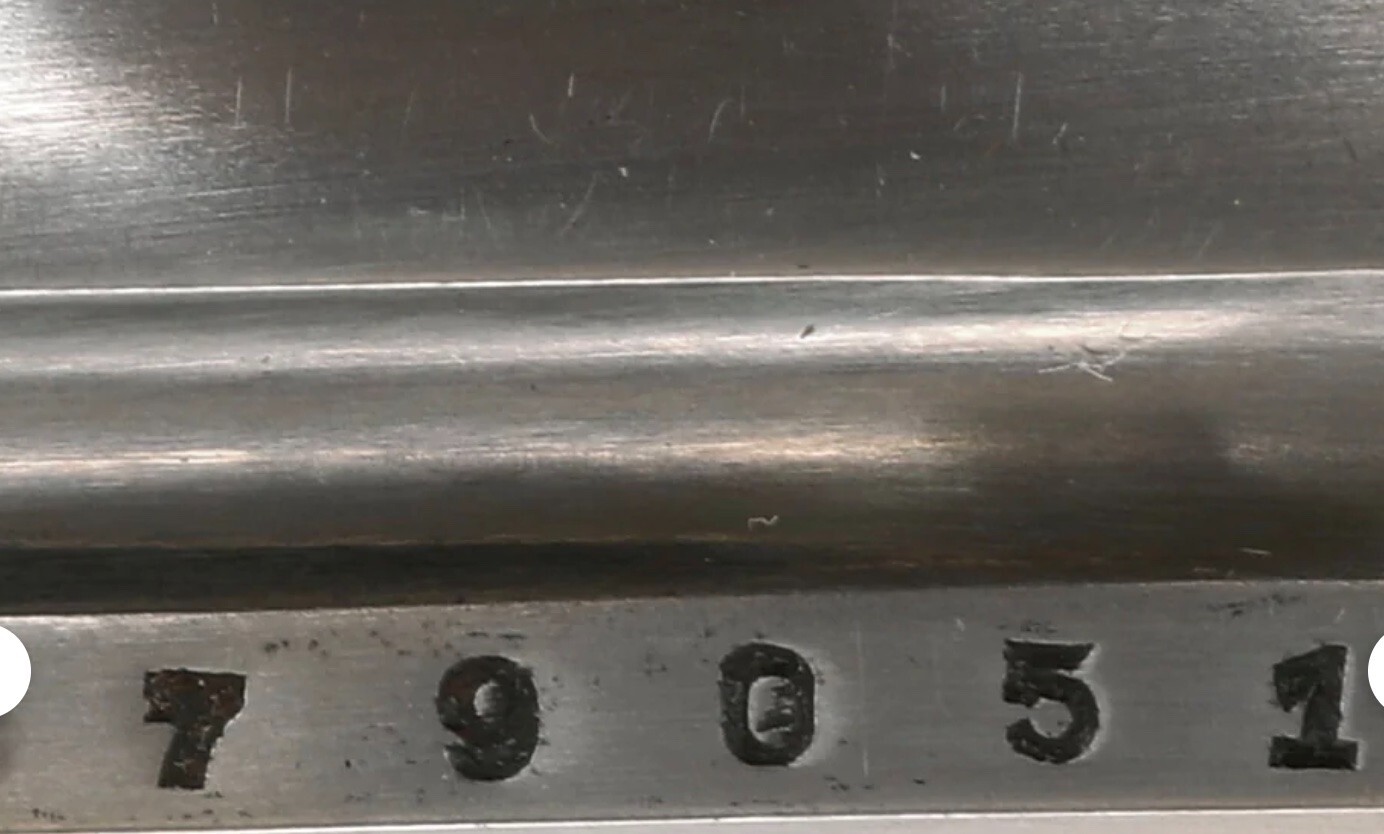
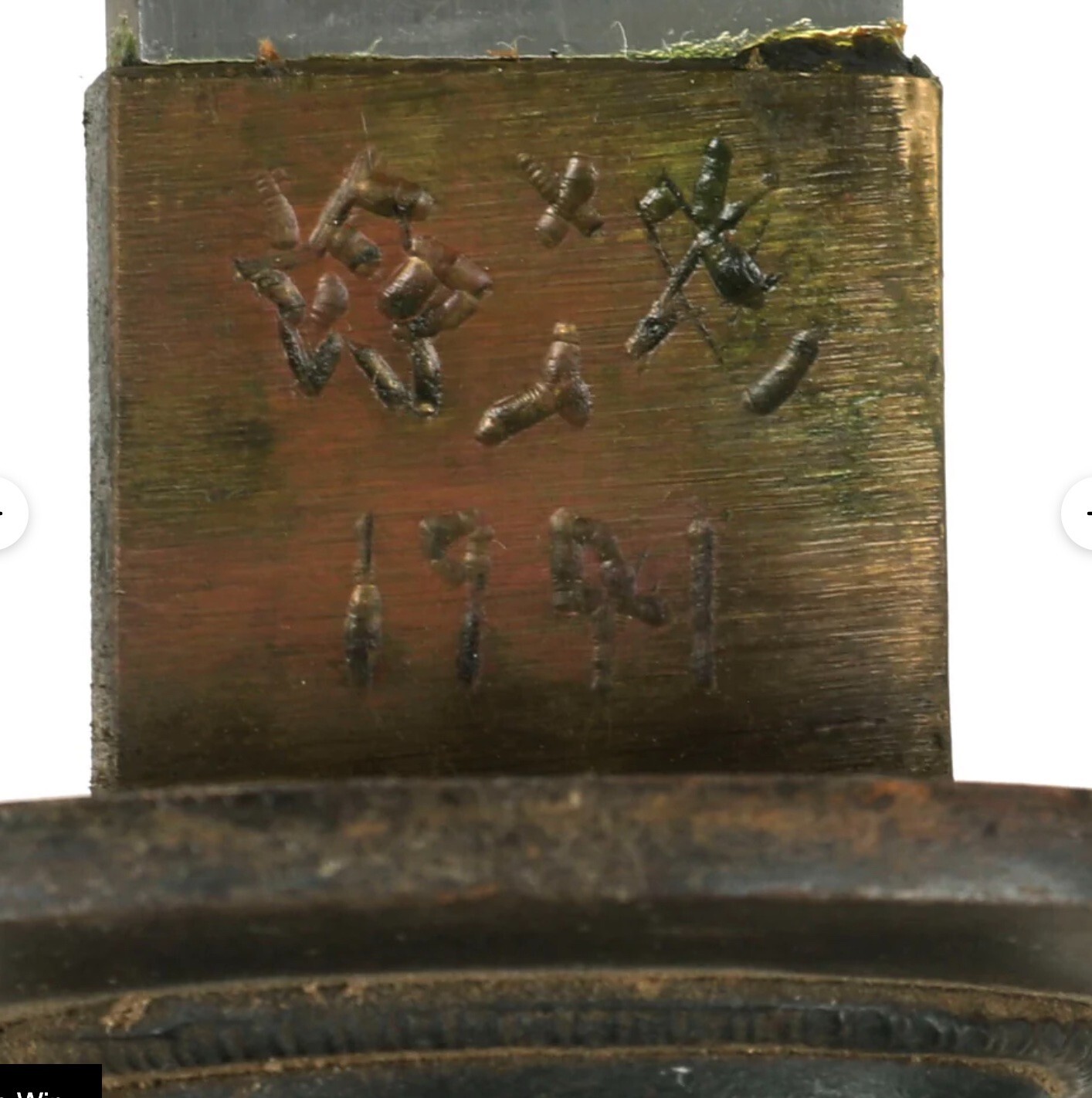
Here is an interesting Type 95 Guntō, with some "bling". I'm sharing here rather than the 95 threads, because these unique features are not factory original. Note the Habaki, leather hanger, and most interestingly those "monkey’s-fist knot" mekugi and grommet screws. https://www.ima-usa.com/products/original-wwii-Japanese-army-type-95-nco-aluminum-handle-katana-sword-with-rare-leather-hanger-matched-serial-79051?variant=41101181190213 Already sold, not sure when. -Sam


 2 points
 -
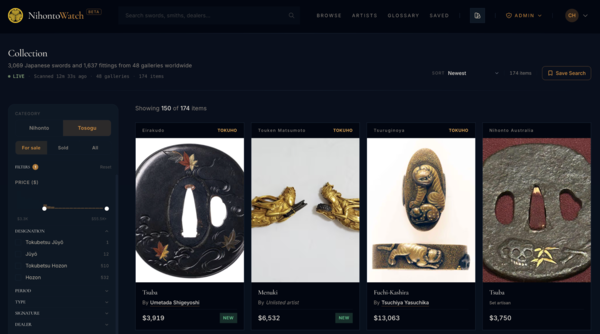
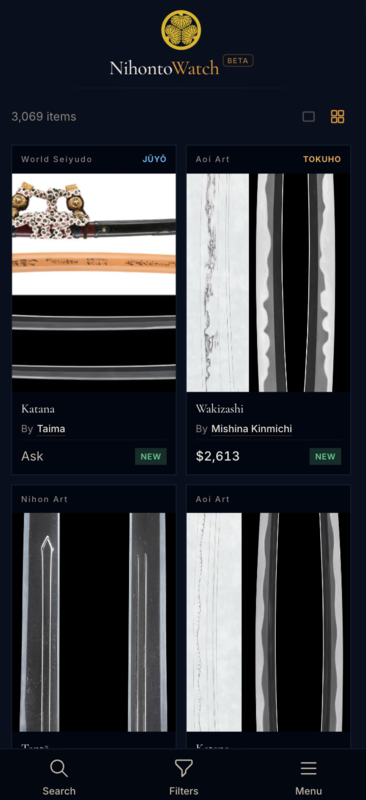
Hello everyone, TLDR: Interested in Japanese swords and fittings? I made this to help the field. Open nihontowatch.com on your phone browser, and add to home screen (Share → Add to Home Screen). Thank me later. --------------------------------------------------------------------------------------------- I have been thinking for quite some time about the future of our field. I have been blessed with incredible mentors and opportunities, most notably the late Darcy Brockbank, who was so generous in sharing his knowledge. Since his tragic passing, I have felt a responsibility to carry that work forward. What I am about to present, I built as an homage to his memory. Our field has problems. We operate in a field of extraordinary depth without being equipped with the knowledge and tools to understand what we're looking at when we browse the market. Refreshing dozens of dealer websites every week, most in Japanese, copy-pasting listings into translation apps, pinching to zoom on sites built twenty years ago — market awareness is just painful and you miss things constantly. You spend an hour and walk away unsure you have seen everything. And this is just the market experience. The deeper problem is access to knowledge. There are no catalogues raisonnés for artists. Yuhindo would have grown into it — it was planned. But alas, Yuhindo is no more. No way to know, with any confidence, whether a price is reasonable without decades of experience or tens of thousands of dollars invested in published references. No way to know why something costs what it does. Communication with Japanese dealers remains daunting for most. No easy way to know who is a reputable dealer. The barrier to entry is simply too high, and this friction keeps our field artificially small. Fine art has Artnet. Watches have Chrono24. Antiquarian books have AbeBooks — markets with comparable depth and comparable opacity, served by platforms that bring transparency and accessibility. These fields have benefited immensely: they have enabled new entrants in droves to collect in confidence. Our field needs more knowledge and transparency to build interest and trust.Japanese swords and fittings. Eight hundred years of collecting history at the highest levels. The category that contains the most national treasures in Japan. The indefatigable search for perfection of an entire civilization. And yet, we have nothing. This had to change. As I write this, there are 3,021 Nihonto and 1,607 Tosogu items for sale across 44 dealers, Japanese and international, in a single searchable interface. Every listing is structured with attribution, certification, measurements, and artist intelligence data. NihontoWatch is on track to follow 100% of the online market for genuine items with NBTHK papers. Refreshed 12 times a day. Everything is translated and structured, as it trickles in live. But what is this worth, if it's so hard to know what you're looking at? Especially for newcomers, it is so hard to tell what you're looking at. This is where the magic is. I am nostalgic of reading through Yuhindo's artist descriptions. It made me deeply appreciate the field. It got me in. NihontoWatch scales this experience and creates something approaching a living catalogue raisonné for every Tosogu and Nihonto artist. It matches every listing against a database combining the complete Juyo, Tokubetsu Juyo, Juyo bunkazai, Kokuho, and Gyobutsu designation data — over 23,000 items at the highest level, with rich text in classical Japanese. This data is then processed, synthesized, and presented into NihontoWatch's artist directory in a way that is respectful of the NBTHK's copyright. With this, you'll be able to discover a maker's historical reputation through quantitative analysis of exhaustive provenance records, in ways never seen before. Over time, all of these artist pages will come alive, forming an ever-expanding knowledge base. - How rare is it? - How many Tokuju? - How many designated works ranked Juyo and above? - Why is this important? - Where does it rank relative to other works? - What is for sale right now? - What was for sale recently? All the answers are in. These are questions that come up constantly in our community, and until now, answering them required years of collecting published references worth tens of thousands of dollars, and patiently indexing them with post-its or one-by-one in a spreadsheet. Only professional dealers or major collectors could afford to do this. This is a BETA, so there are errors. The more obscure the artist, the higher the error rate, and there are still basic errors I need to fix with some famous artists. A lot of algorithmic tinkering and curation ahead. It will keep getting better with your feedback. See the results for yourselves: - Soshu Masamune: https://nihontowatch.com/artists/masamune-MAS590 - Ichimonji school: https://nihontowatch.com/artists/NS-Ichimonji - Yasuchika (tosogu): https://nihontowatch.com/artists/yasuchika-TSU001 - Goto school: https://nihontowatch.com/artists/NS-Goto Click one and explore the designations, the provenance abalysis, the measurement distributions. This is just a first shot — over time this data will grow. Here is one where I have published an item I studied for my Substack article on Mitsutada: - Osafune Mitsutada: https://nihontowatch.com/artists/mitsutada-MIT281 Imagine Yuhindo, but with a page for every artist and every piece ever captured on camera. Saw a national treasure at an exhibition in Japan? Share your photos on NihontoWatch's artist catalogue. In the future, owners of particular works will be able to publish them to the artist's catalogue. Think of it as a growing, community-curated knowledge base for every artist in the field. And so much more Browse and filter: Designation, dealer, item type, school, province — all filterable, all instant. Prices display in JPY, USD, or EUR. Every filter combination is a shareable URL. The sold archive tracks thousands of items for pricing research. And it works for every budget, for collectors at every level. - All Tokubetsu Juyo Nihonto on the market - All Tsuba with Hozon or Tokubetsu Hozon, maximum price $2,000 Setsumei translations: On some items, you can press the floating book icon on any Juyo item to toggle between photos and the Juyo setsumei translated text. For most Juyo and above items, the NBTHK evaluation text from the dealer's page is identified by computer vision and translated into English. It will fail if the dealer has not posted the Juyo Zufu extract, but in the majority of cases they do, and the result is remarkably accurate. Do use responsibly — the quality is great, but not perfect. Always purchase professional translation from Markus Sesko when contemplating the purchase of a Juyo-designated piece. Search alerts: Never miss an item again. Define keywords and filters and save them. NihontoWatch will run your search every 15 minutes, and when something new appears, immediately send you an alert email. In practice, missing a listing that fits your interests becomes almost impossible. Tip: I recommend avoiding overly specific queries. "Juyo tsuba" or "Kamakura signed tachi" are safer than specific artists such as "Yozozaemon Sukesada," which would be more fickle. Broad queries give you the best market coverage. Inquiry emails: Press "Inquire" on any listing to draft a professional inquiry in Japanese. Handles etiquette and formality, and can help you request the 10% consumption tax exemption available to overseas buyers. Did you even know you could get 10% off? How many new entrants lost 10% on this, at least at the beginning? I for one did. I've seen countless high spenders neglect to request it while shopping across Japanese galleries. Glossary: The technical language of Nihonto and Tosogu is deep and specialized — needlessly so for non-Japanese speakers. Anytime a technical term comes up, you can click and see what it means. Over 1,200 terms, searchable, automatically linked from the setsumei translations. Who remembers always keeping an index open to keep track of terms when studying Juyo items? https://nihontowatch.com/glossary How best to use NihontoWatch While it works wonders on desktop, NihontoWatch works most beautifully on your phone. I use it every day — it feels like I have the market in my pocket. Open nihontowatch.com on your phone, hit Share → Add to Home Screen. And voila, you have an app. It becomes something you check with your morning coffee, the way one might check the news. A word of caution The data has errors — always verify independently. This is a tool to explore the market, not a substitute for critical thinking. If it looks too good to be true, it likely is, and this system can't easily correct online misrepresentations. Old listings where dealers have not marked items as "SOLD" will still appear as available. Listing errors will slip through, but data quality improves continuously as the system learns over time. Get involved - Missing a listing or dealer you like? PM me or post here. - Bug? PM me or post here with steps to reproduce. - Dream feature request? Reply in this thread. I will keep this thread active and share major updates when time permits. Everything is free right now, and will remain so until ready for official release. This is no trivial task, and it is expensive to operate — it will need to be covered in some way down the line. It will be tempting to keep it for yourself. But if we want our field to grow, we must share knowledge and expand market access and transparency. The single most impactful thing you can do right now is help others discover and use the tool. Share it with your study group. Share it with your collecting circle. Share it with a friend who has been curious about Nihonto and Tosogu but found the barrier to entry too high. That barrier just got a lot lower. Farewell, Darcy. This is for the teacher in you. Hoshi

 1 point
 -
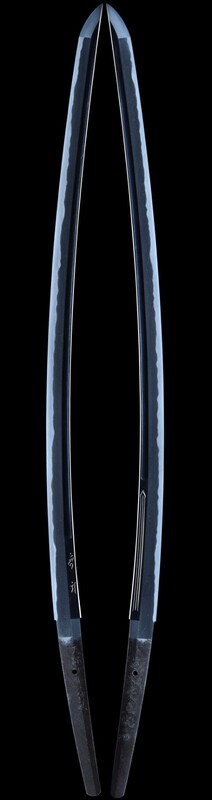
Just wanted to share this for anyone looking at Moses for polish - I recently received back a Taikei Naotane that was originally polished by a very elderly togisihi in Japan that had many problems. Finger stone marks left, hazy ji, a very scratchy surface etc. Now it looks incredible to say the least. The pictures do not do it justice, but I would highly recommend Moses. These pictures are very much a blue tone as his camera white balance must have been on the cooler side, but to the naked eye in real life, the hamon has a beautiful shade of light blue to it.
 1 point
 -
On the plus side of NTHK is that they provide much more information about the item being papered. In that sense, there is more to compare than just an oshigata. John C.1 point
-
I hope that You save all pictures and documentation made during polishing. I would like to have same tosho works polished by many togishi.1 point
-
Some context around the prevalence of radioactive elements : I had my well tested last year, and they found Uranium in the water. Had me a bit worried until I got some context : The level of Uranium was an order of magnitude less than that found in your average bottled water! After that, I relaxed. Given that older Japanese iron may have been made from iron sands, it would not be at all surprising to find some radioactive elements in the mix... not to mention small amounts of gold :-).1 point
-
Yes, should have been included with the commercial invoice outside the package.1 point
-
Looking over your post again. The description Aoi Art provided was "HS Code 9706.10 (Antique Japanese sword, made more than 250 years ago) This isn't adequate and also missing the subcategory. It should have at least contain: "Antique Japanese Sword (Katana), 1575, Bizen Province, for collector purposes only. Not a weapon" Correct HTS Code is: 9706.10.00.60 Documentation should include a copy of the NBTHK paper and anything else that indicates year made. US Customs have a reason now to be overly strict on their classification, so using the right info is necessary.

 1 point
 -
Got it! I thought the same, but thought to throw it out there. Use the site daily and love looking at new improvements Thanks for everything!1 point
-
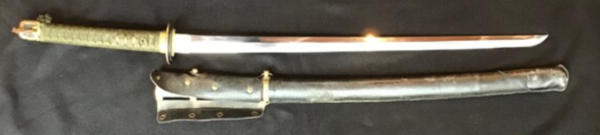
Another kaigunto with it's own take on how to fit around 2 haikan. Posted by @Matsunoki HERE.

 1 point
 -
Hi Sky, Had you thought about going to the man himself? https://www.hizento.com/book-tadayoshi-history.php1 point
-
Total AI [with a little help from me!] [Funny thing is the nakago-ana is one of the few bits original!]1 point
-
This point also applies to sayagaki. Just because a sayagaki might be legitimate, doesn't mean it was written for the blade currently inside the shirasaya.1 point
-
Went entirely through saya and blade’s shinogi-ji. https://www.invaluable.com/auction-lot/wwii-era-Japanese-battle-shot-katana-samurai-swor-583-c-83b62359ed I remember seeing somewhere test of bullet cutting with katana. [this lector ;)]


 1 point
 -
I love Hizento and I love Goto school (I'm guessing that fittings and Tsuba are Goto). Perfect package!1 point
-
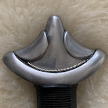
Early prototypes of shingunto. (T94 clearly) Here we have navy dirk so kyu -gunto. I would guess fabric was added at the end to help mute pommel or speed up production. Later dirks happened to be less detailed. So could they drop glue and go with sticky fabric underneath samegawa to cut time? @Conserved123 which one it is? http://ohmura-study.net/908.html Oh and If You have books about conservation of antiques (wood and steel) please drop here. It will get handy.1 point
-
John, sorry, no. We parted company a while ago. Best. C.1 point
-
Assuming this is the same smith, I enjoyed the read: https://markussesko.com/2013/03/22/the-inokiri-and-the-travels-of-masazane/1 point
-
Luke: I just happened across an article written in JSSUS Newsletter vol. 30, number 1 (1998) that is talking about early (1934-1935) gunto mounts being "constructed of wood, and wrapped in a linen canvas before lacquer" (pg. 2). So maybe the same with yours?? John C.1 point
-
Doesnt "new" iron contain a bit of radiation due to the present atomic age and old iron (item) pre atomic age does not?1 point
-
@Hoshi have been using your site every day since it launched. Really great stuff. I am a software engineer myself so I appreciate having a modern implementation to use on our ancient hobby I did notice some bugs with classification of some smith ranks, like Yasumitsu for example being rated as Saijo-saku plus some others. Sorry if that's been reported already.1 point
-
As far as I know Moses is not an amateur polisher. Unlicensed does not equal amateur in the same way that an un-papered blade does not mean a fake blade, the paper (or license) simply de-risks it. Amateur is generally a metric of skill, or a word to describe someone who is a hobbyist, a dabbler. That is not Moses as far as I know. I believe he also has sat on the panels of NTHK shinsa in many cases alongside the Yoshikawa family, from whom he studied polishing with and had close relationships. I totally get the direction of your post though and appreciate the nuances of something like this, but here is the kicker...you can also get bad work from licensed togishi in Japan. In fact, many of them use acid as a shortcut. This sword is actually great proof of that. It was previously polished by a licensed polisher in Japan, but full of hazy jigane, finger stone marks and scratches. I also had the Benson family evaluate the polish before Moses, so I could compare their assessments. They were essentially identical. I am not telling anyone to go to Moses over a licensed polisher, only that based on my experience that his work (at least this one) can be recommended. I have not seen any of his bad work personally so I can't really comment on it. FYI Taikei Naotane has many Juyo already. This blade is certainly a candidate as well, as you can see it was sold previously here: https://eirakudo.shop/6837121 point
-
Sukaira, It has been a while since I participated on the NMB so @Brian, please delete if things have changed. I agree with above where it was said that judging a polish via pictures is challenging. As you have it in hand, I will trust that you are satisfied with the results. That said, this was a risky endeavor. You entrusted the blade of a master artisan - assuming it was done by Taikei Naotane and has or would pass shinsa - to an amateur/unlicensed polisher. When thinking of the unlicensed polishers with the best reputation, Moses and a handful of others come to mind first, which is meant to be said with respect. They have had some level of training and as such, their work is better than untrained “polishers”. Since he is in the camp of one of the better amateur togishi, there is a chance that no damage has been done, but there was a chance that a great deal of damage COULD’VE been done. That is why I’m speaking up here. For every one example like yours that looks good and shiny, there are others where an untrained/unlicensed polisher destroys a blade. People will read this and think that they can avoid the time and cost of sending to Japan and still get top quality results, when on average, that will not be the case. The other reason I’m speaking up is because of the sword you sent. Taikei Naotane is in the list of the best Shinshinto smiths and if he doesn’t have Juyo work yet, it is simply a matter of time until he does. If you would’ve sent a showato or even a mid-range gendaito (read emura or nagamitsu level), I probably wouldn’t say anything, to avoid the almost certain backlash and conflict. But you didn’t. You sent a Taikei Naotane and in my opinion - even if this worked out well, which it’s impossible to tell via pictures - was a gamble not worth taking with what could prove to be in time a Juyo candidate. Apologies for providing a more constructive response, but even if your situation worked out well, it’s important for others to understand the risk associated with engaging non-licensed polishers.1 point
-
Thanks for all the updates. Even today, many advanced collectors recommend these newsletters for beginning collectors.1 point
-
Two Geiger counters? Also, did any of the tsuba develop super powers? All kidding aside, could be from natural uranium found in many types of rocks and minerals, even those used to make tsuba. Or, the tsuba could have been exposed to high levels of radon gas for a period of time. John C.1 point
-
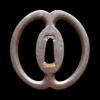
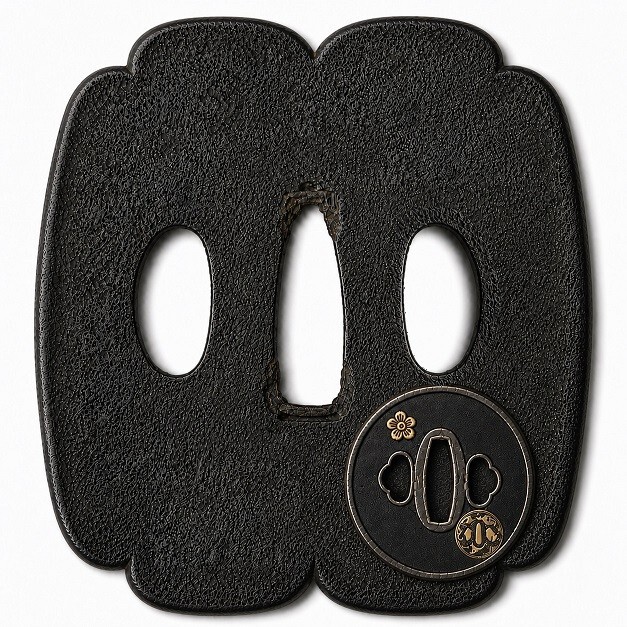
Long time between examples - https://www.jauce.com/auction/q1228610297 Anyone seen a tsuba on a tsuba on a tsuba?

 1 point
 -
Probably: 濃州関住源天秀鍛之 = Nōshū Seki-jū Minamoto Amahide forged this Amahide signed his swords in quite a few different styles. There's a similar-looking one in this thread:1 point
-
It's a cast copy, the sekigane is fake and you can see porosity holes where the metal was too hot practically all over1 point
-
IMPORTANT INFORMATION ABOUT SHIPPING Dear buyers, Thank you for your purchase. I am travelling now and will be shipping the books on 11th and 12th May. I will be back with tracking numbers. Have a nice day1 point
-
I had it tested and the inside was positive for biological material (blood). It does not have an exit hole, so it stayed in the poor chap wearing it. Average military Tanegashima had a caliber of 5/8 to 3/4", so that hot ball will smash a large hole.1 point
-
Alex: I give my two cents here since I have been doing some ordering from Japan. As Rohan noted, it can depend on the seller. There are options for them to ship the item having already paid the fees. On the stuff I have gotten, under shipping it usually says something like "includes all duties and fees" etc. Sure it costs more for shipping and I suspect they are charging a little more than necessary, though the transactions have been seemless so far and actually faster than USPS. I've had stuff shipped DHL, USPS Speedpak, and USPS priority mail international. John C.1 point
-
The US Supreme Court decision invalidated the tariffs issued under the International Emergency Economic Powers Act. These tariffs are separate from the 15% tariff the US and Japan negotiated in their trade agreement following the issuance of the IEEPA tariffs. For now, that trade agreement stands and should continue to dictate the tariff collected on nihonto imported from Japan. One open question is whether Japan will continue to honor this trade agreement since it was based in large part on avoiding the higher (and now invalidated) IEEPA tariff on Japanese imports. @eternal_newbie is right. The situation has been inconsistent ever since the IEEPA tariffs were first announced. Shipping companies have different processes to collect tariffs (or refused shipments altogether), some sellers under-declare the value of a shipment—leading to less tariff collected, and customs agents vary in enforcement—one reason why some have been importing swords via their airline luggage. I expect all of this to continue for the foreseeable future.1 point
-
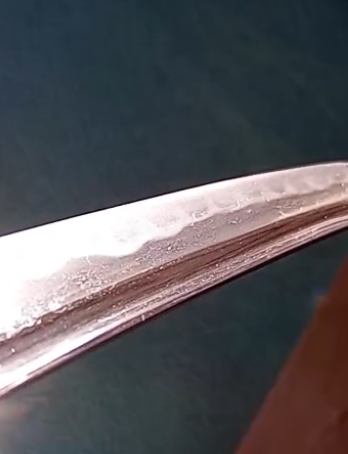
After checking on Norimitsu's work I wish that this sword to be his. But I don't think so. It is another MITSU (readable part of Mei). Anyway, I guess no one wants to have a healthy, in good polish, Ubu, with Bohi and perfect (Edo fittings and Tsuba) Koshirae, Koto Bizen Osafune blade. Sword stays with me.


 1 point


.thumb.png.54593db2789c8a1dcb235543b184ce39.png)






















This leaderboard is set to Johannesburg/GMT+02:00