
Leaderboard



Popular Content
Showing content with the highest reputation on 12/31/2025 in Posts
-
All judgements rendered in 1970s had a tendency to be optimistic. Today's judgements are often pessimistic. It ebbs back and forth, as it usually does. There is some tendency in nihonto community to see the "green to modern" papers transition as a seminal and unprecedented event, but in my experience this is hardly so. My grandparents both collected at reasonable level (violins and firearms respectively) and many relatives wrote "papers" of their own. One had to change his signature entirely, realizing he missed a very prominent series of fakeries. So he disavowed the old signature on such pieces and would generally indicate the need to rewrite other appraisals because the research had advanced in the meantime. But after being burned with those fakes, and more concerned at this point with his reputation, his late writeups have acquired a reputation for being very conservative to the point few actually opted for the "new signatures". In the end blue papers are upper grade judgements from an optimistic period. They can be off, but seldom really raise eyebrows. Koshirae judgements quite frankly have a tendency to be insufficient to begin with, to the point of listing the motifs and not really qualifying who and when made the piece... Also, a very strong contributing factor is that for high value pieces an attempt to repaper would be natural and therefore "green and high value" is a red flag not so much because "all green were bad", but because the "good ones" were repapered... Which in case of koshirae with no specific high value attribution brings a question - what exactly would one expect them to be repapered to? Its often a very generic attribution, blue simply means the piece earned some respect...7 points
-
Yes - basically it's like you write But let's think rationally If there are blue papers with attribution for a big name. or for a zaimei with a big name ( Shinkai, Kotetsu, Tsuda Sukehiro ... - not necessarily Koto blade ), why not make modern papers? if the blade is in Japan we are talking about a cost of 300 USD5 points
-
Volker - I don't dispute your claim However, you show blue papers and modern papers for zaimei Shinto blades In most cases, the discrepancy is in the old papers that have an attribute for a prominent swordsmith from the Kamakura/Nanbokucho period or the few from the Muromachi No one is saying that all old papers are compromised Everyone need to make individual assessments and especially not have too many expectations from a blade that suddenly appears on the market somewhere, has old papers with an attribute for famous names5 points
-
Hello, Yes, blue papers are not comparable to green papers. They are, in general, closer to the truth - survivorship bias not withstanding. They are also more "lenient" - and subtle downgrade are not uncommon (but it is rarely a free fall). The reason for this is that blue papers were issued by the central authority of the NBHTK, and not regional branches. This is the root of Han Bin Siong's observation. Well, it somehow does if you're deep into this. In your example above, your set went from being a true daisho (2 swords, 1 papers) to two distinct blades with separate papers. This means the modern NBHTK judges did not find sufficient evidence to conclude that both swords were ordered from the smith with the intent of forming a daisho. While this may not seem like much, it has surprising implications on the market with regard to value. We are entering arcane topics, but it is worth pointing out. Nonetheless, I would still insist on modern NBHTK papers and Tanobe sensei Sayagaki, and evaluate every piece deeply, in context. Hope this helps, Hoshi5 points
-
Cheers for 2026 Year of the Horse 午 Uma
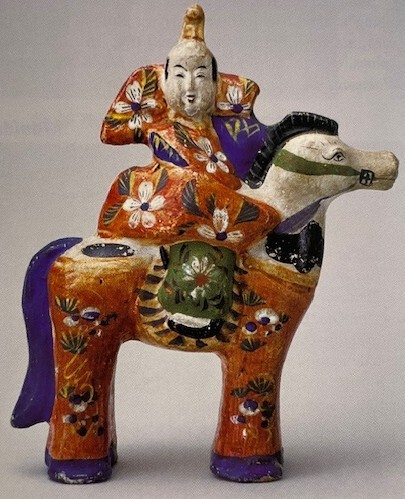 4 points
 -
David - sorry I cannot help with the auction question just want to send greetings from the Bay Area. -t4 points
-
盛世 (Moriyo) on the left!4 points
-
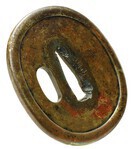
I'm getting awfully old and I've been out of California and consequently inactive Nihonto-wise for twenty years. I collected rather actively, and was buying from Japan all the time when i lived in the Bay area. I thought of offering some top quality tsuba here to test today's market, but when I started looking through my two banker's boxes of tsuba, I concluded that selling them one at time would be an ordeal. Has anyone here dealt with the standard auction houses and can make any recommendation? Here's an example of a high-end one.


 3 points
 -
It seems to me that all this back and forth really boils down to one common denominator……value. Anyone owning a blade with blue papers is fine, no problems, just know that if a day comes when that blade is up for sale, the price may reflect the absence of modern papers. You can argue up, down and sideways until you are blue in the face, but nihonto, like every other art, is only worth what someone is willing to pay. Conditions change, judges change, conceptions change and as such, attributions can change…….3 points
-
Do anything you can to avoid auctioneers. With their massive buyers premium and sellers commission they will keep between 40-50% of what someone pays and you will probably have to do all the descriptions anyway or risk their lack of expertise ruining results. The advice above re trying to work with a trusted dealer is good advice. You might even find one to buy the whole collection but choose carefully.3 points
-
Just look at the many items from the Juyo sessions from the 70s and it is quite obvious that the judges were "lenient" Okay - it's 50 years and some pieces may have changed over that long period with repeated polishing... But certainly not that much Pablo is a businessman - information from them should always be taken with a grain of salt3 points
-
Ball molds Tama-Igata of various sizes. Lead ball, range up to 100 Monmé. Lead ladle 玉鋳鍋 Tama-inabé (Various chunks of lead for melting)
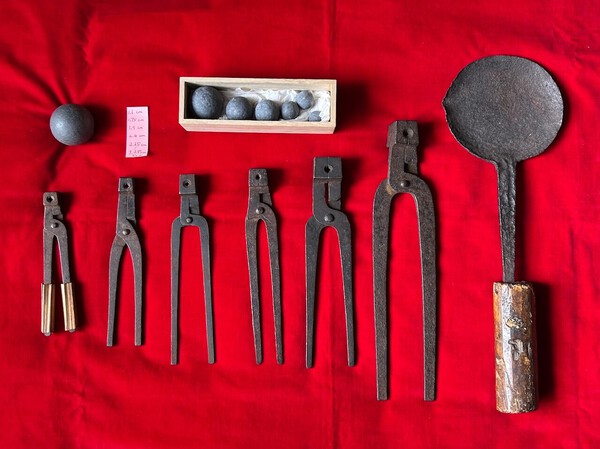 3 points
 -
正阿弥盛世 from Iyo in Shikoku apparently.3 points
-
Han Bing Siong wrote in Token Bijutsu Vol 11 that " a great number of the members of the committee for Koshu Tokubetsu Kicho Token shinsa are also judges of the Juyo Token shinsa " . IF Koshu Tokubetsu Kicho Token papers are suspect does this not therefore cast doubt on some of the 1970s Juyo attributions ?3 points
-
Another option is to work with a dealer who can sell them for you at a consignment (or even split the collection among multiple dealers). I faced a similar problem myself a few years back dispensing with a collection of middling-to-good tosogu and Grey Doffin helped me out greatly by selling most of them on his site and at various shows. Along with Grey, there are some other dealers active on the Board who can be found in the following forum area: https://www.militaria.co.za/nmb/forum/88-dealer-showcase/ Even if they are unable to help you out directly they will probably have better advice than most of us on which auction houses are better and things you should know when dealing with them. Best of luck to you.2 points
-
Thank you Piers, perhaps the first obscured character is Fuji 藤?2 points
-
No. 2 is Hara/wara (Gen) 原 No. 3 is… Gei/Kujira??? 鯨2 points
-
Hi, can someone please translate this Mei on Tsuba?
 2 points
 -
Pat, there is an article written by Bruce that is available for download that goes into more details. South Manchurian Railway: The Mantetsu Blade2 points
-
Hey, Tom, great to hear from you. I hope you are well. Happy New Year!2 points
-
Thank you very much, Piers and Uwe.2 points
-
Being a diagnosed dyslexic myself, makes this stuff pretty challenging. Even keeping word order and spelling straight in English can be rough. I usually reread my posts 5-10 times before I finally catch mistakes that other people notice almost immediately. Sometimes I don't even see those mistakes until I leave and come back with a fresh perspective. It gets even harder when kanji are involved, especially counting strokes. A lot of that comes from just not being familiar with another language, but it still takes a fair amount of effort. I've done it before, but I don’t really like using dyslexia as an excuse, because it’s just part of my everyday life. It’s very common, and most people who have it don’t even know, and those who do, often don't lean on it like an ailment. I literally don't even know what it's like to NOT have dyslexia . As I understand it, there's varying levels severity with dyslexia, so I must have the more common mild version... So it may be the cause for mistakes in spelling here and there, but it's typically no biggie. It makes me a slower and more careful learner, and I think that's a good thing. I even read slowly, which is how I was flagged to then be diagnosed while I was in school. I still have to google MENUKI and MEKUGI half the time, so I don't mix them up -Sam2 points
-
Actually with koshirae it should be OK. If it were a great name without current papers (eg a Nobuie tsuba or Kaneie or some other big name) then I would be worried. But full koshirae sets without some mega name should be OK.2 points
-
正阿弥 Shōami on the right?2 points
-
I have discussed it a bit in the Guide, but generally if you see one of those with say Kaga Muromachi blade, they are reliable and the blade itself is often good grade because those were not dished out in huge quantities. If you see it with very top name, the modern judgement was obtained and was 1-2 grades lower. Blue papers are never crazy, they can be optimistic... or the modern team could be pessimistic, or even plain wrong.2 points
-
Exactly, new papers are only *new papers* until they aren’t. In 2075, the papers of today will be ancient and this conversation will remain ongoing.1 point
-
Hi Joshua, and fellow Oregonian. While it's not specifically Japanese focused, you might be interested in the following Portland militaria events. http://www.oregonarmscollectors.com/gun-shows.html Lots of good guys with knowledge about guns and other various militaria. I often see Japanese bayonets there. I won't be at the January event, but I will be at the following February event. If you'd like, feel free to send me a message and I can bring along a book that covers some bayonet and stamp information. Best of luck, -Sam1 point
-
Precisely……because people will always prefer to keep a big name, regardless of origami age. Plenty of folks out there buying nihonto who just need *something* on paper, regardless of the color or age. The flip side of that is when someone has old papers with a lesser attribution, but good reason to believe that modern papers would attribute it higher. Those folks are the first in line for new papers.1 point
-
Two threads running now!1 point
-
The NBTHK attributed them to Kai Mihara. This school was active during the Muromachi period. Yes when the kissaki is reshaped, the boshi is often reduced in places and you always want to make sure that it is clearly visible1 point
-
We're all getting Old mate!!! Greetings from Australia. How go the .310 Cadets???? And the fishing. Happy New Year and may all your troubles be little ones... Best regards, Barry Thomas. aka BaZZa.1 point
-
1 point
-
My guess is late Muromachi1 point
-
Thank you Piers, some fine looking guns you have there too. My bore is about 17mm at the muzzle tapering to about 12mm for the rest of the barrels length. I'm happy to know it's an Sakai gun because my wife's mother is from Osaka. So it's not only something I would like to shoot, it's also a cultural as well as an art piece. Jay1 point
-
Tanto, supposedly late Kamakura period Another blade, dated to the late Kamakura period, is mounted with a 18th-century koshirae. I acquired this tanto around 20 years ago and it is pictured below. The dimensions are: Blade length (Cutting edge): 26.4cm, Sori: 0.0cm (Uchizori), Motohaba: 24.3mm, Motokasane: 6.2mm I would also be interested to hear your opinion on the dating and classification of the Swordsmith School for this tanto. This would help me to verify the accuracy of the descriptions I received years ago, before including them in the collection catalogue. Richard R.
 1 point
 -
Thanks for this Jussi. Just in terms of showing my thought process (primarily so that my beginner mistakes can be highlighted for me) to my eye Nanbokucho sugata, with the size and o-suriage pointing to that period rather than a retro throwback from a later period. Masame/nagare in the shinogi-ji pointing to Mino-den, and togari elements in the hamon agreeing with that. Guess is Naoe Shizu (maybe Kanetomo or Kanenobu?).1 point
-
Hoping we are not commenting publicly here on people’s goods for sale at all! Having said that John, I am pretty sure you are correct. Oh, and the netsuke beyond may be tagua nut, vegetable ivory. As to lathes in general, they were using hand and foot power to push-pull small spinning lathes with long strings, way back in the Edo Period at least.1 point
-
1 point
-
Agree with Rivkin, or papers might say Nambokucho Mino den.1 point
-
No. Atobori was a historically common and context-dependent practice from the Edo period onward. To recap.. Atobori (後彫り) refers to carving in a blade separate from the original design for the blade at its time of manufacture. That is to say after the sword was originally forged and finished, rather than as part of the smith’s initial “conception”. While often viewed critically by modern collectors, atobori was quite common practice from the Edo period onward. The prolonged absence of large-scale warfare in the Edo period reduced the practical emphasis on armor-piercing and battlefield durability, while factors such as balance, handling, and visual refinement gained relative importance. Within this context, atobori bo-hi were sometimes added to existing blades to alter weight distribution, improve handling characteristics, or adapt older swords to contemporary preferences. Atobori was also influenced by aesthetic fashion. Certain periods favored the presence of hi as a visual element, particularly on otherwise plain blades. Adding a groove could visually sharpen the sugata, emphasize curvature, or lend an older sword a more “classical” appearance in keeping with prevailing taste. When carried out by skilled hands, such work could be executed in orthodox styles, including nagashi terminations, making the best atobori difficult to distinguish from original carving. In the Meiji period, motivations shifted further. The abolition of sword-wearing and the collapse of the traditional samurai market led to the modification of many older blades to enhance their visual appeal to collectors, tourists, or foreign buyers. Atobori bo-hi from this period were often added to make a blade appear more dynamic or refined, sometimes with little regard for historical coherence, though the quality of execution varied widely. In the early 20th century, atobori continued for mixed reasons. Some blades were modified for martial arts use, where balance and handling were prioritized, while others were altered during remounting or refurbishment. As before, the workmanship ranged from careful and traditional to purely cosmetic. Importantly, atobori does not automatically imply deception / fake / gimei or poor quality. Many atobori hi were executed competently and reflect legitimate historical practices. However, because the carving was not part of the blade’s original forging concept, any but the best often reveal subtle inconsistencies in proportion, termination logic, or stylistic harmony when compared to original work. For this reason, experienced observers tend to assess atobori not by a single technical fault, but by the cumulative weight of visual, stylistic, and historical considerations.1 point
-
荘司筑前大掾大慶藤直胤 = Shōji Chikuzen Daijō Taikei Fuji Naotane 天保八年仲秋 = mid-autumn of Tenpō 8 (1837 CE)1 point
-
I just realized I had taken that picture over 5 years ago. Honestly I don't know what the lines are, I have just thought it is more visible portion of hada for some reason. I took few pictures just now, in this sword you can see the squiggly line is at the end of bit openish nagare hada portion. I remember in the first picture I posted I wanted to try to take picture of the good hada and not this lower portion. Metallurigical things are way out of my league but I do think it is possible that the rougher nagare parts that show up on few portions of this worn down sword are core steel, and the fine hada that is on the majority of the sword is the surface steel. I also took a picture now that shows few more squiggly lines closer to the tip. It may not show up in the pictures but the sword is extremely wide. I personally believe it is ō-suriage ōdachi and the hi is added on later. Unfortunately the bōshi is missing as the hamon runs off, so the kissaki has been much bigger in it's original form.

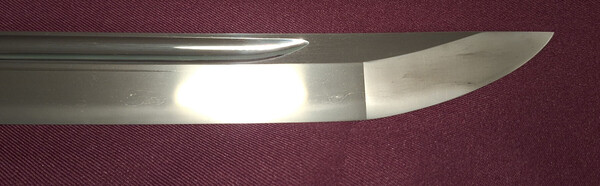 1 point
 -
Bit late, but better late than never. The original question is not quite as simple as it seems. The sword I own is a 4th Gen katana with a katana mei and NBTHK Tokubetsu Hozon papers. I asked Sensei Tanobe about it and he wrote back (Jan 2000) and said " Dear Mr. Robertshaw, Even though your Tadayoshi sword is slightly too long to have a Katana -mei, there are indeed some exceptions amongst swords made by Tadayoshi II, III and IV in length slightly over 2 Shaku. The mei is undoubtedly genuine, thus this sword may be considered a very rare example of such exceptional works. Sincerely yours, Michihiro Tanobe" with seal. The Hizen kaji cutoff for 'Katana' versus 'Wakizashi' is 2 Shaku 1 sun, so a technically long sword at 2 shaku 0 sun 8 Bu (for example) and classed as a katana by the NBTHK, would be thought of as a Wakizashi in the Hizen Kaji and would therefore have the signature on the "wrong" side for the average collector who uses 2 Shaku as the cutoff! The sword referenced above (4th Gen) is ubu at 2shaku 3 sun 3 bu --- so not in the questionable zone of 2 shaku 1 sun, in fact, way outside this zone.. Never say "Never" when it comes to swords! Cheers, Rog
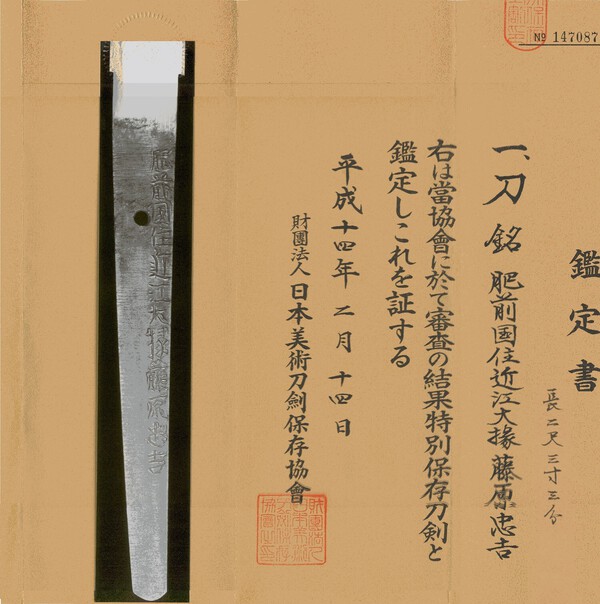 1 point
 -
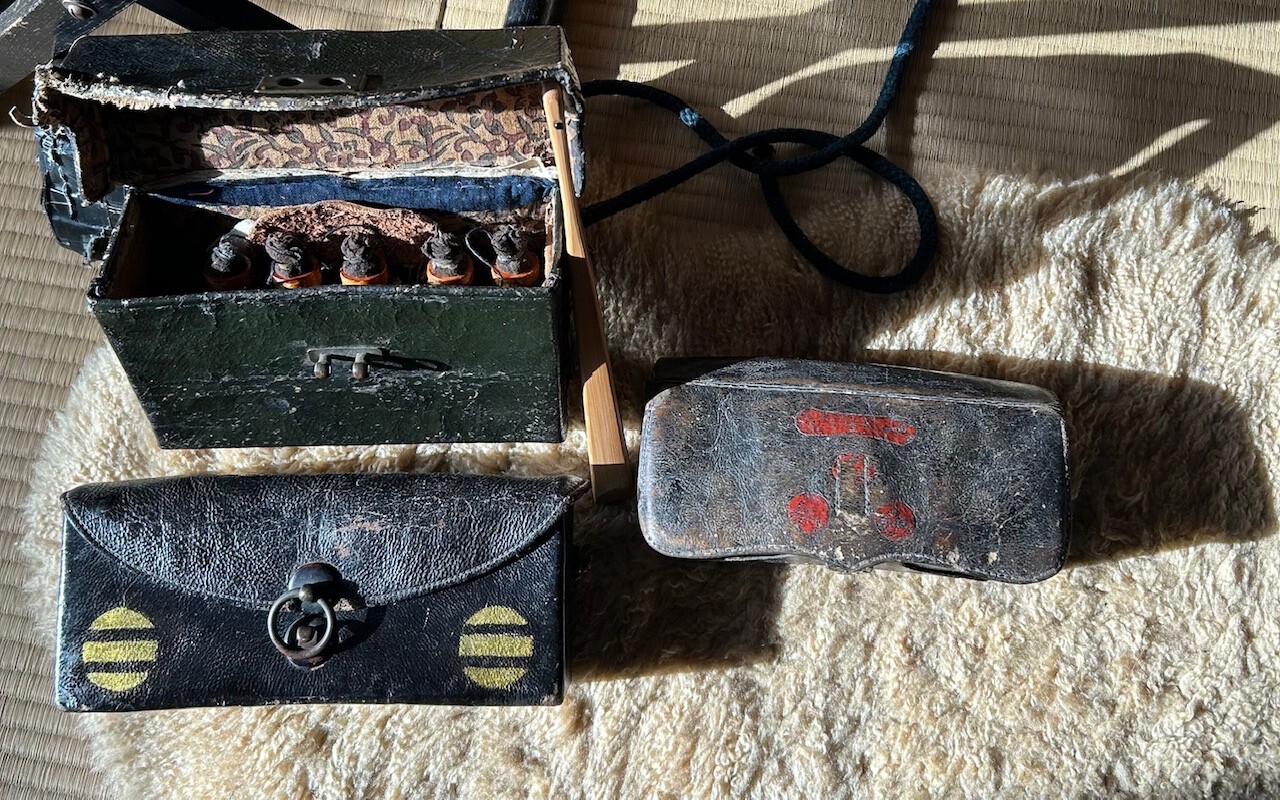
Of course it’s possible they are thinking of Dōran hip boxes or bags for hayago quick-loading tubes and gunner’s accessories, but these have 3D depth to them for the tools.
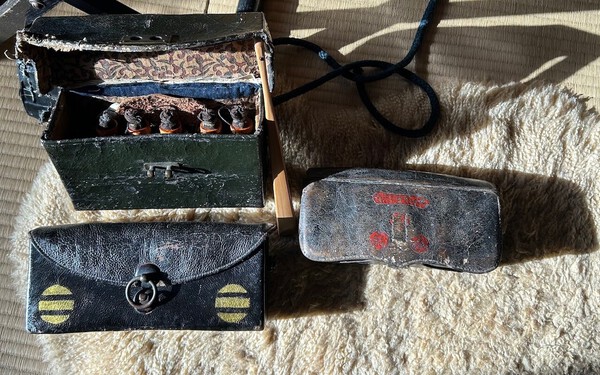 1 point
 -
Somehow I have lost the registration card for a precious wakizashi. In order to get a new one issued there are some hoops through which one has to jump. 1. Contact the education board of the prefecture where the original was issued. Tokyo in my case. Pray you have a copy of the original. Pray you originally registered yourself as the new owner within 20 days of purchase as the law stipulates. They send you the forms to fill out, which you send back to them. 2. In theory they then contact the education board where you live and request a sai-hakkō be issued at the next sitting of their committee, whenever, wherever. 3. You bring the blade at the agreed place and time for inspection, which usually takes a full morning, pay your money for a new card. ¥6,000(?). In order to get past step 1 above, however, they have requested that I go to Police Headquarters and file an official ‘lost’ notice and collect a number code. So I went to the Police station and was advised over the phone by the authorities that if there is a possibility that it’s at home and I’ve misplaced it, in a sword bag or down the side of a drawer, then they cannot issue such paperwork. They would need to know that it got lost out and about, going to the Togishi for example, and I would have to state when I last saw it. I do not want to involve the Togishi in this as ultimately it’s my responsibility and not his. He told me does not have it and I believe him. Feeling stuck between two branches of government, I took the bull by the horns and went to Police HQ with all my paperwork and the forms from Tokyo, and begged them to help me out. Finally they have agreed to issue the vital number for me! Happy Christmas! This has taken a month so far since I first phoned the Tokyo Board of Education. Now I fill in all the paperwork and send it off to Tokyo for a new attempt at Step One above!1 point
-
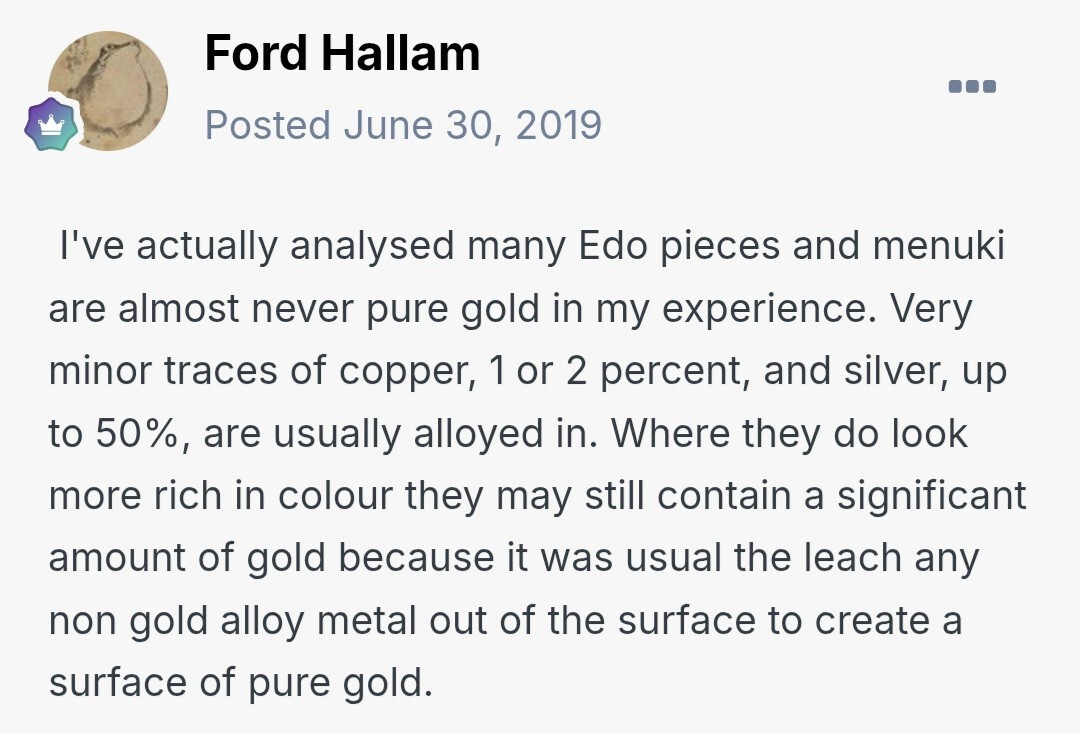
I agree, I am saying these aren't "solid gold" as the OP was told. From the late Ford Hallam himself:
 1 point
 -
I'm going to play devils advocate here, but I am seeing verdigris on these menuki. And it looks like copper showing through on the bottom edge on one of the back menuki of these thats scratched. Perhaps these are gild? Or low gold content 10kt or there abouts?


 1 point
 -
1 point
-
Google Lens translation on a phone works reasonably well for Japanese labels. Some of the literal transitions can sound like gibberish but with commonsense mental replacements (e.g. "nie" for "boiling", "kinsuji" for "gold lines", "Nanbokucho" for "Northern and southern courts") the general gist can be gleaned.1 point
-
I was there on November 4. November 3 (Monday) was Bunka no Hi, a holiday honoring art and culture. Museums are usually open on this day, but I was in Seki. I'm not sure what to think of Token World. The concept behind the presentation of the blades raises questions. Ninety-five percent of the labels are in Japanese, sometimes even 100%. The lighting is like Russian roulette. Some blades can be studied well, others not at all. For some, you need to be 1.85 meters tall or taller, while for others, you shouldn't be taller than 1.30 meters. And what the curators are thinking when they exhibit a blade that can't be seen at all because of the cloth covering the sword stand, or when they put a large sign in front of it, is a complete mystery to me.
.thumb.jpg.4f0669935e53e7e67324acd32db8388f.jpg) 1 point
1 point




















.jpg.772b368cefbbd08996b90fffe20333de.jpg)
This leaderboard is set to Johannesburg/GMT+02:00