
Leaderboard



Popular Content
Showing content with the highest reputation on 11/11/2025 in all areas
-
Showa22 has a Tadayoshi with the polisher mei, Yasukuni, if anyone needs this type of info. https://www.ebay.com/itm/365977509833? John C.
 4 points
 -
Hi, I can chime in. Prices for Tokuju swords climbed by ~25% compared to 2023, beating the depreciation of the yen against the USD/EUR. 30M, 35M, 38M, 60M, 60M, 35M, with one mumei Aoe outlier at 25M (up from 20M in 2023) The most expensive sword of the show was Jubi zaimei Kuniyuki tachi listed at 150M yen. Entry market and low Juyo felt stable in yen terms, so lower in USD/EUR terms. High potential Juyo were absent, due to the approaching Tokuju Shinsa and the dealers preferring to defer cashflow for a chance at increasing value. A mysterious influx of Nobuie tsuba, I counted seven - some have counted more. The Nobuie market enters oversupply and prices are expected to drop as a result. Overall, a combination of factor have deterred sellers from placing high-value pieces on the market, contributing to high prices. It's getting harder for collectors on the buy-side. Best, Hoshi4 points
-
I think there were plenty of very good and great swords there. What however was the issue was the overpricing premium for the top swords. Gone are the days of plenty of great swords at great prices as the dealers have now overcompensated for the depreciation of the yen.3 points
-
銘酒 Famous liquor (Probably imitating the old earthenware Yomeishu flasks found in Tomo.) Tomo-no-Ura is where Miyazaki Hayao wrote Ponyo. Exciting find!3 points
-
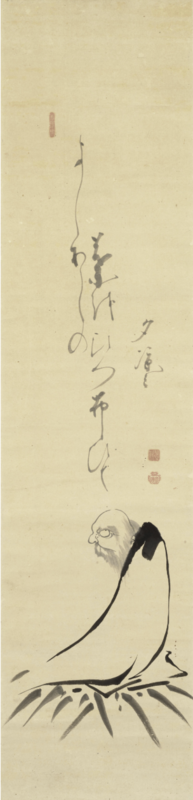
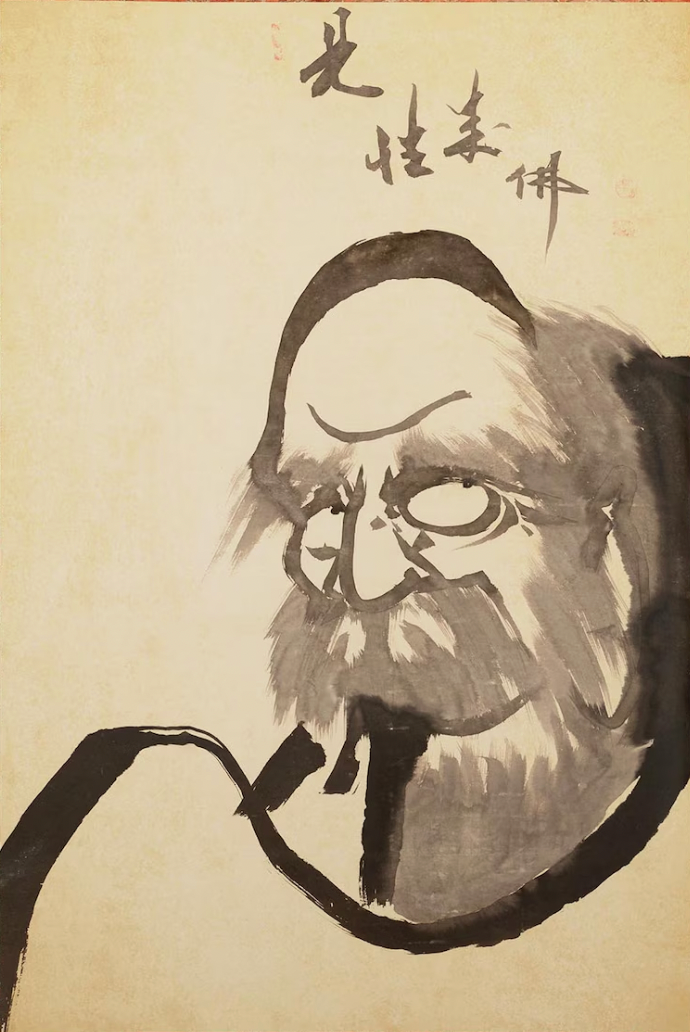
Suio Genro (遂翁元盧, 1717-1790) became a disciple of Hakuin Ekaku at age 30. After the death of his master, he took over the Shōinji Temple. His calligraphy and painting reflect his master's style and depictions, especially of Daruma. This example, a favorite in my collection, is a decided departure from the depiction of a somewhat comically "clueless" patriarch and has much of the fierceness of Fugai Ekun's depiction especially in the eyes, and the flying white strokes that define the body are more angular and powerful. This is a more commanding and intimidating visage, which appears to have been inspired by both masters. However, his calligraphic style owes much to Hakuin. The inscription is of the classic Zen teaching regarding the non-verbal transmission of the mind/heart from master to disciple, traditionally attributed to Daruma. The third and fourth lines frequently accompany the Daruma paintings of Hakuin and Yamaoka Tesshu. A special transmission outside the scriptures, (kyōge betsuden 教外別傳) not founded upon words and letters, (furyū monji 不立文字) [Zen] points directly to the human heart/mind, (jikishi ninshin 直指人心) see into your nature, become Buddha! (kenshō jōbutsu 見性成佛) What does it mean to have a non-verbal transmission? I have asked Kenneth Kushner Roshi (Chosei Zen Dojo, Madison, WI) about this in relation to koan study. Rather than the common understanding of koans as puzzles or riddles, they are most commonly a record of direct encounters between master and student in a question/answer format, collected and widely distributed for centuries as a way to bring the immediacy of the Zen teaching character of great masters into the practice of future generations. It is the closest we can know of having an actual conversation with important Zen masters and Patriachs of the foundational Ch'an Buddhist lineage. The Rinzai school places a greater emphasis on koan study than the Soto school. Kushner Roshi says that when a student provides the "answer" to an assigned koan in face-to-face meetings, it is not through an intellectual or clever verbal explanation that the teacher recognizes a penetration of the koan. Rather, the enlightenment experience of seeing to the nature of the self (kensho) is expressed through evidence of a transformative and often physical experience that is ineffable, but that this is readily apparent to the teacher. Having not embarked on koan study, it is difficult for me to describe what this experience is like. However, even if I were engaged in such study, it is likely that I would not be able to do much better by way of explanation. This is truly a "special transmission" that is "not founded upon words and letters." Fugai Ekun Yamaoka Tesshu Hakuin Ekaku


 2 points
 -
I bought a zaimei Hasebe Kuninobu tanto, although not at DTI per se. Sokendo sold it to me after DTI as it wasn't there. To build on what @Hoshi said, there was a wide range of asking prices, with pricing on higher end swords seemingly higher than last year. There were a couple of nice Juyo swords of interest to me that had asking prices of 15M and 18M, which I thought were substantially overpriced. But by Sunday they seemingly had sold as they were no longer on display. Of course, we don't know what price was actually negotiated. I saw some solid TokuHo and "lower" Juyo swords at decent prices--mumei Aoe with nice koshirae and the like. And some dealers were volunteering discounts of 10% on any expression of interest.2 points
-
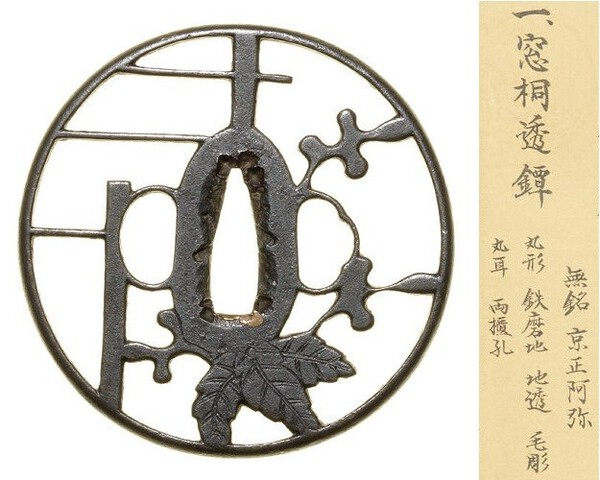
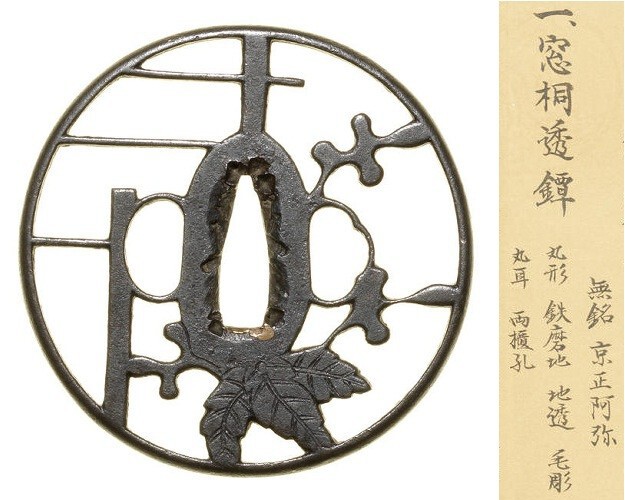
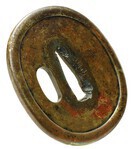
窓桐透 - mado kiri sukashi
 2 points
 -
I recently held one of these. They're much lighter than a real one. Everything seems a bit smaller. The habaki weighs less than half as much. The tuska feels far too small in the hand. The sword feels tinny. The seppa are complete rubbish and don't fit at all. They're purely decorative. The screw and the screw head is very weak.2 points
-
Hi Mal, Here are two pics of the tsuka, It all seems to fit just in a strange place. All the best

 2 points
 -
And yet another excellent article supplied and written by Malcolm E Cox in the downloads section. This one on sukashi iron tsuba, a nice primer on the subject for our tosogu fans. Thanks go out to @mecox yet again for his support and generocity.2 points
-
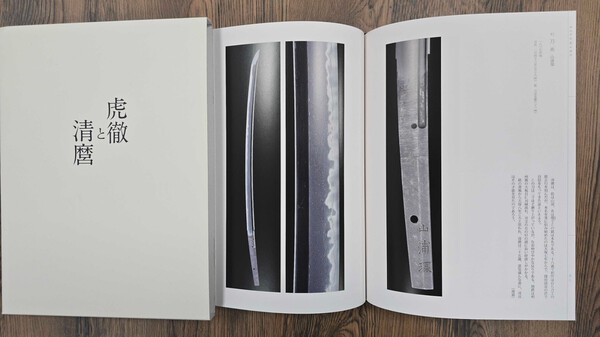
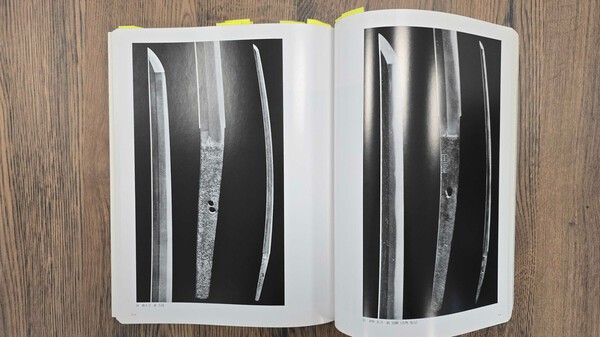
I have a few books for sale Gokaden no Tabi by Tanobe Michihiro: set of 3 books - Yamato Den, Yamashiro Den, Bizen Den ... 90 EUR Atsuta Jingu Kokuho/JuBun full size oshigata ... 40 EUR Supreme sword country Bizen ... 60 EUR Kotetsu and Kiyomaro ... 90 EUR Special exhibition "The Japanese sword Iron Craftsmanship and the Warrior Spirit" 1997 TNM ... 120 EUR Masamune no Sono Ichimon 1961 (undoubtedly the best Masamune exhibition) ... 160 EUR + shipping cost Sent from Slovakia





 1 point
 -
Sad that i didn't weight the sword for record. A genuine Typ95 feels massive in hand. It feels like a real weapon. This feels more like vegan meat or a non alcoholic beer.1 point
-
@Scogg Sam i made some pictures. This sword has been looking very good. But fake. This is one of those swords when you have it in hand you notice instead that it is fake. It feels wrong in hand. I think i shown it hear some time ago. It was good for learning holding in hands. I was sending the pictures Bruce i think. Notice the broken screw head because the material is very weak and thin. Look at the seppa and the habaki. Same weak sheet metal. Last part the fake stamps. The look sharp and not blury but fake.


 1 point
 -
Well that is not surprising re Berlin as Peter is first and foremost an armour collector, who later on diversified into swords and tosogu. He has a great collection and the digital displays for the Rai blades for instance (with the 5?6?m magnification of the blades) are exceptional. One can almost study the micro granules of the metal matrix even…1 point
-
Ah, yes, sorry I misunderstood. Thanks for clearing that up. Ed1 point
-
Those are great observations Chris, thank you. My focus has been cataloging the real ones, but I have also been putting together a "fake serial number list" with notes and features. Details like you describe are great things to include. All the best, -Sam1 point
-
Thats a little sad to hear given the quality of the blades and katchu, the Nagoya Token World has accumulated. I have to say the Samurai Museum in central Berlin was not great either for studying blades. The angles were less than ideal and the lighting failed to illuminate the jihada and hataraki adequately, especially for the blades in the cabinets along the wall. Oddly the central display cabinet was quite good in comparison and it was easy the see the activity and get close to the blade to observe the detail. Given the obvious time and effort put into the general display design for armour, nihonto seemed overlooked.1 point
-
Thank you for posting the link,while it remains an object that is unattainable I very much enjoyed reading its history and the images of a wonderful blade. charles.1 point
-
兼定 - Kanesada Showa 18, 10th month (October 1943)1 point
-
Google Maps and Google Lens are essential survival tools in Japan. Fortunately, I know a little Japanese and can at least read the hiragana transcriptions quite well if I am unfamiliar with the kanji. However, at some point, one gets tired of holding one's smartphone up to every sign. For smaller museums and exhibitions, this is completely understandable. But for a sword museum of this size and prestige, it's very disappointing, especially since it advertises itself as a new tourist hotspot in Nagoya. But then again, Nagoya isn't really on the list of Western tourists. I only saw Japanese and a few Chinese people at the museum that day. It was pretty empty.1 point
-
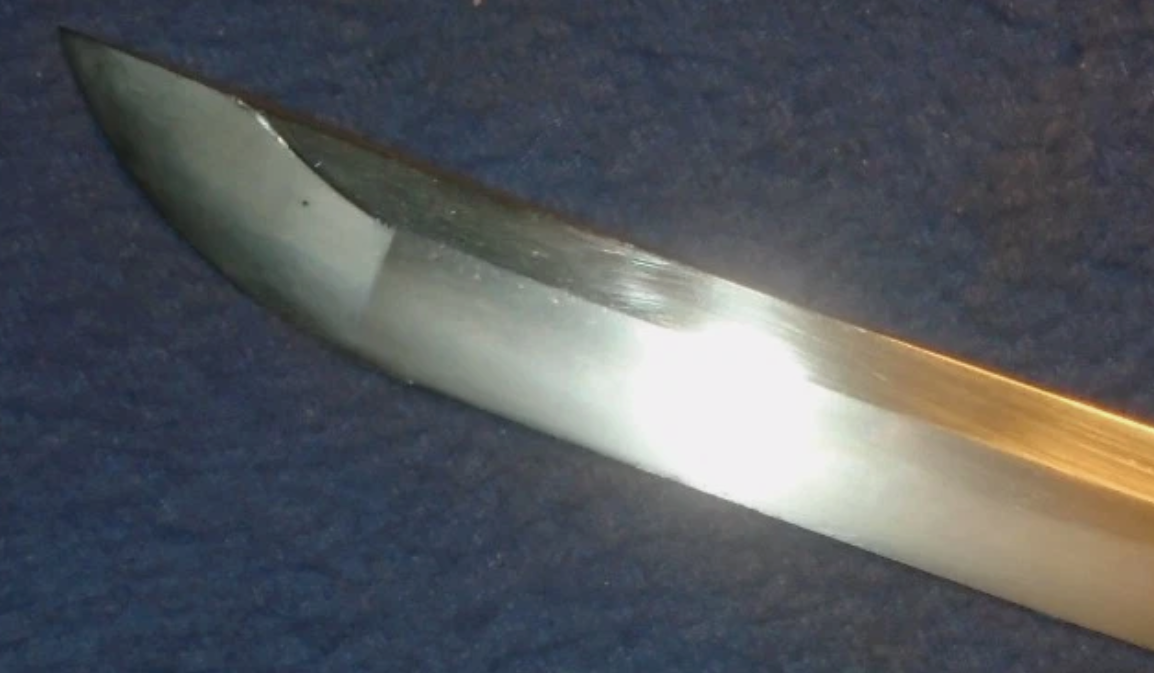
Yasurime and the lack of taper shows that this sword is not from Kanbun era.1 point
-
Hamon, is choji midare mixed with gunome (look at oshigata). As i always say we see nothing on pictures only the hadori.1 point
-
I was there on November 4. November 3 (Monday) was Bunka no Hi, a holiday honoring art and culture. Museums are usually open on this day, but I was in Seki. I'm not sure what to think of Token World. The concept behind the presentation of the blades raises questions. Ninety-five percent of the labels are in Japanese, sometimes even 100%. The lighting is like Russian roulette. Some blades can be studied well, others not at all. For some, you need to be 1.85 meters tall or taller, while for others, you shouldn't be taller than 1.30 meters. And what the curators are thinking when they exhibit a blade that can't be seen at all because of the cloth covering the sword stand, or when they put a large sign in front of it, is a complete mystery to me.
.thumb.jpg.4f0669935e53e7e67324acd32db8388f.jpg) 1 point
1 point -
Those badly polished Showa22 blades often hurt my eyes. I don't know who polished that swords for him.
 1 point
 -
Could I Please get a translation of this Ojime bead signature? Thanks in advance , Howard Dennis
 1 point
 -
I think one of the big giveaways that this is gimei is in the fingers on the fuchi. Granted this is no doubt even smaller than the pictures make it look, fine details like fingers and hands are often a good way to tell the overall quality of works and the fingers here seem to lack the finesse of a master craftsman. Not sure I agree with Kirill either, overall I do not get the Hamano school vibe from these pieces. I can see where this idea has come from as both the Hamano and Mito schools were influenced by the earlier Nara and Goto schools making them stylistically similar. Both schools were known for using iroe takazogan like in these examples on a shibuichi, shakudo or in this case an iron base. One of the characteristic elements of Hamano work that you would often see in Hamano pieces and which you wouldn't generally see in Mito school work are expressive gold eyes. Mito work generally features thinner eyes more characteristic of the Nara school which I think this set (and the higher quality tsuba example) align with. You see these eyes in some late Hamano school pieces too so this is by no means conclusive one way or the other, but it does give some indication. Mito work is also known for its "soft" style whereas Hamano school work often includes more powerful, striking contrasts. The colour combinations featured in the kashira of this set give off more of a Mito vibe to me as the parasol (specifically the colour/metal choice) seems to soften the contrast of the mixed-metal design. On the flip side, the contrast between iron and gold on the robe of what I presume is a court minister(?) in the fuchi does resemble the type of takazogan contrast you would see in both Mito and Hamano school work, so it is hard to definitively rule one way or the other. Both schools also feature takanikubori prominently like that seen in this set.1 point
-
Noshu ju Kaneshige A day in Showa 19, 2nd month heres a link to another star stamped sword by this smith. Kaneshige1 point
-
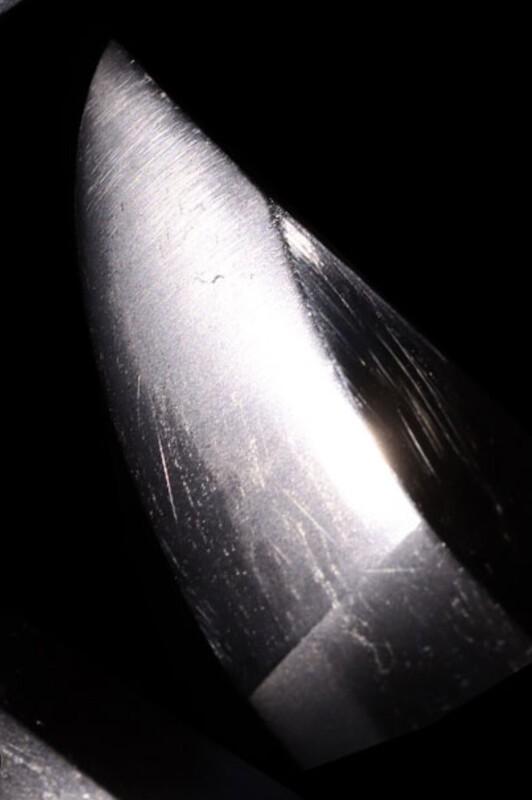
Just sharing another great work by Woody Hall on a TokuHo Ko-Kongo Hyoe blade This blade was important to me and I was very skeptical if this would be worth a shiage with how rough it came from Aoi but he has again exceeded all expectaions above an beyond. Cannot recommend him enough to anyone on the fence about restoring their blade. Pretty wild what a great togishi can do with minimal work.
 1 point
 -
Signed Sekijoken Taizan Motozane https://www.sothebys.com/en/buy/auction/2023/the-samurai-Japanese-arms-and-armour/a-tsuba-signed-sekijoken-taizan-motozane-and-kao

 1 point
 -
A more famous and high-quality work by Hagiya Katsuhira

 1 point
 -
Rai Kunizane juyo token .. sorry coz he's my main target this year lol
 1 point
 -
Well,since you're quoting me. Here are four oshigata - two first generation and two second generation. Compare the signatures closely. I was taught if you can find four anomalies it is highly questionable. Look at your temper line do you see anything like what is illustrated? especially at the tip? Looking at your photo the grain (jigane) looks rough and tired, not in keeping with this master. I'm guessing they (the fakers) saw the shape of your tang and thought "close enough, lets put Kinmichi on this one..." -t


 1 point













.jpg.772b368cefbbd08996b90fffe20333de.jpg)


.thumb.png.4c5df79fec171b2dc4a23af38e280a4d.png)




This leaderboard is set to Johannesburg/GMT+02:00