
Leaderboard


Popular Content
Showing content with the highest reputation on 08/23/2025 in all areas
-
What follows is simply a different view on how and why to get into this collecting field. It is based on my experience and is purely my opinion. Just some random musings. 1.Before you dive in understand how the market is structured (it’s exactly the same as any other collecting market) Imagine a pyramid, wide at the base, pointed at the top. At the base there are a great many collectors interested in a wide range of swords for many different personal and aspirational reasons. These will usually be the more modestly priced swords but that does NOT MEAN THEY ARE CRAP. As you gradually look higher up the marketplace pyramid you will find the numerical customer base quickly reduces the higher you ascend and as the price of the swords increases. At the top of the pyramid you will find a vastly reduced customer base able (and willing) to spend large sums of money on the rarest of swords. This is pretty obvious stuff but the new collector should now start to think about where they might envisage themselves ending up. What are their aspirations (because they will vary enormously) What are they aiming for? Above all, what is realistic. 2. Ask yourself why are you joining this hobby? What do you want to collect because there is a great variety…..and remember it’s your decision, no-one should attempt to tell you what to do. This is your collection, your hobby. Military stuff? Just blades ….. Old swords, newer swords, modern swords? Complete swords (ie with koshirae that have not been cobbled together or made recently) Just long swords? just short swords? Just something to hang on the wall? How much money have I got that I can expose to risk. Do I want a varied collection or just one sword? Would I rather change my car? 3. Basic knowledge needed (can be gleaned from numerous books) How to spot a fake or replica How are swords actually forged, hardened and polished What flaws and problems in the blade will be encountered. How to recognise them and which are serious 4. Take a look at the marketplace in action…..sword prices in various sectors…auctions, dealers, forums, Japan, …..easily achieved on the internet. Within my target market what might fit within my budget. 5. Anyone around nearby that I can talk to….clubs, shows, dealers, internet forums. How do I network and build contacts? 1-5 above should have caused some forethought and most importantly a reality check and maybe the formulation of some sort of plan together with an understanding of the basics of swords. It need only take a few months not years. OK….. now what? Well a few facts to keep in mind….. It is unwise to buy swords for investment purposes. The higher the price generally the greater the risk. You will not buy an “important sword” for a few thousand but you can certainly buy acceptable quality and interesting examples (and don’t be misled by those that sneer and deride lower valued pieces) If buying from a dealer understand and respect that it is how he makes his living (or perhaps partially) and therefore he will have his profit built in. On very expensive swords that profit could be substantial. Many dealers are highly respectable and experts in their field. Some are not. Beware eBay and all similar auction sites. If a sword is available on the internet from a dealer in Japan it is usually because no one in Japan wants to buy it at that price. (Worth just thinking about that is) Always try to actually handle a sword before you buy it. At some point you might want to quit the hobby or raise or lower your sights. Be prepared to change. You will find out if this rabbit warren really is for you. Ultimately…..spend your money on what makes you happy and try not to make too many mistakes along the way (we all made mistakes, some more than others apparently🙂🙂🙂☹️) It’s a journey and an adventure, have some fun…..remember what you’ve decided and go buy something.13 points
-
I think Rayhans advice that has been discussed is very good for high level sword collecting. Some wording he has used might be bit provocative and ticking people off. However the issue might be that there are different levels of collecting. To me it has seemed in recent threads that it is difficult for people of varying collecting levels see eye to eye. What is seen as a no go in high level collecting could be perfectly accessible sword in lower level of collecting. For a brain teaser people can think 15 Kongōbyōe swords vs. Mumei Tokubetsu Jūyō Rai Kunitoshi. I know high level collectors would pick the TJ Rai Kunitoshi and I would choose 15 Kongōbyōe, it is just a matter what you feel is correct to your personal collection. Life would be boring if everyone would just want to buy the same swords.8 points
-
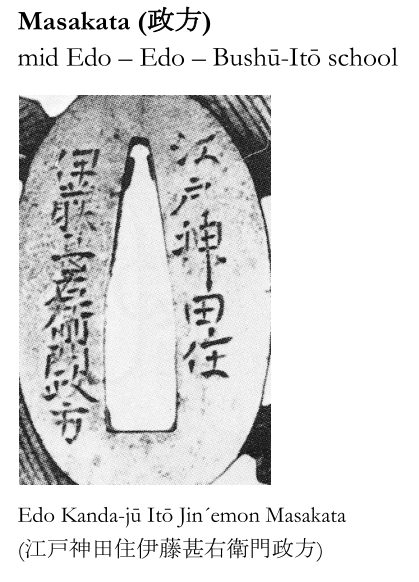
Maybe, 江戸神田住 - Edo Kanda ju 政方 - Masakata6 points
-
Awesome post, Colin! Clear guidance for everyone. I think it's also important to remember that as you climb the pyramid, there's a certain place where some pieces can be difficult to move/sell/trade. It's kind of the upper upper middle/lower top tier, kind of a slow zone, where blades are too expensive for most collectors but not in the realm to entice top-end connoisseurs. Reminds me of what a realtor (estate agent) told me recently about house prices: Those houses over $4m and those under $150k move quickly. Everything in between sits around longer, waiting for the right buyer and sometimes it can be a loooong wait. So, like Colin says, buy what makes you happy, always buy the best you can at your budget, and you are unlikely to go wrong. But at the same time, remember that your taste might change over time as you learn and see more, or something might suddenly come up where you might need to get your money out. So my caveat is the more rarified or narrow your taste - certain schools, blades in rough condition, smaller blades - the fewer the opportunities might be when it comes to cash out or trade up. So, finding others who like what you like, your community if you will, is a great way to not only hedge against that, but it's a better way to learn, share and enjoy even more!4 points
-
There's some truth in that, but to draw from an analogy, consider the car collecting world. There are some, only interested in rare Ferraris, spending millions, and wouldn't even glance at say, a classic Japanese car. For me, I appreciate a Ferrari 250 GTO, and a Mitsubishi GTO, with approximately the same level of interest. I wouldn't buy the Ferrari, because it's well outside of my price range. My argument is, if you're interest isn't wider, perhaps a classic Mini, Lancia Stratos, MGB, Bugatti Veyron, Lotus Elan etc. you're not really a car guy, you'd be well, a snob. That's not saying you have to like everything, but (as with Nihonto), there's different styles, eras, workmanship, showmanship, utility, technology, state of preservation and fame / prestige and ultimately, monetary value. In both fields of collecting, people are well aware of the wallets required to collect in the different areas, but the disparaging/dismissive remarks I often see on this forum sometimes only serves to spoil someone's enjoyment of where they've chosen to collect. Personally, I'm fortunate enough that Juyo blades are attainable - many can't afford that, many can afford much more. But whether you show me your Gunto or Sadamune, I appreciate them for what they are and enjoy people's knowledge and enthusiasm about their collections - and don't need any put downs.4 points
-
Reading the posts of Jacques in here reminds me quite a lot to a thread of mine, where he was very serious about naming the blade gimei a few timesand pointing out minimal mei differences he claimed ... Well, NBTHK papered it with TH . So don't take his posts too serious if others give it chances, just go and find out if it papers.4 points
-
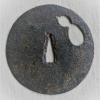
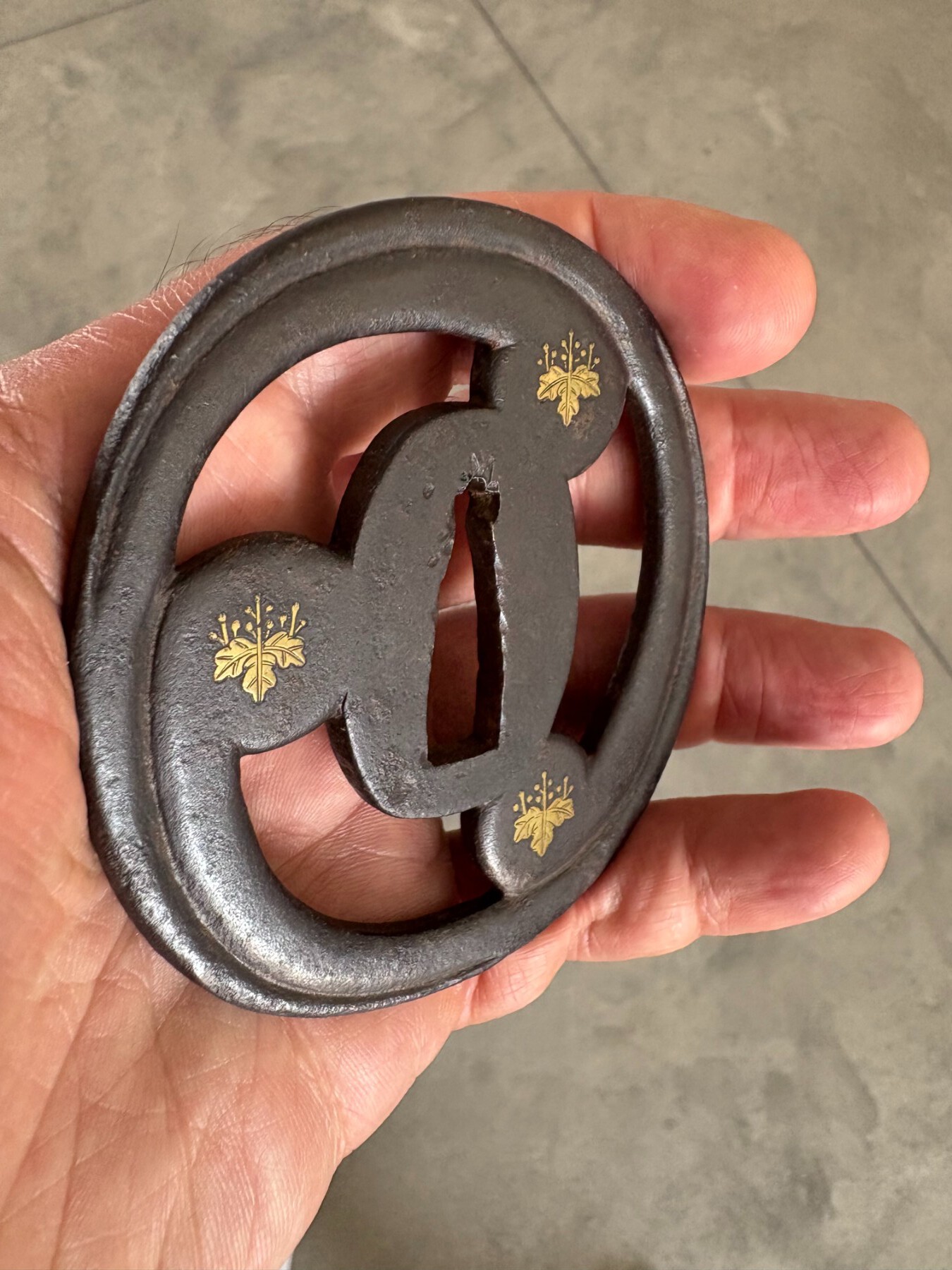
That does seem a bit unusual. Wonder if it was someone testing something with the gold overlay before they went ahead and completed the job. just a guess. Ps, about Bushu. That's not a fact, that's just my observation and will tell you why. The style with the outer rim and two ana seem to fit. The way the trees form around the ana and the way there are real thick like trunks seems to fit. The use of gold overlay is consistent with the school. I like tsuba with trees so they catch me eye. Thats about my knowledge. I find Bushu tsuba to be very in touch with nature, in general. Though i cant say if im correct or not as im not really a serious tsuba authority lol Heres my two Bushu, notice the same style with rim and ana with the nature, one has a touch of gold. (weird picture, not that shiny in hand)
 4 points
 -
I really like that tsuba but It has strange marks and golden color too. Amy thoughts?
 3 points
 -
The signature seems consistent..
 3 points
 -
Just for the record, I used to know John Anderson, who will be well known to all Japanese armour lovers and collectors. And when showing John a suji bachi that I owned, John said that the helmet lining, I forget the name of it as this was forty years back, was only glued in place and that what he did, and then did with my permission, was to gently pull away the lining at the mabixashi a bit to gain access to the inside of the hachi. We could then read the mei, which in that particular case was Myochin Ujiiye and was dated Eisho 14th year (1518?). John then glued the lining in place again using Copydex, so that it was firm, but could easily be removed if desired.3 points
-
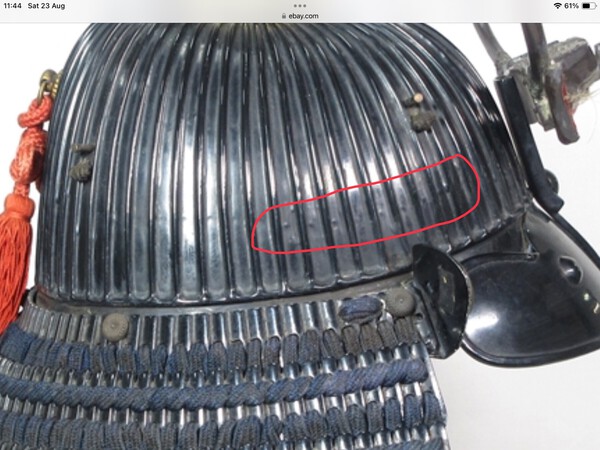
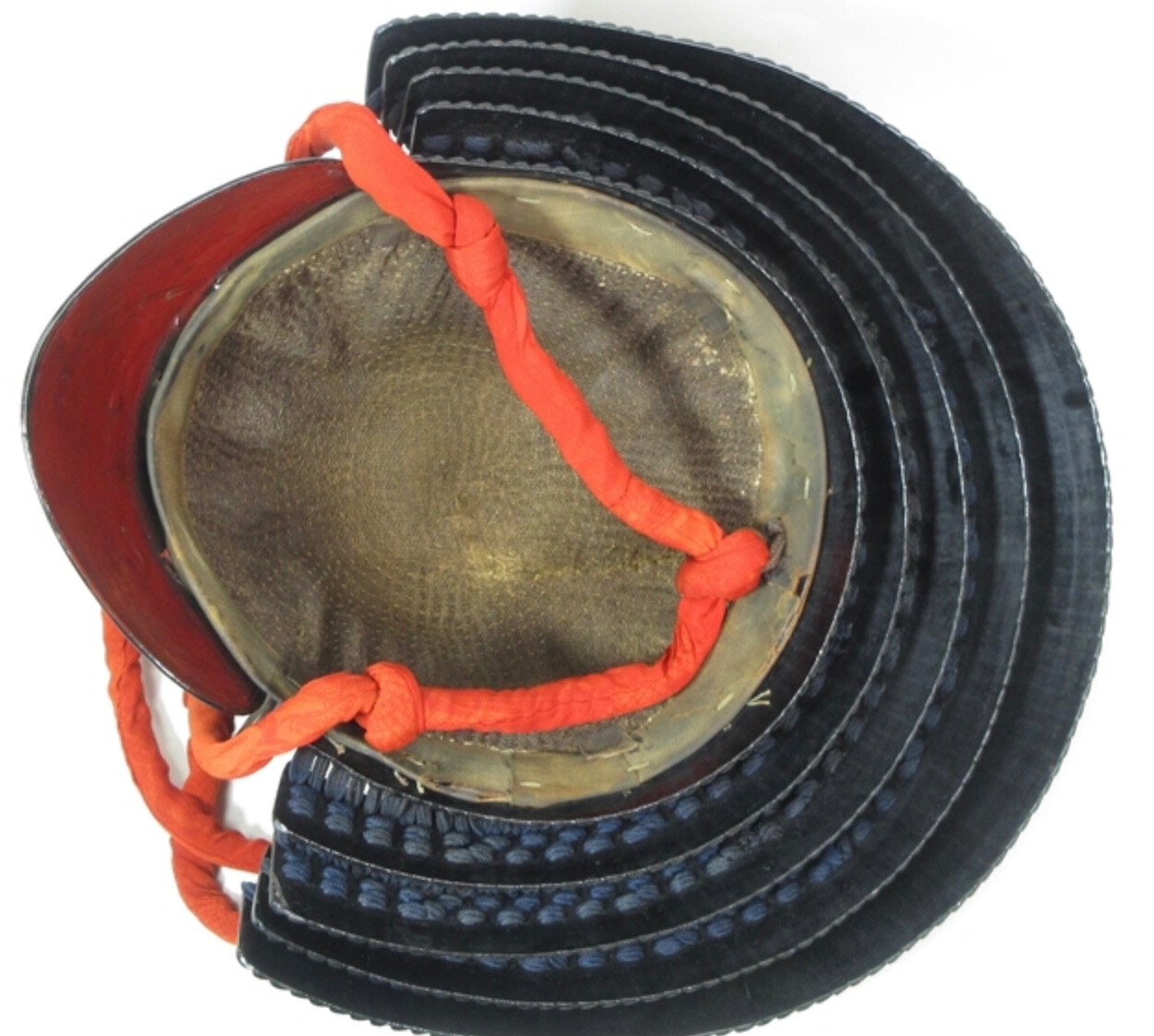
To add another image…..are those rivet heads lurking under the lacquer? Does that suggest a genuine multi-plate construction?
 3 points
 -
G'day Jacques, The Gassan school is famous for its ayasugi hada. Sadayoshi and Sadakazu are credited with rediscovering it, but it was Sadakatsu who refined it to the beautiful uniformity we expect to see today. If we group Sadakazu and Sadakatsu together, I would argue that it isn't Ayasugi hada so much that unites them, but rather, tight, uniform, masame hada. Ayasugi hada never dominated Sadakazu's work, but it is the most common hada for Sadakatsu's Showa period work. Each of these smiths forged blades in all sorts of styles, with some dominating different periods of their working lives, but in general terms, I would describe their work as very controlled, with ko-nie and nioi. Hope this helps. Cheers, Bryce3 points
-
Let's not forget that the TSUBAKO of the late EDO JIDAI were masters of their craft and well able to forge very good TSUBA! In our TSUBA forging workshop this summer the participants experienced how much work is involved to just make a TSUBA blank. From there to a well balanced functional TSUBA with a good size, even thickness and appealing surface texture is still quite a jump. And then imagining the long experience, commitment and talent that are necessary to create a real masterpiece leads to great respect for the old masters and their work!3 points
-
I took that to mean there are no rules to dictate your motivation for owning a Nihonto.2 points
-
Good point, yes, definitely some later adjustments to what may well be an old hachi bowl underneath.2 points
-
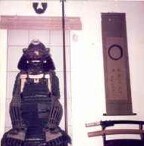
Vocab usage here, wearing my translator’s hat. 三光鋲 Sankōbyō, (or Sankō no byō), are the three ‘shining’ rivets holding on the mabisashi (and centrally the harai-daté dai), named it is said to represent three heavenly bodies, i.e. the sun, the moon and the stars. Personally speaking, on balance I like the package above, but it is not easy to judge, especially from photos. The hachimanza may be newer, and the suemon on the fukikaeshi look slightly too large, as if a later addition.(?) No big deal though.2 points
-
These two smiths have a particular way of engraving certain tagane (they are vertical). I ask which ones and why.2 points
-
Probably I am a bit thick, but Jacques, could you please spell out your question? In the jumble of Gassan signatures above I can see many similarities, and many differences. Your question is heavily suggestive, and the pain is unbearable, but I am not sure what exactly you are asking…2 points
-
The sankō no byō is the rivet in the centre of the mabezashi (peak), IIRC, holding the Oharaidate (crest holder). it seems extremely high in this instance, and oddly placed right on the join of the koshimaki. Uwe, does the laquer where the suji meet the koshimaki seem a bit crude for Edo work?2 points
-
Even then, it's entirely subjective. If someone likes the form of a straighter sword, that's fine - it's fashion, not skill. Later shinshinto produced even straighter swords than Kanbun-era shinto (when kendo became more popular). A rule about "don't collect them" is frankly, nonsense. Just be aware of the demand (and therefore market value) for anything you buy. Again, as above, if anyone would like to offload their out-of-fashion, not to be collected Kotetsu, I'll be happy to accept them. 😂2 points
-
Yamaoka Tesshu (山岡 鉄舟), 1836-1888. Translation (left scroll): John Stevens, The Zen Calligraphy and Painting of Yamaoka Tesshu, 2001. Omae hyaku made washa, Kujyuku made, Tomo ni shiraga no haeru made, Tesshu koho sho. You'll reach one hundred, I'll reach ninety-nine, As our hair turns white together, Written by Tesshu koho. This is a wonderful interpretation of Takasago, a famous Noh play about an old couple. The pair lived for decades in connubial bliss even as they were located in separate villages, and died at a great old age. With just a few brushstrokes, Tesshu has created two elderly lovers who enjoy quiet contentment together. The husband offers to go first, but the couple, as close in death as in life, will likely pass away within a few days of each other. This kind of Zenga served as good luck charm for married couples. The particular style of depicting Takasago appears to have originated with Tesshu and thereafter become a standard theme in Zenga. I own two different versions of this beloved subject matter that Yamaoka brushed throughout his most productive period. The one on the left is fairly short and narrow in scale and is a nice example of how he tended to execute this composition. It was likely brushed in 1885. The one on the right, a very large work, is the only example that I have seen in which Yamaoka brushes the last character differently (hiragana?) rather than kanji and the couple appears to be standing rather than sitting as in all other examples. I'm also not certain that the poem is worded the same as in all of his other versions. Certainly the phrasing is different. The ink is also only thinly and lightly applied to outline the bodies of the standing couple. The rendering is more childlike, almost cartoonish. Perhaps this reflects a declining physical state as he neared his death in 1888 at age 52 from stomach cancer.

 2 points
 -
Nunome-zogan, [gold overlay] very nice Ume/ategane with "cat scratch" decoration - there are several styles and they all have Japanese names [I hope others can clarify the type]. Very nice genuine piece.2 points
-
Another one from the same seller as my other post. This one labeled as Navy NCO sword. https://www.ebay.com/itm/236271429071? For those learning, note the badly punched dimples, the fake Tokyo mark, the faint serial number on the habaki, the uneven flat area on the tsuba, and the writing on the blade. John C.
 2 points
 -
MY advice in life is you learn faster from making mistakes then if you made none2 points
-
I think any koto you buy under X dollars will have something wrong with it. If X is 10k USD the choice is to accept what its missing: half of the original blade, half of the original condition, was problematic to begin with, etc.. Any blade teaches you something. If I would have all the money ever spent back, I would buy just a few good swords and avoid many mistakes. But I would not learn as much as I had.2 points
-
On the right Edo Kanda ju…I think, the signature on the left is too vague for me.2 points
-
Rayhan: Wow, that's quite the journey! Thanks so much for illuminating the goals you set, and the problems they led to - it's extremely useful. I do think that those specific goals - looking to create a "complete" collection in some specific way, are perhaps unusual, so many others will make different mistakes. In addition to your general point - study deeply before you start buying, I would add "study deeply things that you are particularly attracted to, and know why you are attracted to them.", as well as "identify your own goals clearly, and understand what they imply". Based on that guidance, I think "save more, so that you can buy a really good example of what you love, and reduce the liklihood of losing money on it" is often, but not always, true. Understanding whether not losing money is important to you, and whether more expensive blades will better meet your goals, is a critical part of the journey. If the answer is "There's a $2,000 blade that just speaks to me, and I don't care how anyone else values it", then that's also a perfectly appropriate way to buy and cherish nihonto. Every one of these blades is unique, has its own story that we will mostly never know, and was made by a master craftsman, so every one is worthy of being appreciated and cherished!2 points
-
Hi Bobby, I believe the majority of these copies were 19th-century products, created out of the revivalist spirit that percolated through the Bakumatsu Period. At this time, there was a great nostalgia for the outstanding tsuba of times gone by, especially those of the Momoyama and early-Edo Periods. This is why we see many "homage" works copying the brilliant Nobuiye men of Momoyama, as well as of Yamakichibei, and then also Yagyu. The great father and son Norisuke tsubako of Owari Province -- who were excellent makers of iron tsuba in their own right -- are famous for their efforts to create worthy copies of Yamakichibei and Nobuiye. However, despite their dedication and skills, their works are a far cry from the genuine article, and they were among the very best at making these utsushi. This all goes to show that genius is difficult (read impossible) to replicate convincingly. Real is real, and if one wants that experience -- of seeing and appreciating and "bonding" with that genius, one must have the works of these early masters in hand. Photographs, even the best, simply cannot capture their magic.2 points
-
This is a good point, would it have come to where I am now if not for the 100? When i finally started working and earning i set out at first on a path of accumulating as many Nihonto from all the roads. As you know in Nihonto we speak of the roads like Tosando, Tokaido, Sanindo, etc and I thought i could master the Nihonto if I saw a single sword from each kaji along these roads, that became a mammoth task and I eneded up with a very flawed collection because each road or even each of the Gokaden is spread across a millenia and have different representatives. Then I decided to focus on certain districs within the gokaden but to do it for each district across their respective lineages. So you can imagine again a huge task and one that saw me buying single swords from Kamakura period to Shinshinto for Bizen for example. It is at this point I met a group of collectors who helped me understand that im all over the place. Without direction and study and focus I would not achieve what I had originally wanted. They explained that take Hizen, the Kaji in Hizen did everything from Soshu to Hizen hada to Masame, etc but their roots lay in the Heian and Kamakura periods. They asked what do you really want to know about Hizen that studying the original kamakura kaji cannot teach? And this was true of course. They introduced me to study and to observation on swords I would not be able to afford at the time because I had exhausted my budget. Until I had settled on what I wanted to study then they helped me to understand how to whittle down my collection. I could see by then that I had spent a decade plus collection only what I could get my hands on and not what was really representatives from the various schools, I was doing a means to an end style of accumulating and not collecting. Having a community can really save people in this jungle of Nihonto. There is a reason a society is led by senior members vs inexperienced. The swords I have today are still from that original batch, much less but they are the ones that fall into my road, the road I want to discover in Nihonto. And having streamlined im very content reading and learning and letting myself come to blades that fit my path rather than just accumulating or filling a slot. The collection also includes swords from more recent purchases that again fall into my road. I can say at one point I had 15 Kongo Hyoe swords from the inception of the school to its demise many centuries later but it is such a small representation of their work and very ignorant of me to have thought I was doing justice to them as a school. By whittling down the collection i also got to understand what was quality, by going to study sessions with people who had excellent pieces who also studied swords we could never hope to own, we get closer to our hearts content. We begin to see. I was shown a Masamune and TJuyo Chogi back to back as an example and those are moments you get to really study and memorise what you're looking at. Will I ever own one, no, would i have been able if I hadn't spent unwisely, maybe and it would be a single sword collection and I would be content. So, the craziness of accumulating led me to waste money. Would I have been here if not for that, i think if I had listened very early on to the people screaming at me to focus and study first, yes I would be here inevitably. You must understand that selling of the 100 was basically hitting a complete reset button. I started from scratch. My only wish for new collectors is, don't waste by rushing. Study and see and then buy whatever you like after you know your feet are firmly on the path you want to walk. Don't get duped by dealers of low end items. Respect yourself and your intelligence and your hard earned income and buy quality, it will serve you well in the future if you need to sell. Will there be mistakes along the way, yes, but they should not be the kind that makes you reset 10 plus years of hard work and studious love of Nihonto, that is a very arduous and painful path.2 points
-
I would advise the new collector, once they narrow down what it is they want to collect, they focus as much energy and study on spotting issues/fakes as much as studying what is good. There are so many issues that can occur with blades that make a beautiful blade not worth the asking price. A gorgeous blade with a small vertical crack in the ha can have a fatal flaw. Some mistakes I have made: buying a blade that had beautiful pictures of the hamon - except there was about 3 inches in the middle of the blade missing from the pictures, which I didn't notice at the time. I found out why when I got the blade and there were chips in that spot. Look at the pictures CAREFULLY. I have blindly trusted "approved sellers" and found undisclosed issues after receiving the blade. Study the blade in detail. Don't assume that the blade is as described just because the seller is "approved." A little knowledge is dangerous. After doing some thorough research, I thought I knew enough to purchase a certain blade. Received the blade and found something was not correct. Had I chosen the blade first, THEN did the research on that particular blade before purchasing, I may have noticed that it wasn't correct. It takes a lot of research to figure out how many potential issues a blade can have. John C.1 point
-
@tlzkaasen Is it true you relisted this sword for sale on eBay? I have no problem with reselling for any purpose, but I think it is important not to mislead anyone with the description. https://www.ebay.com/itm/177353001828?itmmeta=01K3BF35FS01GSDFRHX3KPNC7C&hash=item294b100b64&LH_Auction=1 The sword is a Wakizashi, NOT a katana, and some other remarks in your description are not true and should be amended to avoid misleading a potential buyer. You mention: Blade Length (Nagasa): 77.0 cm (~30.3 inches) This is not true, nagasa refers to the cutting edge of the blade, which is noted on the NBTHK certificate as: 1 shaku 9 sun 8 or 59.998356cm. I personally love the Mihara school, and I wish you the best of luck on the sale. Greetings, Lex1 point
-
Time to refresh topic https://ebay.us/m/3nQUyu

 1 point
 -
If your talking about the real straight kind of Kanbun sugata blades with 0.5cm sori then i kind of understand the statement about not buying Kanbun. Saying that though, i remember Darcy saying one of his first blades was of that type and he liked the straighter blades at that time. Ive had one and did like it, some people really like them. Not all blades made during that time were of that sugata, many just have typical sori. On a side note and kind of back tracking. There are obviously many people with deep pockets. In the UK you would only have to to look at one certain dealer to realise there are folks with more money than sense. Earlier, i was talking about what i have seen with the sales on the forum and opinion formed by talking with folks here. I find for most folks there are financial boundaries. Lets face it, great examples are too expensive for many so become unobtainable. Hence why i think it seems Shinshinto and Gendai seem to have become more popular in recent years.1 point
-
1 point
-
1 point
-
G'day Jacques, I don't understand your question. You are asking me what characteristics they have in common, when they have so many that most people can't tell their blades apart? Is this a language thing? Is there going to be a punchline? Is this like "Two Gassan smiths walk into a bar .........". Adam, that looks like a nice blade. It is a pity that Eric doesn't post some better photos of the hada and hamon. Cheers, Bryce1 point
-
There are no better SAGEO than those from Kiryudo... Silk Sageo,Sazanami-Weaving Single color Iaido Japanese swords Katana – Kiryudo/桐生堂1 point
-
Koshirae Parts - Namikawa Heibei Co Ltd1 point
-
Yes 🤓 There are several oddities leading me to this assumption. At first have look at the strange placement of the sankō no byō 😉1 point
-
Hi, While I´m nowhere near fluent and still just a beginner, I attended Japanese basic classes at my University. And now, while we are on semester break, I just work through the books while using Anki to learn/refresh Kanji.1 point
-
@uwe Thanks for looking Uwe. Further images……. Just looks too good to be true??


 1 point
 -
This was my first gunto. Stainless Type 97 with brown tassel. The leather is pretty dried out, but I've been using Renapur on it and it seems to be working.
 1 point
 -
Im not making it about you, you already mentioned your purchases so i was replying with some reality. As said before, its a world of instant gratification. Not saying all people are that way, there are the sensible ones that appear to want to study a bit first, though from what i have seen, most just dive in. The first buy is usually a curiosity/impulse buy, saving up more money is the last thing on their minds. To be in the frame of mind to want to save up for something better, one most first have experience, that includes good and bad experiences, learning what one likes etc. You can tell folks all this advice until your blue in the face and it is good of you to care. though some will and some wont listen, the latter seeming the more common occurrence. Personally, i think there is something special in many a cheap sword, something of real interest that makes them stand out. I think its too easy to become overly obsessed about staying on track with ones preferences, in a way it would take the fun out of it for me. Mistakes, whatever, all part of the journey should they jump on board. Mistakes are opportunities to learn and grow (Marcus Aurelius) We are all different though and all have our own ways, horses for courses.1 point
-
Interesting philosophical question aside from "what is a good sword?" we now moved to "what is a good collection?". Is it wrong to collect from all over the place? What's wrong with collecting diversity, rather than everything from one area or period? Perhaps most importantly, for whom are you building a collection; are you trying to impress someone, or do you want to sell the lot for a profit? Or do you want something you enjoy yourself?1 point
-
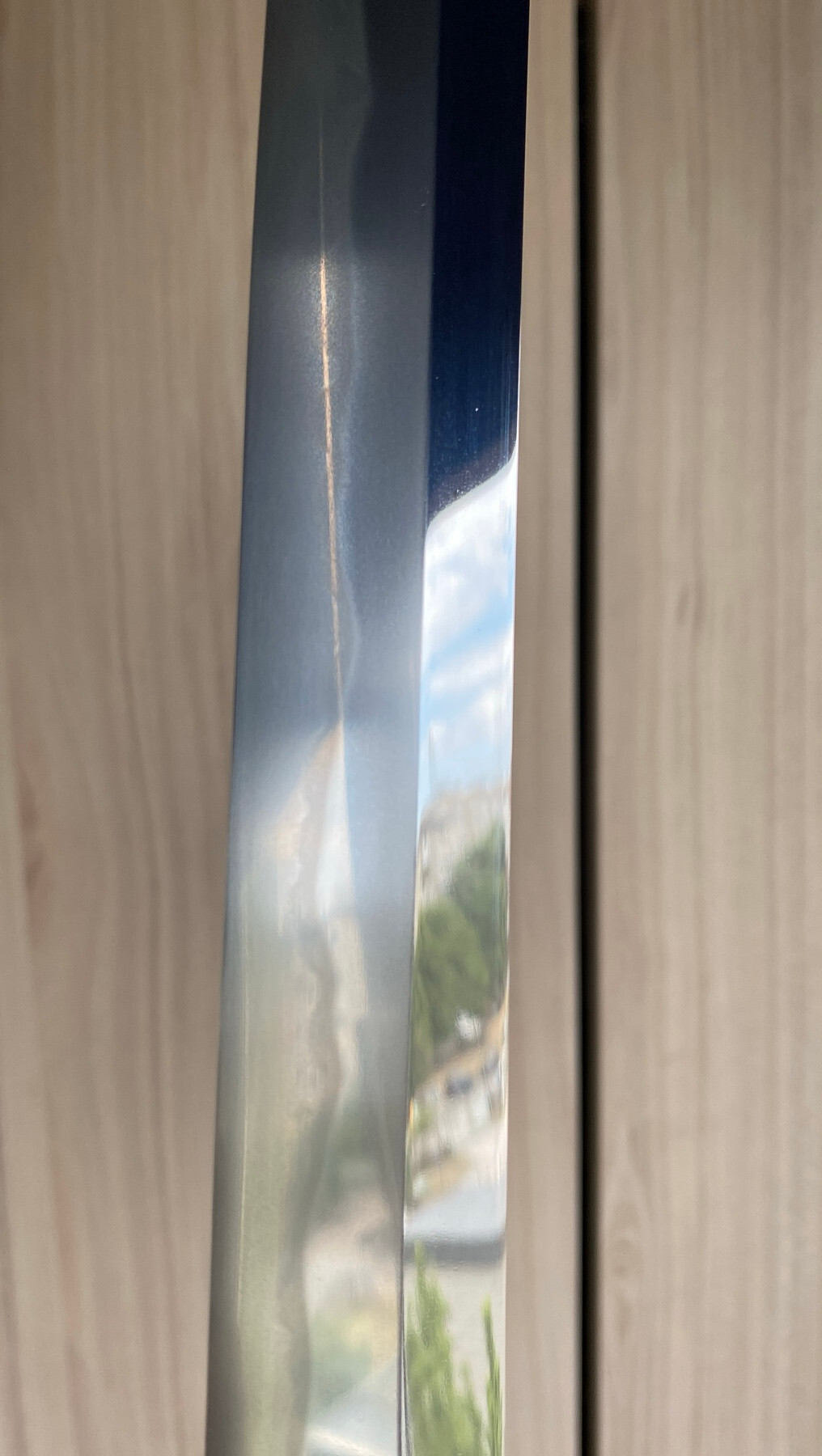
What I got is an Ishido Teruhide blade, made in 1940, sitting in a fresh Japanese polish. Has an original gunto koshirae with junior officer's tassel. Everything is in pristine condition, in fact I have rarely seen, let alone held such a preserved gunto. Huge thanks to the person who made the purchase possible! I have yet to take some proper photos, in order to provide the admiration this nihonto requires. But I will now share two quick close-up pictures which try to capture the beauty of the blade in polish. I believe it has a very tight ko-itame hada, at least in person it looks like ko-itame to me (in the proper light). What do you guys think? I will definitely share more photos once I find the time to take them, probably in a week or so. But I am a very, very happy person right now.
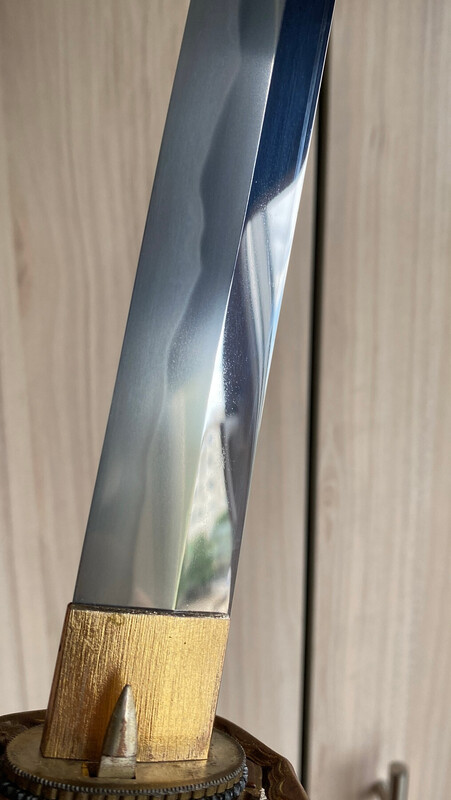
 1 point
 -
This will be interesting: https://www.japantimes.co.jp/commentary/2024/03/06/Japan/Japanese-romanization-rules-change-explained/1 point
-
I am going back to the document box idea. This guard is much later than the tosho. From Grev. Cookes book on the Birmingham Museum and Art Gallery
 1 point
 -
As they say; It's a marathon, not a sprint. The journey comes with a never-ending series of revelations about just how little you know, and how much remains to be mastered. So, "fluency" is one of those words whose definition seems always just out of reach. Memorize hiragana and katakana. Usually in that order, because that is the way Japanese kids learn written Japanese, and that usually provides the best foundation. But some people choose to learn katakana first because they feel that will give them more immediate benefits if/when they visit Japan. Either is fine, as long as you learn both and don't get lazy, and recognize that hiragana gives better gas mileage than katakana. There are only 46 characters in each alphabet, and some are similar, so its not such a daunting task. Start to memorize the fundamentals of kanji when you've got hiragana and katakana more or less mastered. Stroke order, stroke direction, construction, balance, etc... You don't need to memorize all 2000 at one go. University students will know upwards of 8000-10000, but many of those are single-use kanji, or specific to a particular branch of the sciences, and not particularly useful in everyday life. The point is, learn them as you go, and don't worry that you only know 50 or 100 or 200...you'll pick more up as you go along. Start speaking as soon as you are able. Get a tutor or a mentor or an online partner, or youtube tutorials, anything. Speaking is a different beast than reading and writing, but each supports the others. Before long you realize that things like hierarchy and politeness are hard-coded into Japanese in a way that they are not hard-coded into English. It isn't necessary to nail down all of these nuances right away, so don't waste too many brain cycles trying to complete all of these side-missions. It's enough to be aware that the language has politeness levels imbedded into it, and as you become more proficient in Japanese, you can start to get better at using the correct/appropriate language for the audience. If you try to figure out everything all at once, you won't get anywhere. The language of the sword/fittings world is a specialized field. Don't expect the average Japanese person to understand the vocabulary of the sword world. Its full of jargon and rarely-used kanji and specialized readings...etc. It adds a complication to your Japanese studies. It's like a beginning English student trying to understand the language of nuclear physics. It just doesn't happen overnight, or without a lot of specialized study. Took me one year to become marginally conversational. Took me five years to become barely literate. Took me twenty years to become "fluent-ish". I started diving deeper into Japanese sword/fittings vocabulary after about 25 years, and realized I didn't know diddly squat. From there, each incremental bit of knowledge added to my ability, and made me slightly more fluent. I have N1 and a translator's certificate. I got these fairly quickly, after about 10 years of living in Japan. But really, its only after I got these things that I realized how much I had yet to learn. Still running the marathon...1 point
-
Ray One or two comments from people from a certain country cannot equate to the entire country or be a representative sample. Indeed, you have contributed a lot to the study of swords in the U.K. and even here (eg, sharing all the scanned magazines and books!) and internationally (eg study sessions in Japan). You have trodden the tortuous path of collecting numerous swords from various sources (eg people could refer to your publication of your previous collection) and experienced first-hand numerous dealers and people in the community. You are trying to share some of your painful experiences so that others do not get burnt the way you did previously. Our To-Ken Society (which numbers 220 members by the way, not the 2-3 which are more vocal here) is grateful for what you have shared in terms of study material. The desire and ambition to educate is noble and yet the approach needs to be proportionate and appropriate. What might be pertinent for a certain member might not be suitable for another. We are all grown up here and can decide to heed advice or not. Unfortunately such is life - whether in politics, religion, business, hobbies etc. People sometimes listen/learn and sometimes choose to ignore what they are told. We as humans are all flawed like that. There are numerous valid tips you share above. In fact, I would say the advice you give is concordant with the straightforward “canon” in Japan. But emotion as well personal circumstances (and most importantly probably the lack of funds) might prevent people from following that archetype. The economic factor as well as impatience (covered elsewhere) often prevail. Please let us adhere to educating (or trying to). There are various lecturers and teachers here on this board (I know a few and they are prominent members of the board and the nihonto / armour / dealer community) and they can also attest: you can teach, explain etc but it is up to the individual student to wish to learn, follow recommendations etc.1 point
-
Found this in the back of a drawer recently. Good size, tiger mother and cub in silver. Filled with resin/rosin, into which a bolo/loop tie fixture has been set. (Not touched the back yet.)
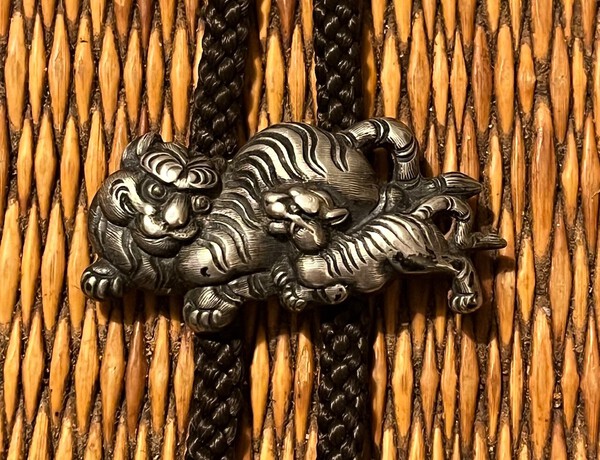 1 point




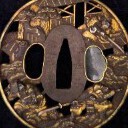












.jpg.1c4715a51d1be2cb563c4485fae0cb52.jpg)
.jpg.a4c990bb1c4c51882903e8252ba46585.jpg)








This leaderboard is set to Johannesburg/GMT+02:00