JohnTo
-
Posts
290 -
Joined
-
Last visited
-
Days Won
1
Content Type
Profiles
Forums
Events
Store
Downloads
Gallery
Everything posted by JohnTo
-
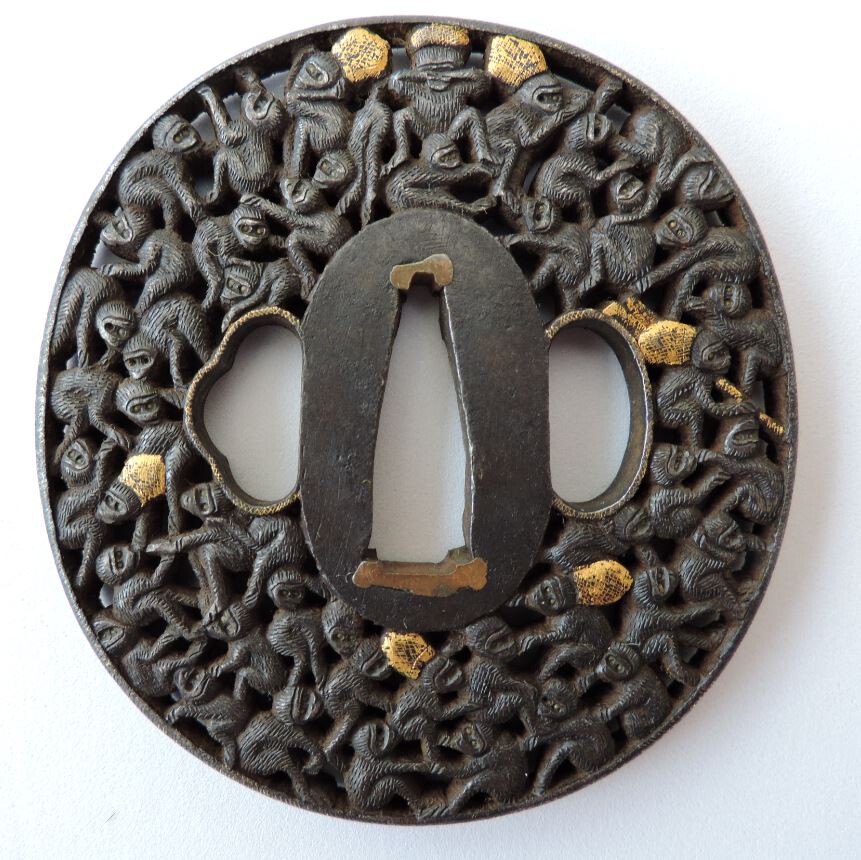
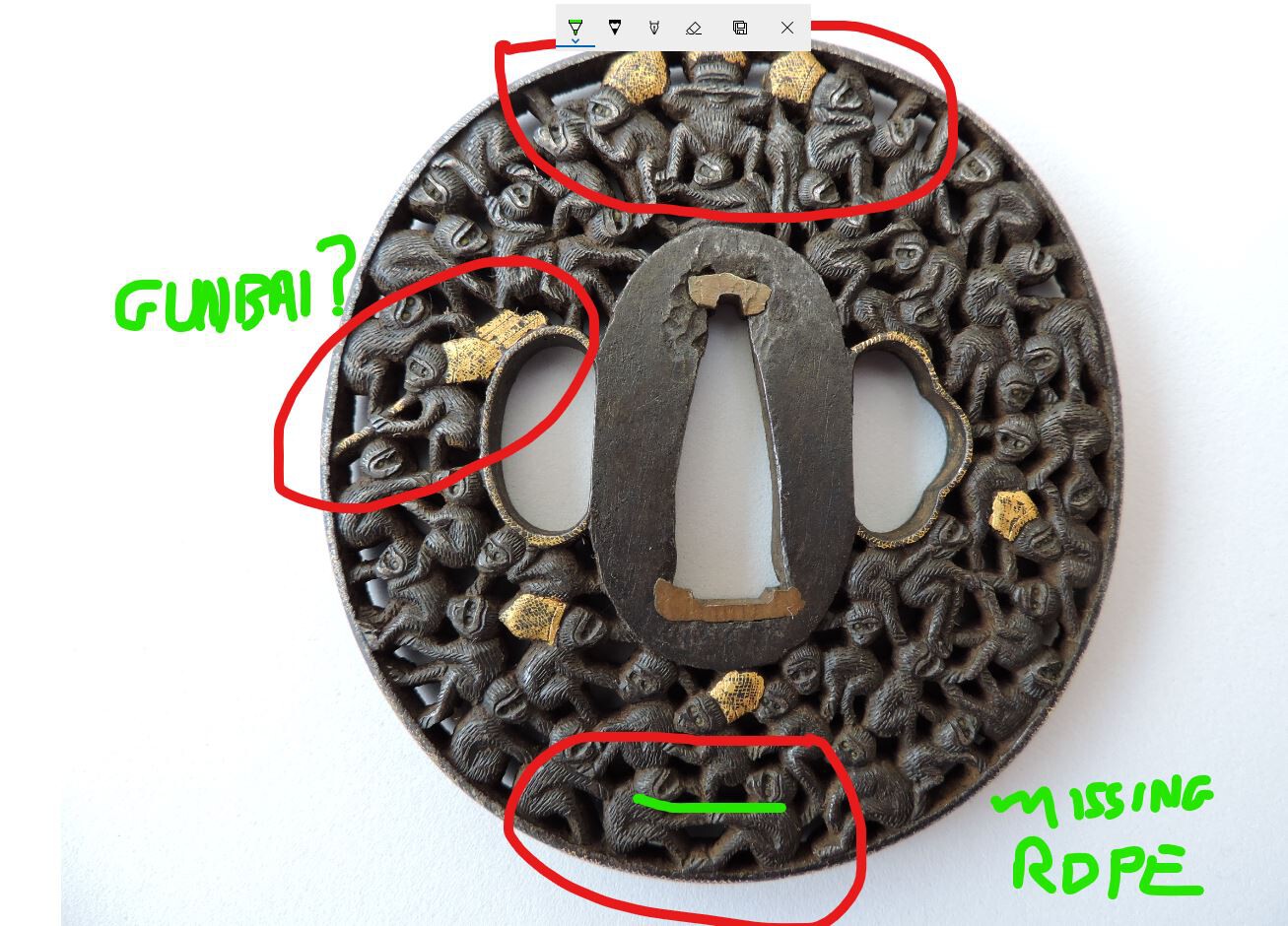
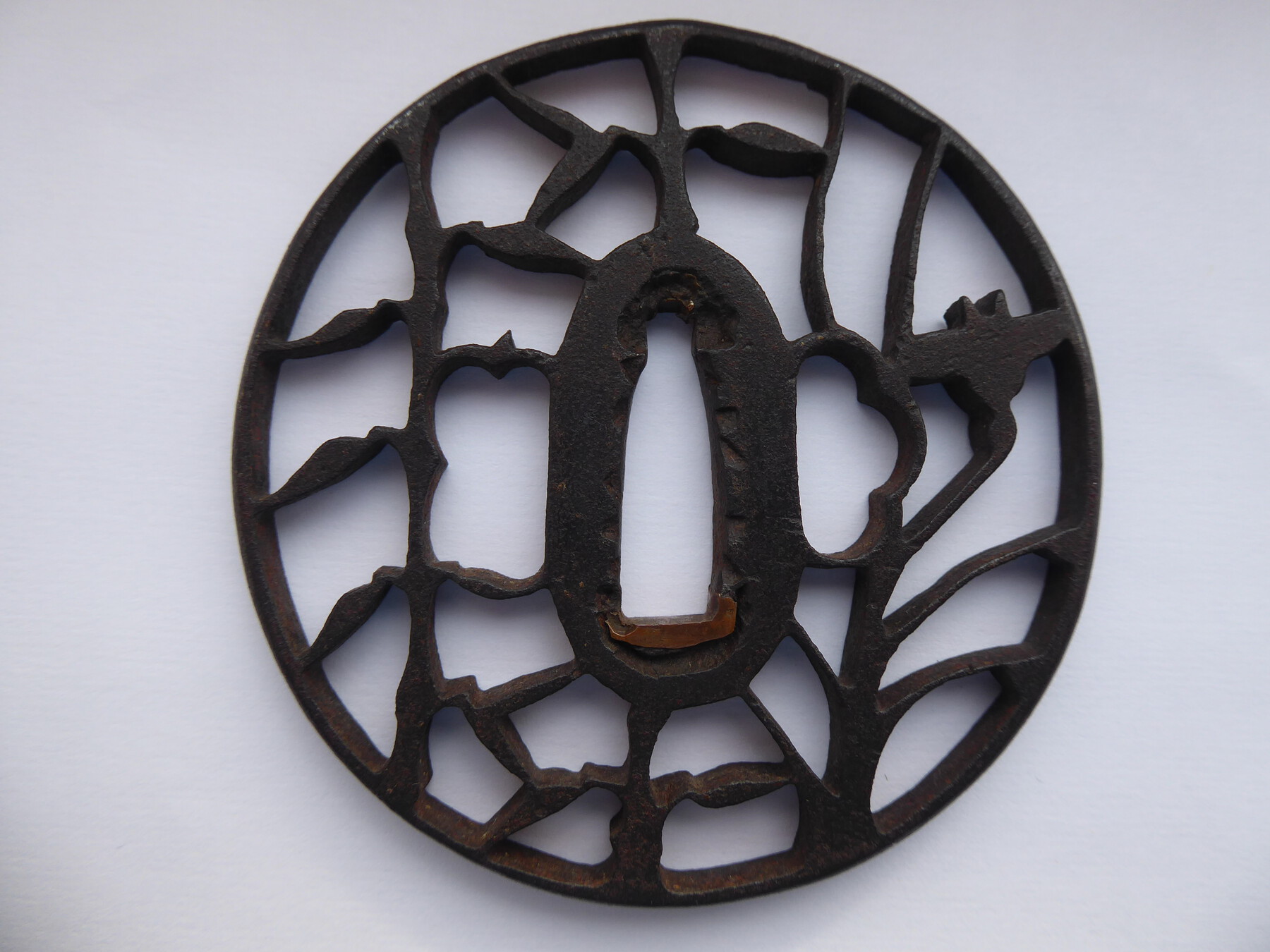
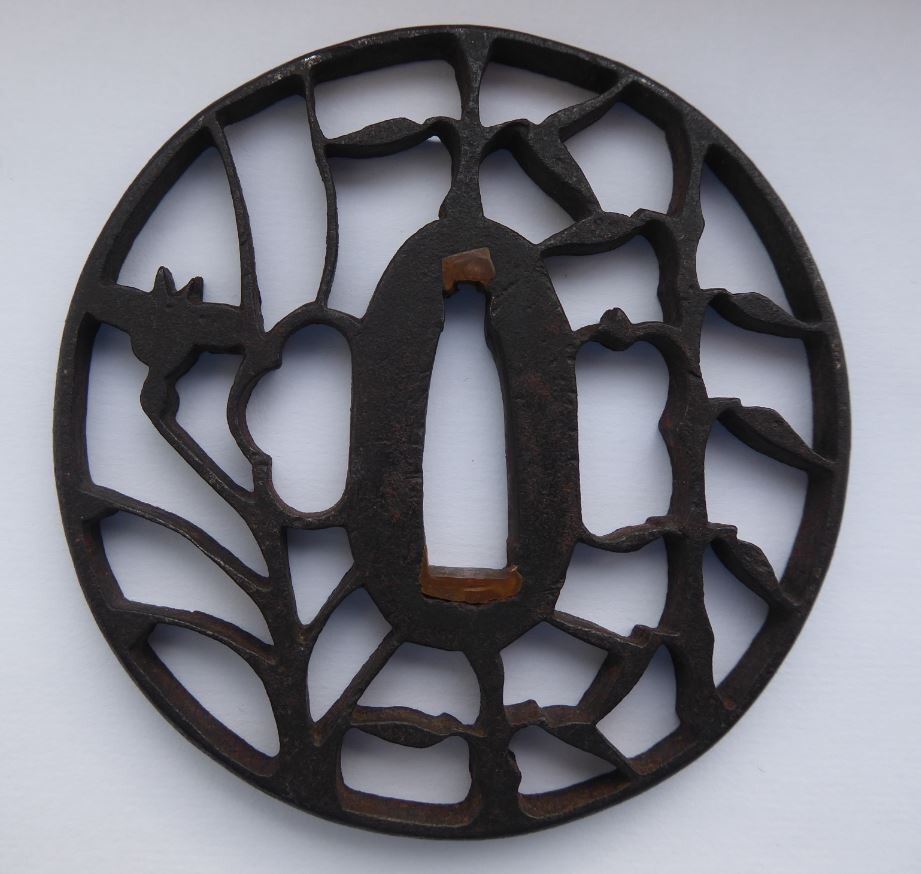
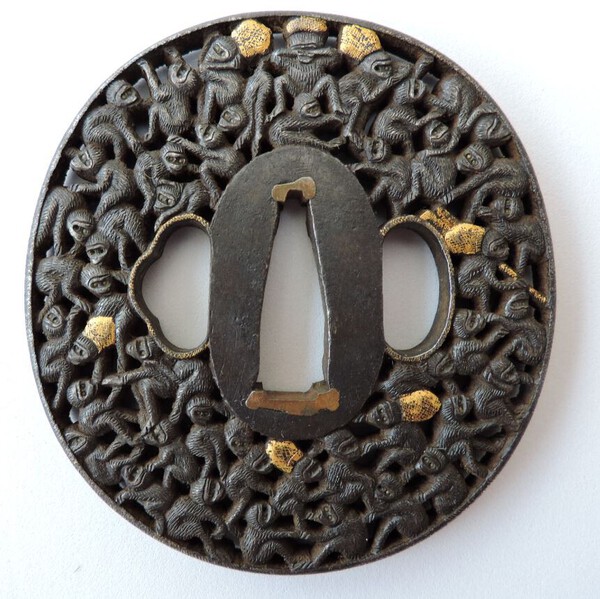
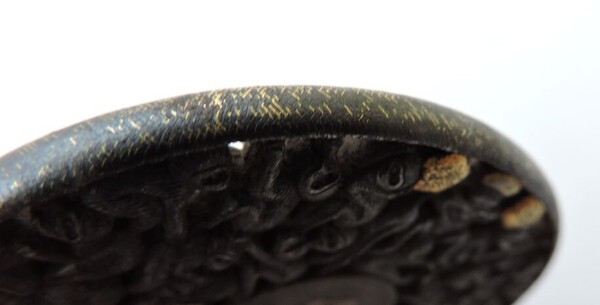
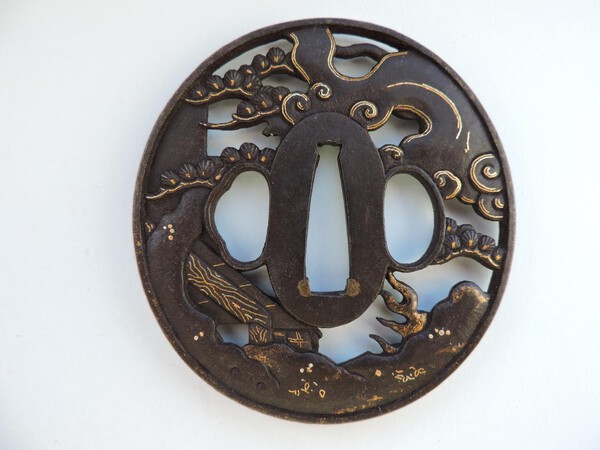
I thought that an unusual feature this 1000 monkey tsuba might be of interest. You might like to go straight to the pics and see if you can spot it. But first, for those unfamiliar with 1000 monkeys, some background info on this type of tsuba that I gleaned from literature (I’m no authority and much was taken from an excellent article by Robert Burawoy, Bushido, 3, number 1 p18-21). Makers: I believe that this design of tsuba originated with the three Mitsuhiro tsubako (father, brother and son) who lived in Yagami, a part of Nagasaki in the 18th and 19thC. Mitsuhiro I probably studied at the Nanban School in Nagasaki before moving to Yagami in Hizen province. The Nanban influence can be seen in the tsuba which is rather stiff and flat in design compared to Mitsuhiro II (regarded as far the best and died in 1823, aged 75) who’s monkeys are rounded and vary in both size and activity. Mitsuhiro III (died in the Meiji period aged 70) did not produce many works and these were like his father’s. Their works tend to be signed Hishu or Hizen Yagami Ju Mitsuhiro and they worked in both iron and brass (sentoku). This tsuba is mumei (unsigned) and may not have been made by any of the Mitsuhiro’s, as others copied their work. 1000 animal tsuba: I’ve seen tusba with both monkeys and horses, but there may be other animals in their designs. Monkeys are the most abundant and this tsuba contains about 40 monkeys, but had they been continued around the rim, as is common, there would have been about twice as many; but still far short of 1000. Therefore, many people refer to the design as 100 monkeys, but the Japanese description is ‘sen.biki.saru’ literally ‘1000 units of monkeys’. The Mitsuhiro’s obviously believed in marketing and stretching the truth (some tsuba are inscribed ‘sentoku kin wo mote kore wo tsukuru’, ‘made with sentoku’, but some believe they just used a cheaper brass alloy. Inventive marketing again!). Most of the monkeys just seem to be scrabbling around in these tsuba, but if you look carefully four groups are often involved in specific activities. Usually found at the top are the three wise monkeys (see, hear and speak no evil), as in this tsuba. In the bottom half can be found a pair monkeys sitting and facing each other with a loop of rope around their necks having some sort of neck wrestling contest (the monkeys appear in this tsuba without the rope). Another monkey can often be seen carrying some sort of baton, paddle or gunbai (as in this example) while another monkey is sometimes depicted as holding a giant peach (absent in this tsuba and I wonder if the peach is actually a tama jewel considering the Nanban influence on Mitsuhiro). If anyone has info on this odd choice of subjects, please comment. Although this tsuba is nicely carved it is rather flat, especially when compared to second generation work. The eyes of the monkeys seem to be inlayed with sub-mm spots of gold (a bit dirty to see clearly). Mitsuhiro I carved monkeys around the rim in a uniform manner, whereas Mitsuhiro II carved them in a variety of poses. This tsuba has a simple mimi with gold nunome cross hatchings, resembling examples of the I and III generation artists. So my evaluation is that the tsuba is quite skilfully carved and inlayed, but no way near the quality of Mitsuhiro II and possibly not by any of the other two generations either. However, this tsuba has an unusual feature (unique as far as my limited experience is concerned). Seven of the monkeys are wearing court caps highlighted in gold nunome and three of these are the three wise monkeys. Another is the one carrying the baton/gunbai and the other three seem be just part of the general melee. Any ideas why seven were selected? Although the three wise monkeys are of ancient origin they seem to have become famous after being carved over a door at the mausoleum of Togugawa Ieyasu at the Nikko Toshogu shrine (see pic). A gunbai (war fan) is the badge of authority of a commander and Toyotomi Hideyoshi (nick named Kozaru, Little Monkey) is also commemorated at the Nikko shrine. The rope wrestling and peach carrying monkeys are noticeable by their absence. In view of this I wonder if the tsuba was a special order from someone who did not like the Tokugawa’s and wanted to imply that Ieyasu, Hideyoshi etc. were a bunch of monkeys. In which case, I can understand why the maker did not want to sign this piece and be identified to anyone in the shogunate. Maybe my imagination is taking flight, so constructive comments welcome as always. Metrics: Height: 7.1 cm; Width: 6.7 cm; Thickness (rim): 0.45 cm; Weight: 106g Best regards, John (just someone making observations, asking questions and trying to learn)



-
By coincidence I was reading a book on Tokugawa Ieyasu from the Royal Armouries, which shows a picture of an Armillary Sphere at the Nikko Toshogu Shrine. It is made of bronze, silver and gold and was commissioned by Sakai Tadanao, Daimyo of Obama in Wakasa and dated 1675. The date scales use the Chinese zodiacal system. It is inscribed 'easy to use small celestial globe that was made by the gold, silver and copper artisan Tsuda Tomomasa. So the design for this tsuba may not be based upon a European import. best regards, John
-
Mauro, Thanks for the info. One of the things I love about tsuba is trying to decipher the design. I've never seen this one before. To dream of a hawk, mount Fuji and an egg plant in one dream. Must have been one hell of a New Years party. John
-
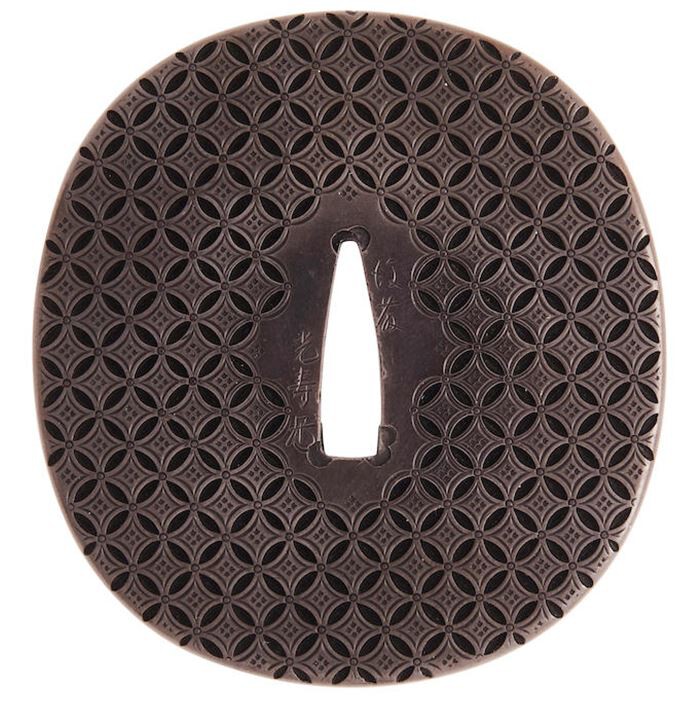
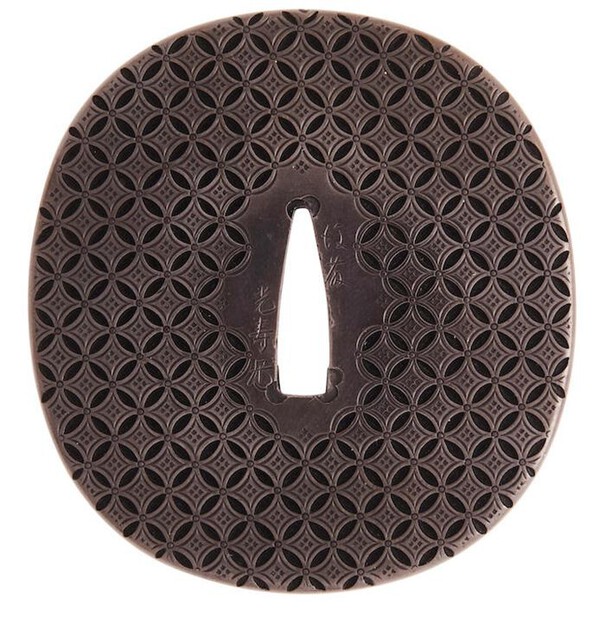
Having stirred up debate with regard to grey/brown shibuichi I thought that it might be instructive to get some comments regarding shakudo, shibuichi and nigurome. The subject has been in the back of my mind for some time and has been prompted by a recent auction that had a tsuba essentially identical to one of mine and was identified in the auction as shakudo, but was chocolate brown in colour. So let’s start with the alloys as I understand them (please feel free to correct me). Nigurome: The base alloy used in shakudo and consisting of mainly copper with some lead and tin. It is often used for cheap copies of Mino Goto work and usually has a brown patina. Shakudo: Nigurome plus 3-7% gold which patinates to a wonderful blue black colour. Shibuichi; Literally ‘four parts/divide one’ consisting of 3 parts copper with one part silver. This alloy usually patinates a chocolate brown but can be other shades including a greenish grey. Tsuba 1a, 1b and 1c. Are three virtually identical tsuba ‘inscribed’ Goto Mitsunobu (後藤光寿, often read as Mitsutoshi, but Toso Kodogu Koza says this is incorect and 1b is catalogued as Mitsunaga). 1b and 1c also have disclaimers in their sources saying they are not by the XIth master Tsujo (so this is not a post to discuss if the tsuba are genuine, but they do appear to be by the same hand). Tsuba 1a is mine. I have always thought of this as being shibuichi due to its dark chocolate brown colour. However, in some small areas the patina is worn and the red colour of copper is visible (see close up pic). My question is: If the patination of shibuichi becomes worn would the base metal appear as red copper, or would the high silver content oxidise to another colour (black?). Tsuba 1b is from the Church Collection in the Ashmolean museum (EAX.10899) and is catalogued as shibuichi. Tsuba 1c was sold recently in NY and was catalogued as ‘shakudo migakiji’ (polished shakudo) but seems to have to same brown patina as the other two. I put this discrepancy down to catalogue error, based upon past observations, but question this assumption as I can see red copper beneath the patina on tsuba 1a and (see below)…. Tsuba 2. Is a nominally ‘shakudo nanako’ tsuba in Mino Goto style, but while the ji appears to be the normal blue black (OK, not the best colour patination), the seppa dai is ‘shibuichi chocolate brown’. I have seen this on other tsuba (mine and photos). So my main question is this. Is the alloy that we generally assume to be shibuichi sometimes shakudo with a low gold content, i.e. gold enriched nigurome, which can be patinated brown or blue black so that tsuba can be deliberately made with this two tone colouration? I guess that it is over to Ford for comment. Best regards John (just a guy making observations, asking questions and trying to learn)




-
OK guys, getting a bit fraught here. We should all be just trying to debate and learn. None of us know everything and I will admit to being wrong quite often. But to keep open the same type of debate I'm about to open another post on shakudo, shibuichi and nigurome. Thanks Ford for your insights Best regards, John
-
Sorry Jean, its still looks Nagoyamono to me. Better than average, but not Mino Goto quality. It also has two other Nagoyamono features. You can see shadows of uneveness around the rim, sunken areas typical of cast tsuba (assuming not poor photo here). The punch marks around the nakago ana appear to be typical Nagoyamono, namely 3 at the top, two pairs of two at the bottom of each sides and three along the bottom edge (ok there is only one here, but there is always some variation). The 10 punch mark pattern always shouts 'Made in Nagoya' to me. Best regards, John
-
IMHO it is a Nagoyamono (thing from Nagoya) rather than a Mino work. The good news is that it is better than the 'standard series' (as I like to call them) of Nagoyamono that keep turning up in UK and Japanese auctions. I am not an expert, being more a book newby and often use the Christie's Compton Catalogue as my main source of info as it seems to be of a higher standard than info in the current major auction house of tsuba. Compton II, lots 132-135 show some nice examples which sold for over £1K (I don't think yours is quite up to that standard and prices were higher then). Using their catalogue notes. Nagoyamono were based in Nagoya in the Edo period and used the style of the Goto workers in Mino and Kyoto. The plate metal for the tsuba was nigurome, a base metal of katashirome (tin and lead) and unrefined copper (yamagane). This alloy is converted to shakudo when 3-7% gold is added, which was not done with the Nagoyamono. Nigurome gets a chocolate brown patina and not the lovely blue black of shakudo. The Nagoyamono that I have seen all look cast and then finished by hand (guilding and application of nanako), they also tend to have guilded nanako finished ryuhitsu, as yours. hope this is of help, best regards John
-
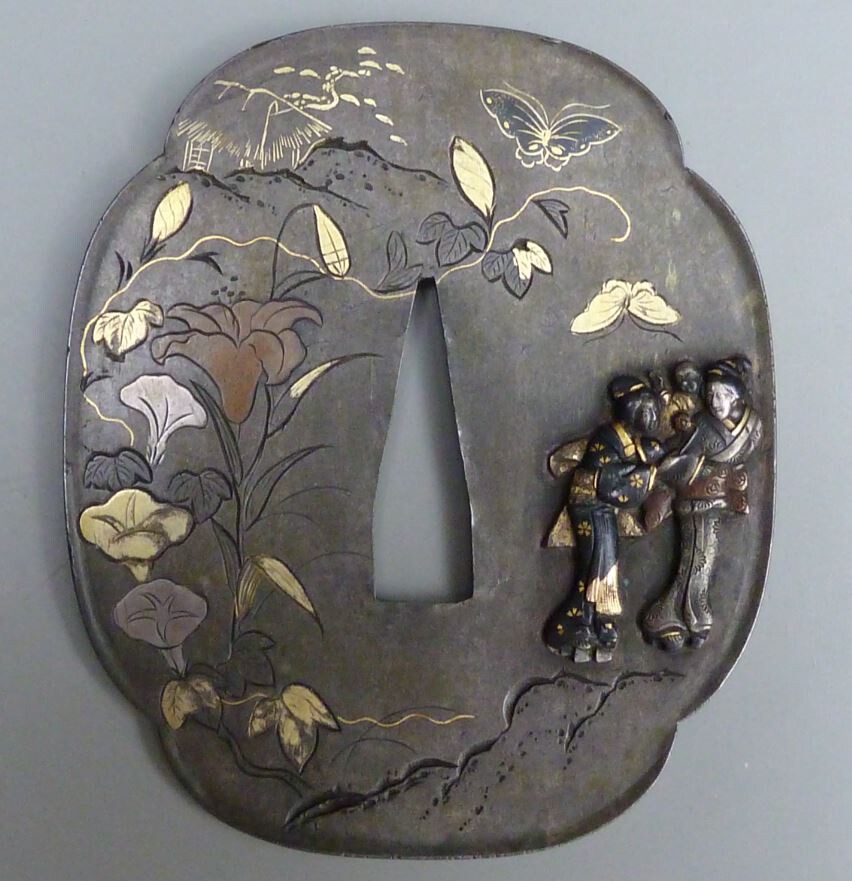
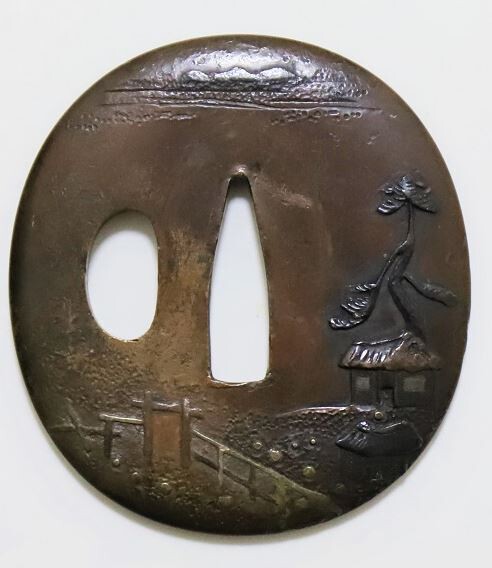
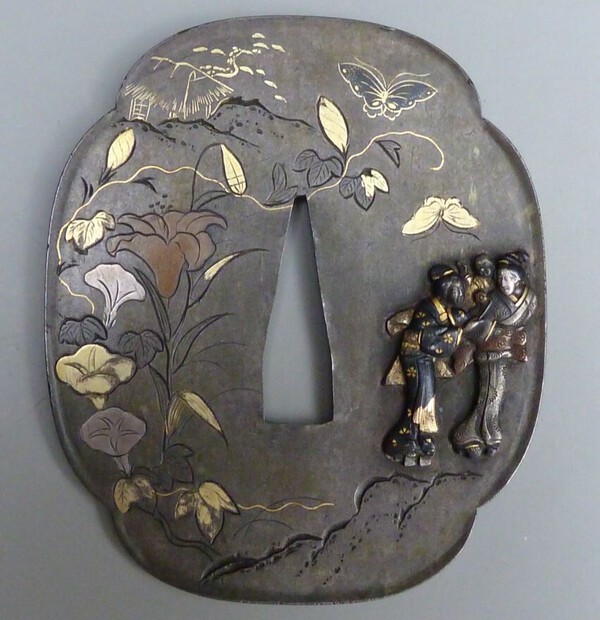
Hi everyone, It’s over three years since I posted this tsuba asking for help identifying the subject matter of this tsuba. I originally thought that it was just a mish mash of pleasant looking objects, but thanks to seeing a seemly unrelated tsuba for sale by Touken Matsumoto (see pic), showing the retreat of lady Kogo, I think I can now explain the composition and hope that you find it interesting. I believe that the subject matter is based upon an incident in the Heike Monogotari, written around the start of the 14thC, telling the tale of the Taira/Minamoto war. Apparently, the 20th Emperor Takaku (reigned 1168-1180) was a bit depressed about something and his wife sent Kogo, a lady of the court, a renowned beauty and koto playing musician, to cheer him up. This she did and Lady Kogo became the emperor’s favourite concubine. This situation seems to have been OK with his wife, (what an understanding woman!) but not his father-in-law, Taira Kiyomori. Fearing that he was losing influence, Kiyomori had Lady Kogo banished. Takakura was heartbroken and eventually sent out a servant to track down Lady Kogo, which he did one evening after hearing her playing the koto in the cottage where she now lived. Takakura and Kogo soon rekindled their romance with secret nigh time trysts which resulted in the birth of a child. Eventually Kiyomori found out and this time had Kogo banished to a nunnery. The front of the tsuba depicts the cottage where Kogo lived (as in the Touken Matsumato tsuba) surrounded by the idyllic surroundings of their love nest (flowers and butterflies). Bottom right shows Kogo leaving this idyll and going into her final banishment of a nunnery, accompanied by a maidservant and her child (name, sex and fate unknown to me, but I assume that it was not Takakura’s famous son Antoku, who was drowned at the battle of Dan-no-Ura in 1185). The reverse shows two quail in the moonlight, representing the two faithful lovers meeting. After four years of guardianship of this tsuba I feel that I have finally interpreted the subject. Now I just need to find candidates for the maker. Best wishes John (Just a guy making observations, asking questions and trying to learn)

-
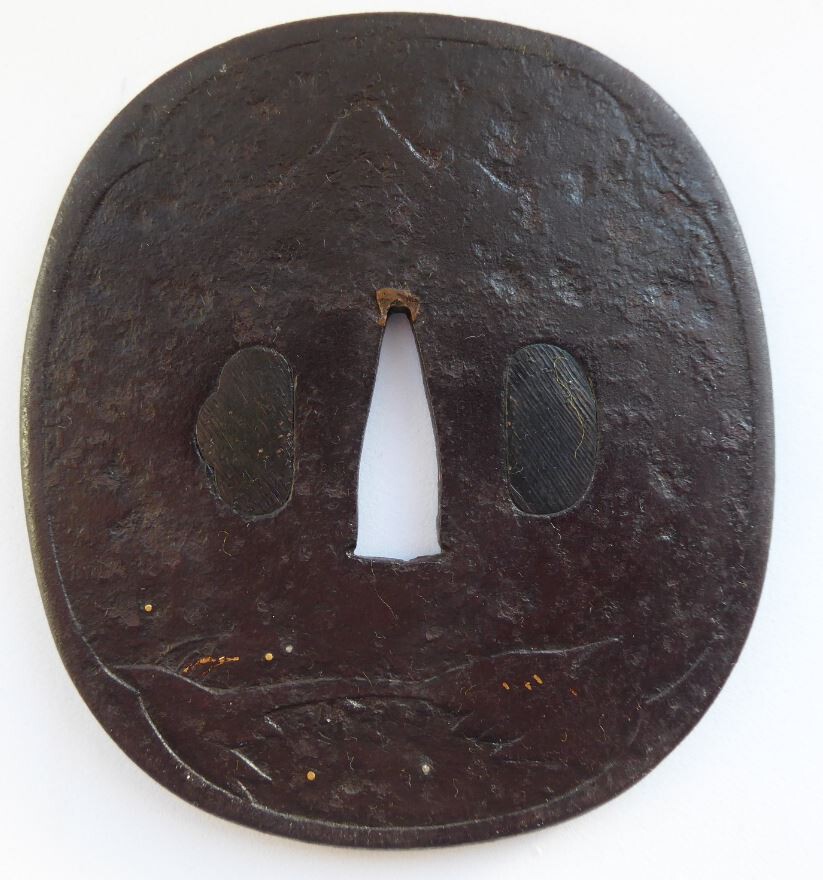
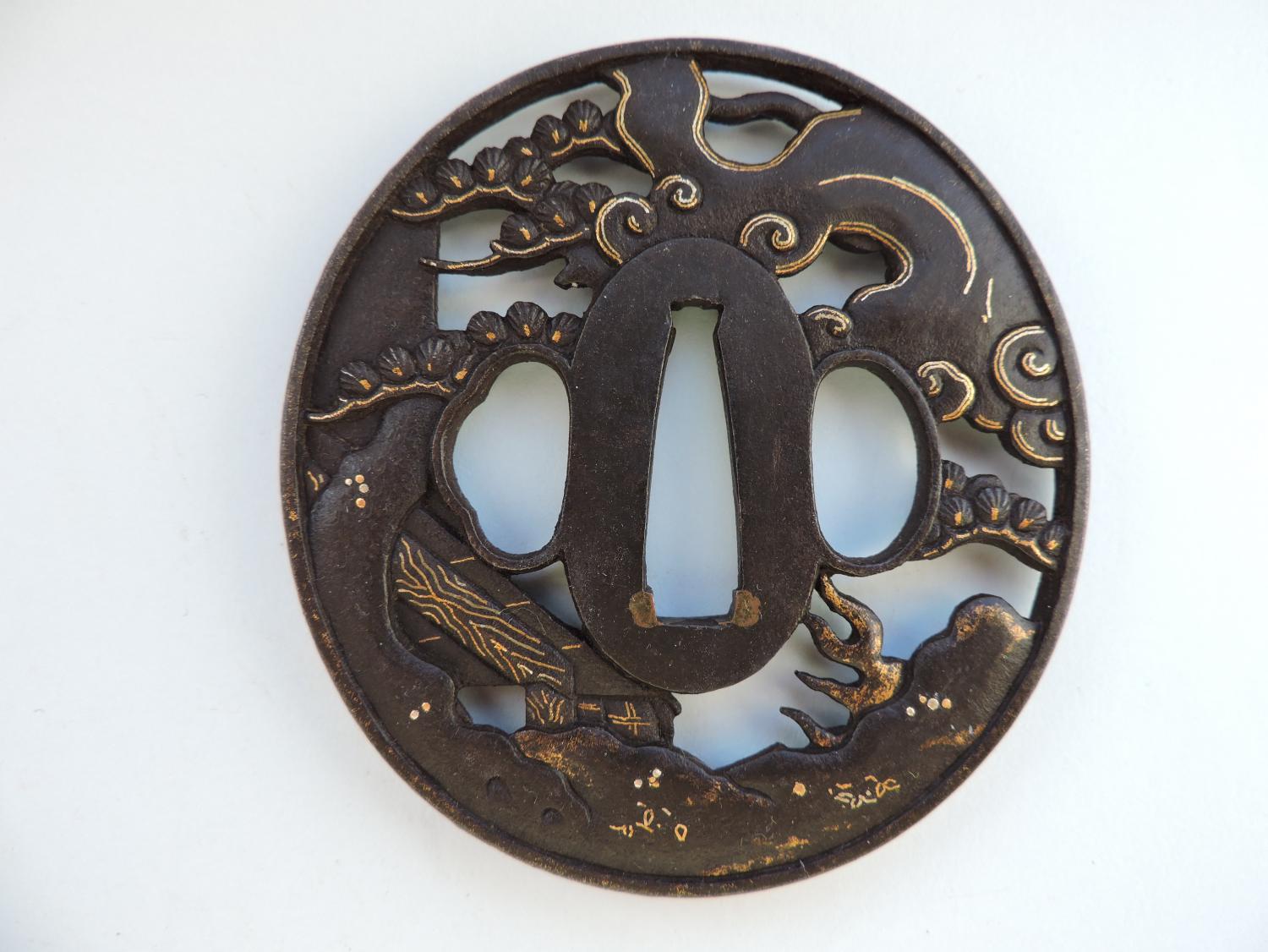
Hi Joe, I have a couple of ‘Kaneie’ tsuba, one of which seems to have similar features to yours and may be by one of the Saga Kaneie. My tsuba was in a mixed lot and rather grubby when I bought it, but has cleaned up nicely and most of the brown patina seems to be extant. I gather that there were about a dozen tsubako named Kaneie plus students and fakers who also signed Kaneie. So I hope you find the following helpful. My tsuba is an oval flat iron plate with a slightly raised rim and Chinese landscape (sansui), both formed by sukidashi bori (engraving the ji of the tsuba to leave the design in high relief) highlighted with gold. On one side there are two pointed stooks of rice, each engaved with fine lines and tipped with gold, near the shore of a lake. At the top of the tsuba is the moon, or sun, depicted in gold, partially covered by cloud. The the other side shows a low bridge, supprted in the middle, spanning two shorelines and at the top is a mountain in low relief. A few specks of silver and gold are scattered around but there is no discernable human or animal form on either side. This type of landscape design is referred to as sansui (mountain and water). The surface of the ji shows areas of what looks like tsuchime (hammer marks), but may be due to areas of local corrosion and also shows clusters of small lumps (ca. 1 mm diameter) which may be tekkotsu.The nakago ana has a sekigane at the tip and is flared at the base, where a second sekigane may have been. There are no tegane (chisel) marks around the nakago ana. There are the usual two ryo hitsu for kogai and kodzuka which have been filled with cat scratched shakudo plugs (partly worn to expose the unpatinated copper base shakudo). My tsuba (like many others) is signed Yamashiro kuni Fushimi Ju Kaneie (Kaneie of Fushimi village [Near Kyoto] in Yamashiro province). Joshu Kaneie and two others of the same name were the famous Kaneie tsubako of the late 16thC. It is reported that they were probably Buddhist monks, perahaps all from the same temple. A large (8.5 cm) example attributed one of these (signed Yamashiro kuni Fushimi ju Kaneie) is shown in Masterpieces from the Randolf B. Caldwell Collection (#4, page 14). Other tsubako named Kaneie worked in the early Edo period and are usually referred to as the Saga Kaneie or Tetsunin Kaneie School in Kyoto. Aoki Tetsunin Kaneie was born in Fushimi in 1594 and later went to Edo to form the Tetsunin School and died in 1675. Various members of this School seemed to have signed ‘Kaneie’ as well as their own names. An example by kodai (later or last generation) Kaneie (signed Yamashiro kuni Fushimi Ju Kaneie) is shown in the Nhon To Koza, vol VI, page 177 and is similar in design, having the gold moon or sun. In conclusion, although the sansui design, sukidashi bori carving and limited highlighting in gold are all features of tsubako named Kaneie, there were several with this name (9 according to one source), plus their signatures were extensively copied by other workers within the School and outside. Another reference states that the 16thC Kaneie tsuba are thin (1.5-2 mm) and the Tetsunin tsuba are 3-3.5 mm, as this tsuba. Although no reliance can be placed upon the signature on this tsuba, it may be from the Tetsunin School. Height: 8.9 cm, Width: 7.9 cm, Thickness: 0.3 cm, Weight: 146 g Best regards, John


-
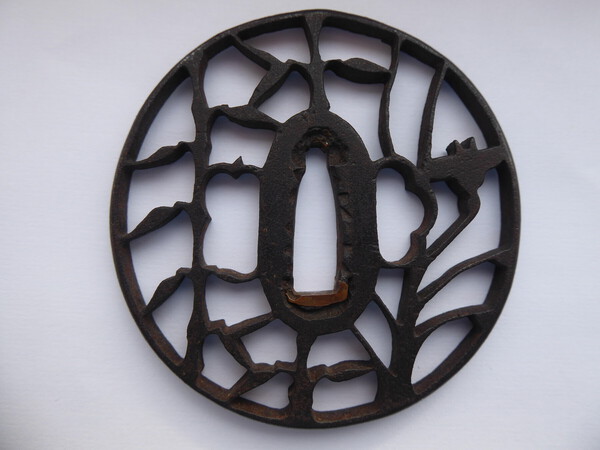
Just thought that you might like to see another tsuba with a sword cut (I believe). The tsuba is a classic Kyo sukashi of the Mikawa irises, popular around the Momoyama period. It came with a NBTHK Hozon. Loo king down at the tsuba from the blade side (ura) there is a cut in the rim at 11 o/clock. It would seem (to me) that the samurai was deflecting a blow by holding his sword vertically and his opponent's blade came down the side of his. I don't think that the split is a folding flaw in the iron. Regards, John


-
Peter Apart from the dragonfly the rest of the carving and nagako ana look 'soft' and poorly defined. In addition the copper seki gane are bright and look new. From the photos, I would guess that it is a modern cast tsuba. Hopefully I am wrong. Best regards, John
-
Hi Peter, Good article, thanks for posting it. Always useful to add to the knowledge base and discussion. I see that there are several similar tsuba to mine illustrated therein. I note that you feel that these tsuba are in fact Japanese made and that the masks are also a Japanese motif. While I agree that many nanban tsuba were made in Nagasaki, probably by Chinese artisans and that the style spilled out to Japanese workers and out to the neighbouring Hizen region, I think that some tsuba, including my two, are probably Chinese. The reason for this is two-fold. 1. The odd shaped nagako ana on these tsuba does not seem to correspond to any Japanese swords or pole arms that I know of. I'm sure that if they were made in Japan someone (dealers and customers) would have got them to change the shape rather than have churn out thousands of ill fitting tsuba that need modification to fit on a Japanese blade. . 2. The mask shapes on these particular tsuba seem to have been popular in Ming China. Please note that my observations are not based upon any actual knowledge, just reading around the subject and drawing conclusions based upon limited evidence. It seems to me that nanban tsuba were made by a number of nameless artisans (like most Momoyama sukashi tsuba), but had no real interest to later Japanese connoisseurs, hence the dearth of information. Best regards, John
-
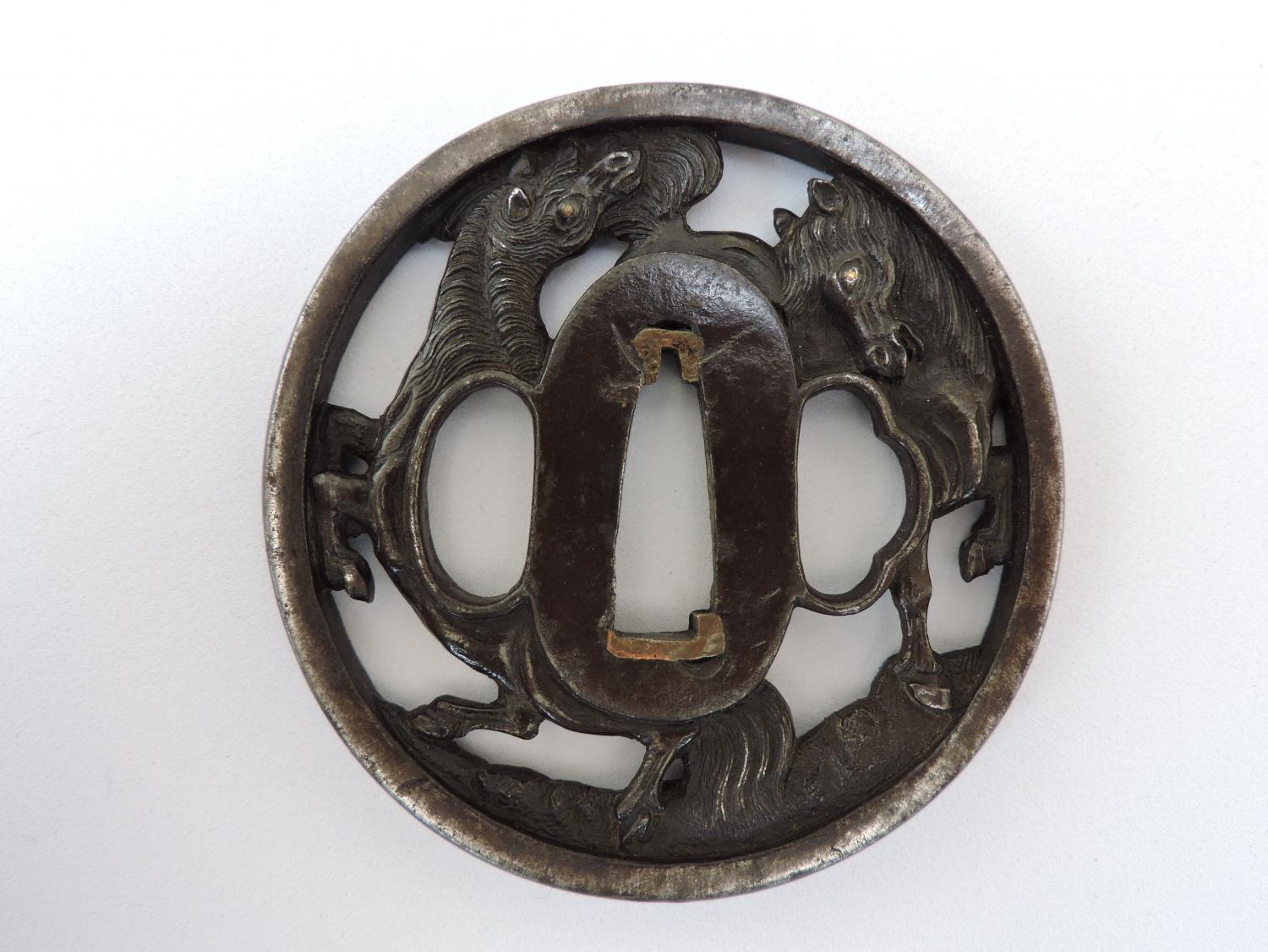
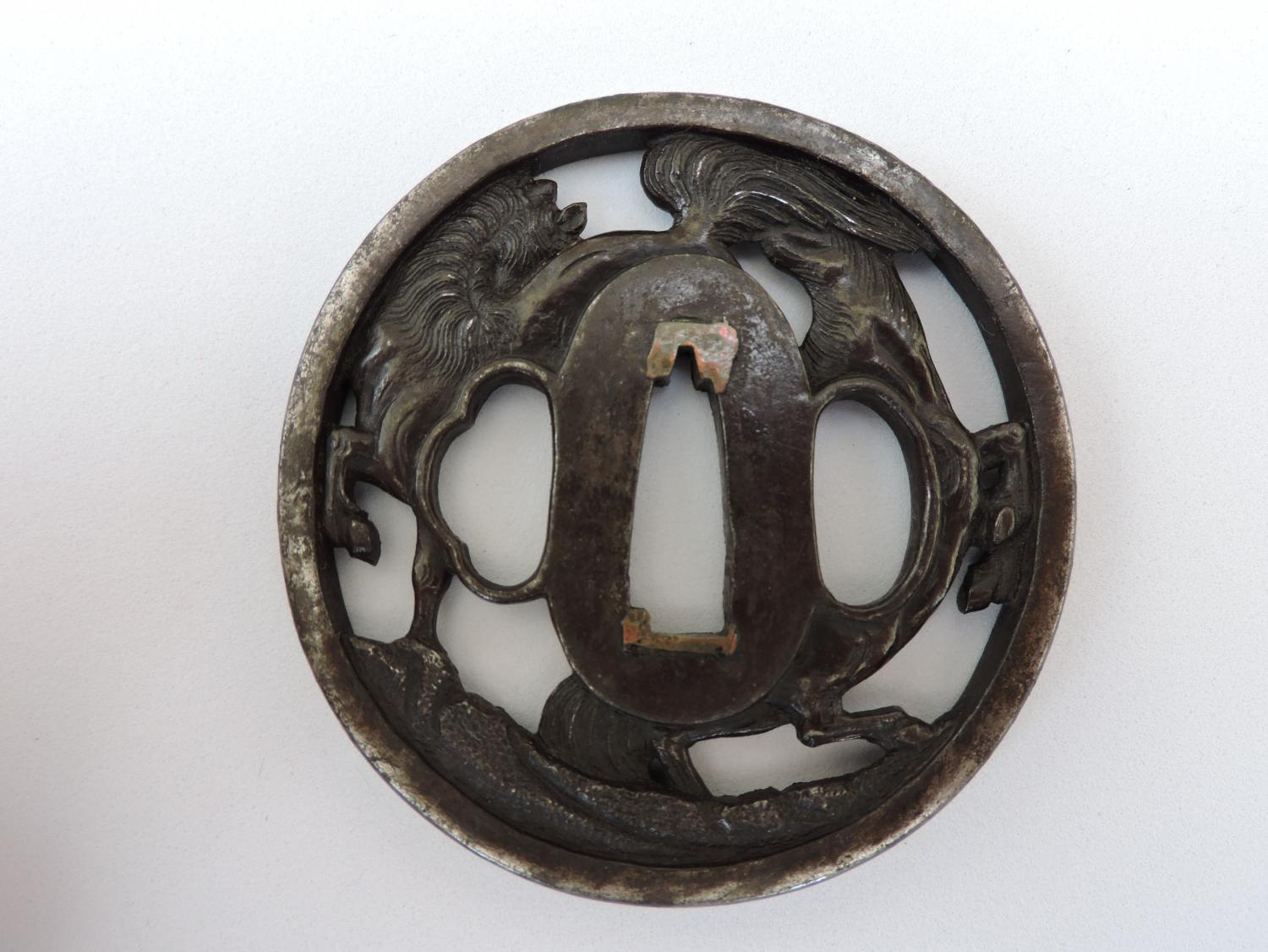
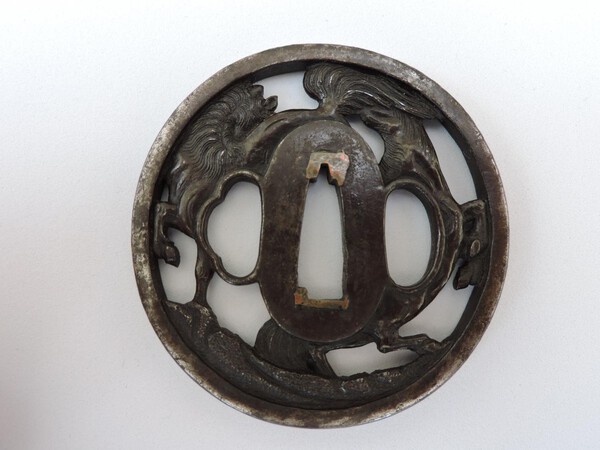
Putting aside the metal bits, the same on example two is odd, it looks black. I have a gunto with black same, but can't remember having seen, or rather noticed, black same elsewhere. Does anyone know how common black same was and did it have any particular significance. best regards, John. PS, prefer the horse as it would make a nice compliment for a wakizashi tsuba that i have.

-
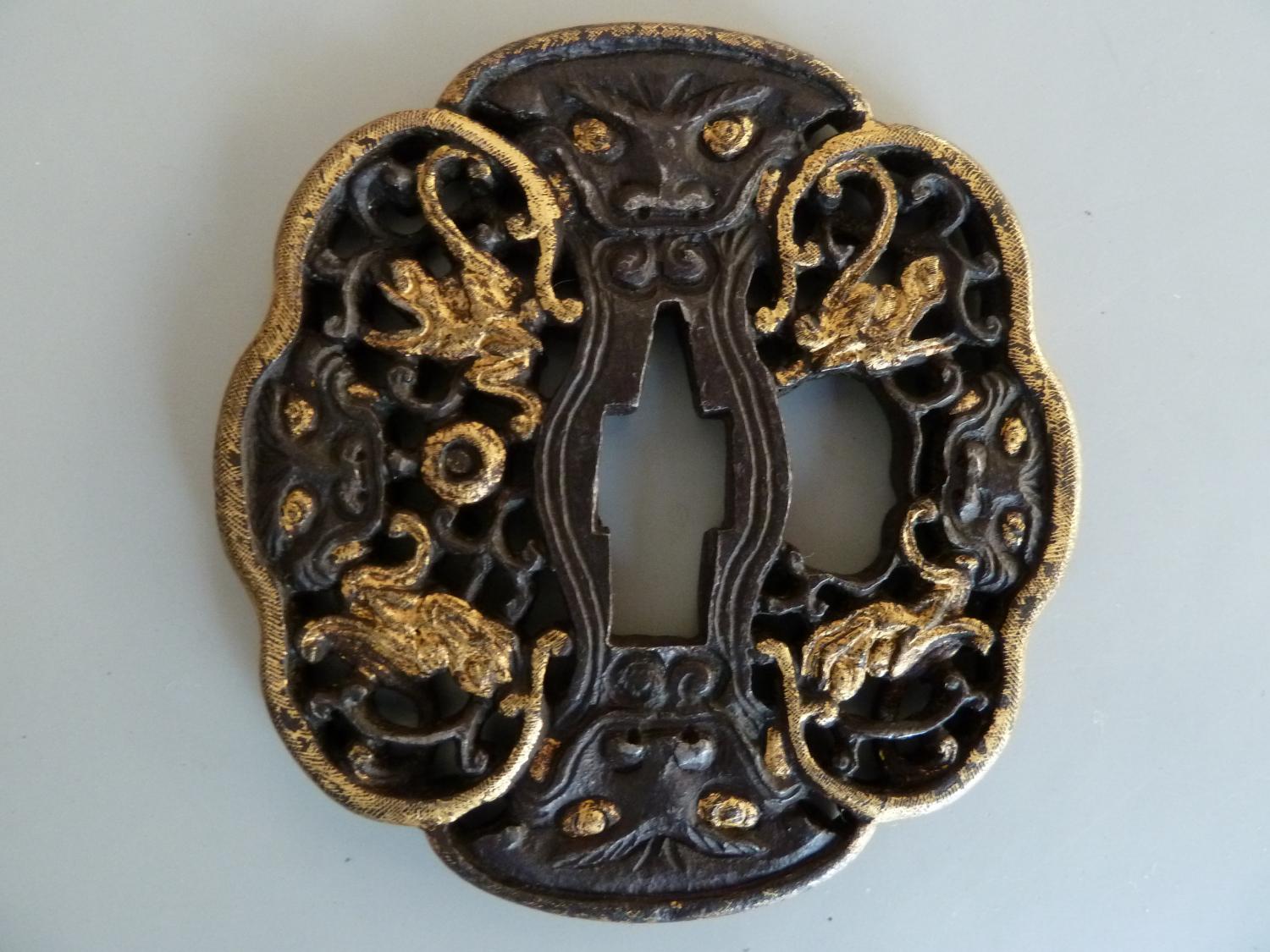
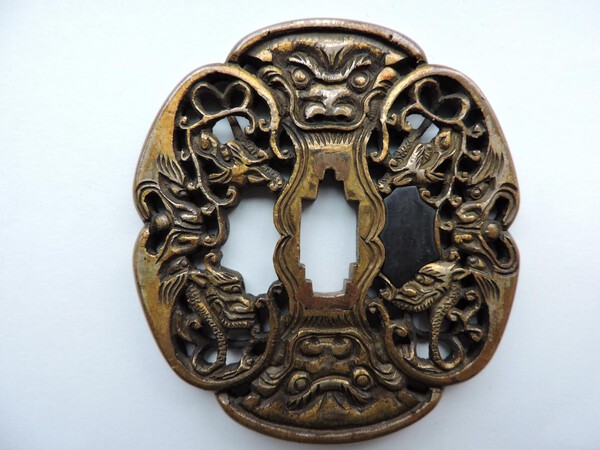
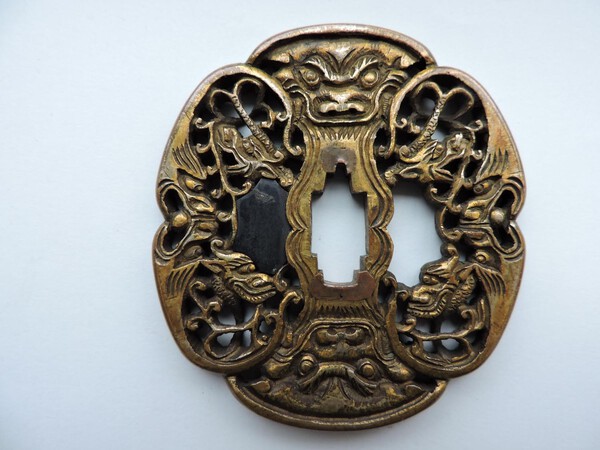
With all the recent correspondence regarding Nanban tsuba, I thought these two tsuba might interest NMB members. They are virtually identical mokko shaped Nanban tsuba with dragon/lion masks the main difference being that one is brass and the other iron. Both tsuba have the same basic design on the front and back, making it difficult to decide which is which. Like all(?) Nanban tsuba they are unsigned. They were purchased as part of job lots from two separate auction houses a couple of years ago. The first tsuba is brass (?) and the differences in colour indicate that it was once gilded, probably using gold amalgam. It has two devil/lion/mythical beast masks at the top and bottom. The Royal Armouries has a similar mask on the guard of the ‘Ming Sword’, dated 1402-24, but only describes the mask as a ‘monster’. It therefore adds weight to my assumption that this tsuba is of Chinese, rather than Japanese origin. The left and right central sections seem to be bounded by what is often referred to as drawer handles, but are actually stylised dragons holding a tama jewel between them. Within each of these areas are two more conventional dragons, the upper ones with open mouths (talking females?, sorry) and the lower ones with whiskers (male?). Eight dragons in all. The seppa dai is the usual grooved Nanban style and the nagako ana is an odd rectangular shape, modified to take a Japanese sword, utilising copper sekigane at each end. I know nothing about Chinese swords and pole arms, but the little I have found out does not relate to the odd shaped nagako ana. Any suggestions? Finally, mention must be made of the shakudo hitsu ana plug. It must have been difficult to shape and I would expect that this was a later Japanese addition. This tsuba is very similar to one sold in the Compton Collection, Part I, Lot 100, at Christie’s on 31st March 1992. The Compton tsuba was described as an early example imported from Canton into Nagasaki, ca. 1600. Both are brass and have the same elements in the design, though in different proportions. It is therefore likely that this tsuba is of similar origin. Dimensions: Height: 7.5cm. Width: 6.9 cm. Thickness (rim): 0.5 cm. Weight: 124 g The second tsuba is virtually identical in design to the first, but is made of iron. In this example the drawer handles, in gold nunome, are not part of dragons and a second pair of animal masks has been placed each side of the central horizontal axis of the tsuba. The four dragons in the centre have the same open mouth pair at the top and closed mouth dragons at the bottom There is only one hitsu ana, the other one being replaced by a gilded tama jewel. The gilding is another important difference, this time it is nunome hammered into criss-cross anchor lines. This seems more like a Japanese influence to me. Does this indicate that the tsuba was decorated in Japan, or maybe made in Nagasaki by Chinese and/or Japanese artisans? As for a date, I’m guessing here, probably 1700? Dimensions: Height: 7.3 cm. Width: 7.1 cm. Thickness: 0.6 cm (rim), 0.5 cm (nagako). Weight: 114 g I’m not a great lover of Nanban tsuba, too fiddly for my taste, I prefer the simplicity of Japanese sukashi of around 1600. However, when I look at the undercut karakusa scrolls (fern fronds) in these and other Nanban tsuba, I’m inclined to say that there appears to be a higher skill level in the cutting than the straight through, vertical, piercings of the Kyoto and Akasaka workers, for example. The karakusa on one side are only cut halfway through and then cut sideways to join up with the karakusa on the other side. Have you seen the Chinese balls within balls in 19thC ivory work? Amazing! Despite being of two different metals the two tsuba look as if they could have been made in the same workshop, even by the same hand. Interestingly (to me anyway), the three generations of Mitsuhiro in Yagami, Hizen, virtually next door to Nagasaki, are reported, in some sources, to have had training in the Nagasaki Nanban workshops. They are famous for their 1000 monkey (senbikizaru) tsuba, carved in the round, which they also made in both iron and brass (claimed to be sentoku on the signatures). Who were these tsuba originally intended for and when were they made? The odd shaped nagako ana would indicate that they were not made for the Japanese market, either for swords or pole arms. I can find no information regarding the shape of tangs of Asian (Chinese) or European (Spanish) swords. These tsuba look as if they could have been made in China for Spanish rapiers, but look a bit heavy to me. Perhaps they are not Chinese or Japanese at all, but originated elsewhere in Asia (I have seen mentioned Sri Lanka) and were imported by the Dutch VOC company. The Compton tsuba has been assigned a date of early 1600’s, but that is ‘auction catalogue’ information. Most references to Nanban tsuba seem to date them to around 1800, but this raises a question in my mind regarding the nagako ana. If the Japanese had been importing these tsuba from China for about 200 years, surely the importer would have got round to asking the Chinese to change the shape of the nagako ana thus making them more suitable for Japanese swords. Best regards, John (just a guy making observations, asking questions and trying to learn)


-
Just happen to have been reading Harry Watson's translation of Nihon To Koza yesterday. Vol VI, p173 has a chapter on Kodai Kaneie with a couple of pics of tsuba on p 177 of Kodai (later or last generation) of Kanei, so I guess its just a general term. Regards, John
-
Thanks Pete, agreed. Looks more like plum. John
-
Hi George, Been away over the New Year, so I've just seen your reply. Thanks, you obviously have a very keen eye. Its not a story that I was familiar with, but you are obviously correct. I did think that it was a funny looking tiger, but animals not native to Japan, e.g. elephants, are often depicted as very strange looking beasts on tosugu. It just shows what a useful forum the NMB is, there is always someone out there who can teach us something new. Best regards, John
-
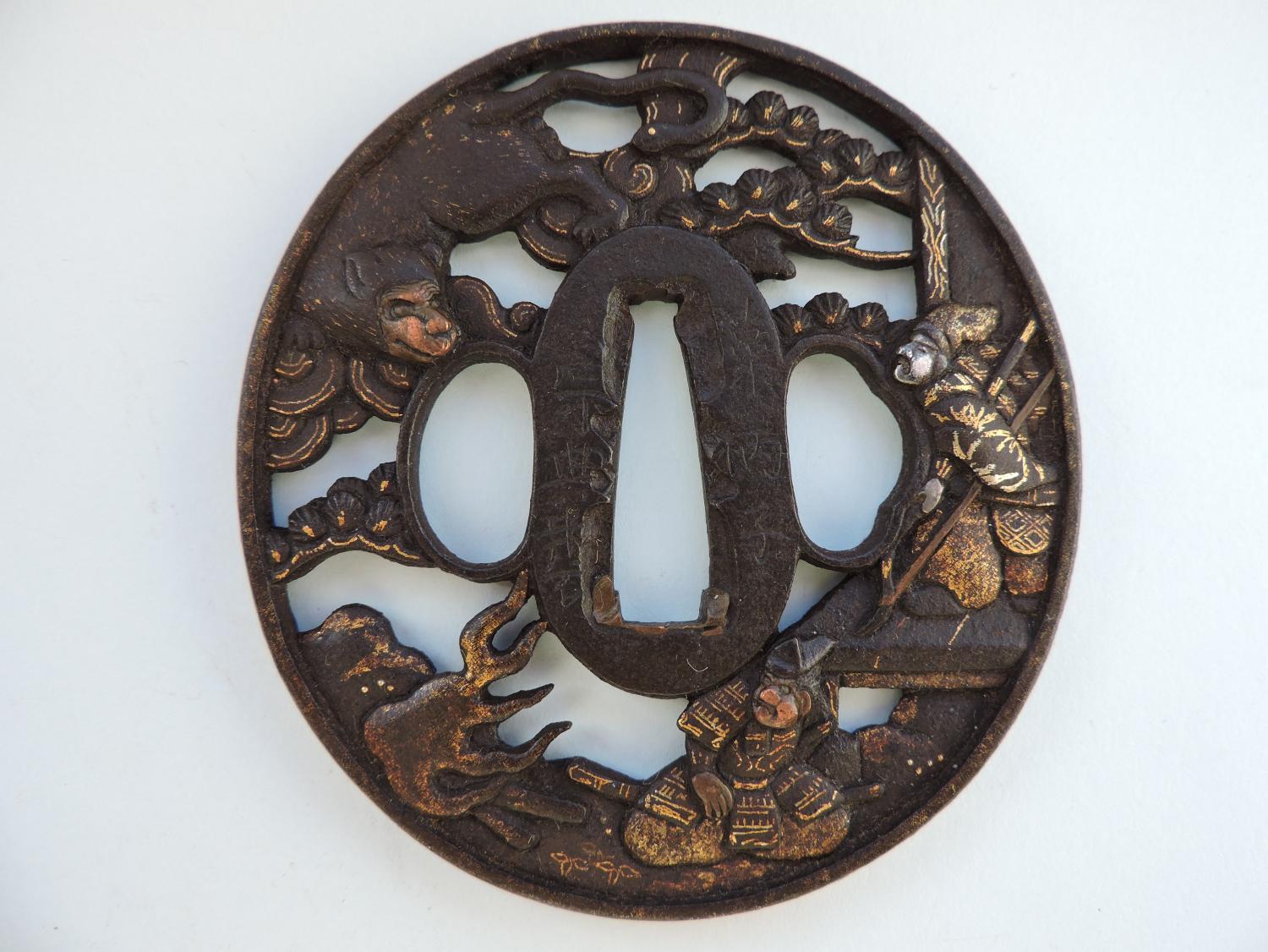
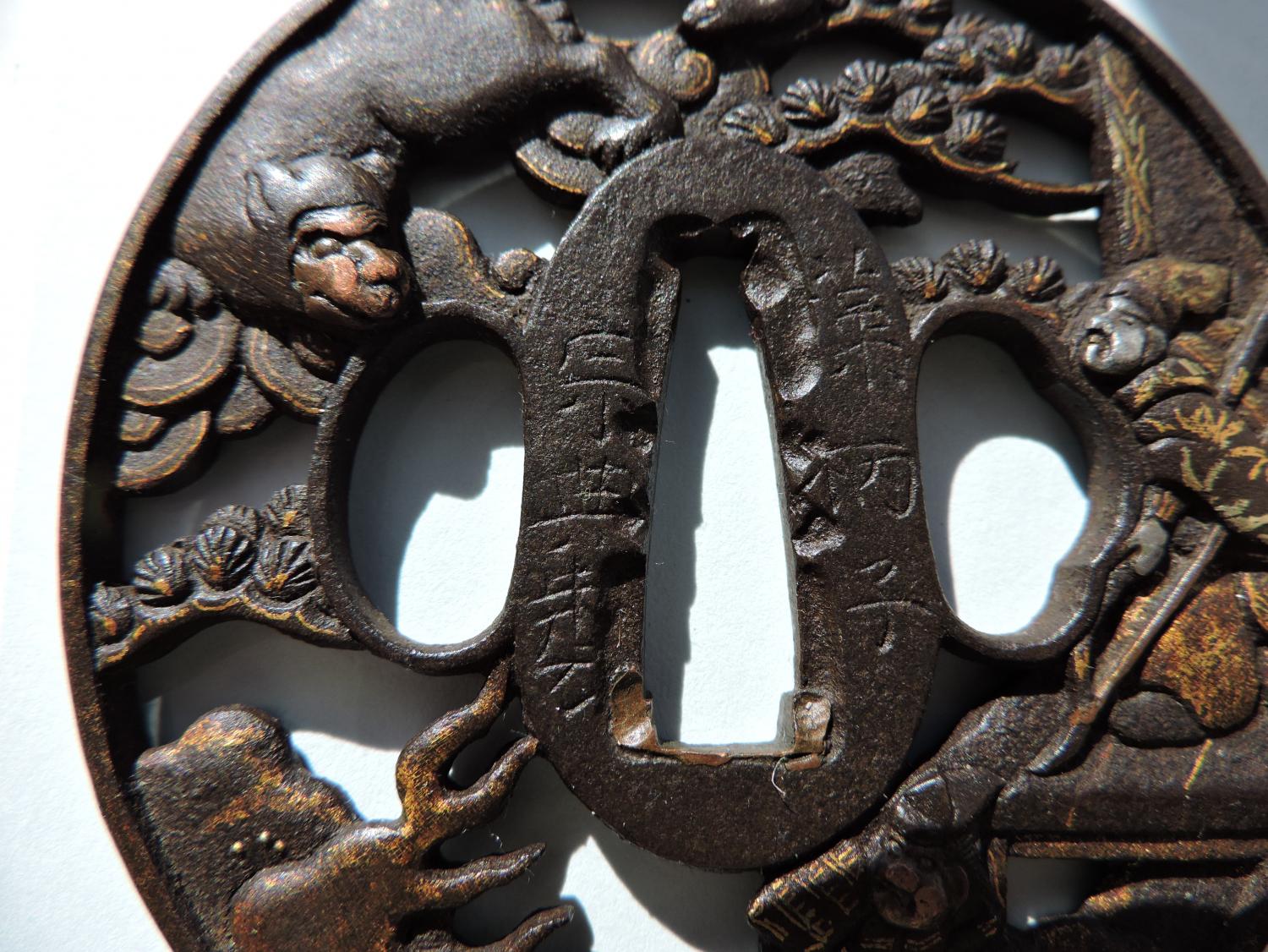
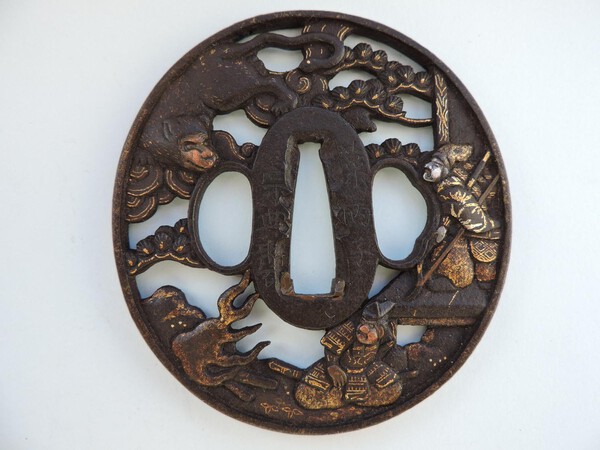
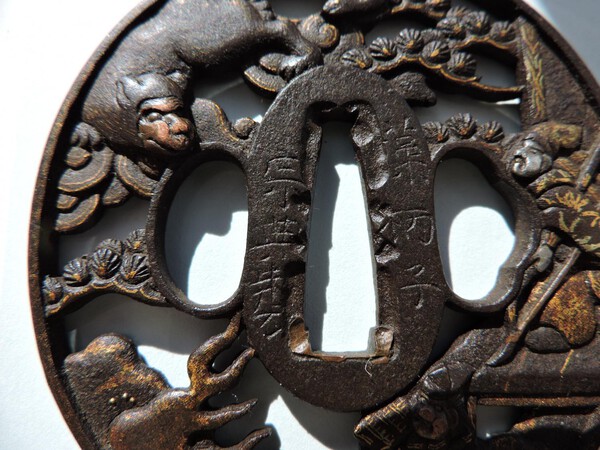
I’m not a fan of Soten tsuba, too fussy for my taste, but this one turned up in a mixed lot that I bought. Most Soten tsuba depict samurai battle scenes which are difficult to identify, but I think that this one depicts Kato Kiyomasa (1562-1611) hunting a tiger while on the Korean (Imjin) campaign (1592-1598). Kiyomasa can be identified as the figure on the right by his trademark high helmet (his famous one was higher) and spear. Apparently Kiyomasa enjoyed hunting tigers while on the korean campaign (OK, not exactly a recognisable tiger, but it does not look like any Japanese animals either). The faces of the samurai and tiger on the front of the tsuba are worn, but otherwise in fair condition. The faces are copper and silver and the details are highlighted in gold nunome. The reverse is in better condition and shows pine trees and a fire with swirling smoke (presumeably to flush out the tiger), highlighted with gold nunome. The rim also has traces of gold nunome. I think that the merit of this tsuba is that I have not seen this design elsewhere. The tsuba is signed Soheishi Soten sei (made), Soheishi being the founder of the Soten School, moving from Kyoto to Hikone about 1750. He used several forms to his signatures such as Goshu Hikone ju Soheishi Soten sei and Soheishi Nyudo Soten sei, the Nyudo added after he entered the priesthood. Soheishi can also be read as ‘Mogarishi’ and the craftman’s name ‘Soten’ was read as ‘Munenori’ before he entered the priesthood. The samurai designs of the Soten School became very popular and were heavily copied, with members of the school also signing Soten, in various ways. 17 members of the school are listed in Marcus Sesko’s genealogy charts. I believe that far more fakes than genuine Soten works are in existence and so I treat the signature on this tsuba as very suspect. I do wonder if Soten gave up making tsuba once his fame was established and he had several workers working for him, concentrating instead on drawing the designs for others to make. Best regards, John (just a guy making observations, asking questions, trying to learn)
-
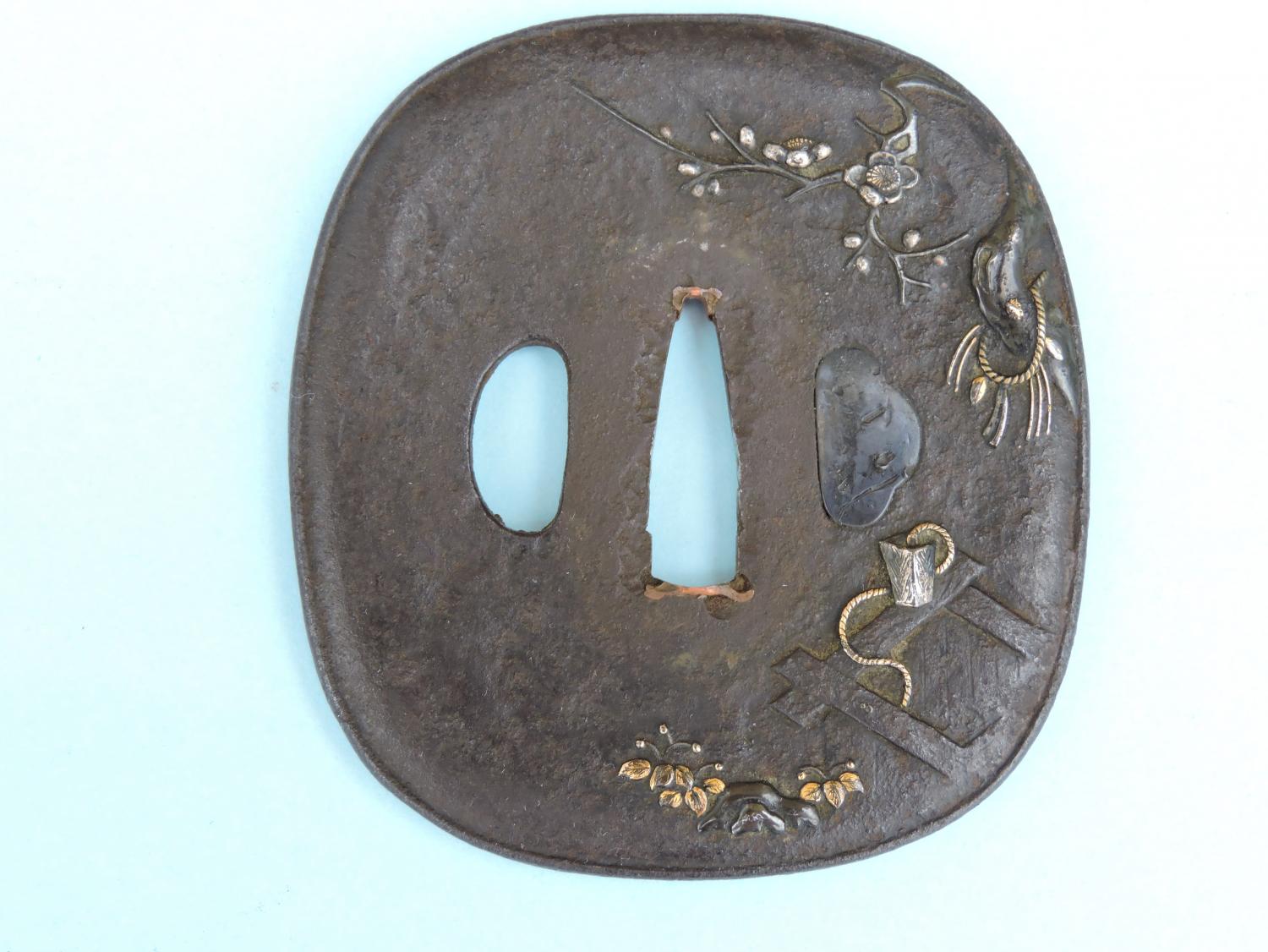
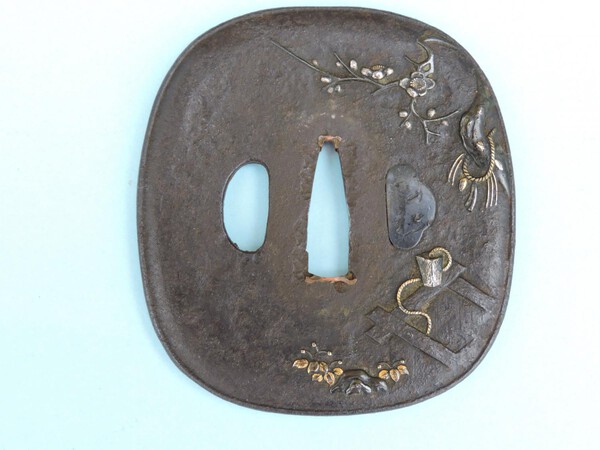
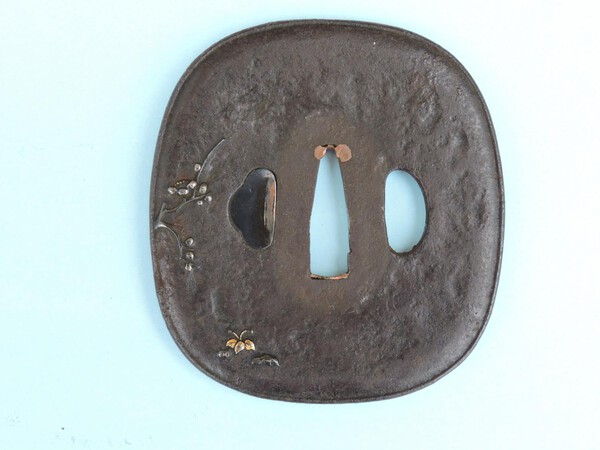
Happy New Year, guys. Just to start the ball rolling I’m posting a New Year tsuba. I believe that the design represents the ceremony of wakamizu, the drawing of the first water from a well on New Year’s Day, hence the rope garland around the tree. It must be in the south of Japan as the cherry blossom is out (ok, artistic licence). The tsuba has a hammered plate and is unsigned, but my best guess is that it may be from the Nara school where Kaneshige produced similar styled works around 1700. Comments welcome. The rim of the tsuba seems to be bound with an iron fukurin (band). This may just be carved into the plate of the tsuba, or possibly the rim has been hammered back on itself (uchikaeshi mimi), which seems to be a complex and skilful task. The tsuba has a takazogan inlay of coloured metals (gold, silver and shakudo) depicting a branch of a cherry blossom tree with a garland around the main branch. Below this is a square well head with a silver bucket and gold rope next to a small shakudo rock and ground plants. The reverse has a twig of blossom together with a small ground plant and rock picked out in gold and shakudo, respectively. Height: 8.2 cm. Width: 7.6 cm. Thickness: 0.3 cm January 25th is the Chinese New Year, the Year of the Rat. So lets see a few New Year tsuba. Best Wishes for 2020, but please don’t bid against me for the tsuba that I want to buy. John
-
Lovely tsuba. The Boston Museum of fine Arts has one with a similar basic design (unsigned Ishiguro School and does not look as good). Accession no. 13.1958 Nive prezzie for Xmas and New Year. regards, John
-
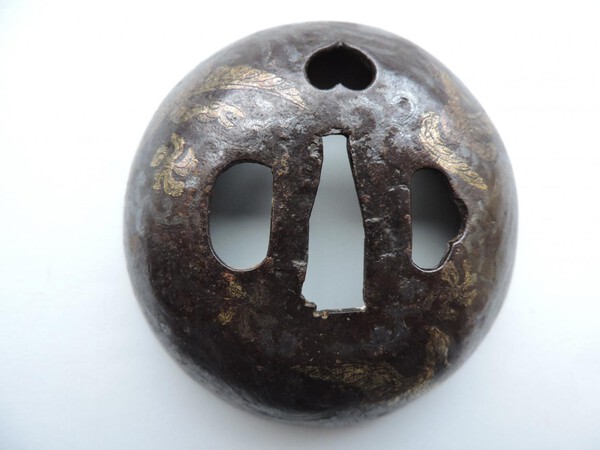
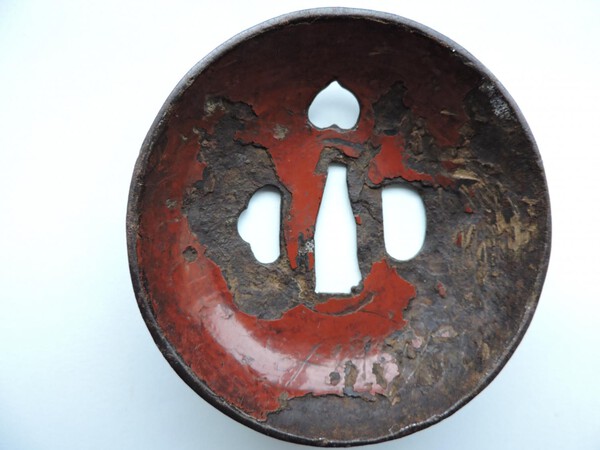
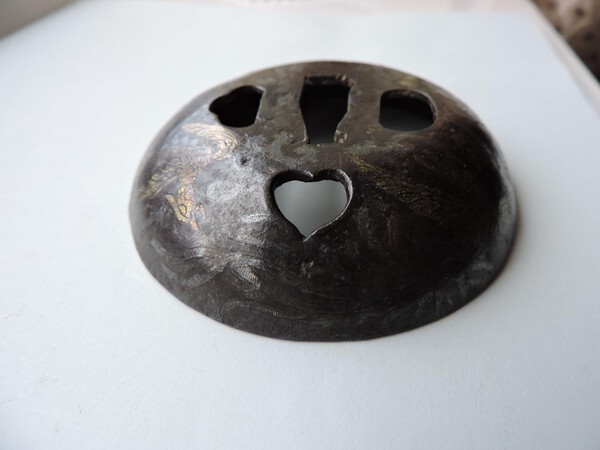
I believe that I have posted this tsuba before. It is decorated on the inside with red lacquer. On the outside are three engraved phoenix in silver and gold gilt (difficult to see in the photo). The boars eye (heart) piecing is also large for a tsuba. What religions do you no that are based on three deities (father, son and holy ghost), believe in rising from the dead (or ashes) and depict the #2 deity with a large heart? I believe that this tsuba belonged to a Christian (Roman catholic). Regards, John
-
Jerimiah, Just looked at the photos on the link supplied by Bruno, which show the area clearer. No sign of a signature being removed. Hope I did not frighten you. John
-
Hi Jeremiah, A very nice restrained design. One adverse observation is that the surface either side of the nagako ana looks like it has been hammered flat. If it was not for the NBTHK Hozon I would be wondering if someone had not obliterated a signature that they did not like. Any explanation? all the best, John
-
Thanks guys for your comments. It seems that there are some nice Tochibata tsuba out there that are not cast, despite the Nihon To Koza virtually describing the Tochibata School as a minor one of village blacksmiths. I see that the Ebay tsuba sold for about £90, so maybe someone got a bargain in terms of a rust free sukashi tsuba from a rare school, or maybe not. I’m still left with the question as to who/why someone should want to make cast copies of a little known school of tsuba makers when Akasaka etc tsuba would have been more lucrative. After all, painting forgers tend to copy Rembrandts and Renoirs, not unknown artists whose original work can be bought cheaply. I see we are moving onto tekkotsu again. Is it hard or soft iron? When I have suggested previously that tekkotsu is formed in a final heat treatment I have been told that there is no evidence that tsuba were subject to yakiire. Reading Markus Sesko’s excellent ‘Handbook of Sword Fittings related terms’ I find three references to ‘yakite’ (translation of ‘application of heat’) as the final stage in the production of some tsuba. I don’t know if ‘yakite’ is another way of reading ‘yakiire’, but Markus tends to be very exact in his translations and corrects general misreadings of kanji found in other books. My conclusion remains that heating and quenching would lead to the formation of hard martensite particles which would be prominent from the surface as softer iron shrinks more during quenching (as in sword making), whereas heating without quenching might lead to the preferential loss (oxidation) of hard iron (as in acid etching) leading to soft iron tekkotsu. After carefully looking at my tsuba, my money is still on hard iron, but as we scientists say ‘We need more research’. I have several cast tsuba, but none have tekkotsu. Best regards, John (just a guy making observations, asking questions, trying to learn)
-
I have several Nobuie tsuba in my collection, they are in great condition and look as if they were made yesterday, or in the 19thC at the latest! The famous 16thC Nobuie (maybe two generations) is probably the most copied, signed, tsuba artist of all. But to be fair, generally, the copies are still nice tsuba. Regards, John