JohnTo
-
Posts
283 -
Joined
-
Last visited
-
Days Won
1
Content Type
Profiles
Forums
Events
Store
Downloads
Gallery
Everything posted by JohnTo
-
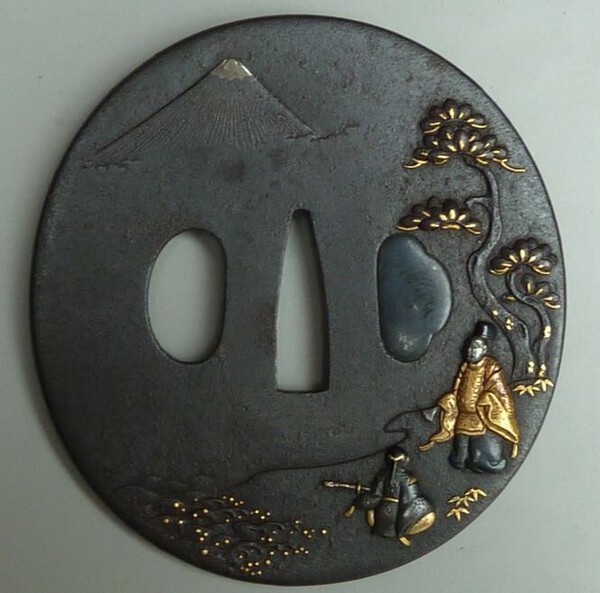
Dale is correct about the subject, it is Ariwara no Narihira (825-880) writing one of his famous poems. Toki shiranu yama wa fushi no ne itsu totemo ka no komadara ni yuki no furu ran Fuji is a mountain that knows no season. What time does it take this for, That it should be dappled with falling snow? I also have an iron tsuba with this subject (attached). Narihira was also the author of the poem that provides the subject for the yatsuhashi (8 plank bridge) so popular in Kyo sukashi tsuba (Karakoromo kitsutsu narenishitsumashi arebaharubaru kinurutabi oshizo omofu.) I have a beloved wife. Familiar as the skirt of a well- worn robe And so this distant journeying fills my heart with grief Apparently written when he was banished from Kyoto for having an affair with a high born lady of the court. So much for the beloved wife! best regards, John
-
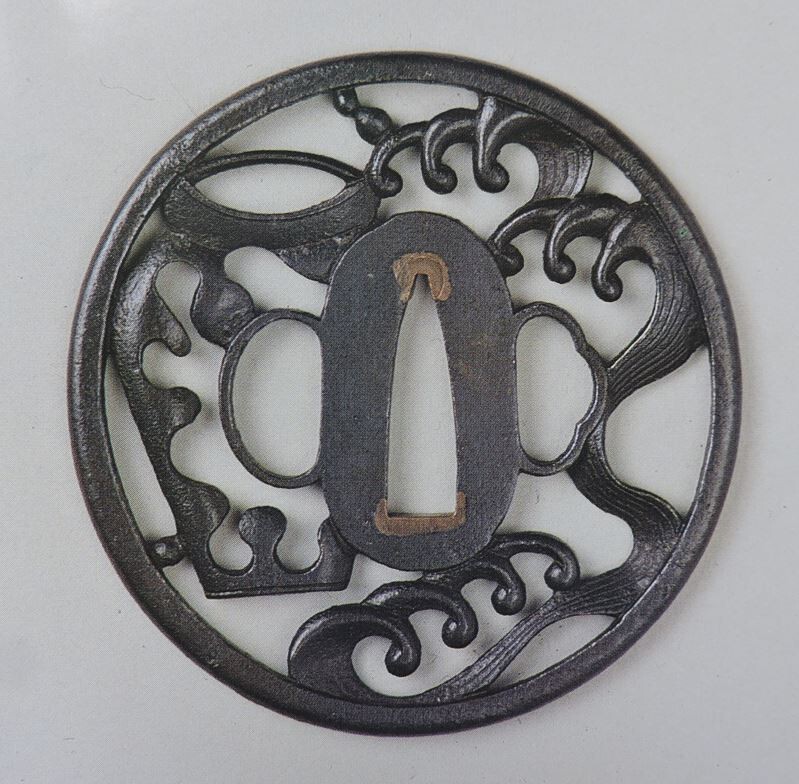
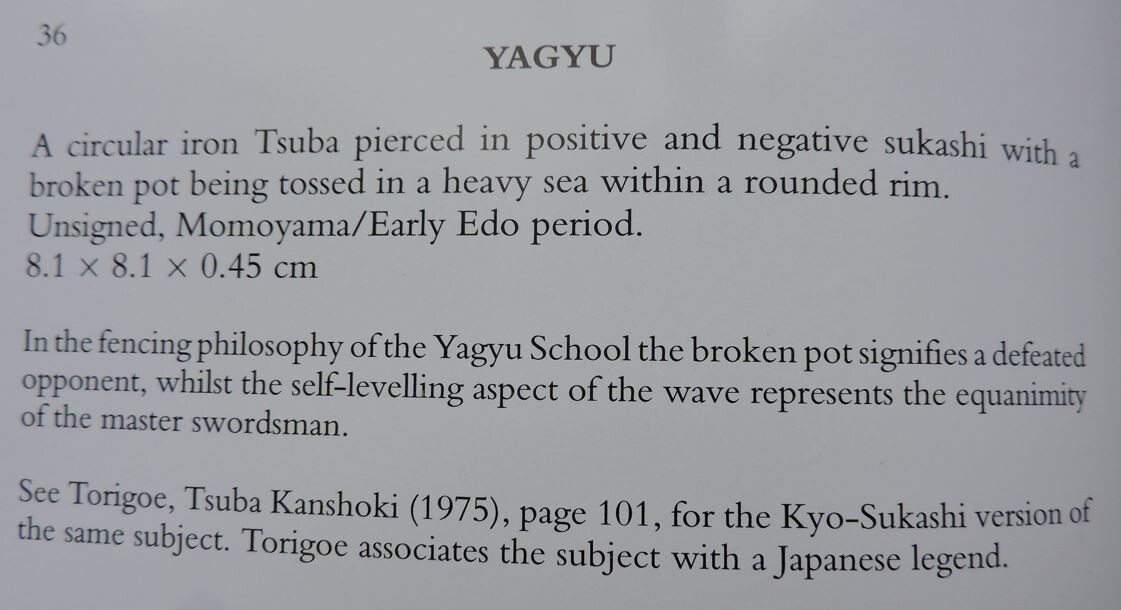
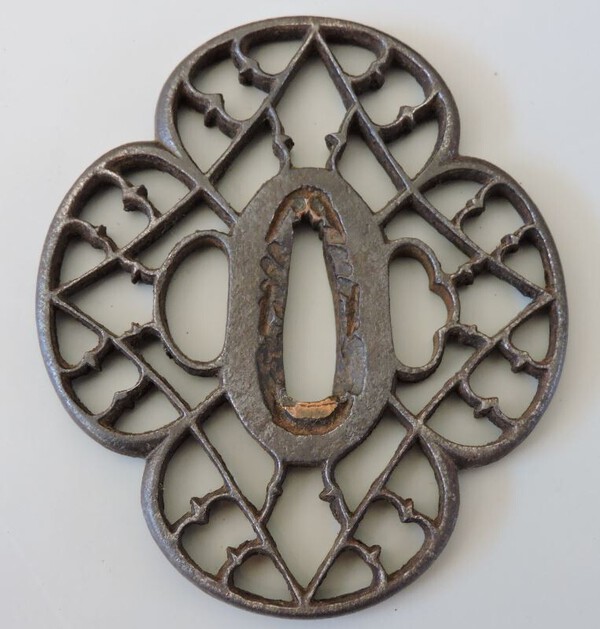
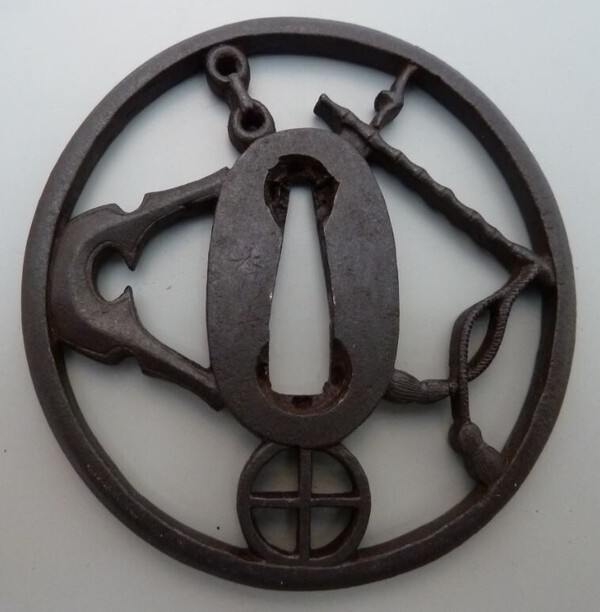
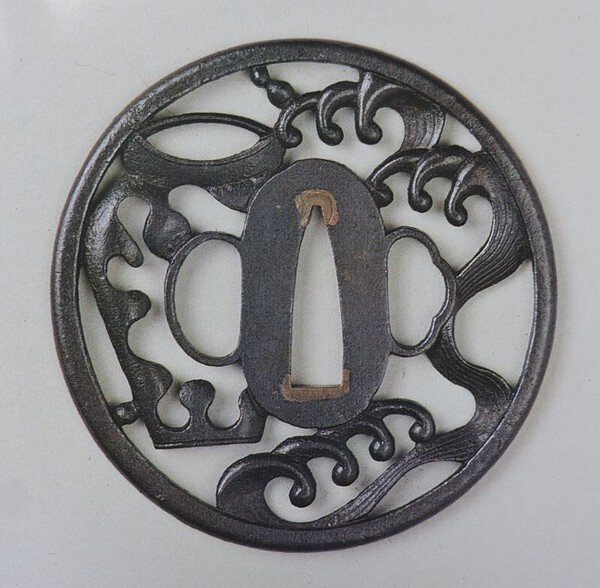
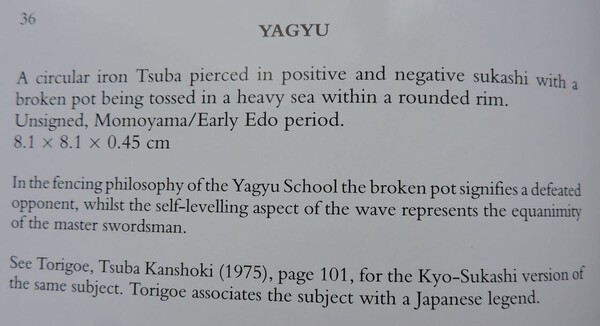
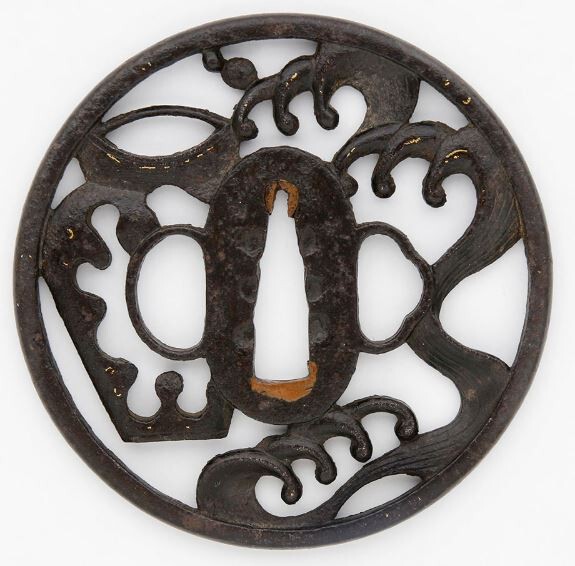
Hi Damon, Welcome and nice tsuba. I have a couple of comments/questions regarding your post. 1. A very common linking element in sukashi tsuba is karigane (geese). I’m Ok when they form part of the design (see Kyo-sukashi mokko tsuba with 24 karigane), but in tsuba #2 (saddle, whip and bit, by Hidemitsu) there is a single karigane at the 1 o/clock position, which has no apparent association with riding equipment. Why were karigane so popular when they have no apparent connection with the design? 2. I particularly like your Echizen ju Kinai saku tsuba with the broken pot and waves. I have recently been trying to find out more about this design. The RB Caldwell masterpieces collection had an almost identical one attributed to Yagyu (see pic of tsuba and catalogue description). Not papered and does not look Yagyu workmanship to me. The second is on sale at Aoi Art (see pic) and has a NBTHK Hozon attribution to Kyo-Shoami, which looks right to me. Its interesting how three similar tsuba can be attributed to three differing Schools. Also I’m intrigued by the design, a broken pot and waves, which does look like it might be Yagyu originated. What does it actually signify? There is a Torigoe reference to a Japanese legend (see pic) on the RBC tsuba, but I don’t have access to this. It is also reminiscent of the Kurasawa film Kagemusha in which Takeda Shingen is buried at sea in a giant pot. Anyone got more info? Best regards, John (just a guy making observations, asking questions, trying to learn)
-
I see that Dale has posted two examples of nanban mask tsuba from my collection, so I won't post them again. A different line of research that I have tried to follow is Korea. The Japanese invaded Korea in the late 16th C under Hideyoshi and finally withdrew when Ieyasu established the Togugawa shogunate in the early 1600s. Some people date these 'Canton' tsuba from this time period, whereas others date them later, but I think both dates are guestimates rather than based upon evidence. I have failed to find any detailed examples of Korean swords from this period, but some looked very much like Japanese swords. Could these tsuba have originated on Korean swords and been taken back to Japan as war booty and reused? As I said, my research has drawn a blank, particularly with regard to the shape of Korean sword tangs. Best regards, John
-
Hi Geraint, Very nice tsuba. I'm particularly impressed with the boldness of the design in that the artist has only connected the body of the tsuba to the mimi at the three apexes of the triangle. The diamonds and karigane are free floating and look rather fragile and easily broken off, unlike the examples from Dale. But the tsuba is thick, 6 mm, so it does have strength and the free floating parts are OK. The unusual design, roughly (hammer) finished mimi and tekkotsu would lead me to Owari. They did make large tsuba and I believe that Yagyu was an offshoot (it does have Yagyu features) Kanayama (usually smaller, but did make large tsuba) and Shoami (who made just about every genre through their numerous branches) would be secondary guesses. thanks for the post, best regards, John
-
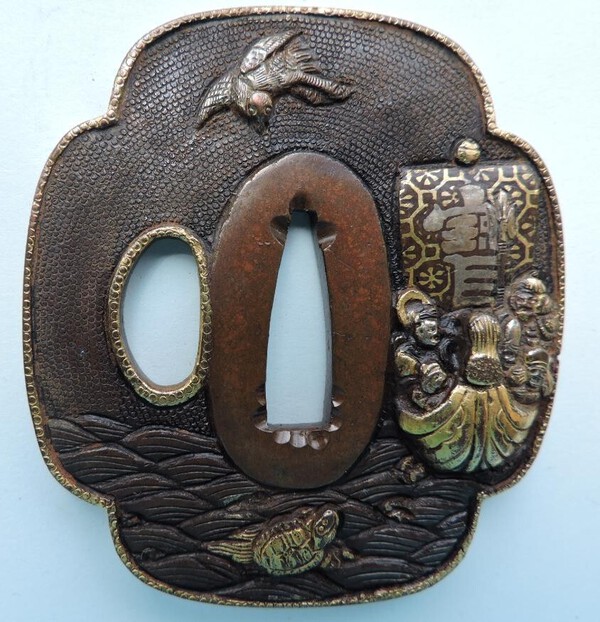
It would appear that Piers and Dale have more examples from 'Mr Suzuki's'workshop' in Nagoya. I started a post on 'Mr Suzuki's workshop' back in 17 Jan 2021 in order to highlight a genre of tsuba that were regularly appearing on Ebay and auction sites and often described with words like shakudo nanako, plus Mino and Goto. They were in fact Nagoyamono and made from nigurome, the base of shakudo without the gold. They had an identical form (see takarabune example below) with a characteristic pattern of tagane-ato around the nakago ana and NMB members sent in about 20 different designs. In view of the tagane patterns i surmised that they came from the same workshop and this was a quality assurance marks (I have a rubbish one without the tagane marks which I assume failed QA). Mr Suzuki was the fictitious name that I gave to the unknown owner of the workshop. From your examples and the pics I took of another 'shakudo nanako' tsuba that I saw at Bonhams this month (May 12, lot 135, see attached) It would seem that 'Mr Suzuki' produced a range of nigurome tsuba besides the original shape that I posted. So much to learn, John


-
Thanks everyone for you replies, and offers. I'm following one up. For others buying boxes the following may be of help regarding costs and quality based upon my purchases on Ebay. Bulk buying from Matsu Kage. 10 standard boxes with cushions for £150. But when you add on postage, UK import tax, admin costs for collecting the tax the cost goes up to about £22 per box. Second hand 5 tier double box from Japan about £86, thats £8.60 per tsuba, but it means that you have 10 tsuba in one large box. Small (10 cm square) boxes on ebay, 6 for £50, thats about £8 each. Poor quality finish (Chinese?) and only really suitable for wakizashi size tsuba. thanks again for your help, John
-
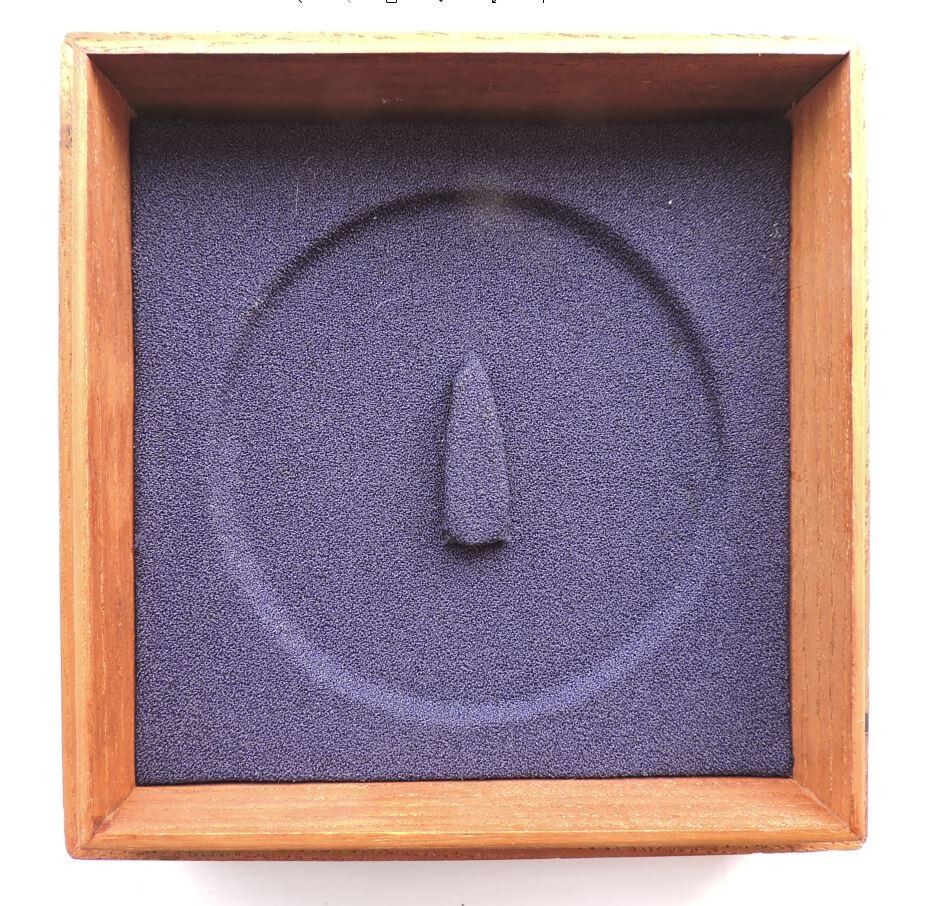
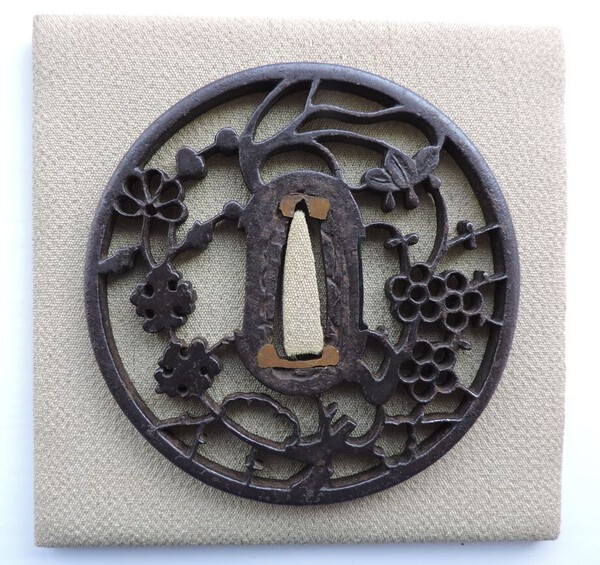
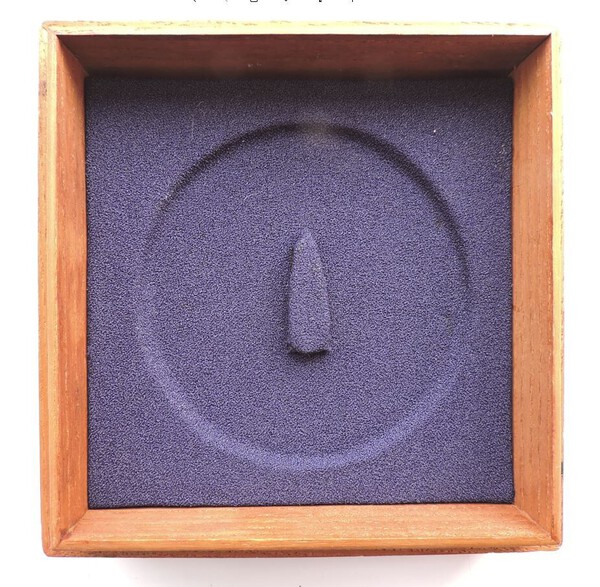
Hi Guys, Can anyone out there give me the name of a supplier of kiri tsuba boxes that come without inserts. I'm in the process of boxing up some of my tsuba but I'm not using the standard inserts that come with a one size nakago peg, held in with a couple of steel tacks. I'm making my own tailor made inserts (see pics) without any nails so that the tsuba does not slide around, knock the peg lose and scratch the tsuba on the nail. It seems that I'm paying about £25 for a kiri box and then throwing the insert away, which seems an expensive way of doing things. Box 1: tsuba on standard ill fitting pad. Box 2: box with replacement insert Box 3: box with replacement insert and tsuba all the best, John
-
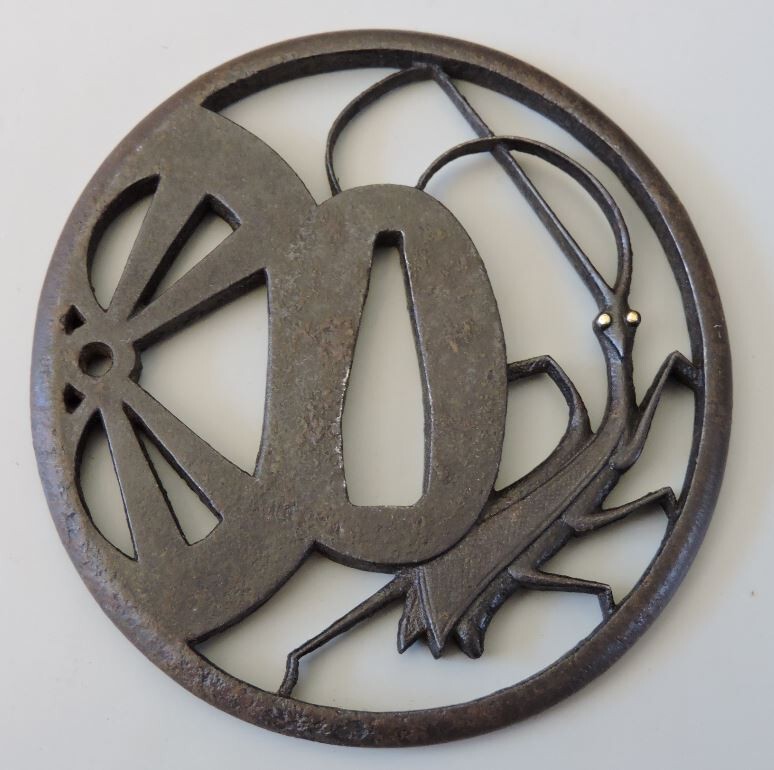
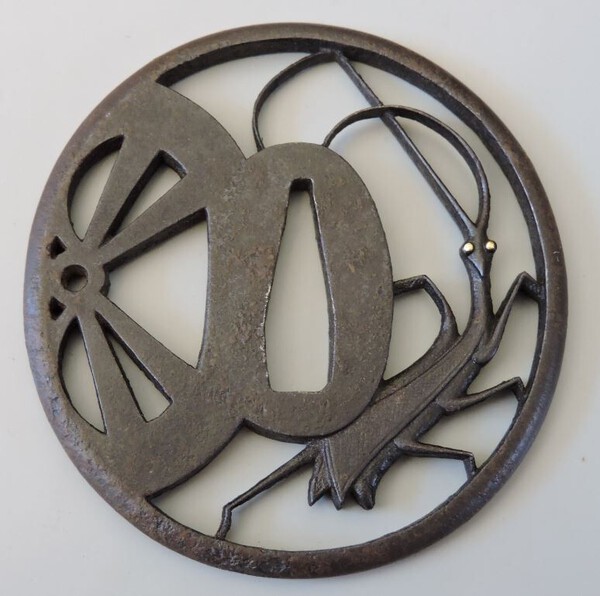
Lovely photo. The mantis has the same defiant look as the one on one of my favourite tsuba (late Edo, Bushu school, Mantis and wheel). I usually have this one out on display as when the room is in the semi darkness the golden eyes still shine out at me. Regards, John
-
Hi Bruno, I would put my money on a Kyoto school, probably Kyo-Shoami. This is based upon the complex picture type of design rather than a symmetrical pattern. Regards, John
-
Hi Bob, I should have added that I love your crane Shoami as a PS to my post. I still have not got a crane, but I'm looking. Best regards, John
-
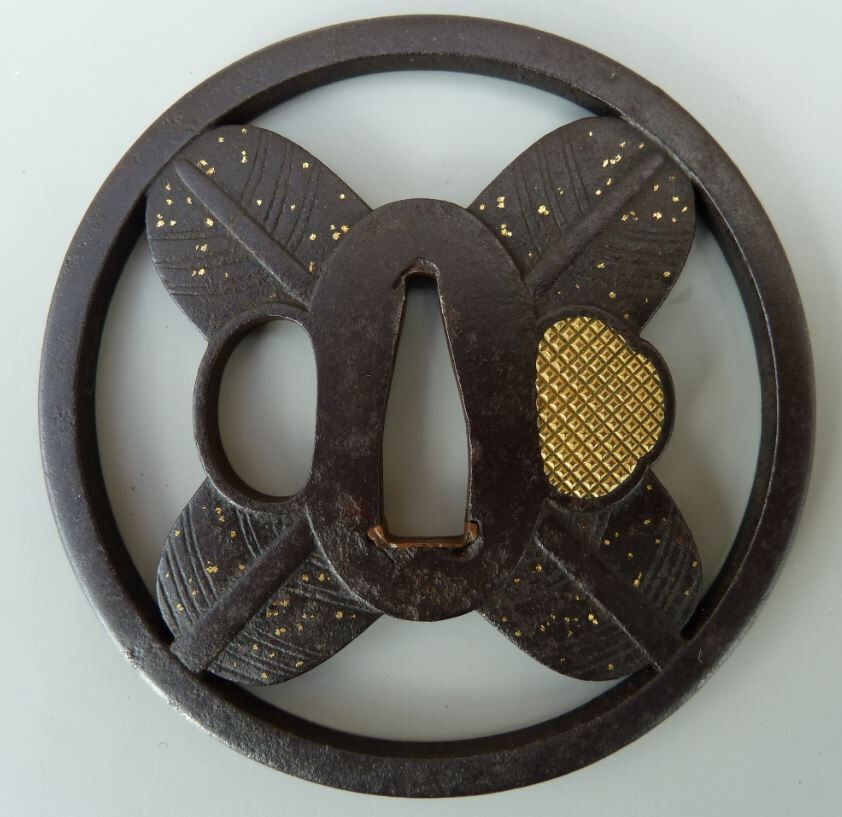
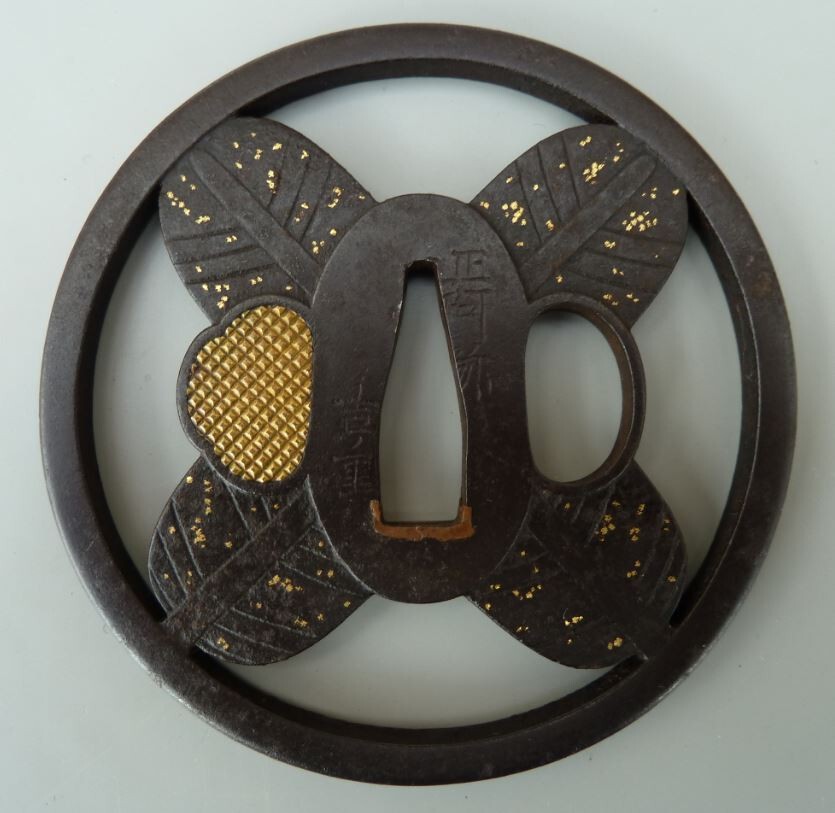
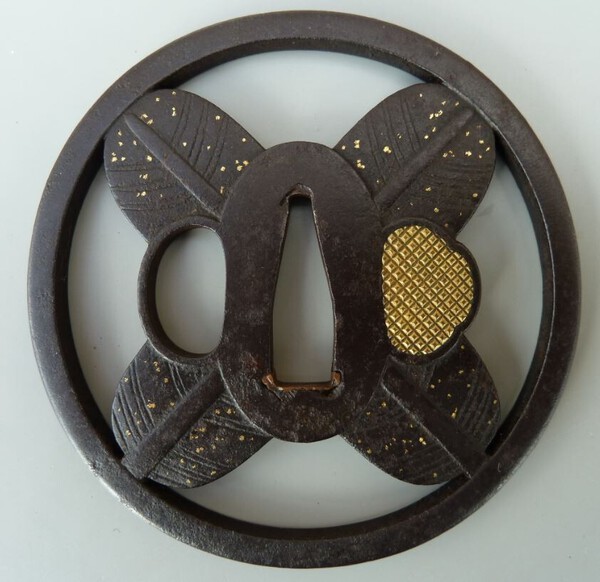
Hi Grev, I have several tsuba which I think might be Kyo-Shoami, etc (my and auction house attributions, so shaky), but as you want just Shoami I'll post this one as the artist just signed himself as Shoami Yoshishige. I'm not quite sure what 'Shoami' actually means as a school as I gather that tsubako were distributed throughout Japan working in the 'Shoami' style. The tsuba has a crossed feather design with specks of gold and one hitsu-ana plugged with gold. The tsuba is signed Shoami Yoshishige. Crossed feathers (tigai taka no ha) was used in the mon of several clans including the Abe and Asano families (of the 47 ronin fame). Usually the left feather is placed over the right, but it is documented that the Asano reversed this configuration. Unfortunately it is not possible to determine the configuration used in this tsuba Two tsuba artists, using the same kanji, are listed in the genealogies charts of Markus Sesko, the first is Yoshishige Gorosaku a student of Goto Takujo (second generation Kibei line, died 1637) and younger brother of shodai Kuninaga. He was famous amongst Kasu engravers, lived around Kan’ei (1624-1644) and received a stipend of 50 koku of rice from the Kashu Lord. The name Yoshishige seems to have been handed down to later generations. The second is a pupil of Muneshige, 5th generation of the Myochin school. Of these two artists the latter is more likely as the Myochin tended to work with iron and the Goto with soft metals. However, various branches of the Shoami School were widely distributed around Japan and this Yoshishige may have worked under a different name while working elsewhere. Height: 8.1 cm; Width: 8.1 cm; Thickness: 0.4 cm Best regards, John

-
Hi Bruno, Thanks for the example of another 3 lobed tsuba. I still can't help wondering why mokko gata tsuba with three fold symmetry shapes and designs are not nearly as popular as those with four fold symmetry. The Japanese are very superstitious and the number 4 (shi) also means death and is considered bad luck, so they usually they avoid things with 4 in them. However a 4-fold mokko gata shape is probably referred to using the alternative form of numerals (yotsu), i.e it is a yotsu-gata shape rather than a shi-gatsu one. regards, John
-
Chris, Steve. Thanks for your replies, especially for the information regarding Umemura. Good old NMB for helping me learn so much about tsuba over the last couple of years. I also thought that the shakudo shoji were a later addition and that the shakudo shim on the mimi might have been to repair a sword cut (practice, not warfare) as it would have been from a downward cut across the back of the blade. I still have not found another example of a three lobed mokko tsuba though. It seems such a pleasing and practical shape that I thought it would have been more common. best regards, John
-
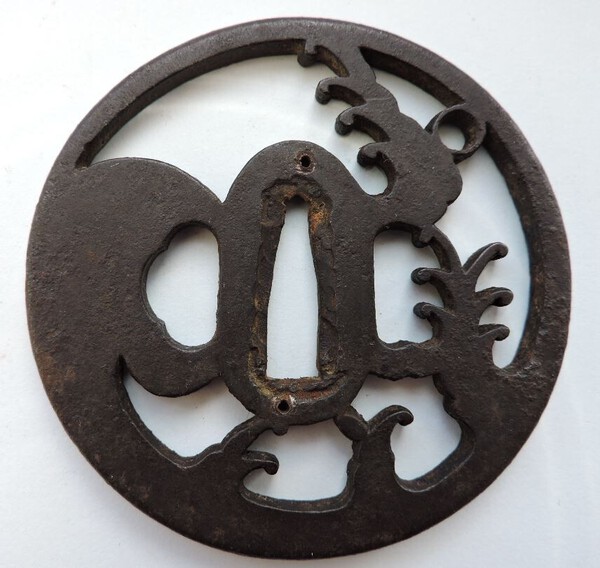
Hi Bruno, Just seen your tsuba. the design looks familiar. I posted this tsuba some time back. It was part of an old collection I bought at auction. It was not in great condition and had a lobster kashira rivited to the seppa dai. Probably used as a paper weight. My tsuba is iron and I put it down to possibly of the Ono school using a Yagyu design. Pics of mine with kashira attached. Best regards, John

-
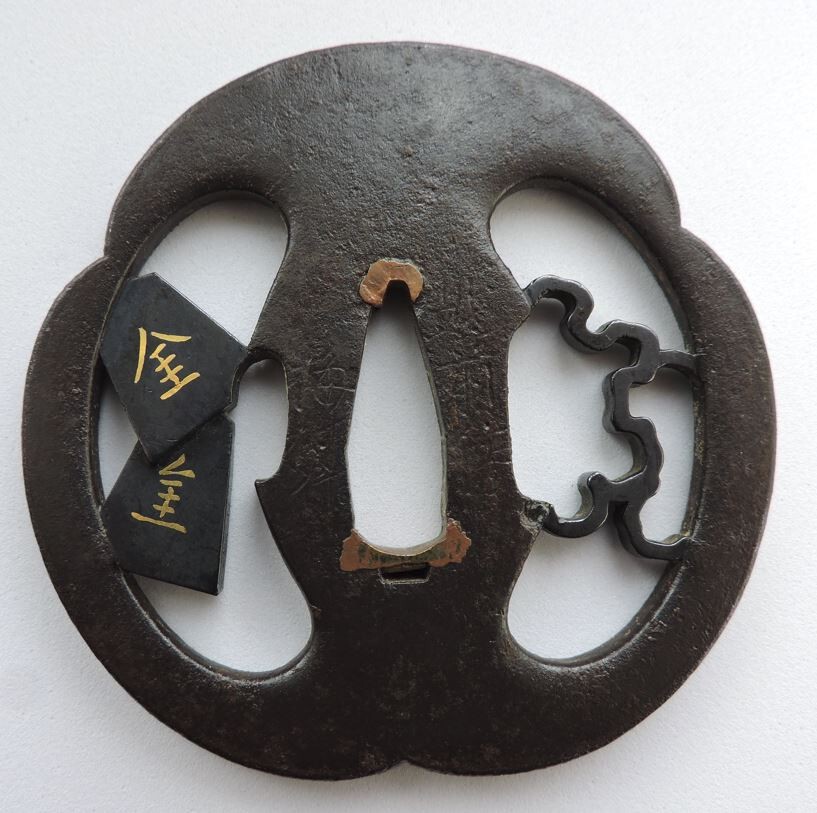
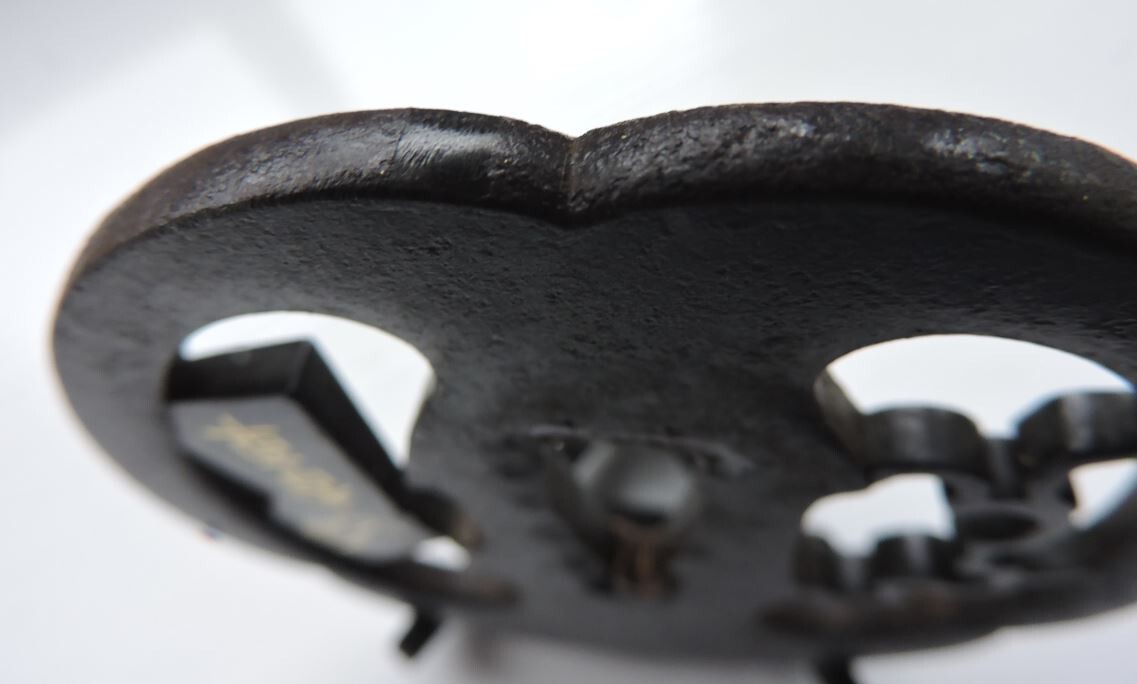
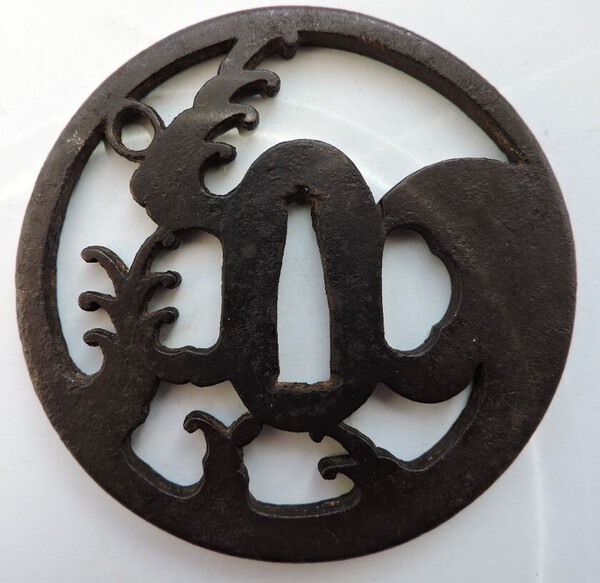
I’m posting this tsuba in the hope that some of you can help me answer the questions at the end. Essentially it is a katana sized iron sukashi tsuba with a pair of large namako (sea cucumber) openings, which have been partially filled with shakudo shoji and a border for a hitsu ana. The iron has a deep brown, purple appearance with couple of fold lines and a few granular tekkotsu on the mimi and plate. I would guess that it is 19thC workmanship. One side of the seppa dai has been cut back for a small kogai hitsu ana and the other side has been cut back to accommodate a much wider kodzuka (?). Both hitsu ana are bound by shakudo inserts; an abstract cloud (?) on one side and shoji chess pieces on the other. The tsuba differs from the usual namako sukashi tsuba in that the body is formed of three mokko type lobes instead of the usual two. I have searched through several hundred pictures of tsuba in books, catalogues and was surprised not to find another three lobed mokko tsuba. I suppose that three lobes resembles the Tokugawa mon and its use may have been restricted in the Edo period. The nakago ana is surrounded by shallow tegane marks on one side and is fitted with copper seki gane. The tsuba is signed on the seppa dai ‘Echizen ju Umemura’, or possibly Baimura (越前住梅村). The left namako opening has an irregular cloud shaped piece of shakudo inserted which seems able to accommodate a very wide kodzuka. The other namako opening has a pair of shakudo shoji (Japanese chess pieces) inserted and inlaid with gold identifying the pieces as the knight and lance . on one side and the promoted silver and the promoted lance . on the other (I think). Ooops, I don't think the shoji pics will upload! At the bottom of the tsuba there appears to be another shakudo insert across the mimi (I don’t think it is just a polished piece of iron). This piece is 4 mm square, with perfectly cut straight edges and just a ‘sliver’ in thickness. Possibly it was put there to hide a small imperfection in the iron. Statistics: Height: 7.2 cm, Width: 7.3 cm, Thickness (rim) 0.5 cm, Weight 106g Questions: Has anyone information regarding the maker Echizen no ju Umemura? I can find no tsubako named Umemura (lit. Plum village, but possibly read as Baimura). The tsuba does not seem to have characteristics of the Echizen Kinai school. The three lobed Mokko shape is unusual, does it have a name? Sesko lists 5-,and 6- lobed forms as itsusu-mokko-gata and mutsu-mokko-gata, so three would be mitsu-mokko-gata using the same form of counters. Any ideas on why the small square of shakudo was inserted into the mimi? Is there any significance on the choice of shoji pieces? I’m not familiar with the game but I understand that most pieces are double sided and flip over if captured. Best regards, John (Just a guy making observations, asking questions, trying to learn)


-
Piers, Thank you for the additional information. It will give me hours of fun translating. I think I was lucky buying this tsuba at auction in 2019 together with three other equally good tsuba in the same lot. By chance I later came across this tsuba in a Sotherby's auction (Nov 199, lot 627) and recognised it as the same tsuba by the small blemish in the nanako. I paid almost exactly the same price for the four as the Akiyoshi sold for in 1996. Maybe tsuba prices are falling. Best regards, John
-
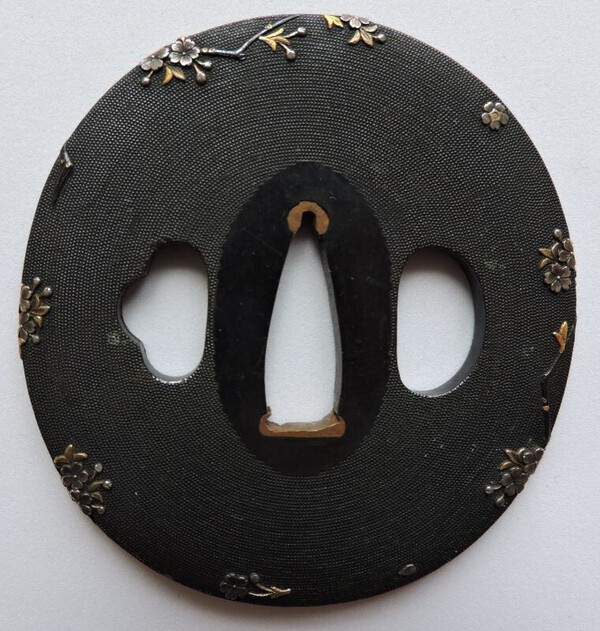
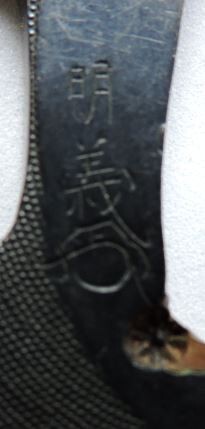
Hi Bruno, I have a tsuba inscribed (I never say signed as too many gimei) Akiyoshi. It is a shakudo nanako tsuba with a simple decoration. The signature on yours and mine look similar, but photo is too blurred to see clearly. My research is as follows: Akiyoshi does not appear in any of my reference books but may be attached to the Kono School in Edo during the 19th C. Markus Sesko’s genealogy charts (p. 43) show that Kono Haruaki (1787-1857) had 12 students who used the same ‘Aki’ kanji as the first character of their names. Akitatsu, a student of Haruaki, in turn had a student named Tasuyoshi of the Kobayashi family. Akiyoshi may be an unlisted member of this school, or may have changed one or more kanji in his name during his career, as Japanese artisans often did. Another reference (The Japanese Toso-kinko Schools, translated by Markus Sesko) lists Akiyoshi (civilian name Tanaka Bunjiro) as a student of Kono Haruaki. An entry in ‘The Early Famed Works of the Kyoto Smiths (Kyomono no Ko-Meisaku)’, tanslated by Gordon Robson lists a tsuba by Akiyoshi with a shakudo ground. The text states that ‘Akiyoshi is among the skilled kinko of the Aizu during the late Edo priod’ ‘There must be some connection with Kawano Haruaki, and because of his signature and kao, we can agree to such a conjecture.’ There appears to be a similarity between the kao on this tsuba and examples attributed to Kono Haruaki, so it looks like the artisan of this tsuba is probably the one referred to. Best regards, John


-
Hi guys, Markus Sesko has a small reference to cast iron tsuba in his book the Japanese toso-kinko Schools (p 129) which states that the kinko artist Daininchi Fucho (active around Horeki, 1751-1764) learned his skills ‘from Ugai Gorozaemon who belonged to an Osaka-based family of kettle casters who produced cast-iron tsuba as a sideline.’ We tend to think that the material used in iron kettles is too brittle for tsuba, or for swords, but look on Youtube (www.youtube.com/watch?v=f7z9pkQnz_0) and you will see a video of Miyairi Shohei breaking up iron kettles to make swords just after WWII when tamahagane was scarce. best regards, John
-
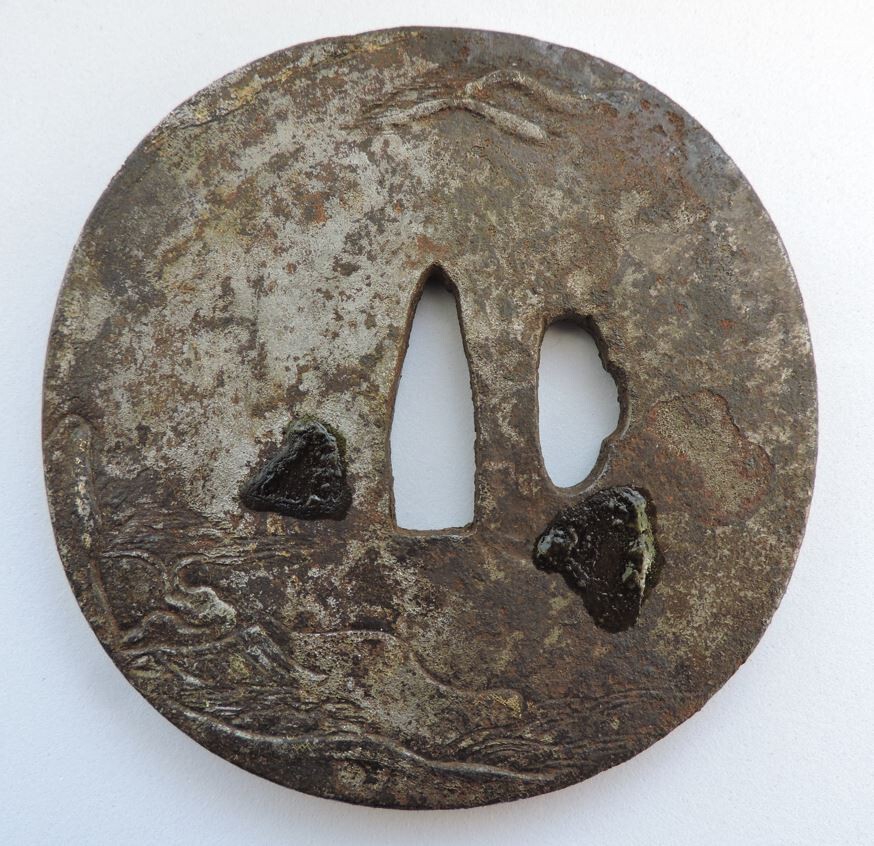
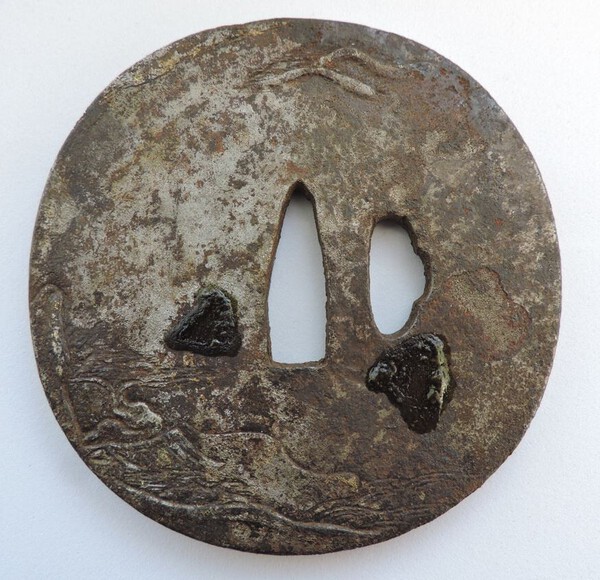
Like most tsuba collectors I have acquired some rusty junk examples. One that I have been experimenting with is a circular plate tsuba, covered with rust when I bought it as ‘the freebie’ in a mixed lot. It is round (8.3 x 8.2 x 0.45 cm) depicting a Chinese landscape with figures next to huts and a boat on a lake. Probably not commercially worth having it professionally restored. My first stage was to clean the surface with cotton buds soaked in WD-40 to remove most of the red surface rust. I like WD-40 (the name stands for Water Displacement formula #40) as it was designed for the aerospace industry and seems to be able to seep in between the rust particles and the iron and loosens them enough to be wiped off with a cotton bud. At this stage the reverse side in particular seemed to have a grey-green colour and this led me to believe that a previous owner had removed the rust and patina with acid, or Cocoa-cola, but the exposed iron had rusted again. The little copper and silver tagazogan figures did come up nicely. After this and all liquid treatments I dry the tsuba with tissue (kitchen roll) and leave overnight on a hot radiator. My next stage was to use WD-40 and penetrating oil, separately, and an old electric toothbrush and this removed more light surface rust (you can see the rusty oils soaking into the kitchen roll) but did not seem to touch the heavy patches. My last stage was to try Renaissance Metal De-corroder, an amine complex of hydro-oxycarboxilic acid in aqueous solution at a pH of approximately 4.0 (i.e. slightly acidic), applied with a cotton bud. It is claimed that this material ruptures the bond between the base metal and corrosion layer, reducing iron oxide to sludge, which can be wiped away. Rust was certainly evident on the cotton bud, but a more liberal covering on the more corroded areas together with use of a piece of bone did not get down to base metal. As the tsuba was effectively junk I decided to try something more drastic. There were several heavily corroded areas and I dripped some De-corroder on these patches. I then placed the tsuba in a plastic box (CD case) to prevent the De-corroder drying out and left it overnight. The areas covered with De-corroder had swelled into a black jelly and wiping this off with cotton buds soaked in water revealed that the rust had been largely removed exposing the bare iron (see pics). I have not carried out this process any further, but I expect that I could end up with a rust free piece of shiny iron, which I would either protect using Renaissance wax polish, or try to repatinate. Please note that I am not recommending the use of De-corroder on areas of tsuba that still have some of the original patina. I have not tried it, but I would expect that long exposure would result in the patina being removed as well as the rust. Remember, rust and patina are both iron oxides. However, this product does appear to remove rust from iron while leaving the underlying metal untouched, which is more that can be said for use of hard abrasives or steel picks. Best regards, John Pic 1 and 2 Before cleaning Pic 3 and 4 After WD-40, penetrating oil with electric toothbrush Pic 4 and 5 before and after De-corroder



-
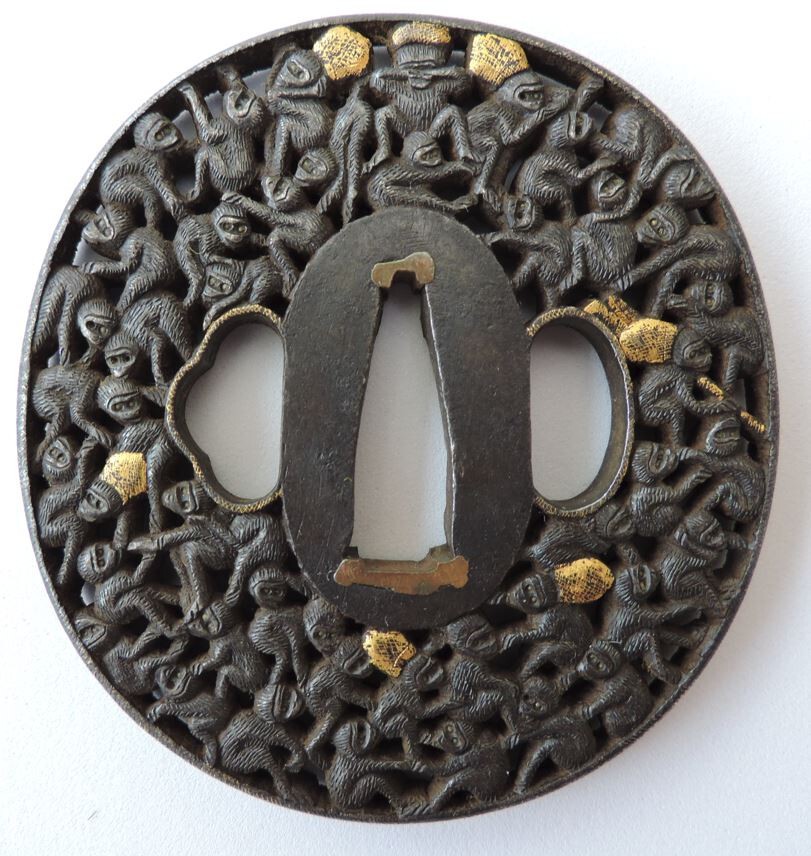
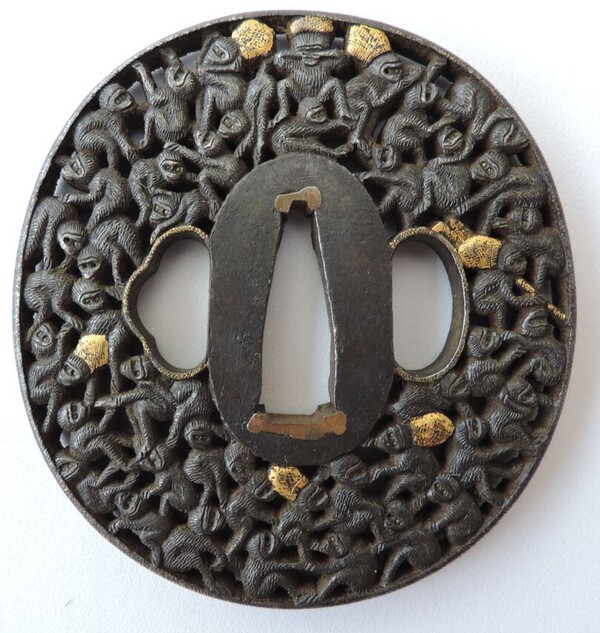
Sorry I’m a bit late getting into this discussion (poor vision due to cataract surgery). Simply put, my philosophy when it comes to rust on iron tsuba is that if it is outside the seppadai and can be easily removed with cotton wool, wooden toothpicks and oils, then do so. IMHO Iron rust scabs allow moisture to remain trapped and if salts (from the general environment, sweat, etc) have also found their way in the iron is going to continue to rust. Harder objects like ivory, bone and antler may be used for stubborn spots, but nothing harder than that. I don’t understand why Jim Gilbert has an aversion against cleaning sukashi piercings. Swords are repolished to remove rust, paintings are stripped of old varnish, museums clean their exhibits. What is special about tsuba? While I would not clean sukashi with a file, sandpaper or steel pick (which would damage the patina and expose bare iron), I regularly use a wooden toothpick with a small piece of cotton wool attached or a tooth flossing brush (see pics) with a bit of WD-40 to remove loose (red) rust and general detritus. Why would anyone want to leave rust, bellybutton fluff etc. (possibly impregnated with soy sauce or other corrosive chemicals) within the piercings? Most of my sukashi tsuba were obtained from old collections and have obviously been neglected. I would remind those non-chemists amongst you that the black and brown patinas found on iron tsuba are essentially the same thing as rust (iron oxides). However, patinas are created in a controlled fashion so that the oxide forms a tight bond with the iron hindering further corrosion. When bare iron corrodes the rust does not adhere strongly, flaking off, exposing more iron which continues to oxide. Moisture and ionic chemicals, e.g. salt, getting trapped in the rust will accelerate corrosion. Remember, rust never sleeps, but removing moisture and salts will slow its progress. To illustrate, attached is a senbikizaru (1000 monkey) tsuba that had a lot of loose red rust in the sukashi. I cleaned it using just a toothpick wrapped in cotton wool and a dental flossing brush with WD-40. I don’t think that I have damaged the remaining patina. If I find signs of rust reappearing I will repeat the treatment and apply a thin coating of Renaissance wax polish, using a cocktail stick wrapped in cotton wool, which is claimed to be used in many museums. Best regards, John


-
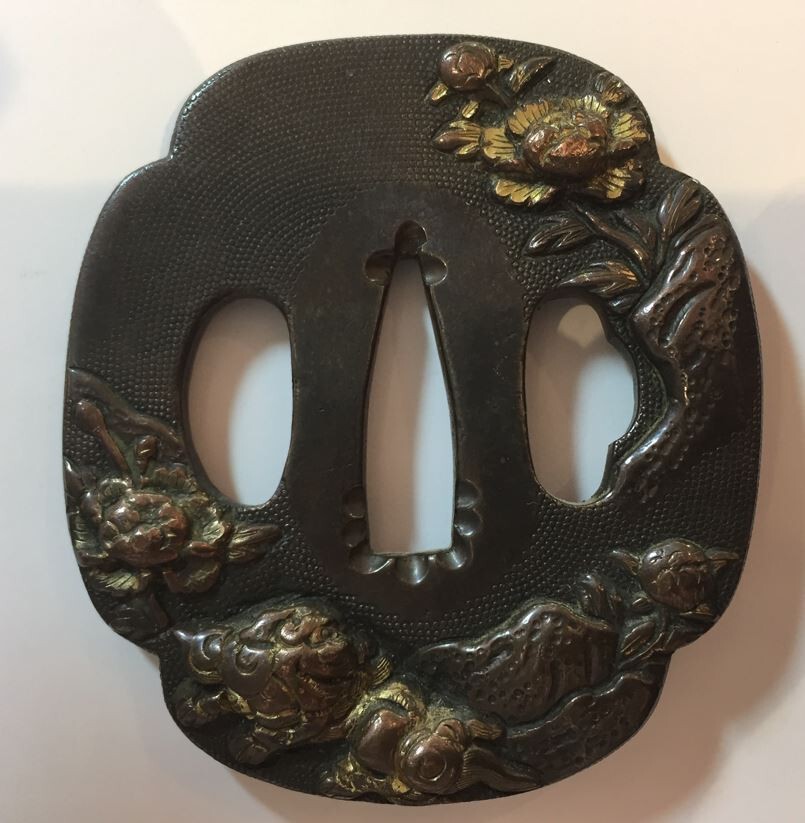
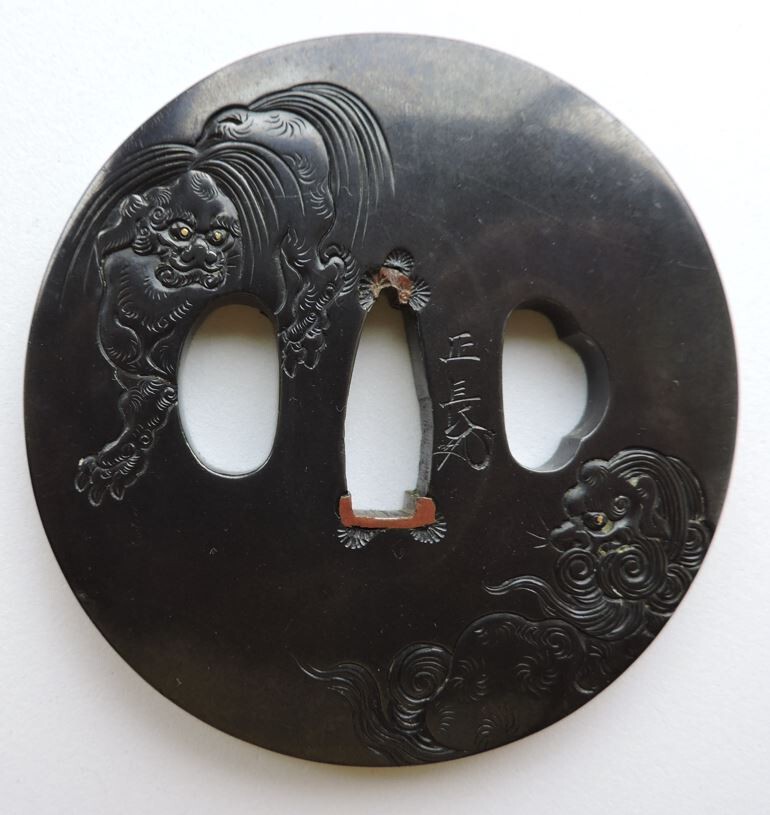
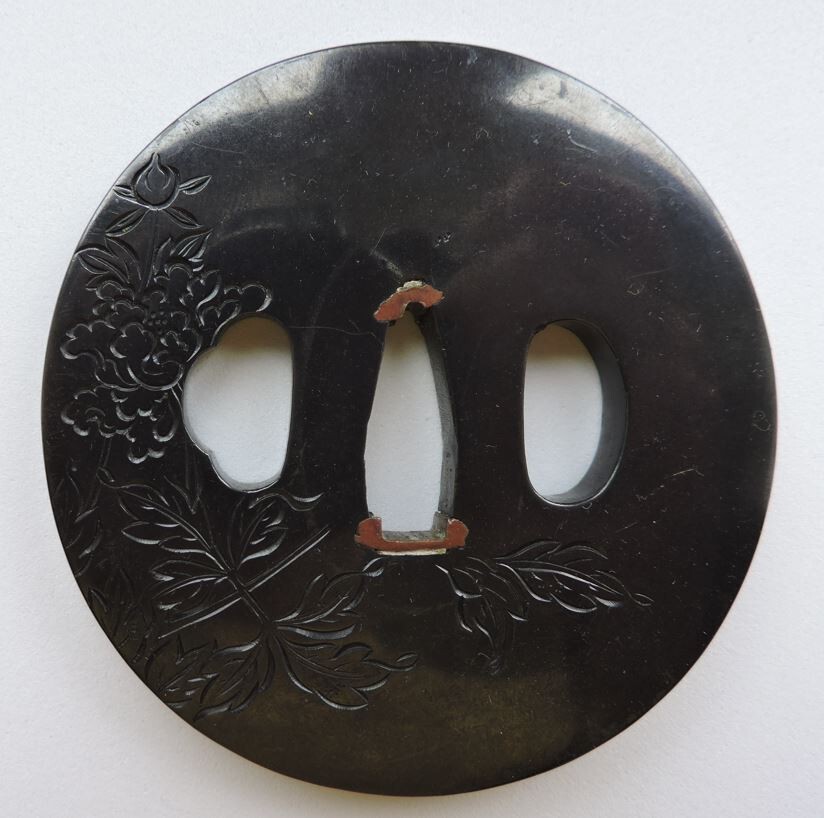
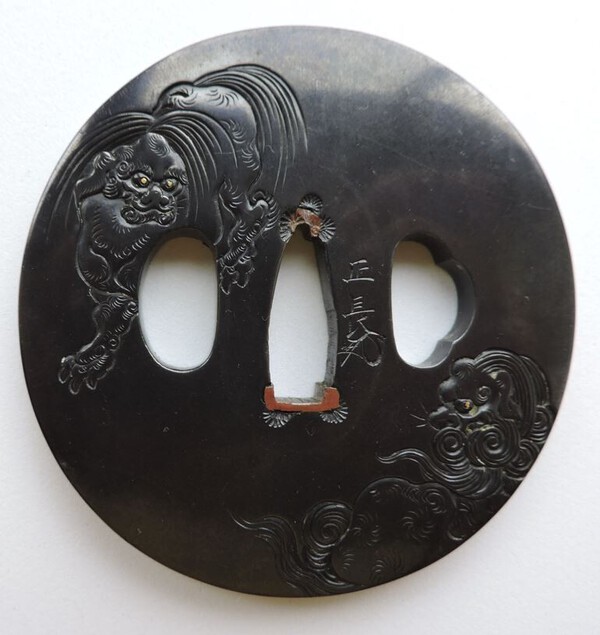
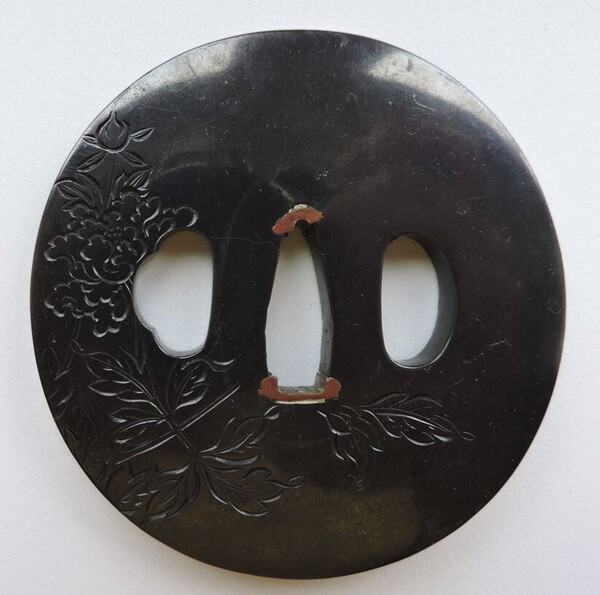
Here are two of the tsuba added to my collection this year, both depict shishi and peonies. The two tsuba were probably made about 200 years apart and show differing aspects of the subject. Shishi are mythical guardian animals in both China and Japan and the peony is regarded in Japan as the king of flowers and symbolises bravery, honour and good fortune. Consequently the two are often depicted on tsuba together. The first is a shakudo tsuba, signed Masanaga, plus kao, with a pair of shishi on the omote and a peony on the ura. The tsuba was catalogued as Haynes Index no. H 04250, which identifies the artist as Chosuke Masanaga (d. ca 1700), who was a student of Nara Toshinaga (Markus Sesko) or Ito Masatsugu (Haynes). However, there were two generations of Masanaga in the Nara School and both used the same kanji for their signatures. The first generation, Seiroku, was a student of Toshinaga (either the 3rd generation master of the Nara School or a student of the same name). His (adopted?) son was Gihachi Masachika, who signed Masanaga for a while after his father’s death and was from the Kawakatsu family and a nephew of Sugiura Joi. The Nara tsuba artist Gohachi Masachika may have been an alternative name used by either of the other two Masanaga (see gen chart). Consequently, there is some uncertainty as to the identity of the artist who made this tsuba (assuming, as always, the signature is genuine). Specification: Height: 7.6 cm, Width: 7.4 cm, Thickness (rim): 0.4 cm, Weight: 216 g This tsuba was purchased by Edward Wrangham from the Roland Hartman Collection of Japanese Metalwork (Christies, 30 June 1976, Lot 130). I was told by the late collector and friend, Sidney Divers, in about 1976 ‘Start collecting tsuba. They will soar in price.’ In 45 years this one barely doubled. The second, a copper tsuba, is a radically different interpretation of the same theme and was made by a modern artist, Yanagawa Morihira (1899-1971). Apparently Ichiyushi/Shinryuseki/Shinryoso) Morihira was a Tokyo artist. From the age of 14 he studied with Yoshioka Mitsushige (who died 14 September, 1923, in the Great Kanto Earthquake). He then studied with Toyokawa Mitsunaga (second generation) and took the name Mitsuo until he established himself. The front (omote) of the tsuba shows both a shishi and peonies, whereas the reverse (ura) only shows the shishi. Interestingly, the shishi on the omote has a silver body and a golden mane and tail, whereas the combination of silver and gold is reversed on the ura. The heads on both animals is copper. Shishi are often represented as playful creatures, but these two are muscular with a fearsome pose and the silver shishi has a head which looks rather like Hannya, the Japanese female demon. The engraved peonies on the omote are coloured with silver and gold gilding and the petals are in a darker shade of silver. The gold and silver seem to be painted on, i.e. amalgam. The outlines are defined in katakiribori (half cut carving) and kebori (hair carving) and, particularly the silver, darkened to add extra tonality to the design. The nagako ana has four 32(?)-petalled chrysanthemum punch marks on each side, purely for decoration. There is also a single kozuka hitsu ana, filled with a gilt cat scratched plug. Shishi is also the name given to a group of political activists (Ishin Shishi 維新志士) in the late Edo period who opposed the westernisation of Japan. I think that it is likely that this tsuba was made in the 1930’s when Japanese militarism was at its peak, which is probably why I got it below estimate. Specification: Height: 8.75 cm, Width: 8.4 cm, Thickness (rim): 0.7 cm; Nakago: 0.4 cm, Weight: 254 g A very similar tsuba to this, in terms of technique, by Morihira is currently for sale by Aoi-Art (https://www.aoijapan.com/tsuba-morihira-sinryuseki/). I bought this tsuba in memory of my nephew, Gary, who died a few weeks before this tsuba originally came up for sale in 2020. It was unsold and came up again at the next auction (2021) when I decided to buy it. I would not normally have purchased this tsuba but Gary was an extrovert party guy whose group of girlfriends gave him the nickname Simba. This over the top depiction of shishi will always remind me of Gary. All the best for 2022, John


-
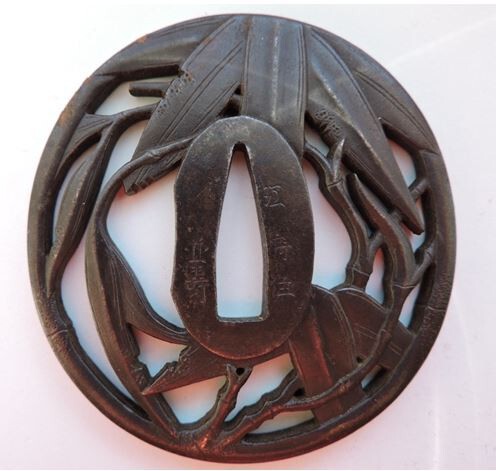
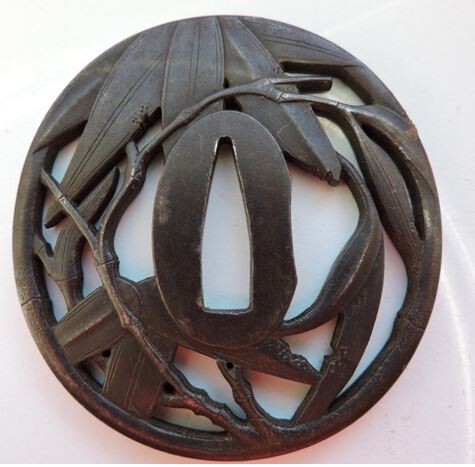
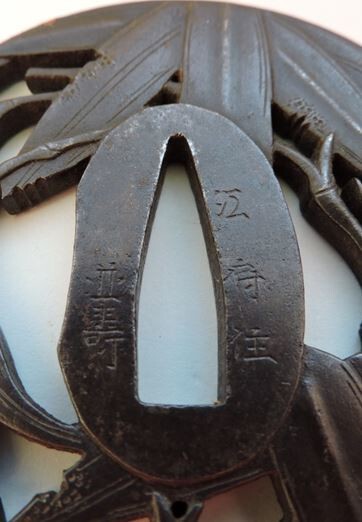
Hi Guys, I've been out of action for a while and missed this post. But here is one of mine, a tsuba signed Efu ju Namitoshi. Signature looks with the ones shown above and design of bamboo seems to have been a favourite of Namitoshi. This tsuba came from the Peter Newall collection an antique dealer and artist whose collection lay undisturbed in a loft for 30 years after his death (luckily it was not damp)., Best regards, John
-
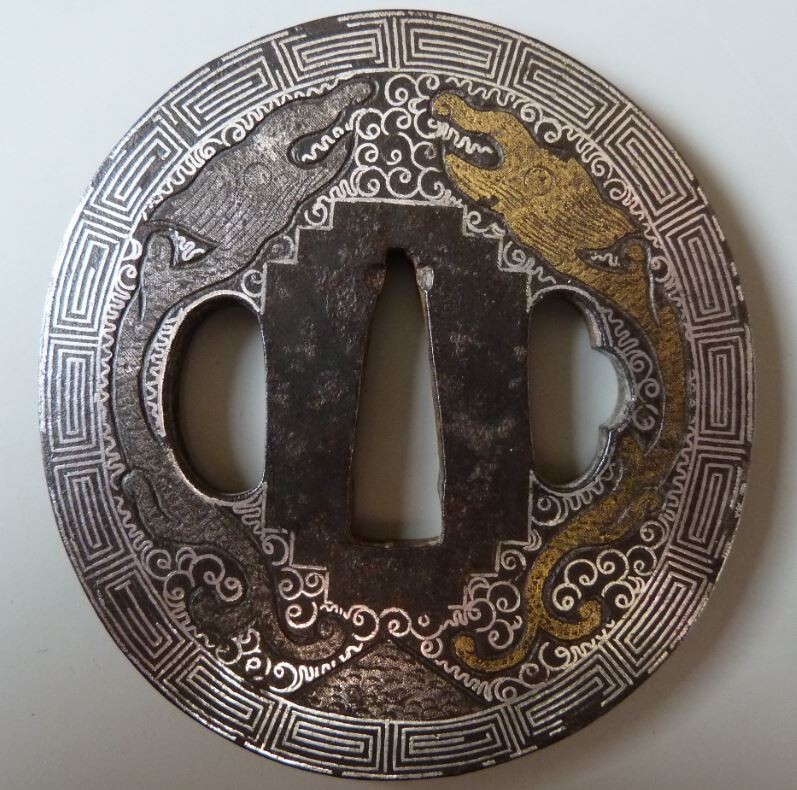
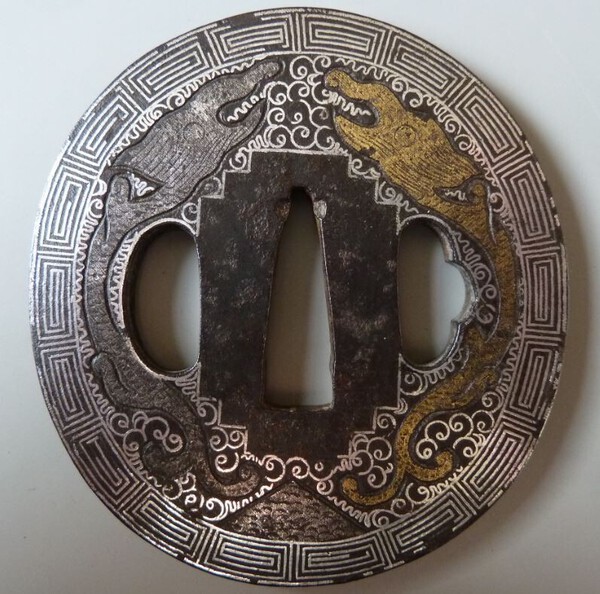
Hi Michael, I have a very similar tsuba, same design, different shape. As others have said it is classed as a Nanban (Southern Barbarian) tsuba. These seem to have originally been imported from China or elsewhere in Asia into Nagasaki. The imported ones tend to have distinctive seppa dai and nakago ana. the seppa dai is grooved and the nakago ana is not the usual triangular Japanese shape. They appaer to have been made in Japan, probably by Chinese immigrant artists who then moved out from Nagasaki into Hizen and made tsuba in the Japanese shape. The thing that interests me in my tsuba is the 'silver' has not turned black, so I assume that it is not silver but an alloy. Anyone know out there. Like yours mine is iron, slightly tapered towards the rim . It shows the two stylised dragons in gold and silver, plus five treasures on the reserve. I believ that they may date from the end of the 18thC. Mine is 7.0 x6.55 cm and 0.3cm thick. Best regards, John

-
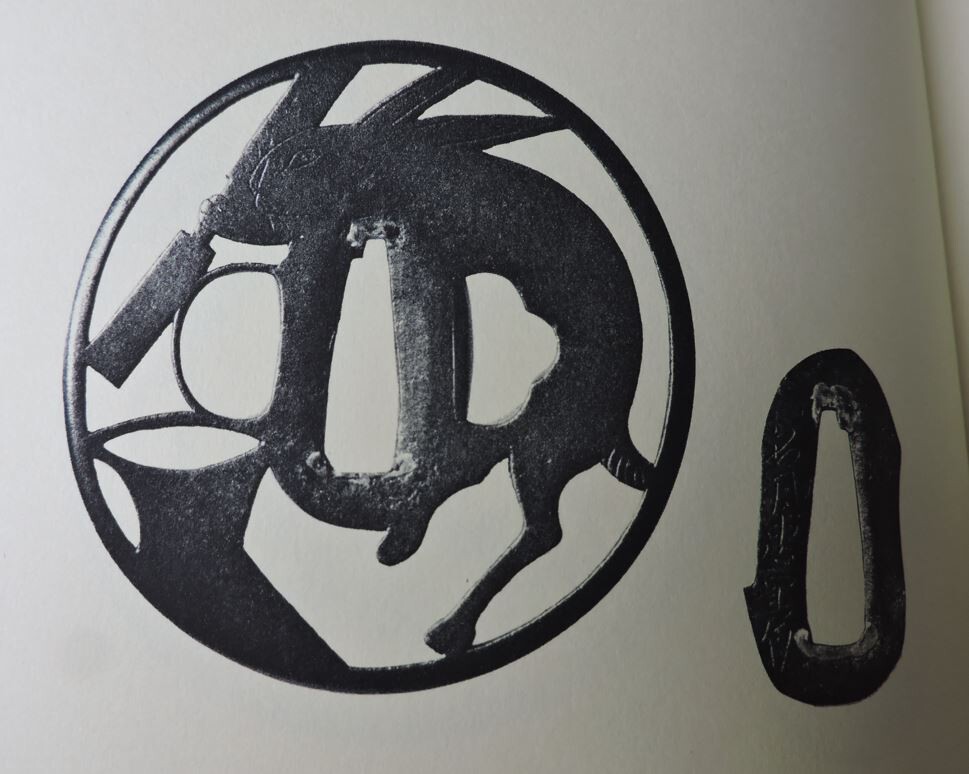
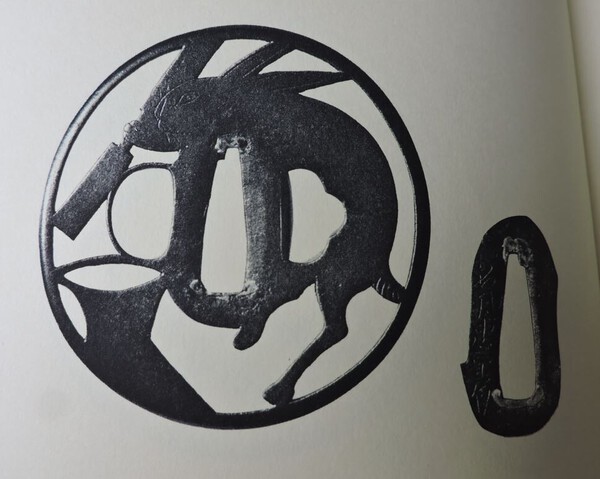
Hi Stephen, Browsing Sasano's Early Japanese sword Guards I came across this bunny (#164, Akasaka signed Tadashige) Not as badass as yours but still a tough little critter as he is pounding rice to make mochi best regards, John
-
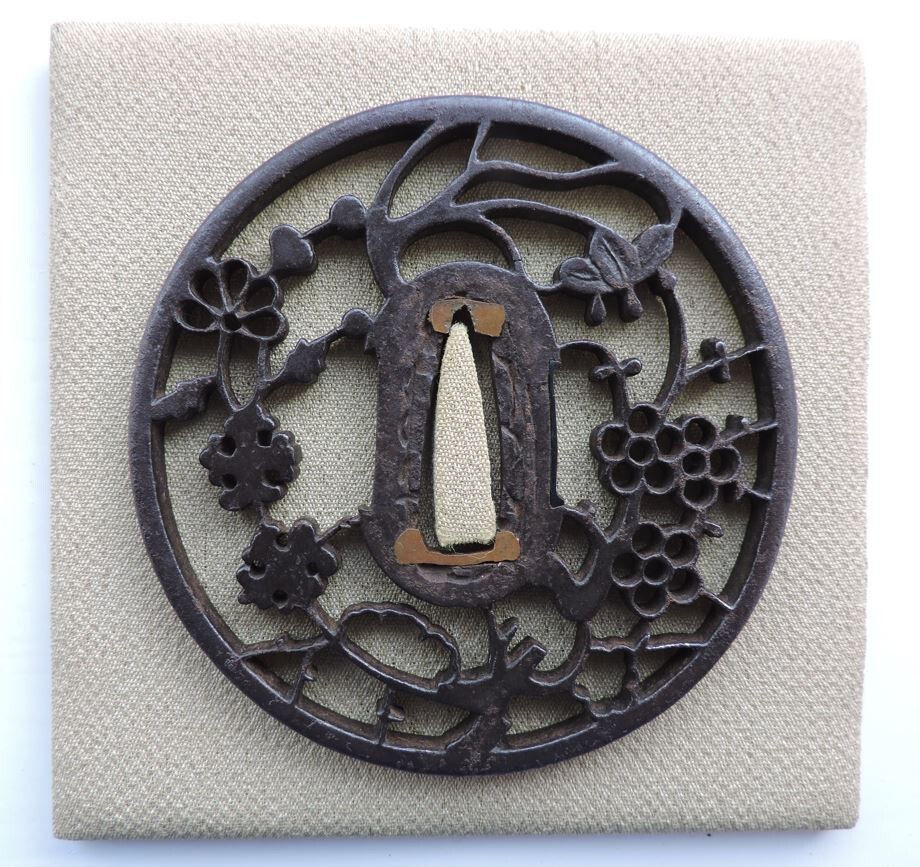
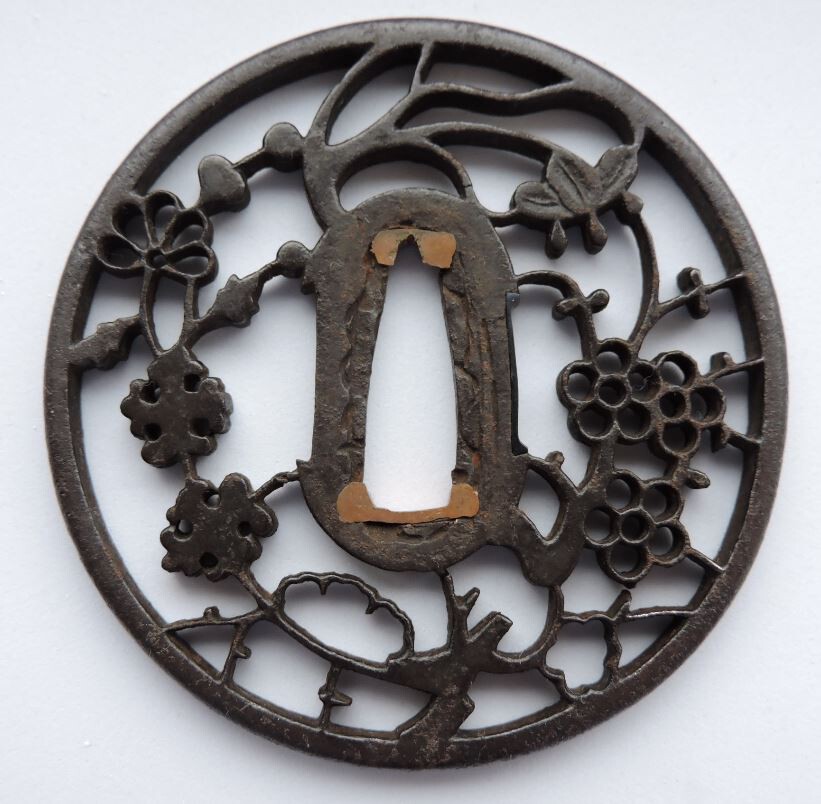
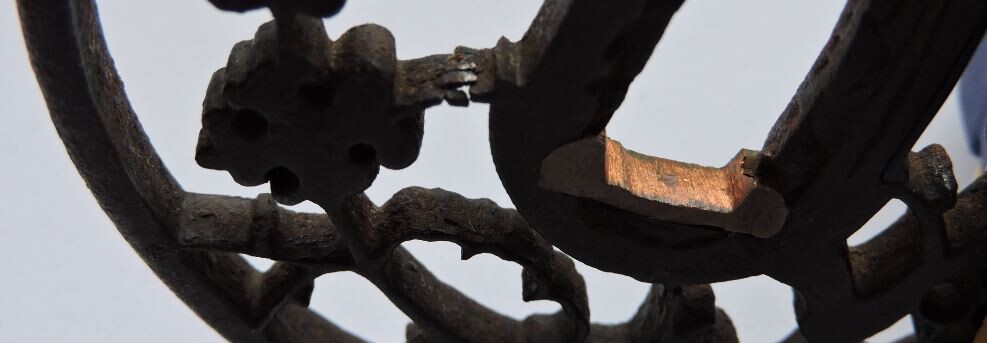
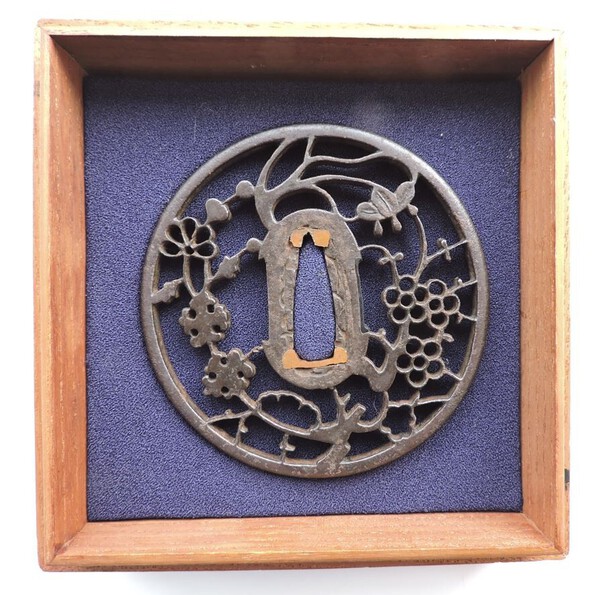
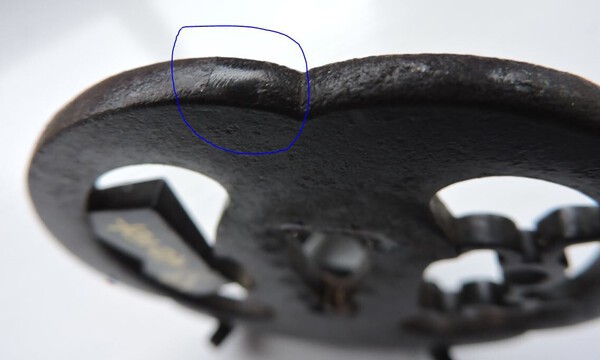
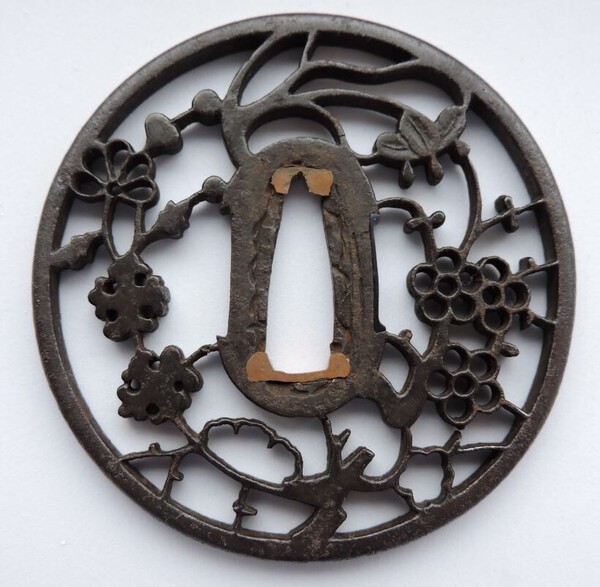
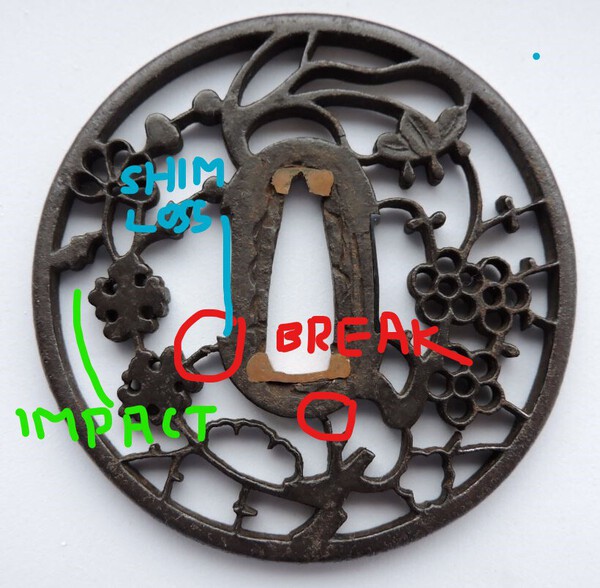
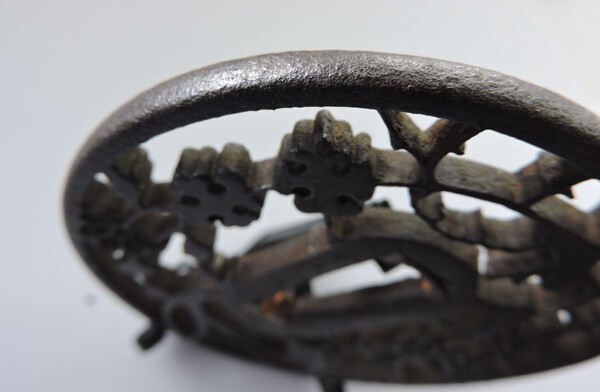
Hi guys, I thought that this sukashi tsuba may be of interest on account of an old(?) repair to the sukashi. This maru gata iron sukashi tsuba depicts various plants including a branch of plumb blossom, a wisteria flower and an unknown flower attached to a thin stem with a couple of four lobed leaves (Any idea what these are?). The seppa dai has copper seki gane and tegane marks on both sides, that differ in style. There are no hitsu ana, per se, but one side has a shakudo shim let into the seppa dai and the other (damaged) side has evidently lost the shim. The mimi is covered with fine granular tekkotsu; and based on this I’ll stick my neck out and assign it to Shoami rather than Kyo-sukashi workmanship. I’m not going to hazard a date as we newby collectors tend to go for early (pre-Edo) dates! I’m also not going to definitely say which is the omote and which is the ura on this tsuba. The design, tegane marks, lack of defined hitsu ana and damage could indicate that it could have been mounted on a sword reversibly. But OK, I’ll go with the plum blossom on the right when viewed from the front. At some time in its history this tsuba seems to have been subject to an impact on the left side, between the four lobed leaves and the mimi. This impact twisted this part of the sukashi and broke two of the fine links to the seppa dai. It probably also resulted in loss of the shakudo shim of the hitsu ana on the seppa dai. The link between the four lobed leaf and the seppa dai was repaired using two small pieces of metal (2mmx1mm), but the twist in the sukashi was not (fully) corrected. I don’t think that this was a result of classic battle damage by a sword, pole arm or musket ball as there appears to be no metal to metal impact marks. It is more as if the tsuba had been hit by something relatively soft, e.g. a piece of wood. After spending some time examining the tsuba, I have come up with this rather fanciful explanation of the damage (other theories welcome). It is perhaps an urban myth that some fencing masters were so good that they gave up using real swords and when accepting challenges from inferiors and used pieces of wood, or even pot lids. It may be that the owner of this tsuba fenced with one of these masters and managed to parry a blow with the tsuba. Out of respect for the master and the encounter, the tsuba was never fully repaired. Besides, it would have made a good talking point with other samurai over a few drinks. I guess that the damage would exclude this tsuba from a shinsa, but it does add a bit of interest. Height: 7.9 cm; Width: 7.7 cm: Thickness (rim): 0.5 cm: Weight: 77 g Best regards, John (Just a guy making observations, asking questions, trying to learn)


-
- 3
-