JohnTo
-
Posts
290 -
Joined
-
Last visited
-
Days Won
1
Content Type
Profiles
Forums
Events
Store
Downloads
Gallery
Everything posted by JohnTo
-
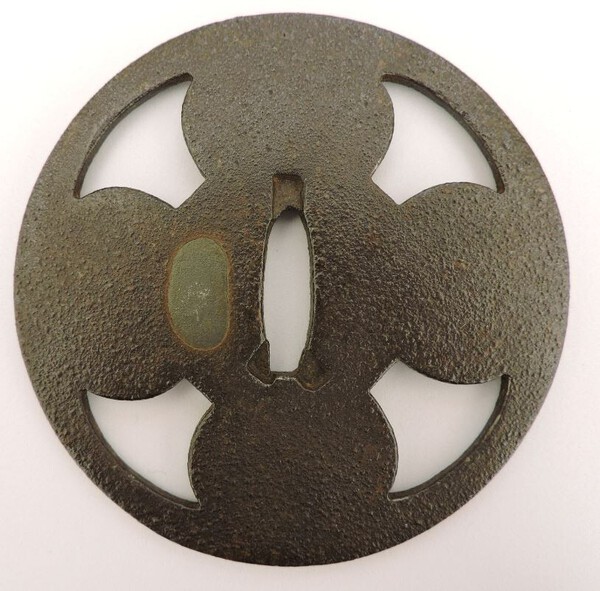
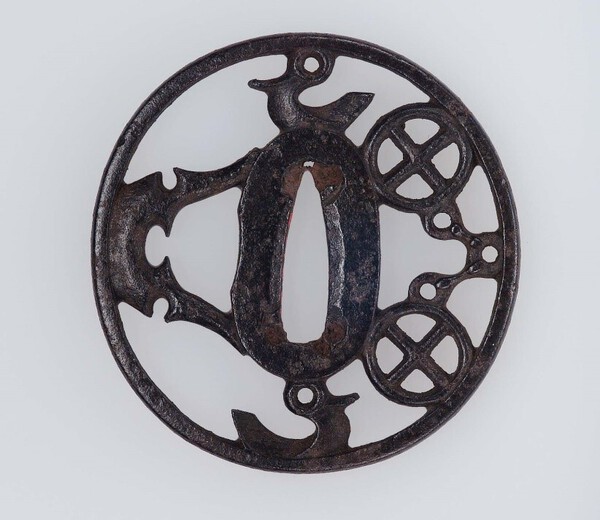
While we are on the subject of yakite-kusarakashi and toad skin I have just remembered this tsuba that I bought about 15 years ago. A simple tosho style tsuba but with an go-ishi kata profile tapering evenly from 5mm at the seppa-dai to 2mm at the mimi. Bought cheaply and I'm not even sure its not modern. What is interesting is the surface finish, now that's what I call toad skin. This is what I think may have been caused by Florian's original post: a smooth surface, speckled with a resist, etched and finally subjected to yakiire to melt the raised areas, before being lacquered to protect the surface from rusting. I've puzzled over the surface effect for a long time, but I think this is how it was probably done. Specification: Height: 9.2 cm, Width:9.2 cm, Thickness at rim: 0.2 cm, Thickness at Seppa Dai: 0.5 cm. Weight: 166 g Best regards, John Just a guy making observations, asking questions and trying to learn

-
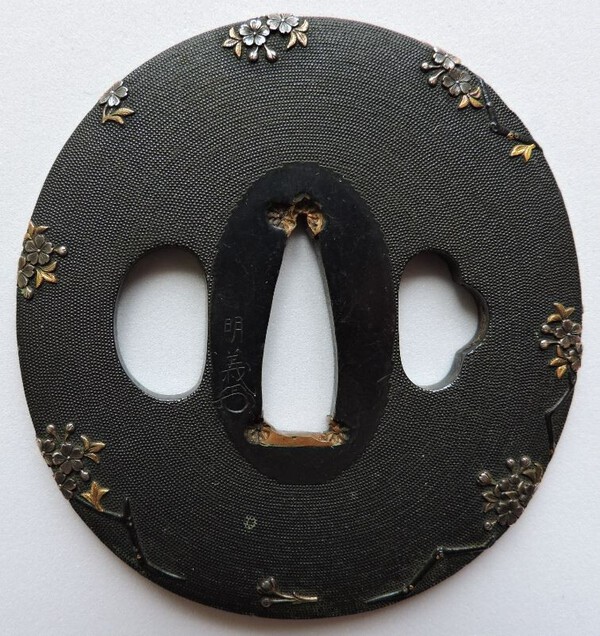
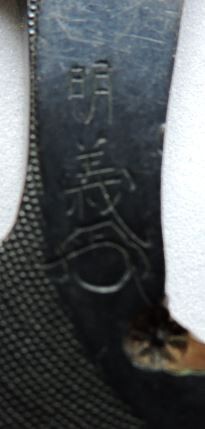
Haynes lists a Meiju as a student of Araki Tomei (H09800) working about 1865-75 and that there is a relationship, or the same person as Inoue Akiyoshi (H00089) The kanji are the same. I have a tsuba signed Akiyoshi which was an early name used by Kiyotoshi (H03368.0, 1804-1876). Not sure if its the same guy. An entry in ‘The Early Famed Works of the Kyoto Smiths (Kyomono no Ko-Meisaku)’, tanslated by Gordon Robson lists a tsuba by Akiyoshi with a shakudo ground. The text states that ‘Akiyoshi is among the skilled kinko of the Aizu during the late Edo priod’ ‘There must be some connection with Kawano Haruaki, and because of his signature and kao, we can agree to such a conjecture.’ There appears to be a similarity between the kao on this tsuba and examples attributed to Kono Haruaki, so it looks like the artisan of this tsuba is probably the one referred to. Akiyoshi seems to have worked around the mid 19thC and changed his name several times Not sure if this helps, or just muddies the picture further. Best regards, John

-
Tim, I was wondering about Kamiyoshi Rakuju and his toad skin, which is reported to be difficult to copy, but the only reference that I could find said that he melted blobs of silver on the iron to achieve the effect. I'm sure that the effect is etching on my tsuba, but the han probably used other surface finishes. With regard to the unfinished nunome, perhaps these were being made about the time of the haitorei and they were going out of business. Thanks for the info, John
-
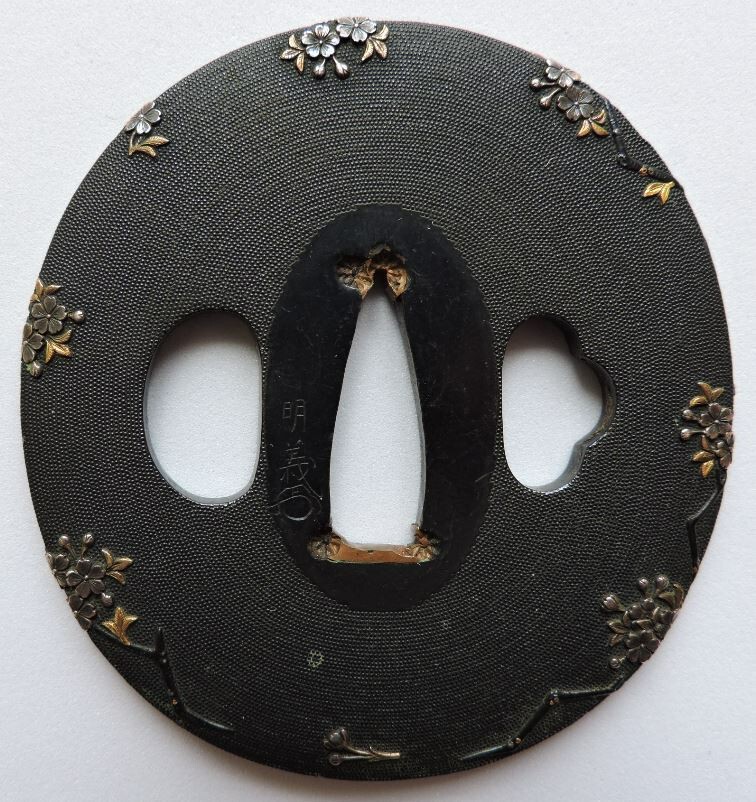
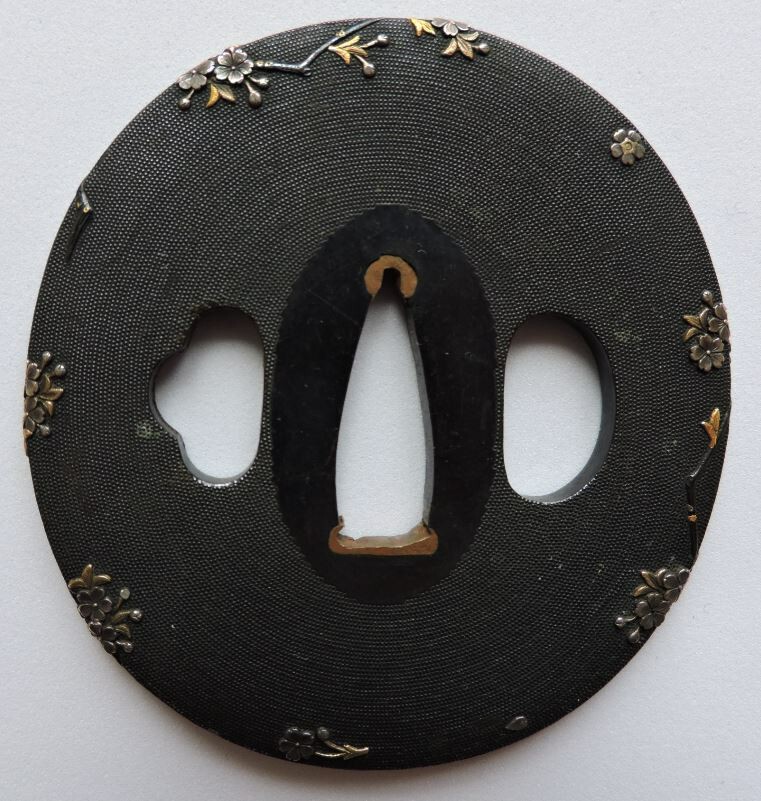
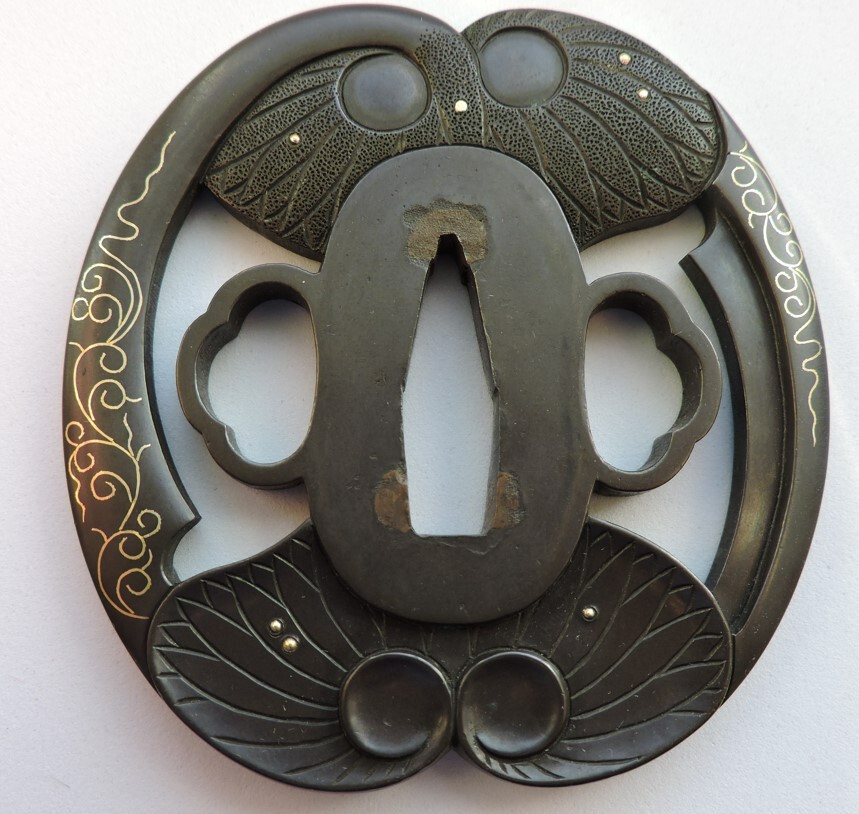
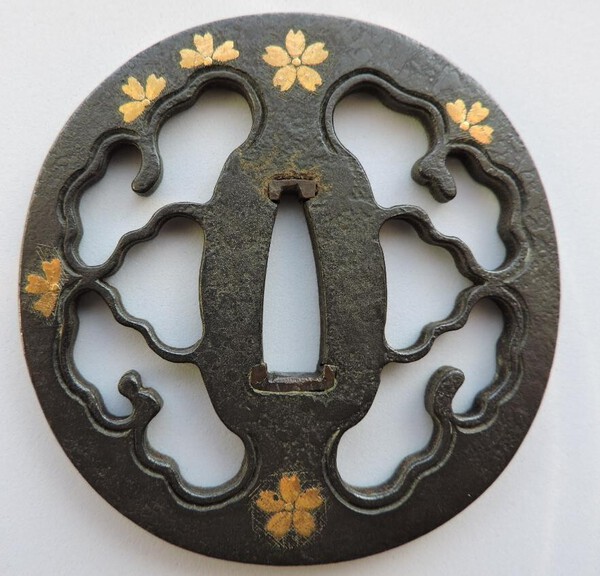
I’ve been wanting to post these two tsuba from a daisho pair for some time as I have some questions you guys might be able to help with. The tsuba are almost truly round, flat iron plates with large sukashi openings, probably stylised butterflies, though I have seen similar examples described as clouds. I go for the butterflies because of the symmetry in the piercings. One of the first things to be noticed is the surface of the ji which seems to have been etched. The high points of the etched surfaces appear to be a random mixture of shapes and sizes. Some are large (ca. 5mm), whereas others consist of clusters of pin pricks. How did the artist manage to apply such a varied variety of resist coatings before etching? My own view is that the plate was sprayed with a fine mist of resist solution and the large areas applied by hand. Spraying with a viscous resist like lacquer to form a fine mist would have been impossible, so how? The other less likely scenario I have is that the plate consists of a very heterogeneous mixture of hard and soft iron and the acid preferentially dissolved one of the materials. If this were the case I would expect the depth of etching to vary. The second unusual feature of these tsuba is the gold nunome cherry blossoms. Each inlay is surrounded by a circle of cross hatching in the iron to secure the gold leaf. While this method of securing gold nunome inlay was standard the observation that the area of the plate prepared to anchor the inlay was far larger than the inlay indicates sloppy workmanship in my opinion. Perhaps the outline of the cross hatching on the plate was not visible when the tsuba was new but subsequent aging and oxidation (rusting) has made it noticeable. Both tsuba are signed, but with gold kao, making them unreadable. Anyone got any ideas? Also, opinions as to whether the signature relates to the guy who made the whole tsuba, or to someone else who finished the tsuba (etching and inlay). Although I cannot read the signature, I have attributed the tsuba to late Hayashi/Kamiyoshi on the ground that the overall design is typical. One of the last tsubako (late 19thC) of the Kamiyoshi ha was Rokujo, who reportedly liked to experiment with surface finishes and signed his name in a variety of ways, including gold inlay. He also had students and so I expect their works would have been similar. Best regards, John Just a guy making observations, asking questions and trying to learn


-
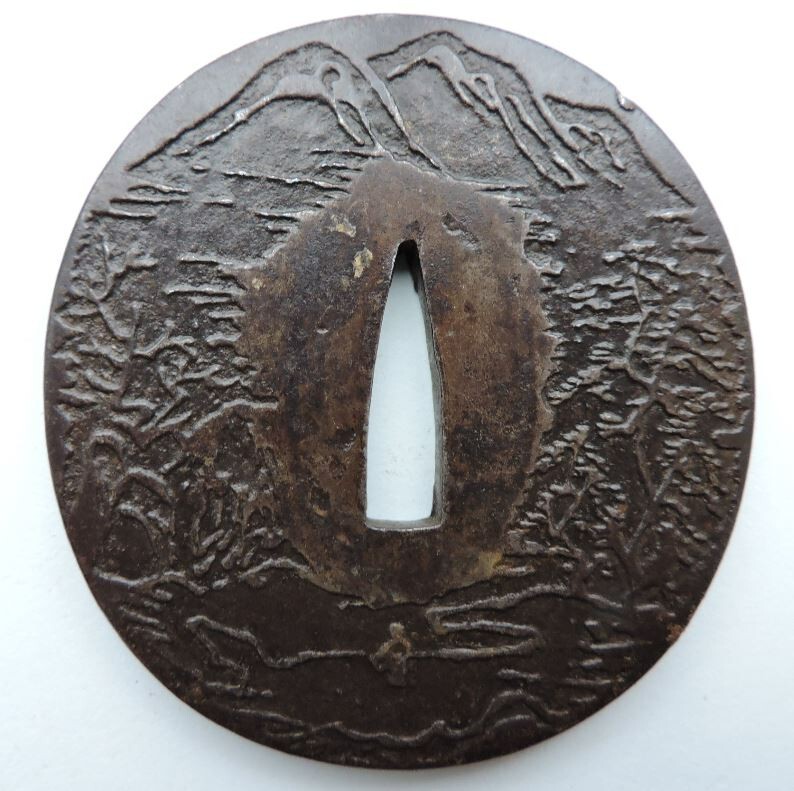
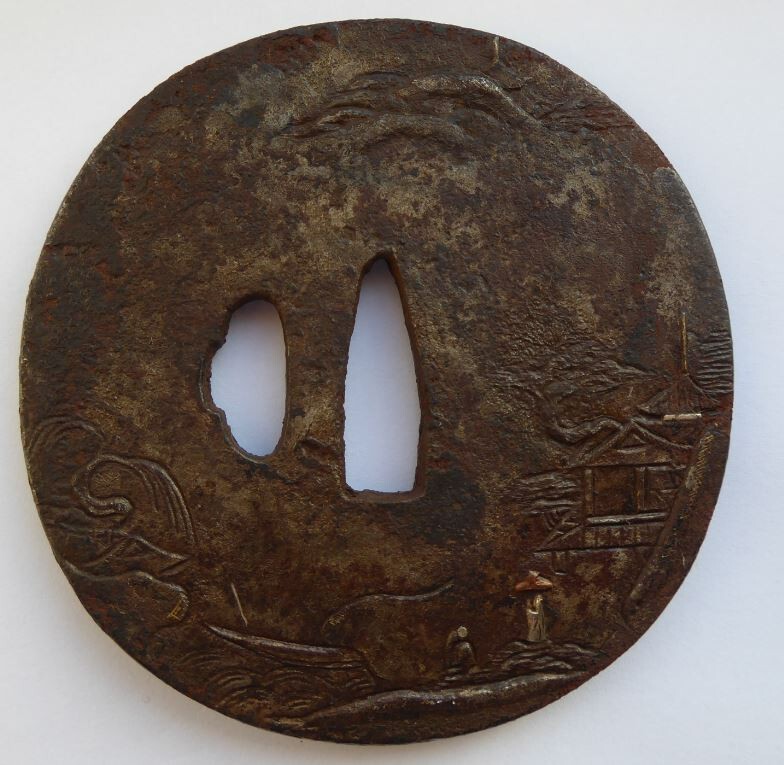
A bit late coming into this topic, other things going on besides tsuba The first etched tsuba I’d like to show is by Efu ju Masayuki (Ruben of the NMB informed me that the odd way of writing the kanji ‘fu’ with a long tail was a characteristic of the last Masayuki of the Ito school working around 1900). This oval iron tsuba is unusual in that it is a flat plate and the decoration appears to have been made by etching. The scenes on the front and back are similar and show a typical Chinese, Kaneie style landscape consisting of a range of three mountains at the top, a woodland in the middle (maybe with a thatched hut) and a lake or riverbank at the bottom, one side with a man in a small boat, the other with figure looking over the water. The brown patina of the iron is unusual in that it resembles bronze and has a sheen to it indicating that it has been lacquered, which has probably prevented any rust. Height: 7.1 cm. Width: 6.7 cm. Thickness (rim): 0.15 cm, Seppa-dai: 0.4cm As an aside to etching I remembered dissolving a copper penny in nitric acid as a schoolkid 60+ years ago. It was fascinating to watch the penny get thinner and thinner but still retaining the clear image of the king’s head (sorry your majesty). As to which acid to use; nitric for copper and sulphuric or hydrochloric for iron Best regards John Just a guy making observations, asking questions and trying to learn


-
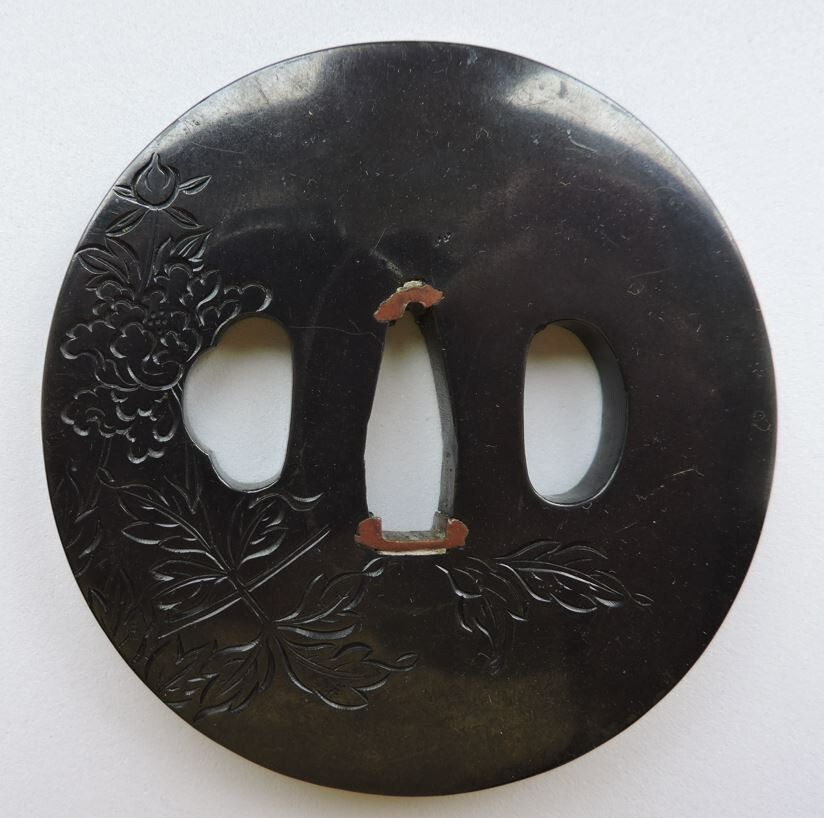
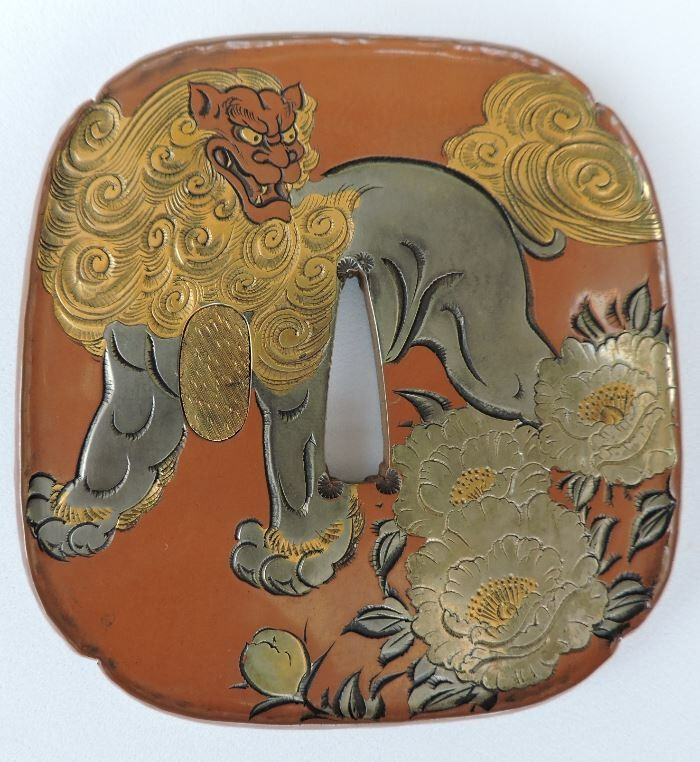
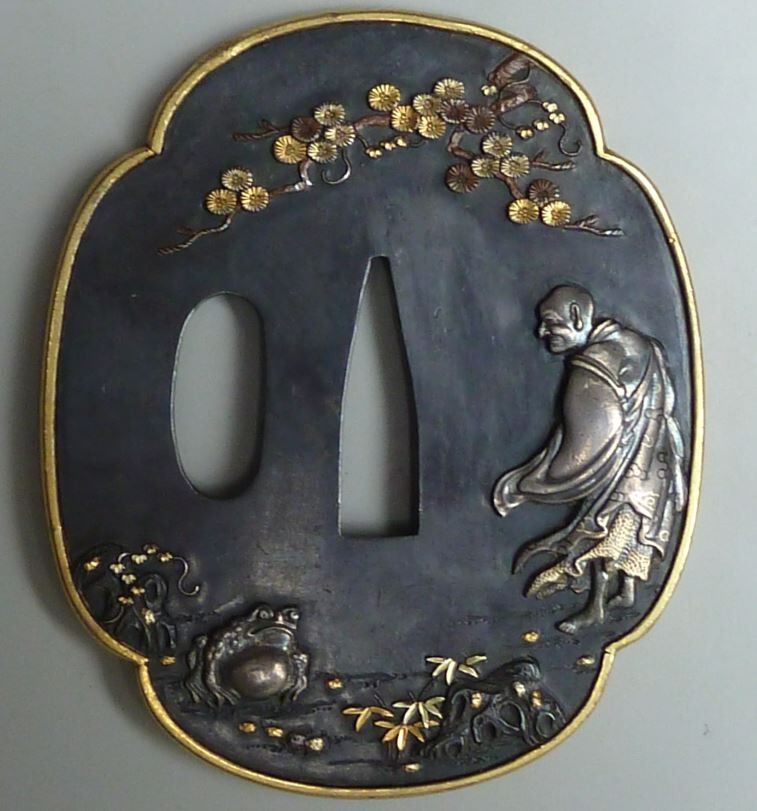
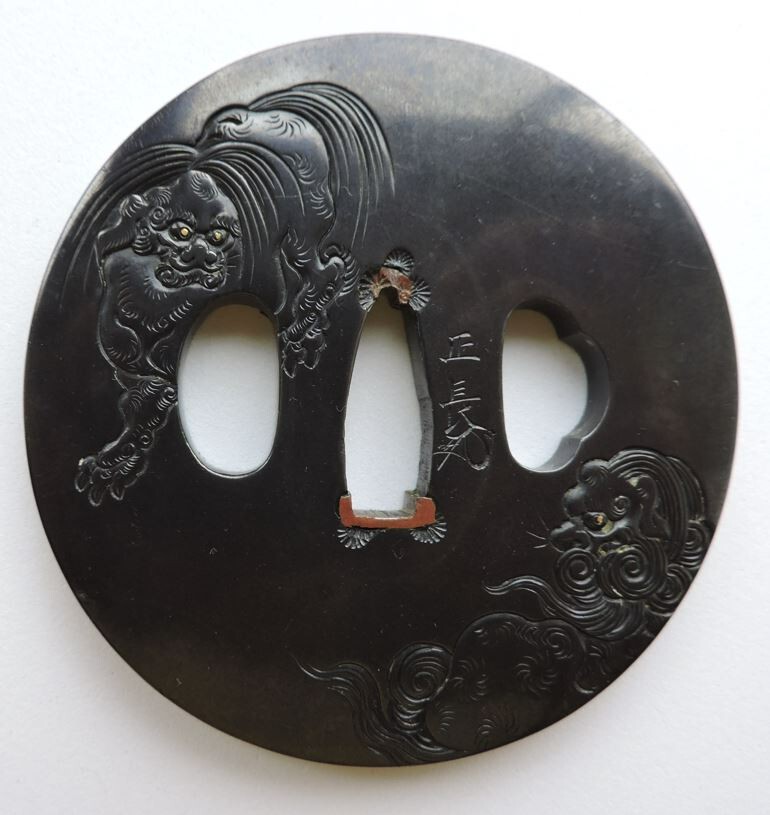
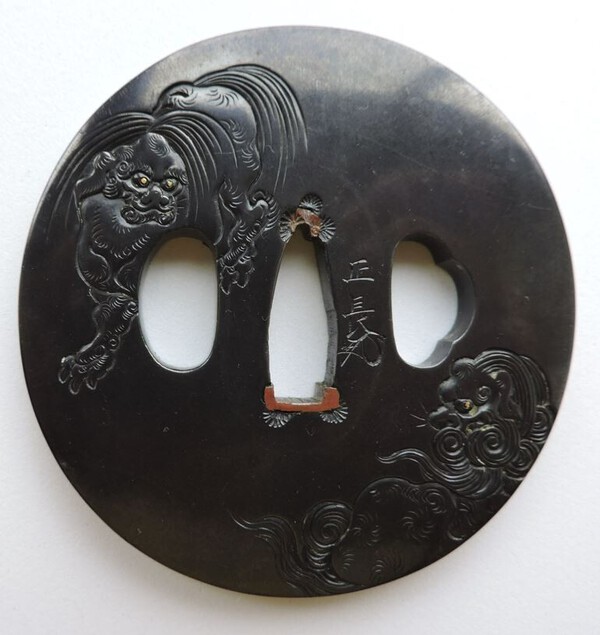
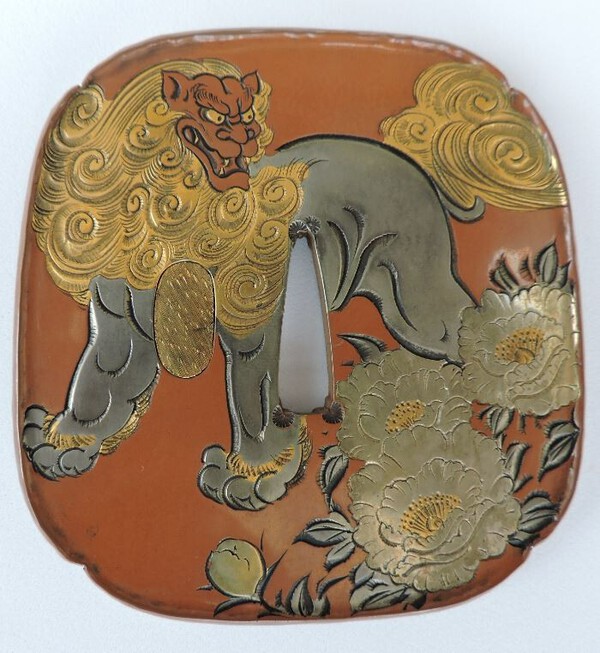
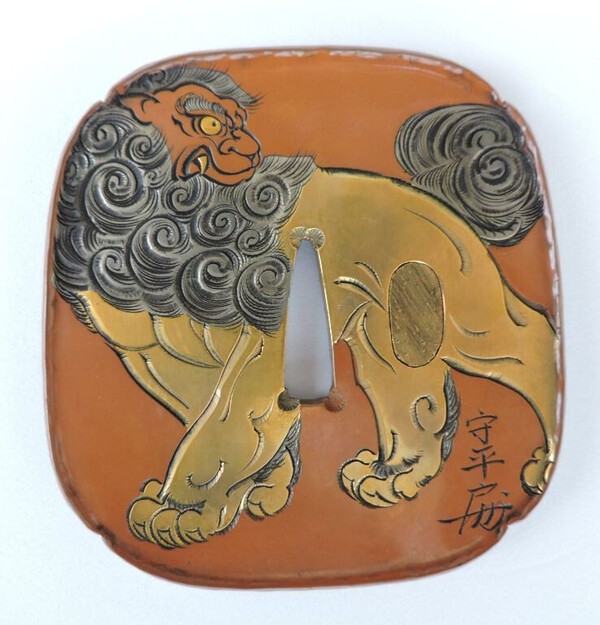
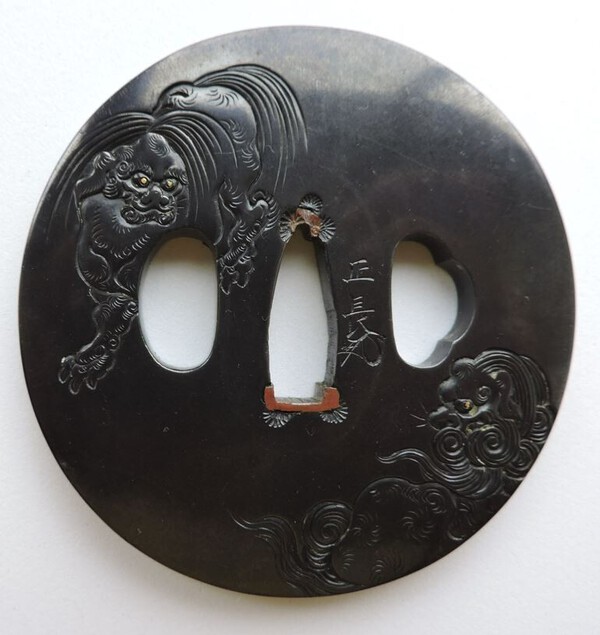
The first shishi tsuba that I have is a Shakudo one signed Masanaga. The tsuba depicts two shishi in shishiaibori and engraved in katakiri on the reverse with a windblown peony. Shishi are mythical guardian lions in both China and Japan and the peony is regarded as the king of flowers and in Japan symbolises bravery, honour and good fortune. The design of shishi and peony is often augmented by the addition of a butterfly. This is because, according to legend, the shish has a weakness in that a bug lives inside it, but if it sleeps under a peony the morning dew is absorbed by the shishi and the bug is eliminated as a larva, which metamorphoses into a butterfly. The tsuba is signed Masanaga, with a kao and was catalogued as Haynes Index no. H 04250, which identifies the artist as Chosuke Masanaga (d. ca 1700), who was a student of Nara Toshinaga (Markus Sesko) or Ito Masatsugu (Haynes). However, there were two generations of Masanaga in the Nara School and both used the same kanji for their signatures. The first generation, Seiroku, was a student of Toshinaga (either the 3rd generation master of the Nara School or a student of the same name). His (adopted?) son was Gihachi Masachika, who signed Masanaga for a while after his father’s death and was from the Kawakatsu family and a nephew of Sugiura Joi. The Nara tsuba artist Gohachi Masachika may have been an alternative name used by either of the other two Masanaga. Consequently, there is some uncertainty as to the identity of the artist who made this tsuba. Height: 7.6 cm. Width: 7.4 cm. Thickness (rim): 0.4 cm. Weight: 216 g Provenance: Edward Wrangham Collection, Part I, 9 November 2010, Lot 37, bought from the Roland Hartman Collection of Japanese Metalwork (Christies, 30 June 1976, Lot 130) The second shishi tsuba is a large copper one made in the 20th century by Yanagawa Morihira (1899-1971) and was made as a work of art, rather than as a practical object to be mounted on a sword. The shape of the tsuba may be best described as sumi-iri-kakagata (lit: notched in square). The front (omote) of the tsuba shows both a shishi and peonies, whereas the reverse (ura) only shows the shishi. Interestingly, the shishi on the omote has a silver body and a golden mane and tail, whereas the combination of silver and gold is reversed on the ura. The faces on both animals are copper. Shishi are often represented as playful creatures, but these two are muscular with a fearsome pose and the silver shishi has a head which looks rather like Hannya, the Japanese female demon. The engraved peonies on the omote are coloured with silver and gold gilding and the petals are in a darker shade of silver. The outlines are defined in katakiribori (half cut carving) and kebori (hair carving) and, particularly the silver, darkened to add extra tonality to the design. The nakago ana has four 32(?)-petalled chrysanthemum punch marks on each side, purely for decoration and the tsuba is signed on the lower right face of the ura Morihira (守平). There is also a single kozuka hitsu ana, filled with a gilt cat scratched plug. Shishi are mythical guardian lions in both China and Japan and it is also the name given to a group of political activists (Ishin Shishi 維新志士) in the late Edo period who opposed the westernisation of Japan. The peony is regarded as the king of flowers and in Japan symbolises bravery, honour and good fortune. I think that it is likely that this tsuba was made in the 1930’s when Japanese militarism was at its peak. I expect that the intention of the artist was to represent the shishi as fearsome creatures prepared to protect Japan in its time of conflict. However, in my view, the artist failed in this respect and they appear rather camp. I purchased this tsuba in memory of my nephew, who died young (52) at about the same time this came up for sale. He was a rather over the top extrovert character and I thought it would be a suitable memorial for him. Height: 8.75 cm. Width: 8.4 cm. Thickness (rim): 0.7 cm; Nakago: 0.4 cm. Weight: 254 g Provenance: Bonhams (Lot 48, 13 May 2021). Best wishes, John

-
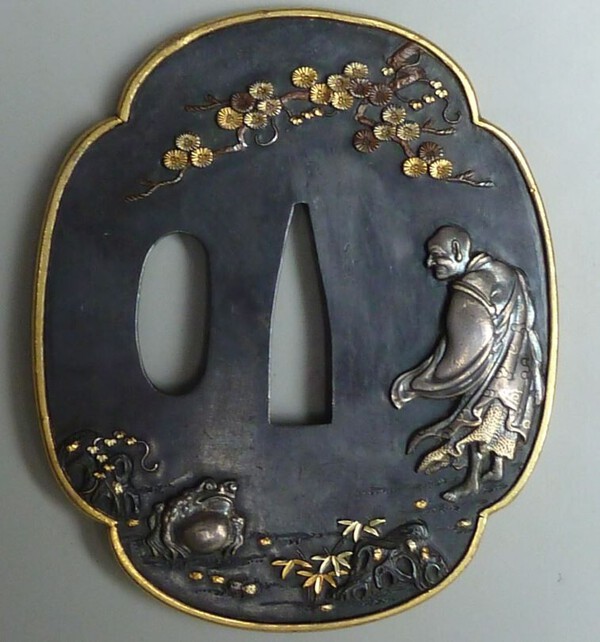
I have often thought that tsuba represented a cheap art form compared to many other collectables. Looking at those shakudo tsuba in my collection with good blue black patina I assume that these were made of shakudo with about 5% gold. Poor quality shakudo, with little or no gold in the mix (nigurome), tends to show a lot of brown in the patina. Comparing the price I paid for these tsuba with the current cost of gold (£122 per g) I find that, overall, the gold content is worth about 60% more. Probably dissolving the copper in nitric acid would allow recovery of the gold, but it is not something that I am considering. Pics of a couple of nice examples are attached. Just a thought, John

-
Hi, No one seems to have mentioned that the NBTHK Hozon attributes the tsuba as mumei: Mito best regards, John
-
Itomaki Gata, (Vertical Spindle Shape Tsuba), Historical Examples ???
JohnTo replied to Barrett Hiebert's topic in Tosogu
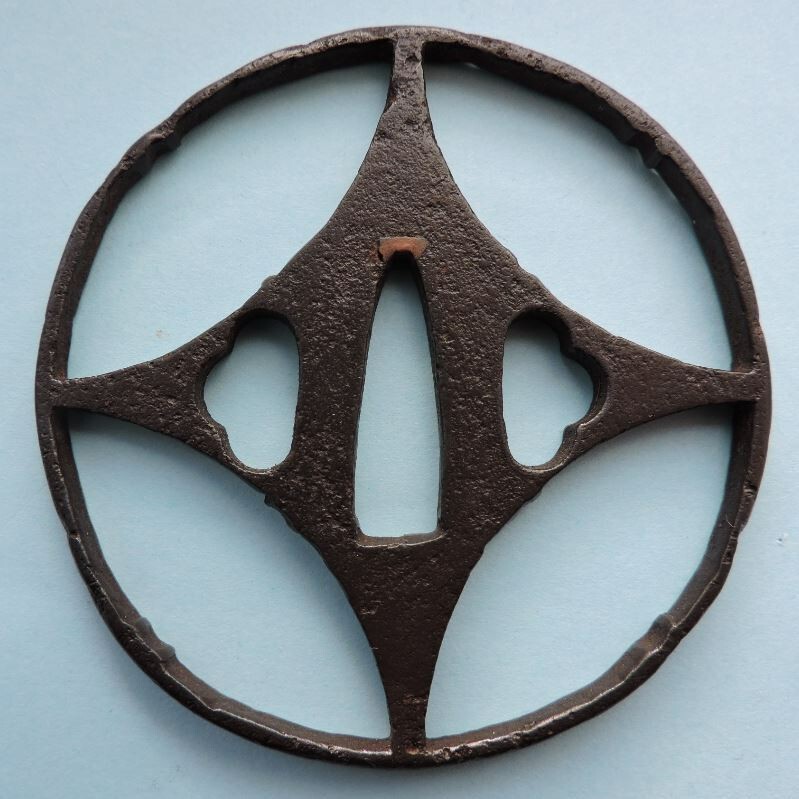
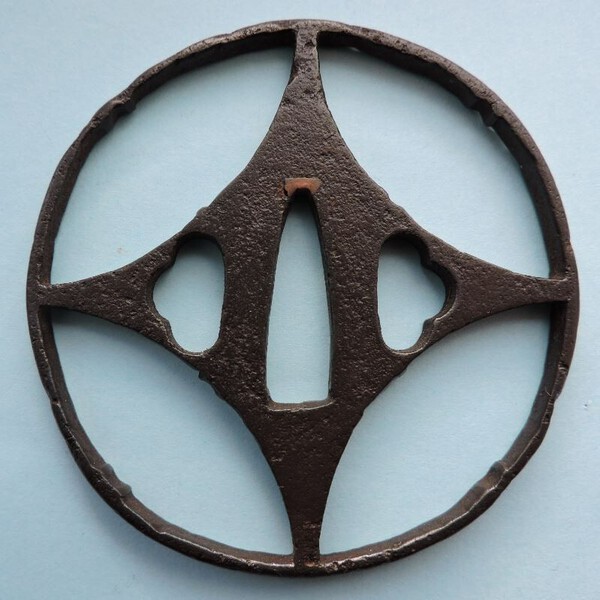
Hi guys, a couple of tsuba from my collection to add to the thread (sorry) The first is a shibuichi tsuba ‘inscribed’ Goto Mitsunobu (sometimes transliterated as Mitsutoshi), Tsujo, 11the generation master (1663-1721) living in Edo. The design is a shippo tsunagi (shippo chain) a symbol found in ancient Egypt as well as Asia and is 3,500 years old and embodies a wish for family happiness and financial success. No one has mentioned that the itomaki gata tsuba presented in this post can also be considered to be a single element of the shippo tsunagi design and I have never seen this mentioned anywhere. The second tsuba is a particular favourite of mine, maybe because it has seen better days and I can emphasize with it. A previous owner also loved it to judge by the old tsuba box in came in, maybe because it exudes wabi sabi. Although it is now an itomaki gata spindle, it was not always so. Inspection of the four large openings reveal that there were once inserts that have been removed. It took me several years before I stumbled across a picture of a tsuba with the missing elements, four jiguro bishi kamon of the Takeda clan (see pics). So why were these removed? Here is my rather fanciful explanation, for which I have no evidence. The jiguro bishi kamon version of the four diamond shapes of the Takeda kamon was used by Itagaki Nobutaku(1489-1548), one of Takeda Shingen’s 24-generals and although he won several battles became over confident, celebrating victories before the battle was finished. He did this at the battle of Uedahara in 1548, where he was killed. The Takeda were famously slaughtered at the battles of Nagashino in 1575 and Tenmokuzan in 1582 by Oda Nobunaga using volleys from matchlock muskets. I think that my tsuba may have been on a sword taken from a fallen Takeda samurai and as the new owner did not want to be falsely accused of being a Takeda clansman had it modified. My tsuba and the intact versions seem to shout ‘Kyo sukashi’ and the sale catalogue sources described them as such. However, Kyoto was in the hands of the Takeda’s enemies, so it would have been unlikely that they were made there. All the best, John

-
Hi Guys, I’m writing for advice on whether to try to remove galvanic corrosion from a brass tsuba, or to leave it alone. For those without a background in electrochemistry it may be useful to describe what galvanic corrosion is. If two different metals are in electrical contact and placed in an electrolyte (a liquid, such as salt water, which enables an electric current to flow) the most reactive metal will corrode much faster than if it was on its own. An early example of this was in 1761 when sheets of copper were nailed to the hull of HMS Alarm in order to prevent marine fouling. Although the copper did prevent weed and marine animals from attacking the wooden hull it was found that the iron nails attaching the copper plated completely corroded far quicker than other iron nails on the ship. The iron nails acted as an anode and the copper as a cathode of a battery and the sea water provided an electrical conducting path between the two metals. Of interest to us, as tsuba collectors, is that copper is often used for sekigane on iron tsuba, but I have yet to see any galvanic corrosion of the iron. This is because of the dry environment around the nakago ana thus excluding the electrolyte component of the galvanic corrosive mix. Iron is the most reactive of metals found in tsuba and thus most likely to corrode: gold, silver and copper the most unreactive and brass between the two extremes. Probably the most common examples of galvanic corrosion of tsuba are to be found in early Heianjo tsuba in which the seal between the iron plate of the tsuba and the brass inlay was not sufficiently tight to prevent moisture seeping in between the brass and the iron. The resulting galvanic cell caused to iron to rust and the increase in volume of the rust, compared to iron, forced the brass inlay out. Later examples of Heianjo tsuba were often coated with a thin film of clear lacquer to prevent water ingress. So now let me turn to my brass tsuba which depicts two gilt and shakudo takazogan horses and some background engraving on a flat base plate of brass. Its mumei, wakizashi size (6.7 x 6.3 cm), a bit battered and not a particularly great piece, possibly Mito or Nara schools. There appear to be three areas where the patina has been discoloured, namely: 1. On the omote the gilt (copper?) and shakudo horses plus gilt flowers on the tree are surrounded by dark areas stretching out about 2mm from the inlays. I assume that this is due to galvanic corrosion of the brass by the copper/gold inlay. (labelled 1 on pics) 2. On the ura are two small pieces of copper imbedded into the brass ji and these two are surrounded by dark areas of stained brass. I don’t know if these pieces of copper were picked up by accident in the brass mixture or if they were hammered into the brass blank to fill in flaws. Whatever, these two pieces of copper retain a bright finish, as would be expected from the cathode of the galvanic pair of metals and it is the brass that has oxidised and become discoloured. (labelled 2 on pics) 3. The lower right quadrant of the ura shows areas of red copper in the ji. This, is probably not actually galvanic corrosion but due to the zinc in the surface of the brass being oxidised and rubbed off as it was formed by the clothing of whoever was wearing the sword, leaving behind a zinc depleted layer, i.e. copper. (labelled 3 on pics) My analysis of the history of this tsuba is that the dark staining was caused by storage in damp conditions, thus providing the third component of a galvanic cell, the electrolyte. The copper-coloured areas appeared during normal wear near a warm moist (sweaty) part of the body and by rubbing against clothing. My initial attempts to clean the tsuba were with ethanol on cotton wool buds to remove the general grime. But I found that the dark stains around the horses were resistant to this. I wondered if Renaissance Metal De-Corroder would remove this film. I have used it on a badly rusted iron tsuba and it does work by softening up rust as an easily removed sludge leaving behind the underlying iron undamaged, but lacking any patina which would have been lost anyway beforehand during rusting. Being cautious I tried this out on an old brass pipe coupling which had become similarly decoloured. Rubbing on the De-Corroder with a cotton wool bud worked within a couple of minutes, but instead of revealing a nice brass coloured piece of metal, it was copper coloured. The oxidised zinc had been removed to reveal a zinc depleted micro layer, i.e. copper, underneath. I then treated the test piece with a paste of 100/200 mesh alumina in WD-40 using a cotton wool bud and sure enough the micro layer of copper was removed, revealing bright shining brass underneath. So, here is my dilemma, do I leave the tsuba as is, or do I remove the dark stains with De-Corroder and then polish out the resulting micro layer of copper? Areas of the ji would then be a mixture of bright and dull brass unless I polish all of the ji and wait bout 20 years for the brass to oxidise to a more aged patina. It would be good to have the horses stand out from the ji, but perhaps surrounded by a bright, rather than dark, halo would not be an improvement. Your help and comments will be appreciated. With best regards, John Just a guy making observations, asking questions and trying to learn


-
Hi Jean, I know that many Japanese sword enthusiasts do not know that iron can be dated by measuring the carbon-14 content using an accelerator mass spectrometer. I saw one of these about 30 years ago being used for medical research it was a monster and was housed in a warehouse. Maybe technology has advanced since then. The ability to do this with Japanese iron artifacts is due to the use of charcoal in the smelting (tatara) and forging processes. It is carbon from the charcoal which gets incorporated into the iron that is dated. No good for Western iron smelted using coke. There are several studies on the web and I believe that the swordsmith Yoshindo Yoshihara got involved in one such study to provide iron with a 'zero' time point. Below is an abstract form another study. best regards, John 14C Ages and Calendar Years of Japanese Swords Measured with Accelerator Mass Spectrometry Kazuhiro Nagata, Akihiro Matsubara, Yoko Saito-Kokubu, Toshio Nakamura Abstract Steel of Japanese swords has been produced with Tatara process from iron sand and charcoal. Carbon dissolved in steel was absorbed from wooden charcoal fuel during the production of the steel. From the decay of 14C activity in the steel, the 14C age of Japanese sword can be determined. The 14C ages of 4 Japanese swords were measured with accelerator mass spectrometry and calibrated to calendar years. Each 14C age provided plural calendar year periods with definite probabilities, and one of the periods agreed with the production year of each sword that was determined from the sword master’s name cut in the grip of his sword after taking the age range of charcoal used for steel production and usage for several generations of the same names of sword masters into account.
-
Mauro, I'm not really familiar with Shonai, but that looks as good an attribution as any from pics I have seen. I did buy a 'shibuichi Kaga' tsuba from Bonhams about four years ago (pic attached, signed Kashu ju Katsukuni)) and the workmanship looks similar. It was evidently made of an unusual shibuichi alloy in that it was magnetic and had some rust spots. At least they did not describe it as shakudo! I agree with Dale, it looks too good to be Kinai. A bit like Ferrari using a Fiat as a model for their new car. thanks for your comments, John


-
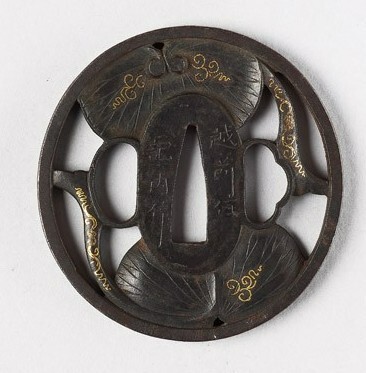
A quick look at the first two pictures of this tsuba and I expect many of you will jumping up and down shouting ‘Easy! Echizen Kinai tsuba of aoi leaves.’ Just like the one I’ve included for comparison signed Echizen ju Kinai saku. Problem with my tsuba is the it is probably shibuichi and mumei (Kinai were never shy about adding signatures). The tsuba is 7.2 cm x 6.9 cm x 0.4 cm, Weight: 132 g and is essentially a standard Echizen aoi design. The tsuba is almost totally symmetrical about the vertical axis, having two kogai hitsu ana and matching tagane around the nakago ana, making assignment to the omote or ura impossible. The inlay karakusa scrolls are the same, but the raindrops on the leaves differ. So who made it? I have never seen a shibuichi Kinai tsuba, but this does not mean they did not make any. The quality looks above their standard output, so why not sign it? Best explanations I have are that maybe it was made for a high-ranking samurai, by another workshop, who liked to wear a bit of bling on formal occasions but still wear the tsuba design that lesser ranks used, or it was made by a kinko artist as a copy of an iron Kinai tsuba to make a more saleable product for the Western market. Either explanation would explain the lack of wear. Look forward to your comments. John Just a guy making observations, asking questions and trying to learn


-
Jake, My dream hobby in retirement would be to spend a couple of days each month in the BM or V&A in London examining soft metal tsuba with an XRF gun and collecting data on the composition. Of particular interest would be 'chocolate brown shakudo' tsuba, often sold by major auction houses and Japanese dealers, which I suspect are nigurome with little or no gold. John
-
Thanks for all the comments guys. Sorry for being so late in acknowledging them as I have been a bit busy with other things. Thanks Piers for pointing out that the NBTHK Hozon does state that it has a tsuchime-ji finish. My bad, I guess I am getting a bit lazy with my translations in my old age and missed those kanji and meant to translate them later. Good to hear that I am not the only one that thinks that the NBTHK shinsa is not perfect, I too have seen identical looking tsuba with different attributions. I just feel that these guys know more than me, so make fewer mistakes and I have so much to learn. I guess that mumei iron tsuba must be the hardest category to evaluate, especially as most of the artists are lost to history and were unrecorded. If only carbon-14 dating was cheap and readily available it would make dating easier, but then we would not want to drill samples out of our tsuba! Elemental analysis using XRF would also be a fascinating area for study to see if different schools had different amounts of trace elements in their iron. Sorry, its just the scientist in me getting carried away. Thanks again, John
-
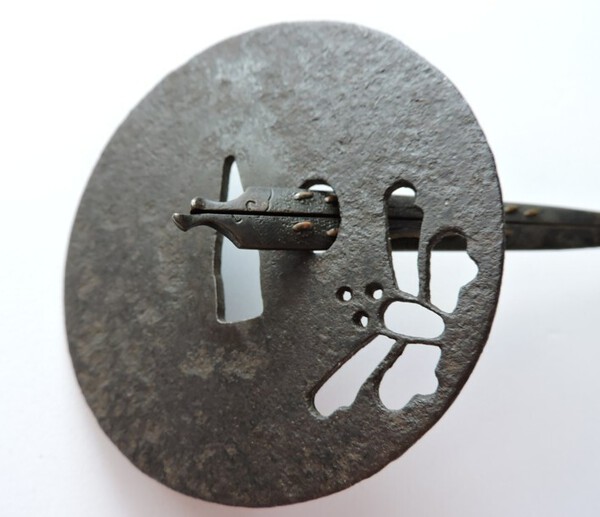
I have a few questions regarding a tsuba that I recently purchased. The tsuba is an iron tosho tsuba (8.88 x 8.8 cm, 3mm at the seppa dai, 2mm at the mimi) with a sukashi butterfly and was accompanied by a NBTHK Hozon certificate. The nakago ana is slightly concave at the sides where the shinogi of the sword would have rested and has no tagane marks, which would indicate that the tsuba was made for a specific blade, probably at the time of forging, which had bo-hi chiselled through the nakago. There are no sekigane, again indicating that this was a tailor made tsuba that has not been remounted. There is a single small kozuka style ana and the overall condition is good, with no active rust areas, but having a mixture of smooth and slightly rough (tsuchime, hammered?) finish. The surface also looks as if the iron is not homogeneous, but a mixture of different irons and speckled with tiny bright spots (tekottsu) on both the ji and mimi. A fairly straightforward tosho tsuba I guess, but I do have some questions. The NBTHK Hozon attributes the tsuba as tosho, rather than ko-tosho. In view of the simple butterfly sukashi and tapered omote surface, I would have dated the tsuba pre-Edo to about 1550. I can’t seem to find a transition date for attributing tsuba to ko-tosho or tosho other than a brief statement by Sasano which places the transition at ca.1543, with the arrival of the Portuguese. Can anyone clarify? The tsuba has a small kozuka style hitsu (1.2 cm) but is too small for a standard kozuka (1.3-1.4cm) or even most kogai. However, I do have a wari-kogai (chopsticks) that fits well (see photo). I don’t think the hole is small enough to be a udenuki ana for passing through a cord in order to secure the blade in the saya. It would seem to me that if a samurai was on a campaign, then a wari-kogai would have been more use for eating his meals than a normal kogai used to fix his hair. Besides if it had a spoon end, like the wari-kogai shown, it would still retain the ear cleaning functionality! The last question that I have is how did the surface get to be like it is? Both sides seem to be a mixture of patches of smooth and rough areas. The smooth areas do not appear to show any traces of residual lacquer. Although the rough areas are below the surface they do not really appear to be as a result of rust. The patina is uniform and there are no rust scabs. I have three possibilities for this effect. Firstly, the tsuba is a fake and has been made to look old. This is probably not the case as it has a NBTHK Hozon and these guys should know the difference. Secondly, the roughness was caused by rust which was cleaned off and the tsuba repatinated (in antiquity?). Thirdly, the tsuba originally had a tsuchime finish, but the high spots were smoothed off using sword polishing stones (hence no file marks) before a final yakite and patination. I like this explanation as I can imagine an apprentice swordsmith making this tsuba and refining his forging and foundation polishing skills. Thanks for your help and comments. Best regards, John (just a guy making observations, asking questions, trying to learn)



-
During the Edo period samurai using the ferries in Edo frequently did not pay the ferrymen and were known as Satsuma no Kami Tadanori. The Japanese word 'tadanori', using different kanji, translates as getting a ride for free, or freeloader. The theme was also depicted in a comic play or Kyogen, in which a monk tries to get a free ride on a ferry by saying that he is 'a noble of the Heike clan, Satsuma no kami Tadanori.' Perhaps it is a shame that such a famous warrior's name became associated with samurai not paying their way during their stays in Edo, but I guess the townspeople had a lot to put up with poor samurai not paying their bills. John To
-
Gee that was quick. Thanks Colin I'll be able to sleep tonight. Best regards, John
-
I sometimes see copper sekigane with a black lacquer finish to blend in with the tsuba. This looks like what may have happened on the lower one, but resolution poor to be sure. The clouds on this tsuba are probably shakudo, but the patination on the high parts has worn away showing the unpatinated colour of copper underneath. IMHO an average piece in a worn condition and well overpriced at about $1000. Best regards, John
-
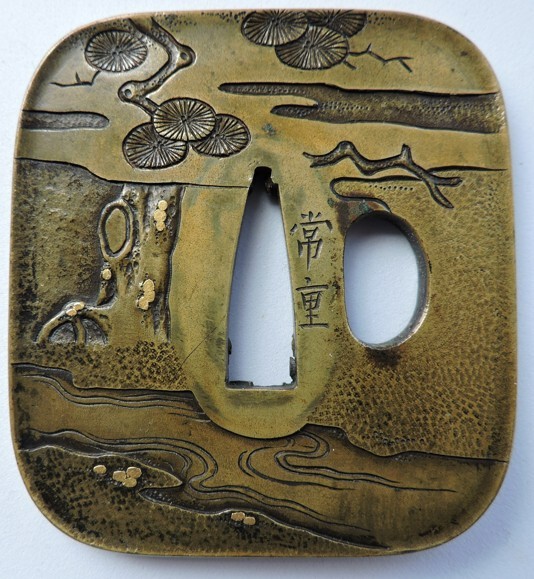
Hi everyone, Can anyone identify the archer on this recently purchased tsuba for me? The scene on the tsuba shows and archer on horseback shooting down a flying bird. The design is not unique and I have seen similar in auction catalogues with the same description but never the identity of the archer. Looking at the short bow the archer is probably Chinese rather than Japanese which fits in with the artist, Tsuneshige, who specialised in historical and mythological subjects from these countries. My searches on the internet have failed to identify the subject and I hate not knot knowing. Tsuneshige (H 10905.0) was an artist of the Nara School who worked between about 1775 and 1800 and was a student of Nara Shigetsugu living in the Kanda district of Edo. His birth name was Ichiemon and originally signed his name as Sekiguchi Masayoshi and is also recorded as signing Ryoka, Takesha and Torin. He is noted for making nadekaku shaped brass tsuba with a uchikaeshi mimi (turned back rim) and shishiaibori carvings in which the design is carved into the flat plate. His subjects were chiefly historical and mythical figures from Japan and China carved in a ‘robust rather than refined execution and he is said to have concentrated on quantity rather than quality’, which is reflected in the large number of tsuba still extant. So, it is unlikely that anyone bothered to forge copies of his work! He liked use an ishime finish on the ground of his tsuba and sign on the right side of the seppa-dai with just two kanji. All of these features can be seen in this tsuba, which also has small amounts gold, silver and shakudo inlays to highlight features in the design. Thanks for your help, best regards, John

-
Can this tsuba have been made by fusing two iron plates?
JohnTo replied to Iaido dude's topic in Tosogu
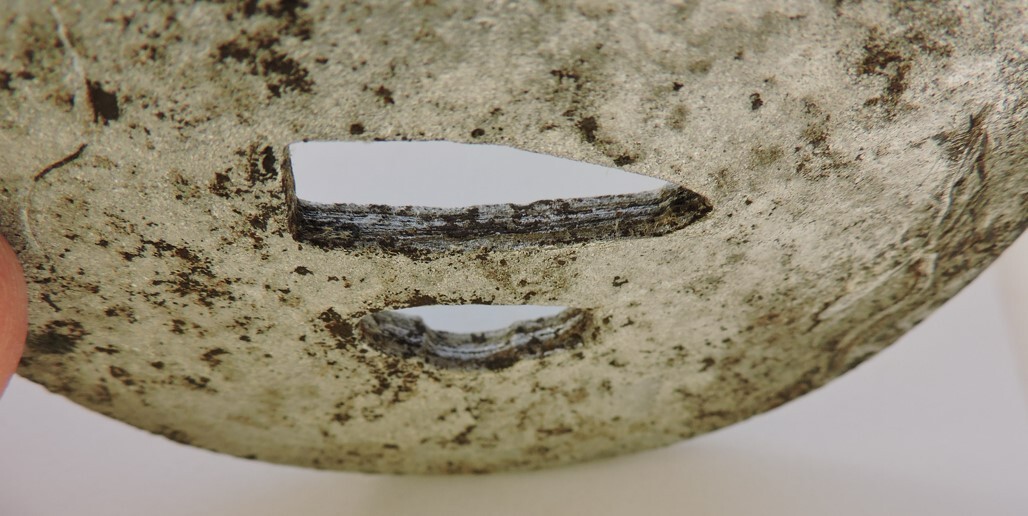
I bought a rusty plate tsuba with a Chinese scene as part of a job lot and decided to experiment removing the rust with Renaissance Metal De-corroder, as it was junk. I think I posted the results before. The interesting thing was that the De-corroder removed the rust without attacking the iron and revealed the layered structure, especially in the nakago and hitsu ana. There were about 10 layers, indicating that the iron had been folded about 3 or for times. There was also an area of about 1 cm square on the ji, just to the right and below the nakago ana where a layer of iron, about the thickness of a piece of aluminium foil had lifted off. Steve's cracks look like poor welding, but don't forget to be aware of lines around the middle of cheap cast iron tsuba. Best regards, John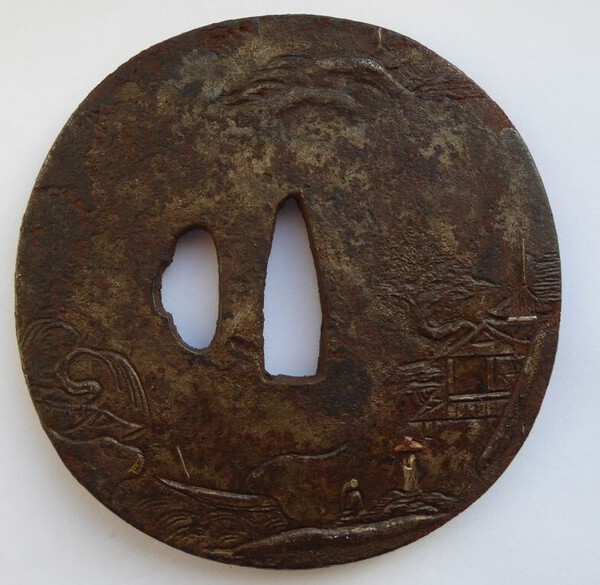

-
Hi Simon, Nice cleaning job to remove the verdigris. I notice that the patina on the main body and seppa dai of the tsuba is brown rather than a deep blue black. This would indicate that the base alloy is nigurome and not shakudo. There are several examples of nigurome tsuba in the Compton collection and Robert Haynes, who wrote the descriptions I believe, describes such tsuba as Nagoyamono (things from Nagoya). Nigurome is described as katashirome (tin and lead) mixed with copper to form nigurome. Once gold (3-7%) is added you get shakudo and the alloy can be patinated to blue/black rather than chocolate brown. Lots of this type of tsuba were made to meet the demand for Goto style tsuba made in shakudo, but presumably they were cheaper. I have a few myself and some are good quality and others not so. I don't expect you have a XRF spectrometer to check the alloy composition. Nor do I, but would love to do an elemental analysis on these tsuba to check if nigurome is actually the same as shakudo without the gold, or a different composition. Nigurome tsuba often turn up in major auction houses and in Japanese dealers inventory wrongly described as shakudo. Best regards, John
-
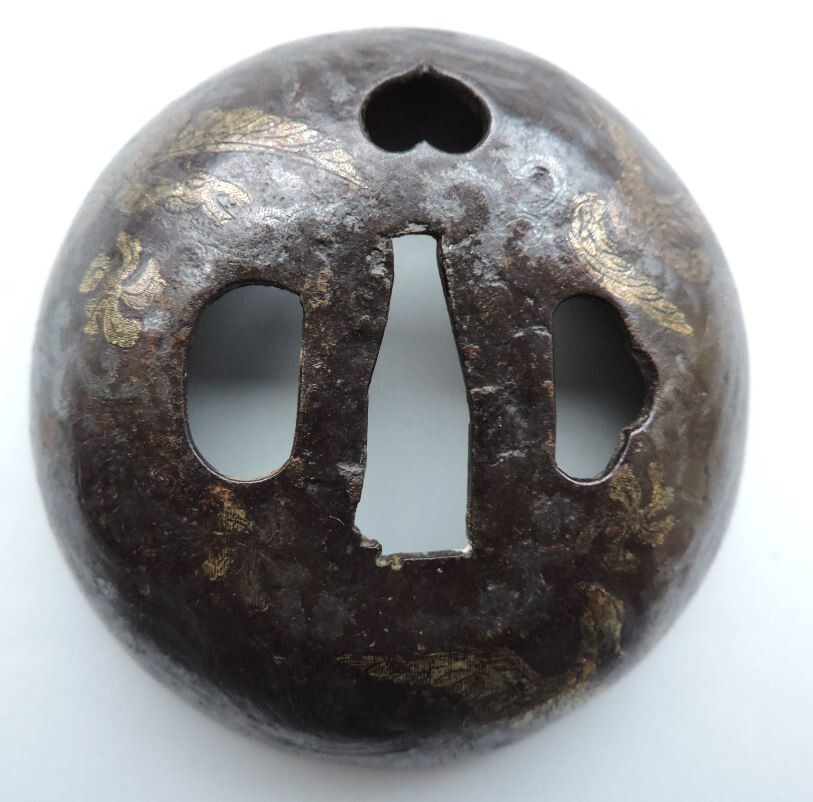
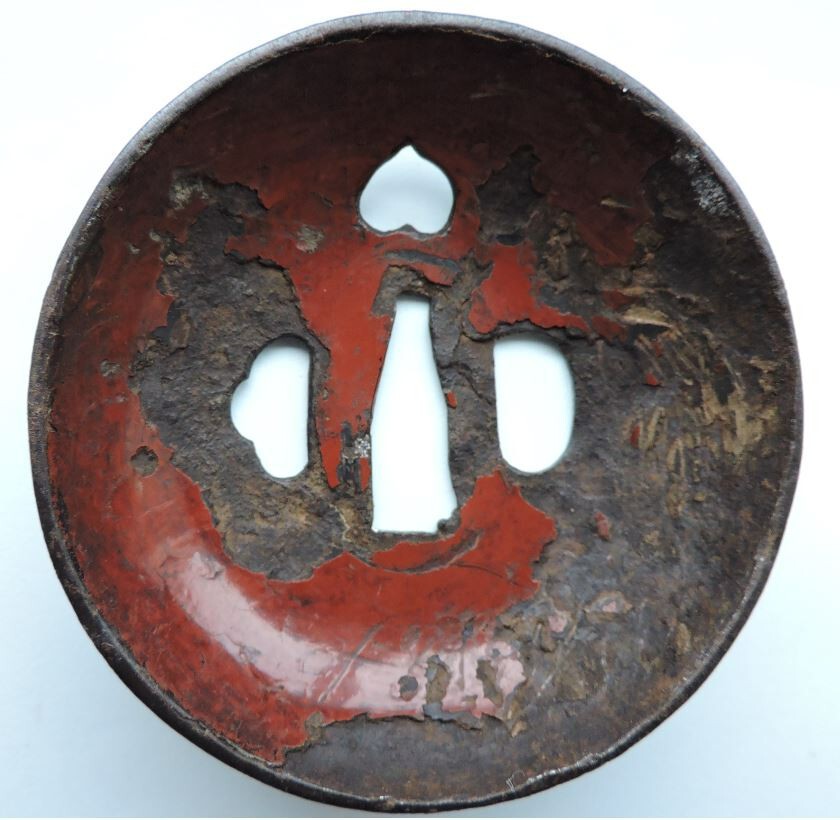
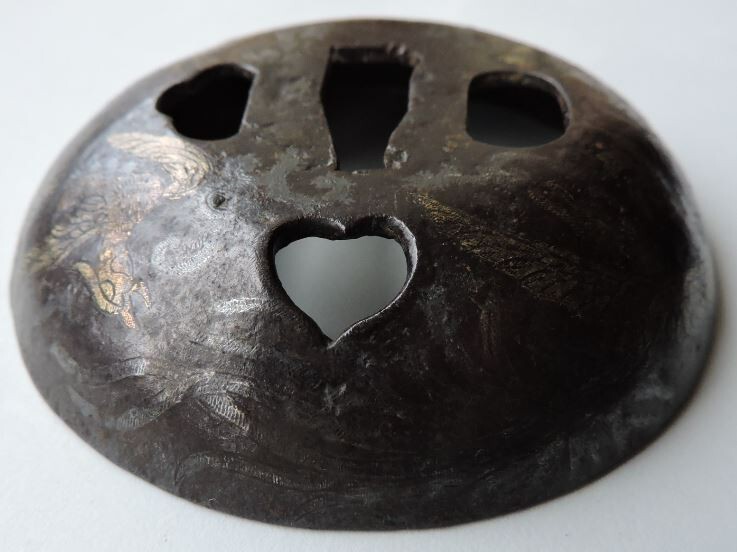
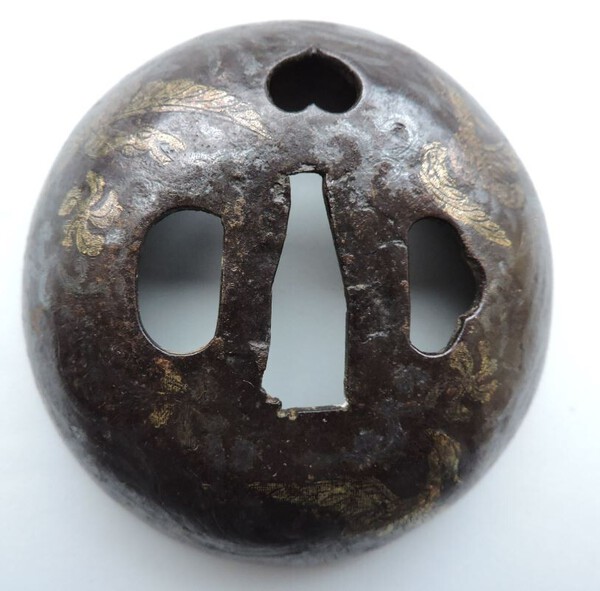
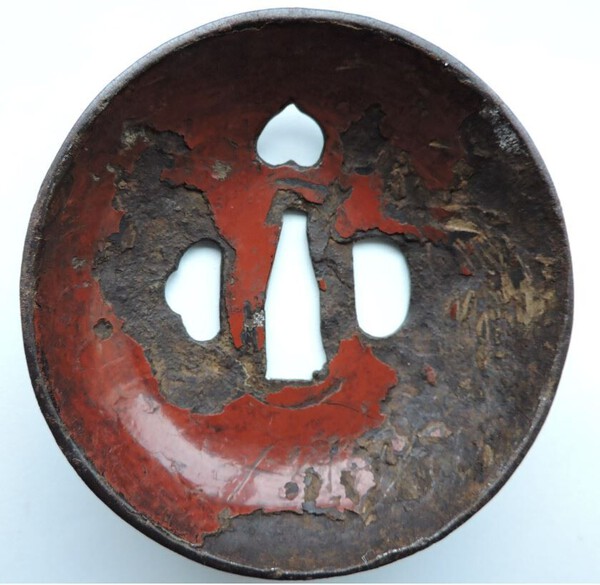
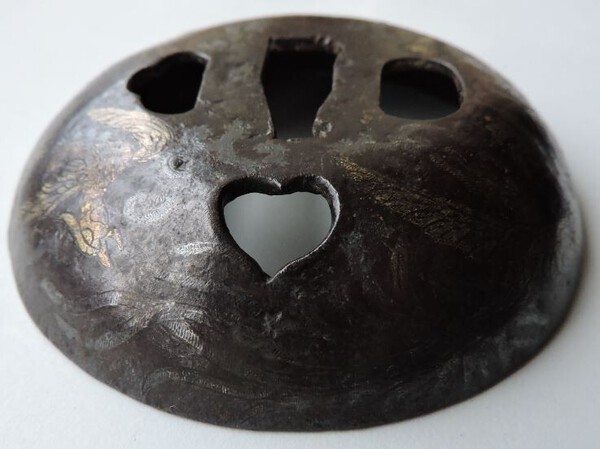
I forgot all about this tsuba I bought as part of a job lot from the Albert Newall (artist and antique dealer) collection a few years ago. I think that I have posted it before, but.. At first glance the tsuba appears to be from a European rapier, but the nakago ana shows its Japanese origin. The Japanese had a craze for Portuguese and Spanish armour in the late 16th C (Momoyama) and perhaps this tsuba dates from then. The iron on the inside has become delaminated, which again makes me believe that this tsuba was made from Japanese folded iron. The inside is coated with red lacquer and I think it would be interesting to have this carbon-14 dated. The tsuba is a thin steel wan-gata (tea bowl) shape and has a large inome (boar’s eye) cut into the top. Usually, Japanese tsuba have four inome and the large single one on this tsuba makes me believe it is a European heart shape; the Heart of Jesus being a powerful symbol of the catholic faith. The tsuba is also decorated with gold and silver highlighted engravings, including three phoenixes in gold (sorry about the photo which does not make them clear). The phoenix is a bird that rises from the ashes, i.e. is resurrected, and the Christian panoply of gods is made up of the trio Father, Son and Holy Ghost. So, is this a Christian tsuba? Best regards, John
-
Hi Guys, I think that I may have a tsuba with a hidden Christian symbol. The tsuba is a variation on the common theme of horse-riding equipment. The first example (not one of mine, an internet image) shows a normal arrangement with a saddle, bit and a pair of abumi (stirrups). In my example the arrangement comprises a saddle, bit and whip. The unusual feature is that the bit has been disjointed with the part that goes in the horse’s mouth becoming separated from the rings that attach the reigns. One ring is completed missing and would lie outside the area of the tsuba and the other is separated from the central part by the seppa-dai, a separation which would be even more pronounced when mounted on a sword as the tsuka would also be present. The remaining ring of the bit, in its isolation, could be viewed as the clan mon of the Shimadzu, or a Christian cross. The tsuba is signed Hidemitsu (possibly H 01077.0, died ca.1750 and worked in Nagasaki making Hizen style sukashi tsuba). Kyushu, where Nagasaki is located, was the home of the Shimazu clan and also had a significant secret Christian population during the Edo period, as Christianity was banned. The Shimazu clan also fought against the Tokugawa at the battle of Sekigahara, so maybe their samurai did not want to openly display their clan allegiance when visiting Edo, for example. So is the isolated ring from a horse bit the Shimazu mon, a Christian symbol, or just a more abstract way of representing a common theme on a tsuba? All the best, John

-
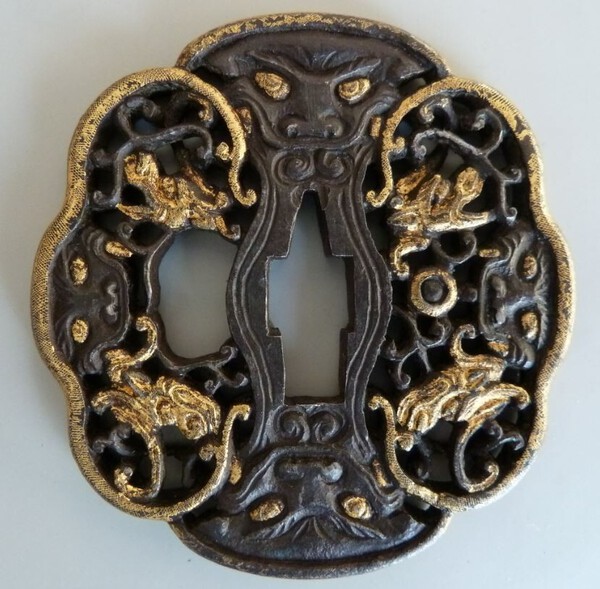
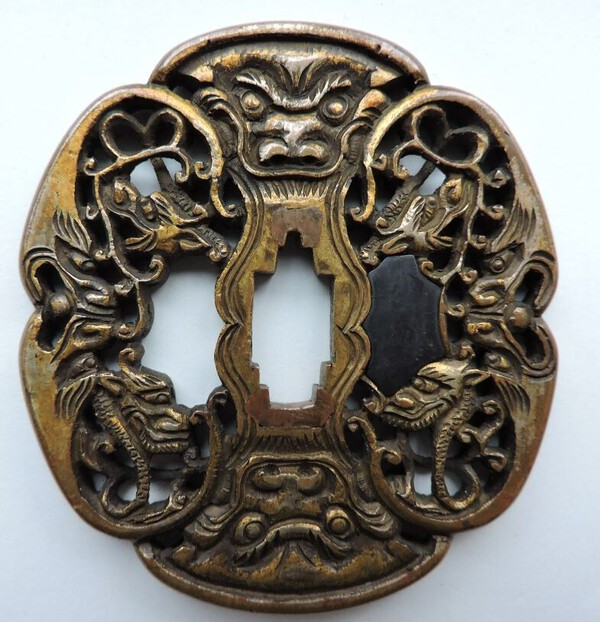
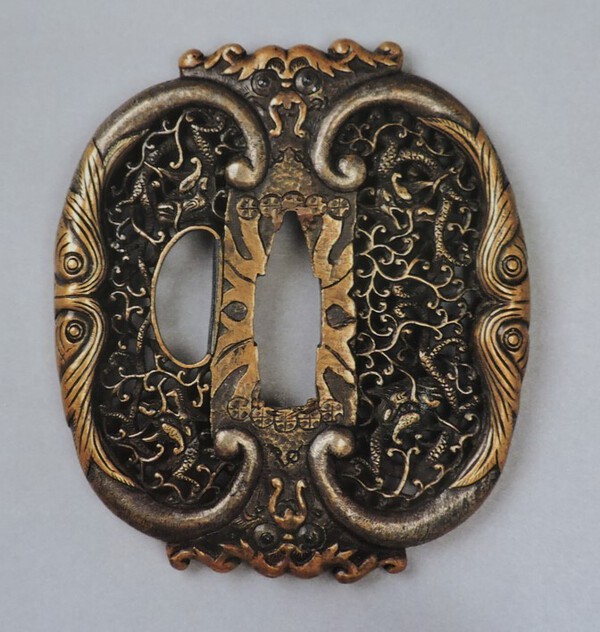
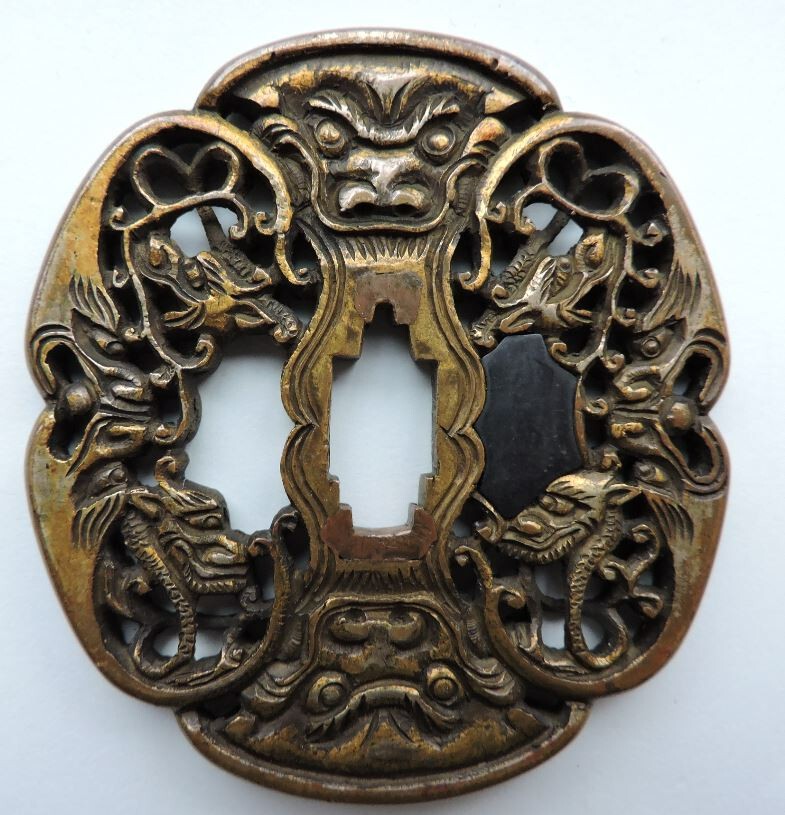
As its Chinese New Year I thought that I would post some Chinese dragons on a couple of Chinese? Nanban mask tsuba, rather than another Japanese version of a Chinese dragon. Like cast iron tsuba (no let’s not open that again) these tsuba invoke a lot of differing opinion as to where and when they were made. The first of my tsuba is iron with four masks (lions, demons?) at the cardinal points and four dragons’ heads together with a tama jewel. The dragons appear to be both male (upside down at the bottom) and female (at the top). Each side is bordered by what are generally termed ‘Drawer Handles’. The black iron is highlighted by gold nunome, which may have been added in Japan? The second of my tsuba is brass and only has two lion/demon masks at the top and bottom. There are still the four dragon heads, two females at the top with their mouths open (talking again?) and the two male dragons beneath with whiskers (this time the right way up). The two drawer handles have been replaced with four stylised dragons, each pair holding a tama jewel in their mouths. Comparing scratch marks on this tsuba with those from a Christie’s sale catalogue (1992), it almost certain that it the one from the Soame Jenyns collection One look at the nakago ana on these tsuba tells you that these were not made for a Japanese sword or polearm. Most people seem to call these ‘Canton Tsuba’ and were made in China, starting in the Momoyama period (pre-1600) up to the late 18th C. Others claim that the Dutch East India Company imported these from as far away as Shri Lanka (old Ceylon). This claim seems to be based upon the ‘Drawer Handles’ which look like the European sword guards and some examples (see photo from RB Caldwell Masterpieces) which seem to have VOC (Vrie Oostindiche Companie) around the seppa-dai (see photo). However, the ‘Drawer handles’ seems to have been used on Ming Dynasty guards and the VOC logo looks a bit ‘iffy’ to me. IMHO, I believe these tsuba may have been taken from Korean polearms as war booty, during Hideyoshi’s campaigns (1592-1598). The Joseon Koreans and Ming Chinese were allies and were armed with the same weaponry. It seems unlikely to me that these tsuba would have been commercially exported from China to Japan with the knowledge that the nakago ana was the wrong shape and had to be modified. Later Nanban tsuba may have had fancy seppa-dai, but the nakago ana was a ‘Japanese shape’. I don’t have any corroborative evidence for this theory. All the best, John