JohnTo
-
Posts
290 -
Joined
-
Last visited
-
Days Won
1
Content Type
Profiles
Forums
Events
Store
Downloads
Gallery
Everything posted by JohnTo
-
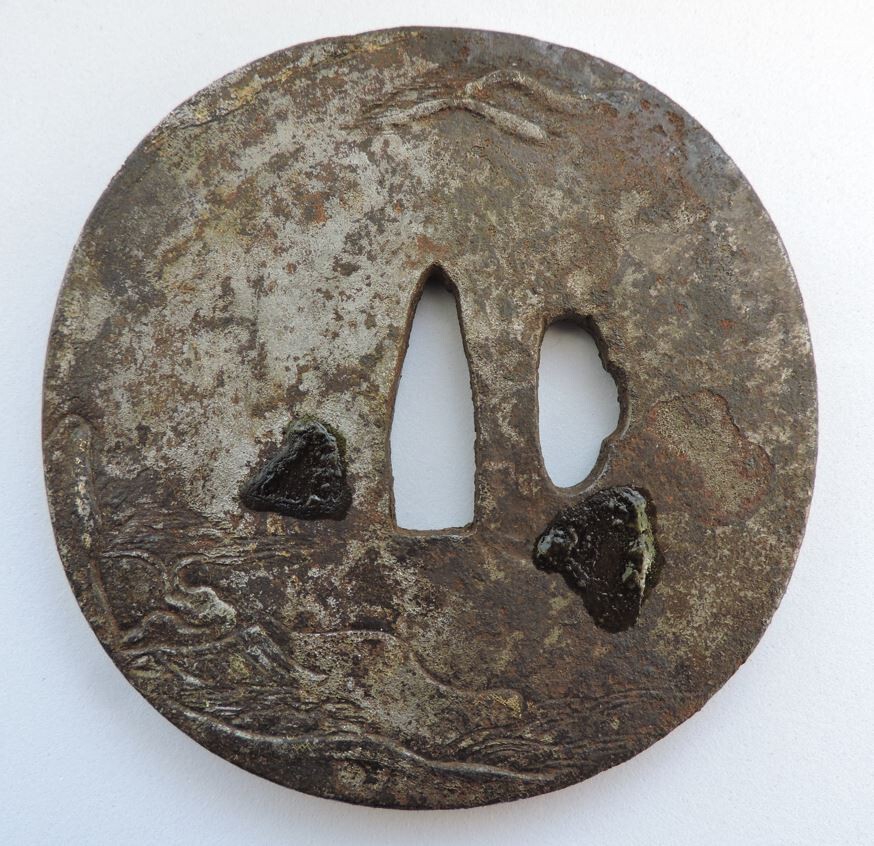
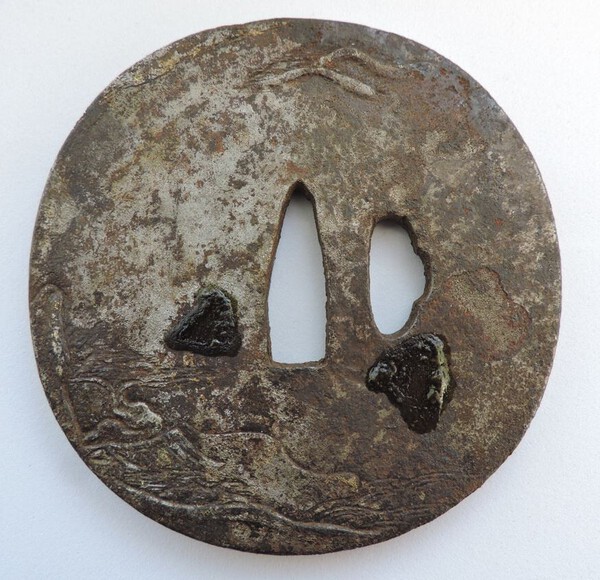
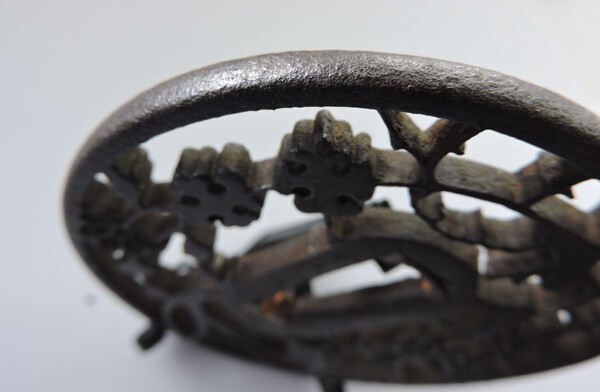
Like most tsuba collectors I have acquired some rusty junk examples. One that I have been experimenting with is a circular plate tsuba, covered with rust when I bought it as ‘the freebie’ in a mixed lot. It is round (8.3 x 8.2 x 0.45 cm) depicting a Chinese landscape with figures next to huts and a boat on a lake. Probably not commercially worth having it professionally restored. My first stage was to clean the surface with cotton buds soaked in WD-40 to remove most of the red surface rust. I like WD-40 (the name stands for Water Displacement formula #40) as it was designed for the aerospace industry and seems to be able to seep in between the rust particles and the iron and loosens them enough to be wiped off with a cotton bud. At this stage the reverse side in particular seemed to have a grey-green colour and this led me to believe that a previous owner had removed the rust and patina with acid, or Cocoa-cola, but the exposed iron had rusted again. The little copper and silver tagazogan figures did come up nicely. After this and all liquid treatments I dry the tsuba with tissue (kitchen roll) and leave overnight on a hot radiator. My next stage was to use WD-40 and penetrating oil, separately, and an old electric toothbrush and this removed more light surface rust (you can see the rusty oils soaking into the kitchen roll) but did not seem to touch the heavy patches. My last stage was to try Renaissance Metal De-corroder, an amine complex of hydro-oxycarboxilic acid in aqueous solution at a pH of approximately 4.0 (i.e. slightly acidic), applied with a cotton bud. It is claimed that this material ruptures the bond between the base metal and corrosion layer, reducing iron oxide to sludge, which can be wiped away. Rust was certainly evident on the cotton bud, but a more liberal covering on the more corroded areas together with use of a piece of bone did not get down to base metal. As the tsuba was effectively junk I decided to try something more drastic. There were several heavily corroded areas and I dripped some De-corroder on these patches. I then placed the tsuba in a plastic box (CD case) to prevent the De-corroder drying out and left it overnight. The areas covered with De-corroder had swelled into a black jelly and wiping this off with cotton buds soaked in water revealed that the rust had been largely removed exposing the bare iron (see pics). I have not carried out this process any further, but I expect that I could end up with a rust free piece of shiny iron, which I would either protect using Renaissance wax polish, or try to repatinate. Please note that I am not recommending the use of De-corroder on areas of tsuba that still have some of the original patina. I have not tried it, but I would expect that long exposure would result in the patina being removed as well as the rust. Remember, rust and patina are both iron oxides. However, this product does appear to remove rust from iron while leaving the underlying metal untouched, which is more that can be said for use of hard abrasives or steel picks. Best regards, John Pic 1 and 2 Before cleaning Pic 3 and 4 After WD-40, penetrating oil with electric toothbrush Pic 4 and 5 before and after De-corroder



-
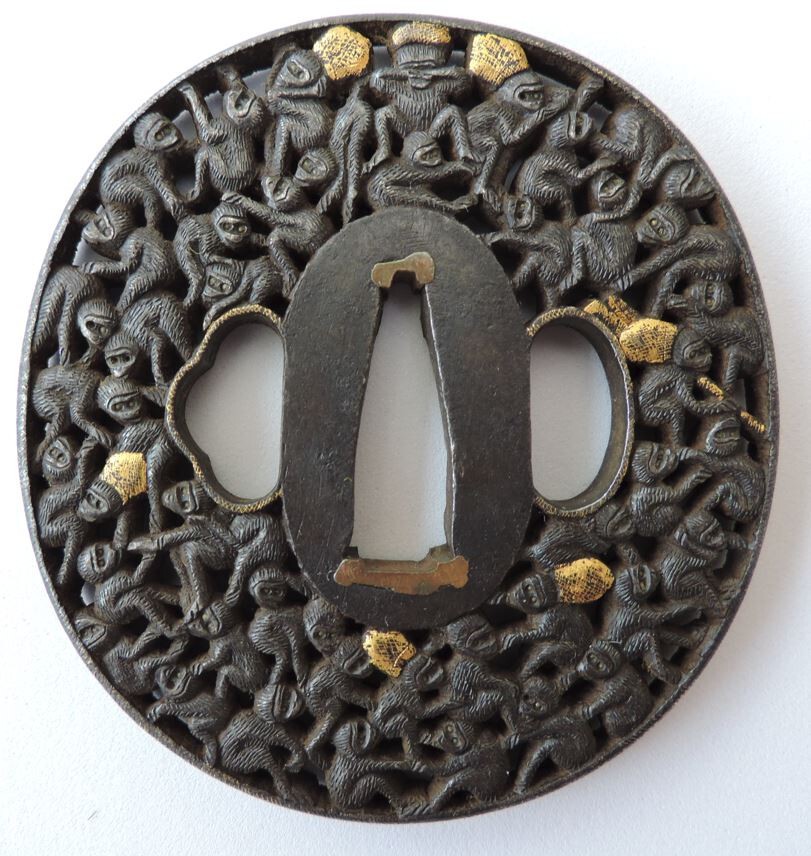
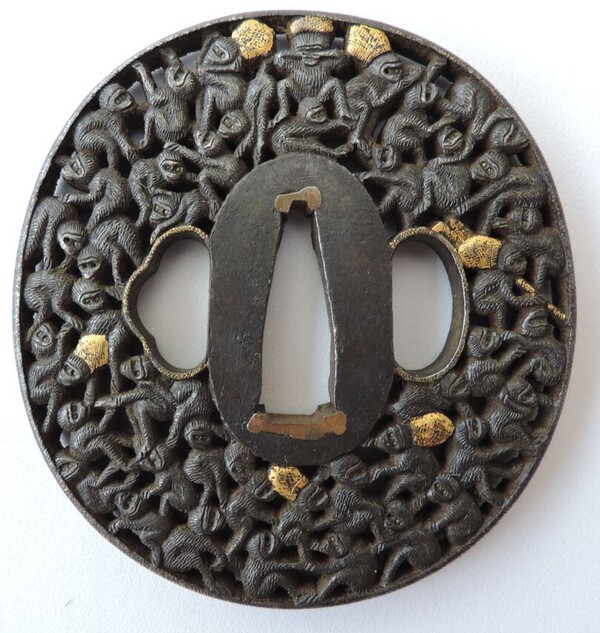
Sorry I’m a bit late getting into this discussion (poor vision due to cataract surgery). Simply put, my philosophy when it comes to rust on iron tsuba is that if it is outside the seppadai and can be easily removed with cotton wool, wooden toothpicks and oils, then do so. IMHO Iron rust scabs allow moisture to remain trapped and if salts (from the general environment, sweat, etc) have also found their way in the iron is going to continue to rust. Harder objects like ivory, bone and antler may be used for stubborn spots, but nothing harder than that. I don’t understand why Jim Gilbert has an aversion against cleaning sukashi piercings. Swords are repolished to remove rust, paintings are stripped of old varnish, museums clean their exhibits. What is special about tsuba? While I would not clean sukashi with a file, sandpaper or steel pick (which would damage the patina and expose bare iron), I regularly use a wooden toothpick with a small piece of cotton wool attached or a tooth flossing brush (see pics) with a bit of WD-40 to remove loose (red) rust and general detritus. Why would anyone want to leave rust, bellybutton fluff etc. (possibly impregnated with soy sauce or other corrosive chemicals) within the piercings? Most of my sukashi tsuba were obtained from old collections and have obviously been neglected. I would remind those non-chemists amongst you that the black and brown patinas found on iron tsuba are essentially the same thing as rust (iron oxides). However, patinas are created in a controlled fashion so that the oxide forms a tight bond with the iron hindering further corrosion. When bare iron corrodes the rust does not adhere strongly, flaking off, exposing more iron which continues to oxide. Moisture and ionic chemicals, e.g. salt, getting trapped in the rust will accelerate corrosion. Remember, rust never sleeps, but removing moisture and salts will slow its progress. To illustrate, attached is a senbikizaru (1000 monkey) tsuba that had a lot of loose red rust in the sukashi. I cleaned it using just a toothpick wrapped in cotton wool and a dental flossing brush with WD-40. I don’t think that I have damaged the remaining patina. If I find signs of rust reappearing I will repeat the treatment and apply a thin coating of Renaissance wax polish, using a cocktail stick wrapped in cotton wool, which is claimed to be used in many museums. Best regards, John


-
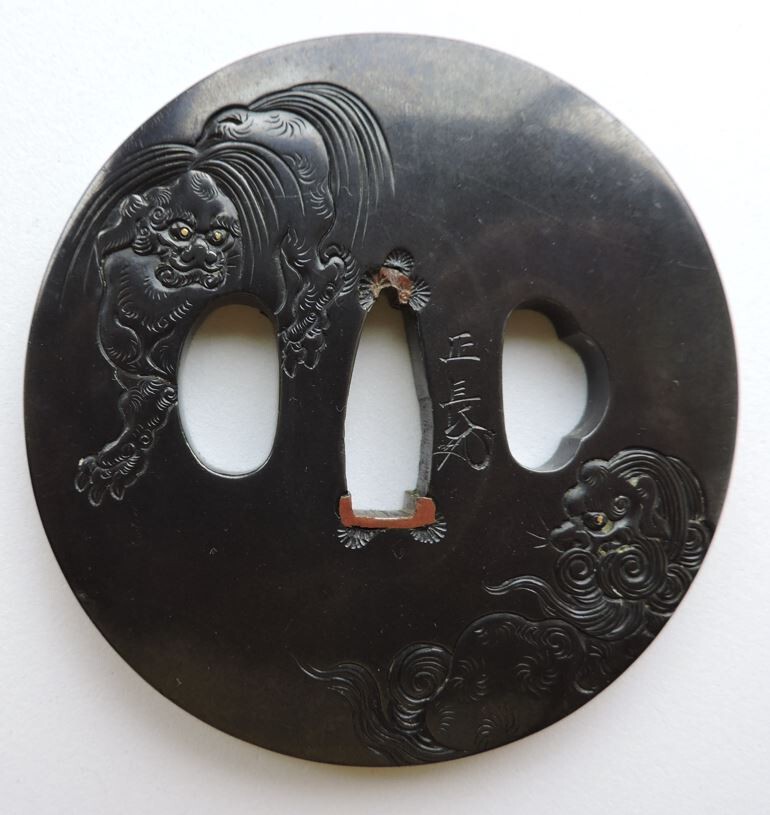
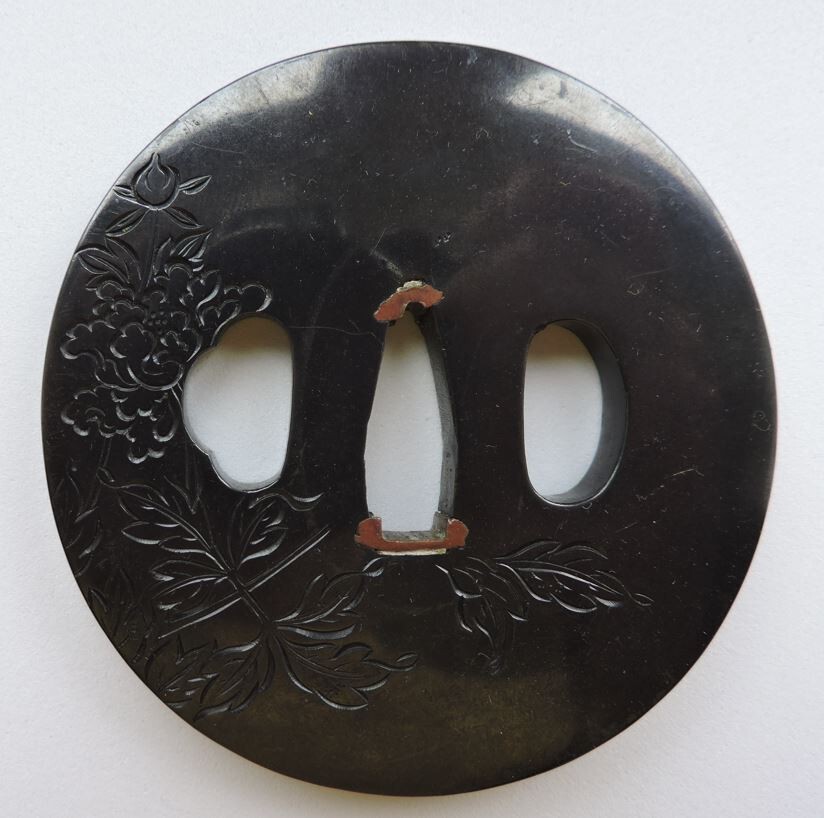
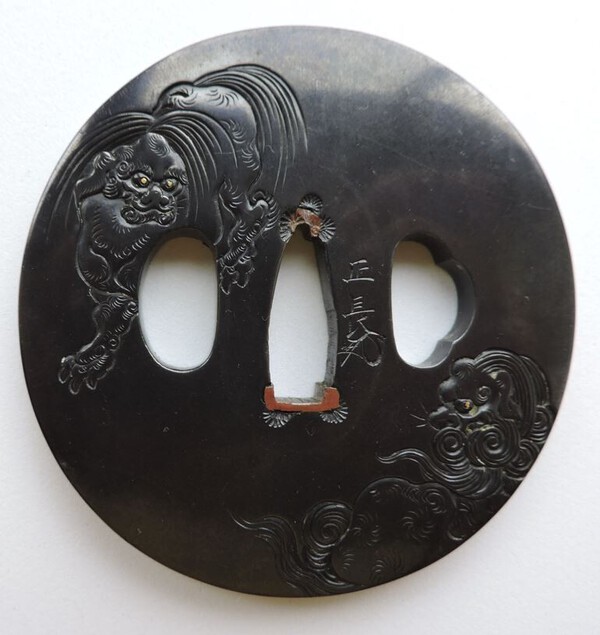
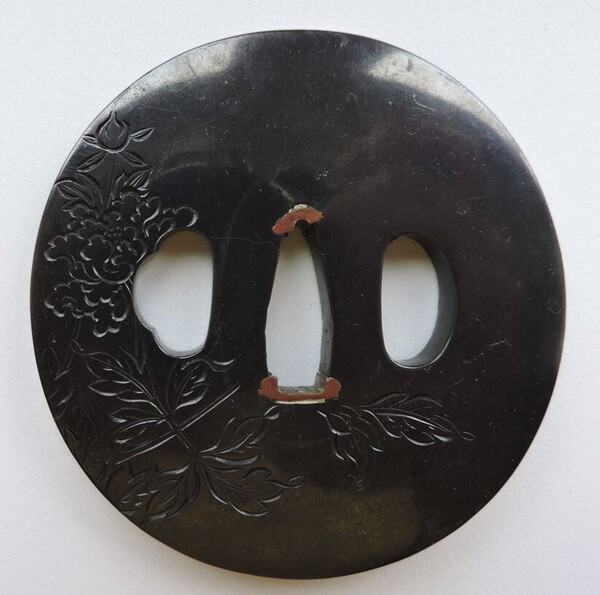
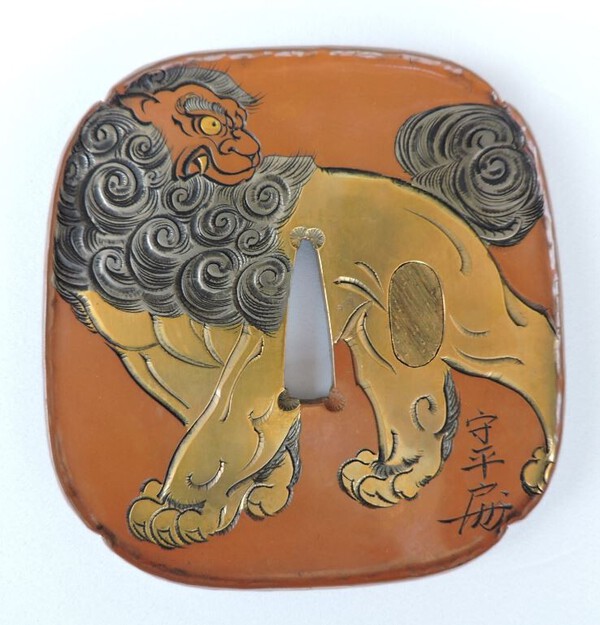
Here are two of the tsuba added to my collection this year, both depict shishi and peonies. The two tsuba were probably made about 200 years apart and show differing aspects of the subject. Shishi are mythical guardian animals in both China and Japan and the peony is regarded in Japan as the king of flowers and symbolises bravery, honour and good fortune. Consequently the two are often depicted on tsuba together. The first is a shakudo tsuba, signed Masanaga, plus kao, with a pair of shishi on the omote and a peony on the ura. The tsuba was catalogued as Haynes Index no. H 04250, which identifies the artist as Chosuke Masanaga (d. ca 1700), who was a student of Nara Toshinaga (Markus Sesko) or Ito Masatsugu (Haynes). However, there were two generations of Masanaga in the Nara School and both used the same kanji for their signatures. The first generation, Seiroku, was a student of Toshinaga (either the 3rd generation master of the Nara School or a student of the same name). His (adopted?) son was Gihachi Masachika, who signed Masanaga for a while after his father’s death and was from the Kawakatsu family and a nephew of Sugiura Joi. The Nara tsuba artist Gohachi Masachika may have been an alternative name used by either of the other two Masanaga (see gen chart). Consequently, there is some uncertainty as to the identity of the artist who made this tsuba (assuming, as always, the signature is genuine). Specification: Height: 7.6 cm, Width: 7.4 cm, Thickness (rim): 0.4 cm, Weight: 216 g This tsuba was purchased by Edward Wrangham from the Roland Hartman Collection of Japanese Metalwork (Christies, 30 June 1976, Lot 130). I was told by the late collector and friend, Sidney Divers, in about 1976 ‘Start collecting tsuba. They will soar in price.’ In 45 years this one barely doubled. The second, a copper tsuba, is a radically different interpretation of the same theme and was made by a modern artist, Yanagawa Morihira (1899-1971). Apparently Ichiyushi/Shinryuseki/Shinryoso) Morihira was a Tokyo artist. From the age of 14 he studied with Yoshioka Mitsushige (who died 14 September, 1923, in the Great Kanto Earthquake). He then studied with Toyokawa Mitsunaga (second generation) and took the name Mitsuo until he established himself. The front (omote) of the tsuba shows both a shishi and peonies, whereas the reverse (ura) only shows the shishi. Interestingly, the shishi on the omote has a silver body and a golden mane and tail, whereas the combination of silver and gold is reversed on the ura. The heads on both animals is copper. Shishi are often represented as playful creatures, but these two are muscular with a fearsome pose and the silver shishi has a head which looks rather like Hannya, the Japanese female demon. The engraved peonies on the omote are coloured with silver and gold gilding and the petals are in a darker shade of silver. The gold and silver seem to be painted on, i.e. amalgam. The outlines are defined in katakiribori (half cut carving) and kebori (hair carving) and, particularly the silver, darkened to add extra tonality to the design. The nagako ana has four 32(?)-petalled chrysanthemum punch marks on each side, purely for decoration. There is also a single kozuka hitsu ana, filled with a gilt cat scratched plug. Shishi is also the name given to a group of political activists (Ishin Shishi 維新志士) in the late Edo period who opposed the westernisation of Japan. I think that it is likely that this tsuba was made in the 1930’s when Japanese militarism was at its peak, which is probably why I got it below estimate. Specification: Height: 8.75 cm, Width: 8.4 cm, Thickness (rim): 0.7 cm; Nakago: 0.4 cm, Weight: 254 g A very similar tsuba to this, in terms of technique, by Morihira is currently for sale by Aoi-Art (https://www.aoijapan.com/tsuba-morihira-sinryuseki/). I bought this tsuba in memory of my nephew, Gary, who died a few weeks before this tsuba originally came up for sale in 2020. It was unsold and came up again at the next auction (2021) when I decided to buy it. I would not normally have purchased this tsuba but Gary was an extrovert party guy whose group of girlfriends gave him the nickname Simba. This over the top depiction of shishi will always remind me of Gary. All the best for 2022, John


-
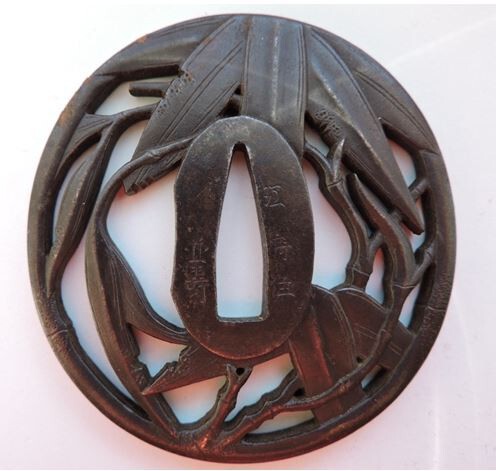
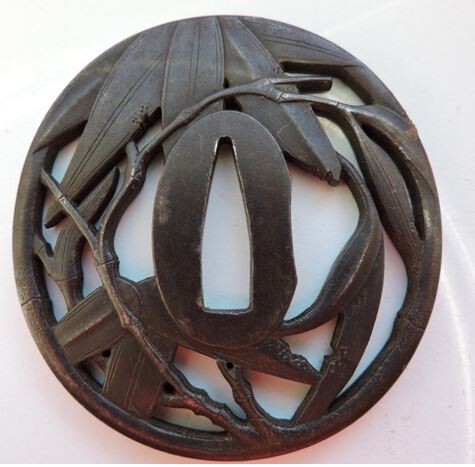
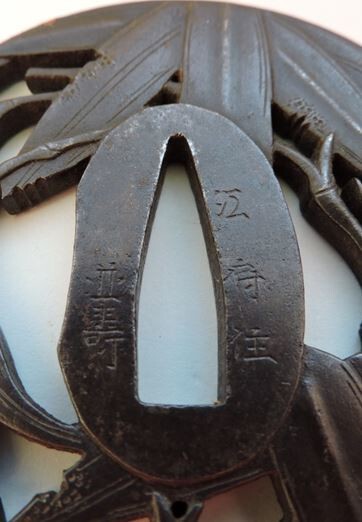
Hi Guys, I've been out of action for a while and missed this post. But here is one of mine, a tsuba signed Efu ju Namitoshi. Signature looks with the ones shown above and design of bamboo seems to have been a favourite of Namitoshi. This tsuba came from the Peter Newall collection an antique dealer and artist whose collection lay undisturbed in a loft for 30 years after his death (luckily it was not damp)., Best regards, John
-
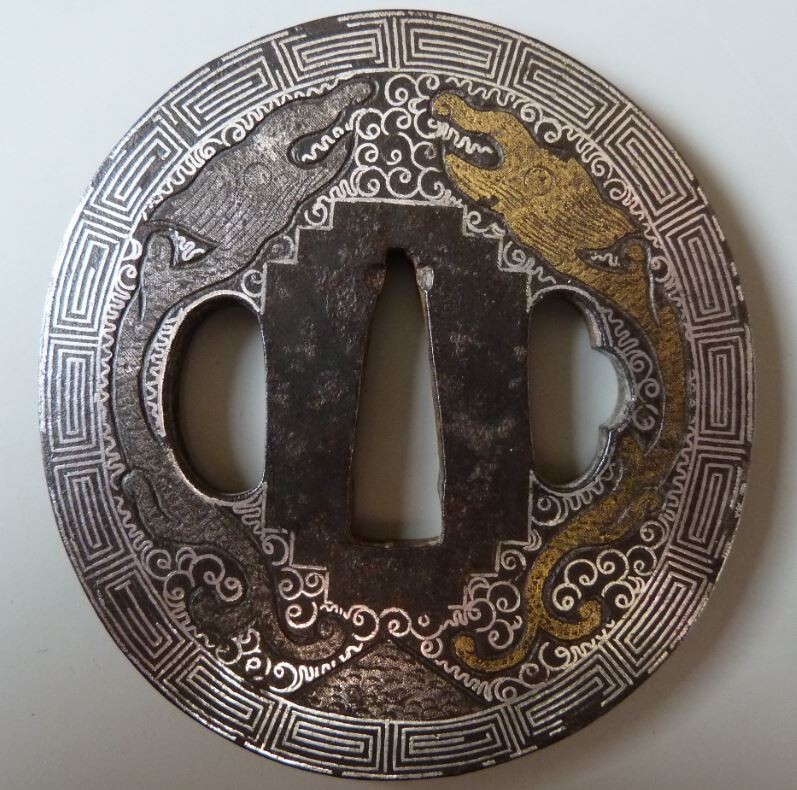
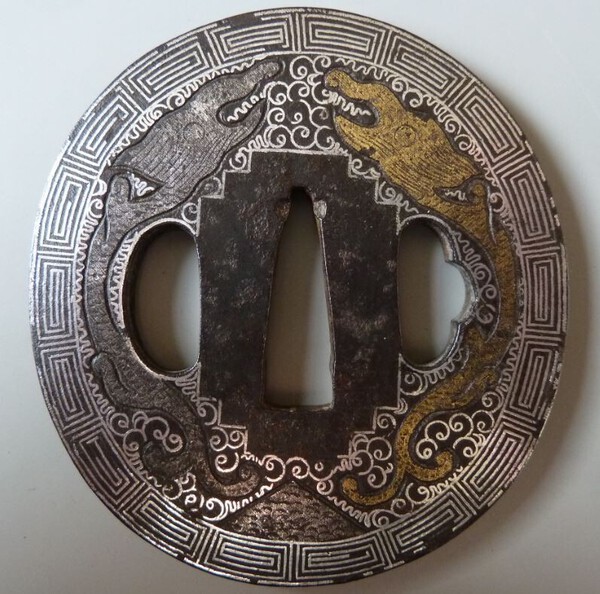
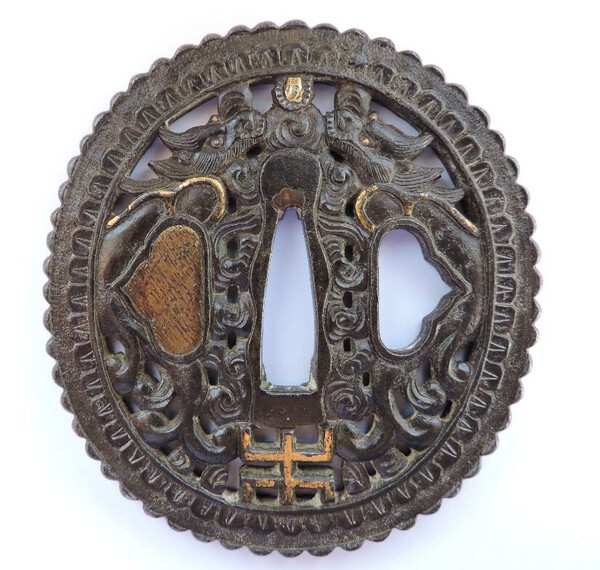
Hi Michael, I have a very similar tsuba, same design, different shape. As others have said it is classed as a Nanban (Southern Barbarian) tsuba. These seem to have originally been imported from China or elsewhere in Asia into Nagasaki. The imported ones tend to have distinctive seppa dai and nakago ana. the seppa dai is grooved and the nakago ana is not the usual triangular Japanese shape. They appaer to have been made in Japan, probably by Chinese immigrant artists who then moved out from Nagasaki into Hizen and made tsuba in the Japanese shape. The thing that interests me in my tsuba is the 'silver' has not turned black, so I assume that it is not silver but an alloy. Anyone know out there. Like yours mine is iron, slightly tapered towards the rim . It shows the two stylised dragons in gold and silver, plus five treasures on the reserve. I believ that they may date from the end of the 18thC. Mine is 7.0 x6.55 cm and 0.3cm thick. Best regards, John

-
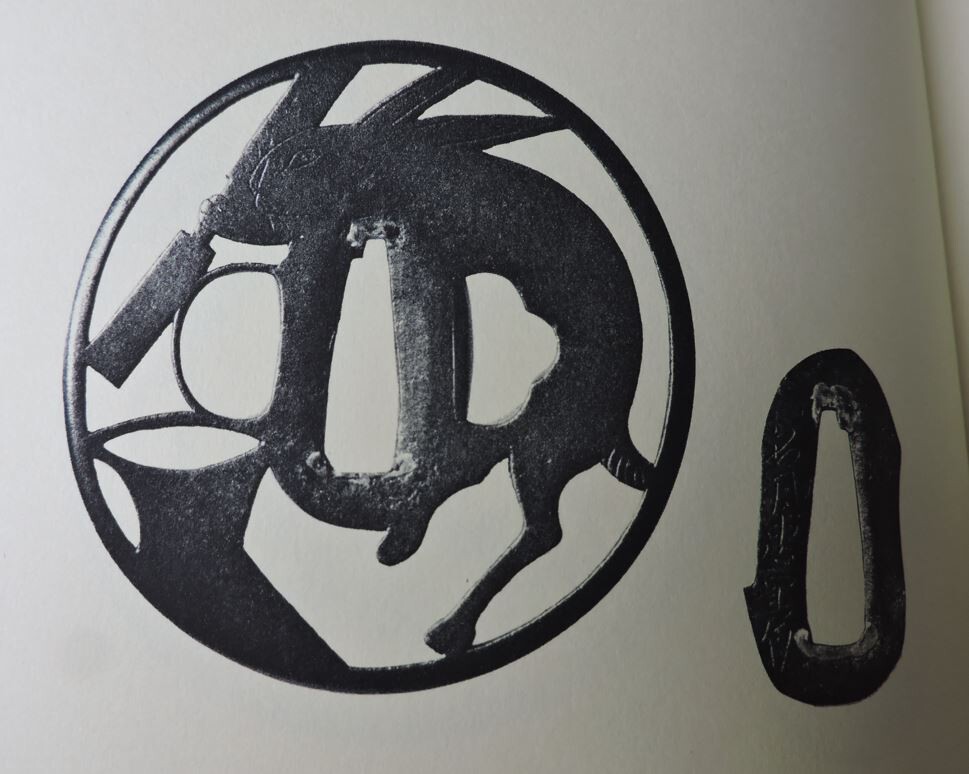
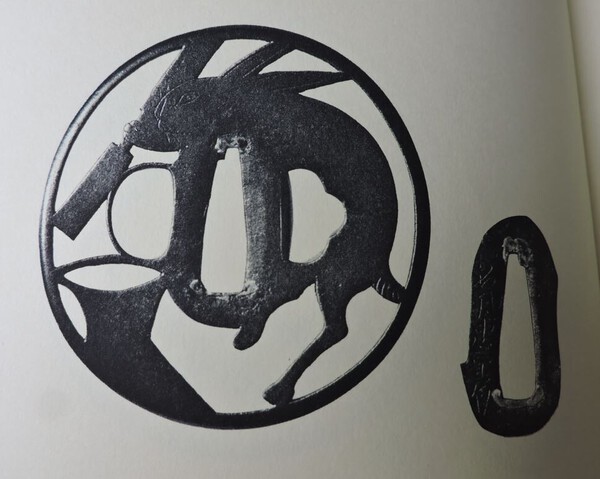
Hi Stephen, Browsing Sasano's Early Japanese sword Guards I came across this bunny (#164, Akasaka signed Tadashige) Not as badass as yours but still a tough little critter as he is pounding rice to make mochi best regards, John
-
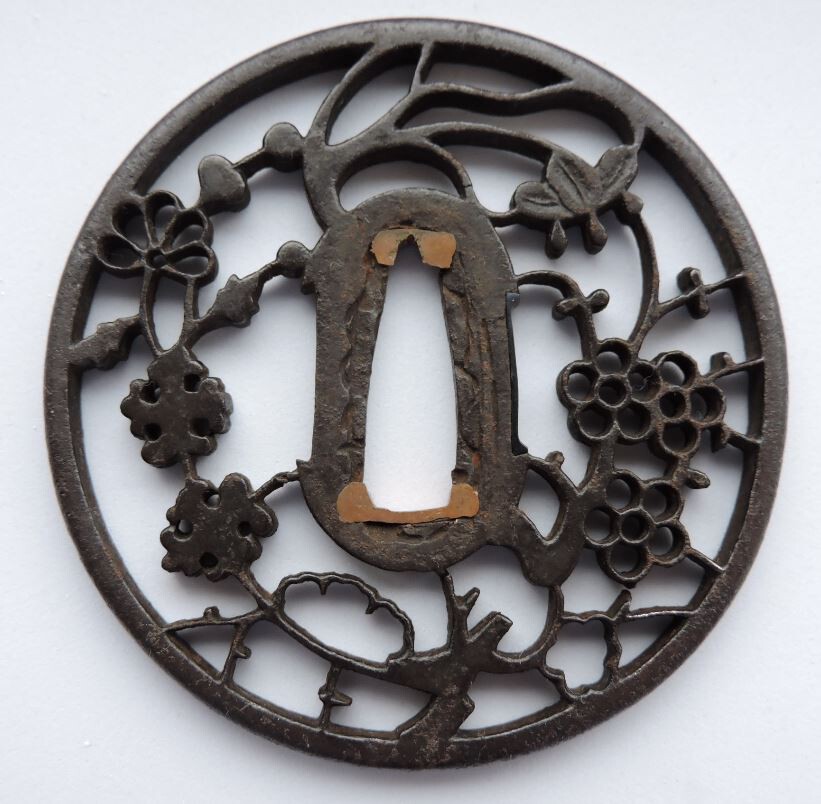
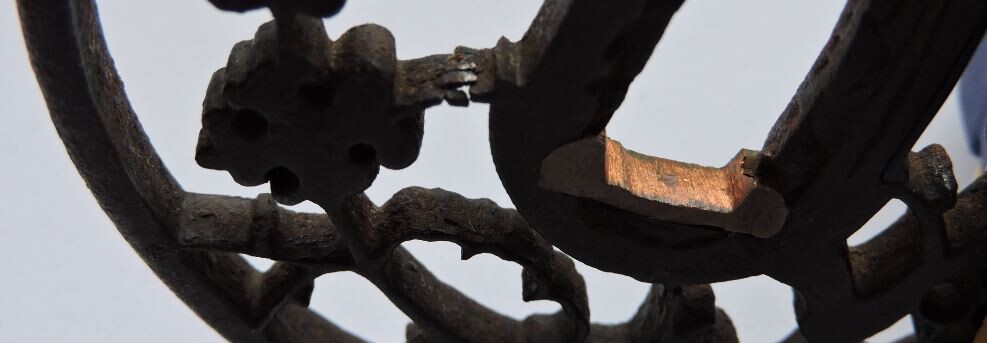
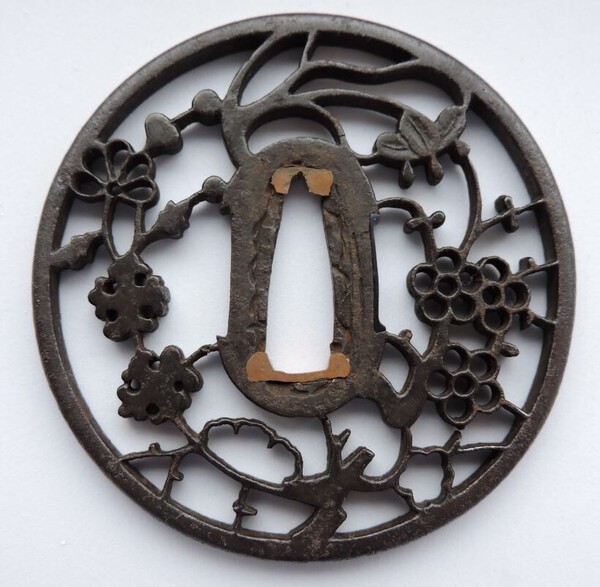
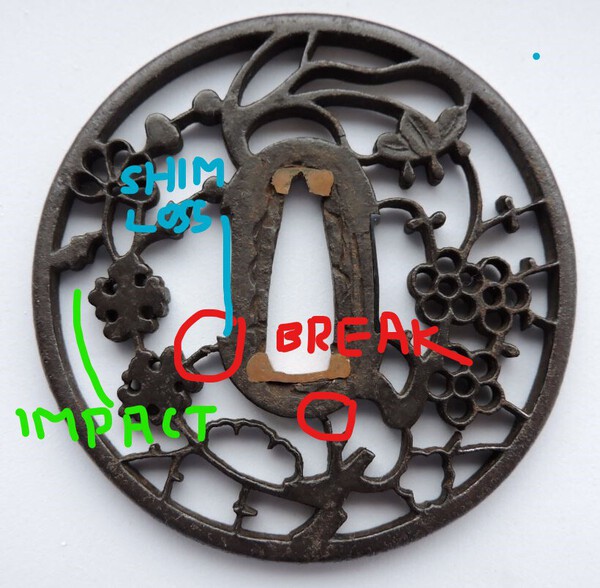
Hi guys, I thought that this sukashi tsuba may be of interest on account of an old(?) repair to the sukashi. This maru gata iron sukashi tsuba depicts various plants including a branch of plumb blossom, a wisteria flower and an unknown flower attached to a thin stem with a couple of four lobed leaves (Any idea what these are?). The seppa dai has copper seki gane and tegane marks on both sides, that differ in style. There are no hitsu ana, per se, but one side has a shakudo shim let into the seppa dai and the other (damaged) side has evidently lost the shim. The mimi is covered with fine granular tekkotsu; and based on this I’ll stick my neck out and assign it to Shoami rather than Kyo-sukashi workmanship. I’m not going to hazard a date as we newby collectors tend to go for early (pre-Edo) dates! I’m also not going to definitely say which is the omote and which is the ura on this tsuba. The design, tegane marks, lack of defined hitsu ana and damage could indicate that it could have been mounted on a sword reversibly. But OK, I’ll go with the plum blossom on the right when viewed from the front. At some time in its history this tsuba seems to have been subject to an impact on the left side, between the four lobed leaves and the mimi. This impact twisted this part of the sukashi and broke two of the fine links to the seppa dai. It probably also resulted in loss of the shakudo shim of the hitsu ana on the seppa dai. The link between the four lobed leaf and the seppa dai was repaired using two small pieces of metal (2mmx1mm), but the twist in the sukashi was not (fully) corrected. I don’t think that this was a result of classic battle damage by a sword, pole arm or musket ball as there appears to be no metal to metal impact marks. It is more as if the tsuba had been hit by something relatively soft, e.g. a piece of wood. After spending some time examining the tsuba, I have come up with this rather fanciful explanation of the damage (other theories welcome). It is perhaps an urban myth that some fencing masters were so good that they gave up using real swords and when accepting challenges from inferiors and used pieces of wood, or even pot lids. It may be that the owner of this tsuba fenced with one of these masters and managed to parry a blow with the tsuba. Out of respect for the master and the encounter, the tsuba was never fully repaired. Besides, it would have made a good talking point with other samurai over a few drinks. I guess that the damage would exclude this tsuba from a shinsa, but it does add a bit of interest. Height: 7.9 cm; Width: 7.7 cm: Thickness (rim): 0.5 cm: Weight: 77 g Best regards, John (Just a guy making observations, asking questions, trying to learn)


-
- 3
-

-
Hi Bob, You could be right about your tsuba No. 83 and mine being a daisho pair. By a strange coincidence my tsuba is number 84 in my collection! best regards, John
-
Hi Bob, the titles on my pics for your tsuba #83 do not seems to have copied over. They are: 1. My tsuba 2. My signature. 3. Boston, 4 Boston signature. 5. Church Collection. 6. Bonhams . Regards, John
-
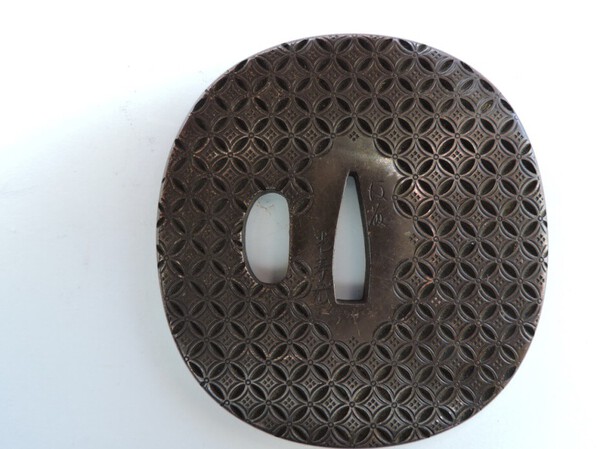
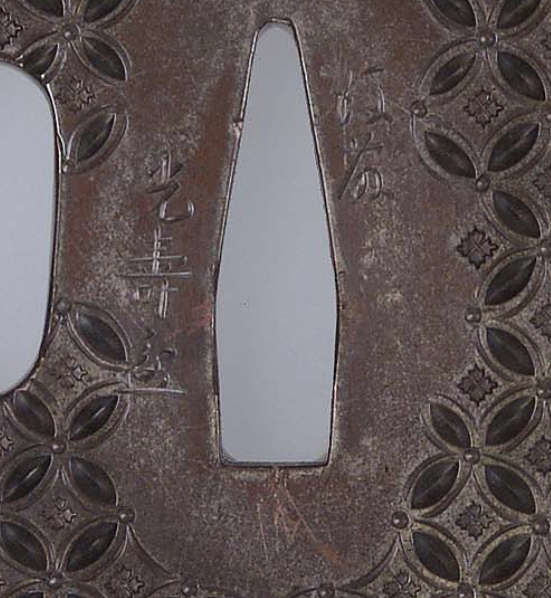
Hi Bob, Reference Tsuba #83, Goto Tsujo I also have a ‘Goto Tsujo’ shippo tsuba(see pics) that I have posted previously. Mine came from the Albert Newall collection, a dealer whose collection had been in store for 30 years after his death. I have also found several other examples on the internet, so a popular design. The Ashmolean museum has one (Church Collection EAX.10899, shibuichi, misidentified as ‘Mitsunaga (probably not Tsujo)’. The Boston Museum of Fine Arts has another (11.5433,shibuichi) and one was up for sale at Bonhams, NY recently (24 Sep 2020, lot 966, brown patina but described as shakudo). Points of interest are: The colour of your pics appears to be shakudo (as you stated), but the other examples have a brown colouration (mostly based on photos) and appear to be shibuichi. The kanji and kao on the examples appear to differ in detail, so are some fakes, student works or just variations with time? I’m not expert enough to judge. I just take the view that any tsuba that I acquire with a famous signature is likely to be gimei and concentrate on the quality of the workmanship. Most people seem to read Goto Tsujo’s personal name as Mitsutoshi however references I have seen stated that Fukushi reads him as Mitsunobu and the Toso Kodogu Koza says that the kanji are commonly read as Mitsutoshi, but Goto documents list him as Mitsunobu with furigana reading aides by his name. One example I have seen listed has the signature as Goto Mitsutoshi (後藤光壽) and another as Goto Mitsunobu ((後藤光寿). As the little square at the bottom of the left side of ‘toshi’ appears on one tsuba, but not on the others, perhaps the artist used both names, changing the kanji. I believe that both forms of the kanji can be read as both ‘toshi’ and ‘nobu’. Japanese artisans were great at using different names; Tsujo was also known as Shirobei, Gennojo and Mitsuo according to Sesko. Stats of my tsuba: Height: 7.05 cm. Width: 6.65 cm. Thickness (rim): 0.35 cm. Weight: 152 g Best regards, John Hi Bob, the titles on my pics for your tsuba #83 do not seems to have copied over. They are: 1. My tsuba 2. My signature. 3. Boston, 4 Boston signature. 5. Church Collection. 6. Bonhams .


-
Hi Mark, Lovely tsuba, I have never seen the design before. I wonder if it is a stylise peony, looking directly down into the bloom: 'the king of flowers and in Japan symbolises bravery, honour and good fortune.' Often found on tsuba etc: example 1 from Boston Museum of Fine Arts, the other from the V&A. Best regards, John


-
The mon may be three oak leaves (kashi0 used by the Makino, Horimoto and Kasai families, and others. To check if it is solid silver you could weigh it while suspended by a fine wire (fishing line) the submerge it in water and reweigh. The density is the original weight/reduction in weight in water. Silver is 10.5, copper 8.4 and brass 9.0. I've done this with a brass tsuba and kitchen scales. The top photo seems to have a fine inscription of the right side by the mimi (rim) and Inome (boar's eye) indentation.. Can you read it. best regards, John
-
Bruno, I can't comment on the signature as I'm not expert enough. But I tend to think that if a tsuba has a unique design, which this one has, then its likely to have be genuine. Forgers tend to make copies. It really is a lovely design. I've never seen one like it. The owl on the front seems to be in the wild and free as it sits on a branch of a tree. However, the owl on the back is sitting on a man made perch. I suppose it is an owl rather than a hawk, which would be more likely to be kept as a pet or for hunting? Regards, John
-
I remember attending the RB Caldwell masterpieces exhibition. I still have the book and invitation (see attached). As I remember it was held at a swanky London house and was filled with lovely ladies, there for the free champagne. As my wife was with me I was able to focus my attention on the collection, one of the few that did. I could not afford any of them, but got a group of three tsuba and the Sotheby's auction of other items from his collection.

-
Hi Grev, Without having the tsuba in my hands one cannot be sure from photos but the following warning signs light up in my head. 1. The mei looks like it was applied with a broad chisel. Fine if it was Nobuie, but.. 2. The seppa dai has a granular finish. I would expect smooth or hammered from a forged piece. 3. The hitsu ana and other features look 'soft', not sharply cut. 4. The photo of the seppa dai shows a flake missing from the top of the sukashi. Mill scaling? 5. The top right hand corner of the seppa dai inside sukashi and left inside mimi show red lines. This might be rust at the weld of folded iron, or it might be the seam of a mould. Individually none of the points above show it was cast, but £430. You can buy papered tsuba from Japan for that. best regards, John
-
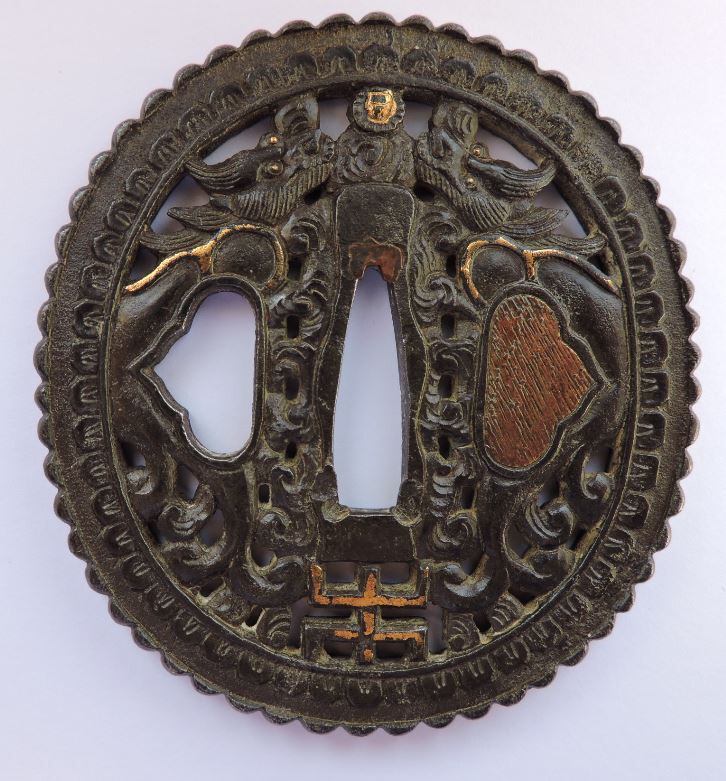
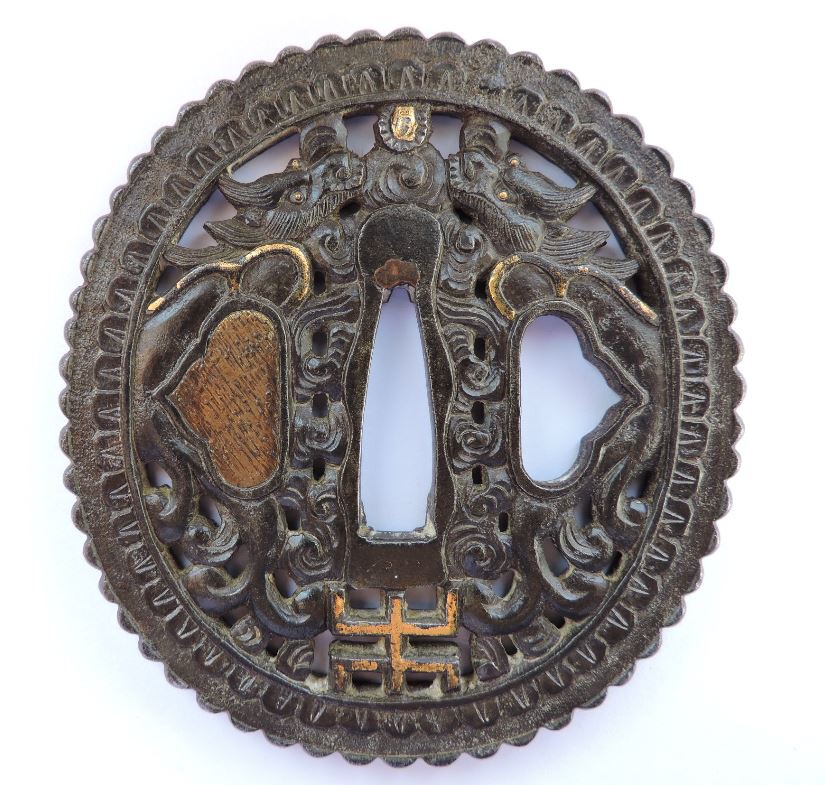
Re: tsuba #46, I have a very similar nanban tsuba (pics attached) and just have a couple of questions. 1. Both tsuba, like other iron nanban tsuba I have, have no trace of rust. Do you think that these were cast? The texture of the iron and softness of the carving makes me feel that they are cast, but the finish seems better (no mill scale) than Japanese made cast tsuba I have seen (our tsuba may have been made in Nagasaki, Japan, but presumably by Chinese craftsmen or Japanese craftsmen using Chinese casting techniques) 2. The tsuba have the usual dragons and the tama jewel at the top. In addition both have a stick shaped gilded character at the bottom of the tsuba that looks like a stylised man. It resembles the kanji 出 (Shutsu, sui, da, de) meaning to put out, or leave but the ‘legs’ at the bottom point downwards, whereas the ‘legs’ on the kanji point upwards. Does anyone know what they represent? Any thoughts on my observations? Enjoying the glimpses of your collections, but I have to remember to reference which one when replying as the list is getting long. My tsuba: Height: 7.6 cm. Width: 7.1 cm. Thickness (rim): 0.45 cm. Weight: 102 g Best regards, John

-
Thanks Piers and Mauro, You are correct they are nets. I assumed that they were rice stoops from similar features on other tsuba and pictures, i.e conical shapes bound at the top. However mine shows criss cross cuts and not lines in just one direction, so they must be nets, especially in the context of this tsuba. And thank you Mauro, but as I cant copy and paste the text into Google translate, I'll give it a miss as my Japanese in not very good. Arigato. best regards, John
-
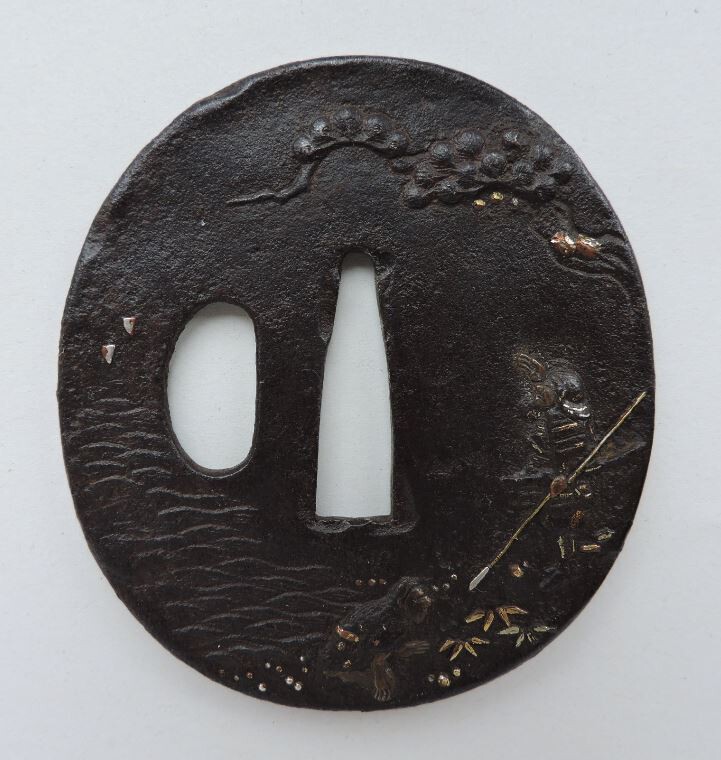
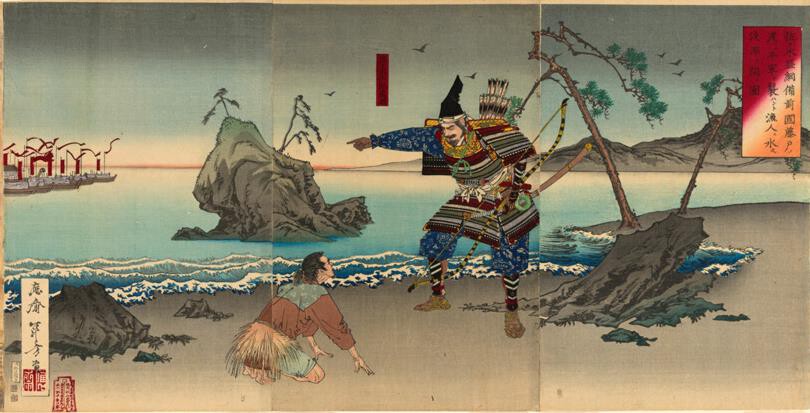
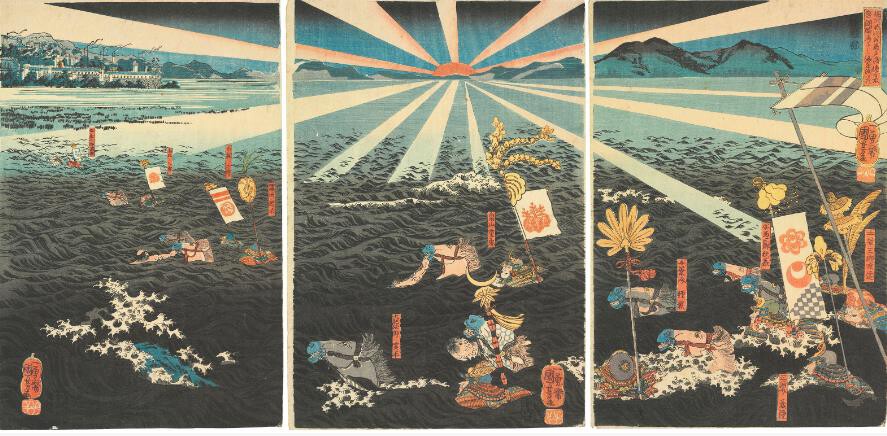
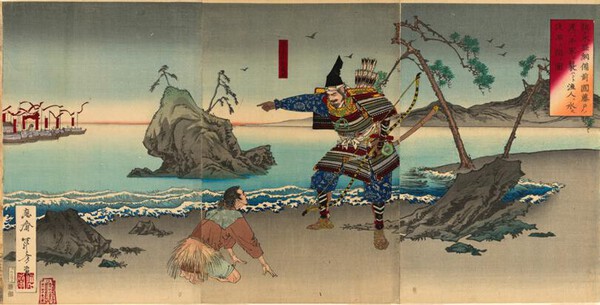
One of the aspects that appeals to me about collecting pictorial tsuba is discovering what the design represents. Often the story behind the design eludes me for several years, as is the case of this example, which I hope is of interest. This small iron tsuba was evidently made for a wakizashi and depicts a samurai in full armour, holding a spear and gazing into the distance, while a peasant kneels at his feet. The samurai is standing below a pine tree and looking over an expanse of water, possible a sea. On the far side are two silver gilt triangles, the sails of two distant boats that the samurai looking at. On the reverse are two stoops of rice tipped with gold. The details on the tsuba are highlighted with gold, silver and copper inlay. The samurai, peasant and pine tree are all raised above the surface of the tsuba and appear to have been formed by hammering the body of the tsuba, as shown by the undulating surface, leaving proud areas which were then carved. The nakago ana has some long tegane at the top and bottom and a single kodzuka hitsu ana. Overall, the tsuba is in good condition, showing some wear to the gilding. It is mumei and I think it probably dates from the 19thC, possibly from the Shoami or Kaneie Myochin School. Other attributions welcome. A shakudo nanako tsuba with a similar design was offered for sale by AoiArt (F21022, https://www.aoijapan.com/tsubamumei-battle-of-fujito/) and was described as showing a scene from the battle of Fujito. According to Internet sources, the battle of Fujito, Kojima, Bizen Province took place on 7th December 1184 during the Gempei wars and is described in the Heike Monogatari. Taira forces (500 men) were holed up in a castle on Kojima under the command of Taira no Yukimori, effectively out of reach of the Minamoto forces. Sasaki Moritsuna asked a fisherman to show him a path through the shallows so that his men could cross to the island and attack the Taira. One version of the story says that Moritsuna was rewarded by being given large parts of the area around Kojima. The fisherman was not so lucky; Moritsuna killed him immediately after learning of the path to prevent the fisherman informing anyone of the plan of attack. I’ve also attached two prints; The first by Mizuno Toshikata shows Moritsuna asking the fisherman for directions. The second by Kuniyoshi shows Moritsuna’s horsemen crossing the sea, up to their necks in seawater. Another version of the crossing shows Moritsuna’s troops crossing on virtually dry land. In view of the fate of the poor fisherman I hope that the Kuniyoshi print is a more accurate depiction of the crossing and that Moritsuna had to fight in waterlogged armour and that his sword rusted from the seawater! I would guess that this tsuba was made for one of the ‘hoi polloi’, rather than a samurai, as the design hardly exemplifies the ‘samurai warrior ideal’, such as found on Soten tsuba; murdering a poor unarmed fisherman after he had been so helpful. Tsuba data: Height: 6.6 cm: Width: 6.0 cm: Thickness (rim): 0.3 cm: Weight: 62 g Best regards, John (Just a guy making observations, asking questions and trying to learn)



-
Hi Mark, I have used credit card with my purchases from with Japanese dealers. Only additional cost for me has been UK import duty, 5% on antiques and 20% on non-antiques. I don't know what it is for the USA, but ask Japanese senders to write on the customs form 'Antique, over 100 years old', just in case you have similar charges. I must admit that I quite like the tsuba, they look like clean examples of generic designs, better than most on Ebay. I might have been tempted myself, but I have to clear the debt for my last purchases. Regards, John
-
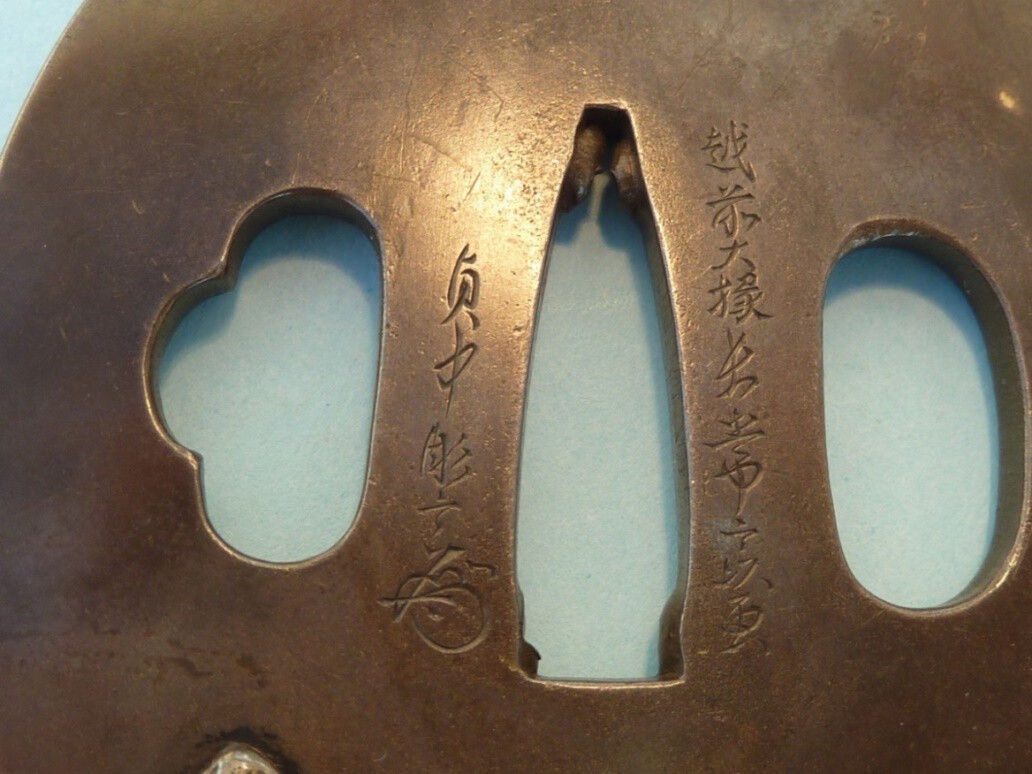
Bob, I have a tsuba signed 'Echizen no Daijo Nagatsune [horu i ko?] Sadanaka kore o horu ' . Which I translate as 'Daijo Nagatsune carved again with' and 'Sadanaka carved this'. In other words this is a joint work by both artists who have worked together before. Note I am not saying the signatures are genuine. Best regards, John

-
Hi Mark, I've had a look at the photos on the Aoi page and the item looks like a genuine piece. There appears to be no rust scabs on the iron and I think that your worry about the loss of gold nunome may be a bit unjustified. It looks like the gold has been applied in kakihagi, shadow inlay, which creates a more subtle effect. Gold nunome around the rim of tsuba does tend to wear off in use, but this inlay is in the main body. It is probably a competently made late Edo piece using a standard design (IMHO). I am not recommending the vendor to you, but I have bought a tsuba from him and the purchase went smoothly and the item was in good condition, as described. The only fault that I have with Aoi is that they are non-committal as to the possible artist schools. I'm sure their knowledge is far greater than mine, but everything seems to be 'mumei,Edo period' unless it has a NBTHK certificate (covering themselves I guess). Hope this helps with your decision. Best regards, John
-
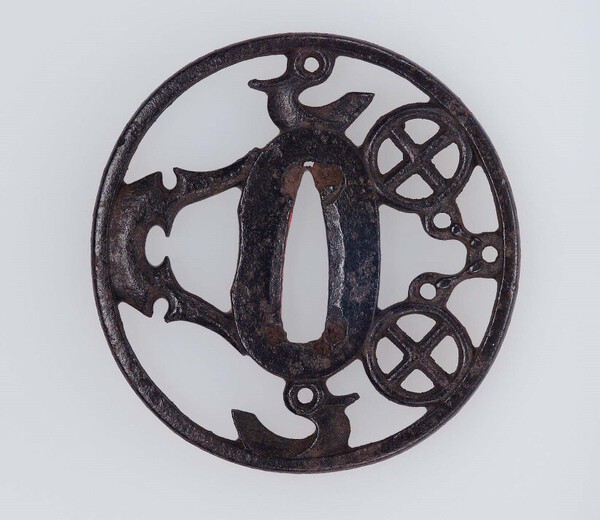
Hi Roger, I also have a tsuba which I think may have Christian symbolism. It is an iron round sukashi tsuba depicting horse riding equipment (saddle, bit and whip) and a bird (karigane) linking the whip to the rim. The tsuba is signed Hidemitsu (possibly Shumitsu), but the artist is not referenced in any of the common books. However, Hidemitsu (same kanji) is listed as the craftsman name of Tomomichi (civilian name Wakayama Hanzo) while he worked under Omori Terumasa. He eventually studied under Someya Tomonobu, from whom he received the kanji for ‘Tomo’ and so would probably have been working in the Busei era (1818-1830). ). [Japanese Toso-kinko Schools, M Sesko, p226] However, it should be noted that the Someya School were primarily kinko artists and so the Hidemitsu who made this tsuba may be another craftsman, although many artists worked in a variety of metals. The style and subject matter seems to be similar to tsuba produced by the Bushu School, or possibly the Echizen Kinai, or Choshu schools around 1800. A smaller (6.6 cm dia) tsuba of similar design is to be found in the Collection of the Boston Museum of Fine Arts (Accession number: 13.2167), and a picture of this is included. The Boston example shows the complete horse bit (both rings to attach reins and the linking bit for the horse’s mouth), whereas my tsuba only shows the link at the top of the tsuba and just one of the rings at the bottom with the seppa-dai separating the two parts. I think that this was probably deliberate so that the ring acts as both a depiction of the Shimadzu kamon and a Christian cross (I gather that the Shimadzu clan had a large number of Christians). Height: 7.4 cm; Width: 7.0 cm; Thickness: 0.5 cm; Weight: 66 g Best regards, John (Just a guy making observations, asking questions, trying to learn)


-
Hi Grev, I find this following link useful; https://kanji.sljfaq.org/. It allows you to draw in kanji freehand then gives you the 20 best estimates. You can then copy these into Word, make up your sentence, the pop it into Google Translate for a rough translation. Quite useful for signatures. I don't bother trying to authenticate mei. my knowledge is not that good, fakers have better references than me to genuine mei. At the end of the day if you consider the object to be a good well crafted piece does it matter if it was made by the master, a student, or a talented faker? I guess it does if you are paying a high price for a work by the master but find out its only by a student. Best regards, John
-
Hi Bob, I’m enjoying looking through your collection and thought I would post a couple of bits. Firstly, your Owari tsuba with ‘bones’ #14. I gather you think bones are the result of sloppy workmanship and I have read that some artists shaved them down. But I love them. They give character to the iron and show it has been forged from a heterogeneous mixture of iron. I find the smooth finish and uniformly fine texture on many Edo period sukashi tsuba a bit boring, even though the sukashi work is more refined. But each to their own. Let me guess, you did not graduate into tsuba from sword blades as I did. Gazing at all the features on a blade caused by folding and phase changes in the iron is fascinating, e.g. Nie, nioi, sunagashi, inazuma. Anyway, moving on to your Tsuba #15. I have a tsuba with a similar basic construction to this, but lacking the inlay and sukashi. I bought mine at Bonhams in 2010 and it was described as a Shoami tsuba, signed Masayoshi. The signature is in gold nunome and partially lost. I’m OK with the kanji for ‘yoshi’, but have never been able to reconcile the partially lost kanji for ‘masa’ or read it as anything else. I have never found any reference to a ‘Masayoshi’ with a similar pair of kanji either. In view of the similar basic construction I wonder if the two tsuba came from the same school, but yours was the deluxe model, or maybe the sukashi and inlay was added at a later date elsewhere. My Tsuba: Height: 7.5 cm. Width:7.5 cm. Thickness (Seppa Dai):0.45 cm. Thickness (Rim):0.5 cm. Weight: 132 g Best regards, John PS. Its good to see your posts being numbered it may get a bit difficult commenting on specific ones as the list grows.

-
The second lot of Inagawa School shakudo tsuba are a daisho pair in maru gata form and each is engraved (kebori and katakiribori) with a ho-o bird (a mythical Japanese/Chinese phoenix) in a paulownia tree with clouds in the background. The ho-o and the paulownia leaves are finely engraved (kebori), but the clouds and branches are cut with a wide chisel (katakiribori). The engraving is without embellishment; except for a tiny (sub mm) spot of gold to pick out the eye of the ho-o. It appears that the bird depicted on the dai is a cock and the one the sho is a hen. The shakudo plate of the tsuba is flat, migaki-gi (polished) and both have a kogai hitsu ana that have been filled with a gold covered plug decorated with fine vertical file marks. The sho also has a kodzuka hitsu. Dai: Height: 7.6 cm, Width: 7.3 cm, Thickness (rim): 0.4 cm, Weight: 200 g Sho: Height: 7.3 cm, Width: 7.0 cm, Thickness (rim): 0.4 cm, Weight: 171 g Like my other Inagawa tsuba (Yoshitoshi, above) these tsuba came in a kiri box together with a slip of paper in Japanese providing information about the artist which read: 良光 青柳氏. 栄五郎と. 良英と兄弟. はじめ掘江興成に学び, 光成と名乗る. のちに良克の門人となる. 青柳良光(花押)と銘して. 獅子,竹菊,克図の縁頭ゃ小 柄がぁる 克 (Don’t think this is the right kanji) 江戸神田,数寄屋河岸住. (号)一楊堂 Once again, using my poor Japanese and Google, I translated this as (corrections welcome): Yoshimitsu. Family name: Aoyanagi. Called Eigoro. His brother was Yoshihide. First studied under Horie Okinari, called Mitsunari. (Note from Markus Sesko: who in turn was a student of Omori Teruhide, 1730-1798) Later, became a student of Yoshikatsu. Signed Aoya(na)gi Yoshimitsu (kao) Lions (shishi), bamboo and chrysanthemum, designs of fuchi-kashira are small ? He lived in Edo, Kanda district, by the river. His Go (art name) was Ichiyodo. (note: Markus Sesko says Ichimudo) According to Markus Sesko (The Japanese toso-kinko Schools) Yoshimitsu was a member of the Inagawa School in the Kanda district of Edo, founded by Naoshige (died 1739). He first studied under Horie Okinari, 1st generation master of the Horie School in Edo, born 1749. Yoshimitsu studied under the third generation master, Yoshikatsu (1725-1779) and was a member of the Aoyanagi family (Note: The samurai manor house of the Aoyagi/Aoyanagi family in Kakunodate, Akita is now a museum). It may be that Yoshimitsu was permitted to sign his work as he was a member of an important samurai family and so added his family name to the signature. The dates of Yoshimitsu or his contemporaries is not given in Sesko’s genealogy charts, but he was probably active around 1760-1820. Both tsuba are signed Aoyagi Yoshimitsu with a kao (Markus Sesko reads the signature as Aoyanagi Yoshimitsu). According to Japanese mythology the ho-o is a symbol of good luck and resides in paulownia trees. However, it said to only appear in times of peace, prosperity and, as it was a symbol of the Imperial house, some believed that it only appeared at the start of a new era. The leaves of the paulownia form the basis of the paulownia kamon (family crest) used by the Toyotomi clan and later by the Japanese Imperial family. I think that it is therefore possible that this daisho pair of tsuba was commissioned to coincide with the inauguration of a new Emperor and start of a new era. 1772 saw the start of the An’ei era (Emperor Hidehito), 1781 the start of the Tenmei era (Morohito) and 1818 the start of the the Bunsei era (Ayahito). There were also changes of the era in 1789 (Kansei), 1801 (Kyowa) and 1804 (Bunka) without a change in Emperor. Although there is no corroborative evidence, it seems probable that these tsuba were made to celebrate the assent of Emperor Morohito and the start of the Tenmei era in 1781, this being the date most likely to coincide with Yoshimitsu’s career. Best regards John (Just a guy making observations, asking questions, trying to learn)