
Leaderboard

Popular Content
Showing content with the highest reputation on 06/23/2026 in all areas
-
Rohan, I agree with you, but only up to a point. While papers or designations don't change the steel or workmanship of a sword, what they can—and often do—change is our perception of the blade. When a sword that you hope will receive higher papers does, you are elated, feel proud or vindicated, and often develop a deeper connection to it, even though nothing has really changed about the piece other than the certificate that accompanies it. And when it doesn't happen, that emotional connection can be affected, sometimes profoundly. Darcy once told me that people would often get rid of blades after a failed Jūyō submission because, in the owner's mind, somehow the sword was no longer worthy of the same love, admiration, or ownership. I used to say that the only reason to pursue higher papers was to make a future sale or trade easier, or to leave your family something concrete and understandable when you eventually pop your clogs. But the truth is that collectors often behave exactly as Darcy described. And I get it. Collecting—and perhaps hoarding as well—are deeply human traits. Humans crave certainty. We want our choices validated. We want our judgment recognized and rewarded. When that happens, it strengthens our attachment to the object. When it doesn't, it can alter our relationship with it, even when logic tells us nothing has changed. I think the Buddha spent a great deal of time teaching that suffering is rooted in attachment and expectation. That may not make rational sense in the context of a sword that remains exactly the same before and after the shinsa results arrive, but it is what it is. We become attached not only to the object itself, but also to the story we tell ourselves about it and the hope that others will validate that story. Human nature being what it is, that attachment can be every bit as powerful as the sword itself.6 points
-
Jussi, while I don't know the story about Katsumitsu fleeing the village, what is clear is that by 1560, the situation in Osafune had changed considerably. The glory days of the Katsumitsu line were already in the past. The atelier appears to have been much smaller than it had been during the time of Ukyo no Suke Katsumitsu and Sakyo no Shin Munemitsu, and it was operating alongside a number of related Osafune branches, particularly the descendants of Jirobei Harumitsu, the second son of Jirozaemon no Jō Katsumitsu. The Harumitsu branch seems to have specialized in higher-quality and often more individual commissions, producing many tantō and the occasional longer uchigatana. Also, by the Eiroku era, the economics of sword production had shifted dramatically. Demand generated by the Sengoku wars encouraged the large-scale manufacture of kazuuchimono, and the principal beneficiaries of that market were the Kiyomitsu and Sukesada groups. These two houses grew into the dominant producers in Osafune, overshadowing many of the older family lines in both size and output. At the same time, Bizen's political landscape was also changing. Since the death of Akamatsu Masanori, the province had been dominated by the Uragami clan, who were also big patrons of the Katsumitsu. But by the mid-sixteenth century the Uragami were weakened by internal divisions and increasingly dependent upon their powerful retainer, Ukita Naoie. During the 1560s, Naoie expanded his influence while maintaining a nominal loyalty to his lords, eventually emerging as the effective ruler of Bizen. Such political and economic upheavals almost certainly affected the fortunes of the Katsumitsu line, as they did many other Osafune families. Against that backdrop, the placement of Kiyomitsu's name before Katsumitsu's becomes easier to understand. Whether the order reflects seniority, prestige, commercial influence, or simply the circumstances of the commission cannot be known with certainty. However, by the Eiroku period the Kiyomitsu workshops were among the most prominent and productive in Osafune, while the Katsumitsu line no longer occupied the commanding position it had enjoyed a century earlier. On the issue of Katsumits fleeing the village, I have not seen and can't find anything to support this, but I guess it's possible. The documentary record for many late-Bizen smiths is fragmentary and not all of it is available online. What is striking,though, is that when the Yoshii River flood of 1590 devastated Osafune and effectively brought the great Bizen tradition to an end, the powerful Kiyomitsu line disappeared from history. Among the few branches that survived were members of the Sukesada line and descendants of the Harumitsu branch. In that sense, although the Katsumitsu family had long since lost its former prominence, its bloodline appears to have been among the last remnants of the classical Osafune tradition.5 points
-
The Cultural Properties Protection Law took effect in 1950. And the tanto Inaba Shizu became a Juyo Bunkazai. Ref. 稲葉志津 - Wikipedia (Only Japanese language available) The following part is extracted and auto translated. ================================================================= On December 20, 1934 (Showa 9), it was designated an Important Art Piece under the name of Marquis Naganari Kuroda. Subsequently, on May 27, 1939 (Showa 14), under the same name, it was designated as a National Treasure (formerly a National Treasure) under the National Treasure Preservation Law. After the enforcement of the Postwar Cultural Properties Protection Law, it was designated as an Important Cultural Property, and since then, it has been owned by an individual in Aichi Prefecture, leaving the Fukuoka Kuroda family. ======================================================5 points
-
Since the Shinsa panel will only judge the blade in front of them and not consider any external commentary or factor in any historical nuance without precedent I am resigned to the strong possibility it will come back Horyu. Even though its clear daimei/daisaku blades were being generated in the atelier as early as 1306. If it gets Horyu again, then Plan B is to put it through NTHK who operate a different set of standards when evaluating a blade and call it a day. I didn't start this project to squeeze monetary value out of the sword. For me its all about preserving history and giving the blade the best possible chance for future generations. Dogma changes and evolves over time, Shinsa panels come and go and new discoveries eg the dated Chogi blade, reset the history books. The sword is more important than any one organization and its draconian appraisal methods. Its survived 718 years, ubu and intact, I want it to survive another 718 years, with or without a piece of paper. The blade will be judged on its own merits as a late period Shintogo Kunimitsu and the unofficial comments of Tanobe and Saito sensei carry enough weight for me as its current custodian.5 points
-
I have a very good friend and serious collector who shall remain nameless. He loves attending the various shinsa in Chicago, Tampa, Orlando and San Francisco. His favorite spot was outside the shinsa room where he would wait for the inevitable angry, disappointed collectors emerging with pink slips or attributions they didn't like. He would commiserate with them over the results, sympathize with their frustration, and then, more often than not, buy their swords and fittings from them for peanuts since they couldn't wait to be rid of their "failures." They walked away happy that they bumped into a "sucker" stupid enough to buy their "garbage." At least three Jūyō swords my friend owns today came from those very rejects. Other pieces received attributions to major names after a good polish. It just goes to show that not all shinsa are created equal, that a mei rejection is not necessarily the end of the story, and that one person's disappointment can become another person's opportunity—especially when that person knows what he is looking at. Knowledge truly is power. It also illustrates nicely the point I was making earlier: the blade itself did not change. Nothing about the workmanship, condition, or history was altered by the result. What changed was the owner's perception of the blade once it failed shinsa. For some, that shift in perception can be powerful enough to sever the emotional connection they once had with the piece. For others, it just creates the opportunity to acquire something exceptional at a fraction of its true value.4 points
-
Hi! This looks like 濃州関住藤原兼廣作 昭和十二二年二月日 Noshu Seki-Jyu Fujiwara Kanehiro Saku Showa 14 a day in February. This is one of those cases where it's 十二二 ("ten two two") instead of the regular 十四/fourteen because 四/Shi sounds like 死/death/Shi.4 points
-
I completely consent to what Robert wrote. Japan had a MINGEI movement which tried to re-"produce" folk-art. Just looking at ceramics and thinking of famous names like SOETSU YANAGI as a theoretic, HAMADA SHÔJI, KAWAI KANJIRO and others as potters, they tried to revive the idea of unintentionally made art-pots that were previously made by folk-potters. That is of course a contradiction in itself. But I find it perfectly reasonable that an old sword, forged with the intent of it being just a good weapon, can have artistic features and merit in our modern view.4 points
-
The mei reads Hizen Kuni Tadayoshi - 肥前國忠吉 IMO the mei looks very roughly chiseled and for a Hizen blade, typically you'd see the mei on the other side of the tang as Hizen smiths tended to sign tachi mei and not katana mei.4 points
-
It is a gorgeous looking blade. You have done well Lewis and have done well by the sword. I would be pretty chuffed with if I were you. Again well done mate and seriously good luck - we are all routing for you!4 points
-
You might be looking at the style the wrong way around - French Art Nouveau took its inspiration from contact with the Japanese. French Art Nouveau was profoundly influenced by Japanese art and design. This cross-cultural exchange—often referred to as Japonisme—sparked a revolution in European visual culture following the opening of Japanese trade in the mid-19th century. Art Nouveau artists broke away from rigid European traditions of perfect symmetry, favoring dynamic, off-center framing and diagonals inspired by Japanese masters. So I guess why it looks Art Nouveau is because the Japanese invented it! Perhaps the style should be called "Art Nihon"?4 points
-
@Jussi Ekholm That walking around part, I did that once and got lost, lol. Walked too far... That was before the smartphone era. A retired local taxi driver "rescued" me and when he asked me what I was doing and I explained I am a sword nerd, he drove me around to show me all the historic sword making sites. He had to quickly stop by his house to tell his wife he will be late for dinner that day, haha. Fond memories.3 points
-
Well said @Mushin. Everyone has different goals of course, but I think if you are not seeking validation and paper, once you have a firm idea and understanding of "Juyo level (and up) workmanship", you realize many, many Tokubetsu Hozon swords meet this benchmark (and beyond), hence why we are still seeing Juyo and higher papering happening at all. The other qualities NBTHK uses to actually issue those high papers represent a certain group of people's assessment at a certain point in time, but as it's been said - doesn't change the sword at all. However, I also understand the position of collectors who chase or want high papers as an eventual exit or value holding strategy etc. Also yeah @MassiveMoonHeh - I think that is because things like grading cards is an objective process, and much like the NTHK process, point based (whether that is numeric or something like B+/A-) while the Juyo+ certification is partially a subjective contest. That may be a healthier way mentally, to consider Juyo+. Not as an overall objective and absolute answer or grading of your sword, but something that involves luck to a degree, given the workmanship is there. Probably also part of the reason why Tanobe does sayagaki on any thing TokuHo+. Many of these swords are easily Juyo workmanship wise.3 points
-
You may be right, I was just curious. Ohmura calls it "last stage" He certainly knows more about Japanese military swords than I do, but I wonder how he came about his dating. From simple appearance, it seems he is going by quality workmanship, left to right, finest to crudest. That may be true as a generalized trend for the war, but I've seen some really nice tsuba/fittings on gunto from the last year of the war, too. I haven't paid enough attention to the topic to say more, and I don't recall whether I've seen crude tsuba/fittings on early or mid-war gunto. Guess I'll have to start paying attention.
 3 points
 -
It is the only system in the world that I know of where you have to spend time and money to submit the same object multiple times to the same organisation to arrive at a final decision. Can you imagine imagine if they graded other collectables like this? Submit a Babe Ruth Baseball bat three times for them to decide it is worth keeping or really worth keeping, then deciding that yes because it was used a Yankee Stadium for the Called shot it was now important to the game and finally because it is such an important bat we needed to submit it again to be told yes, it is a very important bat.3 points
-
The more examples that are shown it would appear it was simply a nicer version, hence why often seen on better than average mounts.3 points
-
Hi Bryan, welcome to the forum. No problem, take your time with the photos even if it takes a few posts. Cropping them usually helps shrink the size, and the forum also has an image resizing tool at the top menu. If possible, show both sides of the tang, oriented so the tip of the blade is north and the tang south. Dark non reflective background works best. Looks like an interesting Type 98 shin-gunto, (meaning those are World War Two officers sword fittings, and they look real from here to me.). Best of luck, -Sam3 points
-
The workmanship of the tsuba reminds me of Inshu Suruga work... I think the original kuchi-beni sekigane (lipstick style copper inserts) was knocked out from the top of the nakago-ana because you can see the sort of "horseshoe" indent that is there, which would have held the copper sekigane.
 3 points
 -
@Bruce Pennington Not sure if this has been mentioned, however after looking at these I don't think there is any special meaning to the chevron other than as an artistic separator between the smooth area of the sarute where the tassel rubs and the dimpled area around the sakura. Just something to mark the transition. Kind of like the wood transition strip used in flooring between two disparate surfaces. John C.3 points
-
Depending on the nature of the art medium, some artists have to be very good craftsmen first. For instance, in my early career I was a printmaker, and definitely had to learn and master significant craft before I could even begin to produce something worthwhile. Likewise with traditional sculpture and painting. Much, but by no means all, of the modernist and postmodernist work lacks this craft grounding... and it frequently shows. For a swordsmith, I would say it is the same - you couldn't even begin to produce anything which was art until you had a deep grounding in the craft... and between the fact that some swordsmiths just made swords - i.e. they weren't trying to make art, just a very good sword - and the fact that all swordsmiths probably had a long initial period where art was beyond them, I would guess that the majority of swords made did not intend or try to be art. And since intention is key, by some definitions they aren't art. The other big factor which makes the whole "art" attribution different in Japan was the degree to which outright copying was considered perfectly acceptable. If you run through the entirety of the V&A's tsuba collection, the number of designs duplicated multiple times is astonishing. In the west, this would de facto make anything which was a copy craft, not art. I get the impression that that distinction was not so important in Japan.3 points
-
The previously discussed sort of Yagyu mimi:
 3 points
 -
I'm happy to announce that my Yagyu utsushi tsuba ranked Nyusen 4th in this year's NBTHK contest. Despite being ranked lower than last year it's still a positive result.


 2 points
 -
Here is another example from a thread a couple of years ago. John C.2 points
-
Thank you for the wonderful historical info package Bobby. There was so much going on in the area during Muromachi period. I think it is possible that I could very well mixing up ruler patronage shifts from one lineage to another etc. There was so much going on in the area historically. It was great riding with Piers as he explained the geographical shifts in the area while we drove past certain areas. Would be awesome some day spend a long time just walking around the various historical areas of Bizen swordsmithing.2 points
-
So, the NBTHK made a mistake. ToBi No. 135 was issued in April of 1968 when the blade was already a JuBun in the new system, but they still reference it as a Kokuhō.2 points
-
Russ: the link works for me; there are at least four version of the go players in a fruit in the BM collection, which one is your favorite? https://www.britishmuseum.org/collection/search?keyword=netsuke&keyword=go&view=grid&sort=object_name__asc&page=1 John C.: decent figural netsuke can be bought already for a few-hundred $/£/€ when one knows what he/she is doing, the problem is distinguishing them from the 99% of modern fakes.2 points
-
Yep, I believe the practice they ended was being able to apply for Juyo token with just Hozon papers. Now, to qualify for Juyo the submission must have TH papers issued at least x months ago.2 points
-
# 3 looks the roughest. John C.2 points
-
Jonathan: I'm sure you have already seen the info on the Hosho lineage, however here are a couple of snipets that may help your research, one from Jussi. The maker's name Kunikane lasted thirteen generations until the early Meiji period. And they all served the Date clan exclusively, forging high-quality blades. And they pursued their ancestor's sword-forging styles from Hosho school in Yamato province (Today's Nara prefecture). And in Shinto tradition Sendai Kunikane lineage is usually listed under Öshu due to their geographical location. So I think easier format might be - Shinto → Öshu → Sendai Kunikane School → lesada John C.2 points
-
There are only 3 blades that are considered to be deeply tempered/hardened or above in the Ko-Hoki school: Ko-Hoki Kunimune (kinzongan) – Juyo 14: Nearly hardened Ko-Hoki Sadatsuna (zamei) – Juyo 26: Ichimai Ko-Hoki Sadatsuna (mumei) – Juyo 63: Deeply Tempered This appears to be less than 3% of the existing blades from the Ko-Hoki school. That Darcy suggests he could have been influenced by Ko-Hoki because of his association with Norishige or Masamune is possible but it would have been a rare event to see a Ko-Hoki Ichimai blade. The Yamato link is also a strong suggestion. Certainly Gō has a strong influence of Yamato in his early works. It is worth noting that Honma observed that a deep boshi “is a characteristic feature of Yamato mono.” I do not share the same thinking around the link to Senjuin Yoshihiro. In fact I do not believe the two to be linked other than by name. Certainly there is no record of Yoshihiro travelling to Yamato to learn and again there is no record of Senjuin Yoshihiro travelling to Etchū. If I was to have an educated guess I would look closer to the Ko-Uda school that we know was founded by a Yamato smith Ko-Nyudo Kunimtisu who settled in Niikawa-gun in Etchū Province (Matsukura is in Nikawa-gun) at the exact time that Yoshihiro was coming of age. Having a Samurai lord's son working in your forge would have done wonders for building your fledgling business. I suspect also that as a Samurai Yoshihiro would have heard the stories of older Samurai about the previous Mongol wars and how their blades shattered on their armour. The weakest part of the sword has always been the Kissaki and therefore it is just as valid to suggest that Yoshihiro wanted to make the strongest sword possible to fight with and as such making the kissaki strong was key - hence the ichimai boshi.2 points
-
Correct there are two Gō blades that went TokuJu in Shinsa 25. This is the from the setsumei of TokuJu 25/Juyo 35: TokuJu25 - Boshi: well covered in Nie, with vigorous Hakikake; on the Omote, Nie lines are especially conspicuous, becoming Ichimai-style. Juyo 35 - Boshi: The Boshi is deeply tempered, almost Ichimai Boshi, covered in nie and vigorously Hakikake. This is from the setseumei of TokuJu 25/Juyo 62 (The above Oshigata): TokuJu 25 - Boshi: The Boshi is deeply tempered, well covered with nie, returns straight into Ko-maru, and has slight nie-suji. Juyo 62 - Boshi: deeply tempered, well covered with Nie, and returning directly in Ko-maru. There are no JuBu, Kokuho or Gyubutsu Gō blades that are considered Ichimai Boshi.2 points
-
Marcin, Remember the saying “with World War II Japanese swords, never say never or always.“ I agree that we have seen some sets where the stamps are found on the drag, as well as the tsuba. But we have also seen plenty where it is just found on the drag. Now I will admit that maybe not all cases show both parts. You would have to run a search and a survey to collect data and find out.2 points
-
Sorry, I lean toward a Chinese teproduction. That is my 2 cents.2 points
-
As do we all, each of us having parts of the giant jigsaw puzzle but never all of it…2 points
-
I think it would be great if the NBTHK would incorporate a system closer to the NTHK, or at least augment their current system with it. The point system lets you have a fairly transparent view and it leaves no room for questions of where a sword stands, at least in the moment of judging by that particular group of people. Would be nice to know if a blade is barely passing TokuHu by points or if it's already right below Juyo, etc. I have the NTHK catalogues of excellent swords and it is obviously much easier to follow than the opaque reasoning of NBTHK.2 points
-
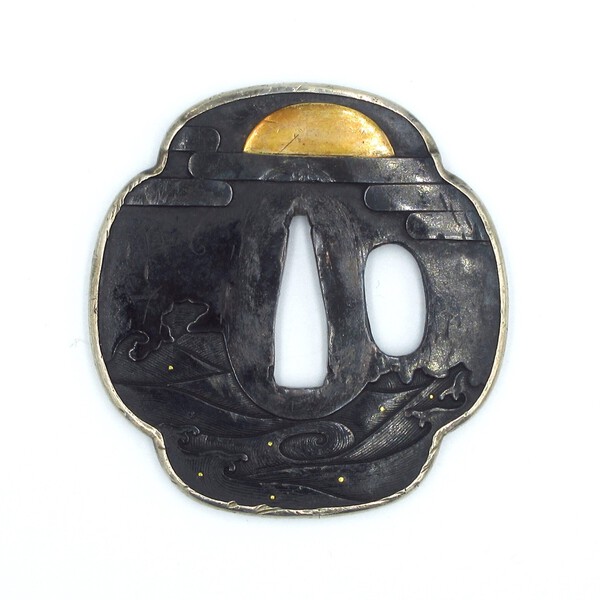
Japan's unique art has influenced European art for hundreds of years. Even when closed, some small amount was flowing out through the Dutch. Likewise, some was flowing in. Japanese designs influenced by European designs are called "Nanban" for "southern barbarian." Nanban Tsuba exist in large numbers, but the word (almost always I believe) with fittings means "influence" and not to actual importation whereas with armor Nanban armor is actually European armor imported, stylized, and used in battle. Also, European cloth was the most valuable cloth in Japan. Learning this was a fascinating moment, because as a child I read most of James Clavell's Shogun. (I ran out of steam in somewhere in the 700s by page count.) In this work, Clavell was said to be "Honest but inauthentic" in that his ideas of Japan at this time were 'correct by the standards of the studies of the period he was writing in, as they were based on often incorrect ideas held in academia, but were indeed held at the highest levels in academia. (So when he was wrong, it was because the research when he was writing was wrong.) One of these wrong ideas is how Blackthorne has a large volume of European cloth as trade goods, but the Japanese despise it and want only silk (and make quite a commotion about how awful they think it is....) while in reality European wool cloth was highly valued for strength, heat retention, and colors available. It was the most expensive cloth in Japan. These are Hideyoshi's personal private time bedroom slippers. They are made from European wool. It was called "rasha." Hideyoshi was a real piece of work, but in his old age he was subject to being cold, and being the most powerful man at the time was able to afford bedclothes and slippers and such made from European wool. These slippers are thought to be private (partly) because they aren't decorated enough to be used in important meetings. They also made battle surcoats for wearing over armor (the long sleeveless jackets) out of it. Because it was strong enough and also as a bit of a wealth flex, and as a way to add a layer to your look. As to influence outside Japan, Rembrandt the famous painter is known to have collected Samurai swords and he died in 1669. (This comes up a great deal when educating people who still think that Samurai swords were 'better in every way, instead of just very solid and extremely beautiful blades. It comes up because no one in European military affairs felt the need to change their swords out for Japanese ones as a functional issue but valued them tremendously as art objects.) But, I am rambling about the older period artistic influences.... On the topic of late artistic transmission.... post-Perry, the Japanese are reported to have used printed art (ukiyo-e) AS PACKING MATERIAL ON EXPORTED GOODS! Imagine you are a 'well to do' European, and you send off for a Japanese vase or screen, or some bit of lacquerware to show off to your friends how worldly you are... and it arrives a year later, packed in 'wadded up newspaper,' except it isn't newspaper. You glance at the paper, unroll it... and find THIS? This is the kind of thing that inspired Mikado by Gilbert and Sullivan. In truth, it seems like Japan has a massive world-wide cultural takeover of the world about every 30 years. When I was a kid Ninja Turtles, Robotech, and so on were massive. As to art going the other way, this absolutely happened but it can be harder to identify. Japanese people were of course fascinated by the outside world, and the time Japan was closed just increased this. One of the last people to travel was Tenjiku Tekobei, and he became famous for his writings on his travels. https://en.wikipedia.org/wiki/Tenjiku_Tokubei I have a picture of him on my wall as a wizard riding a giant frog. (The last great traveler before Japan closed became so fascinating to the nation for his writings about the outside he became a wizard in Kabuki playwriters started using him as a wizard.) As such, when it opened again an influences started flooding in, they absolutely influenced art.... but it's a bit harder for we who are outside to track directly... and also because of the abolition of the samurai class as a power play by the Emperor, there was less need for sword fittings which are the focus of this forum. I recently ordered an antique tsuba which I think must have had a European influence because the bottom is classic Japanese but the top is more of a semi-modern graphic design using bars with semicircles as ends to create a classical Japanese design (the sun over clouds) in a very new and different use of line. These bars stand out to me as a 'influenced design' but it might turn out not to be. It's entirely possible this is an old Japanese style I simply haven't encountered elsewhere.


 2 points
 -
Dear Koichi and Piers, thank you for your support. I now clearly understand that my project was far beyond my capabilities. Each additional difficulty, however, has forced me to reflect on the complexity and cultural value of these hakogaki, and on how unfortunate it is that they are so undervalued as art objects in their own right. While this compilation may prove less useful than I had hoped for the transcription/translation of these calligraphies, I nevertheless hope it will contribute to the preservation of Satō-sensei hakogaki and help prevent the associated tsuba from being randomly distributed among other kiribako. I have a few more requests for help, and I'm about to release the final draft (I promise, regardless of what condition it's in...).2 points
-
I appreciate that comment. I wasn't thinking that French nouveau influenced the samurai because it obviously came after, but I hadn't considered the other way around or how Japanese aesthetic affected the art world in general. I'll have to look into that. Let me know if you have any reading or youtube to recommend.2 points
-
About the gassaku signatures for Muromachi Bizen, if I understood the explanation correctly (high chance I have gotten something wrong 😅) and I got overflow of information in one day. I would use word "prestige" here. As in smith with more prestige would usually be the first in signature. And seniority often carries prestige. At Osafune Sword Museum there was a gassaku wakizashi made in 1560 by Katsumitsu & Kiyomitsu, that had lot of background. Now there was so much info coming in I might have gotten something wrong. Katsumitsu was seen having more prestige than Kiyomitsu. However he angered higher powers and had to flee Osafune for some time. After his return Kiyomitsu was now seen above him in prestige, so in this wakizashi Kiyomitsu name is before Katsumitsu. Even though Katsumitsu was supposedly the better smith. Hopefully I got that correct. 😅😅2 points
-
Sadly he may have left now, something I could have said in anger? Did I banish him, to go and weep by the side of the creek? Fond memories indeed! But he lives on forever in one’s memories…2 points
-
Chrysanthemum and flowing water is the Classical Chinese (Kiki Jido in Japanese) story, treated reverentially in Japan as the epitome of loyalty. How could they hammer the metal inwards towards the Nakago ana without spreading it out and warp the delicate sukashi?2 points
-
I remember reading about a dealer/collector who once picked up an obvious gimei Kiyomaro for a very reasonable price - only to have it paper to Shizu Kaneuji after having the mei removed, and eventually reach Juyo.1 point
-
I need many more detail and much better quality photos to confirm. Providing more background information about your request would also yield more replies.1 point
-
It is extremely complicated in my eyes. I am happy to focus my interest on items that are not seen that interesting by NBTHK. My sword appreciation is different from high level appreciation. I had the privilege to see the 29th Tokubetsu Jūyō exhibition. All of the swords were amazing swords. However I know if I would have seen all of the submitted swords I would probably switched several items from personal appreciation reasons 😁😁 yet they are the experts on the panel and they most likely chose the right items. I think I've been NBTHK member for 15+ years now. I have never been a fan of the multiple tier papering process, yet I understand some of the reasons behind it. And of course given the currently absurdly large submission numbers for shinsa they cannot give too much time for every single sword. Some smiths/attributions are starting to have very large Jūyō numbers. And for me personally I find myself often wondering if yet another mumei XX sword should have passed Jūyō and not a signed Muromachi or Edo sword by YY for a fresh change.1 point
-
Dear All. John's memory does serve, a thread here that discusses these, All the best.1 point
-
Is that how the story is invoked contemporarily? I love how things trickle down through the ages1 point
-
From my F/K Piers.....the likeness is very similar to your netsuke....
 1 point
 -
Indeed...... and for those wondering about the Kamon Piers was referring to:
 1 point
 -
As I understand it... For a thousand years the Japanese swordsmith has been making weapons for use on the battlefield. This purpose continued right up to 15th August 1945 when the Emperor surrendered Japan. In 1953/54, the making of swords re-commenced, but they are officially classified as art, not weapons...so, officially, from 1953/54 Japanese swords are classified as ART, and so the people who make them must be classified as artists. Just my 10 cents worth... Regards...1 point
-
Favored by some, this style of writing is based on ancient Chinese scripts, such as oracle bone script, etc.1 point
-
The brothers weren't the only smiths to inscribe their blades with important contextual documentation. Take this slightly later Gorozaemon Kiyomitsu, resident of Osafune Bizen Province. The nengo dates the swords production to a day in August (funny that) in 1554. Reading further and the inscription states it was commissioned by Tokuoka Kageyuzaemon-no-jo Ieyasu and completed in the castle town of Tatsuno in Harima Province. https://hyozaemon.jp/product/goroukiyomitu/1 point
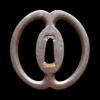

.thumb.png.54593db2789c8a1dcb235543b184ce39.png)




















This leaderboard is set to Johannesburg/GMT+02:00