Tanto54
-
Posts
858 -
Joined
-
Last visited
-
Days Won
7
Content Type
Profiles
Forums
Events
Store
Downloads
Gallery
Everything posted by Tanto54
-
I think that the listing is incorrect. It's probably Omori Tatsunobu instead of Omori Tokinobu. While he may be part of the Omori School, he's not one of the famous masters. This Fuchigashira looks good for his work, but is not top Omori Master work. Therefore, I'd say it was reasonable for what it is (not much reason to counterfeit his work).
-
Ford Hallam has had a heart attack and is hospitalized
Tanto54 replied to Jean's topic in General Nihonto Related Discussion
Dear Ford, best wishes for a speedy recovery. I'll be praying for you and your family. -
I saw one with silver Bu as menuki (small rectangular coins).
-
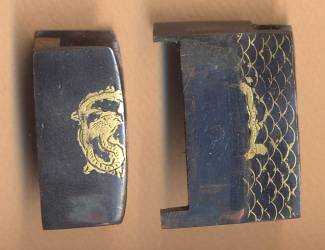
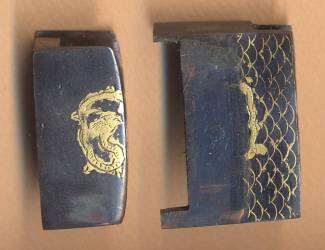
Dear Ludo, The piece of the "outer" habaki (missing in your case) that slips underneath that "lip" on the "inner" habaki is usually thin and I see a significant impact mark of the outside of the "lip" of your habaki (on the mune side) that would have bent it in slightly (enough to be tight against the mune of the sword). When I look at the picture it looks slightly bent in to me... In any event, you need a new habaki. It would probably be easier and cheaper to get an entirely new one, but, if you are determined to salvage the original pieces as much as possible, an expert could probably fix the part that you have and construct a new "outer" part. Just using the inner part alone will probably not allow the sword to fit securely in the saya or create a good seal against humidity. You've probably seen this picture of one like it, but here's how many of these two part habaki work.
-
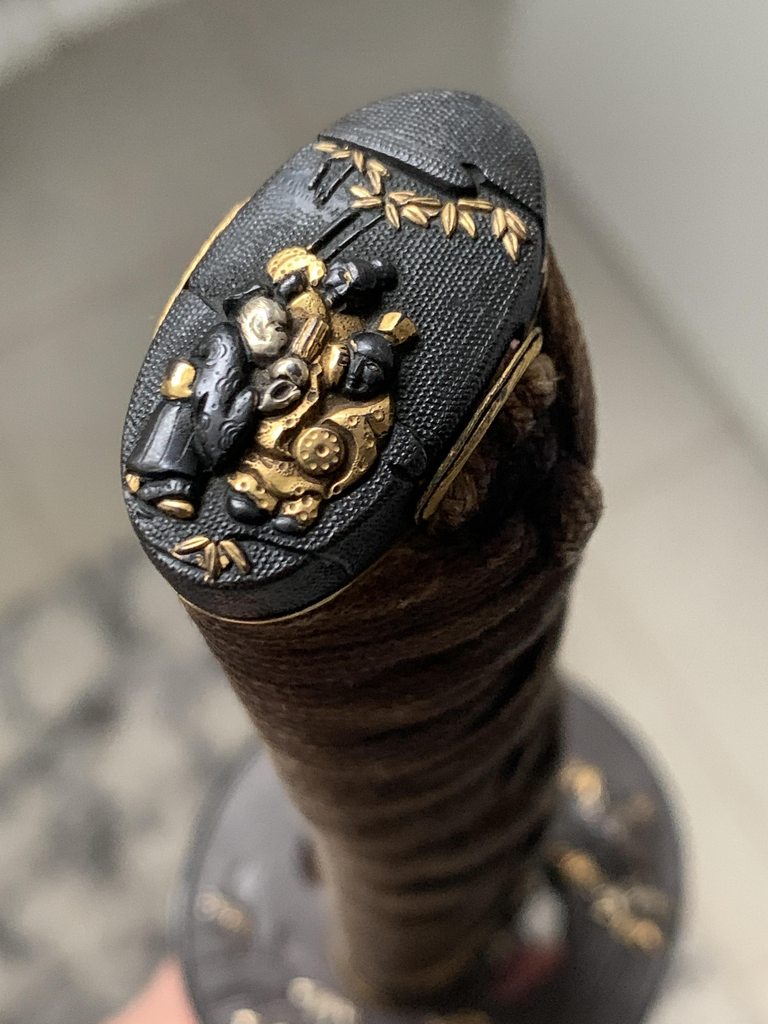
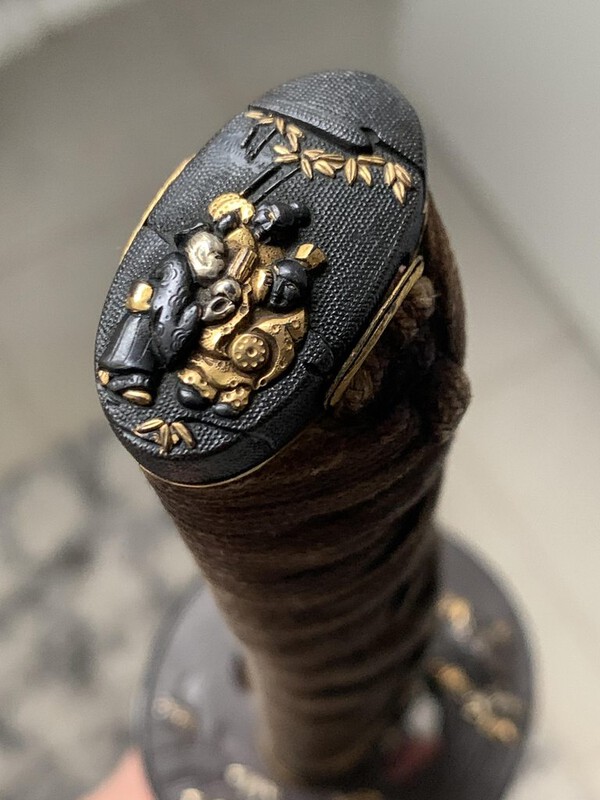
I found this quote in Joly about the Three Dancers: "If three men associate they have between themselves the intelligence of Monju Bosatsu. This proverb is often applied to the three dancers so frequently met with in netsuke, the drummer, flutist, and mask dancer." I think that Jmoto's kashira shows the "three dancers" - I see the drum and flute for sure, but what about the mask? It's usually depicted as a guy putting on or taking off a mask. Do you think that is what the character on the right is doing? If so, then I'm sure about the "San nin yoreba monju no chie" motif.
-
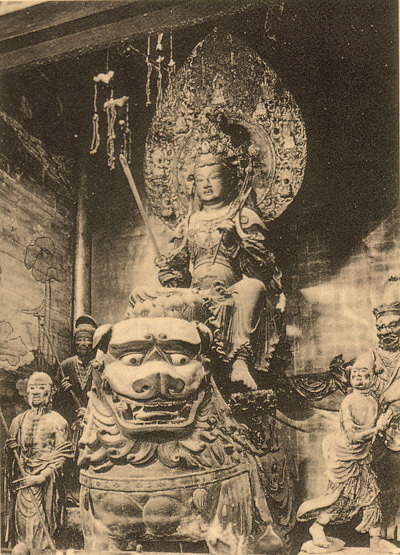
I like Malcolm's idea, but I think that it is the same three individuals (instead of seven different individuals - see explanation below) and the Seven Sages aren't associated with musical instruments. Instead I think that it is "San nin yoreba monju no chie" which translates roughly as "if three people get together then they will have the wisdom of Monju". It's like the Western "two heads are better than one". This is often depicted in Japanese art (e.g., netsuke) as the "Three Dancers" (with drum, sho and mask - see the wakazashi's kashira) but it is also depicted as three individuals studying or doing some activity. Monju is Monju Bosatsu and is one of the wisest characters in Buddhism (and is associated with a Shishi - see below). When we look at one side of each fuchi, we see the three individuals "putting their heads together", but on the other side of each fuchi, we see only one individual in contemplation/activity. I think that this is trying to show the "three are better than one" aspect. This is further bolstered by the choice of shishi tsuba because of the the shishi's association with Monju.

-
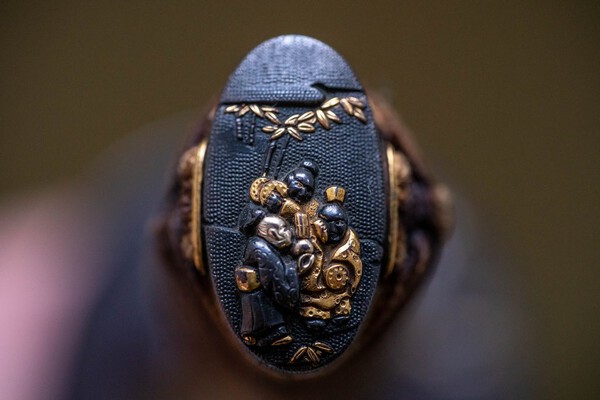
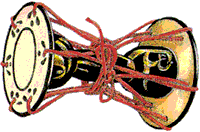
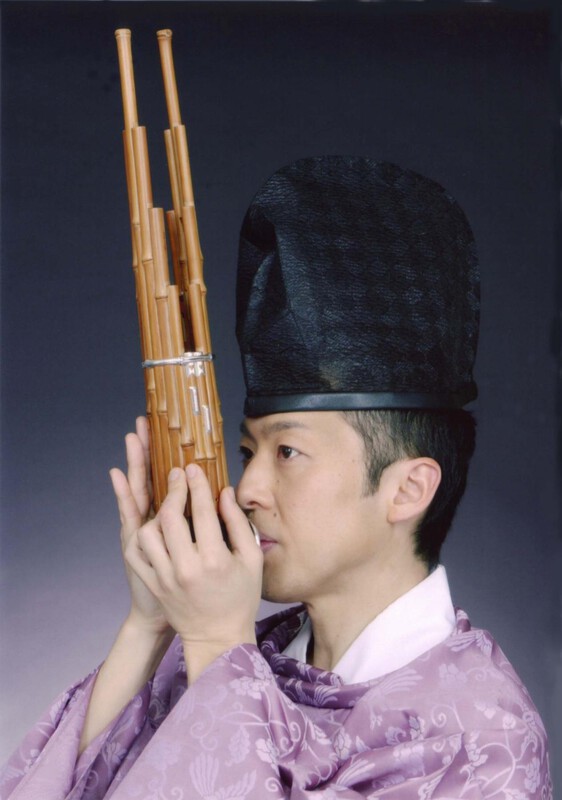
Hey Jmoto, I'm away from the books at the moment, so I'll do more research later. However in the interim, on your wakazashi kashira the three Chinese sages (?) are playing musical instruments. Japanese sword fittings often depict Chinese subjects and legends. These instruments are related to gagaku and are a Tsuzumi (drum) and Sho (mouth organ) in Japanese.
-
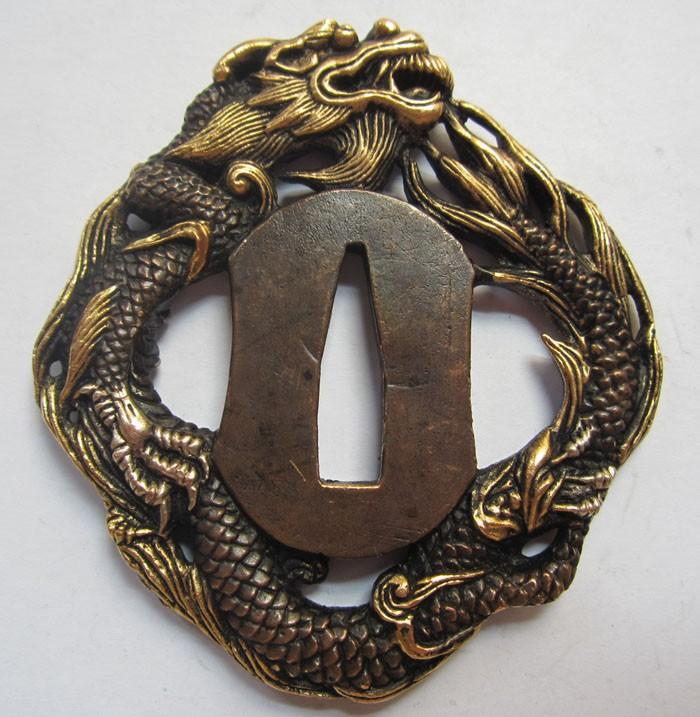
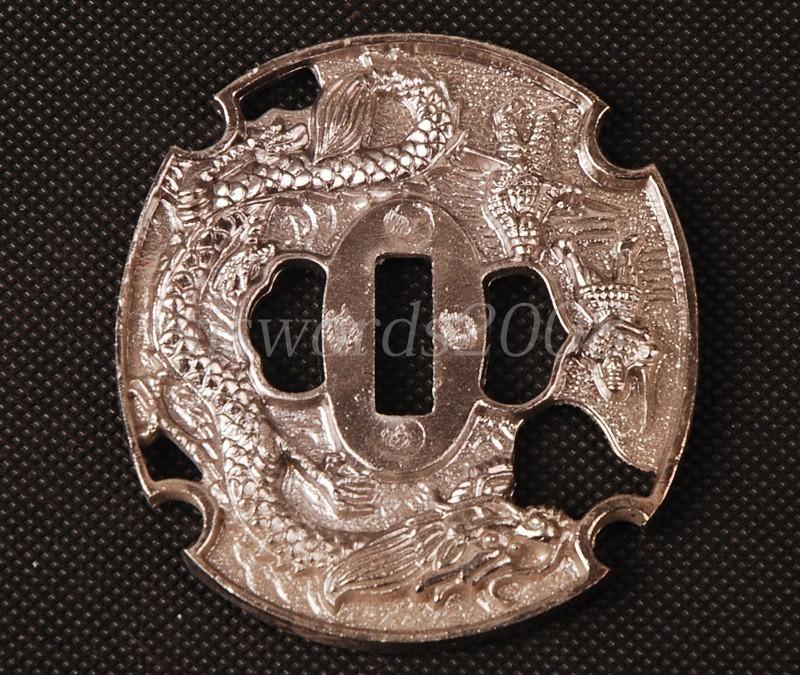
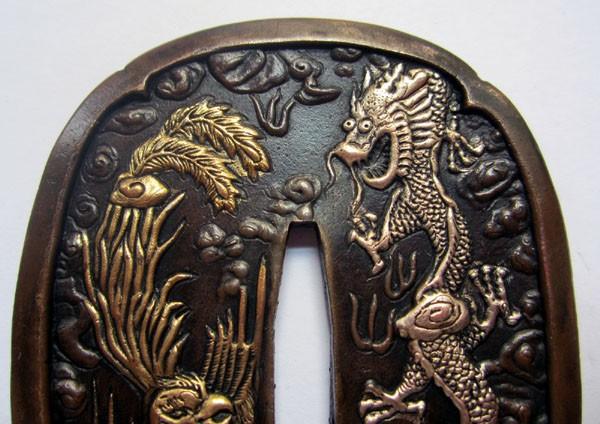
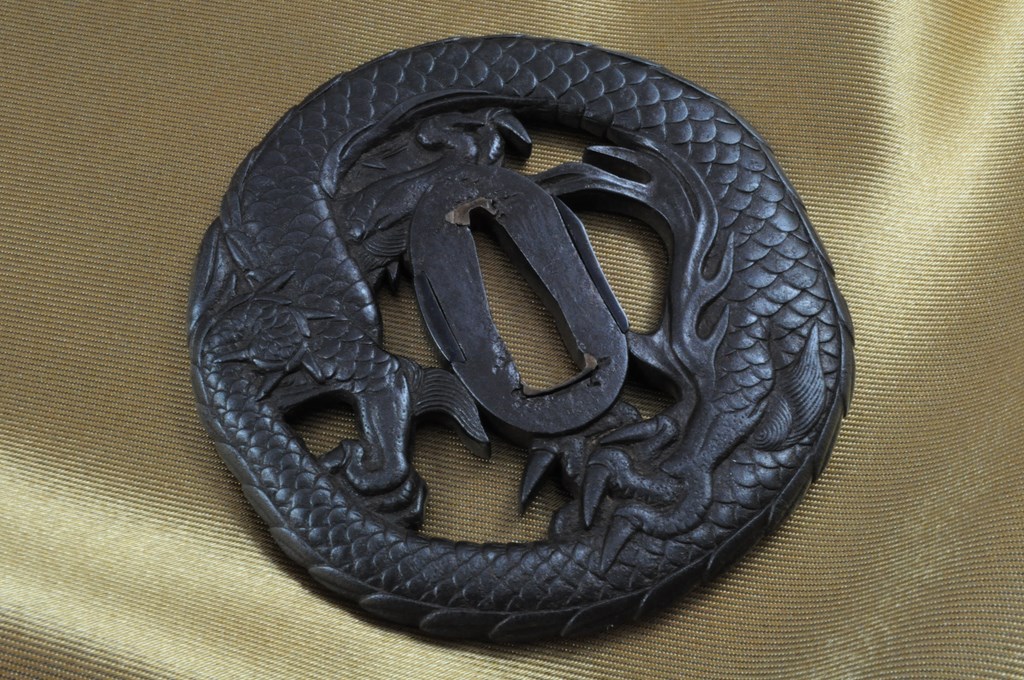
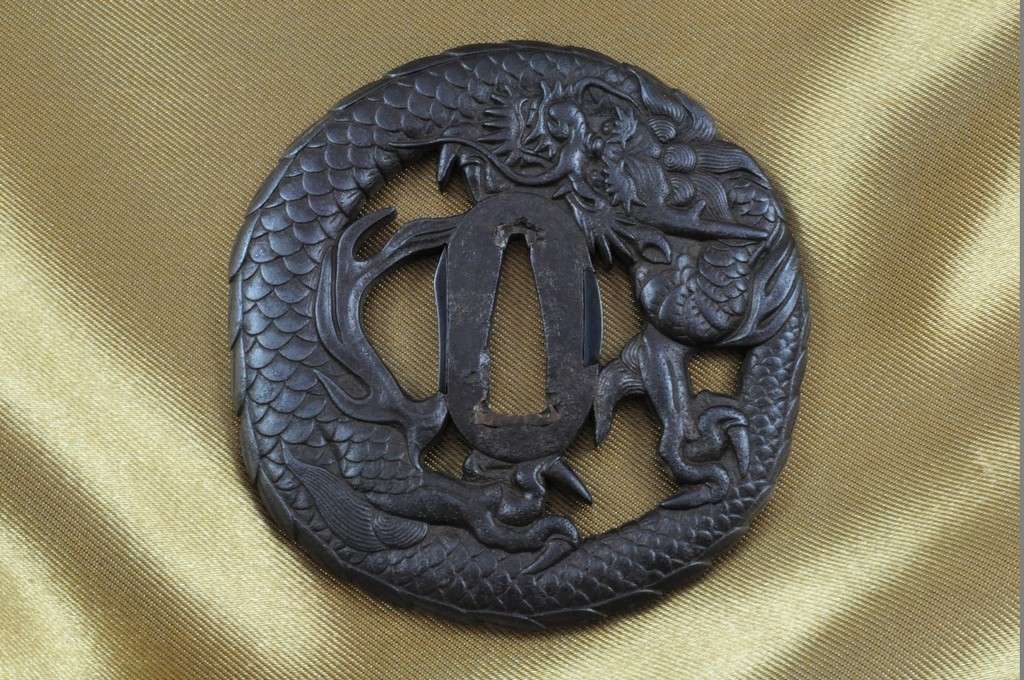
OK, here is some empirical evidence of the proposition that the vast majority of the dragons on antique Japanese tosogu have 3 toes. Why should you care? Because it is a good rule of thumb or kantei point that you can use to help identify fake tosogu (once again, if the dragon has more than 3 toes, it does not mean for certain that it is fake but it should raise a red flag for closer scrutiny). Also, look back at this and the related post to see which of our expert members got this right (something to think about when you take advice...) Here's the result of my empirical study (you can check it yourself): Search the first 100 images of dragon tosogu on a Yahoo image search of "tosogu dragon" (today's date) RESULT: 3 toes = 100 4 toes = 0 5 toes = 0 I used "tosogu" in the search because it filters out the many fake Chinese dragon tsuba on the internet. What happens when we apply the "3 toe" rule of thumb to an image search with fake Chinese tsuba mixed in? Search the first 100 images of dragon tsuba on a Yahoo image search of "tsuba dragon" (today's date) RESULT: 3 toes = 91 4 toes = 8 (BUT EVERY ONE OF THESE IS FAKE - see them below) 5 toes = 1 (BUT IT IS FAKE - see below) While I hope that most of our membership can easily see that the 9 dragon tsuba (pictured below) that didn't have 3 toes are obviously fake, there are some who cannot see that and the 3-toe rule of thumb would be helpful to them. While the issue of whether Chinese dragons can have 3, 4 or 5 toes under the law is interesting, we are talking about Japanese tosogu and shouldn't be diverted by red herrings or wild goose chases. Also, a number of the 3 toes tsuba in the second search were also fake, but that does not change the usefulness of the 3 toe rule of thumb. Further, the numbers are about the same in other forms of antique Japanese art.


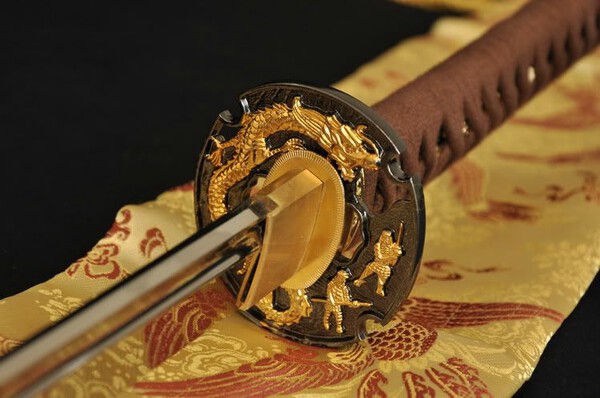


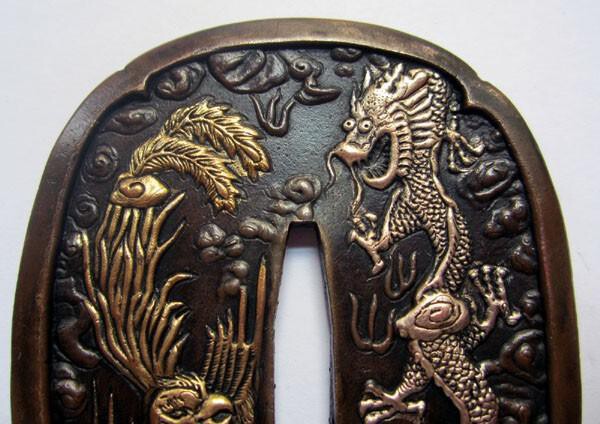

-
Wow, so much misinformation on this topic from some that I had considered experienced. Want to know who you can trust? - look for yourself. Search "tosogu dragon" images on the internet and compare the number of three toed dragons to those with more toes. You'll find that about 99% of them have three toes. Of course there are exceptions, there alway are. However, three toes is a very good rule of thumb that you can use as a point of reference. If you'll take a few minutes to do the search and count for yourself, you'll know the truth. For the record, I'm not saying that just because a dragon has more than three toes, it's not Japanese. Instead, I'm simply stating what should be obvious to anyone who has seen much Japanese tosogu, their dragons usually have three toes, and if there are more than three toes, it should raise a red flag and be scrutinized closer. P.S. Just to avoid confusion, see the front and back of one of the first tsuba that come up in this search. Notice that it is a three toed dragon even though from one side it appears to have five toes on the back legs (it's really both back legs and you are seeing two toes from one leg and three toes from the other leg through the sukashi.


-
StevenK, after seeing literally thousands of dragons in all kinds of Japanese art over 45 years, I can assure you that almost all have three toes. For every one that you can show me with more than three toes, I can show you 99 with three toes (that's how you get to around 99%). Anyway, it's a very good rule of thumb for people to generally tell Japanese and Chinese dragons apart. Therefore, you do a disservice to our NBM community when you tell them otherwise. Also, it's funny the you should use the ceiling dragons at Kennin-ji, the Buddhist Temple in Kyoto as your "proof". I was there last year and saw that painting. It's a new modern painting done in the last few years by Koizumi Junsaku-san. He also did some other temple ceiling dragon paintings with more than three toes, but he is a modern anomaly (and based on the style of his dragons, I believe that he is modeling them on Chinese dragons anyway).
-
For whatever it is worth, I agree with Oyabun Stephen (USMC). Almost all (99%) of Japanese dragons have three toes and Chinese dragons almost always have more than three toes. And as Stephen mentioned, sometimes the Ken at the end of the dragon's tail indicates its sex (especially where there are two dragons - like menuki - and only one has a Ken tail).
-
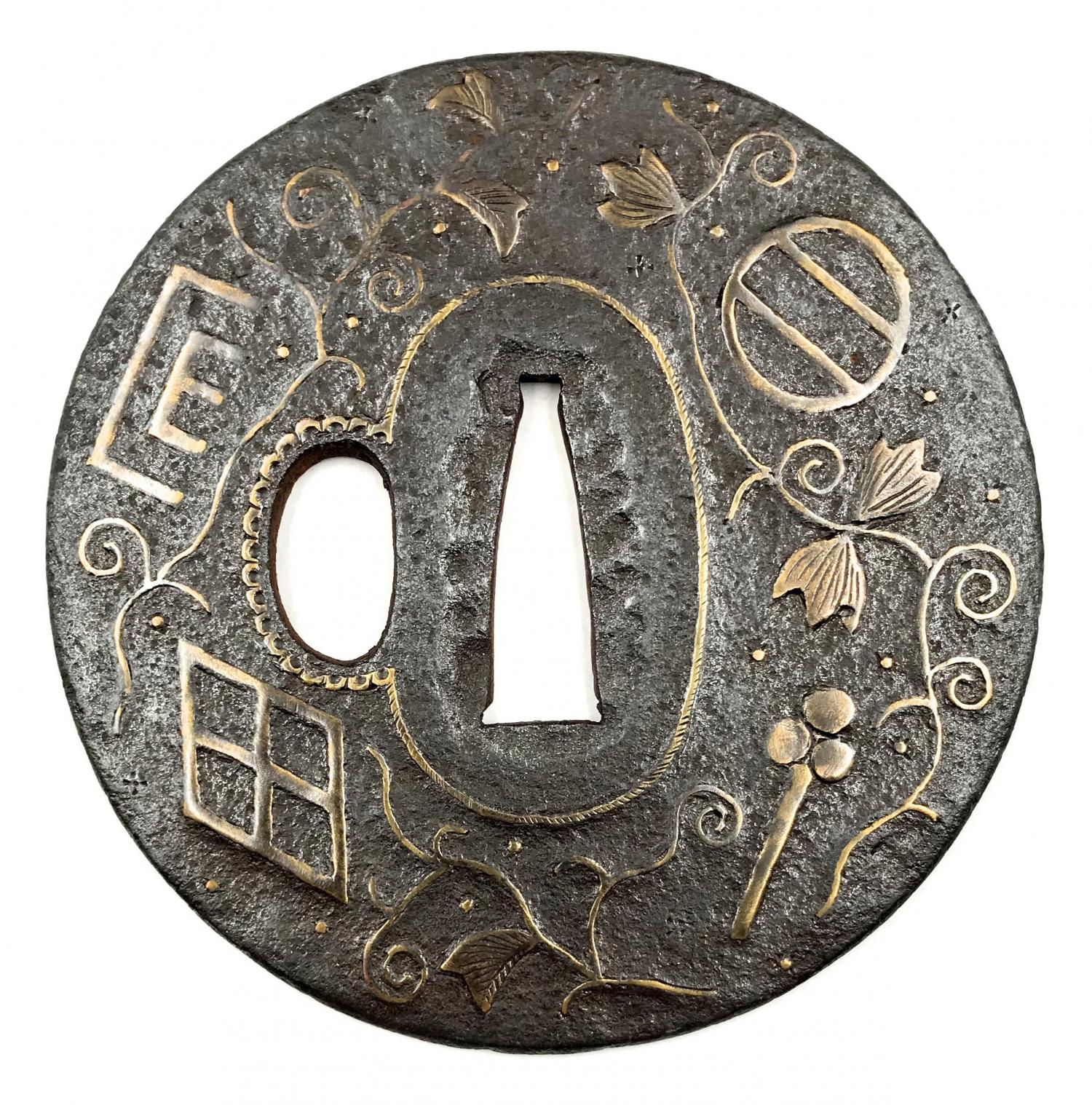
Glad to help. These symbols occasionally refer to the incense game, but most of the time the ones that I've seen refer to a theme from the particular chapter of the Tale of Gemji represented by that symbol. For example, if the symbol on a particular tsuba were for Chapter 4, then the tsuba might also have a Yugao flowering vine because that is the name of the Woman discussed in Chapter 4 (Yugao - the "Twilight Beauty"). Here are a few tsuba that I could quickly find online with these symbols.
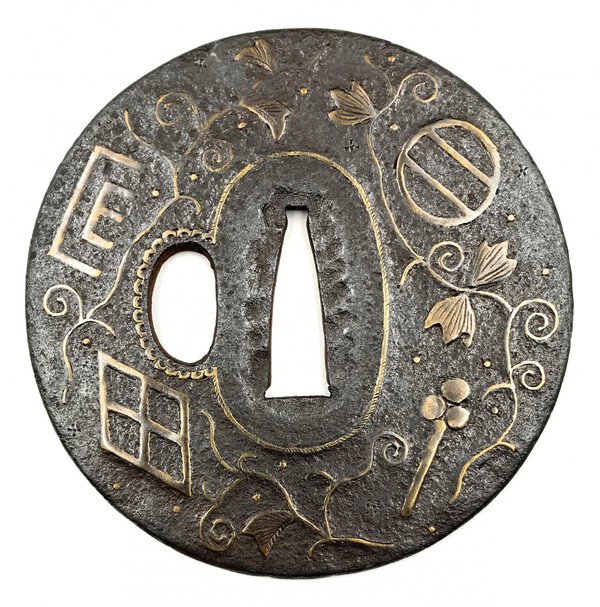
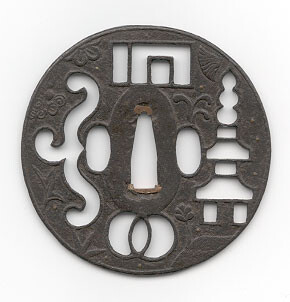
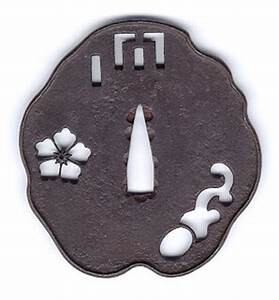
-
Not the Soken Kisho - instead it's the Kokon Wakan Banpo Zensho Vol. 13.
-
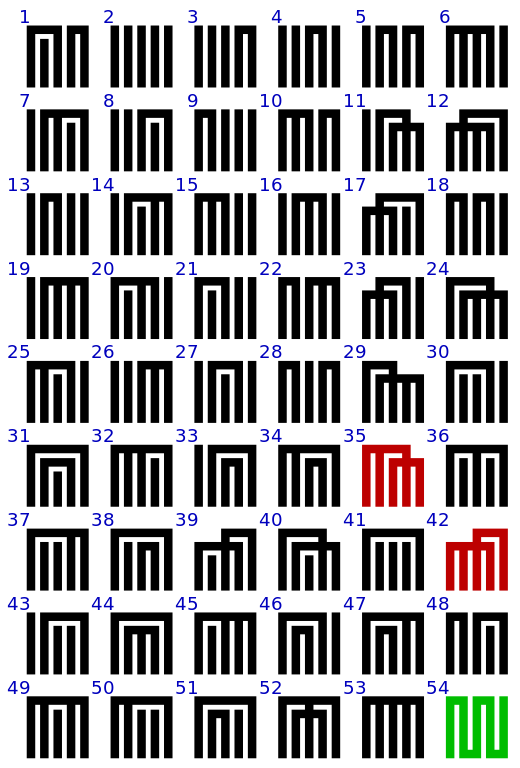
It's the symbol for Chapter 22 of the Tale of Genji. Here's a list of these symbols which are often used on tsuba.
- 18 replies
-
- 18
-

-
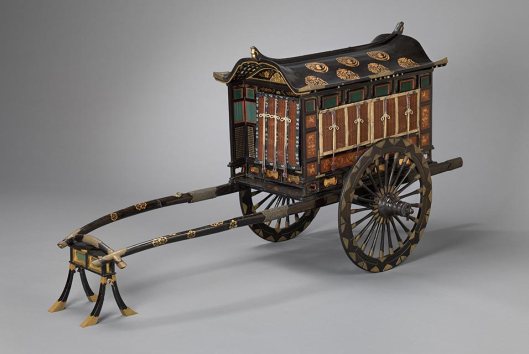
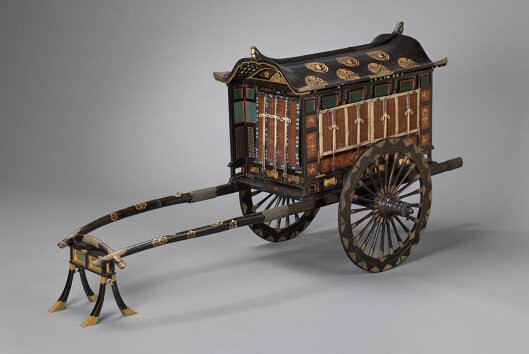
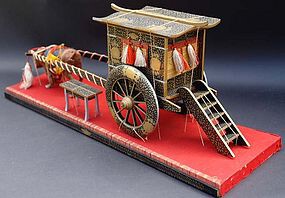
In maki-e and ukiyo-e, I often see a "stand" (or perhaps some kind of yolk) with the imperial ox cart that is the shape (from one side) of the "swimming man"/dragonfly sukashi on this tsuba. Is that a possibility?
-
For The Armor Enthusiasts
Tanto54 replied to Vermithrax16's topic in Auctions and Online Sales or Sellers
Thanks for posting Jeremiah! I don't know anything about armor either, but I know what I like and I like the one with the embossed shishi on the do. I also know that many of the Armor Experts say that [most of?] the embossing on do was done in the Meji period and later to "tart up" old armor for selling to foreigners. I also get the feeling that many of the Armor Experts don't care for the highly embossed russet iron do, but I can't help it - that's the most attractive feature to me. Anyway, I really enjoyed looking at these - thanks! -
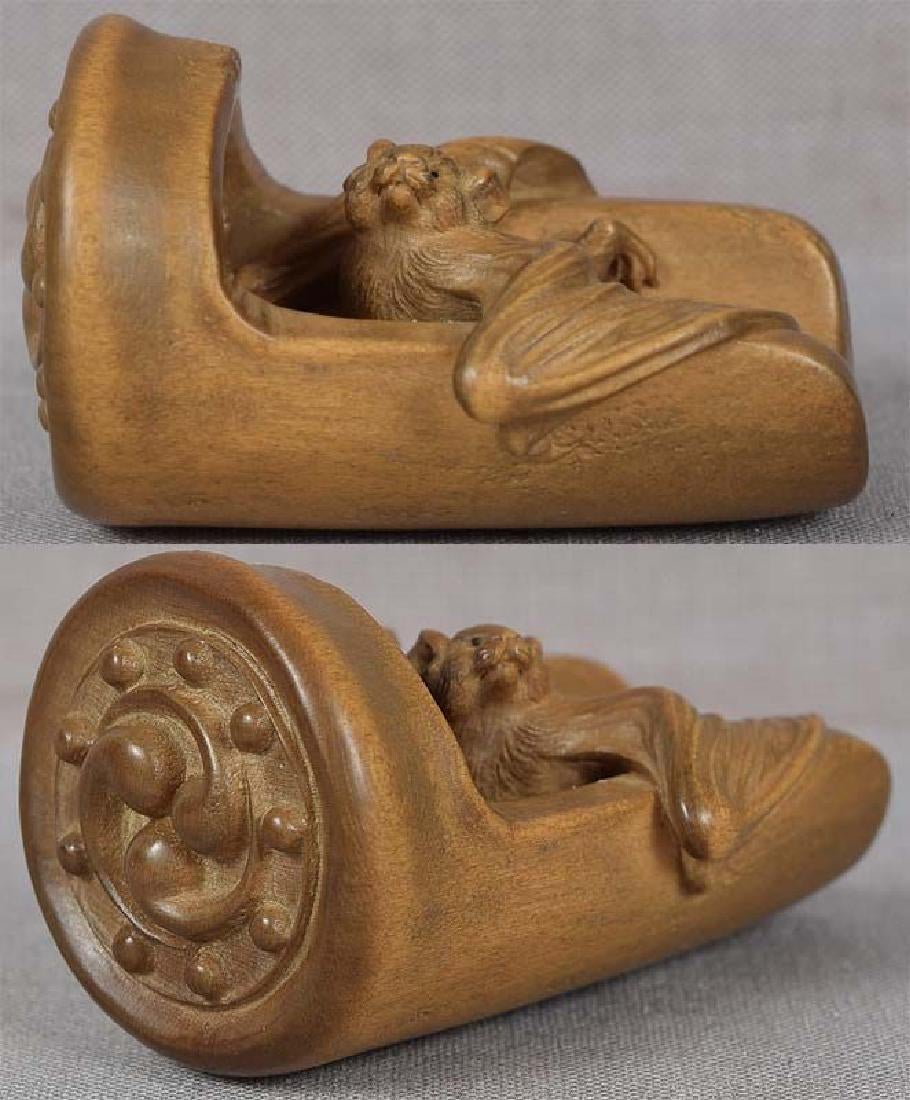
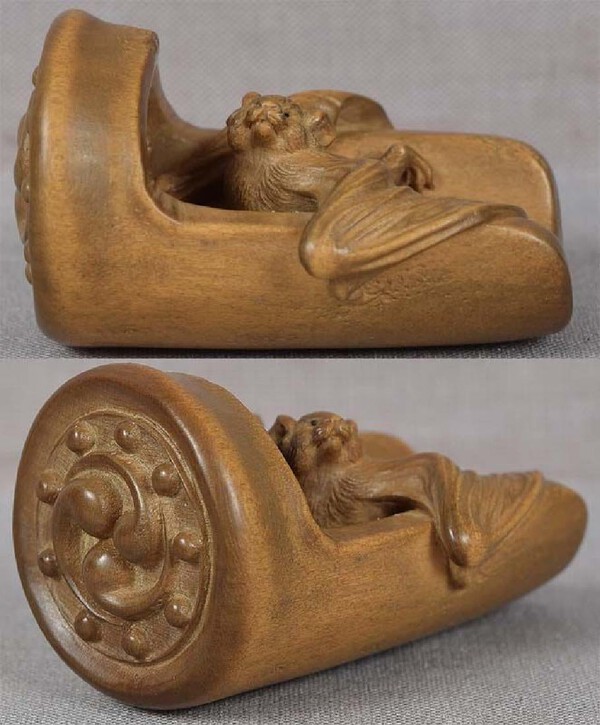
Thanks Curran - just got back from a great trip around Japan, and I think that I can add a little to the meaning of this motif. Ceramic roof tiles (karawa) were introduced to Japan along with Buddhism around the 6th Century, and they are often used symbolically in Japanese art. A single “discarded” tile is sometimes depicted with an animal - frog, bat, etc. symbolizing the transient nature of human life and nature's eventual conquest over man’s constructs. A jumble of tiles, like those on your fuchi, are probably intended to symbolize “gakai”, which is roughly translated as “tile release” and means something like the Western metaphor of “the weakest link in the chain” or “one falling domino knocks the others over”. “Gakai” is made up of the kanji for karawa (roof tile) followed by another kanji that means something like release. When one of these ceramic roof tiles fails and falls, it often causes the others to come crashing down domino style. This metaphor can be used as a Samurai/martial arts reminder to be well-rounded and not have any weaknesses. The specific kawara on your fuchi are called nokikawara (with the round end) and hidarisodekadokawara (curved with design on the edge). To be honest, the quality of your fuchi is not high enough to justify a lot of work (unless it has great personal meaning to you or your family). Therefore, many collectors might simply replace it with a better set of fuchigashira. Alternatively you could use a plain horn kashira (the approach used by many collectors) or try to find an orphan kashira with a matching theme made of similar or complementary metals and colors. Here's my favorite depiction of the kawara motif - a netsuke by Nishino Shoko of the So school.
-
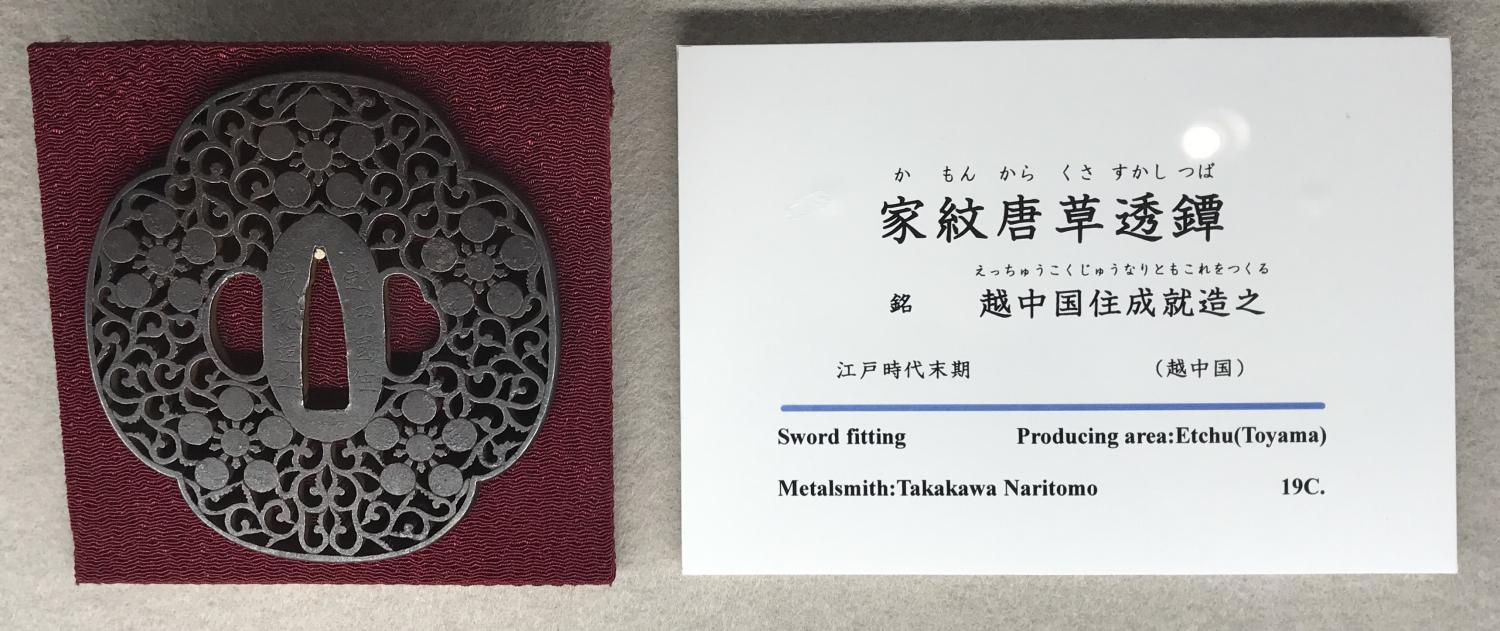
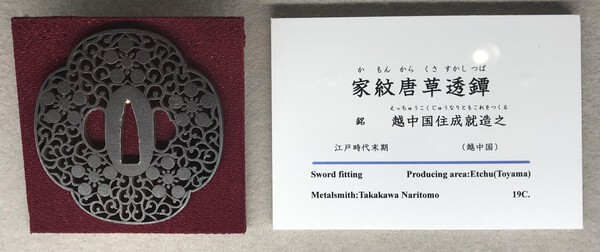
Saw this tsuba at the sword museum in Toyama. Looks like the “Sukashi” was made by rolling flat metal strips and the soldering them in place instead of piercing. Only seen a few good examples of this over the years, so I thought that I’d share.
-
Hi Ed, based on the gold shorts with tiger stripes, the bangle bracket on the wrist, and the three claws, I think that the “standing” menuki is definitely an Oni (a demon not a shishi).
-
I do not have first-hand knowledge of all the details, but this is what a very famous netsuke collector said about his experience in trying to give his world-class collection to a museum. He approached many famous museums: the MET, Smithsonian, MFA, etc. He offered a multi-million dollar collection and a trust fund to cover the costs of caring for/maintaining and showing the collection in perpetuity. His only material requirements were that the museum continue to show at least a small portion of the collection and that they never sell it. All of the major museums he approached refused his offer (he did eventually find a small museum to agree - and I've been trying to see one of his pieces at that museum for 15 years without any luck.... a true waste!) He ultimately decided that the museums refused his bequest because the museums really use many/most bequests as money makers with the intent of selling the objects at some time in the future (the museums are relying on the benefactors' egos in donating their treasure mistakenly believing that their treasures will be on display for future generations, all the while the museums are actually planning to sell the stuff to pay salaries and the electricity bills...)
-
It shows signs of modern rubber mold casting (made within the last 30 years or so). Therefore, the "museum" numbering was almost certainly added to deceive, thereby pointing to a fraudulent, fake, modern copy.
-
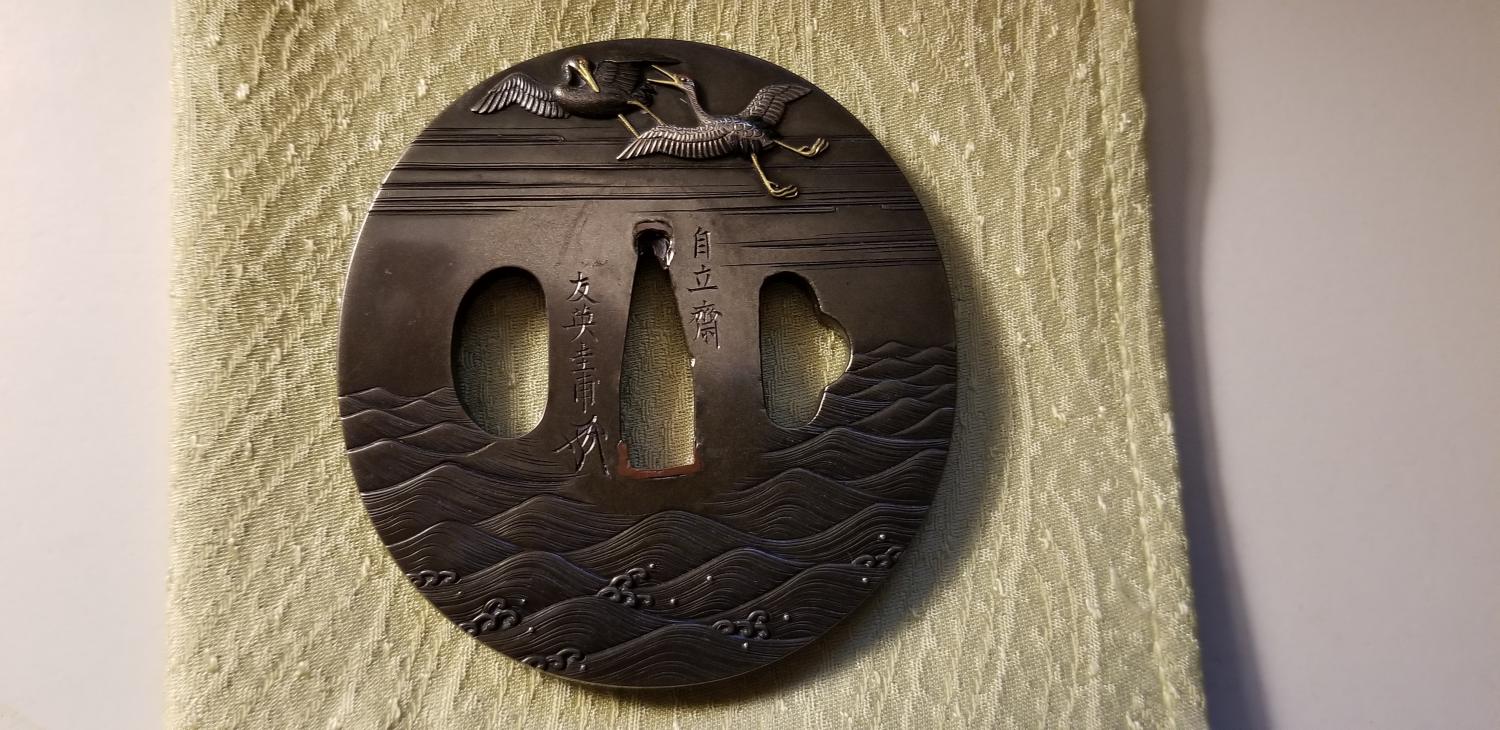
Jiryusai Tomohide - Waves, Cranes, and Pines Tsuba
Tanto54 replied to Vermithrax16's topic in Tosogu
Thanks Jeremiah, I had already noticed the perspective you pointed out in the second picture, and I think that Tomohide is using it to good effect. However, I hadn't noticed the "tilt" you pointed out in the first picture - very interesting. With his skill and attention to detail, I think that there is no doubt that it is intentional. Thanks for the education! -
Jiryusai Tomohide - Waves, Cranes, and Pines Tsuba
Tanto54 replied to Vermithrax16's topic in Tosogu
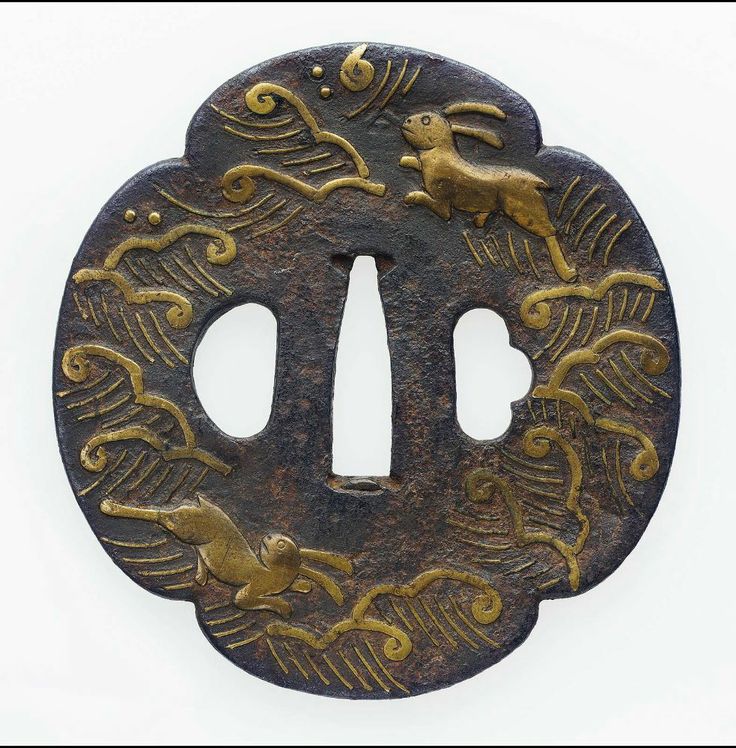
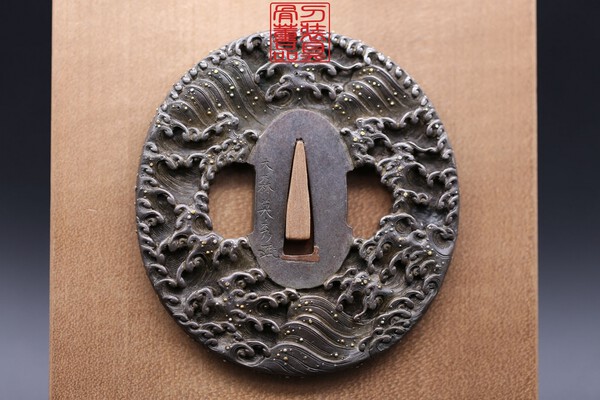
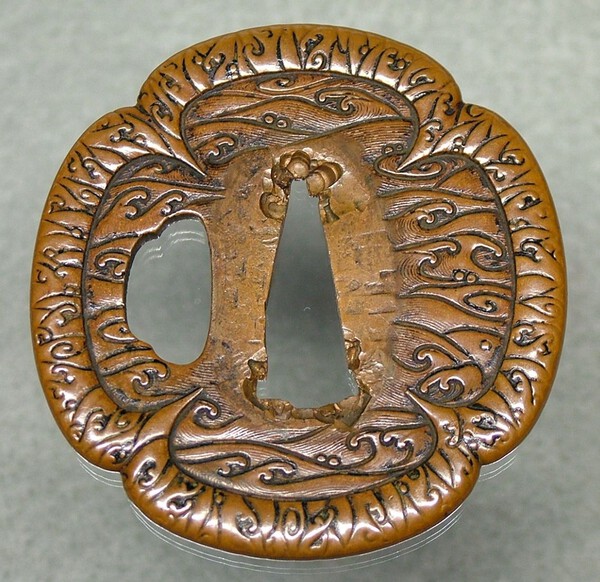
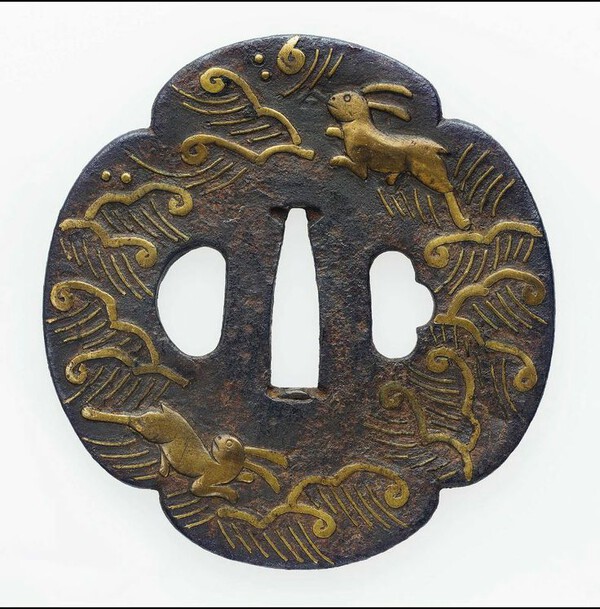
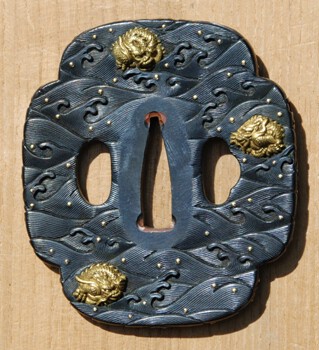
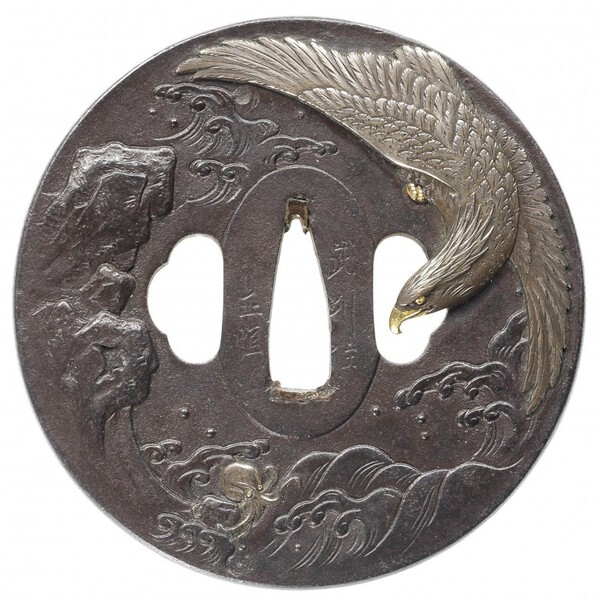
Dear Jeremiah, The waves are great, but I also like the simple and elegant treatment of the sky. While looking at the waves I noticed that they have excellent "true" perspective which I have found to be rare in tosogu (and many other Japanese arts). I've read and observed that most antique Japanese art does not follow "Western" perspective. Therefore, something like waves would be equally sized regardless of how far away they were supposed to be. In your tsuba, the wave breakers are very stylized and uniform. However, the wave undulations are more random and realistic, and they get smaller and fade away into the distance giving a good feeling of perspective. I imagine that the mixing of approaches was intentional and Tomohide uses it to draw us into the tsuba. At one point, you mentioned something about the 3D nature of the tsuba. Care to expand on what your thoughts are? Here's yours again with a few other random tsuba from the web illustrating waves without perspective.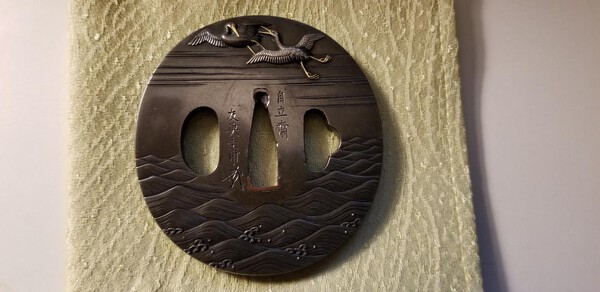
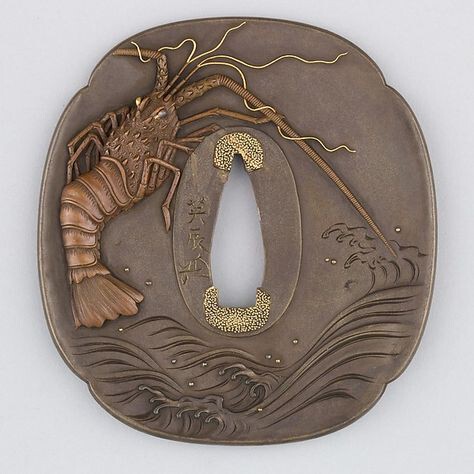
-
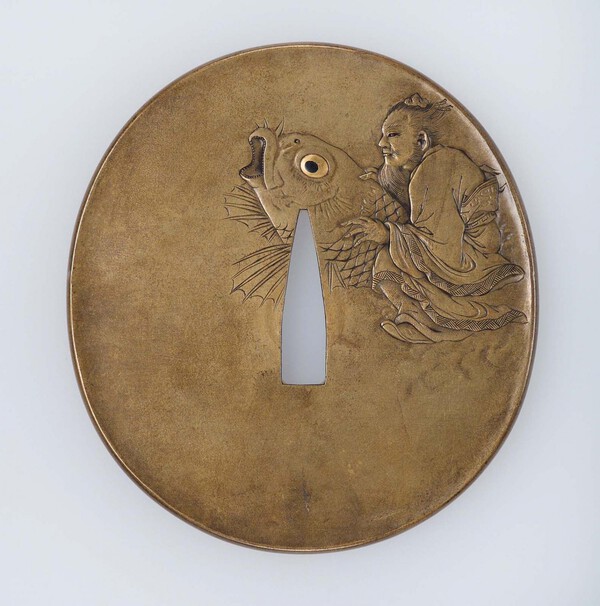
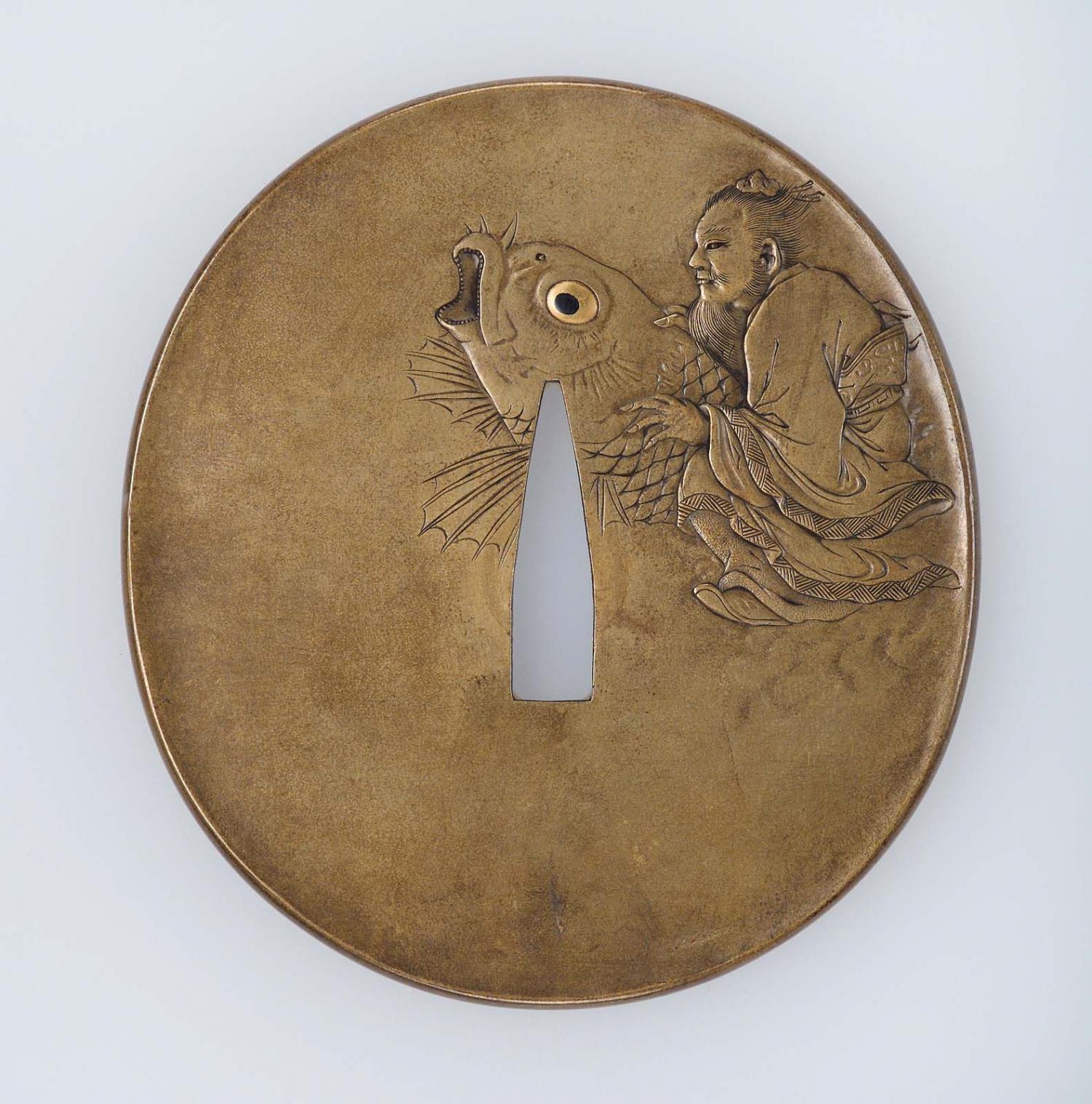
Dear Bruno, nice print! I think that we both posted images of "Shiei" or "Shiyei" Sennin who is actually a different Sennin than the Kinko Sennin that Russ posted... Here's a tsuba that is probably Kinko Sennin instead of Shiei/Shiyei Sennin (because of lack of dragon wings - although Kinko Sennin usually has an open scroll in his hand whereas Shiei/Shiyei Sennin is holding the fish-dragon's horn):