

ROKUJURO
-
Posts
6,997 -
Joined
-
Last visited
-
Days Won
37
Content Type
Profiles
Forums
Events
Store
Downloads
Gallery
Everything posted by ROKUJURO
-
Yes, full moon behind (stylized) clouds.
-
No, not KATASOGI NAKAGO (KAGA), but IRIYAMAGATA JIRI. MEKUGI ANA looks drilled, not punched. Better photos are needed which are not shot in an angle.
-
Pietro, bienvenue à bord et welcome to the NMB! I am sure that your TSUBA is not at all a tourist piece, but a genuine one in NANBAN (or NAMBAN) style, perhaps HIZEN province. It is difficult to make a closer assessment concerning the age without seeing the TSUBA in hand, but EDO period seems to be safe. My personal feeling is mid- to late EDO. In terms of design I think I see foliage, birds, and dew drops. The fissure is a flaw which developed from the manufacture of the TSUBA and can be seen as proof that it is not a cast one. It looks like a welding fault that caught rust in it, thus opening up the tiny gap. It can be fixed by a professional restorer (Ford Hallam) in a way that it won't open more, but it cannot be made invisible. This flaw may influence the value a little, but it is not 'fatal' in my opinion. If you should wish to stay with this form of Japanese arts and crafts, a whole world of fascinatiing and inspiring items and designs will open up for you! Have fun!
-
Logan, a bit difficult without photo....
-
Japanese Art. What would you love to have in your Collection?
ROKUJURO replied to barnejp's topic in Other Japanese Arts
If it was about dreams, then this one could be mine: O-IDO KIZAEMON CHAWAN - no price.....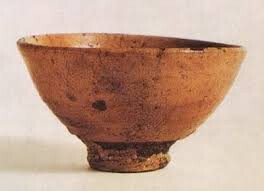
-
Michael, if it is indeed old grease, then any solvent (isopropylic alcohol or acetone) will clean the surface without any harm to the steel. Removing the TSUKA should be no problem, if there was grease or wax involved. Take a piece of wood and place it on the TSUKA (not on the wooden HABAKI!). Tapping with a wooden (or plastic) mallet should cause the TSUKA to come free. I once had a similar problem, but in my case, the TSUKA was glued with epoxy to the NAKAGO. There was no other way, I had to destroy the TSUKA to get it off. Good luck!
-
An attribution rarely seen
ROKUJURO replied to Ray Singer's topic in General Nihonto Related Discussion
To me it looks quite clearly as if a later MEI in the upper part of the NAKAGO had been removed or obscured. Not very well made. -
Harry, welcome to the NMB board! I think you did quite well altogether. Overall condition is good, but I would like to point out two things: - The polish of the blade does not look like a good Japanese polish; it may have been 'enhanced' with non-traditional methods. - The interesting TSUBA should be restored to its full beauty by a specialist like Ford Hallam (a member here). These are just my impressions after looking only at photos, so the sword should be seen in-hand by an expert.
-
No, alcohol is a solvent and removes oil residues. Alcohol (or isopropylic alcohol or acetone or ether) is only used to clean a surface from oil or grease. CHOJI 'oil' is applied to form a very thin layer to keep oxygen from attacking the steel (= rust = iron oxide). Not all oils can do this, and some natural oils even polymerize and become more solid like a wax after a while. If you use CHOJI oil, it is the most basic stuff you can use, and in terms of performance, modern lubricants and protective chemicals might even be better in some respect. However, you don't want a visible layer of whatever on your blade, and CHOJI 'oil' (which consists mainly of low viscosity paraffine which is not an oil but a liquid hydrocarbon derivate) can be succesfully used if you apply and remove it regularly. In the end, rust (or rust 'scars'/pitting) cannot be removed with alcohol, but in some cases, UCHIKO works to an extent.
-
Japanese Art. What would you love to have in your Collection?
ROKUJURO replied to barnejp's topic in Other Japanese Arts
Brian, I'd like two of these, but living ones, to have them in my gateway..... -
Japanese Art. What would you love to have in your Collection?
ROKUJURO replied to barnejp's topic in Other Japanese Arts
Greg, I have no real collection, but besides some Japanese items from the SAMURAI era (mostly iron TSUBA) I have some ceramic items which I am very fond of. As I could not collect everything I like, I leave it with these fields of interest, although looking at others is allowed. -
Anna, welcome to the board! The symbols on the blade are usually not found on Japanese blades. They are chiselled upside-down which would not have been done by a Japanese craftsman. They can be read as YAMAMOTO DAI (can't read the last KANJI), but they have no meaning. So all in all, not a Japanese weapon and certainly not a SAMURAI sword. Items like this are made all over Asia nowadays to deceive unsuspecting buyers. If you want to have a look in our NMB archives, you will find a lot of very nice (genuine) SAMURAI swords for comparison. Some may be less ornate than yours, but they are authentic and beautiful and sometimes have great value. I sincerely hope that you stay interested in this subject and find pleasure in studying it.
-
Szabolcs, welcome to the board! A better picture would certainly help to read it!
-
mratbomb, what is your name please? Looks like two KANJI. The third photo is not well focused, so of no real help.
-
Possible Periode?
ROKUJURO replied to TheGermanBastard's topic in General Nihonto Related Discussion
The photos do not allow a precise judgement. The SHINOGI seems to be a bit rounded. Is this a Japanese polish? -
Nakago mei translation please - Blade opinion?
ROKUJURO replied to acoyauh's topic in Translation Assistance
Grev, my impression is that there was a (KEN to TSUME?) HORIMONO which had been ground away, leaving some poor remains. Probably not made with a Dremel tool, I think. -
Nakago mei translation please - Blade opinion?
ROKUJURO replied to acoyauh's topic in Translation Assistance
Jean Paul, the MEI (signature) is written in SOSHO script, which is indeed difficult to read, but our experts won't have a problem with it. The signature is not etched into the NAKAGO, but chiselled. The blade looks damaged by heavy (incompetent) grinding. I am not sure if the damage is final or if the blade can be saved by a good TOGISHI (Japanese polisher). -
Bojan, three pictures are wrongly orientated. Blades should be shown tip-up.
-
For veggies, I recommend Carnauba or Carnuba wax.
-
Any recommended sword polishers in Europe
ROKUJURO replied to Beater's topic in General Nihonto Related Discussion
Kevin, as you seem to be well acquainted with the subject of NIHONTO, I am a bit surprized about your question. You will certainly know that there are no shortcuts in TOGI, so the chance that a European polisher might find a way to bring out the HARARAKI of a blade at a lower price than his Japanese collegues is small. The foundation polish is what allows the features of a blade to be made visible later, and there is no way around that. The NMB policy not to support amateur work on NIHONTO has nothing to do with arrogance or an elitistic aproach, as you may see it. It is just a responsible attitude as we are only caretakers of these wonderful weapons for a short span of time, so we should avoid everything that could negatively affect them. -
Any recommended sword polishers in Europe
ROKUJURO replied to Beater's topic in General Nihonto Related Discussion
Uwe, I understand your point, I feel the same. But whenever the question of cheap polishers with unclear qualification comes up again and again, I am afraid my answer will be the same. I think the NMB has enough material to read about this subject, but perhaps a short article about this should be tagged in a prominent place for new members, just to prevent those repeated questions and discussions.. -
Jacques, I have read (and seen pictures of it) that cutting tests were usually performed with a special TSUKA without TSUBA. Is my information wrong?
-
The SHIRASAYA is not supposed to come into contact with oil! If the wood sucks up oil, it cannot protect the blade against humidity. Before resheathing, an excess of oil on the blade should be wiped off with YOSHINO GAMI or with a microfiber fabric. A small amount of oil will remain in the micro structures of the HADA.
-
Any recommended sword polishers in Europe
ROKUJURO replied to Beater's topic in General Nihonto Related Discussion
Uwe, I never heard about someone living in Germany and being traditionally trained in Japan. It is difficult to decide if a self-taught polisher is competent enough to be recommended.

