ROKUJURO
-
Posts
7,123 -
Joined
-
Last visited
-
Days Won
39
Content Type
Profiles
Forums
Events
Store
Downloads
Gallery
Everything posted by ROKUJURO
-
The steel does not look like HIGO, and the execution is less carefully made in comparison to HIGO I think. Maybe someone from SHOAMI used this common HIGO motive.
-
Made January 1942 (SHOWA JU SHICHI NEN SHOGATSU) Thank you Steve!
-
Joe, it is difficult to tell the age without seeing your blade in hand. The non-traditional polish did not bring out the HADA - at least I can't see it in the photos. The SORI is significant and could point to an earlier blade, but the MEKUGI-ANA seems to be drilled, not punched. The NAKAGO shows some age and related corrosion, but the YASURI-ME is still visible. If we had the signature of a noted smith, it would obviously be easy, but with these few facts, I would guess that you have an early EDO blade. But please consider that age has nothing to do with quality or market value. As the smith seems to be less known, there is a good chance that the signature is authentic. On the other hand, I don't know if your "renovator" might have changed some features while repairing the KISSAKI, so this might make identification and evaluation more difficult. As I wrote, take some good photos of the NAKAGO (showing the tip always up!) and go to the TRANSLATION section. Maybe our Japanese members could tell more.
-
Joe, someone who 'refurbishes' KATANA should be able to read signatures and define style, school and maker even without MEI. From the photos I do not have the impression of a traditional Japanese polish. I am sure one of our experts here can read the province (which might be HIZEN or BIZEN). Please try again in the TRANSLATION section. Is there a date on the other side of the NAKAGO?
-
Chris, you had probably the peasant population of OKINAWA in mind and thought of KAMA, TONFA, NUNCHAKU and other arms which were derived from farm tools. NINJA (no plural form in Japanese nouns) were a secret society, and very little is known about their inner organisation and their arms, and that is not un-typical for secret societies. It is only recently (< 50 years or so in my observation) that people seem to become interested in NINJA, probably triggered by (non-Japanese) movies. Suddenly there are schools that train wannabe-NINJA, and they have even teacher who consider themselves to be in the genetic line of these former assassins/agents. Quite amazing!
-
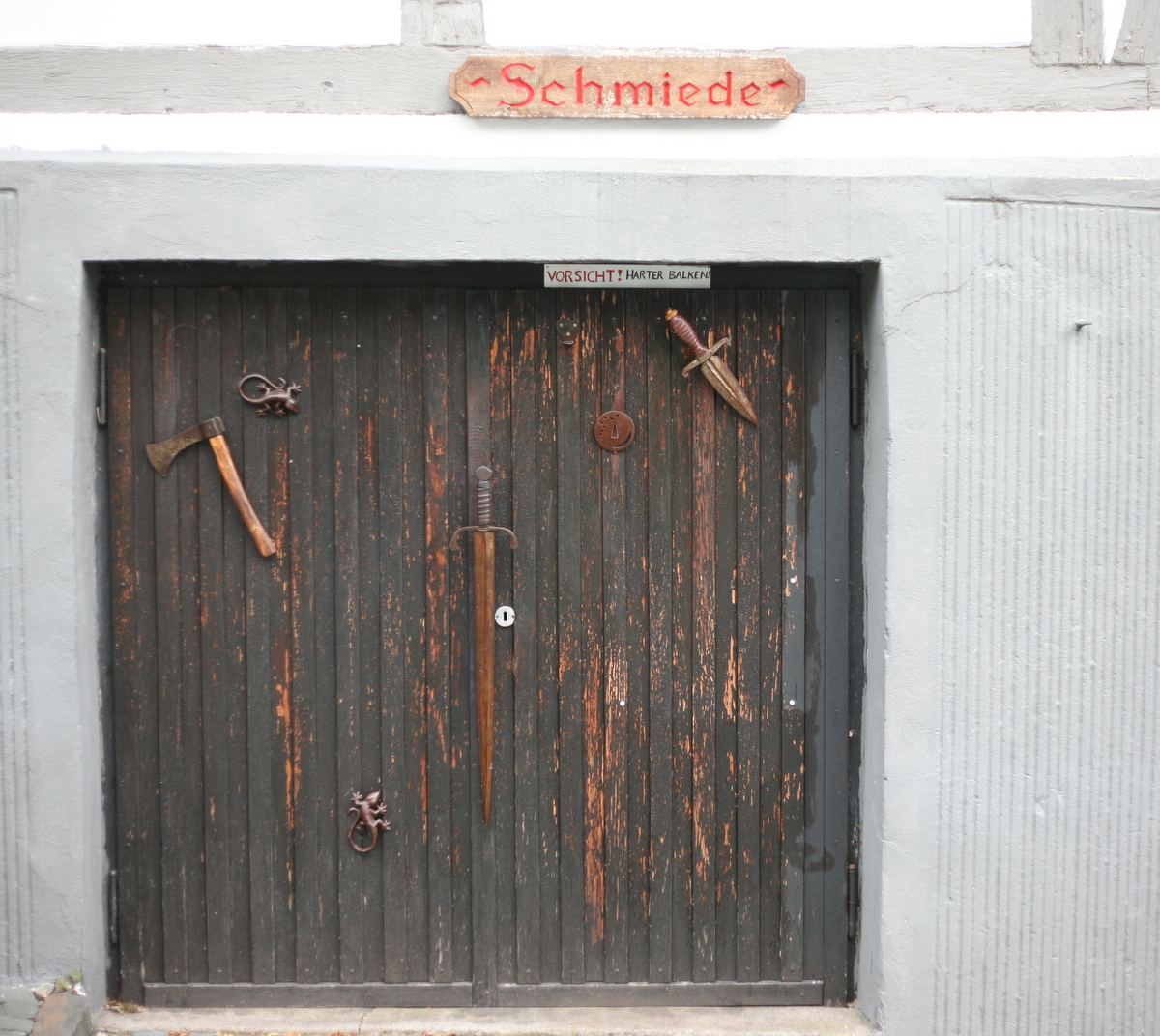
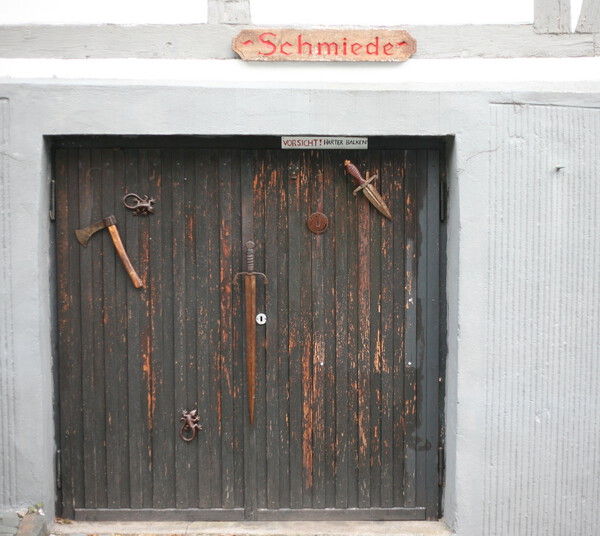
Well, as a blade-smith I am allowed to possess 'dangerous' things that are forbidden for normal citizen. I have a few of these items in my personal collection/museum and on display, but of course mostly legal ones!
-
Chris, I can make them, own and display them, but we are not allowed to carry or use them outside the house, as far as I understand § 42 WaffGes.
-
I would be interested too, to see an authentic and old SHURIKEN. Even the Japanese NINJA museums seem to have only modern copies/items, and these are quite small.
-
Pietro, a good decision NOT to buy this TSUBA! To me it looks cast from the photo, but has of course to be seen in hand to be sure. The design is not nearly as good as the OWARI sample provided by Steve.
-
Chris, without being able to comment on the authenticity of the MEI (signature), I have the impression that the FUJI and the KANE differ from the comparison piece. However, it seems to be a KANBUN era blade with an interesting HAMON. Might be very nice when properly polished.
-
Chris, if the condition of your blade allows, please compare with: https://www.aoijapan.net/katana-sesshu-fujiwara-kanesada/. Is there a date on the other side of the tang? Please consider that many false signatures have been used! You will find some recommendations here on the board about care, handling and etiquette of swords.
-
kh337, please sign all posts with at least your first name plus an initial; it is a rule here. Your sword may well be an older one which was worn in WWII. It is signed KANESADA. You may search for him in the net, there are many swordsmiths who used that name. To give you a better assessment we need to see the whole blade and important details like the tip, the forging grain and the hardened cutting edge if the condition and the polish allows.
-
Yes, full moon behind (stylized) clouds.
-
No, not KATASOGI NAKAGO (KAGA), but IRIYAMAGATA JIRI. MEKUGI ANA looks drilled, not punched. Better photos are needed which are not shot in an angle.
-
Pietro, bienvenue à bord et welcome to the NMB! I am sure that your TSUBA is not at all a tourist piece, but a genuine one in NANBAN (or NAMBAN) style, perhaps HIZEN province. It is difficult to make a closer assessment concerning the age without seeing the TSUBA in hand, but EDO period seems to be safe. My personal feeling is mid- to late EDO. In terms of design I think I see foliage, birds, and dew drops. The fissure is a flaw which developed from the manufacture of the TSUBA and can be seen as proof that it is not a cast one. It looks like a welding fault that caught rust in it, thus opening up the tiny gap. It can be fixed by a professional restorer (Ford Hallam) in a way that it won't open more, but it cannot be made invisible. This flaw may influence the value a little, but it is not 'fatal' in my opinion. If you should wish to stay with this form of Japanese arts and crafts, a whole world of fascinatiing and inspiring items and designs will open up for you! Have fun!
-
Logan, a bit difficult without photo....
-
Japanese Art. What would you love to have in your Collection?
ROKUJURO replied to barnejp's topic in Other Japanese Arts
If it was about dreams, then this one could be mine: O-IDO KIZAEMON CHAWAN - no price.....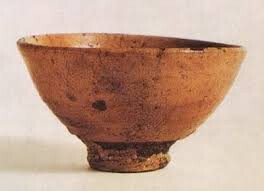
-
Michael, if it is indeed old grease, then any solvent (isopropylic alcohol or acetone) will clean the surface without any harm to the steel. Removing the TSUKA should be no problem, if there was grease or wax involved. Take a piece of wood and place it on the TSUKA (not on the wooden HABAKI!). Tapping with a wooden (or plastic) mallet should cause the TSUKA to come free. I once had a similar problem, but in my case, the TSUKA was glued with epoxy to the NAKAGO. There was no other way, I had to destroy the TSUKA to get it off. Good luck!
-
An attribution rarely seen
ROKUJURO replied to Ray Singer's topic in General Nihonto Related Discussion
To me it looks quite clearly as if a later MEI in the upper part of the NAKAGO had been removed or obscured. Not very well made. -
Harry, welcome to the NMB board! I think you did quite well altogether. Overall condition is good, but I would like to point out two things: - The polish of the blade does not look like a good Japanese polish; it may have been 'enhanced' with non-traditional methods. - The interesting TSUBA should be restored to its full beauty by a specialist like Ford Hallam (a member here). These are just my impressions after looking only at photos, so the sword should be seen in-hand by an expert.
-
No, alcohol is a solvent and removes oil residues. Alcohol (or isopropylic alcohol or acetone or ether) is only used to clean a surface from oil or grease. CHOJI 'oil' is applied to form a very thin layer to keep oxygen from attacking the steel (= rust = iron oxide). Not all oils can do this, and some natural oils even polymerize and become more solid like a wax after a while. If you use CHOJI oil, it is the most basic stuff you can use, and in terms of performance, modern lubricants and protective chemicals might even be better in some respect. However, you don't want a visible layer of whatever on your blade, and CHOJI 'oil' (which consists mainly of low viscosity paraffine which is not an oil but a liquid hydrocarbon derivate) can be succesfully used if you apply and remove it regularly. In the end, rust (or rust 'scars'/pitting) cannot be removed with alcohol, but in some cases, UCHIKO works to an extent.
-
Japanese Art. What would you love to have in your Collection?
ROKUJURO replied to barnejp's topic in Other Japanese Arts
Brian, I'd like two of these, but living ones, to have them in my gateway..... -
Japanese Art. What would you love to have in your Collection?
ROKUJURO replied to barnejp's topic in Other Japanese Arts
Greg, I have no real collection, but besides some Japanese items from the SAMURAI era (mostly iron TSUBA) I have some ceramic items which I am very fond of. As I could not collect everything I like, I leave it with these fields of interest, although looking at others is allowed. -
Anna, welcome to the board! The symbols on the blade are usually not found on Japanese blades. They are chiselled upside-down which would not have been done by a Japanese craftsman. They can be read as YAMAMOTO DAI (can't read the last KANJI), but they have no meaning. So all in all, not a Japanese weapon and certainly not a SAMURAI sword. Items like this are made all over Asia nowadays to deceive unsuspecting buyers. If you want to have a look in our NMB archives, you will find a lot of very nice (genuine) SAMURAI swords for comparison. Some may be less ornate than yours, but they are authentic and beautiful and sometimes have great value. I sincerely hope that you stay interested in this subject and find pleasure in studying it.
-
Szabolcs, welcome to the board! A better picture would certainly help to read it!