ROKUJURO
-
Posts
6,974 -
Joined
-
Last visited
-
Days Won
37
Content Type
Profiles
Forums
Events
Store
Downloads
Gallery
Everything posted by ROKUJURO
-
Anton, just compare it with genuine Japanese swords. This is one horrible decoration for the Ghost train/haunted house!
-
Ray, I just admired your blade and thought how beautiful this would look with a fresh SASHIKOMI polish!
-
José, with that age of the TSUBA I could well imagine that it has seen battle situations. Look for KIRIKOMI on TSUBA, you will find others with similar 'scars'. Concerning the condition of your TSUBA, I am not very surprised that there were no more bidders! Unfortunately it has been sitting quite a while in a moist environment, so that there is not much iron left. I see no way to restoring it, I am afraid. Take it as a piece of history!
-
Didier, TEKKOTSU looks different. Your TSUBA shows TSUCHI-ME (hammer-work) on the face, but also some ISHI-ME (stone surface), which might have been done intentionally but was perhaps also caused by corrosion in places. TEKKOTSU translates as 'iron bones'. The explanation in the books how it is produced is usually not correct. If you look up the term, you will find that almost all authors relate to older text sources, but these mostly don't have a relevant and metallurgically satisfying base. Perhaps others will be able to relate your TSUBA to a school or even a maker.
-
katana Need Help Identifying Blade And Sword
ROKUJURO replied to hbaubele's topic in Military Swords of Japan
Stegel, I cannot comment the ITO quality, but it is wrapped in a wrong manner. That is usually a give-away for non-Japanese production. The cast TSUBA has nothing to do with military, so I have my doubts. You might know better as you had it in hand. I always remember the saying "Buy the sword, not the story"! -
katana Need Help Identifying Blade And Sword
ROKUJURO replied to hbaubele's topic in Military Swords of Japan
Stegel, amazing! You are sure that this is Japanese? NAKAGO, TSUBA, TSUKA-ITO (can't see the FUCHI), all looks non-Japanese to me. Even the KASHIRA is not necessarily Japanese! -
Didier, I cannot see typical signs for SHOAMI, but that is a wide field to get lost. The MEI is not easily to read as there remains only a part of a KANJI, but our experts might see more than me. What caught my eye is the NAKAGO-ANA with its dimensions: Wide and short. If the TSUBA was not for a NAGINATA (then it would not have needed the HITSU-ANA) then perhaps something like a YOROI-DOSHI? Your TSUBA looks old to me and if it wasn't made in late EDO JIDAI to look old ("revival item"), then it is probably a much older TSUBA from early EDO. The dimensions of your TSUBA might help for a better assessment.
-
Well, Brian, nobody should need papers to see what that is. A German proverb says: 'Paper is patient' meaning it does not protest even if you write nonsense on it. Technically, you cannot fold and weld stainless steel in a simple blacksmith's forge, and it would not make any sense at all. The paper is made to look very old, but it is really funny to see that it even mentions the blade's Rockwell hardness! The ground-on HAMON is (nearly) gorgeous! This is a very simple attempt to get to the money of some unsuspecting people..
-
katana Need Help Identifying Blade And Sword
ROKUJURO replied to hbaubele's topic in Military Swords of Japan
hbaubele, the photos lack details and are not very helpful, tang photos are upside down. As far as I can see - and I am not a military sword specialist - the TSUBA could be o.k., the O-SEPPA probably not so. The TSUKA (handle) seems authentic. I can't say if one of the painting layers of the SAYA is original. The blade and its HABAKI are very probably not Japanese, so my guess is that some authentic military parts have been mixed with a fake blade to deceive lesser informed buyers. My advice would be to stay away from this, no matter how cheap it is offered! Please add your first name and an initial to every post, it is a rule here. -
James, my impression is that FUCHI, KASHIRA and KOZUKA/KOGATANA are a little bit better than the TSUBA which seems to be NAGOYA-MONO. All probably very late EDO JIDAI. Please compare with high-end items and have a look at good NANAKO-JI!
- 1 reply
-
- 1
-

-
Insane, but wonderful!
-
Chris, it looks like a blade from the province KAGA, in case you want to follow its provenience and authenticity. The exact length (NAGASA) would be of interest to see if it is less than 30,3 cm (then a TANTO) or more than that (= WAKIZASHI).
-
So you have nothing to do but to teach your wife!.... The main work is stretching out, not the welding or folding itself. It is just normal work, probably less than with your wootz. You need some physical endurance and patience.
-
Phil, nice TSUBA but I don't see the 'silver residue' you are mentioning. In any case, most acids won't attack silver. The glossy surface is not the effect of an etching process; there is some hand work involved, I think.
-
I don't know where you got that, but our European ancestors had no powerhammer for their 'Damascus' steel. It all depends on how big your workpiece is, and if you forge one blade at a time, fire-welding and folding is feasible. It is a complete misinformation that much power was needed. Have a look at the many Japanese sword smithing videos. There are still many who work without machines, and if you imagine how small your Damascus billet for a knife would be, you can get along without helpers. I am 74 and make my own forge-welded Damascus without power-hammer. It is more a question of training and technique than of sheer power.
-
Ruben, so you are going the hard way with wootz? Then you might need more than a normal fire, you will also need a furnace for a crucible. All the best!
-
By the way, the thickness is 3,9 mm at the MIMI, and 4,6 mm at the SEPPA-DAI. Does this help to make an assessment so that I can put a tag on this one?
-
Ruben, that looks like an interesting tool, and the corrosion won't bother you! Is the stamp readable? It does not look Japanese, so where does it come from? Anyhow, have fun working with it and show some results!
-
MangaCarta1215, welcome to the board! Please sign all posts with a first name plus an initial as is required here.
-
I tried KAZUYOSHI, but without success.
-
Chris and Florian, thank you for your helpful comments!
-
Referring to the cross decoration, it is probably 'made in Switzerland'. I can understand that you don't find it mentioned in Japanese literature!
-
Matthias, welcome to the NMB! Please dont touch the NAKAGO except wiping it with a dry cotton cloth! Don't remove anything that could affect the value! There might be a SEKI arsenal stamp above the MEI, difficult to see on the photo. This could indicate a mass produced (not traditionally forged) blade. MEI is indeed SEKI KANEMASA SAKU (not Shaku).
-
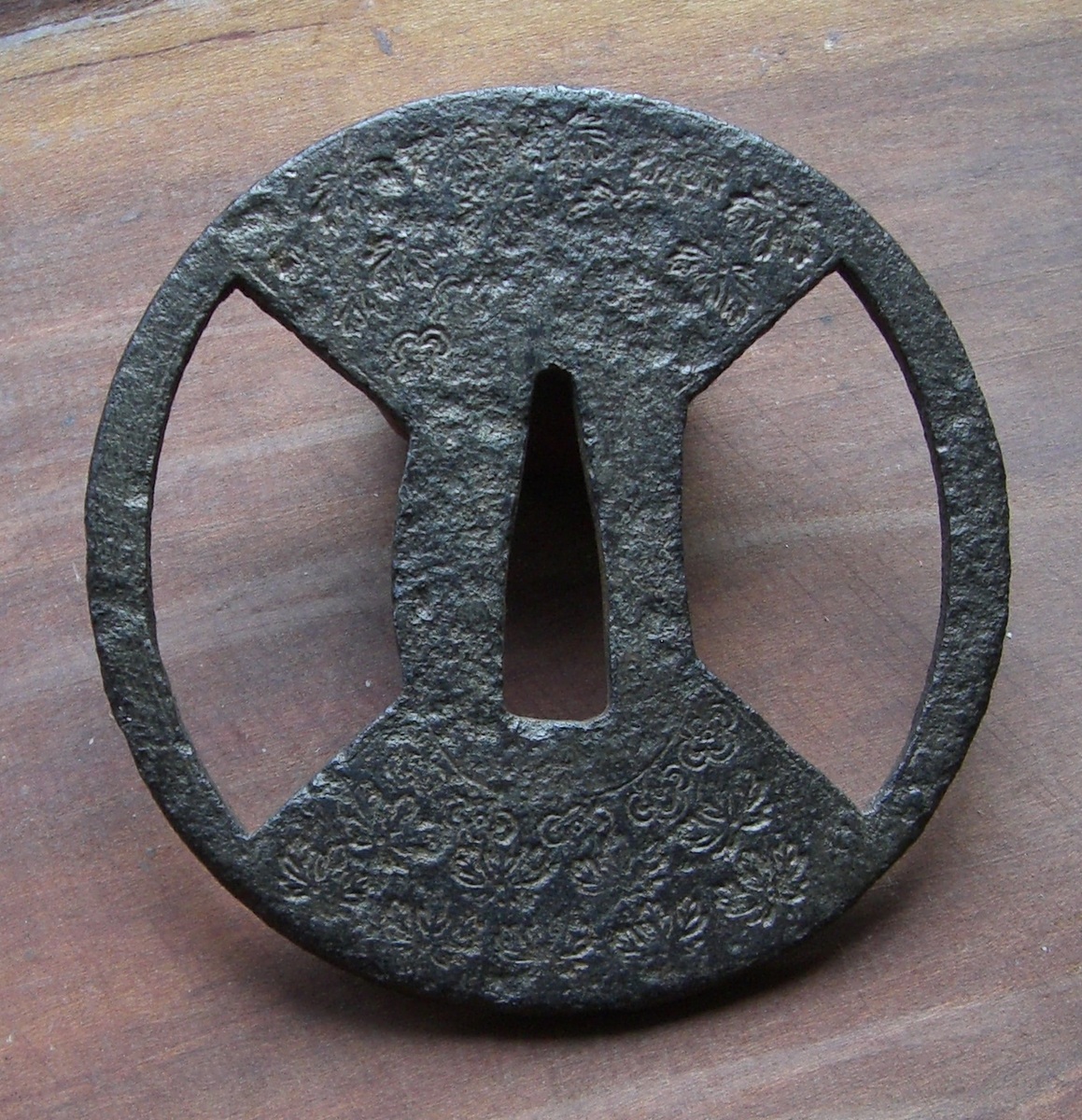
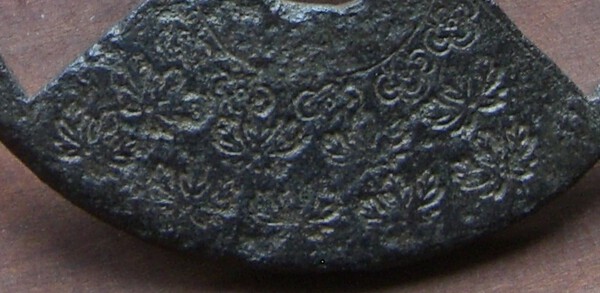
Gentlemen, I just bought a TSUBA from an NMB member. On first glance it looks quite simple, and unfortunately it has suffered a lot of corrosion. Neverteless, it shows some details I find interesting, as it seems to have two different KAMON. One could be the KIRI family MON of the AKAMATSU, the other one resembles the flower (?) in the AKAGAWA or IKEDA I MON. I would appreciate any information on school, period or design meaning of this TSUBA (78 mm dia).

-
Steve, probably KANEAKI.