Gakusee
-
Posts
1,951 -
Joined
-
Last visited
-
Days Won
22
Content Type
Profiles
Forums
Events
Store
Downloads
Gallery
Everything posted by Gakusee
-
Geraint, I have a suspicion I know which one it is and its whereabouts, that is why I am asking. There is a Honami-kinzogan Masamune in the V&A, which looks very good and likely Masamune. I have examined it and have a video of it
-
Geraint please upload a photo of the Masamune with the kinzogan and the nakago of that blade. thanks
-
Thank you, Geraint!
-
Thank, Geraint. Care to show us the index/some plates? Indeed, there used to be big and affluent collectors in the UK in the 19/ early 20 century. Some of their items were donated to museums but some were sold in auctions. I have noticed that various items had ambitious attributions and were frankly not legitimate but many others seemed OK.
-
I am in the same camp as my US namesake Katsujinken: I gently oil the blade, store it in its shirasaya which is inserted in shirasaya bag, which in its turn goes in a ZCorr rifle protection bag (VCI coated) with two 1-kg desiccant gel bags placed on top of the ZCorr bag, all of this in a gun safe, with a dehumidifier constantly running on (maintaining a humidity of 45%-50%) in the sword room. Might sound like an overkill but the value and age of the swords I am dealing with makes the above a no brainer.
-
Lately there have been numerous pseudo big names on Bonhams which look just about possibly right but actually merely so-so. I have looked at various tosogu with famous craftsmen's signatures chiselled on the back but average or mediocre work on the front. So, just because something is being sold by a large auction house, it does not mean that it is legitimate or authentic. Also, even if an affluent collector of yore had previously owned it, that also would not be a guarantee - there were plenty of 'duds' even in the Walter Compton collection, let alone lesser collecting demigods. One, therefore, needs to be sceptical, analytical and discerning when pursuing big names, especially when they seem under-priced. Probably the only provenance I would take unquestionably would be the Museum of Sword Fittings, which dispersed incredible items at not exorbitant prices and even though they were often not papered, they were genuine and highly valuable. Dale, my vision is far from 20-20: in fact, I have both myopia and astigmatism, but at low dioptrical measurements and easily corrected with glasses. But I was talking about the 'proverbial aesthetic eye of connoisseurship' that Ford also mentioned above. You took my words literally, instead of as a constructive didactic suggestion. Perhaps you need more time and more exposure to items, and that is fine. Indeed such a journey takes decades and numerous instances of learning and appreciation generously shared by people. I have been very fortunate to have had such exposure reasonably regularly prior to the Covid-19 restrictions and some very patient teachers. Anyway, we are lucky to have Ford share his knowledge and insights with us and we need to learn as much as we can from him and others. And we should continuously train our eyes.
-
Dale, it is not about pleasant or not, surprised or unfazed. You need to train your eyes more in order to recognise: - quality - execution - chiselling / mei strokes etc Admittedly, my image is rather low-res and not very good quality because it is a photo of a photo from ToBien 545. However, you should be able to discern in the original the high level of intricate detail carved (remember, this is a kozuka and look at the tassels, the robe, the eyes, etc), the smoothness of the lines, the feeling of depth and three dimensionality, the colour palette and so on. I am not even going into the mei and kao which you need to compare side by side for size, inclines of strokes, proportion of the elements to each other, placement etc.
-
Grev/Kissaki In one word, ‘no’.
-
Brian, I am not Tosogu expert but this is a late replica and not that good. Also, if you notice the careful language Bonhams have used. Always beware when they say “after”, “in the style of”, etc. Clever language indicating that it is an imitation. Herewith attached for reference the real thing.

-
Bruno, I believe the confusion of Yas and others might stem from the beautiful and smooth execution of the sekigane. Usually they are crude, protuberant and unsightly and clearly a rushed copper addition to fit a tsuba to a specific nakago. Here, yours are smooth, elegant and flush with the surface. I have seen this before and it has also caused a debate in the past whether it was intended, how/why it was done etc.
-
Interesting tally so far: sugata leads (with 6 votes), followed closely by hada /jigane (either 5 or 6, depending on how we count John’s view on the steel used). So, it seems to more people the shape is the one that speaks most loudly and impresses first and foremost and what one would go for instinctively . I hope I have interpreted that correctly and counted accordingly (as opposed to ‘how do we kantei and what do we theoretically start with when appraising a sword?’, which of course is answered by sugata).
-
Paul, I think this merits another thread: examples of “bad” ubu sugata please. I am not talking about misshaped swords due to unsightly suriage or due to damage inflicted in conflict. I am talking about an ubu sword with bad sugata. I am yet to see one. I think sugata followed function and fashion throughout times and even though personally I am like Jussi, deeply into the deep koshizori camp, I do not allow this to cloud my evaluation of another period’s sugata. Could it be that as you indicated above this has more to do with taste than mechanical characteristics?
-
The blade seems to have good proportions. The mei is chiselled confidently - with gimei sometimes there is a wobbliness here or there or there is a slight misalignment of some sort in the nakago (as the forger tries hard but it is not natural for him to execute the mei - cf Tanobe sensei’s article in gimei). Now, this is a very rare mei and why would a forger choose such a rare mei to inscribe rather than the more common variants? That baffles me significantly. I can also see numerous differences in the mei execution between the examples of Sendai Kunikane I have (with relevant parts) and this here. But very valid comments have been made about the tameshimei - unlikely and what not ... It could be that indeed that OP nakago was modelled somewhat after the sword Jussi posted (and there are different tagane techniques between the two) ...

-
Hmm, it does look special that ensemble. Highly precious habaki and a cutting test would put into a question a gimei, at least to me. I would not have thought Kunikane is sufficiently highly rated to be counterfeited. Especially with numerous generations. Could it be a later generation? Peter -please do elaborate on the thoughts and arguments for gimei
-
Paul, thank you for the interesting questions you posit and I hope they engender a thoughtful discussion. Personally, what I look at in a blade first are the hamon and then the jigane and then the boshi. Frankly, when kantei-ing, we know one should look at sugata first, but I am afraid this is valid mainly for ubu swords. As I am interested in Koto and Heian, very often the swords are o-suriage and the sugata is radically changed. Of course, if I am being regaled by the likes of Kurokawa San of Sokendo or Saito san of Seikodo etc, then I could look at ubu old blades. Bu here the discourse is not about the academic approach and kantei but what enthralls emotionally first and foremost. For me, a beautiful hamon rich in hataraki is the most vivid artistic expression of the smiths and the feature which captivated me most. I would like to ensure that the jigane is skillfully rendered in my favourite mokume (could be komokume and koitame mix) and again that it has soul - variety, richness, vibrancy. I can appreciate both o-hada and ko-hada, as they display different aspirations of the smiths. Difficult to understand.... Frankly, have been looking a lot at / studying utsuri, so not so much this anymore. I would say non-common schools and non-gokaden offshoots. Also the blend of traditions that all got mixed up in Shinto / Shinshinto period. There are a lot of smiths who emulated earlier periods and experimented with all styles and den.. but frankly lost some individuality in the course. Sitting down with smiths of the past: here I would delve into their recipes for utsuri , starting from KoBizen and KoYamashiro through Bizen, Rai, etc and also what made them choose the hamon they forged on the blade - how did they weigh the components tradition, own taste, imperative of war, performance?
-
Curran, this is one of my favourite Joshin sets (not mine unfortunately) due to the clever design and excellent preservation: https://yuhindo.com/goto-joshin/ Another cute design : https://yuhindo.com/goto-joshin-menuki/ I have also developed a taste for Goto. But I am only learning and observing, without dipping my toes financially.
-
Well, pertinently, I see a Dr Honma sayagaki there, and I respect these extremely highly. He was not a prolific saya writer and I have never seen these contested.
-
I second that. Young, ambitious, English speaking dealer with novel approach (recorded videos, even before others started doing it). In fact, one of my great swords came from him....
-
Good pick, Tony, very good pick - the setsumei is strong, the shape robust. Also the Koshirae is Tokubetsu Hozon. I suppose the TH paper mentions the signature etc but have not deciphered it just yet. So all in - a very nice package. Not sure what the price is (Shono san’s prices are robust but he is a lovely guy with a large shop in expensive Ginza 5, so bills must be paid).

-
May he rest in piece. He was a lovely and friendly person.
-
So, Jacques, you found one atari that is different? Surely you can do better! If you look into the shape, it is quite rare and not the typical one forgers usually counterfeit. Also, Masayuki went through a period when he made this particular configuration of sword in that period of time. He was into naginata / nagamaki in his creative period in 1843-1844. He occasionally returned to that sugata in 1850 too. But here we are close enough to period and signature.
-
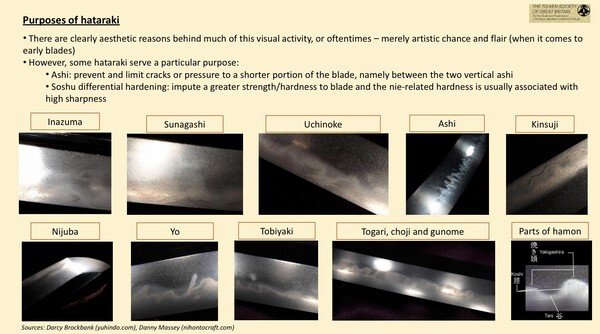
It depends on which Ichimonji school and when it was made. I had a Yoshioka Ichimonji which I have used for lectures at our ToKen Society. It had everything: sunagashi, kinsuji, yo and tobiyaki. Even konie, which was specifically mentioned in the Juyo paper. Soshu could be very intense in its sunagashi and kinsuji hataraki, much more than Ichimonji. If you want a lot of hataraki in the hamon, I suggest Ko-Bizen, Hoki, good Fukuoka Ichimonji, Soshu, Soden (eg Chogi, Kencho). Other schools are more subtle and you need a well trained eye to see them and know what you are seeing: Awataguchi, Rai, ko-Aoe. But they are there (usually ko-ashi, small yo). In the images below, the photos illustrating yo, tobiyaki, choji/togari, gunome are from the same Yoshioka. The images with inazuma , sunagashi and uchinoke are from the same Moriie.
-

Help With Identification Of Japanese Sword
Gakusee replied to Lee's topic in General Nihonto Related Discussion
JP, not really the right approach. One should only really focus on Nakago patina with ubu swords or swords which are slightly Suriage and there is still a Mei visible or there are evident traces of the original old part of the nakago remaining. All the rest is pseudo science as even if the sword is old, if it got shortened in early Edo, the Nakago will have a patina from early Edo and so on. There are cases where old swords had their Nakago “reworked” relatively recently. For instance, I had one such sword, which bore the Mei of an Oei Bizen smith but the NBTHK did not approve of it. The Mei was removed, the Nakago - repatinated professionally by the previous owner and the blade ultimately papered to Yoshioka Ichimonji. The Nakago work was done in the last 15-20 years, before my custodianship, but I had the full paper trail. If one looked at the patina, they would form the wrong views. Nakago and patina are their own area of expertise, where focus and attention need to be paid. One needs to look at the blade in its entirety and form a congruous view with the composite picture in mind. -
Help With Identification Of Japanese Sword
Gakusee replied to Lee's topic in General Nihonto Related Discussion
From the minimum I can see, I would err on Shinto/ ShinShinto made in the fashion of Nanbokucho. May I suggest that you grab an online diagram of a Japanese sword and its parts as well as a glossary of key terms so that you are clear what is being discussed and we have a productive chat. Surprised no one has suggested it yet but you should: - measure the blade kasane / thickness: if 5-6mm then could theoretically be Nanbokucho (if things below also stack up) but if 7-8mm+ you are clearly likely looking at a newer blade - look at the hada: the skin of the steel on the side above the hamon. To me it looks too uniform in one of the pictures: a sign of a newer blade, generally (let us not go into the subtleties of fine Rai or Awataguchi here). The more diverse and rich the hada, generally the more likely you are to be in the older period or be confronted with one of the Shinto masters - look at the boshi: to me it looks like it follows the fukura, ie the curve of the blade tip. If indeed the boshi is so simple, it points to non-Kamakura usually - another small sign: look at the shinogi-ji end check if the hada there is straight (masame) or not. Straight, ceteris paribus, equals newer. - compare the kasane of the nakago vs the kasane of the blade to establish how any polishes it has seen And there are other things to look out for (such as the mune shape, how the hamon starts at the machi, etc) but the above basics should give you a general direction. If the blade is older, looks to have interesting hataraki and jigane, generally it might be more valuable and worthy of polish. If newer, the fact that it is shortened and without a mei generally works against you. Anyway, good to start this discussion and hopefully it leads to something good. -
Help with the service for Tanobe sayagaki
Gakusee replied to Brano's topic in General Nihonto Related Discussion
Brano, not convinced in getting Tanobe sensei sayagaki on this sword. Save the request for something else.