Gakusee
-
Posts
1,954 -
Joined
-
Last visited
-
Days Won
22
Content Type
Profiles
Forums
Events
Store
Downloads
Gallery
Everything posted by Gakusee
-

An alternative to the Den Tametsugu blade
Gakusee replied to Brano's topic in General Nihonto Related Discussion
Jacques, Fujishiro does mention Go Yoshihiro (Koto volume page 129, page 199) but does not show any nakago as there are no signed Go, while his book is a book of nakago and mei. The reality is that shinsa judgment is broadly an assessment of school + period first and then after that, quality determines whether they assign it to a grandmaster (like Go or Norishige) or not (like Sanekage or Tametsugu) and which smith precisely (given some more prevalent features -
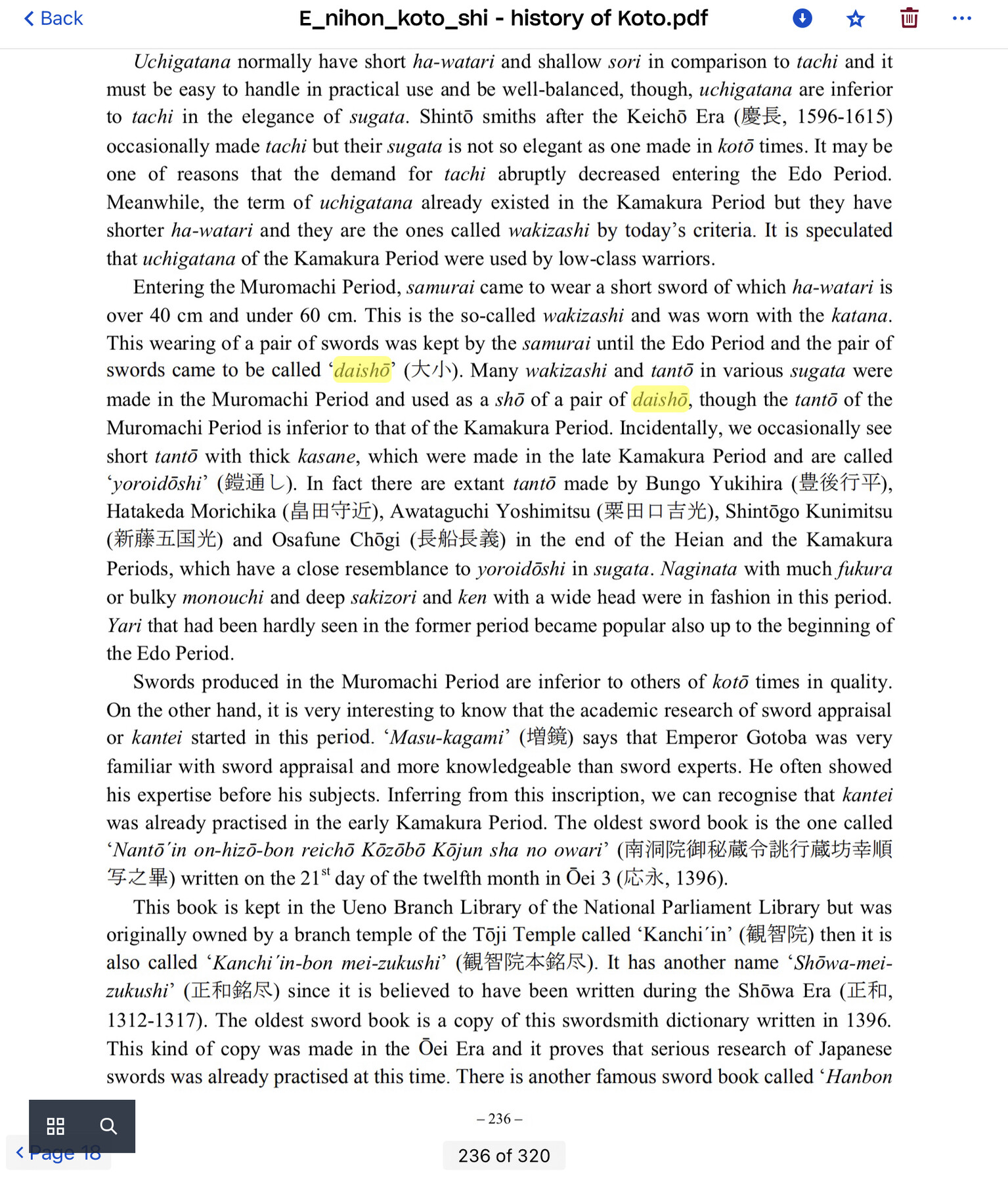
JH Lee, in the narrow confines of a castle or inn, there is no space or time for kata, at least those practised with eagerness by the young iaidoka of nowadays. The wak or kodachi were spare weapons for a palanquin, bedroom, high-level visit etc etc were the longer blade was not permitted or convenient to have on oneself. Of course you can kill an opponent with a short wakizashi - slashing through the carotid, stabbing in the chest or the head etc. As to your blade, the signature is the on the nakago side that indicates it is not by Osafune Kagemitsu, wakizashi were not in vogue at the time and not made, the signature itself is definitely not one of the Osafune sandai master. As to slenderness, I have a close to ubu kodachi by one of the Osafune grandmasters and the haba is close to what you are describing.
-
Recommendation for polish?
Gakusee replied to mgraffam's topic in General Nihonto Related Discussion
Bob Benson and Ted Tenold (legacyswords.com) Both can be found online. -
Kudos for the efforts, perseverance and generosity, Jussi!
-
An alternative to the Den Tametsugu blade
Gakusee replied to Brano's topic in General Nihonto Related Discussion
For fun, Jacques, for fun..... sometimes we take things too seriously.... or we are bored.... or we try to understand “ why den? Why not Tametsugu without ‘den’ and what could the alternative be? “ -
JP, a Hozon paper is often all some older / top collectors in Japan bother with. It has served its purpose to verify what the owner thinks and beside that, if the owner is confident and experienced, the attitude could be: “why bother / I know what I have and I know it is outstanding.” To be honest, oftentimes it is vanity and ego which motivate us, sometimes it is a monetary imperative. There is another aspect: sometimes Japanese collectors are secretive and do not wish others to know what they have. And since the NBTHK publishes the names of the submitters, and in the past - of the owners, this could become uncomfortable to some people. So they prefer their treasure to be “secret”, unpublished in the Juyo/ TJ Zufu. Some years ago, I decided to have few but decent blades. That necessitated culling my already modest collection of 4-5 items to 1 only, before building it up to the current 3. It all depends on what collectors want and like.
-
JP, why don’t we just go all-in for a papered top example like that https://yuhindo.com/shimazu-ichimonji-katana/? Better to save some funds and acquire something which people have vetted and is understood to be the real thing, as opposed to a vapour of hope shrouded in chimerical deceptions. I have heard a few times that some people would rather have one sword (a collection of one outstanding example) as opposed to numerous average or below-average examples. And if one does the maths over several years and the funds expended on multiple swords and multiple tosogu, etc , then it actually seems more achievable than at first.
-
Last night, rather than sensibly going to bed, I went through the Compton catalogues into the early hours of the morning. I could not find that specific sword but was not overly thorough. Found lots of big names across the three catalogues and some with high prices that went for big sums. But many of the big names had modest evaluations probably because of the lack of recent papers and only sayagaki present. By the way, does anyone have the auction results for all three days of the Compton sale in 1992? I discovered that I only had one of the days. Thanks.
-
Well, we are fortunate that there are plenty of zaimei Fukuoka Yoshifusa left, to which we can compare the mei. Here there is plenty of tang erosion, but the “fusa” is clearly way off both the early blocky version and the later more cursive version of the smith’s mei. I also think his hamon usually has more kinsuji and sunagashi than in this yakiba here. This one reminds more, in terms of overall impression, of a later Bizen sword, given its plentiful togari. I would say around a hundred years later, towards Oei. At least the 3 genuine Yoshifusa I have seen (held two of them) were much richer in hataraki within the hamon. Compton had a lot of masterpieces but his collection was vast. There were gimei in there. If you browse through the auction catalogues of his collection sale, you will see various duds, alongside the gems. This could be potentially one of those..... A genuine one, if you are extremely lucky, will set you back more than well over ten-twelve times the price that this one was bought for. This one went at the price of a mumei Yoshioka wakizashi or mumei Ishido sword. The Juyo ones I am aware of trading recently were between $150-200k, the TJ and JuBi ones at the DTI were at $300-400k.
-
Great Jumonji yari added on Aoi
Gakusee replied to Fuuten's topic in Auctions and Online Sales or Sellers
I agree with the posts above. Yari are difficult to forge and jumonji are at the top of the difficulty range. Add to that the difficulty in polishing them. Add to that that they were considered utilitarian weapons, not to be preserved and cherished likes swords but to be brutally used and abused in warfare = not that many examples in great condition or by great masters remain nowadays. Size does not matter really - someone above was complaining about the size. In fact, the Aoi example is quite standard sized. I recommend those interested to have a look at the Knutsen book about pole arms. Also, it is the complete package with koshirae. In the U.K. I have seen worse examples commanding similar prices. -
Great Jumonji yari added on Aoi
Gakusee replied to Fuuten's topic in Auctions and Online Sales or Sellers
I also like it, Axel and do not think it is unreasonably priced. It comes with nice koshirae too. The thing is, polearms are underloved in Japan. They are too bulky with their poles and koshirae and there is not much “blade” in the package. Dealers in Japan have complained to me that no one wants yari and they have shown me drawers full of yari...... Of course, for the bigger names, eg Muramasa, there is always demand. -
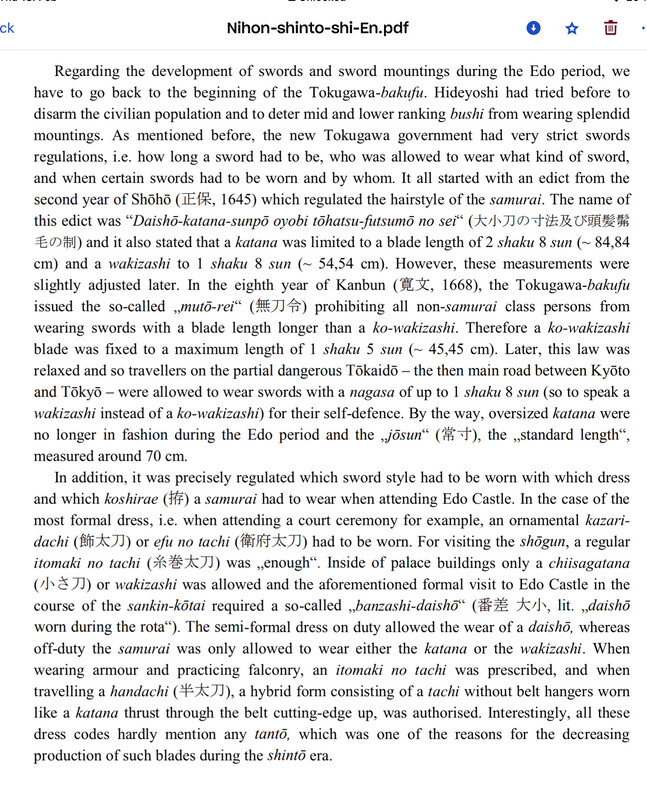
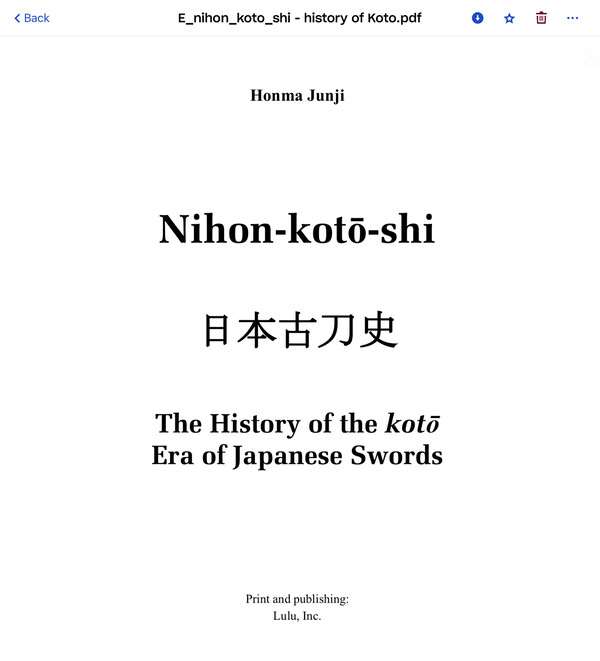
We really ought to hit the books more...... it took me a bit of time to prove the point Christian S was contesting....


-
New Gold Tier Subscription/Membership Launched
Gakusee replied to Brian's topic in Forum Technical Details and Maintenance
I am a supporter. This is the least we can do. -
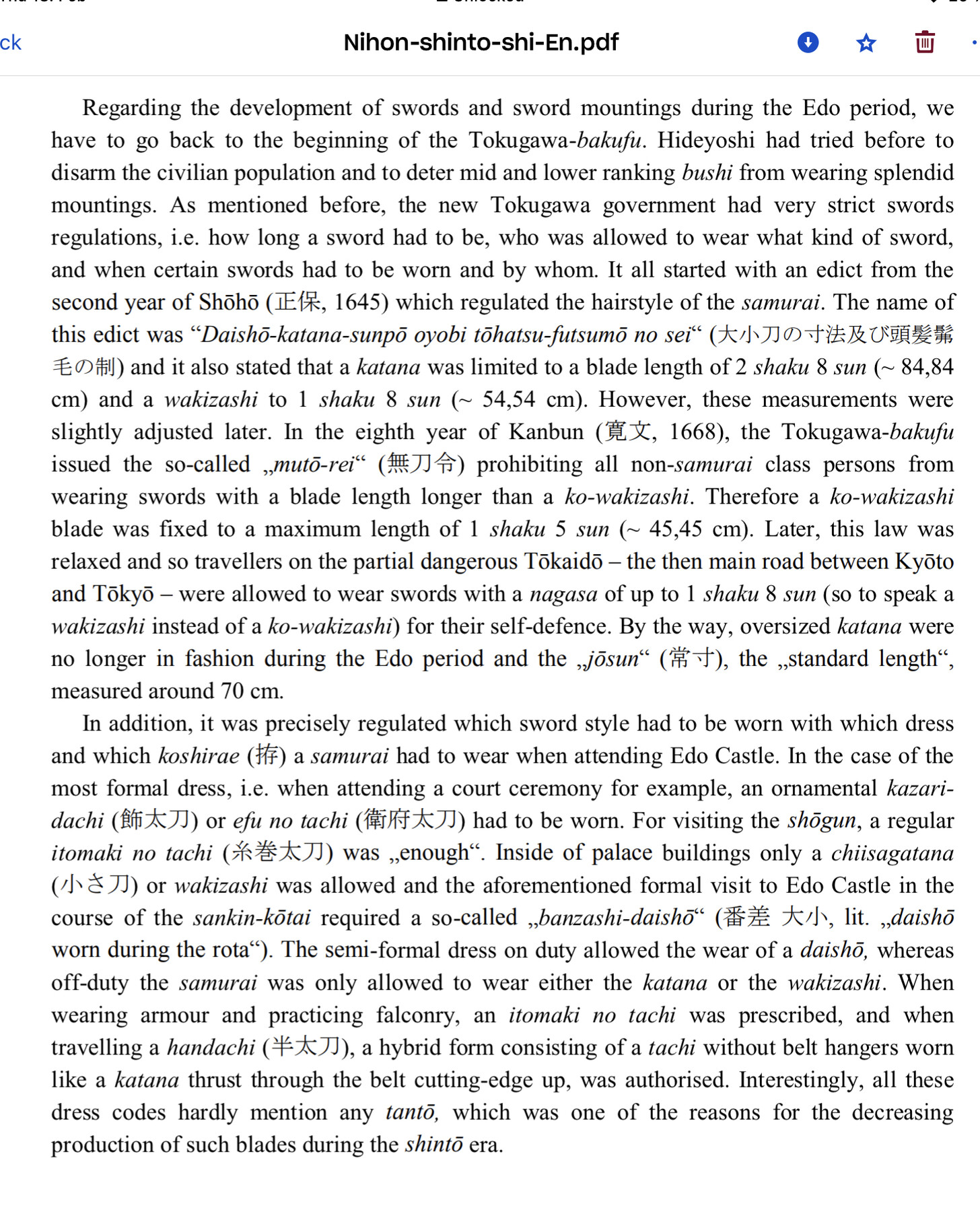
Firstly, all of this is covered ground on this forum. Several times in fact. Just one such thread (but I think there have been others): Secondly, sword length was codified by Hideyoshi and his successors. So, we cannot say that “everything else was added later” for the use of “dealers”. Blatantly wrong statement.
-
Darcy's current tosogu listings
Gakusee replied to Brian's topic in Auctions and Online Sales or Sellers
John, the prices are on Darcy’s website. For comparison, at that level of quality, look at the prices at Iida san’s website , Iida Koendo. -
optimal conservation
Gakusee replied to French nihonto's topic in General Nihonto Related Discussion
Sorry, Brano, but this is just a label. I have been to so many dealers in Japan and have never seen water next to blades, let alone Juyo and above blades. I have, of course, seen the bowls of water next to tsunagi-holding koshirae, armour, kake, etc anything that has high-quality lacquer. I know it sounds petty, but it is time we became pragmatic and logical on this topic , rather than venture into wild and romantic hypotheses as to how it might get done, etc. I cannot count the number of times I have been to the Tokyo National Museum or the NBTHK museum - and guess how many times I saw bowls of water next to swords, or even koshirae or armour ? That is right, never. Even when the NBTHK displays koshirae and lacquer, they do not tend to put water. -
optimal conservation
Gakusee replied to French nihonto's topic in General Nihonto Related Discussion
Time is money, as they say...... Time (money) invested in researching, designing, procuring materials, building, fitting, etc.... Once you calculate all of that, you realise that you are better off buying one. Mostly, they are not expensive :https://www.accessdisplays.co.uk/cat/glass-display-showcases/wall-mounted/ Of course, they could become high-end too: https://en.katana-case-shi.com/product-page/刀展示ケース-漆-urushi-の複製 -
Hmmm, yes, the signature does seem to end in “....ju Tsunahiro” but the Tsunahiro part is engraved in a rather different style to the papered Soshu Tsunahiro blades I have images of. Therefor it is either an “aspirational” signature or some later generation. Opening a window could allow to evaluate how active the hamon and whether it follows the Soshu Tsunahiro style at all.


-
So, I have just suffered a minor hiccough too and want to share: - when people see that their item has arrived in the UK, and has been in Customs / the distribution depot , for 3-5 days, they should call Parcelforce International and start chasing what has been going on with their parcel - usually things go OK - but last week, some clever bod at Parcelforce (clearing agent for parcels arriving in the UK , eg from the US via USPS or Japan via EMS) had managed to make two crucial typing mistakes: misspell my surname and mistype the house number where I live, despite the parcel having all the correct information - as a result, the customs charge notice went to some neighbor of mine, who does not even know me and did not know how to contact me to tell me about that So, having read the above, I decided to call Parcelforce yesterday and clear all it up. Today, I am the happy recipient of my parcel, which had been in the clearing depot since 22 Jan.
-
Ah, Stefan, the wonderful miracle of hindsight.....
-
optimal conservation
Gakusee replied to French nihonto's topic in General Nihonto Related Discussion
Sorry, John, where is the water in the cabinet with Juyo swords? -
optimal conservation
Gakusee replied to French nihonto's topic in General Nihonto Related Discussion
Well, wait a second here. The bowl of water is for the lacquer and not the blades. The really top end blades are never shown with any water next to them and in fact are safely tucked away in their shirsaya in the back room, away from eyesight. In fact, I will go as far as saying that if you see a naked blade and koshirae with a bowl of water, the value of that “package” is probably in the koshirae. -
So, this reminds me of the Sukenaga, who signed as the 57th generation Tomonari. Also the 58 Sukenaga. Style wise and execution wise nothing to do with Bizen, let alone Ko-Bizen. Incidentally that lineage is also part of Yokoyama “Bizen”. The thing is, the example I saw had Mino influences. This exercise is useful in that we need to look into Shinshinto stuff more, at least I do. So, nice to keep learning.
-
Barry - completely agreed. I think choosing a “Bizen” blade from a period when there were hardly any pure Bizen blades but blades inspired by so many intermingled traditions is misleading. In reality, Mino and Bizen started dominating in 15-16c but then there were so many offshoots across different schools with hybridized features that it is difficult to point to pure styles, unless the smith deliberately chose the most obvious and associated features of the particular gokaden (eg Hankei and Soshu, K Munetsugu and Bizen etc). Mark S - I assumed it was katana mei as I took this for a later blade. You are right that actually a tachi side has been shown and if Kiril implied that the signature was on that side [as he obfuscated the mei and only tachi side was shared with us], then I have probably made a mistake and it might be signed tachi side. But much more importantly than guessing on which side the signature is, we should focus on the quality, workmanship, characteristics.
-
Indeed the bo utsuri points to at earliest Oei and more likely well into Muromachi. Super fine hada points to tatara-produced, uniform tamahagane used by united Japan. The nakago shape is also well into Shinto and there is a mei katana side. So one needs to find a Shinto/Shinshinto Bizen located or Bizen-name bearing smith who produced Yamato/Yamashiro inspired konie deki suguha hamon. in fairness, I would have gone for Hizen or Oei Yasumitsu had it not been for the clues dropped by Kiril.