Gakusee
-
Posts
1,944 -
Joined
-
Last visited
-
Days Won
22
Content Type
Profiles
Forums
Events
Store
Downloads
Gallery
Everything posted by Gakusee
-

Experience with Ginza Seiyudo?
Gakusee replied to Kanenaga's topic in Auctions and Online Sales or Sellers
I know the father and son Shono who own and manage the shop. Nice guys and have a lovely shop in Ginza 5. Never bought from them, but they have a lot of inventory and English speaking staff. The son speaks some English as well. I think you can get some decent deals there but some of the higher end stuff is quite pricey. -
Sunagashi, Imozuru ...or?
Gakusee replied to george trotter's topic in General Nihonto Related Discussion
I agree with Rivkin above. My simple rules are: - several strands parallel to each other: sunagashi (sand strands) - single strand but not passing through habuchi: kinsuji.NB you could have several and multiple kinsuji but in sequential longitudinal hamon parts. - kinsuji passing through habuchi like a lightning: inazuma When the hataraki is longish and composed of nie/konie and does not fit any of the above, I tend to follow the NBTHK and just call them niesuji -
I would err on the side of Shigetsune Katayama
-
Same, JP, I could not see this shinae in the EBay listing. The blade might have been bent and then straightened or something at some point.
-
Mumei Muromachi does not get to TH. It is currently believed to be Masashige and not Muramasa. They are both very close but the student had bigger hamon and larger nie on average. Still, the price is low.
-
Ko Uda Spectacular Example
Gakusee replied to Vermithrax16's topic in Auctions and Online Sales or Sellers
Thanks, Jussi, great sleuthing, as always. To summarise, apart from the founder Kunimitsu (who by definition should be Ko-), the shodai worked broadly around 1370-1390. So, notice that while his work period is described as Nanbokucho in the books, he might have forged swords in Oei (1394-1428) but we do not know. The midpoint of the shodai Kunifisa’s career is mentioned as Eitoku (1381-1384), which is Nambokucho. Very few blades are dated and the oldest dated is a tanto going back to 1389. The second oldest dated is a tanto with 1405 nengo (could be the nidai). The nidai is described as being firmly in the Oei era. There are swords signed and dated to 1445-1455 or thereabouts but I think these are described as ko-dai, later generations. Therefore, an attribution to the Nanbokucho period or early Oei is great.
-
Ko Uda Spectacular Example
Gakusee replied to Vermithrax16's topic in Auctions and Online Sales or Sellers
Bob, Shodai Kunifusa should be Ko-Uda, as the son of the Uda founder. Nidai Kunifusa is more towards Oei. What is certain is that Kunifusa is the top name in Uda. Therefore, an attribution to Uda Kunifusa means attribution to the top of that school. -
Dale, Bonham’s has lately been selling a lot of these replicas or imitations. I have spent numerous hours also being tempted and even viewing items in person, hoping it would be a genuine article. Unfortunately, I have often been disappointed. As mentioned, notice the careful language: ‘Hamano-style’ and “After Iwamoto Konkan’. So, even though their descriptions correctly stipulate that both tsuba bear the name and mei of the famous maker, Bonham’s carefully directs the reader way from the actual master and points towards another maker.
-
Georg There are many ways rust can still develop within a shirasaya : if the blade was touched with a bare finger and the owner did not notice (that is why I handle my blades when I view them with plastic gloves) or someone breathed on the blade or a saliva/sweat drop fell on the blade, and the owner replaced the blade within the shirasaya without properly removing either of those. Remember, a shirasaya is not watertight or airtight anyway but is more airtight than an open display cabinet. So, yes, frequent care and maintenance are required regardless of how you choose to store your blade. But the most important thing is to take particular care of the blade in the first 6 months after fresh polish until the ferro-oxide layers on top have stabilised. I have been told that a newly polished blade is most sensitive and it “sweats” in the aftermath of the polish and one needs to regularly oil and clean, oil and clean etc - more frequently than afterwards.
-
What a great post and thank you very much for it! May I make only one request: would it be possible to copy the text of the FB beginner guide post over here, for the Luddites among us who avoid FB? Again, thank you, Andrew
-
I have bought countless books and magazines from Grey. He is reliable, kind and reasonable. He is also very helpful - eg, once he checked a sword for me at a sword show I could not attend in person. Afterwards he sent me his views and commentary. His prices and attitude are great and he is an asset to this community. I wholeheartedly recommend Grey.
-
There are so many different types of utsuri (midare, choji, jifu, bo, shirake, etc ) also rendered in either nioi, ko-nie or nie , that it is difficult to generalise. Some modern smiths do achieve some sort of utsuri but one needs to be much more specific than saying “utsuri”. May I recommend browsing Darcy’s excellent website for examples of utsuri (I suggest go through his KoBizen for jifu, through Ichimonji and Hatakeda for choji, through Rai for nie utsuri, and look at his Oei for shirake) and also read Markus Sesko’s excellent blog entry on the topic plus the commentary below the MS blog entry.
-
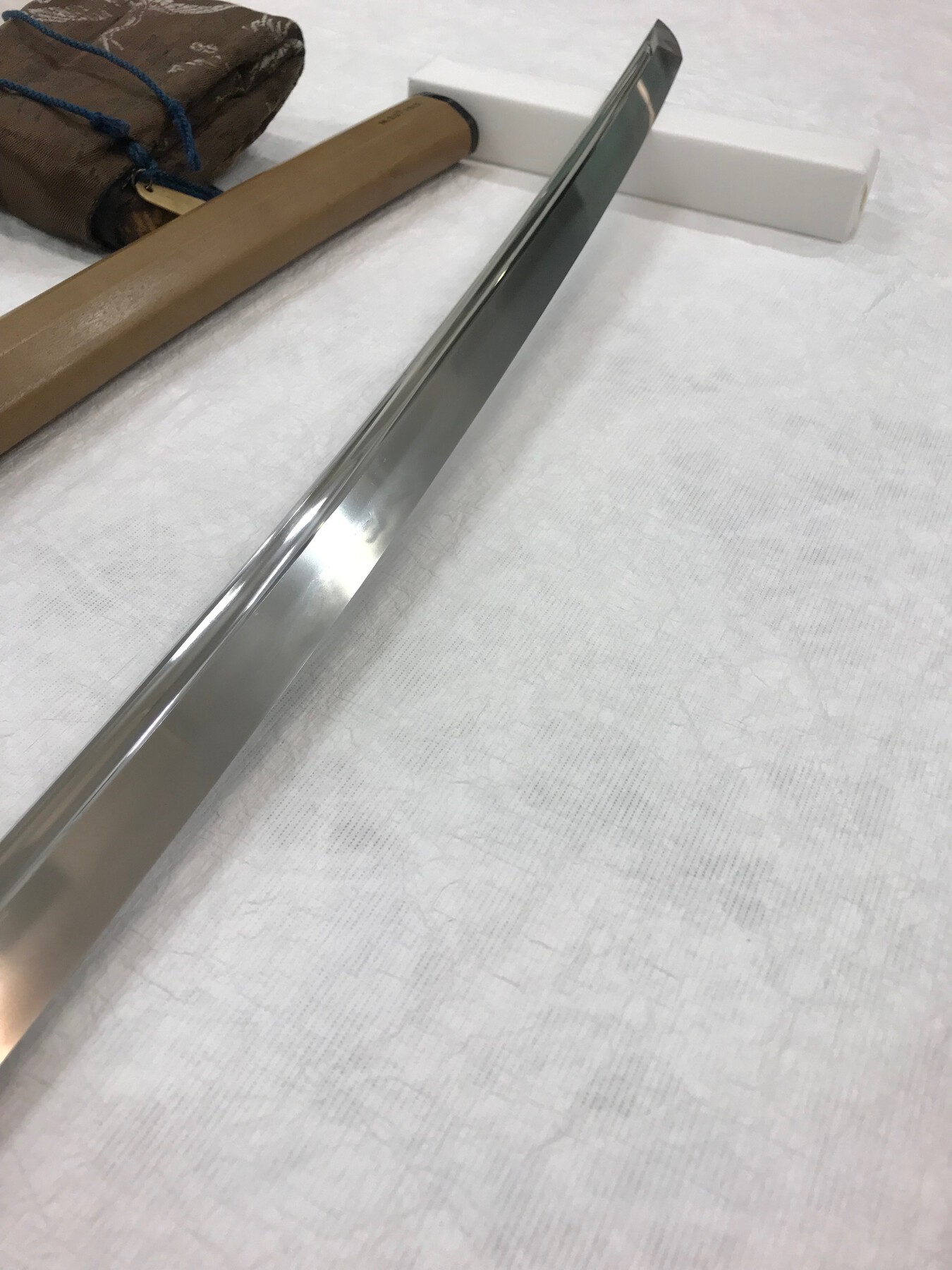
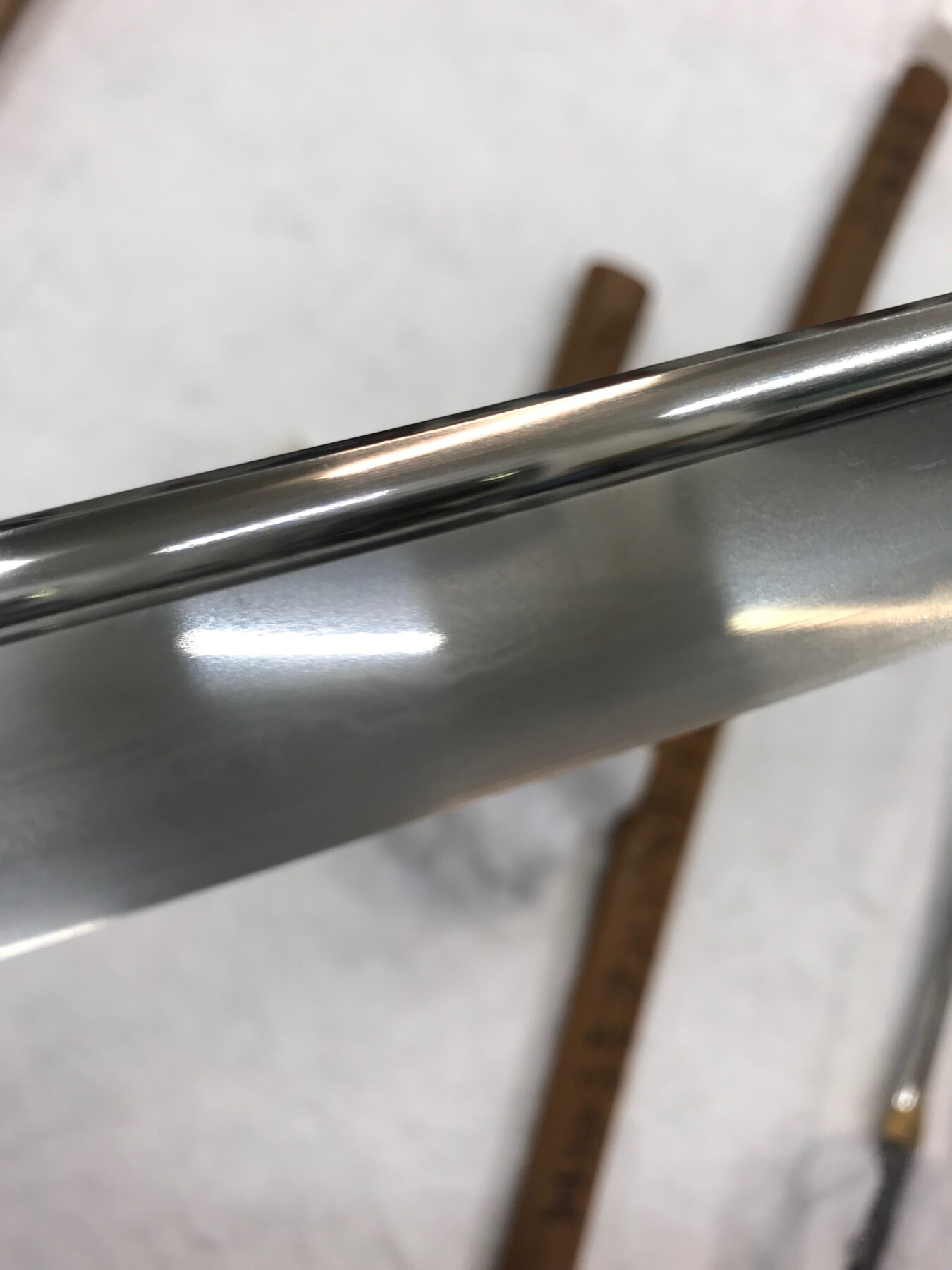
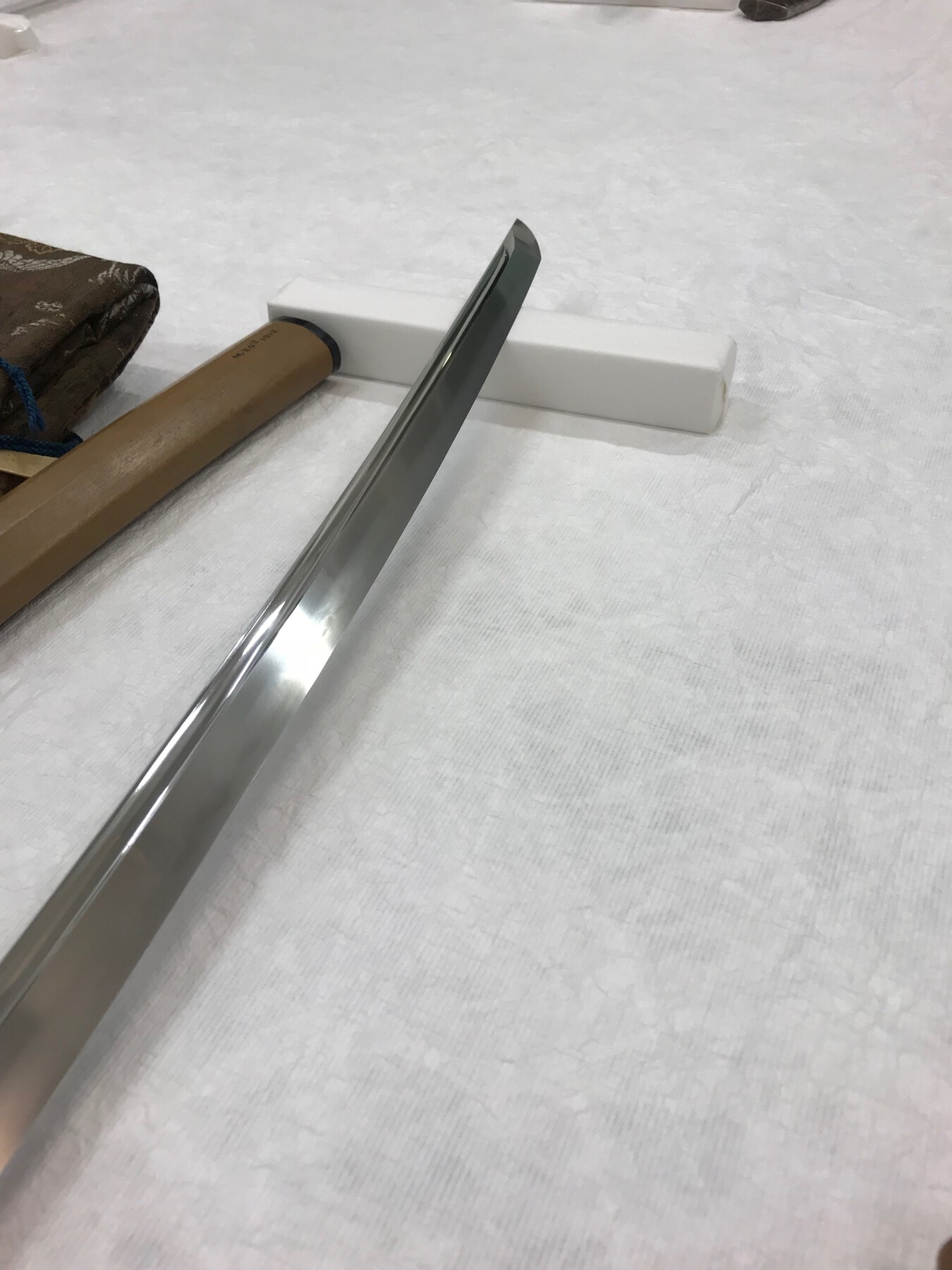
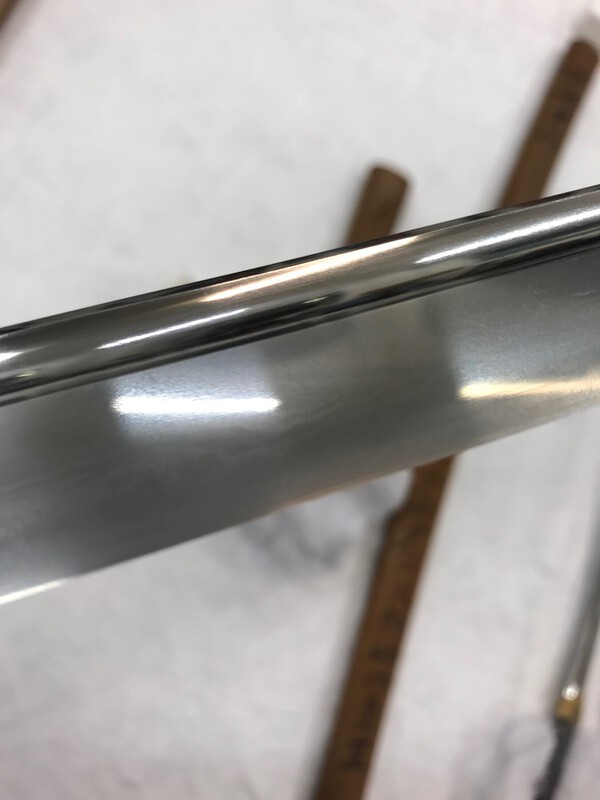
Hi Geraint Some more pics of the Masamune. I did not take too many but recorded a couple of short clips, which are much better for study as I could angle the blade. The shots are rather poor but you get an idea of the acitive jiba. I cannot share the clips as I have recorded some of the people, who might not want to be shown, and also are around 300MB each. But as you are in the UK, and if you are a ToKen member, may be one day you could see the blade yourself.


-
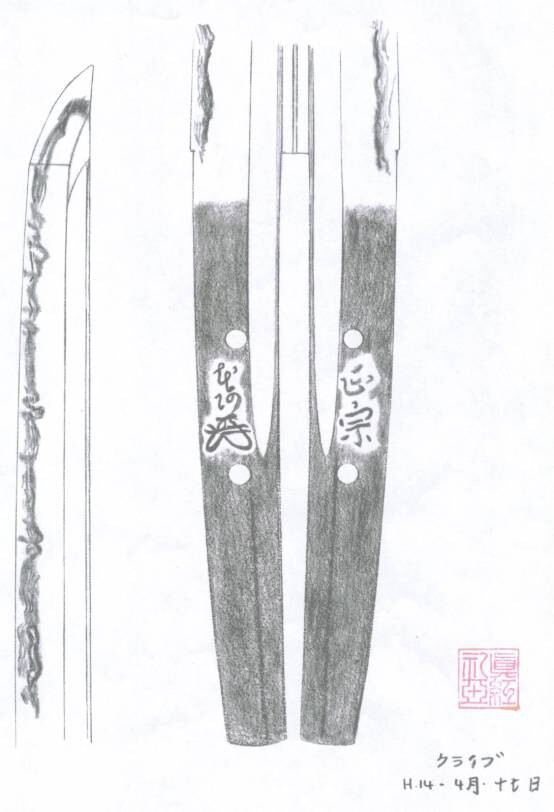
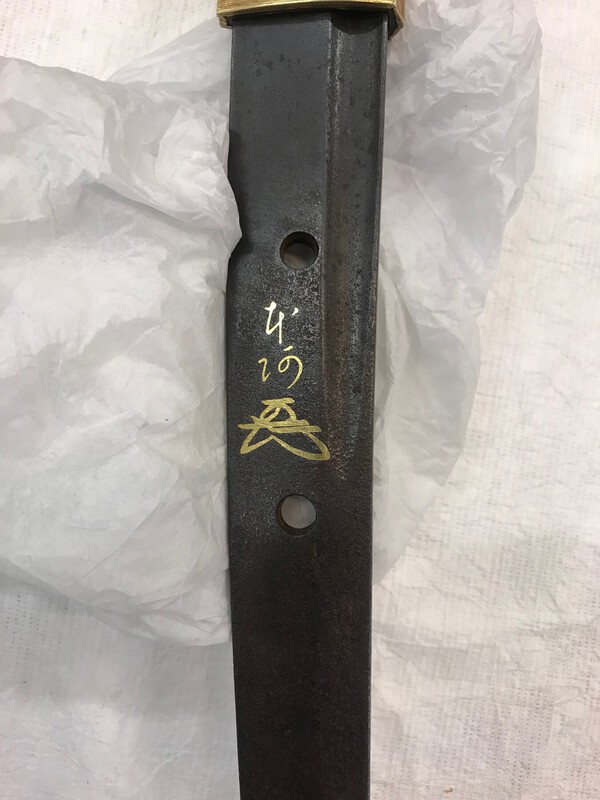
Hi Geraint So, the kinzogan Masamune in your book could be one of two blades which circulated in the UK, which I know a bit more of: a) the V&A blade above, which to me seems like a Masamune due to the vivid nie and plentiful chikei in the blade. It has the chikei, sunagashi and kinsuji combined with fine hada typical of a top Soshu work. Also, the Honami who adorned the nakago with his kao is the highly respected 12th Honami head, Honami Kojo (1643-1710). He is deeply trusted and his judgements are upheld by the NBTHK; b) potentially the blade which Darcy bought, but despite all the paperwork and reputed Inaba/Tokugawa provenance, is not likely a Masamune. More likely a later replica. You can find it here and it was indeed in the Festing collection https://yuhindo.com/masamune/ I think the tanto you mention is believed to, possibly, be by Sadamune (I seem to remember that Tanobe sensei thought as much). Clive’s fuller description of the V&A sword is included in our UK to-ken register, which Clive maintained prior to his retirement and I include it herewith: UK Sword Register. No. 56 TYPE: Koto katana Nagasa: 72.0 cm Moto-haba: 3.1 cm Saki-haba: 2.0 cm Sugata: Hon-zukuri, a graceful tori-zori, chu-kissaki, mitsu-mune. Jihada: A prominent and flowing itame-hada with mokume and abundant ji-nie forming chikei. Hamon: Fine nie-deki, notare-midare with some gunome like inclusions, profuse sunagaeshi which spills over into the ji in places and kinsuji. The boshi is slightly midare-komi with very little kaeri. Horimono: A bo-hi on both sides that finishes in the nakago between the two mekugi-ana. Nakago: Suriage by probably 3 or 4 cm and machi-okuri, 2 mekugi-ana. Kiri-jiri, faint kiri yasurime are just visible and the bo-hi finishes in a pointed end. There is kin-zogan mei on the sashi-omote MASAMUNE and on the sashi-ura HON-A with kao. This sword has a robust sugata that retains its elegance in spite of the suriage. Both the hamon and the jihada reflect the nie dominant hataraki, which together with the large itame-mokume-hada and mitsu-mune, associate the sword with old Soshu-den. The shape is both graceful and strong whilst the bo-hi provide the sword with a balance that makes it very easy to handle. It is in fine condition and all details are easy to see. The nakago has a Honami kinzogan mei (gold inlay inscription) which attributes the sword to the famous Masamune of the late Kamakura period. (the inscription may be by Honami Koson Tadayoshi, the 12th master working between 1662 and 1679). As the sword has no modern Japanese authentication, it is impossible to say whether the attribution is correct or not. However, it does appear to be fine old Soshu-den workmanship, but as we know, swords such as this were heavily faked throughout sword history. It is also difficult to believe that it could have been taken out of Japan in the Meiji period by a non-Japanese. (it was the property of Alfred Dobree, an active collector in the early 20th century, who donated it to the Victoria & Albert Museum in London). It is well known that Masamune is considered to be the most famous of all Japanese swordsmiths and is usually thought of as being the founder of the Soshu-den style of swordmaking in the late Kamakura period. This style was greatly influenced by both Yamashiro-den and Bizen-den but is quite distinct from them. As Japan was under threat from a third Mongol invasion (two had already taken place in 1274 and 1281) the Kamakura shogunate encouraged the production of sturdier swords to combat this potential threat. Based at the capital city of Kamakura in Sagami province (Soshu) the swordsmiths fulfilled this need and Soshu-den was founded. It is considered that Masamune’s teacher (possibly his father) Shintogo Kunimitsu produced the first blades that could be called Soshu-den, but this was further developed and refined by Masamune who attracted many students from all over Japan. The ten most famous are known as the Masamune Jutetsu.
-
Ko Uda Spectacular Example
Gakusee replied to Vermithrax16's topic in Auctions and Online Sales or Sellers
Jussi, if I am not mistaken, almost most Uda Kunifisa recognised by the NBTHK or Bunka-cho are signed, hence there is little left to the imagination. Kiril, I have identified two mumei blades, one a Juyo from the early 1990s and the other one in the Kanto Hibisho but seemingly not a Juyo (yet?). Given that the latter is in volume 2, it must have been written about by Honma sensei also in the 1990s. So, we cannot speak of mumei Kunifusa going Juyo with any “reasonable frequency”. As to more generic, unnamed or unattributed, Ko-Uda, these are indeed rare lately but there was a 2018 Juyo blade ascribed only to Ko-Uda. In fact, in the last 30 years or so there seem to have been only around 10, or thereabouts, Juyo mumei Ko-Uda attributions by the NBTHK. I might be out by a couple items here and there but the broader point stands. Ko-Uda as attribution is not frequent in the recent times. -
Bruce, there is absolutely no confusion here. What some, the more cautious of us, are saying is: do not display the blade for an extended period of time in a cabinet. Instead, store it in its shirasaya with the other precautions mentioned and take it out only occasionally to study. So, very clearly some of us are saying not to display in cabinet but store properly. Not unless the cabinet is watertight and dehumidified as in museums or high-end dealers. Now, of course if you live in the Sahara, you have no issues. But with high humidity or even vacillating humidity, one has an issue when storing.
-
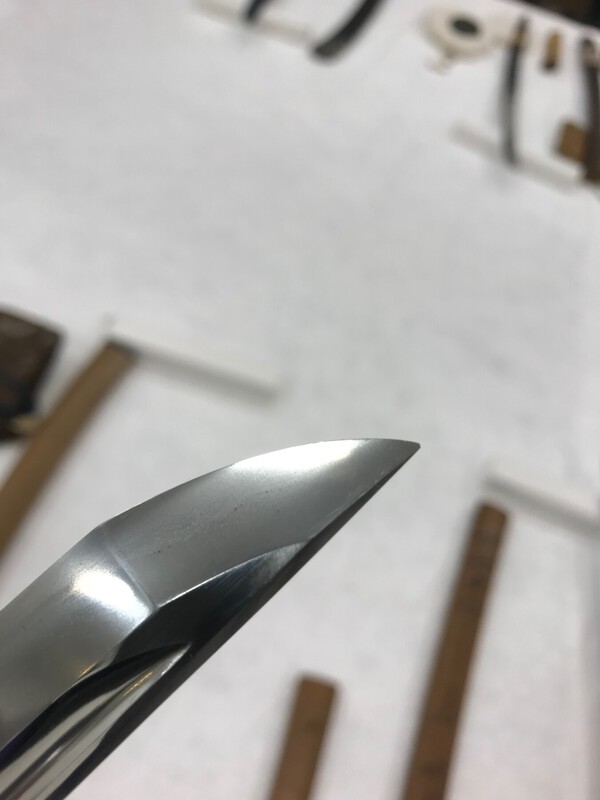
Geraint During one of the small-circle visits we organised for our members at the ToKen Society, 10-12 of us had the opportunity to study that Masamune at length. Below are description and oshigata by Clive Sinclaire and photos by me. Nagasa: 72.0 cm Moto-haba: 3.1 cm Saki-haba: 2.0 cm Sugata: Hon-zukuri, a graceful tori-zori, chu-kissaki, mitsu-mune. Jihada: A prominent and flowing itame-hada with mokume and abundant ji-nie forming chikei. Hamon: Fine nie-deki, notare-midare with some gunome like inclusions, profuse sunagaeshi which spills over into the ji in places and kinsuji. The boshi is slightly midare-komi with very little kaeri. Horimono: A bo-hi on both sides that finishes in the nakago between the two mekugi-ana. Nakago: Suriage by probably 3 or 4 cm and machi-okuri, 2 mekugi-ana. Kiri-jiri, faint kiri yasurime are just visible and the bo-hi finishes in a pointed end. There is kin-zogan mei on the sashi-omote MASAMUNE and on the sashi-ura HON-A with kao.



-
Ko Uda Spectacular Example
Gakusee replied to Vermithrax16's topic in Auctions and Online Sales or Sellers
Bob, sounds exciting and well done for the great judgement. Would love to see it. by the way, not many people think that many ana are a good thing. Sometimes multiple ana might work against you -
Geraint, I have a suspicion I know which one it is and its whereabouts, that is why I am asking. There is a Honami-kinzogan Masamune in the V&A, which looks very good and likely Masamune. I have examined it and have a video of it
-
Geraint please upload a photo of the Masamune with the kinzogan and the nakago of that blade. thanks
-
Thank you, Geraint!
-
Thank, Geraint. Care to show us the index/some plates? Indeed, there used to be big and affluent collectors in the UK in the 19/ early 20 century. Some of their items were donated to museums but some were sold in auctions. I have noticed that various items had ambitious attributions and were frankly not legitimate but many others seemed OK.
-
I am in the same camp as my US namesake Katsujinken: I gently oil the blade, store it in its shirasaya which is inserted in shirasaya bag, which in its turn goes in a ZCorr rifle protection bag (VCI coated) with two 1-kg desiccant gel bags placed on top of the ZCorr bag, all of this in a gun safe, with a dehumidifier constantly running on (maintaining a humidity of 45%-50%) in the sword room. Might sound like an overkill but the value and age of the swords I am dealing with makes the above a no brainer.
-
Lately there have been numerous pseudo big names on Bonhams which look just about possibly right but actually merely so-so. I have looked at various tosogu with famous craftsmen's signatures chiselled on the back but average or mediocre work on the front. So, just because something is being sold by a large auction house, it does not mean that it is legitimate or authentic. Also, even if an affluent collector of yore had previously owned it, that also would not be a guarantee - there were plenty of 'duds' even in the Walter Compton collection, let alone lesser collecting demigods. One, therefore, needs to be sceptical, analytical and discerning when pursuing big names, especially when they seem under-priced. Probably the only provenance I would take unquestionably would be the Museum of Sword Fittings, which dispersed incredible items at not exorbitant prices and even though they were often not papered, they were genuine and highly valuable. Dale, my vision is far from 20-20: in fact, I have both myopia and astigmatism, but at low dioptrical measurements and easily corrected with glasses. But I was talking about the 'proverbial aesthetic eye of connoisseurship' that Ford also mentioned above. You took my words literally, instead of as a constructive didactic suggestion. Perhaps you need more time and more exposure to items, and that is fine. Indeed such a journey takes decades and numerous instances of learning and appreciation generously shared by people. I have been very fortunate to have had such exposure reasonably regularly prior to the Covid-19 restrictions and some very patient teachers. Anyway, we are lucky to have Ford share his knowledge and insights with us and we need to learn as much as we can from him and others. And we should continuously train our eyes.
-
Dale, it is not about pleasant or not, surprised or unfazed. You need to train your eyes more in order to recognise: - quality - execution - chiselling / mei strokes etc Admittedly, my image is rather low-res and not very good quality because it is a photo of a photo from ToBien 545. However, you should be able to discern in the original the high level of intricate detail carved (remember, this is a kozuka and look at the tassels, the robe, the eyes, etc), the smoothness of the lines, the feeling of depth and three dimensionality, the colour palette and so on. I am not even going into the mei and kao which you need to compare side by side for size, inclines of strokes, proportion of the elements to each other, placement etc.