Gakusee
-
Posts
1,942 -
Joined
-
Last visited
-
Days Won
22
Content Type
Profiles
Forums
Events
Store
Downloads
Gallery
Everything posted by Gakusee
-
Jussi, I think we know your preference for large dimensioned blades ...;)
-
The design could and do trespass in the nakago area sometimes. Even one of the greatest did it sometimes but clearly much more skilfully as can be seen by the tagane work. Clearly the fake tsuba above are emulating some of his famous design features and I do admit that the elevation of the leaves is excessive here. What should have been highlighted above instead are the sloppy execution, blunt lines, lifeless replication caused by casting, the crudeness, etc.

-
 I would suggest to leave it as is.
 -
Hi Yas, quite the opposite actually. Many of your posts are informative and educational, eg #50, 60, 71, etc. In fact, I have commented positively above on what you are doing. However, many of the examples in this thread are too obvious, even for the novice tosogu person such as myself: they are too crude, the casting bubbles or fissures are too obvious, the lines are too dull/blunt and clearly an artefact of lousy, sloppy and lazy casting. Where your posts shine best is when you highlight non-obvious imitations or fakes, which only a more experienced eye could pick. You had a few posts in which eg the tiger looked very good but some of the lines in your circular highlights were just a tiny bit blunt rather than crisp as should be when done with tagane. Or in one of your posts you had circled some areas and one needed to look carefully in order to notice that there was a bit of “bleeding” of the gilding in an otherwise acceptably decent piece of work. That is all useful and what people should be becoming attuned to and looking out for. Also, in many of the posts the explanations are missing - why, what, how? Just low-res pictures of low-quality trash..... Please do not take this personally but constructively. It does not apply only to you but also Dale’s posts, by the way. That plethora of eyesores does not help. It is better to pick out one or two masterly examples of a fake and dissect it: eg “ hey, NMB, look at the hitsuana; look at the sanmai method; look at the way the flower is chiselled; look at the cast post of these menuki; etc etc”. I have always been a supporter of the maxim: “less is more”. Again, please keep up the good work - we appreciate it , are grateful for it and salute it.
-
Would it please be possible please to revert this thread to the less obvious fakes? Not these crude imitations (eg the guilt brass monkey and wasp above) of tsuba-like objects but actually good-quality tsuba where a discerning eye notices something is amiss? Otherwise, you will keep flooding this thread with shocking examples but we as a forum shall not necessarily be learning, progressing, etc. Thank you.
-
I second the recommendation of Massimo. He is a lovely, friendly gentleman and really helpful. I have been to his home, and treated with such great hospitality and warmth. He is an accomplished polisher and I have seen a number of certificates of merit issued by the NBTHK for swords he has polished. For a beefy, late tanto like this one, definitely try Massimo. He lives in not far from Firenze.
-
Customs wait for antique arriving in UK
Gakusee replied to shanegt's topic in General Nihonto Related Discussion
Well, you would not believe it but the issues I had in the past with them were: - once they registered the parcel on their systems in the name of the sender and not mine. So the recipient was the sender according to them (data input error) - once they sent the letter to the wrong address to some neighbours who do not know me (so imagine the poor people receiving some letter about something they don’t know about related to a person they don’t know and with the wrong surname - all they had was Michael but still that did not help). Again data input error - my surname was wrong and the house number was wrong. In both these cases the senders had done an immaculate job including my correct data (names, address, mobile etc) and describing the contents beautifully and including the correct codes - however, of course, Customs or Parcelforce never call you or email you in the first instance. The first comms are always the letters. If the letters end up in the wrong place then you could wait many weeks. Once you have tracked to where exactly in the chain the parcel is, then you can call various people and exchange emails from that point onwards. This is an email that works for valuable items: pfw-ccb@parcelforce.co.uk Good luck. -
Customs wait for antique arriving in UK
Gakusee replied to shanegt's topic in General Nihonto Related Discussion
What they did with me is they sent the letter to another address and in the wrong name. Not the item itself but the customs charges letter, which unlocks the process. -
Customs wait for antique arriving in UK
Gakusee replied to shanegt's topic in General Nihonto Related Discussion
I have recently been through this. With two swords (one coming from the US and one from Japan) and a fuchi-kashira set. with the tracking number you should be able to see where exactly it is (in the UK or not, in customs, in the Parcelforce distribution center or the local distribution depot). if you notice that it has been in customs for more than 5-6 days, call Parcelforce. It sometimes happens, though rarely, that they send the card or letter with import VAT charge to the wrong address. Until you clear that, you will not receive the item. So, you can call them, they ask for reference number, your name, the sender’s name, your address per the sent items paperwork. If it all checks out, they tell you on the phone what the charge is and you can pay by phone or on the web. While on the phone with them, make sure to obtain the UK Parcelforce reference number (and not the UPSS or EMS reference number). -
Well done, Georg, what a journey. If Saito san polished it, it must be stunning like a jewel now. He is one of the very-top polishers currently. If you leave it there, yes it is another year (as it might get exhibited too) but probably worthwhile. In this hobby unfortunately sometimes years pass before we see our treasured possessions. Frankly, even with “only TH” people in the know could judge the quality and understand that it is Juyo level. And if you do not intend to sell it or brag around that it is Juyo, then you know it is the same sword whether it is TH or Tokubetsu Juyo. This is one of these rare stories of serendipity that make people here happy and hopeful. Please continue sharing with us. Thank you.
-
Well done, Georg, congratulations. There were some doubts at the beginning but these got majorly dispelled when Tanobe sensei looked at it, and as we started looking at it more closely with examples of that period. Now, with Tanobe sensei’s blessing and the NBTHK shinsa attestation, I think you should aim for Juyo later this year. But please try to get it polished if possible before then. It is very tight timing-wise and you really need good friends in Japan who can pull some favours for a last minute squeeze in.
-
An alternative to the Den Tametsugu blade
Gakusee replied to Brano's topic in General Nihonto Related Discussion
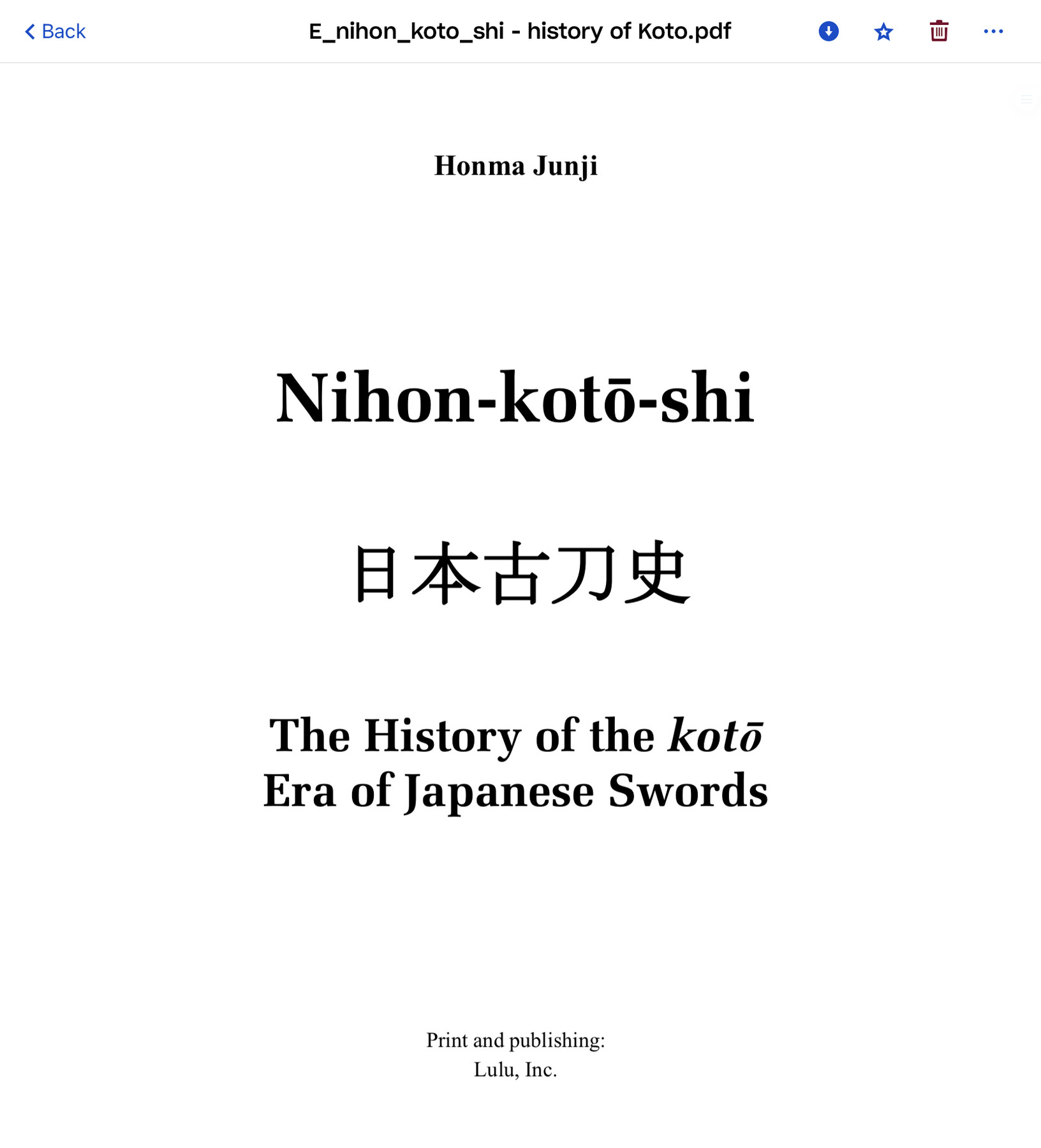
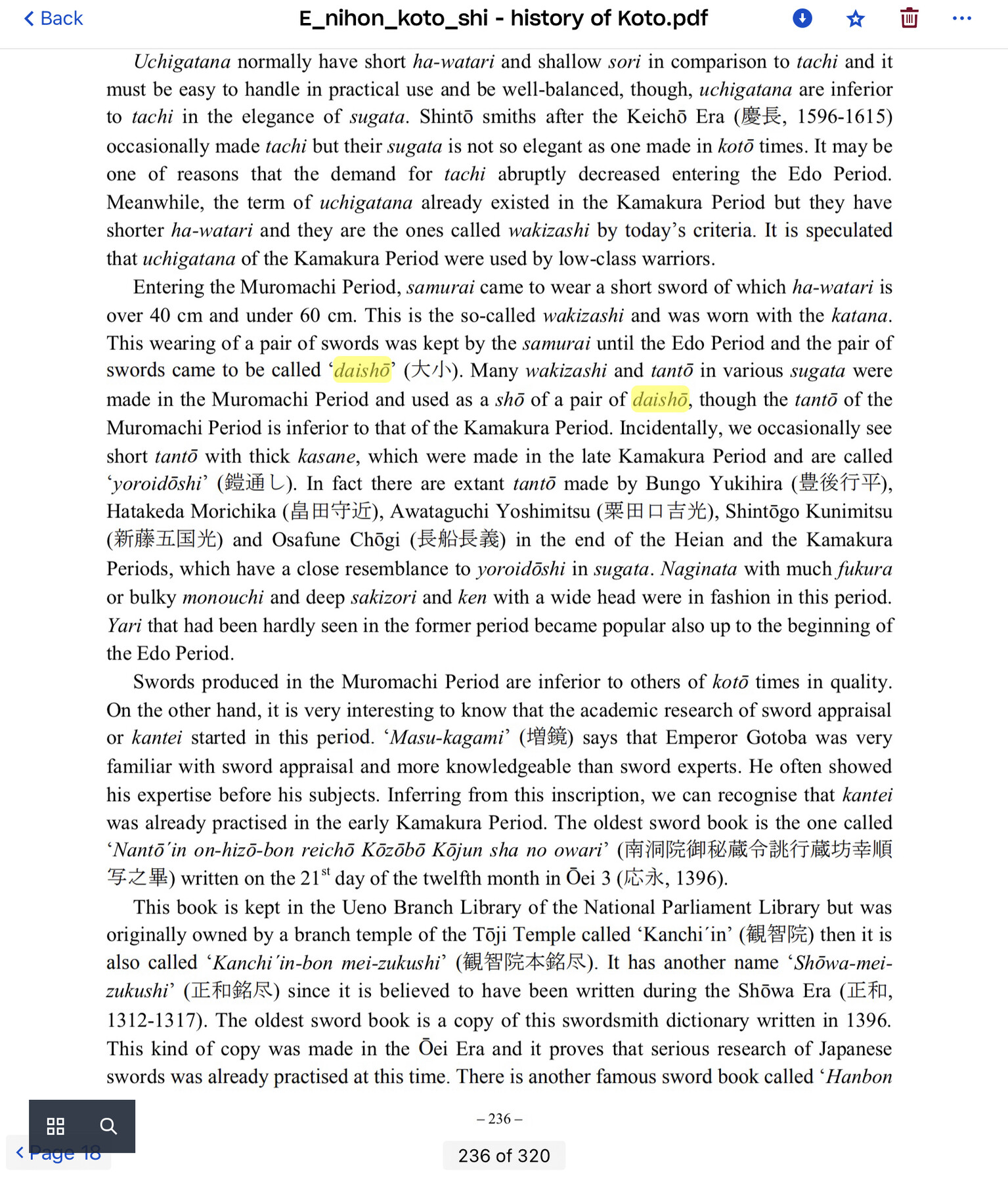
Jacques Thanks for the corrections and reminding us of the name of the progenitor of the doubts about Masamune, That is useful. I do remember there was a subsequent resurgence in 20th century of that vein of thought/belief, after Imamura Choga but I would need to dig it out. Why do you, however, have to be argumentative? You are not achieving anything by this but alienating people. I respect and look for thoughtful discourse rather than dismissive insults. You have knowledge and experience to bring to the forum but sometimes pettifoggingly cling on to a particular word or sentence. Please take it positively and not as an attempt by me to antagonise. I do pay attention, especially when I talk to Tanobe sensei, the NBTHK lecturers or people with extensive knowledge and collections. It is easy to be a desktop warrior, waging verbal campaigns. It is also easy to refer to 2-3 books, accepting them as canon, but it takes a broader minded person to question, interrogate, juxtapose texts with differing opinions. Every authority has something to teach us: Fujishiro, Kanzan, Kunzan, Tanzan, Nakahara, Nagayama, Yamanaka, etc etc. Of course, it is easier to understand that basing (inferring) mumei work via signed precedents is the strongest foundation for analysis. But nowadays the shinsa and others also place reliance on old (Honami usually, but also other) documented examples of the the masters - be they Masamune, or one of the students, even if these are not signed currently (or were never signed), or non-Soshu works. In other words, reliance is placed on preceding authorities who might have seen such signed examples before they were suriage, or compare to blades which have been preserved over the centuries in the various daimyo families. That is why we still have and refer to the Tsuchiya oshigata, Kozan oshigata, Imamura oshigata, Koon oshigata, Kyoho Meibutsucho, etc or in more modern times - indeed Fujishiro volumes, but also Kunzan’s Kanto Hibisho or Tanzan’s Go-ka-den No Tabi, etc. I could append documents talking about the existence of Go. And with all due respect to Fujishiro, they will be by arguably ‘greater’ experts than Fujishiro, having seen more than him and not just photocopied pictures of the mei of Kokuho, JuBi and JuBu swords available at the time. At least this how I view Honma Junji, Kunzan sensei, who in Nihon-koto-shi posits:”I conclude that Gō Yoshihiro is the most skilful smith amongst the students of Masamune and is equal to Sadamune in skill.” Anyway, this is a pointless argument and unwelcome digression from the topic at hand. The sword is beautiful and has been judged indeed by experts as Tametsugu. Understanding why the judgement has been conferred, and what the alternatives could be, shows eagerness and interest to learn. -
An alternative to the Den Tametsugu blade
Gakusee replied to Brano's topic in General Nihonto Related Discussion
I completely agree that is a bit more subtle and complicated than what I described. However what I mentioned was a shortcut to summarise that: quality in the blade leads the shinsa, alongside some specific smith quirks or signature characteristics, to a specific smith out of several possibilities when a blade is mumei and belongs to a particular group/school/ period. Time and again I have heard how Tanobe san has said this blade could be this smith or that smith (working in a particular style or during a certain period) and needs to study it to figure out why precisely a particular smith , or how a blade was 20% Go and 80% Sadamune (or something along these lines). So, when the obvious conclusion is that a blade is top Soshu, then one really needs to then delve into what is going on as unfortunately some of the work there is interchangeable (top Yukimitsu if a bit wilder could be confused with Masamune, or Shizu with average Masamune etc). There was a fad in the mid 20th century into the 1970s-1980s to question the existence of Masamune and I suppose other top Soshu. That does not surprise me. I am not a blinded and mesmerised Soshu aficionado, who proclaims Soshu is the best thing under the sun and everything else is blasphemy; even though in fairness the top pieces I have held (some Masamune, some Chogi and even a Go or two) have been breathtaking. So I do not buy the theory this guy and that guy did not exist. The saying about Go and the ghost was simply because for the commoner it was completely out of the question to see a Go, since they were / are relatively rare. Fujishiro is entitled to his own views and opinions, and they were informed by the blades he had seen and /or polished. Things have moved on since then and they keep moving. That is why it is important to keep studying, keep reading, talking to experts (such as Tanobe sensei, the NBTHK when Japan reopens to foreigners, to some of the knowledgeable dealers in Japan who are also collectors, to other collectors and advanced students etc). If we rely only on Fujishiro or Hawley or Afu’s translation of the Koza, we will get far but not progress beyond a given level. -
An alternative to the Den Tametsugu blade
Gakusee replied to Brano's topic in General Nihonto Related Discussion
Jacques, Fujishiro does mention Go Yoshihiro (Koto volume page 129, page 199) but does not show any nakago as there are no signed Go, while his book is a book of nakago and mei. The reality is that shinsa judgment is broadly an assessment of school + period first and then after that, quality determines whether they assign it to a grandmaster (like Go or Norishige) or not (like Sanekage or Tametsugu) and which smith precisely (given some more prevalent features -
JH Lee, in the narrow confines of a castle or inn, there is no space or time for kata, at least those practised with eagerness by the young iaidoka of nowadays. The wak or kodachi were spare weapons for a palanquin, bedroom, high-level visit etc etc were the longer blade was not permitted or convenient to have on oneself. Of course you can kill an opponent with a short wakizashi - slashing through the carotid, stabbing in the chest or the head etc. As to your blade, the signature is the on the nakago side that indicates it is not by Osafune Kagemitsu, wakizashi were not in vogue at the time and not made, the signature itself is definitely not one of the Osafune sandai master. As to slenderness, I have a close to ubu kodachi by one of the Osafune grandmasters and the haba is close to what you are describing.
-
Recommendation for polish?
Gakusee replied to mgraffam's topic in General Nihonto Related Discussion
Bob Benson and Ted Tenold (legacyswords.com) Both can be found online. -
Kudos for the efforts, perseverance and generosity, Jussi!
-
An alternative to the Den Tametsugu blade
Gakusee replied to Brano's topic in General Nihonto Related Discussion
For fun, Jacques, for fun..... sometimes we take things too seriously.... or we are bored.... or we try to understand “ why den? Why not Tametsugu without ‘den’ and what could the alternative be? “ -
JP, a Hozon paper is often all some older / top collectors in Japan bother with. It has served its purpose to verify what the owner thinks and beside that, if the owner is confident and experienced, the attitude could be: “why bother / I know what I have and I know it is outstanding.” To be honest, oftentimes it is vanity and ego which motivate us, sometimes it is a monetary imperative. There is another aspect: sometimes Japanese collectors are secretive and do not wish others to know what they have. And since the NBTHK publishes the names of the submitters, and in the past - of the owners, this could become uncomfortable to some people. So they prefer their treasure to be “secret”, unpublished in the Juyo/ TJ Zufu. Some years ago, I decided to have few but decent blades. That necessitated culling my already modest collection of 4-5 items to 1 only, before building it up to the current 3. It all depends on what collectors want and like.
-
JP, why don’t we just go all-in for a papered top example like that https://yuhindo.com/shimazu-ichimonji-katana/? Better to save some funds and acquire something which people have vetted and is understood to be the real thing, as opposed to a vapour of hope shrouded in chimerical deceptions. I have heard a few times that some people would rather have one sword (a collection of one outstanding example) as opposed to numerous average or below-average examples. And if one does the maths over several years and the funds expended on multiple swords and multiple tosogu, etc , then it actually seems more achievable than at first.
-
Last night, rather than sensibly going to bed, I went through the Compton catalogues into the early hours of the morning. I could not find that specific sword but was not overly thorough. Found lots of big names across the three catalogues and some with high prices that went for big sums. But many of the big names had modest evaluations probably because of the lack of recent papers and only sayagaki present. By the way, does anyone have the auction results for all three days of the Compton sale in 1992? I discovered that I only had one of the days. Thanks.
-
Well, we are fortunate that there are plenty of zaimei Fukuoka Yoshifusa left, to which we can compare the mei. Here there is plenty of tang erosion, but the “fusa” is clearly way off both the early blocky version and the later more cursive version of the smith’s mei. I also think his hamon usually has more kinsuji and sunagashi than in this yakiba here. This one reminds more, in terms of overall impression, of a later Bizen sword, given its plentiful togari. I would say around a hundred years later, towards Oei. At least the 3 genuine Yoshifusa I have seen (held two of them) were much richer in hataraki within the hamon. Compton had a lot of masterpieces but his collection was vast. There were gimei in there. If you browse through the auction catalogues of his collection sale, you will see various duds, alongside the gems. This could be potentially one of those..... A genuine one, if you are extremely lucky, will set you back more than well over ten-twelve times the price that this one was bought for. This one went at the price of a mumei Yoshioka wakizashi or mumei Ishido sword. The Juyo ones I am aware of trading recently were between $150-200k, the TJ and JuBi ones at the DTI were at $300-400k.
-
Great Jumonji yari added on Aoi
Gakusee replied to Fuuten's topic in Auctions and Online Sales or Sellers
I agree with the posts above. Yari are difficult to forge and jumonji are at the top of the difficulty range. Add to that the difficulty in polishing them. Add to that that they were considered utilitarian weapons, not to be preserved and cherished likes swords but to be brutally used and abused in warfare = not that many examples in great condition or by great masters remain nowadays. Size does not matter really - someone above was complaining about the size. In fact, the Aoi example is quite standard sized. I recommend those interested to have a look at the Knutsen book about pole arms. Also, it is the complete package with koshirae. In the U.K. I have seen worse examples commanding similar prices. -
Great Jumonji yari added on Aoi
Gakusee replied to Fuuten's topic in Auctions and Online Sales or Sellers
I also like it, Axel and do not think it is unreasonably priced. It comes with nice koshirae too. The thing is, polearms are underloved in Japan. They are too bulky with their poles and koshirae and there is not much “blade” in the package. Dealers in Japan have complained to me that no one wants yari and they have shown me drawers full of yari...... Of course, for the bigger names, eg Muramasa, there is always demand. -
We really ought to hit the books more...... it took me a bit of time to prove the point Christian S was contesting....