Shugyosha
-
Posts
2,952 -
Joined
-
Last visited
-
Days Won
12
Content Type
Profiles
Forums
Events
Store
Downloads
Gallery
Everything posted by Shugyosha
-

Is this blade made by Kawachi Nagakuni?
Shugyosha replied to Freddie's topic in Translation Assistance
Even if all details were clear, I think I would say look for something else as unsigned wakizashi aren’t very desirable and it might be a hard sell down the line. I’m not sure that the (old) papers to a minor and little-known smith (he doesn’t show on an online search) add anything to its value other than to confirm it isn’t a fake. Is there an asking price or are you expected to make an offer? -
Is this blade made by Kawachi Nagakuni?
Shugyosha replied to Freddie's topic in Translation Assistance
Looks more like Inaba to me, but it is Nagakuni. See here. http://www.jssus.org/nkp/kanji_for_provinces.html -
Do Shoshin and Gimei refer to the sword or mei
Shugyosha replied to Freddie's topic in General Nihonto Related Discussion
Guido, If you’d written it in flashing neon letters 10ft high there would still be people wanting to believe the opposite of what you’d said. -
Do Shoshin and Gimei refer to the sword or mei
Shugyosha replied to Freddie's topic in General Nihonto Related Discussion
Freddie, it’s not that clear, but, what I believe this is saying is that the Mei on the sword will be recorded on the torokusho irrespective of whether it is genuine or false. It does not express an opinion as to whether it is genuine or false and so is not a certificate of authenticity. No one who has been around this hobby for any time treats the torokusho as authenticating a sword’s signature. -
Try something like WD40 to see if that will loosen it.
-
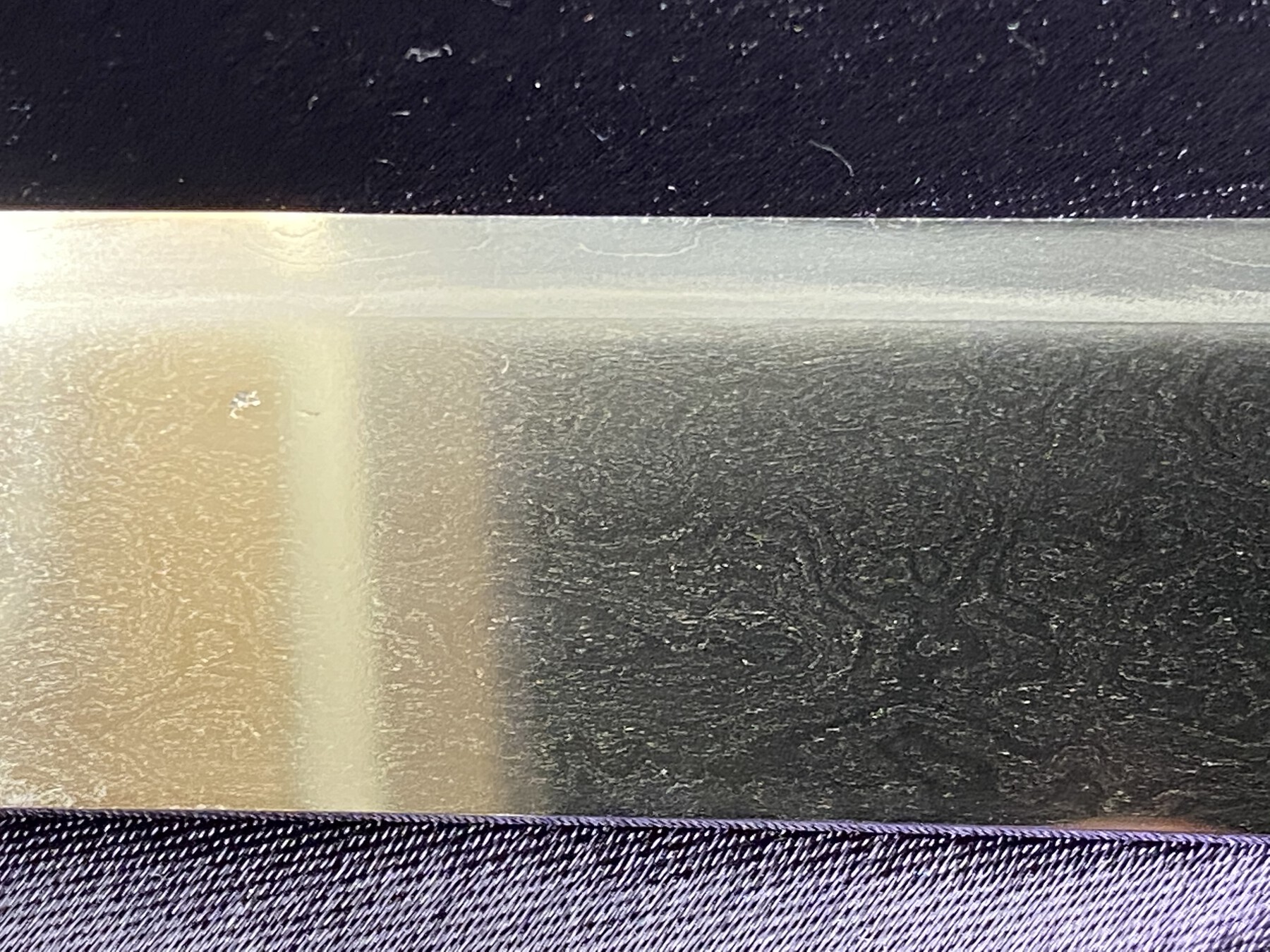
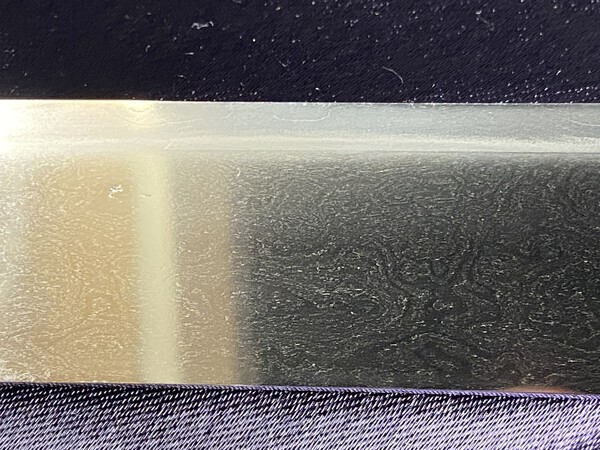
Jack, What are the dimensions of the blade in terms of width and thickness at the machi and at the yokote? There's no rush to come to a conclusion - use it as an opportunity to learn. As Geraint says, once things start opening up more in the UK maybe someone can have a look at it for you. The tight itame hada is certainly more of a shinto thing though there were koto schools that forged in this way but they tended to be schools in Yamashiro or linked to them- see Rivkin's comments above. Here's an example of the hada on a Mihara blade:
-
Hi Max, From right to left: Kanteisho - appraisal paper. Length - a little over 1 shaku 4 sun 8 bu. One wakizashi, unsigned (Uda) - this is the attribution. Two columns of standard blurb including designation "Hozon Token" - worthy of preservation. Date of shinsa - Heisei 21st year, August 12th. More information can be found here: http://www.nihontocraft.com/japanese_sword_papers.html Enjoy your new sword!!
-
There were many later blades that were made to hark back older style blades, including looking like being o suriage so it may be shaped to look like an earlier blade. Certainly, there’s more to see in the second set of photos than the before but I can’t see Rivkin’s utsuri though his eye is sharper than mine....
-
Hi Pinchbeck, Welcome to NMB. Honestly it’s hard to tell from the photos. There’s not a lot of sori and a fairly tight hada, verging on muji hada, and that would push my guessing towards later than koto at this point and maybe into the shinshinto period. If you can post some detail photos I’m sure you’ll get some better answers.
-
Hi Bruce, can you spin the picture round, I think it’s upside down.
-
Darcy's current tosogu listings
Shugyosha replied to Brian's topic in Auctions and Online Sales or Sellers
What Valric said. -
There's an interesting article here on the swords of the 47 ronin. It's surprising how many of the examples cited carried a short sword of what we would regard as katana length. http://www.japaneseswordindex.com/ronin.htm
-
Bonjour Gerard, Je pense que le papier est vrai. Il me semble que la couleur du papier est un peu pâle mais je pense que c’est le photographie plutôt que quelquechose de faux. Il y a des sceaux normals au coin droit supérieur et au bout de la colonne proche la photo du nakago qui apparait d’avoir son propre sceau. Il y a aussi le numero percé au coin gauche supérier avec « Hozon » la dessus mais c’est pas possible de voire le filigrane dans cette photo ou des autres petits kanji qu’on mets par les grands kanji pour montrer la véracité du papier, mais je pense que c'est le photographie encore. Est le vendeur bien connu? Regardez ici pour ce que je dis et des exemples des papiers. http://www.nihontocraft.com/japanese_sword_papers.html#japanese_sword_4 Encore désole pour le mauvais Francais. Hi Gerard, I think it’s a genuine paper. The colour is a bit pale but I think it’s the photograph rather than it being fake. There are the normal seals in the upper right-hand corner and at the end of the column closest to the photo of the tang, which appears to have its own seal. There is also the pierced number at the upper left hand corner with “Hozon” above it but it’s not possible to see the watermark in this photograph or the small kanji that they put by the large ones as a mark of authenticity but I think it's the photograph again. Is the seller well known?.
-
Hi Freddie, Go to this website and do a search on “kinai”. You’ll find a number of examples that have sold previously so pick ones with a similar design to get an idea of prices. You might need to refer to a currency converter. https://www.aoijapan.net
-
Variations of NBTHK Hozon Papers?
Shugyosha replied to quoshy's topic in General Nihonto Related Discussion
My understanding is that the name on the back is the name of the owner of the blade, or person submitting to shinsa, rather than the certifier. It's sometimes blocked out to preserve their privacy. -
I (knowingly) bought a late koto Bizen wakizashi with a gimei in a shirasaya from a US dealer and board member for $1,100 IIRC. It’s in similar condition to yours and is a similar length. I’d guess $800 to $1,200 as the ball park for a generic low end blade in a storage scabbard but it might be wider. Obviously, yours has the fittings which ups the value and attractiveness as a package a great deal. Just to repeat others’ comments, you’ve done fine and better than most on their first outing.
-
osoraku-zukuri -- are they all dummied up?
Shugyosha replied to Peter Bleed's topic in General Nihonto Related Discussion
I remember that there was one on here relatively recently which had the look of a normal shinogi zukuri blade where someone had moved the yokote to enlarge the kissaki. Can’t remember who posted the blade but it was clearly an attempt to make an osoraku blade from something less interesting. I think it’s definitely an issue. -
Ah so hoso, not Hosho - being one of the 5 Yamato schools. That was why I asked about masame earlier.
-
Luis, please don’t take this amiss, are you referring to hoso suguba? Hoso in this context meaning, thin or narrow. I think the Daikokuten horimono is a strong clue as to age but not conclusive...it could be younger, but it would tie in with the Sengo thing - early 1500s. But I think Sengo is a long shot.
-
Hi Luis, The tang has a bit of a Sengo look to it, but it doesn’t look quite right and might have been modified to make the blade more attractive. Daikokuten would be ato hori if nambokucho. He became popular with samurai in the muromachi period. I think that’s him but it’s quite worn down. I didn’t realise that Hosho tanto had a distinctive sugata. Is it pure masame hada? If not, I’d say you can discount that as an option. Sorry Luis but the condition makes it hard to say more. I’d date it as koto but not earlier than muromachi but I’m guessing.
-
Darcy's current tosogu listings
Shugyosha replied to Brian's topic in Auctions and Online Sales or Sellers
Michael, Obviously I know what Darcy’s prices are. I assumed Stephen may have done a comparison of specific similar items in order to draw his conclusion. -
Darcy's current tosogu listings
Shugyosha replied to Brian's topic in Auctions and Online Sales or Sellers
Ok, I’ll bite. Many of his items are fairly unique (at least in the West) and so it’s potentially a case of Darcy being able to set his own price. Do you have any examples you can quote? (Just so I know where to look if I get my hands on that kind of money). 😬 -
Bizen Den Sunnobi Tanto/ Wakizashi listed on eBay Auction
Shugyosha replied to Lei-Ray's topic in For Sale or Trade
It’s listed as Keicho in the header but Oei in the blurb (as well as on the tang and in the sayagaki). Oei Morimitsu is a big name smith if it’s Shoshin and most likely will pull in more punters. -
Bizen Den Sunnobi Tanto/ Wakizashi listed on eBay Auction
Shugyosha replied to Lei-Ray's topic in For Sale or Trade
You might want to amend the date in the title of the thread to match the more attractive one on the blade also. -
Showato or Gendaito? Help with nie nioi
Shugyosha replied to Infinite_Wisdumb's topic in Military Swords of Japan
Hi JP, sorry comment was directed to the Jesse: I thought he was looking at buying and was weighing what was on offer. I agree with your comments re the hamon but this isn’t a pool that I would fish in as it’s hard to know what you are getting. Even genuine gendaito made this era can seem vague in terms of their attributes and it’s easier to err on the side of caution. Jesse, if you are looking for tradionally made blades, I’d suggest you go for something that has obvious known qualities. It’s easier to learn that way than where hamon and hada are vague - even Kantei competitions in Japan use clear cut examples.