

Shugyosha
-
Posts
2,959 -
Joined
-
Last visited
-
Days Won
12
Content Type
Profiles
Forums
Events
Store
Downloads
Gallery
Everything posted by Shugyosha
-
I have no idea and need help please in Translation
Shugyosha replied to No Clue's topic in Translation Assistance
Nikki, In non-nohintoese that means the hardened edge, the point and activity above the whitish area at the edge but below the ridge that runs the length of the blade. -
katana Help me identify the age of my katana!
Shugyosha replied to Thedarknerd100's topic in General Nihonto Related Discussion
+1 -
I’m in the Tenbun camp. Niju something nen?
-
Or the guy who drew up the paper. 😬
-
Hi Howard, It doesn’t look like a genuine Japanese sword to me from this photo. Can you post any others? What does the description of the sword say?
-
Japanese style reproduction friend won’t accept it!
Shugyosha replied to Bjj's topic in General Nihonto Related Discussion
Sounds like a candidate for shinsa to me. At least he’ll know the answer then. 😬 -
Hi Alex, Nagamitsu - 長光
-
Sorry Alex, I'm gonna have to stop looking at this stuff on my phone and late at night.
-
The blade has a Seki armoury stamp, the smith’s name is Sadahide and the date is Showa 17 - 1943.
-
I’m not honestly convinced of the “sai” in the Aoi Art example. Ray, yours looks closer.
-
Maybe Tetsushinsai. https://www.aoijapan.net/tanto-tetsushinsai-minamoto-yosikazu-tsukurumeiji-1-nen-10-gatsu-hi/
-
Nice write-up Dale!
-
As Geraint says the sugata is unusual and the patina on the tang is quite dark so maybe the bidders are thinking it’s a koto nagamaki naoshi blade and seeing dollar signs.
-
...but maybe not - Hawleys doesn't have anyone signing with that kanji. Here's the best I can do with the rest the first kanji might be the "Un" of Unshuu but might not be. The majority of Kanehiros were working in Mino. 雲州 ? 島住意 ?金宏作 So Unshuu something shima ju Moto or Nori Something Kanehiro saku. Edit: agreed on the "hiro" so your suggestion is better.
-
Hi Dan, I think it's this hiro: 宏 - there's something that looks like the pot lid radical at the top on the left.
-
Hi Charlie, see this thread:
-
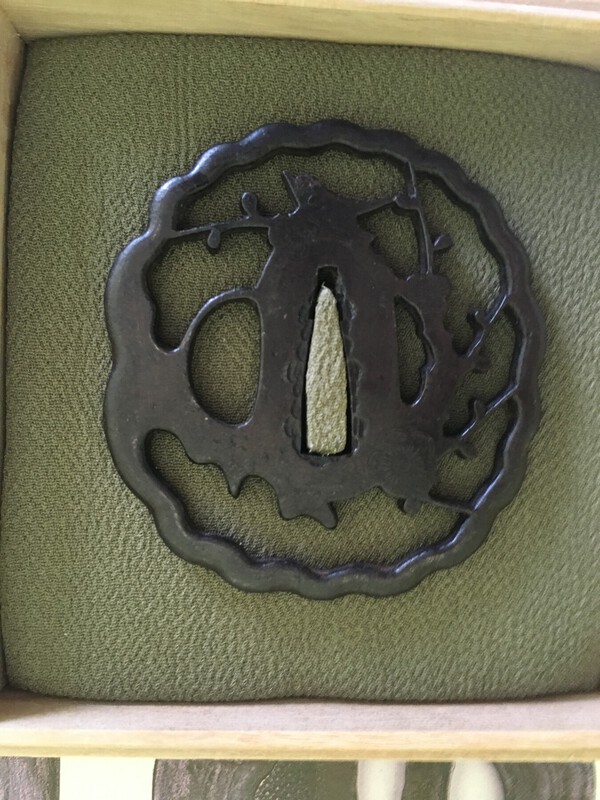
Here's a similar design, plum blossom and bush warbler which I think is Hayashi, but another design found in Akasaka tsuba:
-
Here is the entry as promised:
.thumb.jpg.602d9c7d9b93f37659edd605bfdbdcc5.jpg)
.thumb.jpg.b24dc22ebb36e0b7cdc4a02232efbdbc.jpg)
.thumb.jpg.97fadcee234d38d7d62908869bcdce14.jpg)
-
Hi Tony, It's the blade that is juyo - the koshirae is barely worth mentioning - only Tokubetsu Hozon. 😉 The signature on the kojiri is 誠意 - Seii. Haynes has three of these: H08047.0, H08048.0 and H08049.0. The first one is a student of Goto Seijo (the others don't get more than an entry) and was allowed to sign with Goto in various permutations: Goto Mitsuie Seii plus kao and Goto Seii plus kao. No kao recorded in Haynes but the quality of the work on the kojiri points to Goto for me though I'm not sure if all of the metal work is by him.
-
I couldn't find an example on line.
-
I think you have that right Thomas.
-
I think the top into is signed Koma Koryu saku (based on the Inro Handbook by Raymond Bushell). I know nothing about inro but this guy looks like a big name - one example sold for £36,000, so I’m guessing that it isn’t genuine. If you google the name you’ll see that the workmanship here is different. I’ll post the signature from the book in the morning.
-
Hi Nick, Welcome to NMB. The signature is partially obscured but luckily it's possible to work out who it is (assuming it's genuine): 佐渡(の)掾藤[原宗平] There may be characters before this, but the part that is visible reads Sado (no) Jo Fuji (the first four characters in the line above). Sado is an island off Japan and one of the old provinces. "Jo" is a honorary title equating to a subordinate government official so our guy held the rank of government official of Sado province. Fortunately, there was only one smith awarded this title - Fujiwara Munehira who worked in Hizen province around the Kanbun era (1661-1673) and yes, it is confusing that he had a rank relating to a province in which he didn't live. "Fujiwara" was the name of an old aristocratic family in Japan with whom he probably had no connection, but this it is not unusual for swordsmiths to take the name of one of the old Japanese aristocratic families (Fujiwara, Minamoto, Taira are common) and this doesn't seem to be something that was done officially but done by the smith themselves to add weight to their reputation. His art name was Munehira and again it's usual for swordsmiths and other artists in Japan to take an art name, usually linked to that of their master or instructor and different from their family name. I'm sure you'll get some more comments soon but I hope that this gets the ball rolling.
-
First post, Type 3 Gunto. Remove rust to expose mark?
Shugyosha replied to DavidB's topic in Military Swords of Japan
They're assembly numbers so the blade can be matched to the fittings at the factory. -
Bishu Osafune Sukesada. It's a long tanto 9 sun and a bit with the look of it. Looks a decent blade and koshirae but I can't see what sets it apart from all of the other Bizen Sukesadas. One of them is a big name and maybe they are gambling that someone will take a punt on it being him is all I can think of.




.jpg.d6eabeb1c2bf2dd06454606592371ac4.jpg)
.jpg.810eef056ee4fd5a59e2a2a883b49189.jpg)
.jpg.467800404084548f469adc0f2d4d2ead.jpg)