Oldman
-
Posts
46 -
Joined
-
Last visited
Recent Profile Visitors
1,319 profile views




Oldman's Achievements






-
PM sent re #2.
-
Accidental Autograph Collector Kanzan Sato
Oldman replied to Surfson's topic in General Nihonto Related Discussion
This may not be quite on point, but I have a sayagaki question. I have a rather old sword which has writing on the shirasaya that I would like to have translated. Unfortunately it is quite faded. I've tried photographing it in various light conditions but without much success. I'm including one of my efforts to illustrate the problem. Can anyone suggest a way to improve the contrast so that the characters are more readable? Would blacklight help? Or? Any ideas will be appreciated. Thanks! Michael BC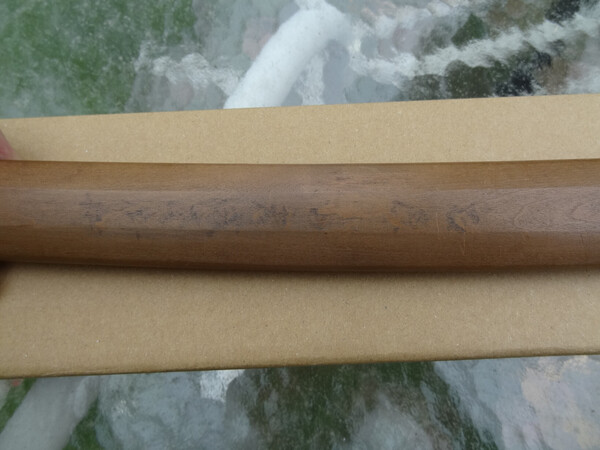
-
New video from NHK - Samurai Sword Ethusiast
Oldman replied to MassiveMoonHeh's topic in General Nihonto Related Discussion
Thanks for sharing the video. It conveyed a nice, positive, bridge between the past and the future. Michael BC -
After more time and experience, I want to add some clarification to my original post in this topic. The tsuba that I reported on was one in which I was saving/improving an existing patina, once I had removed whatever was on it there was a good basis to work from. I am currently using the same methodology on another tsuba which, after using bone scraping to remove rust, was showing bright metal. The method is working but is much slower, taking many weeks with intermittent rubbing with a soft cloth. Cheers, Michael BC
-
Just by way of sharing experiences with sellers. I have made two purchases in the last year or so from this seller and have been very satisfied with my dealings with them. I found them to be cordial to do business with and Yuji-san provided excellent and prompt communication. Their prices seem reasonable and the quality, at least in the purchases I made, is there. Of course one should know what one is looking at and ask questions, important in any distance transaction. Michael BC
-
Coincidentally, I had this same question come to mind a couple of days before the original post. I don't see that it's actually been answered - does anyone have anything further? Michael BC
-
Whether "original" or a fairly old re-wrap, since the tsukamaki looks intact and well done I personally would leave it alone. It seems to me that a degree of 'wabi sabi' is attractive in an older sword, unless you're going for full "restoration." Cheers, Michael BC
-
Kanada antique shipping help for friendly seller
Oldman replied to Marcin's topic in Auctions and Online Sales or Sellers
It appears that the query is about shipping into Canada, albeit with a somewhat different spelling - still a different country from the U.S. . Non-furniture antiques are duty free, use tariff code 9706.00.00.90, but may still incur GST. The dollar amount to avoid GST is quite low, like $40 or so, but the collection is somewhat erratic. Cheers, Michael BC -
Thank you! This is a terrific guide to the collecting of nihonto. l wish that I had it when just starting out, but it is quite useful even after a number of years of following this sometimes obscure and confusing subject. Michael BC
-
I had the same observations, and reservations, as other members have responded with. I didn't necessarily mean to endorse her comments. That having been said, she was a lot closer to that reality than any of us are, although her being female may have restricted her access to knowledge of weaponry. Her final remark about the kogai featuring in dramas could perhaps be verified; anyone here familiar enough with classical Japanese dramas? Cheers, Michael BC
-
I recently read an interesting book titled "A Daughter of the Samurai". Published in the U.S. in 1925, the author, Madame Etsu Inagaki Sugimoto, was born into a high ranking samurai family in 1874. Described as an autobiographical novel, it is quite readable and provides many insights into traditional Japanese culture and practices, including shedding light on a number of themes that we see expressed in koshirae. The book is available for free download on the Project Gutenberg website. She doesn't discuss weaponry very much, but in one place laments seeing servants carrying off bundles of katana and armour to the second-hand dealer to raise money. There is also a passage which goes into some detail about the katana, kogatana, and kogai, which I thought might be of interest to NMB members as it is somewhat different from what I've seen previously: "[S]he brought out her other treasure - a slender, blunt knife called a kogai, which, with the throwing- dagger, forms part of the hilt of a samurai's long sword. In very ancient days Japanese warfare was a science. Artistic skill was always displayed in the use of weapons, and no soldier was proud of having wounded an enemy in any other manner than the one established by samurai rules. The long sword had for its goal only four points: the top of the head, the wrist, the side, and the leg below the knee. The throwing-dagger must speed its way, true as an arrow, direct to the forehead, throat, or wrist. But the blunt kogai had many uses. It was the key that locked the sword in its scabbard; when double it could be used as chopsticks by the marching soldier; it has been used on the battlefield, or in retreat, mercifully to pierce the ankle vein of a suffering and dying comrade, and it had the unique use in a clan feud, when found sticking upright in the ankle of a dead foe, of bearing the silent challenge, "I await thy return." It's crest told to whom it belonged and, in time, it generally was returned - to its owner's ankle. The kogai figures in many tales of romance and revenge of the Middle Ages." Cheers, Michael BC
-
Hello All: I'm looking at purchasing a wakizashi with the enclosed NBTHK hozon. The seller describes it as a mumei, late Muromachi, blade attributed to Kanefusa. It is also said to be inscribed with information about a one body tameshigiri performed at a later date (1642). Unfortunately I can't read Japanese and am posting this with the request that someone who can please let me know if the certificate supports the seller's description. Any red flags? Thanks in advance for any insight you can offer. Michael BC

-
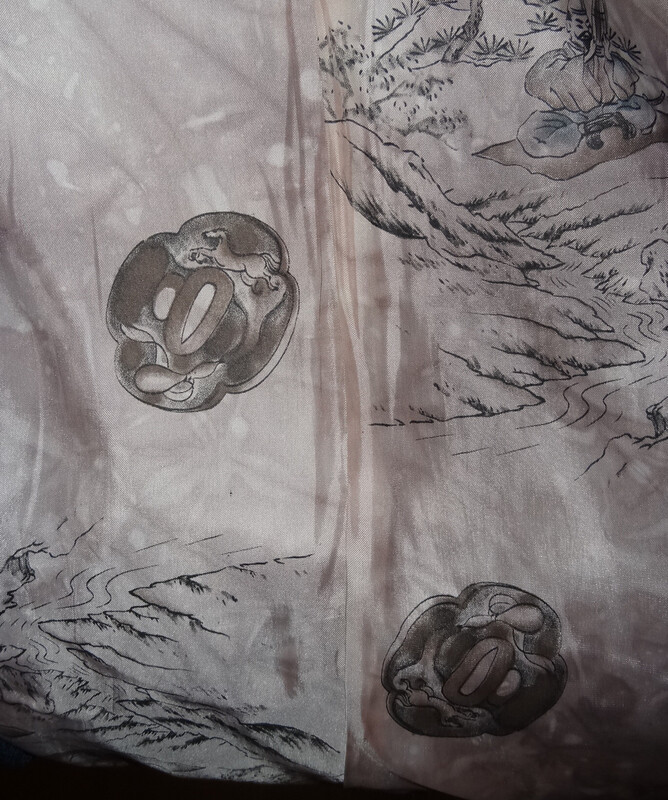
I have had a haori coat for some years but just recently noticed that it has tsuba images in the lining fabric. Kantei anyone? Michael BC
-
Yes, to Bruce's comment. Given the enthusiasm with which the samurai adopted matchlock guns, and better ones to follow, I think that the "romance" of the samurai and katana needs to be kept in perspective. There were certainly episodes of large scale slaughter even in the old times. I have read that perhaps 40,000 - 60,000 heads were taken at the battle of Sekigahara for an instance. And to an extent, some of the philosophy and practises of the samurai carried on through modernization, at least to a degree and in certain contexts; fearlessness in the face of death, and honourable conduct come to mind.
-
PM sent.