Guido
-
Posts
3,242 -
Joined
-
Days Won
99
Content Type
Profiles
Forums
Events
Store
Downloads
Gallery
Everything posted by Guido
-
That part is about "other features of the bōshi" – I can only read the first two characters, 返り kaeri, after that I'm lost in (more) bad handwriting ...
-
While I don’t think that the gold highlighting is paint, it kind of leaves that impression because of the ragged edges and areas covered. I put the Raindragon and Chōshūya examples side by side. While the edges on the latter are somewhat blurred (possibly due to being rubbed off), there’s a distinct pattern. On David’s menuki, it looks like the gold was applied randomly with a stiff brush. Furthermore, the partial gilding of the mane and a leg looks contrived. I’m under the impression that it’s a later “enhancement”, or a sloppy job to begin with. Just to be clear: I’m not endorsing the Chōshūya menuki; they’re not what I aspire to in a collection. OTOH, they probably would look nice on a koshirae (which, btw, is exactly what they suggest in their description). But they are a small notch above the Raindragon ones IMO.

-
Old Mumei Tanto Blade Restoration
Guido replied to Artur DrogaMiecza's topic in General Nihonto Related Discussion
I was at the ER, getting stiches for my tongue. I think Artur got a lot of talent, but also needs a lot of guidance when it comes to Japanese aesthetics, and the finer points of making koshirae. As to non-traditional polishing: don't make me to go there . In this case, there probably wasn't done any harm (because of the blade itself), but I nontheless strongly discourage any amateur attempts, and this forum should indeed be pruned in this regard; thank you, Brian, for always stepping in when it's needed. -
Unfortunately they only work with light reflected from a non-metallic surface - you don't really think physics/nature would make taking photos of nihontō that easy for us?
-
People on the NMB immediately get their pants around their ankles when it comes to amateur polishing of swords, but it seems to be open season on fittings. Why this deeply rooted urge to mess with tsuba when there's no rational reason? What does wax or oil on a soft metal tsuba do that makes it more desirable than without? And what are the consequences of it a few decades down the road?
-
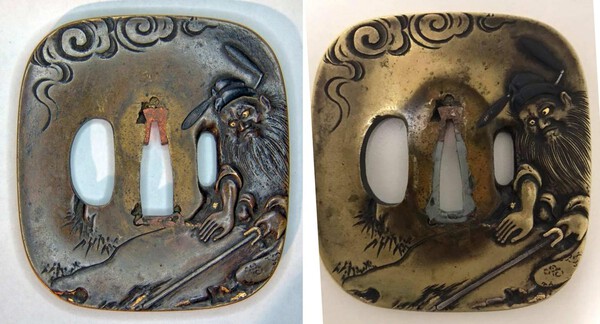
May I ask again why this tsuba needs any cleaning, waxing, manicure, detoxification, aroma therapy, or the like? And btw, while an iron tsuba might benefit from the application of wax in certain instances, I don't advise using it on soft metals. And it also doesn't matter if you use a brush made from the hair of a virgin cut during a full moon. Case in point: in 2006 I sold a papered shinchū Nara tsuba, and saw it again last year. The new owner felt the need to “clean” it. Judge for yourself, the one that left my hands to the left, the “improved” one to the right.
-
Just click on the “unfollow topic” button and you‘re good.
-
I'm with Geraint. Maybe soapy wather and a soft toothbrush if there's any gunk, but I wouldn't go any further than that. But I frankly don't see any reason to "clean" this tsuba judging from the pics.
-
Better yet, don't look at it at all, it'll only hurt your eyes. Besides, there's not even a trace element of Yagyū in that tsuba ...
-
I don't. The upper one looks too much like me when my wife returns from what was supposed to be window shopping.
-
I think ist's a 錫杖 shakujō, a Buddhist monk's ringed staff. The metal rings jingle as the monk walks, supposedly in order to alert insects and other living beings of his passage, so they might get out of the way, thus preventing him from unintentionally harming any living creature.
-
This reminds me to give an update on my catalog: after the longest time, the museum finally answered, and reimbursed the money. A French NMB member was incredibly generous, and sent me a spare catalog for free. Thanks again to "you-know-who-you-are"!
-
Actually I cut back the last coat with charcoal powder to give it a more matte, antique look.
-
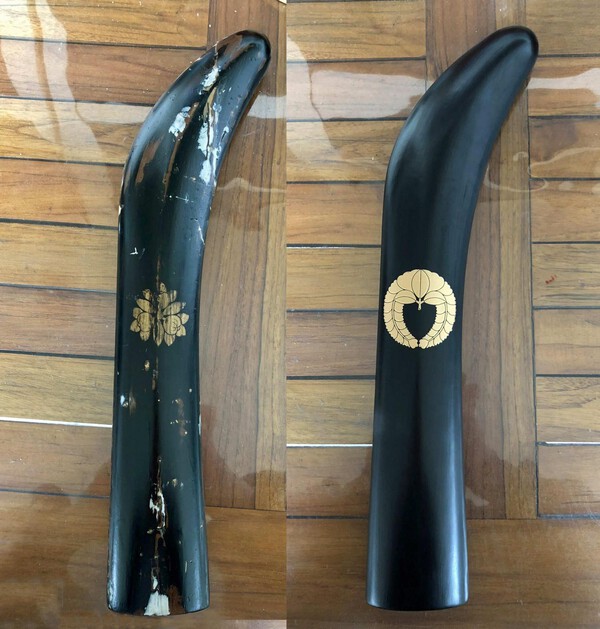
To bring this thread to a conclusion (kind of): after doing research on the internet, going through all my books, and 30 years’ worth of Ginza Chōshūya catalogs, I can state that the orientation of more than 70% of all kamon on naginata-saya is towards the tip, i.e. if the pole is held vertically. However, I still don't know if there's a "rule" in regard to the orientation, just my empirical evidence. The reason for my question was that I had a naginata-saya with cracks, a split tip section, lots of bumps, nicks, and termite holes, that I wanted to restore. When I started sanding it down, I actually found a faint kamon under the black topcoat. After lots of wood glue, wood putty, 20 layers of cashew, and hours of sanding in between, I’m quite happy with my restoration efforts. Btw, I got the new kamon (one on each side) from a company in Kyōto. They call it “makie-sticker”, and they are made of red lacquer (or maybe plastic?) with a gold lacquer coating, and are 3-dimensional, i.e. have a raised design of about 1 mm. If you don’t use a magnifying glass, they look like real hira-makie.
-
Would you mind sharing them with us?
-
Pinterest - Teppo And Other Interesting Shtuffs...
Guido replied to Bazza's topic in Tanegashima / Teppo / Hinawajū
I made the stupid mistake of signing up on Pinterest some time ago because of some research I did. Not only was I disappointed with the content, I'm now bombarded with "recommendations" by Pinterested although I unsubscribed already a couple of times. Those mails go straight into my spam folder now, but I still find it irritatating. -
Selamat datang, Dion! I collect Japanese swords and fittings for mor than 40 years now, and started collecting kris when living in Jakarta from 2012 to 2016. I beg to differ when it comes to (assumed) similarities in the construction of nihontō and kris, and even the spiritual significance (which is much stronger in Indonesia). But both are unique weapons/art objects, and I hope you'll stick around long enough to appreciate the differences, and like nihontō for what they actually are.
-
In an ideal (nihontō) world, the koshirae starts with the saya, which should be slender, and slightly egg-shaped. By “slender” I mean being as slim as possible without sacrificing its integrity; such a saya doesn’t only look elegant, but is also more difficult to make, and thus shows the skill of the sayashi. The koiguchi then dictates the size of the seppa, which should be slightly larger than it, extending about 1 mm or a little more, depending on the decoration of its rim. The seppadai of the tsuba should align with the seppa. The second seppa (and usually the upper seppadai) is a tad smaller than the lower seppa, and determines the size of the fuchi. The next step is tsukanari, i.e. the shape of the tsuka. The dimension at the tip is of course in accordance to the kashira, assuming that the fuchigashira are a true pair. The length might be adjusted depending on the width of the tsukaito chosen, but usually it’s the other way around. In any case, shape and length should be in harmony with the length and shape of the sword/saya. (Don't ask me to give a definite rule, it's like with porn - I can't describe it, but know it when I see it.) That’s how it was done traditionally, and also nowadays if executed by a koshiraeshi who knows what he is doing. A little tweaking is possible if the tsuba has no discernible seppadai, and the fuchi is a little larger than of perfect size. The role of the koshiraeshi is IMO often underestimated, producing one that “flows” with the blade isn’t an easy task by any means. But then again, I’m quite anal when it comes to koshirae (my country of birth makes it probably immensely politically incorrect, but I actually wouldn’t mind the term “koshirae-nazi”). I just hate those animé-style mountings, and colors and decorations that are non-traditional – being possible and maybe considered cool by the younger crowd isn’t something I can subscribe to, it just gives me the shudders (and I suspect sometimes even tinea or parodontitis, but I can’t prove that). But to each his own, de gustibus non est disputandum …
-
https://www.katanatansu.jp/katanahako%E6%9C%83%E6%B4%A5%E6%A1%90%E5%88%80%E7%AE%B1/
-
No problem!

-
There are Japanese sword collectors in HK, you can order books easily via Amazon or Lulu, and there's a *ton* of info about Kotetsu online, not only in Japanese, but also in English: https://www.google.com/search?q=%E9%95%B7%E6%9B%BD%E7%A5%A2+%E8%99%8E%E5%BE%B9&spell=1&sa=X&ved=0ahUKEwizoo-Lw_zfAhUF57wKHfDaC1UQBQgqKAA&biw=1280&bih=658 https://www.google.com/search?ei=sH9EXImXOMym8AW1wYywCg&q=nagasone+kotetsu&oq=nagasone+kotetsu&gs_l=psy-ab.3..0j0i22i30l9.7533.8500..9481...0.0..0.127.714.0j6......0....1..gws-wiz.......0i19j0i22i30i19.jG7H7WtdcPw
-
I don't think that's there a special term for this, other than a qualifying one for the sakikasane 先重ね - if the thickness is different from "the norm", it's sakikasana atsui 先重ね厚い (thick), or sakikasane usui 先重ね薄い (thin).
-
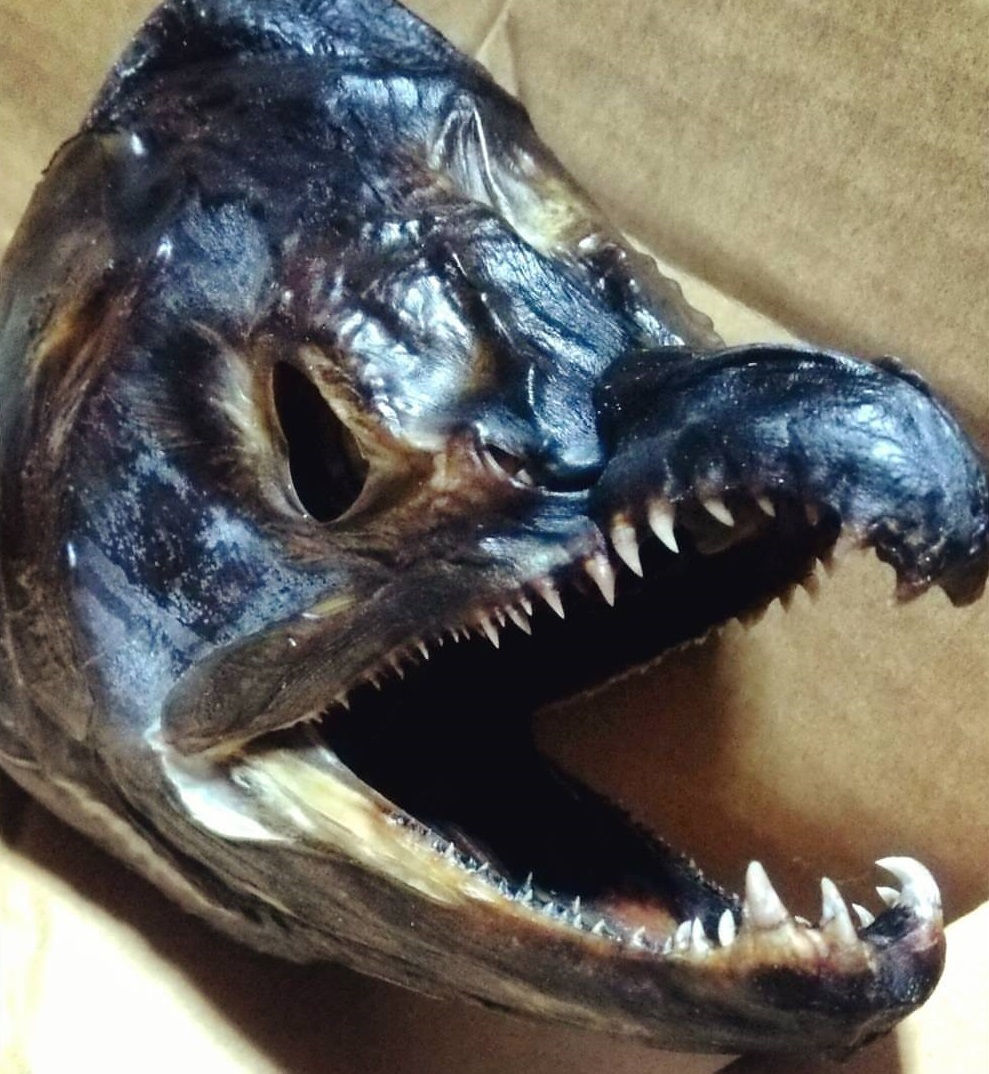
IMO it’s definitely sake no himono 鮭の干物, dried salmon.