Ganko
-
Posts
437 -
Joined
-
Last visited
Content Type
Profiles
Forums
Events
Store
Downloads
Gallery
Everything posted by Ganko
-
Looks like it has yakiotoshi about 1/2", which would imply that it is ubu. Probably a Shinshinto piece.
-
Those clusters took many hours to do, that is an over the top one.
-
I believe it was from a Japanese site that was in English, it may have been "Kichigai nuri". I had a tachi kake that was done in that manner.
-
Robert, I recall reading some time ago that it is sometimes referred to as "idiots lacquer", since anyone would have to be crazy to spend the amount of time it takes to produce it. I like it. Great koshirae.
-
I believe the line you are looking at is the boundary of a difference in metal composition. The hamon hardened differently for that reason. The center metal is slightly different from the sides in that area.
-
Very nice koshirae. I think the rust on the F/K will clean off fairly well, as Geraint says, a little work with sharp piece of bone will tell you more. The lacquer is a variant of Wakasa Nuri I believe, and very nicely done.
-
Looks like Chinese fake to me.
-
Maker is ?. ?, Kanemasa. and dated Showa 19 (1944) 8th month( Aug.)
-
Well put, George and les. There are many of us who could care less about snob appeal. We acquire what we like for whatever reason we are attracted to it, whether it is an unsigned Shinshinto piece or a signed Juyo. Fortunately ,we do not all have similar likes and dislikes and in Japanese swords there is something for everyone. If I collect NCO swords am I to be looked down upon by the Juyo Ko-Bizen collector, I would hope not. Buy what you like for your own enjoyment for whatever reason and you will not regret it. There is nothing to be gained by putting other people down.
-
San Francisco Show 2020
Ganko replied to Grey Doffin's topic in Sword Shows, Events, Community News and Legislation Issues
Here is the notice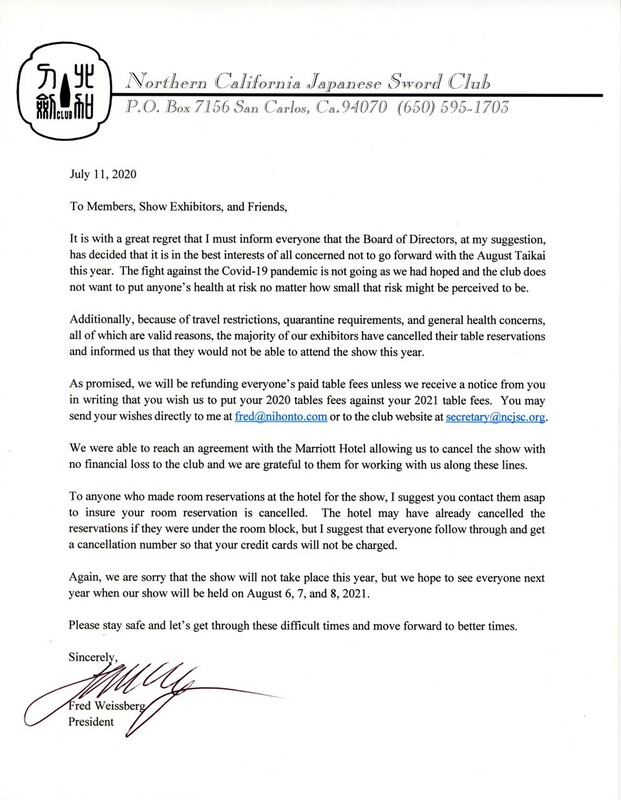
-
It is Kanehiro saku kore, Showa ju roku nen,(1941)
-
It is my understanding that the friction between the habaki and the saya mouth should take place on the ha side and mune side of the habaki. The cat scratches may be there to keep ugly rub marks from appearing on the sides of the habaki as it occasionally touches the mouth or maybe they are purely decorative?
-
If you've got it flaunt it, I guess.
-
Matching "Type 3" gendaito with random Type 3 scabbard
Ganko replied to Bruno's topic in Military Swords of Japan
From my observations, all of the type 3 RJT star stamped blades in steel scabbards have always had the double release buttons (the additional button on the scabbard). These pieces are quite rare. -
A couple of Albert Yamanaka words of wisdom; "The less a collector knows about swords, the more he wants swords with a big name", and "The limits of a dealer's scruples are in direct proportion to the collectors cupidity". Applies to fittings as well. Just saying
-
The artist certainly had the ability to portray the fruit accurately and no doubt did so. The fruit shown is definitely not a loquat.
-
Looks like a nice piece "Bushu ju Teruhiro", worthy of a polish and a new wrap with decent menuki.
-
Anyone Read the New Ohmura Book?
Ganko replied to Bruce Pennington's topic in Military Swords of Japan
Maybe Markus could do a translation? -
San Francisco Show 2020
Ganko replied to Grey Doffin's topic in Sword Shows, Events, Community News and Legislation Issues
A victim of auto correct? -
The characters down below, Japanese for "Past this point be dragons".
-
What Sebastien said.
-
Welcome to the NMB Greg.
-
Also in that book, Amata Akitsugu states that Shibata Ka researched jigane and succeeded in forging a jigane that was mistaken for that of the Kamakura Period and was not emulated by any of the Showa era Smiths. I have a sword by him and it does indeed have a very nice jigane.
-
Nice work, Artur, looks great.
-
Welcome to the NMB Jim, we are all still learning and some further along the curve.