PietroParis
-
Posts
783 -
Joined
-
Last visited
-
Days Won
4
Content Type
Profiles
Forums
Events
Store
Downloads
Gallery
Everything posted by PietroParis
-
When I encounter this problem, I edit the picture on my computer/phone, rotate it 360 degrees (i.e., back to the original orientation) and save it again. Usually this works for me.
-
This page seems somewhat skeptical on the Hiroshige signature, but who knows.
-
Some info on that series is here.
-
I hope I have not given the impression that I claim some special erudition on Shin Hanga. In fact, I am just efficient with google searches... Anyway, I have found this one. Cheers, Pietro P.S. I guess there is a misprint in the linked page, the name of the publisher should be Daikokuya.
-
I looked here for the potter's seal but could not find it. Maybe it's not a famous potter... Anyway, if none of the experts in this forum can help, you might want to try the Facebook group "Japanese STUDIO POTTERY collectors". Cheers, Pietro
-
The prices are not for the faint-hearted, but I suppose they match the quality...
-
Indeed, from below they look like Chinese-made tourist trinkets, you might show a group photo from above to remove any doubt. The one in the third picture might read 松山 Matsuyama/Shozan, which is a typical "Hong Kong" signature. The round inlay in the seventh picture is another typical giveaway. Anyway, the signatures on such NLO (netsuke-like objects) are often just meaningless squiggles.
-
Probably I am stating the obvious, but if you hang the print you should also make sure that it is never hit by direct sunlight...
-
For woodblock prints, "genuine" vs "copy" is a tricky concept. First editions, later (but lifetime) editions and posthumous editions could all be considered "genuine" if they were pulled from the original woodblocks, but they vary considerably in value. If yours is really from 1925, congratulations!!! A copy would be a print obtained from re-carved blocks, such as the one being currently auctioned on catawiki.
-
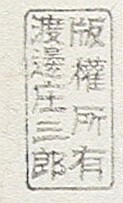
At the very least, it does carry the "A seal" that, according to this page, was in use between 1924 and 1930! You might indeed want to replace the matting with a more professional one, I see no reason to cover part of the image. Be sure they use acid-free, museum-grade materials. Also, I would hesitate to hold a valuable 95yo print with bare fingers.
-
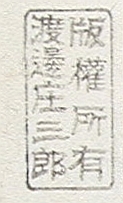
If this was a Heisei reproduction, one should see also the 7mm round Watanabe seal within the image, near one of the lower corners. Anyway, I notice that the matting covers a bit of the image along the lower and right margins. P.S. in case somebody wants to give it a shot, a modern reproduction of that print is currently being auctioned here with no reserve price. Contrary to what the seller writes, it is not from the original woodblocks, but from recarved ones. I would also question the "expert estimate" of 350-450 EUR, since the price in Watanabe's shop is 25920 JPY.
-
I've noticed that seller in the past. They have also a few quality items, but I was under the impression that their prices are higher than usual. Correct? Cheers, Pietro
-
Bizarrely, his main lines of business appear to be kimonos and kinky dolls.
-

53 Stations of the Tokaido by various artists
PietroParis replied to Baka Gaijin's topic in Other Japanese Arts
AH, the magic of the internet! It's in fact Toyokuni not Utamaro. In your print the greens are completely faded and the paper is "foxy". I don't know if it is worth restoring, but it might be valuable too. -
53 Stations of the Tokaido by various artists
PietroParis replied to Baka Gaijin's topic in Other Japanese Arts
Congratulations! I don't know what to say about the "foxy" one (except that it reminds me of Utamaro), but if any of the remaining three is actually old you've got a great deal. -
53 Stations of the Tokaido by various artists
PietroParis replied to Baka Gaijin's topic in Other Japanese Arts
SO? Any luck with the auction? -
Comments on this print - much appreciated.
PietroParis replied to barnejp's topic in Other Japanese Arts
As explained here, in the Kichizo Tokaido series the stations 24 and 25 were combined in one print (the one numbered 24), thus the print numbered 25 corresponds indeed to the station 26 (and so on). -
53 Stations of the Tokaido by various artists
PietroParis replied to Baka Gaijin's topic in Other Japanese Arts
The first edition of the rightmost one was in the 1930s. The peacock also must date to the early 20th century if the artist was really born in 1884. Nothing wrong with that anyway, in fact "shin hanga" can fetch very high prices. -
53 Stations of the Tokaido by various artists
PietroParis replied to Baka Gaijin's topic in Other Japanese Arts
The peacock is by Ito Sozan (1884-?), see here. -
53 Stations of the Tokaido by various artists
PietroParis replied to Baka Gaijin's topic in Other Japanese Arts
The abalone and needlefish print is by Hiroshige, see here. Also much more expensive than 60$ if original. The problem is that, for all you know, you might be buying modern inkjet prints (except the first one, where I don't think they would have bothered to fake the "foxing"). But if you like them and they don't shoot up in price you might want to roll the dice. -
53 Stations of the Tokaido by various artists
PietroParis replied to Baka Gaijin's topic in Other Japanese Arts
An original Shotei print would usually cost much more than 60$, see here, here and here. It's hard to judge from your picture what is it that they are selling. I'm not aware that Watanabe made posthumous reprints (atozuri) of that one but I can check. EDIT: more examples for Shotei: https://ukiyo-e.org/image/mfa/sc205668 EDIT 2: no reprints of that one in Watanabe's catalogue. If you research that artist, note that he also used the art name Hiroaki. -
53 Stations of the Tokaido by various artists
PietroParis replied to Baka Gaijin's topic in Other Japanese Arts
Showa 7 (1932) was the first edition. The 6mm round seal in the lower-right corner of both the MFA print and mine points to later (but still lifetime) editions, 1946-1957. -
53 Stations of the Tokaido by various artists
PietroParis replied to Baka Gaijin's topic in Other Japanese Arts
I have this one! Cheers, Pietro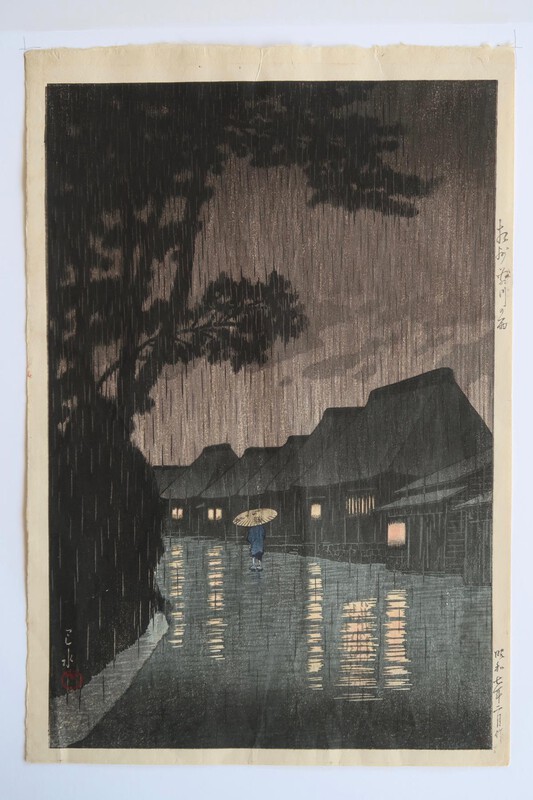
-
12 Swords Available For Sale
PietroParis replied to matthewbrice's topic in Auctions and Online Sales or Sellers
From France I see all twelve of them.