PietroParis
-
Posts
783 -
Joined
-
Last visited
-
Days Won
4
Content Type
Profiles
Forums
Events
Store
Downloads
Gallery
Everything posted by PietroParis
-

Comments on this print - much appreciated.
PietroParis replied to barnejp's topic in Other Japanese Arts
Maybe this could be used as an argument with the seller? -
Comments on this print - much appreciated.
PietroParis replied to barnejp's topic in Other Japanese Arts
Thanks a lot Malcom, this is very informative and a lot of fun! According to the classification in this page, the seals in my print are G/N, which would correspond to the period 1847-1850. This is consistent with the dating 1850-1851 given here for the Kichizo Tokaido series. The seals are the same as in the BM and MFA examples linked in both your post and mine above. Of course I understand that this alone does not imply that my print is really from that period... Concerning the paper, it's hard to judge since it is backed, but from the edge that is not fully glued to the backing it looks relatively thin. Under magnification, the paper also shows a structure of vertical filaments, but I could not make out anything resembling "grid marks". Concerning Greg's print, in all but one of the examples shown here the seals are on the lower-left margin, hence not much can be learned from this source without taking the print out of the frame. Cheers, Pietro -
Comments on this print - much appreciated.
PietroParis replied to barnejp's topic in Other Japanese Arts
Some context to the question above, and apologies to Greg for hijacking the thread! Last year I bought a "Kichizo Tokaido" print for 50 EUR (all included) at an online auction: It is in a pretty sad state, with folds and stains, and it is even backed (which I only realized when I picked it up from the auction house). However, I assumed that at least it is original, because the woodgrain visible in the blue sky above the right mast matches the one in similar prints at BM and MFA. Was I too gullible?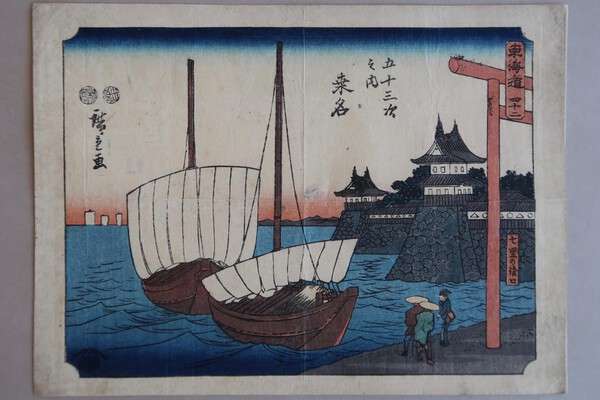
-
Comments on this print - much appreciated.
PietroParis replied to barnejp's topic in Other Japanese Arts
Thanks Malcom! Good find for the print with the added cartouche. If it is in the British Museum it should not be too fake... The link on "original" prints is also interesting. I notice however that it does not mention the wood grain: I believed that, when visible, it was considered a kind of "signature" that helps determining whether a print is from the original blocks. Is that criterion overrated or prone to falsification? -
Comments on this print - much appreciated.
PietroParis replied to barnejp's topic in Other Japanese Arts
Hiding in plain sight! How did I miss that? -
Comments on this print - much appreciated.
PietroParis replied to barnejp's topic in Other Japanese Arts
Compared with the MET and MFA prints, it looks like the greens have faded a bit, no? -
Comments on this print - much appreciated.
PietroParis replied to barnejp's topic in Other Japanese Arts
Here you find other examples of this Hiroshige print. Here and here some minimal info on the "Kyoka Tokaido" series. Cheers, Pietro -
One in three. But since I own three tsuba in total it is not a representative sample
-
Do I understand correctly that the rust on the tang should be left alone? Or is red rust to be removed everywhere?
-
In fact the blades I am referring to are most often described as wakizashi. And 1000$ is a rough ballpark for the final price, the auctions start from 10$ with no reserve. P.S. here is another recent example: https://www.ebay.fr/itm/NBTHK-Attested-Japanese-Wakizashi-Sword-Kanesaki-Samurai-Katana-Nihonto/254535530457
-
I've noticed two eBay sellers, "katana-boutique" and "Japanese-swords-hq", who often sell blades with modern (I mean, yellow Hozon) NBTHK papers, with no reserve and reaching prices in the ballpark of 1000$. From a quick search in the forum, it seems that at least the former has a checkered reputation. Two current examples (one per seller) are: https://www.ebay.fr/itm/Authentic-Japanese-KATANA-SWORD-WAKIZASHI-KANENORI-signed-w-NBTHK-HOZON-NR/254538104469 https://www.ebay.fr/itm/NBTHK-Attested-Japanese-Wakizashi-Sword-Norimitsu-Samurai-Katana-Nihonto/254540228236 I am not planning to bid on a sword anytime soon, this is more a general question: I suppose a lot can still go wrong even with a Hozon paper, but at least "fake" should not be an issue (unless of course the certificate itself is fake!). What other problems should one watch out for? Maybe flaws (e.g. scratches, nicks) that occurred after the shinsa? Cheers, Pietro
-
Indeed, I was referring to whether the tsuba was meant to ever be mounted on a sword. Apart from the lost decoration, I was wondering if the relief of the hand would prevent the seppa from properly adhering to the surface. But from a closer look at the third picture it seems that the hand is not significantly raised with respect to the background. Cheers, Pietro [apologies in advance if I am not using the correct terminology!]
-
No seppa-dai on the front side. Does that make sense?
-
In the first, second and last picture the shadow of the blade can trick the eye.
-
Not my kind of stuff, but they might be interesting for somebody here: https://www.ebay.fr/itm/Arami-Meizukushi-1721-Guidebooks-of-Swordsmiths-Woodblock-print-Katana-Antique/274278898959 https://www.ebay.fr/itm/Koto-Meizukushi-taizen-1792-Guidebooks-of-Swordsmiths-Woodblock-print-Katana/402106907981 Cheers, Pietro
-
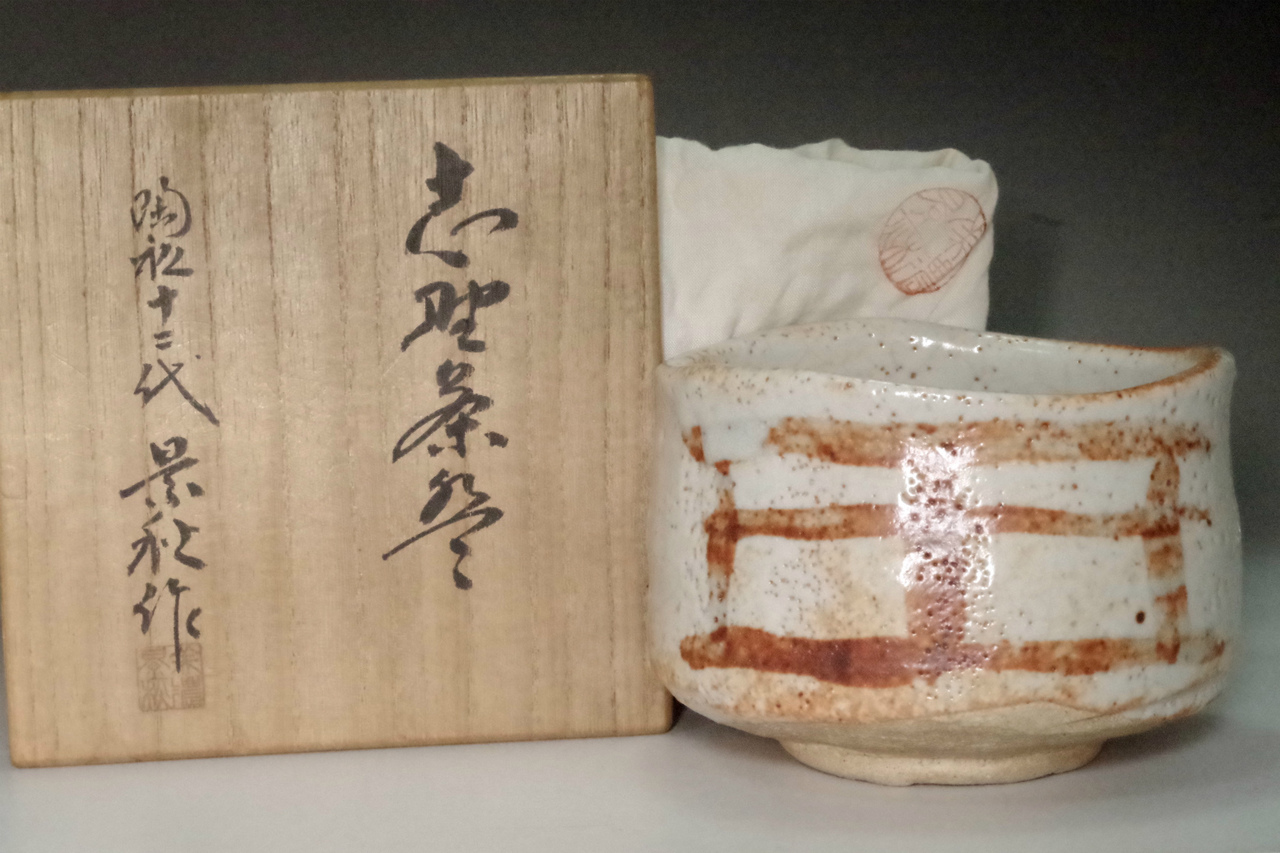
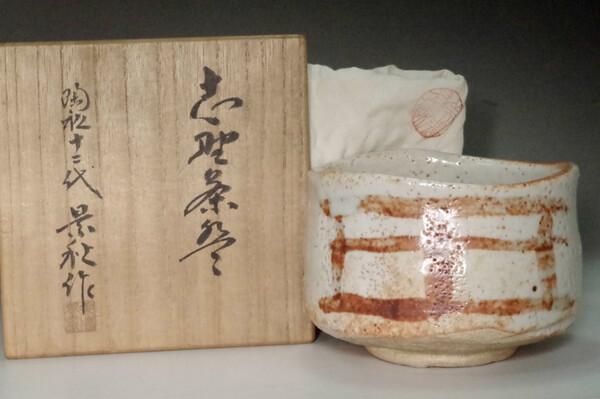
Thanks a lot Steve and Evan for your detailed explanations, which I would summarize as "too cheap and too new" That website has been something of a mystery to me for a while: they have a seemingly endless stream of suspiciously cheap "big name" bowls that are snapped up within hours after they go on sale. I too had noticed the one by Chojiro and thought that it was absurd. I did however buy a shino bowl from them, supposedly made by a 20th-century potter, Kato Kageaki (more details in this post): Incidentally, the decoration recalls the famous Unohanagaki in Steve's post above. I cannot swear on the authenticity, but I've been using it every weekend to drink tea and I am quite pleased with it Cheers, Pietro
-
Thanks a lot, this puts my mind at ease! Then I must assume that the appraisal too is only inspired by Toyozo... I understand that he had a major role in the revival of shino ware, so it's unlikely that he would have been fooled. When you have time, would you mind explaining to a beginner what details in the cup point away from the Momoyama period? Thanks again for your help, Pietro
-
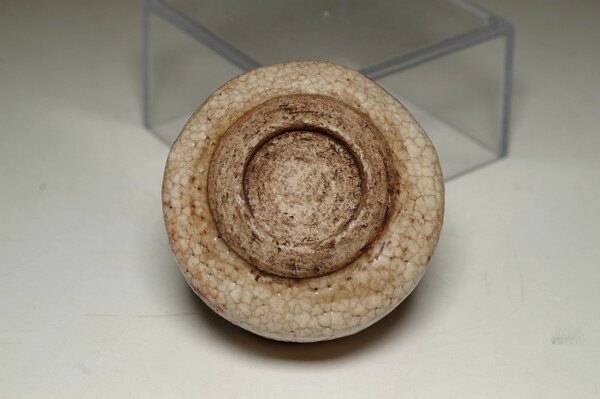
Anyway, here it is:
-
Thanks for dropping by! If you follow the link in the first line of my original post you’ll find many more pictures, including the foot.
-
Have you checked out this one in the sales section of the forum?
-
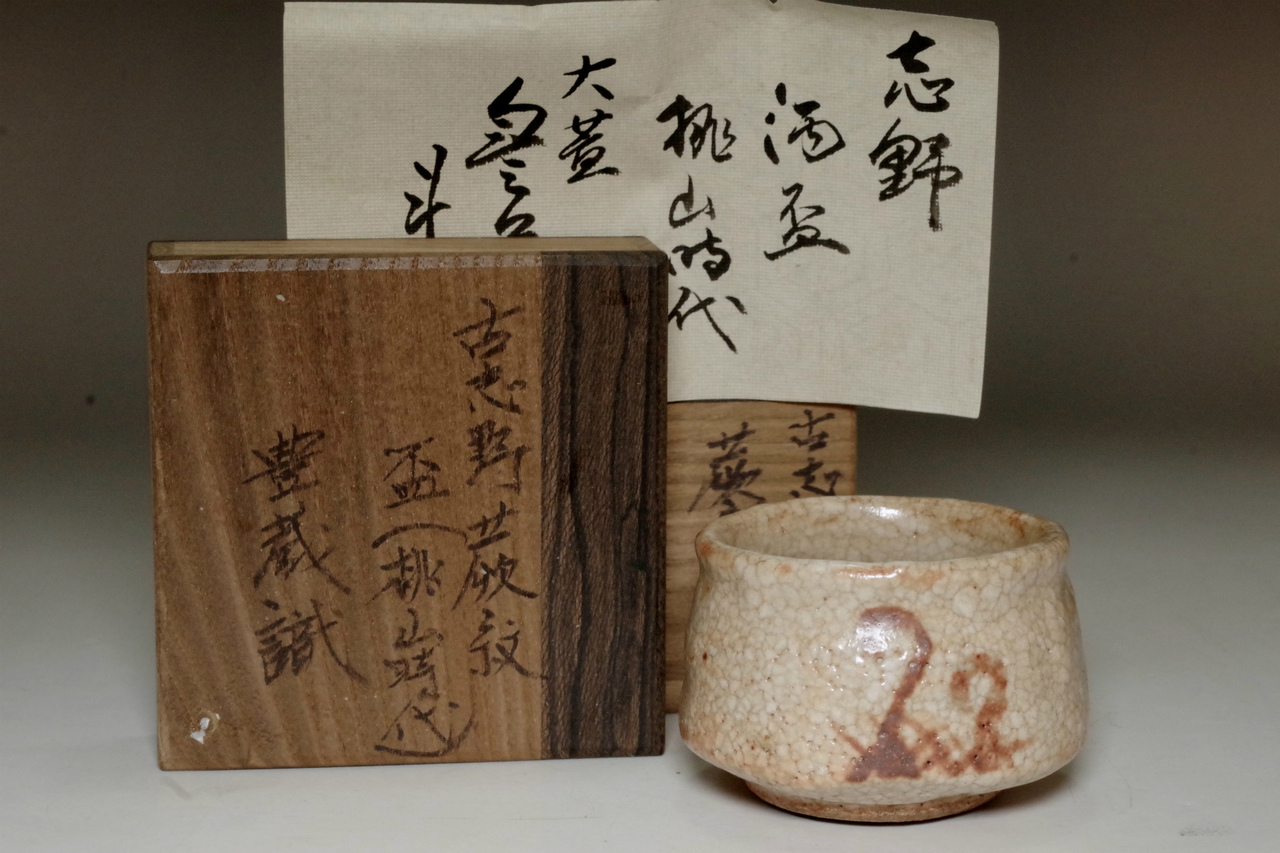
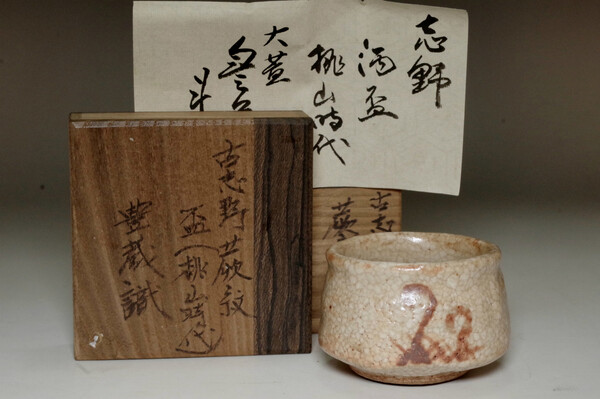
This small shino cup was briefly on sale today: More pictures are available following the link above. Somebody snapped it up while I was busy trying to decipher the calligraphy on the box and on the appraisal paper. The latter does look like Arakawa Toyozo's writing, judging by some of his boxes that were sold on the same site. A question to the local experts: was the dating realistic? I guess I missed a bargain in that case... Cheers, Pietro
-
I get 14 items.
-
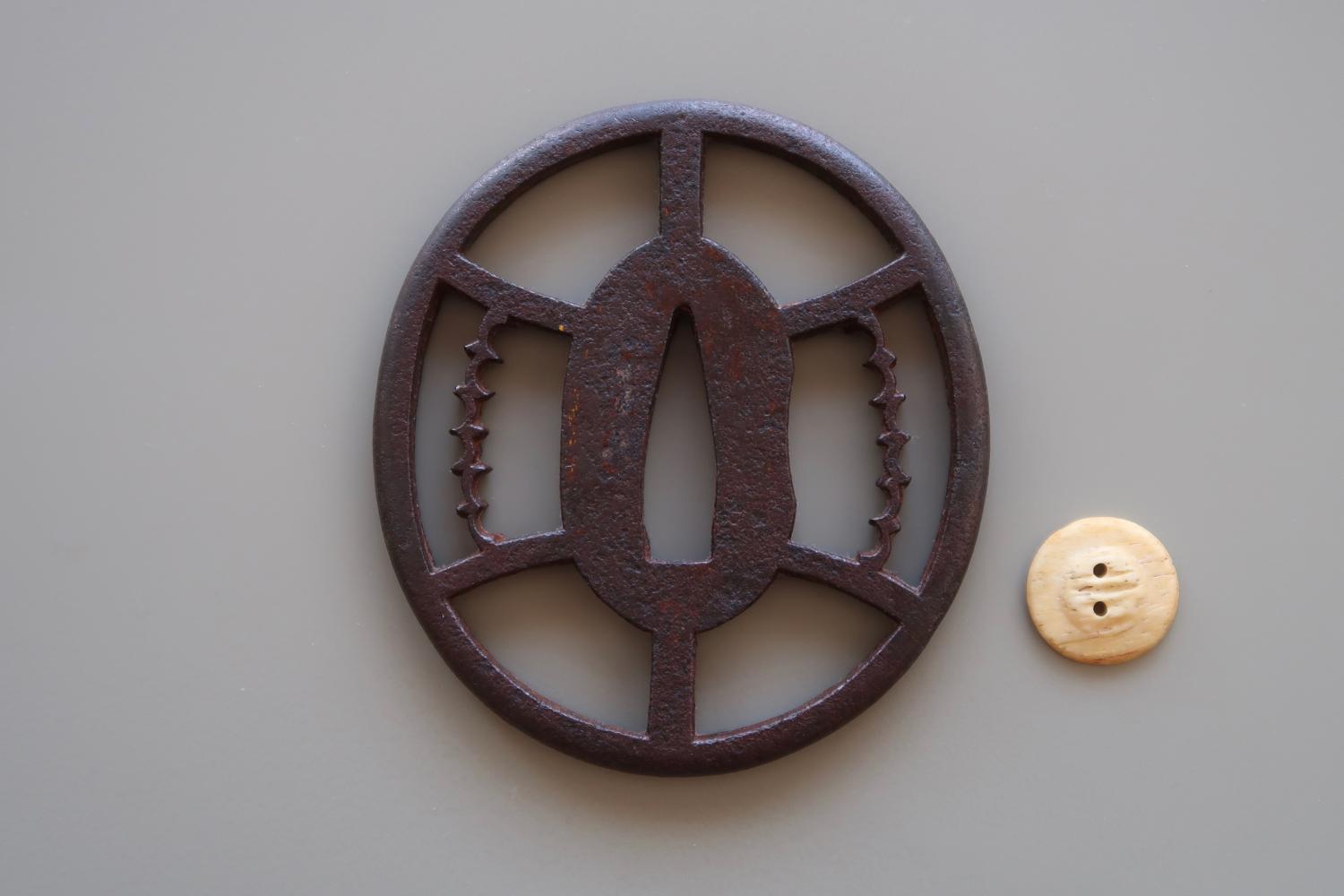
In that case it was a waste of the seller's time, as the tsuba sold for a mere 17$ on eBay (the price I had mentioned a few posts above included shipping). Scratching with the broken edge of the button helped remove a bit more red rust, but not all of it. Anyway, I'll give it a rest now. It was a valuable experience to me, and I thank you all for comments and guidance. Cheers, Pietro
-
Thank you all for your comments! I'll try breaking the button, although I would say that even the rounded edge has already removed quite a lot of rust. As for brushing the whitish area, unfortunately it has no effect. I suspect that the patina is really affected, and I am wondering if I've done something wrong or if it was an inevitable outcome. Cheers, Pietro
-
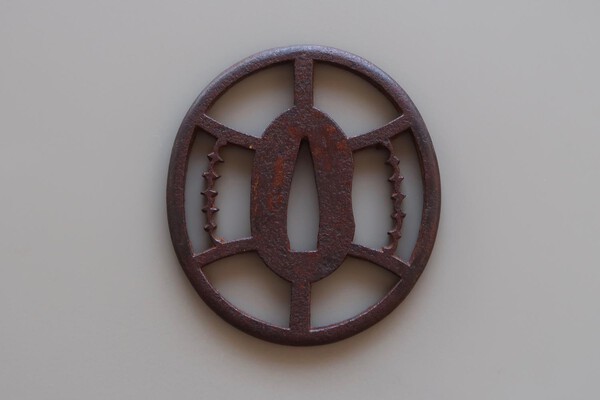
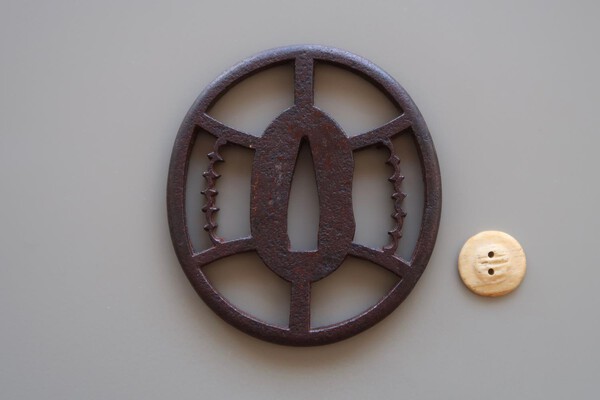
I gave it another try, with repeated cycles of dabbing with camellia oil, letting rest for a few hours, scratching with a bone button and wiping with a cloth. However, I am not too pleased with the result: The "before" and "after" pictures show that quite a lot of red rust came off, but the patina appears to be damaged in one area (see the whitish spots on the left of the nakago ana). Did I scratch too hard? A more-charitable interpretation could be that the red rust had already eaten through the patina: indeed, the whitish spots showed up quite early in the process, and other areas that I scratched just as hard were not damaged. Anyway, it's just as well that I tried this procedure on a low-quality tsuba that I had bought for 26 EUR on eBay. I don't think I'll dare to try it on my "good" tsuba, I guess I'll stick to oiling and wiping... BTW, is there anything I can do now to reduce the damage to the patina, apart from waiting a few decades? Cheers, Pietro