Katsujinken
-
Posts
826 -
Joined
-
Last visited
-
Days Won
3
Content Type
Profiles
Forums
Events
Store
Downloads
Gallery
Everything posted by Katsujinken
-
The first one is definitely a small ware. The others look like old rust pits. Grab yourself a copy of ‘The Connoisseur’s Book of Japanese Swords’. That’s pretty much the first book anyone should buy. Enjoy your sword!
-
That bit refers to the chrysanthemum crest (kiku mon).
-
 Well, it’s a blade. And it has a signature. The rest? ...
 -
Identify this Katana Sword
Katsujinken replied to Jcremer24's topic in General Nihonto Related Discussion
This is Katana Boutique on eBay, which means if it doesn’t have papers already it never will. “Daimyo registered” means less than nothing without provenance and/or papers. Would need much better pictures to speak to the blade itself, but honestly in this case they’re not necessary. Nothing evil going on here, just caveat emptor. -
Incredible. What a treat to read such a thorough report.
-
Help for translating my nbthk forms for my mumei
Katsujinken replied to acidicarrow's topic in Translation Assistance
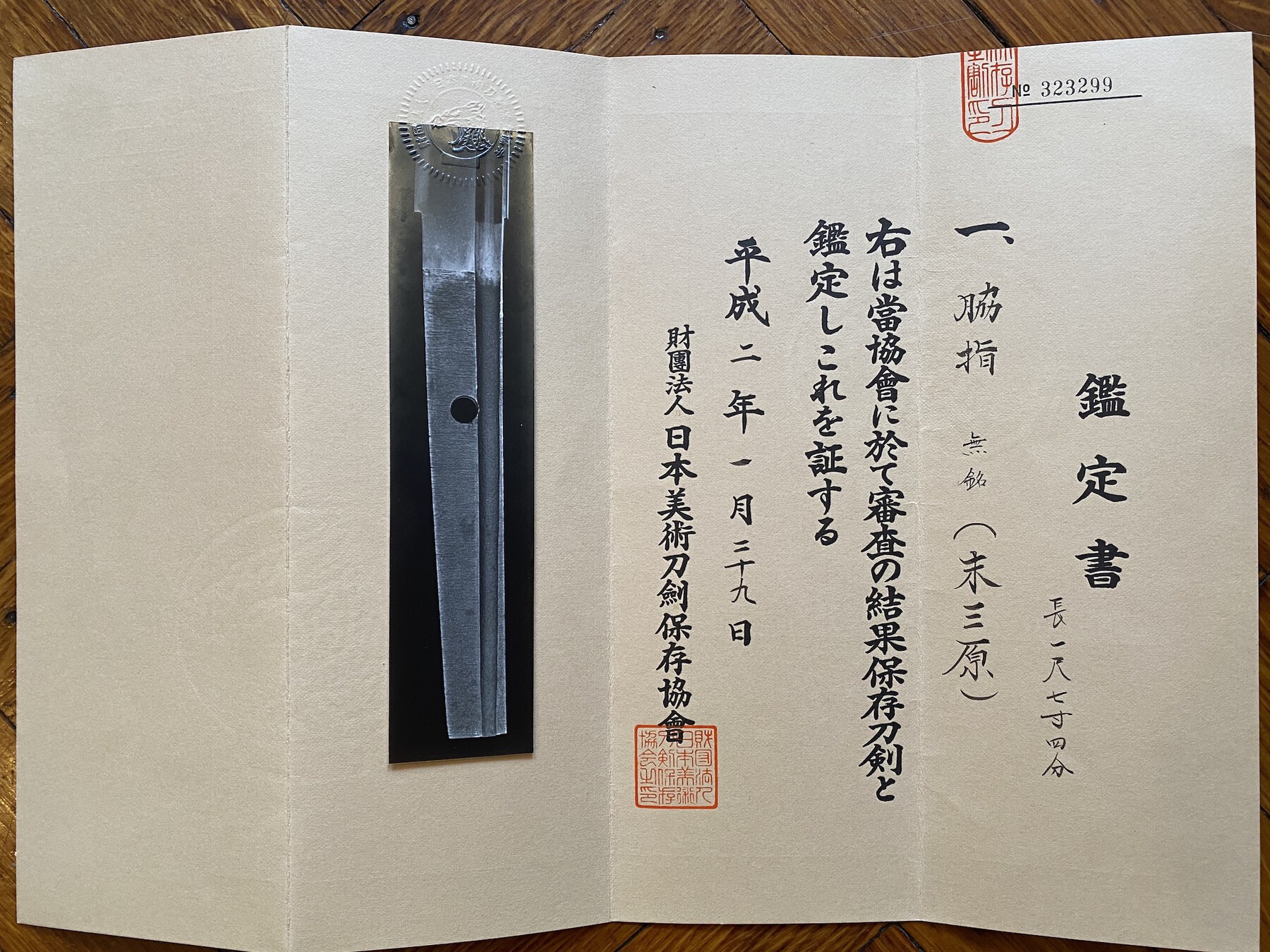
The NBTHK paper just states the length along with the attribution and date. Everything else is boilerplate about the sword being judged as tokubetsu kicho, etc. Now that you know the attribution (Nio) you can start to learn about the school’s work and time period(s). Based on the sugata, you’re looking at shinto in my humble opinion. I’m not sure why the NBTHK didn’t go so far as to say Sue Nio in that case, but others with more expertise may chime in. -
Help for translating my nbthk forms for my mumei
Katsujinken replied to acidicarrow's topic in Translation Assistance
The smaller card is the torokusho, the registration for the sword, which has no bearing on attribution. These are supposed to be surrendered to authorities upon export of the sword from Japan. Now share some photos of the blade. :-) -
65th for me. Although it is a touch shorter it is definitely healthier save for the small issue by the kissaki. I’m not really willing to tolerate rough jigane in a Juyo blade outside of very specific circumstsnces. By the way, it looks like someone had a mei removed... To be honest, I don’t love either of these swords!
-
I agree with Barry, Johan. A quick Google search for Rai Nobuyoshi should also bring you to the same conclusion once you compare your blade to authenticated examples.
-
A series of fittings ( or how not to build a collection )
Katsujinken replied to Bob M.'s topic in Tosogu
I love this thread! -
Where do you train, Jeremy? I’m in New York.
-
Safe to say if it were shoshin we would know by now.
-
Check my translation of a Hozon paper
Katsujinken replied to Katsujinken's topic in Translation Assistance
Thank you, as always, Steve! -
Introduction and some general terms.
Katsujinken replied to Mark's topic in ASIAN ARTS & ANTIQUES LTD
Just recently had a great experience buying a blade from Mark. It was exactly as described and Mark was a pleasure to work with. And Grey is a gem too! -
I know what this paper says of course, but if someone with a few moments of spare time would be willing to confirm my translation I would be so appreciative. I'm giving a sword as a gift and would like to provide a nice translation of the paper. Normally I'd go to Markus, but that's not an option at the moment. Moving from right to left, I know: Certificate / Kanteisho Length: 1 shaku / 7 sun / 4 (?) bu (52.75 cm) Wakizashi / mumei / Sue-Mihara According to the result of the shinsa committee of our society we judged this work as authentic and rate it as hozon-tôken. 2nd Year of Heisei / January 29th [1990] Nihon Bijutsu Tôken Hozon Kyôkai, NBTHK Thanks in advance! And if anyone has all these kanji easily available and wants to copy paste into this thread I won't say no...

-
Definitely worth asking. My point was just that the cost of restoration may not increase the value more than that cost. But if you love the piece it doesn’t matter!
-
Yes it’s made from tamahagane. Value is very low in this state. It could certainly be restored by someone qualified but it would not be a profitable investment by any means whatsoever.
-
Thoughts on this Octopus Tsuba ...
Katsujinken replied to TheGermanBastard's topic in Auctions and Online Sales or Sellers
I don’t think this is particularly good work, including the way the mei is carved. Caveat: I’m a blades guy -
Holy moly.
-
Congrats!
-
Thanks! That’s very helpful. In Japan there’s the idea of a “batto polish” for keeping tameshigiri swords in shape. I myself use an Ogawa Kanekuni shinsakuto from the mid 1980s for battodo. And I agree 100% with your last paragraph! I posted something similar on this board just the other day, actually:
-
These are great, thanks for sharing. Are you based in the US? I’m curious about how often you get your tameshigiri sword sharpened/polished and who you have do the work given that it’s a shinsakuto.
-
Kanesada Wakizashi Shinsa Preparation
Katsujinken replied to Tokugawa Gord's topic in General Nihonto Related Discussion
1) What Brian said; but also 2) When we’re talking about a signed Shinto wakizashi, condition and validity of signature matter very much indeed (regardless of papers, though papers make something more marketable because most buyers rely on papers to some extent). -
Brian is correct, but if you contact a shop in Japan (e.g. Giheiya), they can often surprise you given the volume they see. I contacted Giheiya and asked about shinsakuto made by 2 specific and not necessarily famous smiths who were working in the 80s and 90s, and they had found two examples within a few months. That said and to Brian’s point, in some ways targeting a year of production is more specific. As long as you’re not buying a mukansa-like art sword, you could probably find something around $5000 USD. But Brian’s $8000 estimate is definitely a good barometer (depending on koshirae as well).
-
Authentication paper without signature?
Katsujinken replied to Freddie's topic in General Nihonto Related Discussion
Thank you both. I tried to be diplomatic. Nothing more for me to say. :-)