Katsujinken
-
Posts
826 -
Joined
-
Last visited
-
Days Won
3
Content Type
Profiles
Forums
Events
Store
Downloads
Gallery
Everything posted by Katsujinken
-
This is a great thread, and an issue of ongoing concern and bewilderment for those of us who practice a sword art. I struggled with this decision myself awhile back and conducted similar research. Mark's responses above are fantastic. As he said, adding a bohi will sacrifice some flexural rigidity in exchange for a proportionally outsized gain in agility via a reduction in weight and changes in balance. About 40% of nihonto katana have bohi, and I haven’t been able to detect much of a pattern. I’ve seen masterpiece blades with kirikomi from fighting with bohi and just as many without across all periods after Heian. I think the idea with bohi is to use it to make a heavier sword as light as an equivalent sword without bohi – so you essentially end up with the same mass but greater maneuverability. It improves the strength to weight ratio, basically. As Mark also said, a tamehagane sword will bend on any cut of sufficient power in which the hasuji is off. My shinsakuto, with very traditional geometry, cuts like a lightsaber when my hasuji is good and I cut with proper technique. If one or both of those elements are off it's a very different story, which is quite a different experience from the ultra-thin optimized "cutters" that are in vogue these days. Re: depth of bohi, the bohi on my shinsakuto, a sword made by Ogawa Kanekuni in 1984, the bohi is quite shallow (and therefore tachikaze is generally low in volume, although an experienced practitioner can easily judge quality of tachikaze regardless of volume). My understanding is that shallow bohi on shinsakuto (relative to modern "shinken" not made with traditional materials or methods) are the norm. Basically, anecdotally speaking, bohi on real shinsakuto are shallower than on mass market swords intended for use in "iai". I realize I haven't added much substance to Mark's already excellent contributions, but hope this is helpful in some small way.
-
How deep is the hamon?
Katsujinken replied to Mikaveli's topic in General Nihonto Related Discussion
Fantastic responses from Jean and John. One important distinction/clarification for Michael from the UK: when Nakamura Sensei and I mentioned "depth" of the hamon, we were referring to its "height" from the ha to towards the shinogi. Other references after that to actual blade construction (i.e. the arrangement of kawagane and shingane, how "deep" the hamon "penetrates" blade structure, etc.) are also extremely important to understand, but these are distinct ideas. -
How deep is the hamon?
Katsujinken replied to Mikaveli's topic in General Nihonto Related Discussion
The conventional wisdom is that the harder steel of the hamon is more brittle and therefore a “deeper” hamon is less optimal for combat because it makes the blade more likely to take damage that can’t be repaired or fail entirely. The hamon as a statement of art was less of a concern (in general) prior to 1600. That’s not to say it wasn’t something important and purposeful, but it is fair to say that most blades were made for fighting and that consideration extended to the hamon. That’s not the same as saying most blades that have survived today were made for fighting. By definition there is some survivor bias there (plenty of masterpieces came out of the forge and never saw combat, and these may feature “non-combat hamon” more often), so some nuance is needed here. Nakamura Taisaburo wrote, “ Between a third and a quarter of the blade’s overall width is a suitable depth for the hamon on a sword for practical use. In general, blades with flowery and deeply applied hamon have a tendency to be brittle and those chip or snap easily.” (The Spirit of the Sword) -
Definitely not! The shape is wrong for real use, and unless you’re about 5’6” it’ll be too short. And it’s way too expensive. Respectfully, what art are you studying and with whom? Your teacher should be able to advise you in addition to us.
-
Lots of very good advice above and I wouldn’t fault any of it. No matter what you do it is of utmost importance to use a sword that is actually appropriate for training. Sadly there are plenty of swords out there that only offer frustration or fantasy wrapped in marketing. I would also add that there are plenty of shinsakuto meant for martial arts use, as it’s illegal to use anything else in Japan! I own both a shinsakuto and a modern monosteel “shinken”, and I cut with both. I for one believe that using a blade with traditional geometry, regardless of who makes it, is a good idea if you are interested in truly developing the body of a swordsman. In either case you should not need to sell a Juyo sword to buy a training blade as we’re talking about multiples in price here. You should NOT spend $15k on a sword for martial arts use. You should spend $2-6k, maximum. I would also heartily recommend Motohara/Evolution Blades as far as monosteel swords go. Here’s an article that might help you (I am one of the authors): https://www.brooklynbattodo.com/reading/5-6-2021/how-to-buy-a-real-sword
-
Sad News: Bob Elder passed away
Katsujinken replied to Mark's topic in General Nihonto Related Discussion
Bob was a lovely man, and in addition to his work related to the Orlando show he was also one of the founders of the US Federation of Battodo. It is safe to say there are generations of sword practitioners in the United States who would not be in the dojo now if it weren’t for Elder Sensei. He will be missed. -
You should spend some time looking through the dealer section here and at other Japanese dealer websites. The prices at the "Samurai Museum" are generally a bit, shall we say, optimistic.
-
Two nice iron tsuba (Umetada and "Nobuie")
Katsujinken replied to Katsujinken's topic in For Sale or Trade
But of course! Thank you Steve. And thank you Robert for spurring an interesting discussion. There is always more to learn. -
Two nice iron tsuba (Umetada and "Nobuie")
Katsujinken replied to Katsujinken's topic in For Sale or Trade
Interesting, thanks Jussi! Maybe it’s a later generation thing? Never a dull moment in this hobby. :-P -
Two nice iron tsuba (Umetada and "Nobuie")
Katsujinken replied to Katsujinken's topic in For Sale or Trade
So what kanji do you see? I’m honestly asking because this is a bit puzzling. Could this not just be a case of funky penmanship? -
Two nice iron tsuba (Umetada and "Nobuie")
Katsujinken replied to Katsujinken's topic in For Sale or Trade
Yes, that was my understanding as well. -
Two nice iron tsuba (Umetada and "Nobuie")
Katsujinken replied to Katsujinken's topic in For Sale or Trade
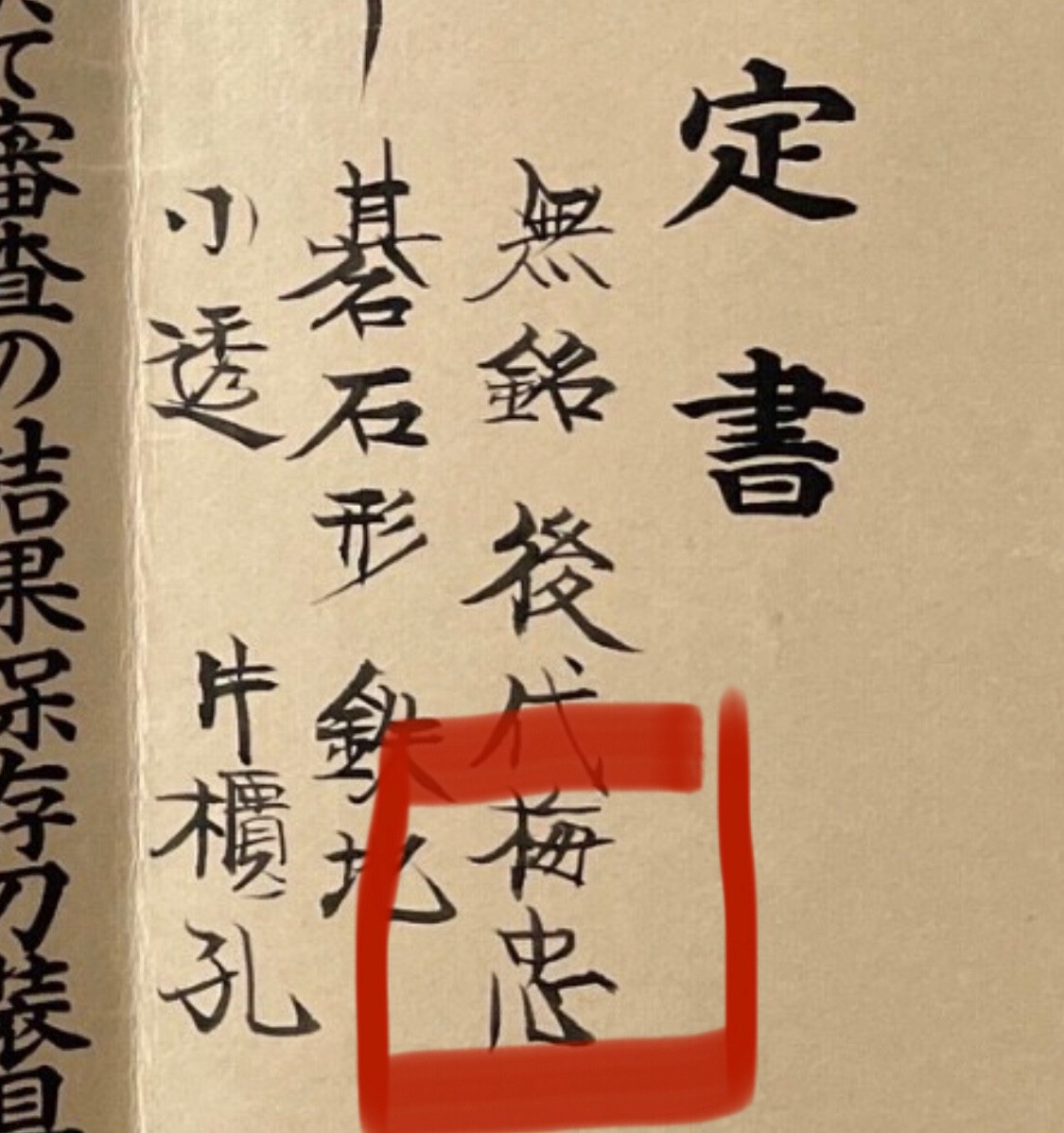
The tsuba is mumei. What do you see on the papers? The tsuba is already sold, but I’m happy to have the correction. I thought these kanji were Umetada:
-
Two nice iron tsuba (Umetada and "Nobuie")
Katsujinken replied to Katsujinken's topic in For Sale or Trade
I admit the handwriting is a bit funky, but I do see 埋忠 (as did the Japanese dealer who originally sold it to me). We’re all fallible though! -
Two nice iron tsuba (Umetada and "Nobuie")
Katsujinken replied to Katsujinken's topic in For Sale or Trade
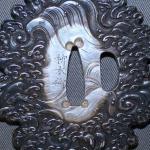
Hi Jason, The sukashi (cut outs) are gourds, and the engravings on the plate are grape leaves. Thanks! Michael -
Advice on a potential purchase
Katsujinken replied to John F's topic in General Nihonto Related Discussion
I agree with Mark and Piers! -
Happy New Year … an explanation … and an apology !
Katsujinken replied to 16k's topic in General Nihonto Related Discussion
Sending all my good thoughts your way, JP! No apologies necessary. Be well. -
Two nice iron tsuba (Umetada and "Nobuie")
Katsujinken replied to Katsujinken's topic in For Sale or Trade
Bump for a happy new year! The later myochin tsuba ("Nobuie") is still available for $500. This should appeal to any martial artist as the grape leaves carved into the surface represent a play on the word "budo"! -
Is this Nakago alright looking?
Katsujinken replied to Misconstrued's topic in General Nihonto Related Discussion
A poor fake from a mile away. -
Our thoughts are with you, Guido!
-
Two nice iron tsuba (Umetada and "Nobuie")
Katsujinken replied to Katsujinken's topic in For Sale or Trade
Bump! When both tsuba are sold I will make a donation to the board. -
Is a date worth 1,000,000 JPY?
Katsujinken replied to Artorius's topic in General Nihonto Related Discussion
This thread reminds me of many conversations we’ve had on this board about the “danger zone.” Here’s one: But essentially, when you’re looking at blades between $10k and $20k you need to tread very carefully. -
Two nice iron tsuba (Umetada and "Nobuie")
Katsujinken replied to Katsujinken's topic in For Sale or Trade
The Umetada tsuba is sold. -
Two nice iron tsuba (Umetada and "Nobuie")
Katsujinken replied to Katsujinken's topic in For Sale or Trade
Bump! Open to offers. :-) -
For me, I love having physical copies of especially important references—the kinds of things meant to stand for decades or more. Nihonto Koza, Fujishiro, books with very special photography. But for anything more ephemeral than that, digital is just fine. I’m already drowning in (and way behind on reading!) the monthly NBTHK magazine as it is. :-P
-
Wonderful! What a fantastic horimono. I hope you can get it polished one day and set up to rest in a comfy shirasaya. Great find. The blades are lucky you found them.