Spartancrest
-
Posts
3,813 -
Joined
-
Last visited
-
Days Won
102
Content Type
Profiles
Forums
Events
Store
Downloads
Gallery
Everything posted by Spartancrest
-
Is it possible to see the opposite side of the guards - I notice the drum one is shown with the ura view and not sure of the first top row - unusual thin hitsu.
-
I personally can't wait till the next sequel to come out. It is for the more advanced collectors - "Tsuba - in your blood!"
.thumb.jpg.141acfbfc69c9dde934cde6450c98791.jpg)
-
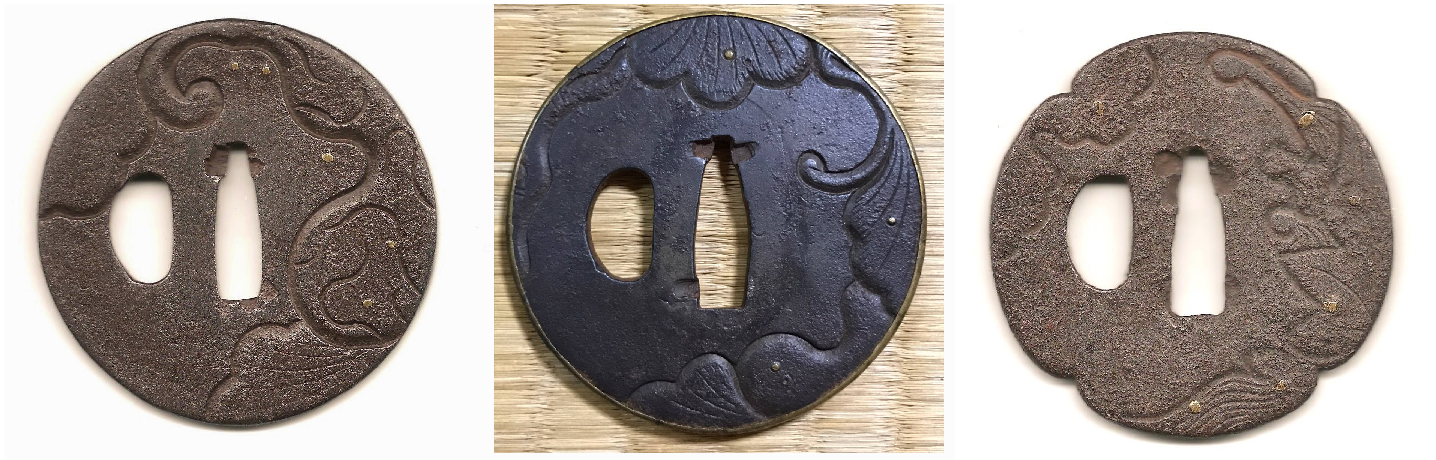
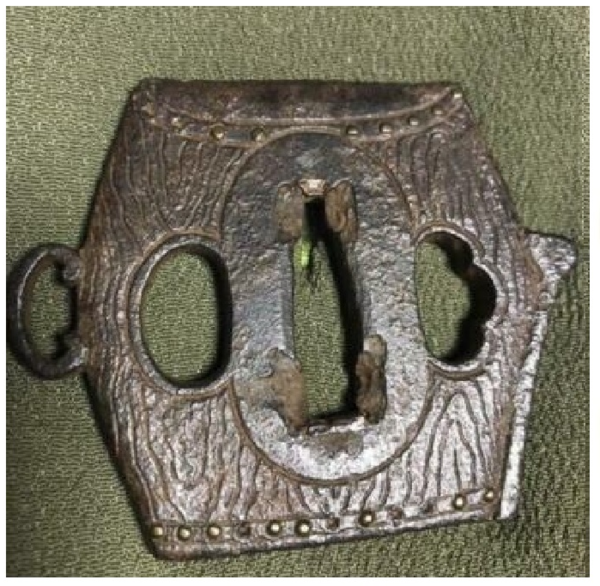
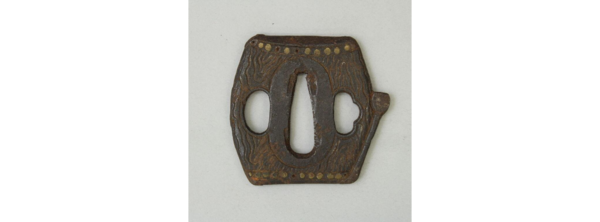
Well I can tell him that the second top one [Taiko drum] has a similar one in the V&A [Victoria and Albert Museum UK.] that one does not have the handle on the side. https://collections.vam.ac.uk/item/O462573/tsuba/ Also close to one of my pieces which has the handle and a drumstick on the opposite side - looking like a spout of a teapot. Unfortunately I can't say what school or maker made it - nor can the V&A . But a wild guess going with the ten-zogan inlay it is possibly Shoami? The left bottom one could be Soten or at least Hikone-bori. The bottom right is Hizen or Namban. I have not seen many Namban in that shape.
-
I will send you a PM with his email.
-
Colin, you are right - but the dot inlay is difficult to see [that's my excuse anyway ] I wonder if there was more inlay that has fallen out over time? It is pretty common on older pieces. By the way two of the examples I sent are mine - they may be 'low grade' but I think they are honest and I rather like them.
-
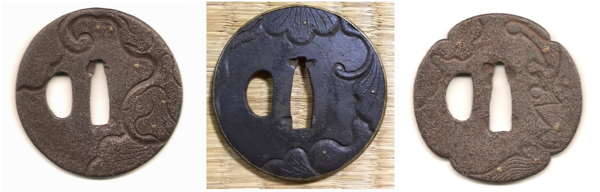
I think it may belong to this group- what I have always thought of as low grade Shoami [I could be wide of the mark] they usually have some ten-zogan and very simple designs, yours looks even simpler and just punch marks rather than ten-zogan. An ebay signed example https://www.ebay.com/itm/334182104384
-
Considering a lot of 'good' nanban was cast and then worked on - I think yours is worthy of further study. There is no tagane-ato marks, how tight does the tsuba fit the nakago? Some edge shots, side on would help or side views of nakago-ana and hitsu to see any casting seams but on soft 'brass' these are easily filed smooth so these may not be evident. [Soap and water have improved the look a lot ]
-
Bruno, there is a remarkably similar guard in the Cleveland Museum of Art, number - 1919.258. Theirs is described as "(Soten type)" which is not very helpful as it too is not signed.

-
Hikone would be my guess - check this link, the guard shown even has the same mimi type. https://www.samuraimuseum.jp/shop/product/antique-Japanese-tsuba-t-69/ Hikone often have slightly larger figures than Soten and less inlay - they are both forms of Maru-bori literally “round carving". The style was so prevalent that it was also called Hikone-bori
-
https://cookingwithdog.com/recipe/sweet-potato-kintsuba/ try making your own!
-
This one is a little rough and ready -

-
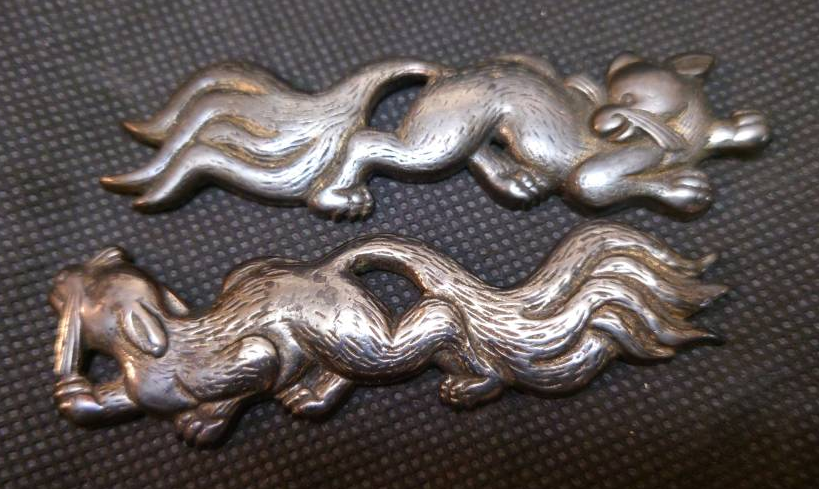
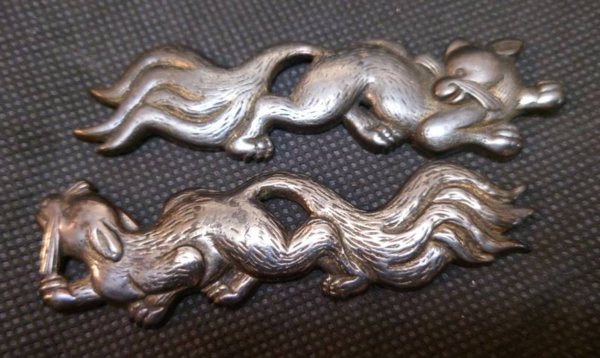
Some similar ones to those found by Franco D. https://www.jauce.com/auction/n1050471823 I am not an expert on menuki but the underside doesn't look right to me. The image shows clearly the animals thick whiskers and an improbably thick and wavy tail - no spots.
-
This is hardly tosogu but it might interest a few members. "Kin-tsuba is a Japanese confectionery made in the shape of a sword guard. It originated in the Kansai region during the Edo era, where it was also called gintsuba (Japanese for 'silver sword guard') after its white colour. Covered with rice flour when baked, this delicious confectionery has a filling of sweetened and crushed beans. When it was brought into Edo (modern-day Tokyo), wheat flour dough was used to cover the filings and obtain a golden colour when baked, with the belief that gold brings more luck than silver. While you can buy prepackaged kin-tsuba at station booths, the best ones come freshly baked at popular local shops. The cakes are soft on the outside and a little chewy, accompanied by a memorably rich taste from the filling. Product demonstrations sometimes take place at certain department stores, so keep on the lookout."


-
Could this fuchi be a match to your habaki? I realize the stacked stone pattern is not as deep. https://www.jauce.com/auction/s1045753360
-
Harking back to Jon and Piers description of Gotoku Futaoki. This guard in the San Diego Museum of Art shows one, with other implements of the tea ceremony. [image has been enhanced] That museum has some of the worst images you can find, the photographer was not really interested in showing off the collection - dark and taken at odd angles and images of the ura rather than omote. The site is worth seeing if just to show how not to capture images for future reference. https://collection.sdmart.org/objects-1/portfolio?records=50&query=mfs any "tsuba"&sort=9


-
 Brian your criteria for collecting are the best reasons there are ! I hope you never lose those feelings.
 -
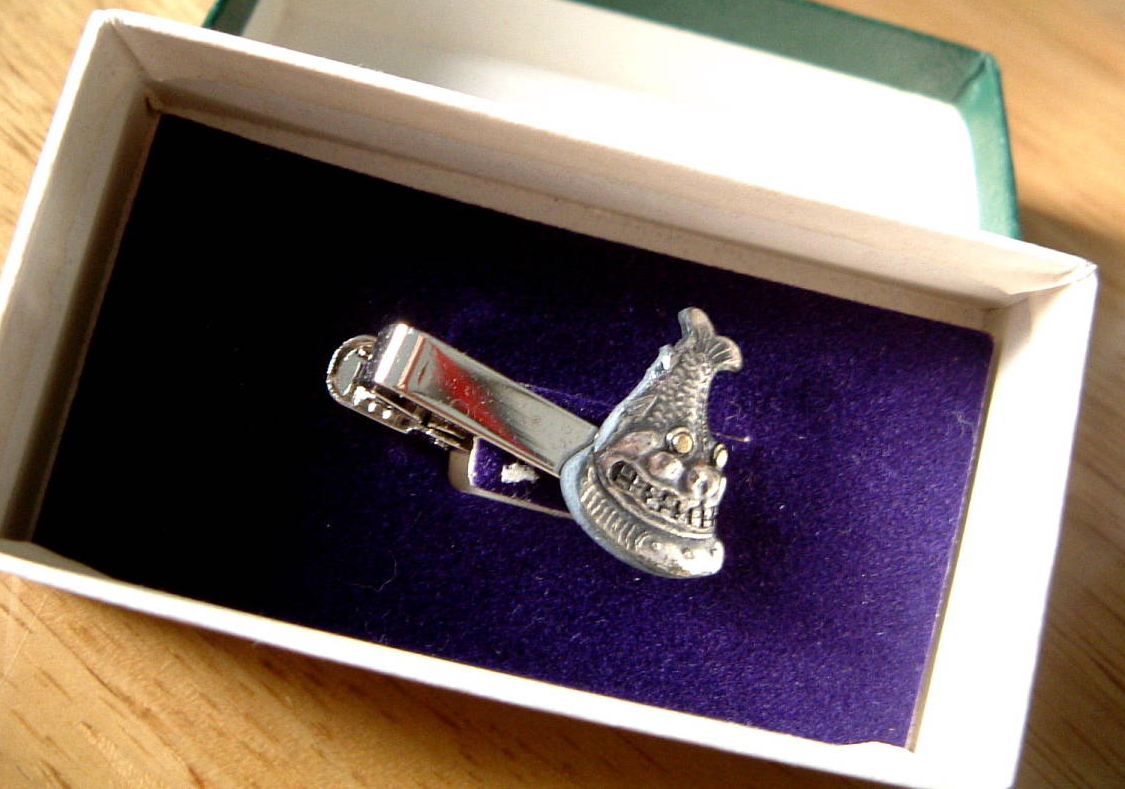
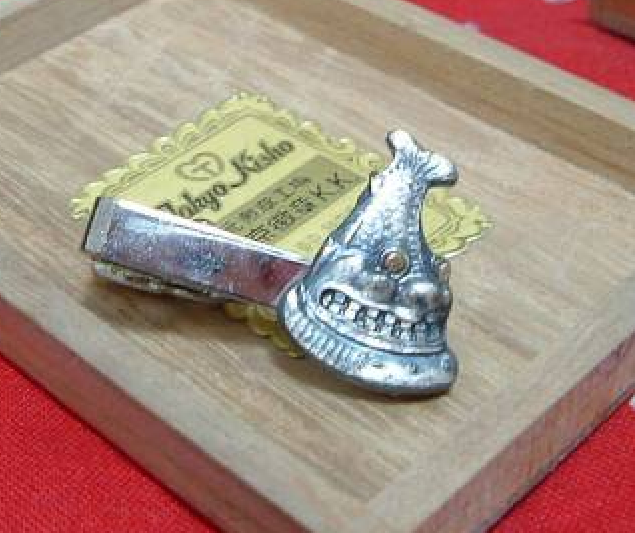
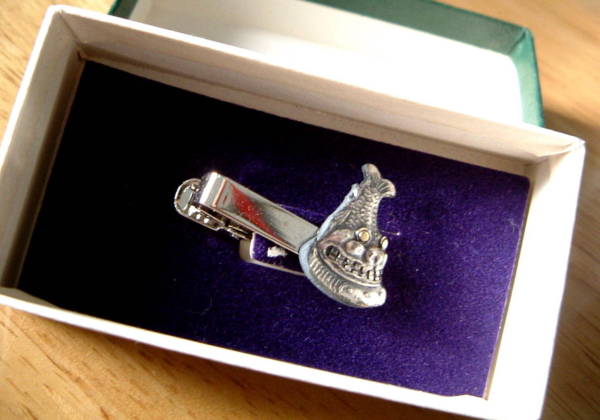
Would you believe two of these going at once? This one is described as "Showa Retro Shachihoko? 1968 Taito-ku Kendo inscription tie clip" https://page.auctions.yahoo.co.jp/jp/auction/398876473 It looks to be in better condition. What would be the chances of two tie-pins from the one 1968 Kendo tournament selling at the same time? [What would be the chances of me finding them to fit in this thread? ]
-
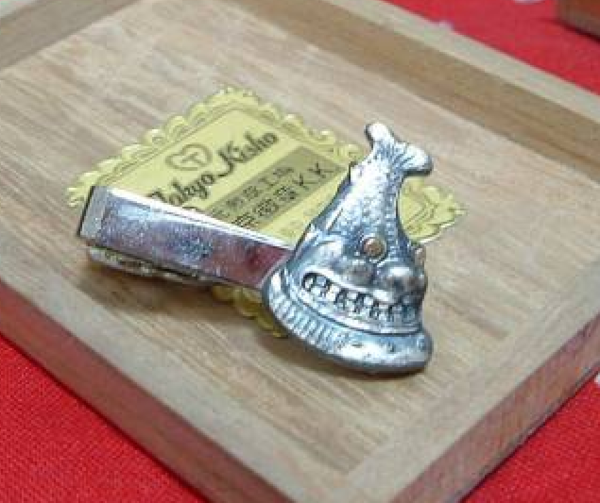
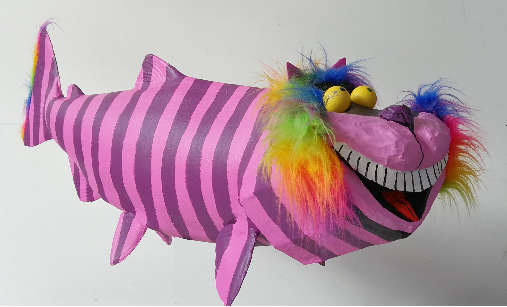
Now I am not sure this is a Shachi, but if not, what is it? A Kendo tie-pin from 1968 - https://www.jauce.com/auction/l364447901 It might be the Cheshire Cat-fish
-
Glen that is a much better image - yes the same guard, signature is much clearer. 10X the price! Wow what a difference a good clean can make!
-
but I forgot to show the padded cushion to stop contact between the lid and base tsuba. It makes a good handling sheet as well, all my own work. [You can tell I am no great seamstress!] The fabric was sent to me by my son's fiancé from Japan.

-
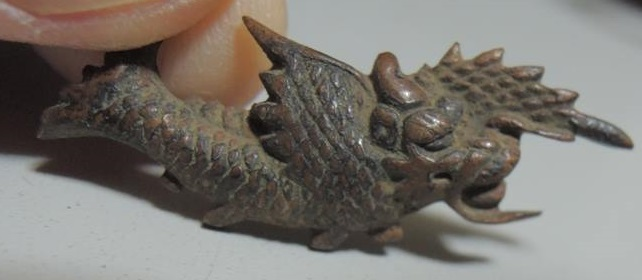
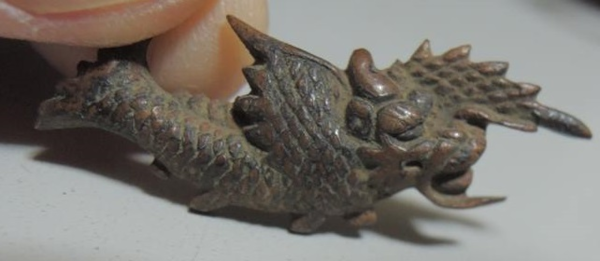
Back to the beginning of Barry's post - Shachi menuki. [or at the least a kata-menuki] https://www.jauce.com/auction/h288259783 It says that it is in Shakudo but from the colour it looks like bronze.
-
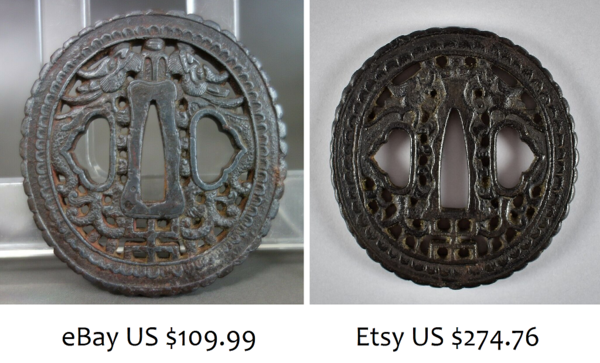
If there is one thing I have yet to work out, it is why some pieces sell for such high prices and another virtually identical will sell for next to nothing. From similar examples selling at the moment you paid a little under the market but it is very subjective. In an open auction two or more people can get carried away but a fixed price sale is a little different - the market will like the price or it will still be for sale years into the future, I can show you examples of over priced pieces sitting in a dealers shop for over ten years! Ebay has a few namban dragons - https://www.ebay.com.au/itm/275198438438 not too far off your price. But in my opinion this one is not as good as yours. These almost identical namban [cast at that!] have a big difference in price, you would be hard pressed to work out why! [especially when they are available from Japan for around $30! https://www.jauce.com/auction/f1036357306 ] But your example is far better than these.
-
Great Pietro it is a handy go-to. I bought a facsimile book version a few years back from India it is not too bad to look through - its one major drawback was the transparency pages with the guard numbers were not printed, so it was very difficult to work out which attribution applied to each picture. The PDF at least has these numbers. The cheapest copy is around $30 [you can than insert the image numbers]- The original book is getting close to $1,000. US. at that price I would be afraid to open the cover. https://www.abebooks.com/servlet/SearchResults?isbn=&an=joly henri&tn=Japanese sword-mounts collection hawkshaw&n=100121501&cm_sp=mbc-_-ats-_-new
-
Well Brian for $100 - you got a great piece! Anything really worth while these days are much more expensive - I keep saying even Chinese fakes are more expensive than that. I see it had been fitted at one time with sekigane, now gone, so to my mind it says it has been mounted at least twice - might help explain the heavy tagane both sides.
-
Well I think you got a bargain! Undercutting of the tendrils, scales of the dragon are very fine. It does look late and Japanese - the design has formed the hitsu, they were not cut through later like a lot of namban made in China were. If you look at some of the fakes getting sold you really did well! [I would have liked a bit more focus on the images - they make my eyes water ] I am not sure what the little line on the mimi tells us, is it a casting fault, a later scratch or a slip of the chisel?

.jpg.1d153f7486e9b18fe3ee1c408d86de70.jpg)