Spartancrest
-
Posts
3,703 -
Joined
-
Last visited
-
Days Won
100
Content Type
Profiles
Forums
Events
Store
Downloads
Gallery
Everything posted by Spartancrest
-
The words "minimal protection" spring to mind. On the example above the guard would be close to the size of the shaft itself. The orientation of the guard must come into the discussion. We know that the guards are always oriented as the first example - but if it was to parry an opponents blade surely the other orientation would work better. I think in the case of naginata the guard is more likely to simply serve as a stop when fitting the saya.

-
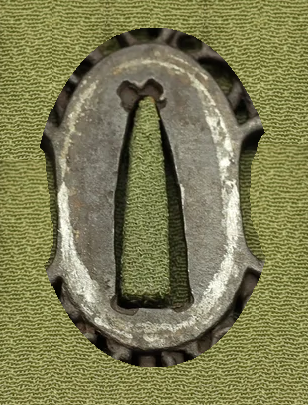
Someone needs glasses! Glen might be close to the mark - it does look like it has been blown to bits! Etsy have a better one - NOT https://www.etsy.com/au/listing/1106553329/tsuba-very-distinctive-shape-eyoju The scrap metal price is outrageous! 'Distinctive shape' alright! With a little modification you could turn this one into a daisho of the other one! [it is a bit of a rushed job. ]

-
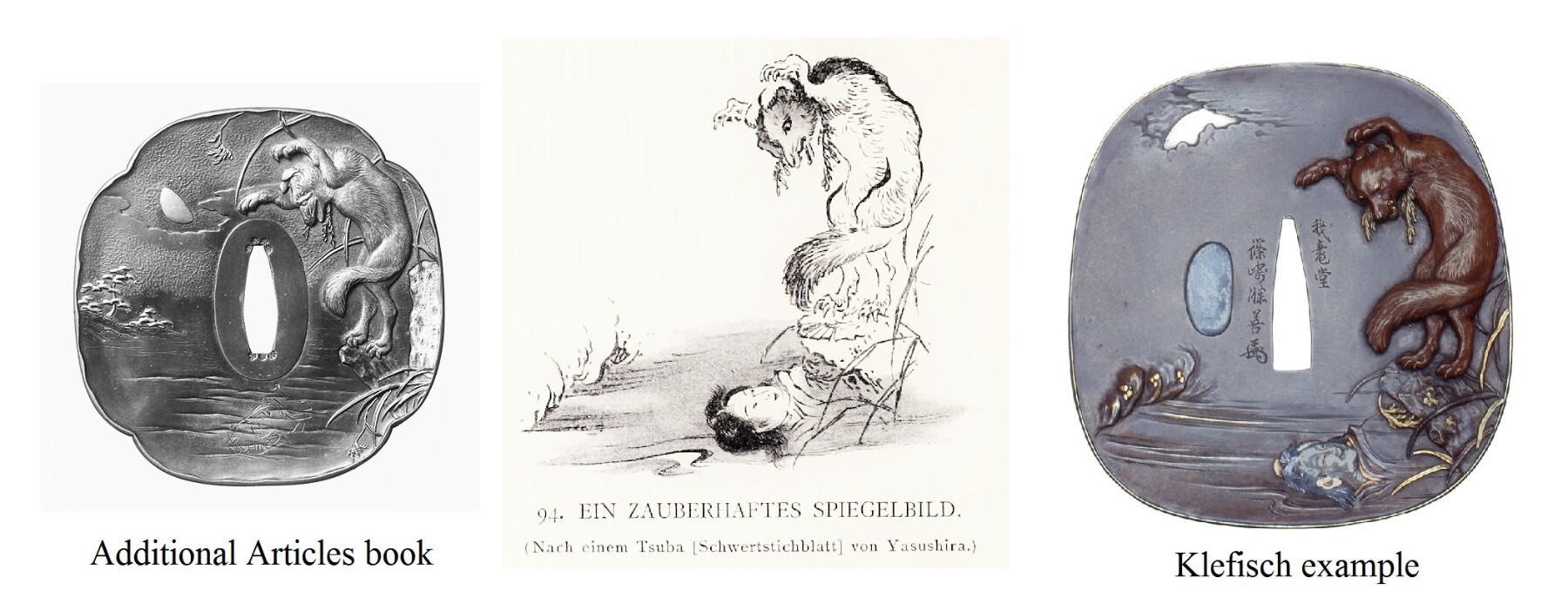
I already made use of one of their images. It is a variant of a design I have in one of my books.

-
There is an auction running now with a Naginata bare blade [cut] which shows the plain small guard mounted and un-mounted. https://www.jauce.com/auction/k1036264492 I can't see any use on a Naginata for having hitsu-ana on the guard. How was a Naginata carried? Surely kogai & kozuka would fall out when the weapon was carried vertically. However I am sure some guards were recycled, just not made with hitsu to fit a Naginata.

-
Please be aware the images are under copyright, I had the occasion to contact them to find this out. Great reference though for a huge variety and possible source for provenance on sold pieces.
-
Semegane are reinforcing bands on the saya to prevent the saya splitting. They can be made of a number of metals, early ones in iron others in bronze or copper alloys. https://www.worthpoint.com/worthopedia/Japanese-edo-period-samurai-sword-3772390771 an auction description and images of two iron ones. https://www.worthpoint.com/worthopedia/edo-yari-semegane-tsuba-katana-yoroi-172705105 a reinforcing band for a Yari https://nihontoken.wordpress.com/2012/03/17/rare-nambokucho-saya-koshirae/p1090977-3/ Double semegane

-
Ding dong - https://www.jauce.com/auction/v1016196295

-
When you see a namban like this - run, run, run! Same design as Glen's first example but it came out of the mold a bit different. I know, I know!

-
Can anyone spot the difference between this - - and this- apart from the scratches? Answer is 30,500 yen https://www.jauce.com/auction/q1025366646 + https://www.jauce.com/auction/k1036012236 Ok so what about this one compared to this one Answer is 48,600 yen [the rusty plain one is the more expensive!] https://www.jauce.com/auction/t1035229661 + https://www.jauce.com/auction/w1035433253 Talk about price gouging these two designs are just the tip of the iceberg when it comes to modern fakes. I have to give thanks to Roger Dundas who sent me an example of the gilded guard [same as that at the top] to examine.


-
Les, any images with a similar seppa-dai? I had a look but can't find an example. Also what about the niku around the hitsu-ana, any Higo like that? Comparable images might help Soren to narrow it down. I am not an expert on either school so I am just going on visual similarities. Wouldn't brand names have been helpful!
-
Soren, in the case of your example it is the shape of the seppa-dai that points toward Hizen. Hizen are often confused with Namban/Nanban from whom it is believed Hizen drew their designs. Not all Hizen had this Namban style seppa-dai but from what I can find Higo never had Namban style seppa-dai. So your piece would fit Hizen from the shape of seppa-dai - if you had one with a standard Japanese seppa-dai we would still be debating which school to attribute. More knowledgeable members feel free to correct me!

-
Hizen school also from me - which is good, it is made in Japan and not a Chinese or Southeast Asia import. Like Dan says great pictures and its a nice guard.
-
Stephen, there would have been a few members out there who had never even been born when that song came out. [1979] You are right though it is darn hard to get it out of your head once it is in there! [and it's not a favourite either!]
-
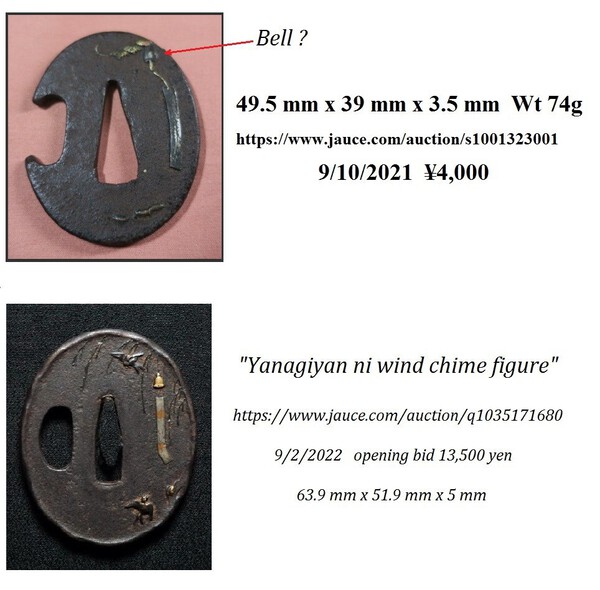
Thanks Piers that is a very comprehensive link. From what I gathered, the wind chime could be seen as a place of sanctuary from evil influences.
-
Practical use for an antique - thanks Jesse!
-
I just received a little tanto guard with a wind chime motif on it and noticed another still listed for auction. Has anyone seen this motif before and can anyone tell me the story or legend of the wind chime in Japan?
-
Dan [and others] there is some information on the The Techniques of the Japanese Tsuba-Maker by Elaine I. Savage and Cyril Stanley Smith [1979] here - https://art1lib.org/book/27951721/79fc1b also found here - https://archive.org/details/arsorientalisar111979univ/page/n1/mode/2up?q=tsuba but you will need to scan through to page 291 An interesting analysis of tsuba construction carried out on vandalized tsuba - who gave their lives for science!
-
Thanks Geraint, you may have solved two questions for me. I bought a gama-hada kogai several years back and when it arrived I was surprised at how small it was - I assumed it was made for a boys koshirae, but it would fit a tanto very well.

-
Jesse, frankly hitsu-ana always seem weird on a tanto to me. You mean the different sizes? From having it in hand I can see the cloud carving going slightly down into the hitsu and nothing but the ishime either side of them so I think they were done that way originally and not cut in later or enlarged. Why the two sizes - no idea. Maybe a way to tell which side to mount? I can't help noticing the tagane-ato one side neat and precise the other a bit more forceful deep and heavy. You don't usually see punch marks both sides but it does happen. I am not too concerned, it cost less than a Chinese fake and I am sure it isn't.
-
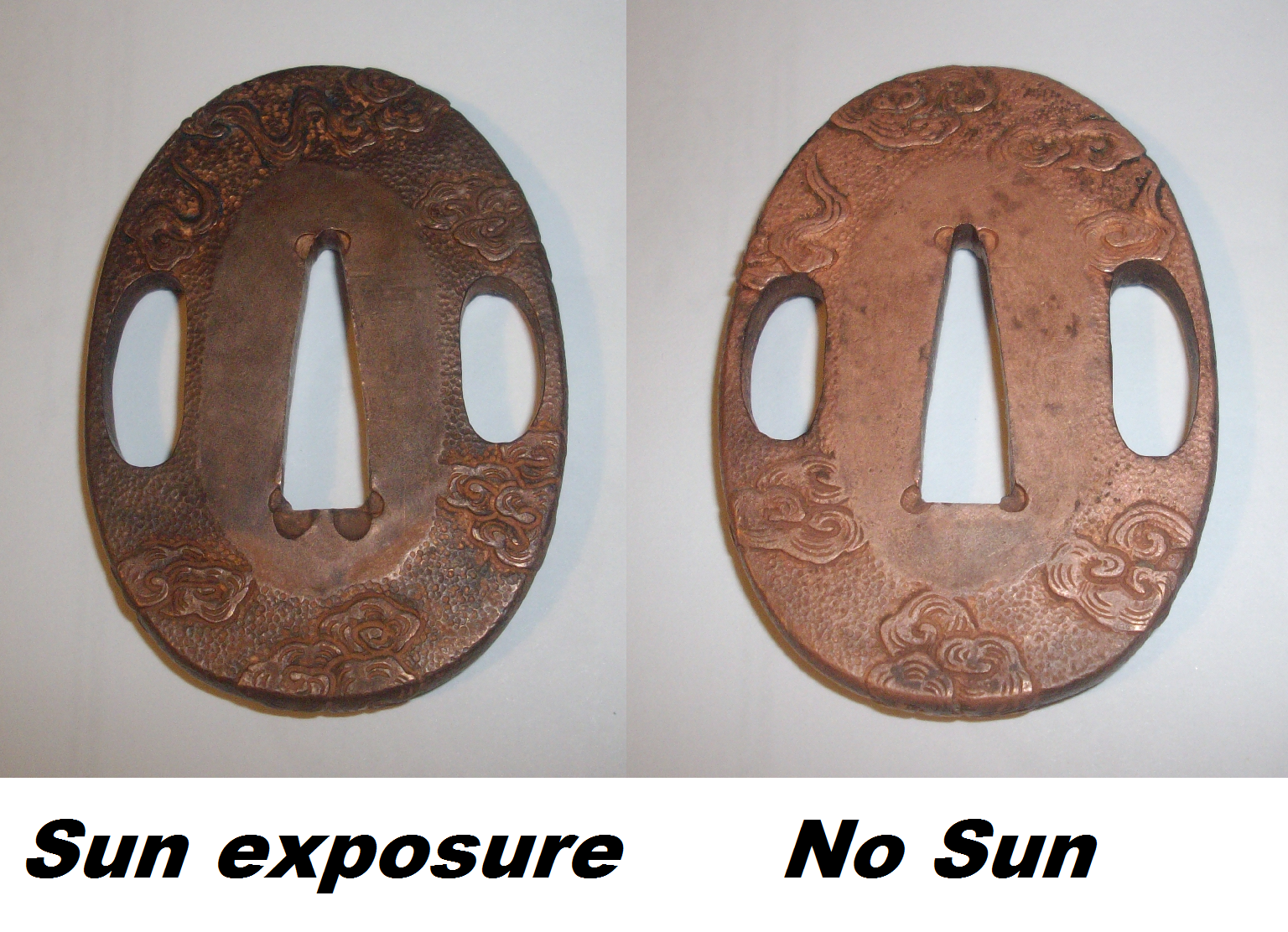
Thanks Bjorn, I suppose almost all alloys vary a little in colour. Whichever alloy it is, it has continued to darken slightly and only in a few hours 8 > 10 hrs. I left it on a windowsill all day in the hot sun and that side is distinctly darker than the other, so there must be some chemical reaction to sunlight or U.V. Does metal develop sunburn? I do hope it doesn't get melanoma and go back to black again! [unless it turns out to be Shakudo]

-
I just got this very cheap tanto guard - basically no one else wanted it. The condition as advertised was pretty bad but I do like a challenge. I can easily presume that anyone seeing the auction would think it was a cheap Chinese copy but in hand you can feel that it isn't. Somewhere in the past someone though it a good idea to blacken it with candle soot(?) or something else, perhaps making it look like iron. I have spent hours cleaning the soot off. Whatever it is, it has the consistency of tar in spots. I finally resorted to citric acid [from the pantry] this seems to have worked well. [Another method I found on-line was to use lemon and salt but I was out of lemons!] I fully expect the guard will darken up over time but won't attempt to 'hasten' it along. There is ishime over the entire surface, other than the seppa-dai and the cloud carvings extend over the mimi on both sides as well as top and bottom. When freshly cleaned it had a distinctly 'pink' tinge to the colour but has within a few hours started to darken to an olive bronze. Anyone got an idea what the metal is Shibuichi, Suaka, Sentoku or Yamagane? I now appreciate the difficulty some people have in getting clear images - mine are not too sharp.


-
Kiri mon is the prize in this set. Top two look OK to me as genuine but not top class. The 'rabbit' number four has me more worried, heavy tagane-ato in the nakago but not much movement of metal? A few 'soft' spots in the design that tend to indicate casting. [The bright spots around the seppa-dai on the first two - is that rubbing of the seppa, or a habaki sitting directly on the tsuba? Whatever, the two metals don't like each other.]
-
Welcome Jay. I think I would agree with Glen, that is a wide deep mei - I think it would fit in the "In the manner of" Naokatsu/Naoaki. The lighting is a bit harsh. I don't mind the overall design of the piece. The mei may have been added much later. Judge the tsuba foremost, then the signature. This is why. [Taken from another thread https://www.militaria.co.za/nmb/topic/38416-tsuba-casting-molds/page/2/#comments] Terry's Japanese Empire, including Korea and Formosa - 1919 [COPYRIGHT 1914] ...Terry, T. Philip (Thomas Philip), 1864-1945. "The latest art objects to attract the attention of the maker of antiquities are sword-fittings. Kozuka handles have been counterfeited for some years past, but it is only recently, we believe, that the forgery of tsuba (sword-guards) has taken place on really commercial lines. Until two or three years ago the only forgeries met with were those tsuba originally unsigned, but on which an enterprising dealer had chiseled the name of a famous chiseler or inlayer, often disregarding the fact that the work on the tsuba was quite foreign to that of the master whose name had been used."
-
Ken, practical experience always out does speculation - well done! When in doubt try it out! There was speculation in an earlier thread on this same subject, about the total failure of a sword if the tsuba was to be broken and falls off in a fight - it sounds reasonable but in fact the tsuka won't come apart from the blade if the tsuba is lost and the weapon remains totally serviceable. It is not hard to try it out just remove the tsuba and remount the tsuka, I have done it and it still works as a sword. If not, the tsuka is not fitted correctly and the mekugi has suddenly gone missing!
-
There are two extracts from old articles that may help with dates. They don't specifically indicate cast iron guards but do show that copies and 'reproductions' were well under way well before the 20th century. This also has the effect that these copies are now all 'genuine' antiques as defined by being over 100 years old [at least] Japanese ART INDUSTRIES BY ERNEST HART, D.C.L. Delivered May 20 and 27, 1895. London - I regret to say that a very large part of the ingenuity of the most accomplished Japanese art workers in metal and in lacquer is devoted to the reproduction of clever forgeries. When I was in Japan I went to the shop of a very distinguished dealer. He showed me many hundreds of objects, and out of these he guaranteed four hundred to be genuine, and gave a written certificate to this effect. After casually looking the things over, I had them sent to the hotel where I was staying for further examination. I had then a good look at them, and found the result so unsatisfactory, that I sent for two of the greatest experts in the town, with the result that we found only five of the pieces were really genuine. While in Japan we had the advantage of the services of the Governor's secretary, so I arranged that this gentleman should come and meet the dealer and hear what explanation he had to offer, which was very long. We then asked him how it was he had certified that some 400 of the objects were authentic of which only five were genuine ; we pointed out that either he had been going on selling forgeries for years, or else he did not know his business. He replied with characteristic Japanese courtesy that he was much obliged for the information we had given him, and finally made the following concise and comprehensive apology :—“Old objects very few, buyers very many, my eyesight very bad." I communicated with the Minister of the Interior and suggested that it should be made an offence to forge well-known names on curios, but it was explained to me that in Japan there was no such thing as forgery, as a man may use what name he likes. It is however an offence to copy a seal, but that is only an offence against the living and not against the dead. Terry's Japanese Empire, including Korea and Formosa - 1919 [COPYRIGHT 1914] ...Terry, T. Philip (Thomas Philip), 1864-1945. "The latest art objects to attract the attention of the maker of antiquities are sword-fittings. Kozuka handles have been counterfeited for some years past, but it is only recently, we believe, that the forgery of tsuba (sword-guards) has taken place on really commercial lines. Until two or three years ago the only forgeries met with were those tsuba originally unsigned, but on which an enterprising dealer had chiseled the name of a famous chiseler or inlayer, often disregarding the fact that the work on the tsuba was quite foreign to that of the master whose name had been used."