Spartancrest
-
Posts
3,949 -
Joined
-
Last visited
-
Days Won
107
Content Type
Profiles
Forums
Events
Store
Downloads
Gallery
Everything posted by Spartancrest
-

Cheap Tsuba - heavy iron base with nice incrustration.
Spartancrest replied to Marcin's topic in Tosogu
I agree, it is a strong contrast to the rest of the decoration - it wouldn't look so good on a polished plate. -
A set of fitting here with very similar punched surface [like reverse nanako?] https://www.jauce.com/auction/r1231118933
-
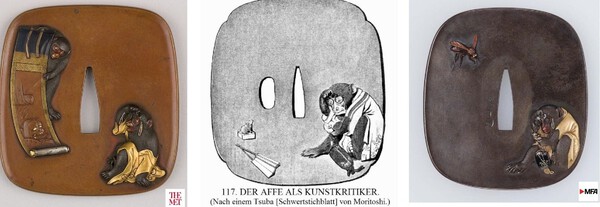
Even the fake monkeys wore glasses - I wish I could un-see this one!
-
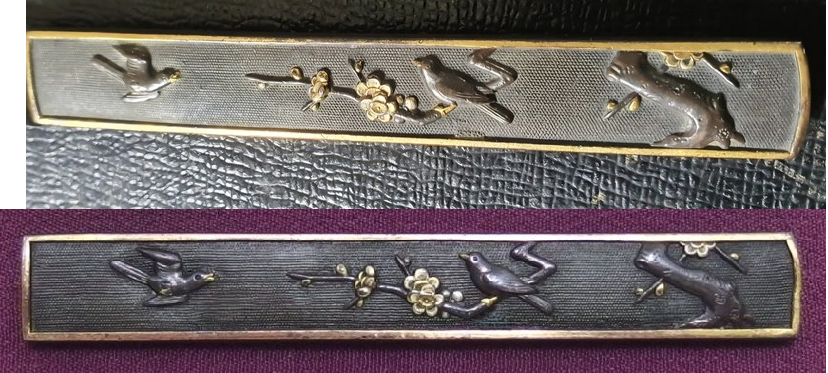
Two different metals, one each side Two different metals, one each side Four different metals, two each side. These examples from the Metropolitan museum
-
Cheap Tsuba - heavy iron base with nice incrustration.
Spartancrest replied to Marcin's topic in Tosogu
Beautiful - I think the price is right! Sakura falling on rafts and water, then switching to Chrysanthemums beside a stream I love the bold shape.
-
Nunome Zogan: From this reference Nunome-zogan is NOT originally a Japanese technique - however they certainly mastered it Nunome Zogan means cloth weave overlay and uses very thin foils - 0.02mm thick and the gold is attached to the base metal by creating a cross-hatched ground made with chisels. Around 7 - 9 chisel marks per mm created in three different directions at 45 degrees to each other. The technique is a type of Damascening that was introduced to Japan by the Portuguese in the 16th Century. The technique was originally used on Iron and Steel to decorate weapons although more recent practitioners have expanded this to include copper, brass and sterling silver. https://www.sandrawilson.co.uk/blog/nunome-zogan https://www.scribd.com/document/439904095/Numone-Zogan

-
What is this then? is this related?

-
https://emuseum.cornell.edu/objects/18527/tsuba-with-pierced-design-of-6pointed-star-inlaid-with-squ similar technique? But the only others are in the Ashmolean museum and are listed as various offshoots of Shoami school - and that is a pretty general attribution as we all know.
-
How about Jauce? https://www.jauce.com/auction/s1233055547
-
https://auctions.yahoo.co.jp/jp/auction/u1224612069 Comparing the two: very, very close but not identical as far as I can tell. The reverse side is markedly different with the striation marks all over the place on Bruno's

-
Reminds me of a local baskeball club -

-
I think I have seen these before? I have an image of one with the rim removed. A common theme but each seems unique?

-
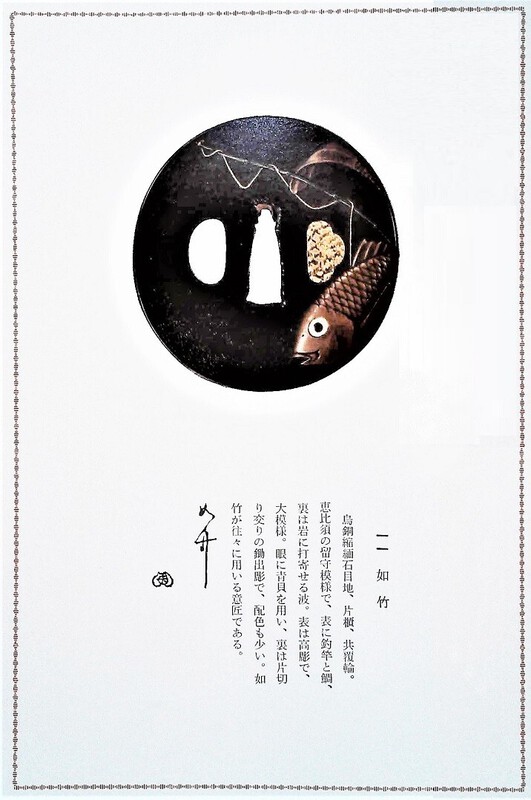
Another example pretty close to the original image.
-
There are several examples where the opposite of what is actually shown implies something else. Mice amongst rice bails - implies wealth, only people with excess food have mice. Poor people don't leave scraps- so no food for rodents.
-
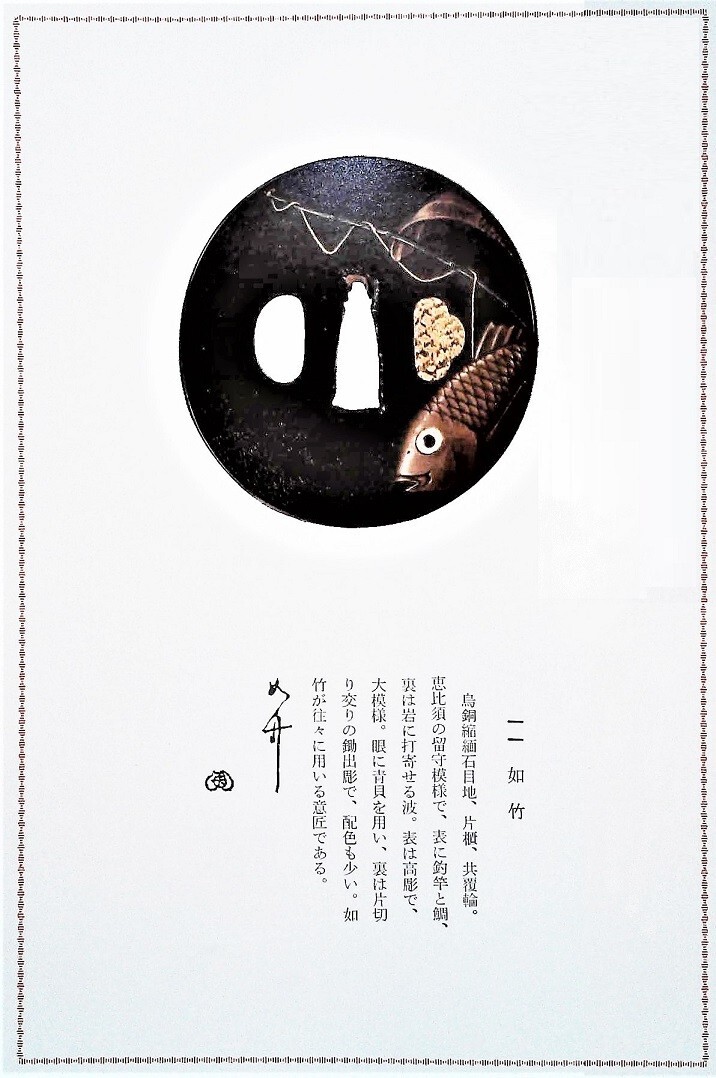
No doubt about the subject matter in this instance! Though the description of "Carp" might be questioned? [that is an ugly fish IMHO] OTSUKI MITSUOKI: A SUPERB INLAID IRON TSUBA WITH EBISU AND CARP, DATED 1803 Sold for €4,160 The image taken from a Japanese book I have - unfortunately not in colour and the shape of the guard is different. The design is not uncommon. From Google translate [very poor]. Ebisu is implied by his absence on the guard.

-
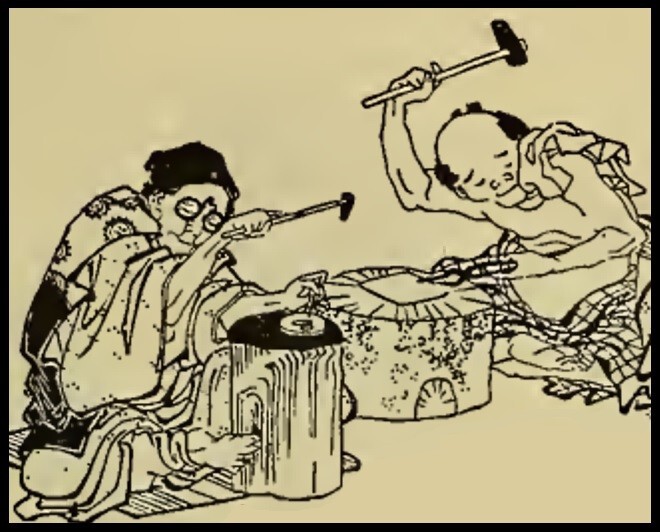
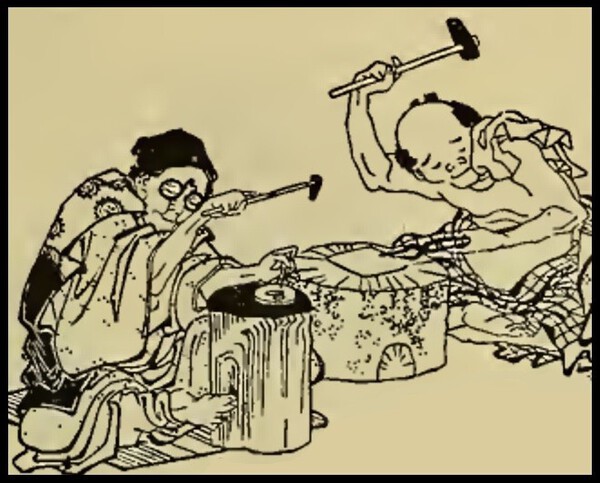
The tsubako artists have had glasses for several hundred years - as shown in this Edo period woodblock - also even the Monkeys wore them!
-
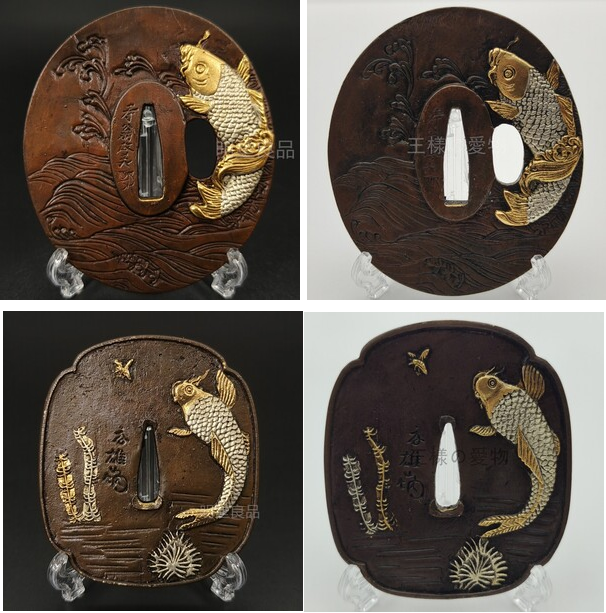
Various types of Ishime-Ji - by their very nature they tend to be "unique" Technique : Ishimeji base, Certificate :NBTHK hozon tosogu paper (Issued 24 December Reiwa 3(2021)) https://nihontocraft.com/Ko_Kinko_Tsuba_G.htm ishime ji. This tsuba dates to early - mid 1500s Tsuba with eagle searching for prey (NBTHK paper) Modern cast examples are not "unique" in that they are numbered in the hundreds if not thousands. It is a matter of finding multiple examples and comparing- I can't find another matching the Carp, but plenty of obvious fakes with a Carp theme.

-
What is the school of this tsuba ? Shoami or not Shoami.
Spartancrest replied to Fred420's topic in Tosogu
Interesting: there are two types of dragon represented. The one on the fuchi is a conventionalized "Rain Dragon" they have a bifurcated or double tail and a lions mane.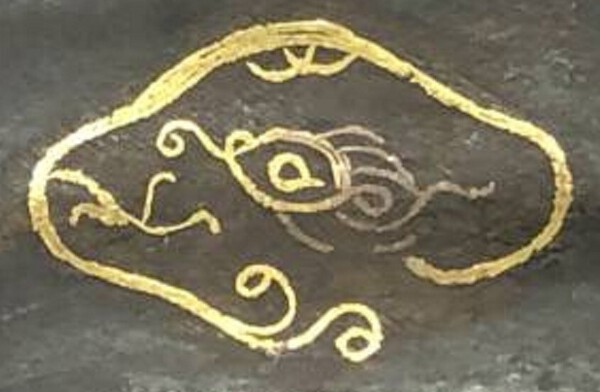
-
Tsuba in everyday objects - the culture of Tsuba
Spartancrest replied to Spartancrest's topic in Tosogu
One for the ladies - Obi. https://www.jauce.com/auction/e1217356383 an expensive but attractive Obi!
-
What do non-Japanese tosogu artisans sign their work with?
Spartancrest replied to NotANinja's topic in Tosogu
Never trust Google to get it right! what about 名前のない馬 I'd stick with ロバート The kanji strokes are much easier to inscribe as well!

-
What is the school of this tsuba ? Shoami or not Shoami.
Spartancrest replied to Fred420's topic in Tosogu
Welcome to NMB Fred. I vote for Kyo-Kenjo [presentation] or possibly Higo style? Powerhouse museum - A5308-13 https://collection.powerhouse.com.au/object/182968 A Kyo-kenjo from Gary Murtha's book - notice the gold edging to the hitsu-ana and the seppa-dai
-
tsuba Signed garō-zu tsuba: Seeking information on maker
Spartancrest replied to tosogu_eu's topic in Tosogu
There is a history of half starved animals in Japanese art - I guess a rice diet doesn't agree with them? For goodness sake feed the poor things! -
What do non-Japanese tosogu artisans sign their work with?
Spartancrest replied to NotANinja's topic in Tosogu
I am no expert on kanji - I struggle with the crazy English language! But try these kanji ロバート Robāto I see problems translating surnames - even Japanese surnames can translate to "odd" word groups. 越前住 記内作 = Echizen-Ju, Kinai Saku But if you put this into google translate it comes out as "Written by Echizen Sumi" -
What do non-Japanese tosogu artisans sign their work with?
Spartancrest replied to NotANinja's topic in Tosogu
Perhaps Gustavo Hoefs could answer this? : He has done several works and adopted one set of Kanji [グー ] which is pronounced Gū. This is close to his pseudonym of Goo However he has had feedback from Japanese and others that leaving his pieces unsigned in anyway is ideal - a view I tend to disagree with. If you are proud of your work why hide it? Also an unsigned modern utsushi just muddies the waters and creates future problems of authenticity and provenance. No one would like their work to be lost or worse, thrown in as some sort of Chinese fake. My opinion is "You make it, you take ownership" JMHO -
Kannon tsuba by Kano Natsuo Halo figures, recent additions to older tsuba? A cross over from Kannon to the Christian Madonna - "Maria-Kannon" This syncretic icon was developed in the 17th century by the Kakure Kirishitan (Hidden Christians)