Bruce Pennington
-
Posts
14,332 -
Joined
-
Last visited
-
Days Won
171
Content Type
Profiles
Forums
Events
Store
Downloads
Gallery
Everything posted by Bruce Pennington
-

Attention Mantetsu Owners: A Survey
Bruce Pennington replied to Bruce Pennington's topic in Military Swords of Japan
Purely speculation, but I wonder if something like this might explain one of the Mantetsu waki on file. I have 2. One was clearly cut down to make the waki, as the mei is cut, whereas the other was clearly made as a waki with intact mei. Maybe someone had a damaged blade, like this one, and had a repair team or smith cut it down and make a waki from it. Cut down Original:


.thumb.jpg.16fc076fa45942850d7f40c7e97f3fcf.jpg)
-
Hmmmmm..................... This has all the appearance of one of the post war souvenir gunto made by the Tenshozan Factory. Read this ARTICLE ON THE POST WAR SOUVENIR. But the souvenir, until now, always had a rounded steel tsuba, and more gilded metal fittings. It's only a guess, but my thinking is that it's one of the first versions of the souvenir. There's certainly a chance it's a late-war gunto. The only thing not "army" is the black fabric same'. But I've seen a good number of these and the overall look is of the souvenir gunto.
-
Celluloid Same of WWII...and Type 3 mon.
Bruce Pennington replied to george trotter's topic in Military Swords of Japan
Not sure why I had earlier posted that my only gunto with celluloid was that RS, because my 1941 Mantetsu has it as well. Like George's, mine hasn't yellowed, just some aging patina. The yellowing of some may be due to amount of exposure to the elements? I have seen celluloid same' in various years, but they do seem to appear more in the last couple of years of the war. This may be due to a military order for all weapons makers to avoid using animal products, due to shortages. Nick Komiya posted the order on Warrelics (don't have the link at the moment).
-
Thanks Thomas! I had the 2 '44s, but they aren't star-stamped. I've added the star-stamped '45. Interesting that they were making these earlier, but no star. Maybe someone at Korkura thought their blades deserved the recognition (i.e. his career portfolio) and submitted some blades to the RJT people for qualification? Or maybe it was someone distributing the tamahagane and realized the Kokura factory blades deserved the star? Wish we knew.
-
Right! So, no further speculation as to it's true meaning in life? Letter opener? Souvenir? Re-purposed kozuka? I'll start with the deer antler method and go from there.
-
Barry, we will need to see more pictures of the blade full length, a close-up of the blade tip, and better pictures of the handle fittings and hand guard to tell you for sure. Initial impression is a replica or Chinese fake. They like to stamp numbers on the blade and habaki.
-
Quite amazing beauty on your kozua! Here's some more pics of that "letter opener" of mine. I started wondering about the kozuka idea, but I doubt someone would put a mekugi and tiny shirasaya for that, right?
.thumb.jpeg.7977d4454168eb1dae0da8986ca8a817.jpeg)
.thumb.jpeg.2618265f041261f9d869edf1f2312e5e.jpeg)
.thumb.jpeg.a492de066fac205d9251ebcf6717dac7.jpeg)
-
Mei Translation Type 3 Gunto
Bruce Pennington replied to MacTheWhopper's topic in Translation Assistance
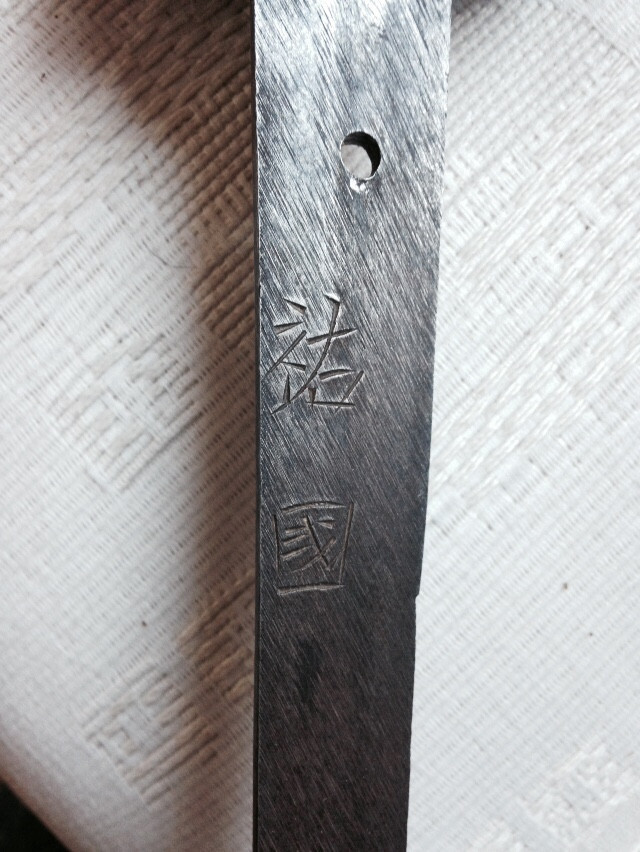
Kenny, I once owned a Feb '45 Sukekuni. I wonder why the box is missing around the kanji for the "kuni" on yours? Just another example showing that the Japanese weren't flawless perfectionists in their work! is yours in the standard tan fittings? Here's the mei from mine: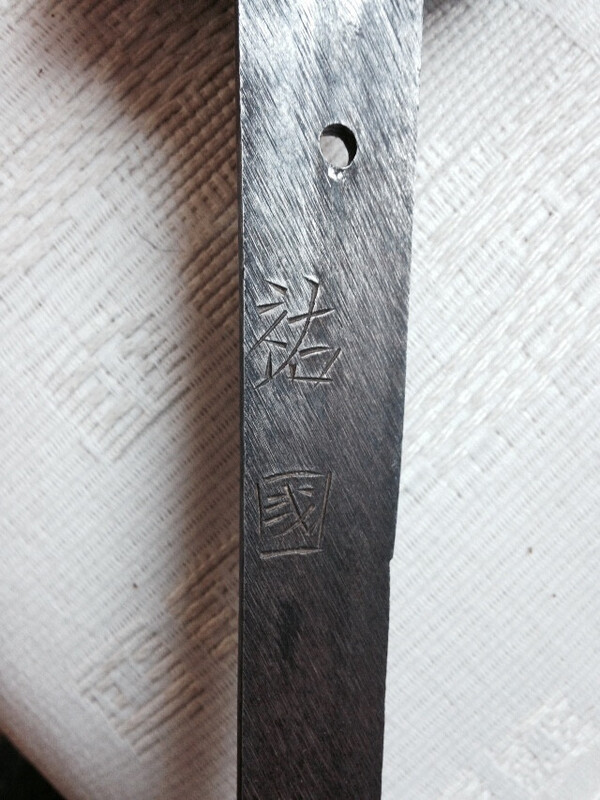
-
Ok, thanks guys! Not part of my normal area of study, but always good to learn new stuff.
-
Attention Mantetsu Owners: A Survey
Bruce Pennington replied to Bruce Pennington's topic in Military Swords of Japan
Thank you Trystan! Matt sent me this one yesterday, too, but I'm glad to see your thoughts on the "2" or "3". The center stroke is so slight, compared to the others, I was tempted to call it a 2. But I think you're right on that. Such a sad sight! The tsuba is quite interesting. I've seen a small number of fittings with the kana/number system used, but this one has the extra kana next to the Suya logo. Quite a puzzle. -
Here's a muromachi period blade, not Aoi, but relevant: https://www.Japanese-sword-katana.jp/katana/2210-1007.htm This one from 1864, you can see the careful cleaning around the kanji, but leaving most patina on the kanji: This example to me shows enough corrosion that my impression is that the nakago has been smoothed down. Not polished, just cleaned up. https://www.aoijapan.com/katanamumeiyamato-shizu/ And Edo period, again not polished, just cleaned: A Muromachi one: I just don't see any with ugly, corroded nakago. I guess I'm not seeing any on that site "polished", but I have seen polished nakago. Maybe it's being done by polishers in other countries?
-
Mei & Date Translation Gendaito
Bruce Pennington replied to Foo Dog's topic in Translation Assistance
Ray, I have 3 other star-stamped blades with this mei on file. Is the "kuni" a first name, Kuni Kanemoto? The RJT listing shows 3 Kanemoto, but none of them show "kuni" as a name. Thanks! -
Thomas, Can I get links or photos? I don't have these in my files.
-
Thomas, You just popped all my Circuit Breakers with this overload!!! Ah! First, I'd go with "May" Now this post-war report is confirming, clearing up our question as to the meaning or right translation of the Kokura 1st Factory inspector mark and 2nd Factory inspection mark. Right? Which also blows the Collectors' Urban legend that Kokura Arsenal didn't make swords, they were just an Administrative overseer for Tokyo 1st and Nagoya. Or are we distinguishing a difference between an arsenal making swords within the arsenal itself vs an arsenal that has 2 factories specifically made for them and making swords for the arsenal? Either way, we now have the actual name of the Kokura Arsenal 1st Factory! Ok, and now we have Star-stamped blades with a shop mei - Kasuga Workshop + Smith - and we have 2 of them, one by Fumitada (not listed on the RJT pages, Slough, nor Sesko), and Yasunori (also not on the RJT list). Now, Yasunori. Slough lists 2 - Kajiyama (High to Superior Gendaito) from Tokyo; and Kotani (Med to High grade Gendaito) from Hiroshima. Both used the kiri yasurime style found on Yasukunito. He doesn't mention the Yasukuni shrine operation for either of them. Any idea which Yasunori we might be seeing here? @mecox @george trotter - any help?
-
Show Us Your High Class Gunto
Bruce Pennington replied to lonely panet's topic in Military Swords of Japan
Annnnnd another black-painted tsuba! Convinced these were done by the original owners during the war, maybe even by the outfitting shops. Matt, those are normally seen as Roman numerals, so "46" or "64". Trystan was right in seeking numbers on the other fittings, as that is often the case. Yours might have been re-fitted after the marks were put there. It is also possible they are put there by the smith for his own purposes and the fittings shops simply piggy-backed on the number already present and used it on their fittings. -
Just seeking clarity, not vested in either side of the issue. So the polished/cleaned nakago in Aoi Japan sales - do you think they were polished outside Japan?
-
Japanese Type 95 Sword for NCOs
Bruce Pennington replied to Shamsy's topic in Military Swords of Japan
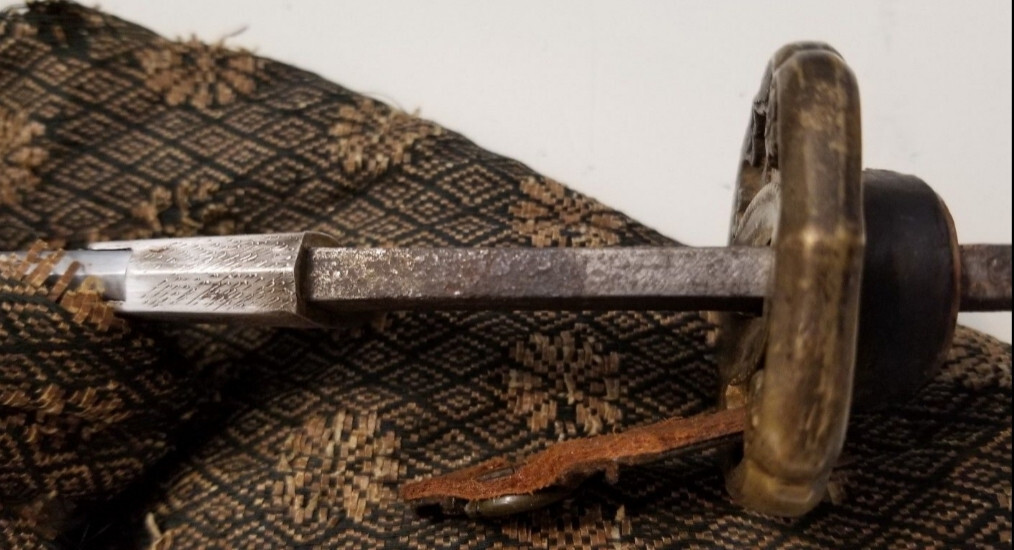
The photos aren't clear when zooming in, so there's no way to see the fine details of the tsuka. The only thing I wonder about is the sarute. It appears to be steel. Were there steel sarute? I agree about the leather. Appears to be quality workmanship. -
Japanese Type 95 Sword for NCOs
Bruce Pennington replied to Shamsy's topic in Military Swords of Japan
You’re right! That’s what I get for going by memory! A mind is a terrible thing to waste. -
Japanese Type 95 Sword for NCOs
Bruce Pennington replied to Shamsy's topic in Military Swords of Japan
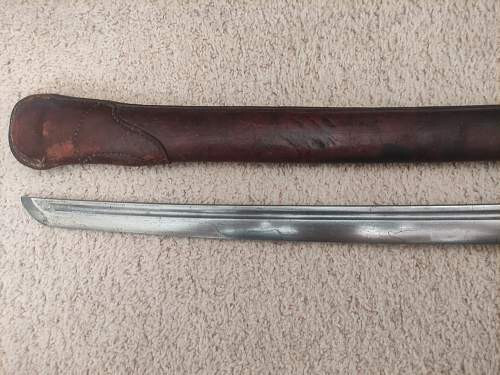
Steve, found this fully leather-wrapped Kobe 95 on this Warrelics Thread. Also interesting was the owner's observation that the tsuka details were poor, aligning with what we've learned that the Kobe shop losing their contract because of poor workmanship. It also has the double chevron or "W" stamp on the nakago!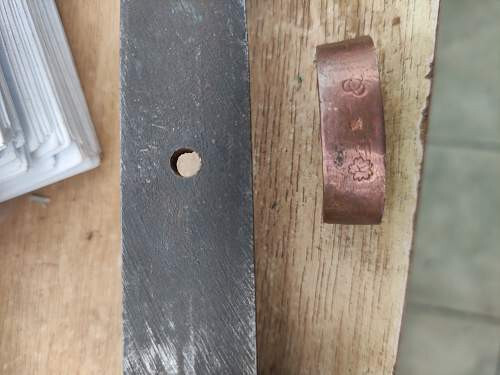



-
Posting some pics for posterity:


-
I understand the precaution to not mess with a nakago. The depth and coloration of the old rust, patina, helps in determining how old a blade is. But then, you send it off for polish, and half the time, most of the time?, the polisher cleans the nakago. I just browsed through Aoi Japan's blades, and half of them had the nakago polished too. Is there any rhyme or reason to when they clean a nakago and when they don't? And on top of it all, I don't see the harm in cleaning some kanji on the nakago mune. The entirety of the patina on the nakago sides are intact and plainly useful for dating purposes. Where am I off on that?
-
The second kanji looks like "9". Someone else will have to help with the first one. They are on the back edge (mune) of the nakago right?
-
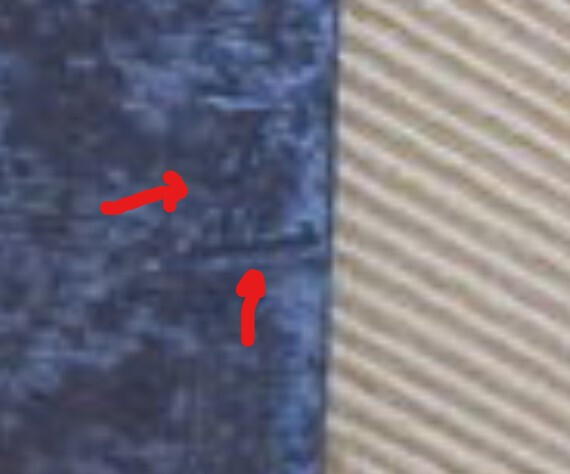
Is that just corrosion at the end, below the "868" or something stamped?
-
Type 95 Naval / Navy saya re paint
Bruce Pennington replied to robinalexander's topic in Military Swords of Japan
Just a note on that kaigunto, it's amazing to me the vast number of WWII gunto that show up on the market with those yellow cords. Bring-back gunto likely didn't come home in sword bags, yet these cords appear to be from sword bags. Puzzling to me. -
The steels mentioned in Nick's discussion of the star stamp weren't standard, every day steel. They were tamahagane and "bullet proof" steel. Don't recall if others were mentioned. My impression is that the steels gathered and distributed by the Army, thus receiving the stamp, were special, hard to come by, material. So I wouldn't expect the steel used in Type 95s to fall into this category.

.jpg.0894000cc25f22f382d3d0755cd61ecd.jpg)

.jpeg.ad159ae9cd8685a38544b5a2c48ed404.jpeg)
.jpeg.77ea7a96963f61b0ebc038cbb39562a1.jpeg)
.jpeg.482fdd06795a600098a666d3b83a0f09.jpeg)