Bruce Pennington
-
Posts
14,084 -
Joined
-
Last visited
-
Days Won
169
Content Type
Profiles
Forums
Events
Store
Downloads
Gallery
Everything posted by Bruce Pennington
-
It is! And I love your thinking. While we all recognize the beauty of a well-crafted nihonto, there are many of us who value every blade. When I hold a sword in hand, I see the many lives that went into making it - The smith and his apprentices, sure, but guys spent hours of their lives mining the ore; others spent hours processing it into steel; lives were spent producing ito, same', cutting wood for saya and liners; then more lives shaping it all into gunto koshirae. Transportation was hours of someones' lives. Then you have the shop owner, and likely his family, and finally the buyer, young newly commissioned officer or graduated/promoted NCO. Every one of them with stories, families, and lives. Each gunto is a snapshot of moments of all those lives - right in our hands.
-
Sure that's how the saying goes? I say "never trust Bruce with a file!" Ha!
-
Boy that first shot really shows the three different directions! I’m not a yasurime expert in the slightest. But that doesn’t look normal to me.
-
Inna, Date is Autumn of 1943. Are there numbers stamped at the end of the nakago? Anyting on the back edge (mune)?
-
This gets deeply into the whole question about the Sho and Seki stamping. It has been said in one of the old interviews that sometimes the stamp was done lightly to make it easier to move later. This observation would support the idea that the stamps only went on showato, and were there to say "This is a good quality showato." If so, then removing the stamp would allow a shop owner to sell, falsely of course, the blade as gendaito.
-
Mal, I see what you mean. I agree, but it doesn’t look new, it looks as aged as the rest. Do you think a shop owner might have had this done to conceal the stamp? Possibly to get more money for the sword?
-

WWII Katana - Return to Rightful Owner
Bruce Pennington replied to M04's topic in Military Swords of Japan
Mike, thanks for the extra photos! It was worth a try, checking for a mei (smith name). The smiths didn't always sign their blades, don't know why. Likely had to do with haste, efforts to meet high production demands. I have a navy gunto with an unsigned (mumei) blade estimated to be from the 1500-1600's, a time with a lot of warring and high demand. By the looks of the light, reddish rust, my guess is this is a WWII era blade, probably made in the last year of the war, based on the fittings. In spite of the fact that we had almost bombed their sword production out of existence in that last year, they manage to practically double sword production. The wooden, black-painted saya (scabbard), less-detailed tsuba (hand guard), and unsigned blade point to one of these swords made in a rush in the last year. It is a pretty blade with a nice hamon (temper line), so even with all that, the smith worked hard to produce a blade of quality. Take care of it, as it deserves, and it will last for centuries. Here's some care tips: https://www.militaria.co.za/nmb/faq/ -
Brimstone? Found by @NathanLM Here

-
For the record. AOI sale, found by @Tsuku, HERE

-
WWII Katana - Return to Rightful Owner
Bruce Pennington replied to M04's topic in Military Swords of Japan
Mike, Trust me, it's quite easy to remove the handle. The small bamboo peg in the handle can be tapped out from the opposite side. It is the only thing holding the handle and hand-guard on the tang. Once you remove it, everything slides off. Sometimes they are on tight, but usually they slide off quite easily. There is often a swordsmith name and/or date on the tang. Yours is fitted in a wooden scabbard that originally had a leather cover. Sometimes that means the blade was an older, ancestral blade; not always, but it could be. -
And yet, there are Army examples too, so maybe the practice was just more common than I picture it.
-
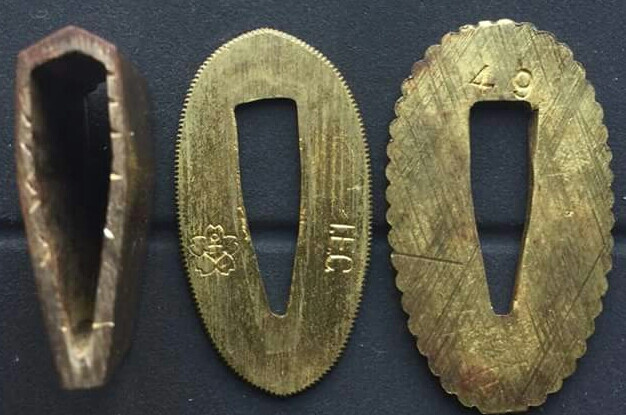
@Shamsy - good to see you again! What an amazing gunto! And the Roman numeral markings are an interesting development. Looking in the files, I have 2 other habaki from Toyokawa kaigunto with Roman numerals. More Interesting-er, both of the other examples had different shop logo. Soooooo ...... was the Roman marking done by the arsenal? If so, why??? Was the style of marking dictated by the arsenal? That may make more sense:


-
Nihonto; a bad investment?
Bruce Pennington replied to paul V's topic in General Nihonto Related Discussion
Whether the sword is a bottom-rung item or a top one, my experience is that it's difficult to find a blade fore sale that is under-priced. My abandoned effort and getting into buying/selling is because of this. Of the 10 or so gunto I moved, only 2 or 3 were found under-priced. The rest, after auction premiums and shipping, were all sold at cost or at a loss. -
My Pitted 98... and why it will remain "as is"
Bruce Pennington replied to Kolekt-To's topic in Military Swords of Japan
I appreciate your thoughts on this. It's still a piece of history that "lived" through the biggest war mankind has ever seen. Should be preserved. Closest I have like that is my Type 32 Ko. I didn't do the "cleaning", so it must have been cleaned up by a prior owner. You can still see the pitting, though. I believe the course file marks are something done in the field. There are several examples of that on NMB and a thread where someone pointed out a reg or something that showed it to be war-period filing.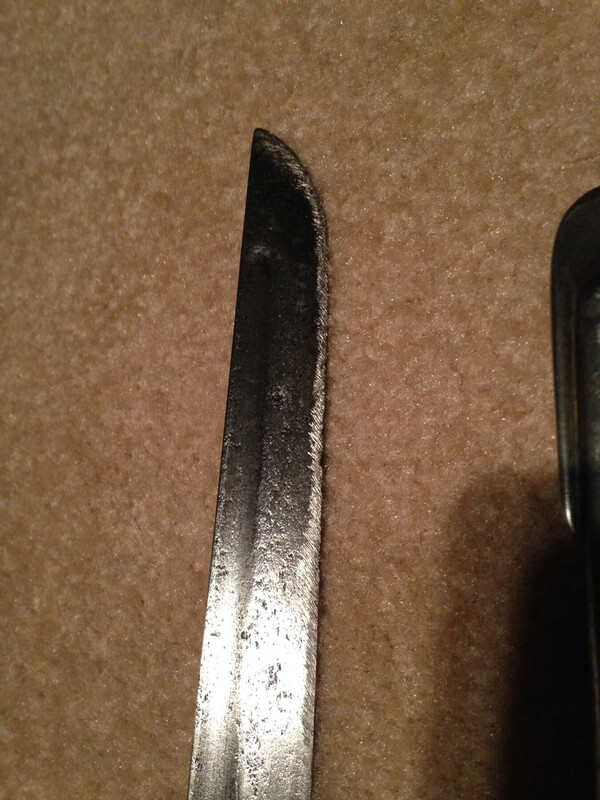

-
Help with RJT mei and date, Please
Bruce Pennington replied to Bruce Pennington's topic in Translation Assistance
A couple of thoughts. I have a lot of star-stamped blades with painted numbers, as of yet, none with quite as much painting as this one, but not unusual at all. Secondly, as I've been scouting through the files, I found this 1945 Kanetomo with painted numbers right across the mei. You'll notice that the paint didn't get down into the mei cutting, so the painter's strokes were likely fast enough, or light-handed enough to not get down into the chisel grooves. Since the one on topic is powdered it's hard to know if the paint as first or the kanji, but having now seen another example where the paint was not in the mei cuts, I don't think that would be a firm determinant. The only real evidence would be if the powder were cleaned out and the mei cuts were obviously new. We face a lot of fakery in this hobby, so skepticism is never out of place.
-
@loiner1965 - Steve, could we get some nakago photos of your Kanetoshi and the Seki stamp? Date if it has one?
-
Help with RJT mei and date, Please
Bruce Pennington replied to Bruce Pennington's topic in Translation Assistance
Listed as Gifu, so yes. -
Help with RJT mei and date, Please
Bruce Pennington replied to Bruce Pennington's topic in Translation Assistance
Thanks everyone, fabulous as always! Brian, with a little zoom, you can see the powder here and there outside the kanji. Richard's Oshigata on Japaneseswordindex has the same mei: http://japaneseswordindex.com/oshigata/sukenobu.jpg -
Thanks Charlie! I'm starting to recognize some of the name kanji - as in "I know I've seen that that kanji many time before!" - but the remembering part is yet to come along.
-
Help with RJT mei and date, Please
Bruce Pennington replied to Bruce Pennington's topic in Translation Assistance
Thanks Kyle! That's the 3rd dang time I've forgotten that I knew about that variant of 20! -
Would appreciate help with both sides. Normally I can see the dates but this one is confusing:


-
Haven't tried to have the mei translated yet: https://www.proxibid.com/Firearms-Military-Artifacts/Military-Artifacts/Japanese-KATANA-SWORD-w-SHIRASAYA-SIGNED-TANG/lotInformation/65039084#topoflot



-
At the risk of running up the price for someone that may already be after this one: https://www.proxibid.com/Firearms-Military-Artifacts/Knives-Blades/Very-Rare-Copper-Hilted-Japanese-Type-95-Pattern-1935-NCO-Shin-Gunto-by-Kokura/lotInformation/64741722#topoflot
-
Surrender Sword with Certificate
Bruce Pennington replied to Butch's topic in Military Swords of Japan
That is an exquisite collection in so many ways!!! Wow.