Bruce Pennington
-
Posts
14,546 -
Joined
-
Last visited
-
Days Won
175
Content Type
Profiles
Forums
Events
Store
Downloads
Gallery
Everything posted by Bruce Pennington
-
Yoshikiyo (for future smith name searches! @BANGBANGSAN I've also noted this Tai stamp in the Stamps of the Japanese Sword doc. I have 4 smiths listed now: Okimitsu, Masakiyo, Masayoshi, and Yoshikiyo. I don't know my source for the 2 "Masa" smiths, but the 2 plus the Yoshikiyo looks like a mashup of names. Wondering now about the 2 Masa names.
-

Attention Mantetsu Owners: A Survey
Bruce Pennington replied to Bruce Pennington's topic in Military Swords of Japan
Thank you Trystan! Any chance of getting links to the owners/sellers? I could use the flip-side of every one of those nakago. Plus, the '43 TE 305 is "W/M" stamped, but I cannot read the stamped number above it. That blade is probably a non-Koa and should have a Nan on the other side. @Kiipu and Trystan- I just realized, looking at the chart that the "M 61" is an overlap into 1939, as there is an "N 574" in 1939; or I should say the '39 is an overlap to the '38 lettering. As such, we should someday expect to see an "M" numbered blade in '39 as well. Also, to your list, Thomas, there are "V" "W" numbers on file for '39: 1939 N 574-S V 18-S V 33-S W 38-S -
Attention Mantetsu Owners: A Survey
Bruce Pennington replied to Bruce Pennington's topic in Military Swords of Japan
That's an interesting question, Thomas. Ohmura stated that SMR was making 400 blades per month in those first years, although there was a discussion of the engineering team figuring out some improvements at the first that enabled them to increase production. So, I don't know if he meant that they were making less than 400/mo at first, then the improvements ramped up production to 400/mo. If it was 400/mo across the board, there were 12 months, so 12 letters would be A - L. Yet we now have N's and M. So I suspect their initial production was something less than 400/mo. accounting for the letters running past "L". We have numbers in the N line into the 400's. Possibly that was the first line that the engineering improvements pushed production into that number. But like you say, our sample is so incredibly small that we will never know if we don't get more samples. Here's a new one @Ontario_Archaeology tipped me off to. It's a 1942 "MA マ77", which now makes the 1943 "Ma" line an overlap. Checking all the other years, they all overlap, except '41/'42, but we probably simply don't have an example yet. I bet they all overlapped.


-
Attention Mantetsu Owners: A Survey
Bruce Pennington replied to Bruce Pennington's topic in Military Swords of Japan
Just found this 1943 "WE 494" Koa Isshin on a past ebay sale. It is only the second "WE ヱ" found to date, and the other ヱ 299 is a Ren-stamped non-Koa mei. Which brings me to the reason for the post - I have been leaning toward the idea that the Nan-stamped, non-Koa blades were being made at/for the Nanman Arsenal. But I've been tracking the Nan-stamped blades as well as the mixed Koa vs non-Koa blades in the same year groups. It doesn't make sense to me that Nanman had made blade WE 299 and SMR Dalian made blade WE 494. I can understand blocks of numbers being allocated to different arsenals/shops as we have seen in the Type 95, but this doesn't seem to be what's happening here. In fact, all the other lines in '43 are intermingled as well. BUT, if the other case was true, that SMR Dalian was making all blades with both mei, why then are the Nan and Ren stamps only seen on the non-Koa mei blades? I'm stumped. Here are the charted blades for 1943, the yellow highlighted ones are non-Koa Nan stamped and the others are Koa Isshin (sorry if you are using a dark themed screen, the numbers are whited out) 1943 A 17-S A 65-S A 105-S E 537-S KI 122-S KI 144-S KI 347-S KI 536-S KE 731-S KE 583-S KE 805-S KO 115-S SA 1-S SA 52-S SA 361-S SA 459-S SA 520-S Shi 304-S TE 71-S TE 224-S TE 284-S TE 337-S TE 486-S TE 567-S TE 595-S TE 699-S TE 801-S TE 835-S HI 22-S HI 41-S HI 153-S HI 226-S HI 591-S FU 48-S FU 106-S FU 624-S FU 757-S FU 758-S FU 795-S FU1008-S FU1272-S FU 960-S FU 1196 FU 1385-S Ma360-S Ma373-S Ma374-S Ma381-S Ma538-S MI 206-S MI 288-S MI 505-S ME 19-S ME 87-S YU 115-S YU 209-S YU 367-S YU 432-S YU 479-S YU 543-S WE 299-S WE 494-S ? 76 ?276 ? 330-S ?361 ?624-S KA 242-S A 601-S -
Films featuring Japanese swords
Bruce Pennington replied to Kolekt-To's topic in Military Swords of Japan
More pics from the "See" show. Wrap actually looks like it has alternating folds. It has an IJA menugi. Tsuba is all wrong, as is the fuchi. As a prop, they did a darn good job.


-
I know the feeling! I still have the sword from my dad, but he’s gone now and I never asked him how he got it. Wish I had. Well, there are plenty of both kinds to be found these days. You should pick up one or two and get hooked to the hobby like the rest of us!
-
Films featuring Japanese swords
Bruce Pennington replied to Kolekt-To's topic in Military Swords of Japan
Here’s one being used in Apple TVs “See”. The kabutogane looks quite accurate, if a prop. Can’t get enough details about the rest.


-
Thanks for the interesting story! Curious as to why you decided they were not samurai swords. Many officers and sometimes an NCO carried old family blades handed down through the centuries. Yes remounted in military fittings most of the time. So wondering what you learned about them that made you rule out the possibility.
-
Waiting for the nakago pics of the military blades!
-
An RS gunto, mumei … for George T
Bruce Pennington replied to paulatim's topic in Military Swords of Japan
Thanks for the added photo George. And Mal, thanks for clearing that up. I misunderstood my own annotation! I thought I was reading a first name, but I put it in parenthesis because it was an alternate art name he used. -
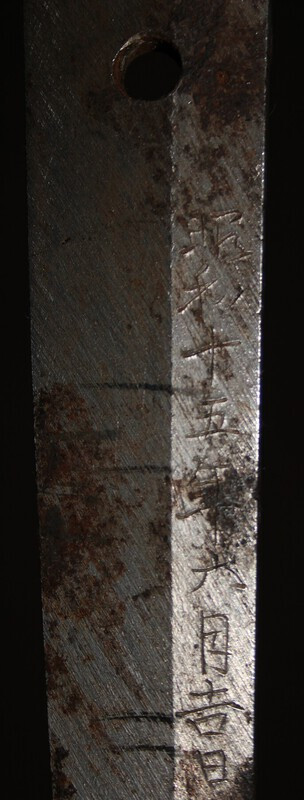
I have the nakago photos of yours, Barry, but not of the whole gunto. I didn't know where to find the thread I got the pics from or I'd have posted the link. Here's what I have:

-
An RS gunto, mumei … for George T
Bruce Pennington replied to paulatim's topic in Military Swords of Japan
George, I have both of those, plus more, but I got them from your survey and don't have photos on file. If it's possible, I'd love to get the photos. Here are the charted numbers I have, like this on the mune. There seem to be a different stamping practice with the "1", "2", and "3" (there is a "6" on file too) combined with an arsenal stamp. My suspicion is something like "inspector 1" "inspector 2" or "inspection 1 or 2" because several blades are found with the same number + arsenal stamp. The larger numbers seem to have a different function, for they are nearly perfectly linear. Only a couple on record out of sequence. The Nagamitsu numbering seems to be in it's own class, tied to the smith. @george trotter - a question about the Mitsunobu(Teruhide) mei from one of your articles, in a kaigunto - Sesko only lists one Showa era Mitsunobu but he's not "Teruhide". And none of the older era Mitsunobu listed are Teruhide. Is it possible this guy is the Showa Kaneda Mitsuhiro (金田光弘), listed by Sesko and the Teruhide has some other significance? Sesko's was an RJT smith and that would align perfectly with the mune stamping practice we see with all the others. 1943, Feb Kanetoshi (RJT) – Gifu Na 30 on mune Star Simpleman, NMB RS 1944, May Masakuni (RJT) – Osada 78 on mune Star Trotter Survey 1944, Jun Masakuni (RJT) – Osaka 75 on mune Star Volker62, NMB RS 1944, Jul Tomonari (RJT) – Kobe Hyogo 24 on mune Star 1944, Aug Kunihide (RJT) – Kyoto 90 on mune Trotter Survey 1944, Aug Kunihide (RJT) – Kyoto 98 on mune Trotter Survey 1944, Aug Kunihide (RJT) – Kyoto 99 on mune Trotter Survey ND Mitsunobu(Teruhide) 707 on mune UniqueJapan.com; kaigunto ND Nagamitsu (RJT) イ313 on mune Ooitame; NMB, RS ND Nagamitsu (RJT) 695 on mune Spidersrule123,NMB,RS ND Nagamitsu (RJT) 2005 on mune Reeder, NMB ND Nagamitsu (RJT) 2205 on mune Roromush, NMB, RS ND Nagamitsu (RJT) 1 saka 3490 on mune Vajo; NMB ND Nagamitsu (RJT) 3973 on mune IJASWORDS, NMB broken heart seppa ND Nagamitsu (RJT) 1阪3991 on mune mauser99; NMB ND Toyo Knife Co; Shinbo “Bravely Brandish” 510 on mune; “S九” on mune Paul Griff, NMB; “10” on fittings -
Japanese Type 95 Sword for NCOs
Bruce Pennington replied to Shamsy's topic in Military Swords of Japan
Victor, Nice one! The blade seems to be in decent shape. You the tsuka and saya could be restored with a re-paint. Some collectors prefer to leave gunto in the condition they were found in, as it is the "life of the blade". Some will restore. I have one Type 95 that I repainted. It looks too new and too good, so it's not ideal, but it's better than the gold paint it arrived in. Even the blade had been painted gold. I had a buddy who paints model airplanes do the tsuka, and I did the saya. Hard to get the WWII Army green just right. On another note, I have 5 Type 95s on file with the "W" or "M" stamp and 3 of the 5 are Iijima blades. One is a Kobe and the 5th is steel fuchi, but probably Seki. All 5 are Tokyo blades.

-
Rechecked files. The '44s I have are "Kokura" mei. The '45 I have on file with star is also a "Kokura" mei. And I didn't have Trystan's which is a '44 Kokura. This is the first one I have marked "Kosuga".
-
Rough Forged Nakago on Type 3 RS
Bruce Pennington replied to DTM72's topic in Military Swords of Japan
@Shamsy @Stegel another one for the records. -
Links to other blades with the mei: Tanrenjo Mei - Stu W Can someone please help me identify this - dominator315 Kai Gunto - Ed Wolf Nice Naval Officers Sword - Ed Hicks Tsuba and Gunto mei Translation Needed - truelotus Translation Help - mdiddy Assistance with mei Please - b.hennick Translation - daishobohi And the tally went up to 18, 16 with mei.
-
Barry's post seems to be the best one for a continuing line on the Tenshozan Tanrenjo mei blades. I've gotten 16 Tenshozan blades on file now, 13 with the forge mei. The latest comes from a friend with what may be the first one sighted of it's kind - one with a bohi. I've seen navy blades with bohi, on rare occasion, but I've searched and cannot see that I've ever come across a Tenshozan Tanrenjo mei blade with one. Dated March 1942, so the third earliest on file with the anchor stamp and second earliest with the mei.


-
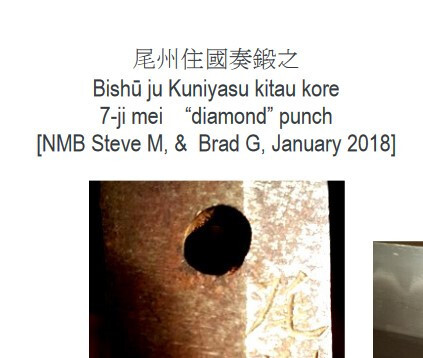
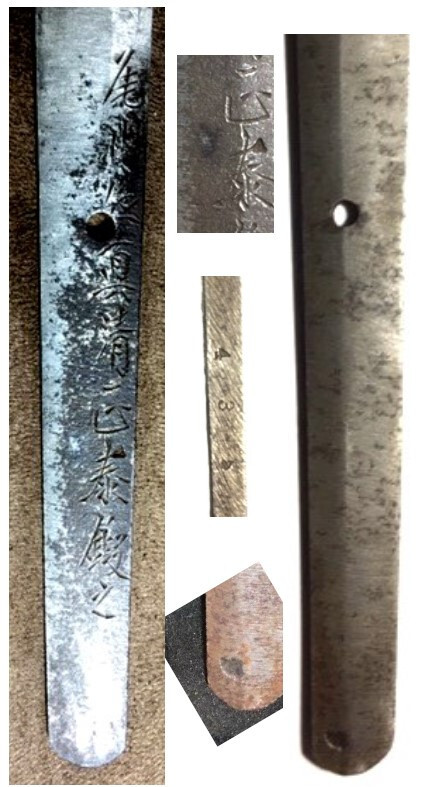
Wanted to post an update to 2 stamps previously in the 'unknown' category in the Stamps Doc. Thanks to @mecox's newest tome - Showa Swordsmiths of Aichi Prefecture, I can now tie them to specific smiths. The "diamond" stamp is found on the work of Kuniyasu: Mal uncovered 5 blades with this stamp, all Kuniyasu. One even has 2 diamond stamps: Of course, we still don't know the meaning or significance of them, but they seem to be specific to this smith, unless they show up someplace else in the future. The other is the "delta" stamp, or triangle. It's seen on Masayasu blades. Mal shows blades with 1, 2, 3, and 4 of them: I've been working on an update for the Stamps Doc and I'll be sure to include this new information. Thanks again to Mal Cox for the great work!




-
Rough Forged Nakago on Type 3 RS
Bruce Pennington replied to DTM72's topic in Military Swords of Japan
Let's see your Nagoya Type 95 NCO gunto! -
Rough Forged Nakago on Type 3 RS
Bruce Pennington replied to DTM72's topic in Military Swords of Japan
Very well could be. I mention the island swords, too, because this is how their nakago always look. If this were the case for yours, it's still a Japanese officer sword, but simply made "over there somewhere". -
Rough Forged Nakago on Type 3 RS
Bruce Pennington replied to DTM72's topic in Military Swords of Japan
Oh, it's hurting my eyes!!! Dang, two of these. They must be late war. With what we know about sword production being moved out of country in the last year, I wonder if these were made in occupied territory. It's the first thing I thought about when I saw the "workmanship" of those nakago. -
Nlf Gunto Discussion
Bruce Pennington replied to Bruce Pennington's topic in Military Swords of Japan
I want to post these two from a discussion on the Translation Forum, to consolidate the items to this topic. One is a souvenir for sale on fleabay (mislabeled as a Navy kaigunto - seller notified) and the other posted by @MacTheWhopper HERE. They are interesting because both blades were made by Toyosuke, a Toyokawa Navy blade in Type 98 fittings, and the other in souvenir fittings. Toyosuke in Type 98 fittings: Toyosuke in Souvenir: So, either this smith was actively making swords both before and after the war, or as a minimum, there were surplus blades of his to use by Tenshozan after the war. Still doesn't prove either case, but I found it fascinating to see blades of the same smith in both wartime and post-war fittings.


-
Thanks guys! And thanks for the links for that other you Moriyama-san! This makes for an interesting turn of events. It shows blades made by Toyosuke in both war fittings - @MacTheWhopper's Type 98 - and in souvenir fittings. So either the smith was still working for the forge making the souvenirs after the war or the blade was surplus. So, it doesn't clear up the question of whether some of the souvenir blades were surplus, but it's a "real life" example of a smith's blades on both sides of the war's end.
-
Rough Forged Nakago on Type 3 RS
Bruce Pennington replied to DTM72's topic in Military Swords of Japan
I'll make a post to say "I don't know what to say!" Your guess sounds as logical as anything I could speculate. -
Attention Mantetsu Owners: A Survey
Bruce Pennington replied to Bruce Pennington's topic in Military Swords of Japan
I don't have a close-up of it. Maybe @charlie1 does.