MauroP
-
Posts
870 -
Joined
-
Last visited
-
Days Won
5
Content Type
Profiles
Forums
Events
Store
Downloads
Gallery
Everything posted by MauroP
-
You are possibly right, but most NBTHK shinsa staff think otherwise...
-
江刕彦根住 - Kōshū Hikone jū 藻柄子宗典製 - Sōheishi Sōten sei
-
On this point I completely agree with Dan (well, unusual, but can happen...). On the image below the red arrows point at different gilding of the same items in ura and omote. Quite interesting, the green arrow points at an unpressed area (confirming the way of production). So for sure, IMHO, a sanmai tsuba of lower quality BUT possibly very old (usualy papered as ko-kinko by NBTHK). Not worth the price asked, but not rubbish...

-
I regret to disagree on the attribution of the first tsuba to Kaga school. Maybe I'm unable to see properly the pics, but my guess is nunome-zōgan. Kin-nunome-zōgan on iron makes (more probably) Kyō-kenjō school.
-
Nanako describes a pattern, whatsoever the way it was obtained. Here a NBTHK paper reporting nanako-ji in a sanmai tsuba: https://eirakudo.sho.../tsuba/detail/774209
-
Here a selfportrait of Gotō Junjō at the age he signed that kozuka (and his late signature)


-
Maybe a sanmai shitate (三枚仕立) tsuba?
-
與政 more likely reads Tomomasa (as you have already written in the book)
-
Well Grev, if even you mess with your own book, makes our task harder...

-
The ishime-ji looks similar, the kanji carving quite different...

-
Here a quite common religious theme (well, it takes a little bit of explanation...). The theme is obviously 茗荷 - myōga (Japanese ginger). But 茗荷 is perfectly homophonous with 冥加 (myōga) meaning divine protection or divine blessing. This kind of pun is not uncommon (e.g. budō meaning both grape and martial arts).

-
Exactly what you said: ChatGPT spits suggestions (which is better than nothing...), but still far from reliable knowledge...
-
Very curious about what’s written on the mimi, my try: 光林 五世 嫡流 大龍斎 光興 - Kōrin go-sei chakuryū Tairyūsai Mitsuoki - Kōrin the 5th main line [generation] of Tairyūsai Mitsuoki (Ōtsuki school) 文政八乙酉三朝 … - Bunsei hachi kinoto tori (1825) …
-
Thanks God a piece of useful information from this thread: Cornell University is confirmed an unreliable place to go for tosogu studies!
-
Full transcription of the relevant part of the paper: 雲龍図鐔 - unryū (no) zu tsuba 鉄地 撫角形 - tetsu-ji nadekaku-gata 銘 早乙女[家]則 - mei Saotome Ienori
-
The paper says the tsuba is signed 早乙女家則 - Saotome Ienori
-
 Dear NMB fellows, I'm very pleased to read the "Established ideas that need to change" threads. It's a comprehensive effort to line up all the main issues that perplex every western scholar. Usually is said that it takes ten years time to master a specialized branch of knowledge. But that's not true for tōsōgu studies; why? Till now I was thinking it's just the lacking of relevant literature accessible in a language I can understand in a reasonably clear way. Now it seems to me that the "state of the art" in this field is much worse than I had perceived so far. Let me brefly focus on the main points emerging from this interesting thread and then discuss each separately: 1. school categorizations; 2. period of production; 3. consistency in assigning a categorization. Point 1: are tōsōgu studies a science? No (IMHO), it's a kind of religion! The "revelation" came out many years ago, but far later than the objects of its speculation, and resulted in a coherent "theology". Scientific approach is simply impossible: no contemporary documentation available (historic criteria), almost no circumstantial data available (archaeologic criteria). Stylistic analysis could be a (weak) basis, but we all know that in Japan the same models of tsuba have been produced for centuries, and many styles were present in the same period. Point 2: in principle it's possible date an iron specimen produced in a traditional way (using charcoal obtained from wood collected almost the same time the iron was produced). Actually the available technology is still immature: it's destructive, needs quite a lot of material from the specimen and is prone to pitfalls (if fossil fuel was used in the production, the result could predate the specimen by many centuries or even millennia). Point 3: this is a goal that can reasonably be pursued. But is it so important? Personally I'm interested in theology (nihil humani a me alienum puto) and I appreciate a coherent preach, but what if I'm an atheist or a believer in another religion... It's no clue to teach Catholicism to the Pope (and kantei to NBTHK).
 -
Hi Philip, the good news is that at least another very similar tsuba has been judged authentic by a shinsa in 2004 (and hiashi-yasuri is reported in the paper). See https://www.seiyudo.com/tu-08082.htm

-
Welcome Tom, I'd suggest a Hizen (肥前) attribution for your tsuba, early to mid Edo age.
-
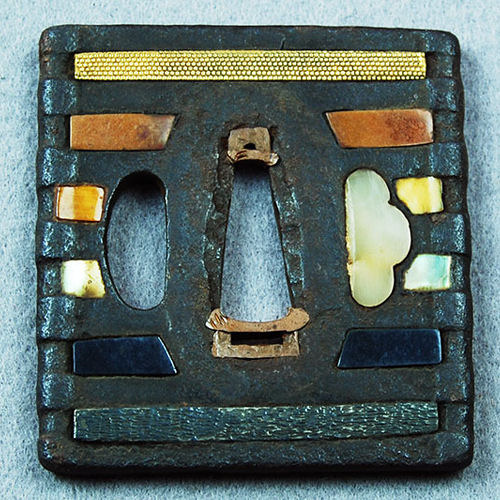
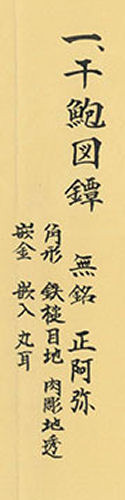
The plugs covering a sukashi are called gankin (嵌金), the homologue elements covering hitsu-ana are called ume (埋).
-
I think in omote is written 藻柄子 - Sōheishi (not Mogarashi),
-
久国 - Hisakuni? (but possibly some other sign over 久)
-
Possibly once was a plain tsuba lately converted for a bokken use (also an explanation for the presence of hitsu-ana).