Geraint
-
Posts
3,115 -
Joined
-
Last visited
-
Days Won
10
Content Type
Profiles
Forums
Events
Store
Downloads
Gallery
Everything posted by Geraint
-
Kawachi Daijo/ Kuni Sada sword - opinions please
Geraint replied to Dean1981's topic in Military Swords of Japan
Dear Dean. This mei is unusual in that the character for sada is not the one expected. Check out this link for information, https://nihontoantiques.com/project/name-sword-fss-795/ Apparently this smith is ranked josaku so not that great, not to be confused with other more famous Kunisada. If it is priced in dollars then expect some extra coin getting it to you and as it's out of polish then you are looking at several hundred to put it in order. You don't mention the length but it looks like a wakizashi. All in all I would take Ray's advice. All the best. -
Dear Darius. Well that is interesting, seems that saya kanagu or saya kanamono is a generic term but sagurigane is specific. New one on me. All the best.
-
Dear Darius. First of all please add your name to your posts on NMB as we all do. I cannot comment on the question regarding Emishi koshirae but the fittings you describe on tachi tsuka are called tawara byo, usually described as rivets in the shape of rice bails. They would not be fitted to a tsuka which was wrapped but are common in unwrapped style. The menuki like ornaments on saya are saya kanagu and are only ever fitted to the outward side of the saya as worn. Looking forward to someone answering the last of the three questions. All the best.
-
Dear Don. The first image in your latest post shows what looks like higaki yasurime and with the hamon this suggest a Mino den tanto. The mounts are pressed brass and are a fairly common late Edo tourist rig. Most of the time the blades found in these mounts are of no consequence but sometimes something slips through. Go carefully, anyone near you who could take a look for you? All the best.
-
Dear Carl. Always interested in this line of smiths, any chance of some images o the rest of the sword? All the best.
-
Dear Margaret. Please add your name to your post as we all do here. The first with the black scabbard is a Kaigunto or Naval sword from WWII, the other with the brown scabbard is a Shingunto or Army sword, also from WWII. The Kaigunto has an anchor stamp and is made from rustless steel. Both are wartime swords in very good condition. Do they have a family history? All the best.
-
Orikaeshi-mei — needle hole?
Geraint replied to RichardP's topic in General Nihonto Related Discussion
Dear Dave. There is so much information on that site, isn't there? My only addition is that there should be a vertical line joining both edges of the new nakago jiri on the third diagram down. All the best. -
Dear Kirill. Forgive me, I am unable to work out whether you are agreeing with Jean or contradicting him. All the best.
-
Orikaeshi-mei — needle hole?
Geraint replied to RichardP's topic in General Nihonto Related Discussion
Dear Richard. So you are shortening a nakago and wish to preserve the mei. You carefully file down the excess nakago to leave a thin strip of metal that carries the mei and you chase out a corresponding groove into which this will fit. Now all you have to do is bend the strip through 180 degrees and make it fit the groove. You can't really dress the end with a hammer to close it firmly so you fold the strip of metal with the mei over and push it into the groove you have prepared. You fold the metal and it forms a radius which does not quite match the squared end of the nakago that you have filed leaving a very small gap that should be clearly visible running from mune to ha. Not perhaps needle shaped but non the less visible. This is a way of discerning that the orikaeshi mei has been done properly and that a mei cut from a completely different sword has not been used. If the mei is a continuous strip of metal then is was originally part of the nakago and hence the small hole. If it has been cut from a different sword and added to this one then you might not see it. Hope that helps. All the best. -
Dear Ken. This is a nice result and the sword looks good, koshirae (Mounting) subdued but very attractive. I think you can ignore the cord. The tsuba (Guard) is of a type usually found on tachi (Long swords carried edge down) with the two extra large seppa (Washers). As it stands it might be called a handachi koshirae, (Half tachi). Muromachi is a period, basically 1400 to 1600 though those dates are not precise but easy to look up. By the end of this period many swords were being made, some in quite a hurry and so are less well regarded by collectors. This does not necessarily apply to your sword. How this survived in a theatre props store without being tarted up or damaged is almost beyond belief. Perhaps they felt it was a bit too realistic to use. All in all a very nice find and certainly something to hang onto, I would if it were mine. Enjoy! All the best.
-
Dear Peter. Please forgive what might be a very long answer to a very short question. The 1993 exhibition, "The Beauty of Shinsakuto" , featured quite a number of blades by some very excellent smiths. A significant proportion were described as challenges to specific named and well known blades, in other words utsushi mono. The exhibition was brought to the UK under the auspices of the Token Society and it was an immense pleasure to be able to examine the blades in hand. Many had the nakago copied faithfully, even o-suriage with many mekugi ana, which I found a little odd at the time. Naotane, renowned for mastering all five of the Gokaden, may have done the same so that specific nakago sori would be related to the blade he was challenging and thus not of itself a kantei point for him as the maker. His blades always seem to have a very well shaped nakago in relation to the overall sugata with appropriate sori for the shape and size of the blade. Thank you for the question, I have enjoyed looking at his work. All the best.
-
-
Dear Steve. Your wakizashi appears to be by Hishu ju Hirosada. Have a look here for more information. http://www.militaria.co.za/nmb/topic/17848-wakizashi-signed-hishu-ju-hirosada/ All the best.
-
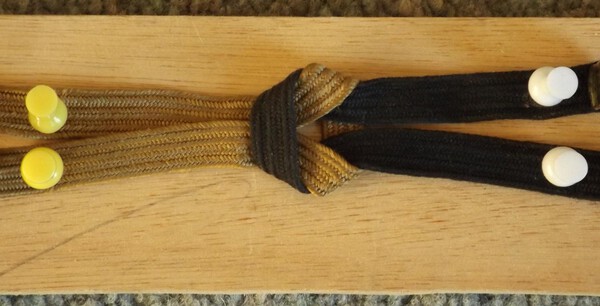
Dear Steff. You can sure pick 'em! Managed to find one image, (In Markus Sesko, Encyclopedia of Japanese Swords), and did a mock up of the knot to show how it works. It is not something I have ever seen. What makes you so keen to try this wrap? Hope this helps. All the best.
-
Dear Phil. Well, photo 6, of the whole koshirae is the most revealing. Kodzuka appears to be pressed brass with a hole in it that suggests it might once have been a piece of cutlery, the urugawara in the saya has been broken or cut to suit the kodzuka, tsuba is way out of alignment as is the tsuka. I can't tell much from your images about the tsuba. How many seppa does it have? I quite like the fuchi kashira, not sure about the menuki, tap them with a finger nail and see if you can get a sense of how solid they are; a thin high sound might confirm that they also are pressed brass. All in all I would say this is a bitsa, as in, "Bits a this an bits a that". However you have the sword in hand and can judge the fit of the blade to saya and tsuka, you can also remove the fuchi to see if any packing or other adjustment has been done. My guess would be that blade and saya belong together and the rest has been added to 'complete' the sword. All the best.
-
Dear Ken. I was about to say that a sword bent and then straightened = shinae but having checked I discover that it is not so simple. See here, http://www.ksky.ne.jp/~sumie99/flaws.html I had not realised that the transverse cracks caused by poor work in the steel were also called shinae. However I do not think that either of these cases apply to the sword posted. All the best.
-
Hi Scott and welcome. Have to agree with the advice you have been given. In addition to the suggestion to buy some books think of joining the Token Society of GB or the Northern Token Society or both. Get to meet some people and see some swords. It's really tempting to jump right in but a little patience now will see you right in the future. All the best.
-
Dear Christian. The flower is the impression of the punch that was used to spread the metal of the sekigane to get a good fit to the nakago. As far as I am aware it has no particular significance other than that. All the best.
-
Dear Steff. If you are trying this then you definitely need this book that Jussi recommended, https://www.amazon.co.uk/Art-Tsukamaki-Pocket-Thomas-Buck/dp/1505226147/ref=sr_1_1?keywords=The+art+of+Tsukamaki&qid=1578928345&sr=8-1 Lots of really useful practical advice and clear diagrams. The author is the person who runs the website that Ed suggested. Look forward to seeing some of your work. All the best.
-
Dear Steve. Here's one. The sword Kenny has is a civilian handachi koshirae and a rather nice one at that. It has resemblances to a kaigunto koshirae because they were based on tachi koshirae but it is most definitely not a kaigunto hence the observation that the kaigunto seppa and tsuba combination would look out of place as it will never be anything but kaigunto. An exact parallel would be sticking shingunto tsaba and seppa on a civilian katana, The extra seppa would certainly take up the space though. Good thread on handachi here, http://www.militaria.co.za/nmb/topic/6503-literal-meaning-of-handachi-applied-to-sword-koshirae/ Good place to have a look to get some ideas Kenny. All the best

-
Dear Kenny. I hater to disagree with Steve but I think a Kaigunto tsuba and seppa, the set on the Ebay link, would always look like what they are and would ruin this koshirae. You don't need anything flashy, how about something like this one? https://www.aoijapan.com/tsuba-mumeiunsigned/ Bear in mind the overall size of the tsuba as you look, generally larger tsuba for larger swords and too big a tsuba would look a little odd on yours. All the best with your hunt.
-
Wow Peter! They are both really nice but I'm in love with the butterfly! All the best.
-
Dear Ken. Late to the party but to answer some of your questions...... I don't think your sword was ever wrapped but it would have had menuki, I think I can see a pale shadow on one image just above the reluctant mekugi where one would have been. I would add my vote to the pre 1600 camp though be aware that age alone, while fascinating is not a guarantee of quality. I think we expect this sword to have been shortened which in part may account for the rather straighter blade than you are used to. We always enjoy the possibilities when a sword like this pops out of the woodwork. Chuck's advice about attempting to remove the mekugi is great, there is one more possibility which is that it is in the form of two sleeves that are a friction fit in each other, really worth having someone who knows what they are doing take a look. As to what you paid for it, well I can hear the sound of a lot of people banging their heads on the table and muttering, "75 Euro, 75 Euro, why don't I ever find anything like that!" Enjoy! All the best.
-
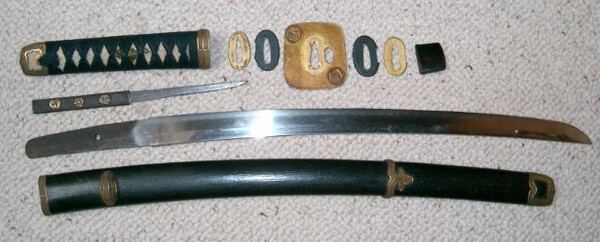
Dear Kenny. There is hope here. I have attached a picture of a very similar handachi wakizashi of mine which has two pairs of seppa. It is quite possible that your sword had the same originally. Tachi often have more than one set of seppa and shingunto and kaigunto mimic this with up to four sets of seppa, some of which are sometimes quite thick, so it is quite reasonable for a handachi to follow this pattern. If you find a tsuba that you like it is a relatively simple matter to make some seppa or have some made to take up the slack. Hope this helps.
-
Dear Neil. I agree with Ed, Hoshu Takada ju Fujiwara Yukinaga. Compare here, https://www.aoijapan.net/katana-hoshu-takada-ju-fujiwara-yukinaga/ Can we see more of the sword please? All the best.