


Geraint
-
Posts
3,165 -
Joined
-
Last visited
-
Days Won
10
Content Type
Profiles
Forums
Events
Store
Downloads
Gallery
Everything posted by Geraint
-
Unknown signatures and reference books.
Geraint replied to Worfieldlg's topic in Translation Assistance
Dear Luke. Well, there ya go! As to the kojiri the gold mark is a kakihan, roughly a stylised mark rather than a signature per se. I am sure others will add to this but you might find, https://www.amazon.co.uk/Shosankenshu-Jolys-Kakihan-Collected-Mounts/dp/B0015HYW06 a useful starting place. If you feel inclined I am sure we would all like to see some photographs of the whole pieces? All the best. -
Dear DAn. Orikaeshi mei, thinned down signature folded over and inlaid into the other side of the nakago. Gaku mei, signature cut off, thinned and inlaid into the nakago. This example is orikaeshi mei. For what it's worth I think these are simply two blades mounted as nagamaki, so I suppose calling them nagakatana works. I don't hink these were ever intended for use, at best parade items.
-
Dear Josh. First step would be to take off the habaki, blade collar, and get some shots of the whole nakago and of the whole blade. That will give us some more idea about it from the sugata. Wow! New Board. I see Raay has replied already. All the best.
-
translation Translation for alleged WW2 Officer Sword
Geraint replied to SomeAussie's topic in Translation Assistance
Hi and welcome to NMB. Please add your name to your posts. You can do it in your profile and it will be automatic. Just to add, your friend was right, the small blade or kogatana is signed Bitchu Mizuta ju Kunishige. It's a well respectd line of Shinto smiths, ie working after 1603 and before about 1800. As a rider, the signatures on kogatana are often honorific rather than genuine so don't place too much emphasis on this one. There were later Nio Kiyotsuna smiths, one about 1500 who might be this one. Nice thing, just need to get the hilt rebound properly and it will look even better. Oh, and this has nothing to do with a WWII sword, it may have been brought back from Japan around then but it is a civilian wakizashi and has not been modified, as some were, to use in the war. Enjoy! All the best. -
Dear All. Try this one. https://bid.sofedesignauctions.com/auctions/4-PDUT1/summer-Japanese-islamic-european-arms-and-armor-sale At first glance it look interesting. All the best.
-
Dear Daniel. Everything so far about this screams that it is a Chinese fake. Add some photographs of the rest of the blade to be certain. Sorry if that is bad news. All the best.
-
Some confusion with the order of the images. So, first and last images, dated Tadamitsu, second and third, Tsuguhide. All the best.
-
Try this one. https://www.japaneseswordbooksandtsuba.com/store/tsuba-%26-kodogu/t492-akasaka-tsuba# Grey has got some lovely stuff available at the moment. I guess if you like both tsuba equally then it might be an obvious choice, but do you think both are of equal quality? All the best.
-
Dear Kubur. I think the answer to your question is, "Yes." Either term would work though given it's apparent size and period of production I would be inclined to call it a ko wakizashi as it looks to be quite a bit over the 300mms mark but appearances can be deceptive. Enjoy. All the best.
-
Dear Kubur. Nice find! Take it slow, a little gentle work with a piece of bone or antler on the rust and a gente clean and re wrap and it will start to look great. As to tanto or wakizashi, well, it's hira zukuri so the test is nagasa, over 30cms and it's a wakizashi, usually called a ko wakizashi. Under and it's a tanto. I would guess from your pictures that it is a ko wakizashi. Then you can start researching when this style of blade was common and match that to the mei that Peter has given you. Hours of fun! Enjoy! All the best. Edit to add, jammy, so this was a kind of freebie?
-
Dear Brodie. The starting point is what you can see in hand. The blade appears to be suriage, it is possible that the lower mekugi ana was the original, would you agree? If so what would the original length of the blade have been and what sort of sori would it have had? The original shape of the sword and length are the surest indicators of age. What about the boshi? If it is midare komi then probably Koto or Shinshinto. Without that information all we are doing is guessing based on what we can see which isn't much. Hope that helps you think about the sword. All the best.
-
Dear Simon. Welcome to NMB! (Please add your name to your posts, you can do that in your profile and it will be automatic.) Just to add to what Manuel has told you, and perhaps explain a bit if you need that. Your sword is in Shingunto koshirae, that is WWII army mounts. The blade is signed by Kojima Norimichi whi is the smith who made it. The small stamp shows it to have been made in Seki city, which is a bit like Sheffield in that it is famous for cutlery of all sorts. During WWII it was a major center of sword production. This stamp confirms that the sowrd was made by modern production methods, not traditional methods. Manuel identifies the smith as a maker of gendaito, usually taken to mean a modern, gendai), sword, (to). Gendaito are made using the traditional methods and are more highly regarded than Showato which are the ones made in quantity. It is quite common for a smith to be known as a maker of both types. Apologies if you knew all that already. If you have anything more to ask then fire away. All the best.
-
Dear Laura. If this sword is in Shingunto mounts then it is an older blade remounted for use in WWII. This was done for a number of reasons but it makes the sword interesting because this is a traditionally crafted blade rather than a so called mass produced blade. We would love some more picture and dimensions, particularly the length from the tip to the notch in the back of the blade which will confirm whether it is a katana or a wakizashi. If you Google the signature you will find many examples by this smith but as Tom suggested, with such a well known name the chances of it being gimei, a fake signature, are quite high. This does not mean that the sword is a fake. More photos please. And on a personal note, much more than the sword see if your grandfather will tell you about how he got the sword and any other memories you can get him to share. All the best.
-
Sharp eyes spot top blade at Grantham auction
Geraint replied to BIG's topic in Auctions and Online Sales or Sellers
Hi Robert. I don't think it's an out and out fake but I have my doubts about the mei being verified. From memory there are two other very similar examples recorded, one was in a catalogue from a London dealer some years ago, one in the Hartman collection. Each is slightly different but all are of the dragon entwined around a flute and the mounts are very high quality metalwork, hence my suggestion that they fall into a category that is different from most swords. I think they appeal to a market which is much more interested in the quality of the decorative art object than the veracity of the mei of a sword. Certainly the London catalogue was of masterpieces of Meiji metalwork and included some fantastic creations in bronze, some Komai and so forth. All the best. -
Sharp eyes spot top blade at Grantham auction
Geraint replied to BIG's topic in Auctions and Online Sales or Sellers
Dear All. We discussed this one some time ago, personally I do not think this is likely to get an attribution to Umetada but the extravagant koshirae and the gilt horimono puts it into the art metalwork market, outside of the sword market, hence the big bucks. All the best. -
Dear Juan. A partial answer to your question. The yokote is a somewhat subtle thing and can easily become blurred or obliterated by, for example, someone 'cleaning up the surface rust'. It is sometimes useful to see if you can detect where it would start at the ha. In this case there is no discernable evidence that the sword ever had one, that could be a sign that it never had one and indicate that it is not Japanese, or it could be because it has seen some damage. If all else is sound then a good polisher should be able to recreate the yokote having reformed the geometry of the area. If that is the case then it would not be a fatal flaw. All the best.
-
Dear Jean. Are you concerned by the lack of imozura? All the best.
-
Dear Yuri. I can't work it all out but the smith is Yoshishige, so the last three kanji are Yoshishige saku. The one above could be da and there are some Shimada smiths with this name. It's a start and I am sure someone will ace it shortly. Whatever it is don't get too excited, mei on kogatana or often honorific rather than genuine though that is not always the case. All the best.
-
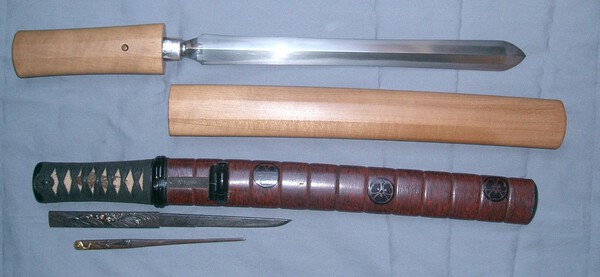
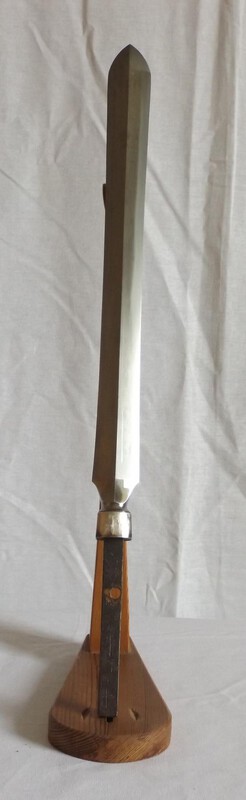
Dear All. A couple of things to add, one while browsing in Bushido, vol. 3, no. 1. A description of a yari by Nidai Kawachi no Kami Kunisuke. ""..in an old shirasaya that looks like it must be a tanto until the portion covering the head is removed. The shirasay is made in such a way that there is an inch and a quarter of wooden habaki behind the head making the nakago (tsuka) end shorter and the upper saya portion longer. At first glance one automatically thinks of a tanto until the saya is removed." In this case the unusual mounting allows for the yari nakago to remain unshortened, preserving the mei intact. I suspect that this might be the case with the example originally posted. It is quite common to find blades in koshirae where the blade is much shorter than the saya and this would easily allow the length of the saya to fit into an obi properly. Here is a more conventional yari tanto. The blade here. All the best.
-
New sword bought home by USMC vet from Tsing Tao 1945
Geraint replied to Dean1981's topic in Military Swords of Japan
Hi Dean. Well the blade looks like an older one, for best opinions take a photo at 90 degrees to the bare blade, habaki off. Obviously the saya and tsuba are civilian and pre WWII. The tsuka has had an odd re wrap but the saya could be improved by replacing the missing horn fittings. The next question will be, do you get it polished? All the best. -
Sweet! Thanks for sharing these, that's a lovely koshirae. Just look at the shittodome on the kashira. I think the first step is some careful work with a fragment of bone to clean off the worst of the fresh rust. All the best.
-
Dear Leen. Here is some information for you. NOBUSADA, real name is Ganmaku Ichirōsaemon, located in Shimizu Ouno-gun (now Shimizu, Ibigawa-town, Ibi-gun, Gifu pref.) during Early Edo period in early 17th century. (Sanmei) “The Ganmaku school engaged in swordmaking in Kiyomitsu of Mino province, from the Daei era of the mid Muromachi period, to the early Edo period. It is said that the school originated from the Jumyo school, who were active in the same part of Mino province. The head of the family traditionally used the name “Ujinobu” as his artist’s name. Uninobu, (a different character), and Nobusada also belong to this school. They were favoured by many samurai because of the brave and daring name of the school. (This refers to the sound of the name when pronounced by Japanese). (Nihon-to, Issue No. 4, 1996) If yours is like the one I have then it will be quite a substantial sword, when I first got mine I was shocked when I compared it to another wakizashi. A nice find. All the best.
-
Dear Bob. I am sure that I am not the only one who would love to see some pictures of the rest of the koshirae. What you have posted so for looks really nice. All the best.
-
Dear Mark. I'm sure you have already done this but it is possible to track some of the ships that this man served on so definitely adds to the interest I would say. All the best.
-
Dear Mitch. Just one observation to add to what John has said. It's very tempting to think in terms of a single description for a hamon. Many swords require more than just one name to describe what is going on. For example you might see something like, " suguha becoming notare towards the monuchi", Or, "gunome midare with some togari". One rule for sure, nothing about this hobby is ever simple! All the best.


