Geraint
-
Posts
3,165 -
Joined
-
Last visited
-
Days Won
10
Content Type
Profiles
Forums
Events
Store
Downloads
Gallery
Everything posted by Geraint
-
Tanegashima Made Swords - Gendaito
Geraint replied to fatrat2's topic in Tanegashima / Teppo / Hinawajū
The assumption underlying the original question is that there were other means of producing iron available in Japan throughout the edo period. We know that imported iron was available, Namban tetsu, I have also read reports of swords being made form foreign anchors and so forth. The Royal Armouries have an early European dirk that was put through yakiire and mounted as a tanto. We know that cast iron was in use for other purposes (No, don't go there again!) We also know that tamahagane is picked over by contemporary swordmiths to make sure that the pieces they use are suitable for their purposes. If gun makers had access to a totally different source of iron for their work then the question stands. If the iron was produced in a tatara, as I suspect it was then reusing gun barrels is simply a way of accessing supplies of tamahagane. The fascinating blog posted elsewhere on the Board today shows a smith mixing tamahagane and the nails recovered from old buildings. He seems to suggest that he is doing this to create a specific result. -
The assumption underlying the original question is that there were other means of producing iron available in Japan throughout the edo period. We know that imported iron was available, Namban tetsu, I have also read reports of swords being made form foreign anchors and so forth. The Royal Armouries have an early European dirk that was put through yakiire and mounted as a tanto. We know that cast iron was in use for other purposes (No, don't go there again!) We also know that tamahagane is picked over by contemporary swordmiths to make sure that the pieces they use are suitable for their purposes. If gun makers had access to a totally different source of iron for their work then the question stands. If the iron was produced in a tatara, as I suspect it was then reusing gun barrels is simply a way of accessing supplies of tamahagane. The fascinating blog posted elsewhere on the Board today shows a smith mixing tamahagane and the nails recovered from old buildings. He seems to suggest that he is doing this to create a specific result.
-
I have only ever seen them illustrated so your search may be a long one. I am sure that Ford would make you one and it would be stunning............ All the best.
-
Matt, please check out your earlier post for another reply including some suggestions for additional pictures. We are asking because we can't see enough to help you yet. Cheers
-
Hi Matt and welcome. I assume you have added the pictures, you will need to take some more if anyone is going to be able to tell you something. I clear image of the whole tang, both sides, tip to the silver foil habaki, the collar around the blade. If the habaki will slide off the tang then so much the better but be careful as it may be quite firmly stuck if it has not been removed for years. Another image of the full blade and if possible close ups of the boshi, the point section, again both sides. The advice not to polish was good, don't even think of cleaning up the fittings at the moment, and while we are on the subject a good pair of images of the tsuba, the guard might be worth posting in the tosogu section on this board. So far what it looks like you have is a Japanese sword that has been shortened and mounted for use in WWII. The blade seems much older and the carving in the blade on one side is interesting. You mention that the blade is 24" long, believe it or not this matters, where did you take the measurement from? Ideally from the tip to the point on the back of the blade where it starts to disappear into the habaki. Lots more to discover here and an interesting first find. Looking forward to more pictures. All the best.
-
Hi Peter. From time to time you do come across kodzuka that are wider than normal and it sounds as though your saya is designed for one of these. Cheers
-
Hi Mark. Try Kevin at http://www.ryujinswords.com/ He should be able to help you. Another cabinetmaker, huh? You should have no problem then. Cheers
-
So, the same mei as your wakizashi Gary, compare the two signatures to see if that helps. Daisho? Cheers
-
Hi Brian. The comments you have so far are all correct but I wanted to explore the topic a little more. As you now know most of these pieces, sometimes called won-to I believe, are made for a late Meiji Western market and as such the blades are very often no lore than metal tsunagi, not swords at all. In other words the value was seen as being in the ivory carving. However as Brian points out rarely you do find blades of greater interest in such mounts. While I cannot be certain of the detail I have heard that one collector discovered a Tadastuna in such mounts. Don't get your hopes up! I attach some images of a couple of rather good quality tanto and one fabulous tachi as well as one other of a shinshinto daiso with very exaggerated sori, though perhaps not quite in the league of the one you illustrate. I also recall reading an article that pointed out that contemporary swordsmiths were quite capable of making a sword to fit a koshirae implying very real control of sori in the forging process. All this leads me to the following points: most nihonto collectors would regard this as an oddity, probably more of interest to collectors of Meiji art. Sometimes the unexpected occurs in this fascinating hobby and almost any rule you work by will sooner or later come unstuck. You suggested that the value way well be in the ivory carving and you are probably right. The ivry tachi in the image had quite a substantial estimate though I don't have a price realised. If you are a purist nihonto collector then you will probably pass on this one but f your interests are broader and the price seems right to you then you may well end up owning it, enjoying it for what it is but not concerned about the blade over much. At least this blade is streets ahead of most of the ones that you find in such mounts. All the best and if you do go for it enjoy.


-
Hi Tobias. Some years ago I purchased a small Japanese export box covered in these pressings. The thin pins on the back fixed them to the wood. Not menuki, not even pouch ornaments I fear. All the best.
-
Hi Dimitri, I bet we all have tales about the one that got away. A sign in a local antique shop points out that you always remember the things you should have bought......., I am also sure that they get better and better as memory plays it's usual tricks. Perhaps a thread for the Itzakaya? Glad that you found a little something to ease the pain though.
-
EDO PERIOD ABUMI ( SADDLE STIRRUPS )
Geraint replied to watsonmil's topic in General Nihonto Related Discussion
Hi Ingrid and welcome. (Forum etiquette is to sign all posts with a real name, by the way.) You don't mention which country you are in which might make a little difference to value but the abumi you show are certainly of interest and some value to collectors. Compare them with the pair that started this thread and you will see some differences, it might help if you could tell if yours are iron or lacquered wood and perhaps some more photographs? Cheers -
Masafusa? Mei help and sword advice sought.
Geraint replied to Cuirassier's topic in General Nihonto Related Discussion
Hi Mark. So what you have looks to be an interesting civil wakizashi in a gunto saya. This is going to be a personal thing for sure but when the sword arrives check the saya fit with care and see if perhaps it was made for the blade. It is possible that this was simply done to bring the sword sufficiently in line with dress regulations to make it possible for the officer to wear it. Assuming that to be the case then my personal inclination would be to keep the saya as it is as a part of the story of the sword. I know many collectors would want to do what you suggest and swap it out for a new civil style saya so perhaps live with it a little while until you maker your decision. Nice find, I would have had it like a shot if it came up anywhere near me. Enjoy. -
Really not my field but toward the bottom of the tsuba, between the nakago ana and the rim, is what looks a little like gomoku zogan. I wonder if the intention was to do this to the whole tsuba but the work was heated a little too high and the applied metals flashed over the surface? It seems unlikely to me that the mimi would be covered so well if this were the case. Just a thought. Cheers
-
I should have added that according to Fuller and Gregory any sword of this type "must be classified as rare." Best of luck working out a price.
-
Hi Pablo and welcome. Thomas beat me to the punch. The sword is exactly described in Fuller and Gregory 1996 in the way that Thomas has told you. The single star and the ends of the sun rays on the emblem on the shell guard are distinguishing features that separate it from the earlier 1875 version. The straight blade marks it as for wear with full dress uniform, a more traditional blade shape was worn for field use. Cheers.
-
Help regarding the Bigelow collection
Geraint replied to markturner's topic in General Nihonto Related Discussion
Hi Mark. Posted a reply earlier but must have done something stupid as it has gone astray. The catalogue of the Boston Museum Collection is fabulous and a great learning resource so worth saving up for. In the meantime here is a little something from it. In essence Bigelow was born to a wealthy Boston family, trained at Harvard medical school and then went to Paris to the Institute Pasteur to further his studies where he became involved with the craze for 'Japonisme'. He went to Japan for a short visit but ended up staying for seven years. He recognised the quality of Japanese art and craft, also the fact that in the rush to westernise it was being neglected. By influence, patronage of craftsmen and donation toward the establishment of the Juyo|Bijutsu-in he contributed greatly to the appreciation of Japanese art and was awarded the Order of the Rising Sun, Third Class; the highest award available to foreigners. There is a book; "A Short Biography of W. S. Bigelow" written by Yamanaka Sadajiro, probably very hard to find now though SOAS might have a copy. Apparently he donated his collection of some 46,000 items to the Boston Museum between 1911 and his death in 1926. His sword collection was assembled with the advisory assistance of Honnami Koga and the sword dealer Machida Heikichi. The catalogue makes no mention of other parts of the collection but of course Bigelow may have sold items or the museum may have deaccesioned items at some point. Either way the sword has an interesting history. You must be gathering quite a collection by now Mark, enjoy! -
Assistance with ancestral blade in Army mountings
Geraint replied to mercierarmory's topic in Translation Assistance
Hi Mike, There are people over here who would be happy to look at the sword if that's any help. Couple of board members down here in the far south west at least. Cheers -
Hello again Rouse. I agree with Mark, the shape is unusual but known and was made this way as a katana, it is not an altered polearm in this case. The blade style was also made around the time of the earlier smiths signing this way and the rather large kissaki also occurs in early Edo swords as well as shinshinto ones. Bt the by, it looks as if the blade has been shortened, suriage, and the machi, where the habaki rests moved up. Quite a normal procedure for swords. I really like it, you should be very pleased. Cheers
-
Hello Rouse and welcome. Your sword is in shingunto mounts from WWII with the added feature of a mon of arrow fletchings. The blade is signed Onizuka Yoshikuni. There were several smniths of this name in Chikugo working between 1615 and 1660, one other in around 1865. Hard to be more precise from the images but the sword also appears to be a rather unusual shape which to my mind at least makes it more interesting. Sorry, I have no idea of the value in France but it is colllectable and has value. Please don't try to do anything to the sword other than apply a coat of light oil. It is worth looking after. Hope this helps a little. Al the best.
-
Here you go Scott. From Christie's, 28th March 1995. Described as, "A pair of Got Ichijo tsuka plates. One of shakudo decorated with a hot punched design of snow flakes and the other of shibuichi similalry decorated, each sealed Ichijop, late Edo period with box. 13cm. The shibuichi plate is of extremely high quality and the pear skin effect of the separation of the two base metals is clearly visible." You will also see the daisho pair of Ichijo tsuba, lot 92, an Umetada shakudo tsuba from the Sasano collection, lot 94 and a shakudo Bushu tsuba, lot 95. Lot 92 sold for £17,250.00, quite a price. The tsuka plates sold for £1,995.00. Again from memory but I can't recall the source, I believe that I have seen metal embossed to resemble same on a sword. All the best.

-
Hi Scott. Some time ago a pair of tsuka gane were offered for sale in one of the major London auction houses. From memory they were Goto Ichijo work. I will see if I can find the catalogue and scan the image for you. I have never come across them other than that and of course in the type of tachi mount that you illustrate save for some commissioned for a koshirae shortly after the auction.
-
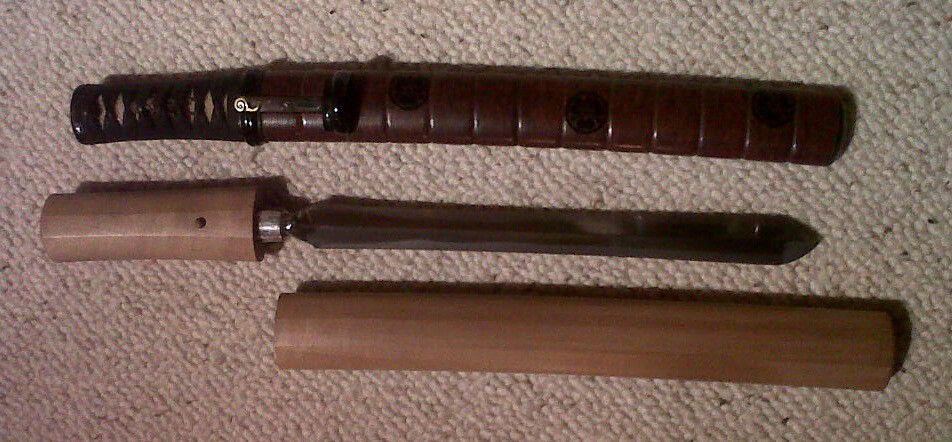
Dear Edward. I like this one as well as the other. Relatively simple job to replace the horn kashira, polish and there you are. I have read that generally good quality yari are found mounted as tanto but I cannot recall the reference. I have seen one or two in hand and have always found it to be an attractive combination. I own one which is a ryoshinogi yari in aikuchi koshirae, when mounted in it's koshirae it is quite a frightening prospect. Do you plan on having this one polished? If so I am sure we would love to see some pictures. All the best.
-
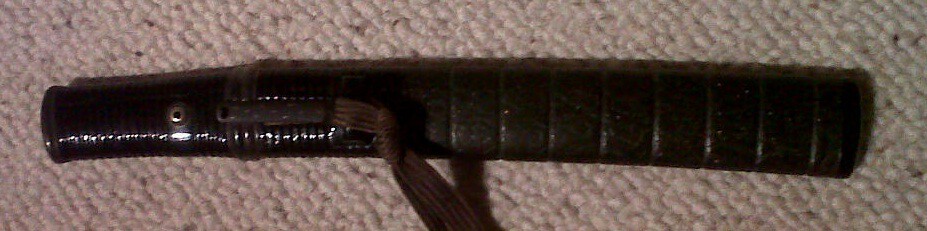
Dear all. Tanto fest! Whatever it is I love it. For what it's worth I attach two images; one is of what I would call an aikuchi because of the lack of tsuba, the second is what I have always understood to be a yomeiri tanto. The first has a shin shinto blade signed by Seishin shi Masayuki, the saya is a rather fetching lacquer with aogi used to create a brocade effect and pale horn fittings plus a mini bashin. The second is unsigned and probably Taisho, mu mei blade with hi and a pretty lacquer job on the tsuka and saya. This tanto has no kurikata but it has a bevel on the kashira like the one you posted. This is to make it possible to discern by feel which side the edge is on when the tanto is worn in the folds of a robe. As with most things in the fascinating hobby I am sure there are exceptions and oddities to every rule but what the heck, they are still pretty.

-
Ah, Thierry. I am surprised that you don't recognise this for what it is; this form of kozuka is often found mounted with a kogatana blade like the one in the attached picture with a companion piece whose blade is rather fork like. A pair of these would be mounted in the saya of a bento tachi mount for use when samurai were going on a picnic. Rather like the so called hunting tachi koshirae.