Geraint
-
Posts
3,174 -
Joined
-
Last visited
-
Days Won
10
Content Type
Profiles
Forums
Events
Store
Downloads
Gallery
Everything posted by Geraint
-
Dear Geoff. (You can auto add your signature in your profile to make life easier.) I'm with Ken in that I can't see much but if your view of the boshi is choji midare then it's either Shinshinto or Koto. Given the nakago then I'd be inclined to go for Koto. Is it just the pictures or is the kissaki quite short? With some tlc this will be a nice find. All the best.
-
Dear Rich, Nice sword, (nice array of chisels too!). Just to help things along some overall dimensions would be useful, especially length from tip to notch. All the best.
-
Dear Chris. It's always difficult to do any sort of informed kantei based on an out of polish sword but here are some thoughts. First, 26.52 mms seems very slender for a sword of this length but what that gives us is an ubu sword of 27" length with an extended kissaki. You suggest the sword is Koto based on the nakago colour, caution here, the colour and condition of the nakago depends on how the sword has been treated and this seems to have had a hard life. I would hope for a smoother and deeper patina for a koto sword. Although it technically qualifies as an o kissaki it does not look like the classic version of that feature. If I am seeing things correctly the sword has a raise shinogi. So what we have is an ubu sword, 27" nagasa, maybe a raised shinogi. If we are looking for the classic o kissaki then Nambokucho, Momoyama or Shinshinto spring to mind. However if we are seeing a slightly elongated kissaki then perhaps late koto also. Ubu at this length is not Nambokucho, nothing suggests Shinshinto so we might be looking at late Koto early Shinto. All of this is speculative as we cannot see anything really of the hada or hamon and you don't give the kasane. I realise that I'm not helping with this word but some things to think about. Also to remove the habaki a couple of soaks in really hot water should do the trick, obviouslu you are going to dry the sword carefully in between. Let us know how it turns out. All the best. Crossed post with Jean so all that he said as well!
-
Dear John. I can certainly see why you like that one! However as a pupil of Masahide and a shinshinto smith I think his connection with the Enju school is more of an honorific than anything else. All the best.
-
Dear David. Nice wakizashi and potentially nice koshirae. No one has yet suggested that this is in the form of a naginata naoshi, this is one made in that form rather than an actual shortened naginata judging from the nakago jiri. Don't be in a rush with this and whatever you do leave the blade and it's nakago alone. If you are thinking of doing a rebind then you need this book, https://www.japaneseswordbooksandtsuba.com/store/books/b909-art-tsukamaki-thomas-buck As with everything to do with Japanese swords, it's more complex than you might think. Looking forward to seeing your work. All the best.
-
Dear James. As you have ruled out all the obvious, perhaps some of the filling behind the menuki is loose and rattling? All the best. (Snap! Jean Pierre.)
-
I have two stories for you. Firs,t a neighbour of my father in law turned up a very nice tsuba in his back yard, presumably lost by someones children playing with it. To my bitter regret he told the guy about another collector he had heard about and din't send it my way. Some time later I met up with the chap who bought it who told me it was one of the best tsuba he had ever had. I did get to handle an o tanto belonging to a friend who had nearly got it stuck into himself while working as an agricultural contractor. They were muck spreading and this came flying out of the spreader and whirred past his ear. Needless to say it was out of polish! Ho Hum! Keep digging! All the best.
-
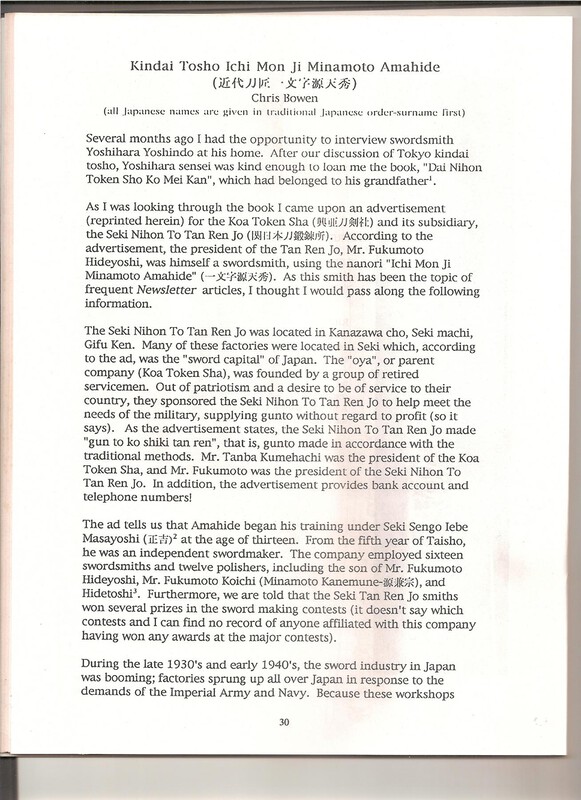
Dear Bruno. Found the article from Chris. JSS/US, Vol. 27 No. 2, March April 95. I can't recall off hand anything about Ishido Teruhide. All the best.
-
Dear Bruno. I think all these came from JSS/US journals, I am sure someone has the complete set though finding these articles might be a bit time consuming. Not sure if I have them but will havea look. All the best.
-
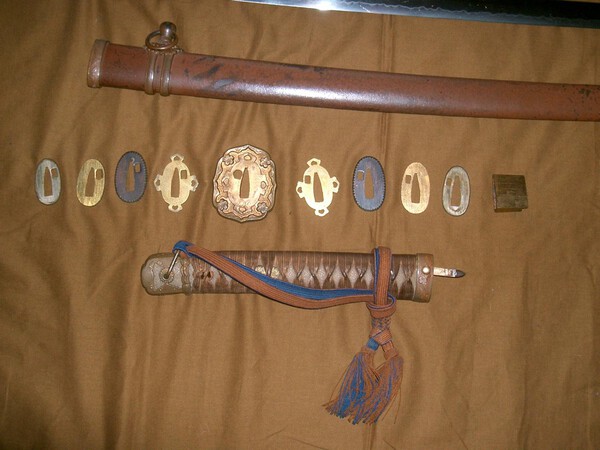
Dear Stephen. Welcome to NMB. This is a real Japanese sword but that's about all we can tell from these photographs. The tang, nakago, would suggest that it is a Showato, sword made for WWII. It may or may not have a small stamp on it somewhere. The fittings are far from standard and the blade is out of polish. To summarise this is not a good example of the type and it shouldn't be much money. If you buy it you will not be able to learn a lot from it and will have trouble selling it on. Just for comparison here is one in standard mounts. If you are prepared to give us an indication of what is being asked for the sword then we might be able to be a bit clearer but if you are looking at WWII military swords this is not a great example to start with. Don't give up! Keep an eye on the For Sale section here and I am sure one or two of our UK members will tip you the wink if they come across anything good. All the best.
-
And here it starts! You know that feeling where you think you might have got yourself into something that is going to end up costing you? That is a lovely book, and by chance Grey does have one for sale, just in. But it's going to cost you a lot more than your tanto. If you are bitten and want to study there are some books that we would all recommend that will ease you into the collectors library. Mind you, if you do go for the Bauer collection likely you will never recover. It's a feast of beautiful things. All the best.
-
Any information on this sword!
Geraint replied to claymoats's topic in General Nihonto Related Discussion
Dear Clay. This has possibilities so go very carefully. As George suggests to clean but do nothing else, condition is all and ruining a sword is terrifyingly easy to do. If you can give us a length from tip to the notch on the back of the blade where it finishes inside the habaki, the blade collar that would be useful, as would a shot of the whole blade from 90 degrees side view. Welcome to NMB. loads of expertise and advice here. Enjoy the ride. All the best. -
Dear Marc. Check out Matsuda Kanetaka. Showato but often quite nice. All the best.
-
Dear Terran. If you are going to store the blade outside the koshirae then you really need to have shirasaya made. Each shirasaya is individually made to fit a given sword and so that makes it a reasonably expensive option. Given the possibilities with this blade you need to have it made by someone who knows what they are doing, I am sure that US members will let you know who that could be. I guess that a lot of collectors would tell you to have the blade sent to Japan where it could have a polish, new habaki and shirasaya made before submitting for authentication papers. In the end that is the only way that you are going to know what you have there. Whatever you do it's a very nice sword. Worth looking after in its own right as well as because of your family history. Enjoy! All the best.
-
Dear Samantha. Same board, same people, same answer I'm afraid. All the best.
-
Dear All. In regard to the guri bori tsuba that started this thread, yes I do think it is classic guri bori, carved into the plate, though when I showed my wife the picture she instantly responded with, " Oh, it's repousse." Look at the lower left quadrant and note the highlights. With regard to the shippo tsuba, which I like and would love to own, if I had bought it I would not think that I had a Hirata tsuba. Note the copper cloisennes. I was reading an old text the other day and came across this, "..Sir Arthur Church, who formed a notable collection,had said that whilst on a trip to the London Docks he had seen a packing case fall from its sling and break open. It was full of iron discs, dirty and many rusty, and he saw a labourer piling up the lose ones into a bucket. He had a closer look at them, being mildly interested, and bought a quantity." (Newman and Ryerson 1964) Now at this point we should pause out of respect for all the tsuba collectors who are having emotional moments at the prospect of a crate full of rusty old tsuba, some of which were good enough to find there way into the Church collection. Enormous quantities of tsuba were making their way to the West at the end of the 19th and early 20th centuries. Many were bundled up and sold in bunches on strings. If any of you read the Discworld books by Terry Pratchett then you need to imagine a Japanese version of Cut me own throat Dibbler the eponymous street trader, anything for a fast buck. "Iron tsuba? Nahh, selling them by weight but your enamelled stuff, now that's a different story. Stick a few flowers on that one and we'll call it a Donin." I regret to say that most auction houses are run by distant cousins of Mr Dibbler and a Hirata label still sells. I fear that this is another case of technique driving classification; it has cloisonne it must be Hirata. However it does not have the hall marks of a tsuba by Hirata Donin which are explained here, http://www.jameelcentre.ashmolean.org/collection/7/10237/10398 Well I am just off to duck behind a substantial wall for an hour or two while you guys fight it out. All the best.
-
Thank you for this, some great stuff. As usual Google translate not always up to it, apparently the Chosu has, "sizzled and pierced decoration". All the best.
-
Dear All. Just a couple of observations. First, the tsuba in the original post is classic guri bori, carving down into the plate. If you are seeing this as raised then you are subject to an optical illusion. Second, we have seen before on NMB that confusion exists between technique and school in attribution, there is no reason why an Umetada artist should not have made this tsuba using guri bori technique. I am not saying that this is Umetada, just anxious that we understand guri bori as a technique, not a school. All the best.
-
Dear Tom. Have a look here, http://jameelcentre.ashmolean.org/collection/7/10237/10400 They are not common and usually command quite high prices. Luis, there were indeed some nice tsuba, be interesting to find out what they went for. All the best.
-
And perhaps it could find a home in the Articles section for future reference? All the best.
-
Need help with tōrokushō and mei translation
Geraint replied to Alexey's topic in Translation Assistance
Dear Alexey. Welcome to NMB. When you get a moment please add your name to your post, you can set it up automatically in your profile. Your sword does appear to be signed Kanesada as does the torokusho. There were many signing with this name and yours might well be a Mino smith. Have a look here, http://www.johnstuart.biz/new_page_14.htm, please note I am not suggesting that your sword is by this smith but at least it is a Mino smith signing with the same kanji. Does the sword have any papers? interesting that it is signed tachi mei. When it arrives we would all love to see some more photographs. All the best. -
Dear Mark. Axel is right on this one. Usually quite crudely carved sections of bone with a very thin blade and a weak habaki, as here. (Though the carving is better than many on this example, at least in the one section we can see.) Produced to export in the late 19th century and possibly later. Rarely there are examples with genuine blades in them and also some with superior carving but by and large, and in this case, you can walk away without any regrets. All the best.
- 12 replies
-
- 2
-

-
- fake
- restoration
- (and 1 more)
-
Dear Aiden. To answer your koshirae question, I think your instincts are good, it's not sensible to put more money into koshirae for this. Fitting sekigane, (copper inserts) into the nakago ana of the tsub might be an easy fix so that at least that fits. Other wise just enjoy the learning curve, it gets steeper! All the best.
-
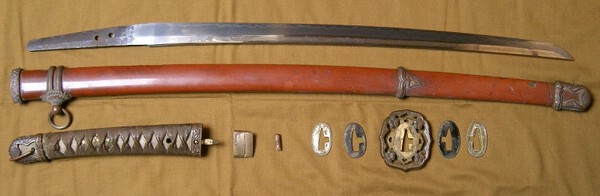
Couple of earlier wakizashi in gunto mounts, The kaigunto is signed Kunihiro, (I wish!) And the shingunto Shigetaka. All the best.

-
Dear Michele. Welcome to NMB! (Please add your name to your posts, you can set it up automatically in your profile.) I would be interested to see photographs of the whole blade, the misaligned machi are interesting. Is the habaki a good fit? Just to add to Ray's translation look up Kai Mihara school. This is a good place to start, http://www.sho-shin.com/sanyo16.htm All the best