


Geraint
-
Posts
3,132 -
Joined
-
Last visited
-
Days Won
10
Content Type
Profiles
Forums
Events
Store
Downloads
Gallery
Everything posted by Geraint
-
Dear Georg. You refer to the dragon tsuba as having signs of heavy use or damage. What makes you think that? All the best.
-
Dear Peter. The handle is covered in what is usually called same, a species of ray skin. Lots of information around on this subject. If you haven't already discovered how to care for this sword going forward then the links at the top of the page will take you to this guide, http://www.nbthk-ab.org/swordcare.pdf Please feel free to ask any more questions as you continue your research. All the best.
-
Dear Peter. The mei reads Echizen Kuni Kanenao. Probably Echizen Seki smith from Shinto times. Having said that I can't find a smith listed with this mei so worth checking the last kanji. Ahh! Maybe Echizen Kuni ju Kanetane. Compare here. https://www.aoijapan.com/wakizashi-echizen-kuni-kanetane-first-generation/ All the best.
-
Dear Piers. Firstly, I think you are absolutely correct in identifying this as a late Shinshinto work, although you don't give us the nagasa, the sugta, the kasane and the feel are all indicative of that. Jean is also spot on though perhaps understating the case. Mino smiths moved all over Japan in the Shinto period and many carried on with the work style. Echizen Seki and Inshu Kanesaki school for example. From what I can see I wouldn't have called the hamon sanbonsugi however, perhaps more togari gunome, which still has a Mino feel. I think a number of smiths got a bit lost during the Bakumatsu, perhaps those just starting up and not yet enjoying a reputation in particular. I like the koshirae. All the best.
-
Dear Bruce. Matsuda Kanetaka possibly? All the best.
-
Dear Matt. The false beard is a straw rain cape, and the rest, well look up Daikoku and his attributes. Enjoy. All the best.
-
Dear Matt. Nice one! The takanoha yasurime and the togari gunome point to this schools Mino den roots. Most sources suggest the original Inshu Kanesaki moved from Mino in the early Edo period and the lineage continues until he very end of the period. Enjoy! Just to add, this one popped up on Aoi. https://www.aoijapan.com/wakizashi-inshu-ju-kanesaki/ Interestingly it does not have the pronounced takanoho yasurime and in this regard is more typical of the school. All the best.
-
Just to echo what Gwyn has said, I have bought several items from Kevin over the years and apart from one delay when he was moving it has all been good. When my daughter kindly bought me a sword bag as a birthday present he even added a fusahimo to the order. I imagine that ordering supplies from Japan has been an issue recently but if in doubt drop him another e mail Vaughan. All the best.
-
Dear Alik. Well, the first one at the moment seems fairly ordinary, don't do anything to it except wipe the blade down with a little light oil at the moment. Forgive me if you know this but you should never touch the blade with bare hands, only the nakago, (tang). The second is fare more interesting and you should go carefully with it. Ideally a member here will be within reach and will be able to give you a more informed opinion from and in hand examination. To start with it is a nice shape, the large kissaki, (point),is often found in Shinshinto swords. The signature is of a very good smith and the cutting test makes it even more desirable. Now a caution, big names are often faked so don't give up the day job just yet. It is in it's civilian koshirae, (mounts), which still has the kurikata and fittings protruding through the leather combat cover. If these are your first two Japanese swords then you have done well, we look forward to seeing what happens with that wakizashi. All the best.
-
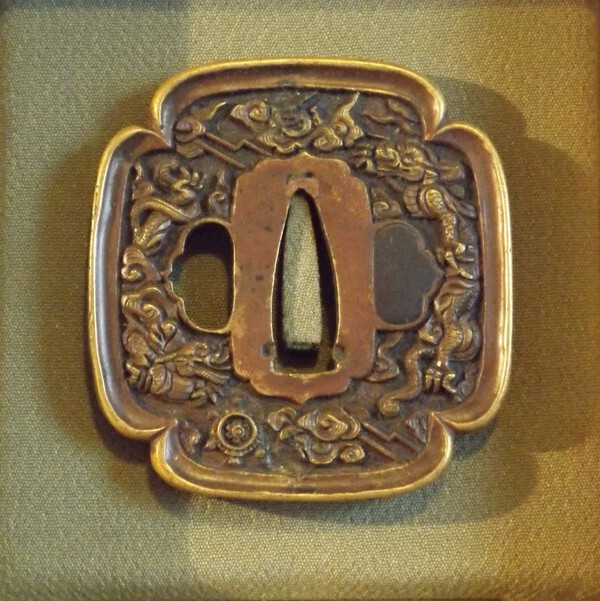
Just the one, a rather typical small sized example.
-
Dear Katran. Do please add your name to your posts as we all do, you can do that automatically in your profile. I have purchase from this site and was very pleased with the transaction if that is your question. Jussi has just offered two comparators, the sword in question has everything going for it, good polish, shirasaya, good papers, nice koshirae and an interesting signature as well as being by a very good smith. What's not to like? All the best.
-
Welcome Ankh and Alik. Ankh, you have our sympathies, stick around and don't be afraid to ask questions. Alik if your swords are military then post them in that section, by the sound of it they might both be better off in the Nihonto section. We will look forward to seeing what you have. All the best.
-
Dear Robert. Well, I'll bite. Hirado Kunishige school. As you say some typical features and some not so typical. The piercing is unusual, as is the sense of squareness of the mimi. Also the carving in the panels on the mimi. Looking forward to what you are going to tell us on this one. Reasons for: Moko gata in shinchu, Namban type seppa dai, both hitsu shaped for kogai, raised mimi with carved cartouche, carving lower than the mimi with textured border, peony decoration, style of carving...........
-
Hi Barry. Welcome to NMB! I can't make out the first kanji on the tsuba but the second is kyu or hisa. What do you understand the signature on the sword to say and why do you think it is probably gimei? What are the rest of the fittings like? All the best.
-
Dear Don. I surely hope that you are in for a nice surprise with this one. Tell me, did you see it in person? All the best.
-
Dear Doug. The form of the signature should be the name of the province, followed by (no)ju or 'living at' and then the smiths name. It is just possible that in this case the province is Inshu, short for Inaba province. I have to say that the first kanji does not conform to the usual way of writing this and looks much more like 'Kuni' . There is a smith signing Inshu no ju Munenaga but there is not very much information on him and from the shape of the blade I would not have thought it right for his period of working. Of course there is always the possibility that the signature is spurious, as in all forms of art. Not much help I'm afraid, but as other s have said it is a genuine Japanese sword. Enjoy the chase. All the best.
-
Dear Michael. Well the idea of just finding it is quite something. This one is a fairly straight forward tanto, the blade is unokubi zukuri and in quite nice koshirae. Nice jabari ito, just a dot of glue to secure that loose thread. Chances are strong that it is Shinshinto. It looks like the habaki is stuck, if so we can suggest ways of easing it off. Good one. All the best.
-
Dear Dick. Nice find and pleasing koshirae. Just to confirm, you mention the length as the, 'total length'. Is the figure you gave based on the length from tip to the end of the nakago? If so then could you give the measurement from the tip to the notch where the nakago starts as this is the nagasa and significant in this case. All the best.
-
Nice one Piers! Looks like a good quality shirasaya to boot. Will the auction tell you how it came to them? I wonder if it had papers which simply did not make it to the auction? All the best.
-
Is this a fatal flaw?
Geraint replied to PietroParis's topic in Auctions and Online Sales or Sellers
Reminds me of a dealer I called in to some years ago who assured me that a sword had been looked at by the, "nakago society". At last I understand! 🤣 All the best. -
Dear All. Metezashi tanto is the name given to tanto worn on the right. Apparently the name means horse hand and refers to the fact that the reins would usually be grasped in the left hand. In this case I do not think the rule, such as it is, for tachi katana mei applies and it is down to the individual smith. All the best.
-
Dear George. This is a wonderful story with a wonderful outcome. My imagination is working over time on what your sword looks like now, can't wait to to see pictures when it returns to you. Are you planning on having the koshirae restored as well? Given the age of the sword this is most likely it's original outfit. All the best.
-
Dear David. First of all, welcome to NMB! So far what we can see is that this sword is mounted in Shingunto koshirae, I think I see a leather covered scabbard in one shot which is for field use. It has silver mon or badge on the kabutogane which is a nice touch. From the tang, (nakago), it seems that this is an earlier sword, not made specifically for WWII. This is less common but well known. The blade has suffered and is not in good condition though so far none of the damage is serious as far as we can see from your photographs. Whatever you do don't try and clean anything, just keep the blade lightly oiled and get into the habit of not touching the blade with bare hands as this is a cause of damage. The sword may have been shortened during it's life and it has some minor flaws but you might want to do some more photographs of the blade to give people more to go on, specifically some shots of the tip, (kissaki), and of the whole blade without mounts. Others will pile in with more info. Both accounts of how the sword was acquired are possible and you will probably never be able to find out which one is correct but I don't think that really matters. Your Grandfather fought a long war, this is a tangible reminder of what he did. I am very glad that you are regarding it as a family heirloom and finding out about it. All the best.
-
Dear Mike. Take it easy. Almost all of us would assure you that you have a lifetime of study ahead of you and even then you won't be an expert. That is at least part of the fascination. I started quite by accident when my Mother bought me a Japanese sword for Christmas. All I had to go on were some very basic general books on swords, there was no internet and almost no material in English. I did some work on the subject at college and manged to glean a lot of information from Stone's Glossary. Pretty thin stuff. The Victoria and Albert museum had a small booklet, I still have it, and then I found by accident again, a copy of Sword and Same. That and a copy of The Arts of the Japanese Sword by Robinson were it for many years. All this time I still only had the one sword and that was battle damaged. A year or three later I cycled past an antique shop and saw a fine katana in koshirae, had to go in just to see it but I couldn't believe my eyes when I saw what it was going for, the dealer didn't know what he had and I went into overdraft to get it, it' still one of my best swords. Carrying it home on the bike was tricky! Some years later I met a guy who had a sword and he put me in touch with a dealer who was not too far away and who used to publish typed lists of his stock. Oh, the excitement when a new one arrived! No pictures, just typed text but you could dream. He suggested to my wife that a membership of JSS/US would be a good present and so on. No NMB and no one to talk to until a collector got in touch as he had seen my details in JSS/US. Too much information I'm sure but the point is it all took a very long time. With the advent of the internet a host of information and disinformation is at your finger tips. If you have not already found it try here, https://www.aoijapan.com/ Read the descriptions and try to see what they mean by looking at the photographs. Try to decipher some of the signatures. Lots of information here, https://www.japaneseswordindex.com/sites2.htm and links to many other sites as there are if you click on the Nihonto info tab at the top of the page. One of the FAQs gives you a list of books to start with. I still have that first sword, it's worthless as it has a bullet hole through the hamon but I still learn from it. Most of all enjoy! OK, enough rambling, time for another sip of Calvados. All the best.
-
Dear Jason. I am really surprised that no one has commented on this. You seem to have started collecting in the way that we all advise others to do but failed to do ourselves. Most of us started with a pretty dodgy sword and then found out what we were looking at. To start with a papered Shinto katana which is ubu, in full polish and with Kanzan sayagaki is pretty good going. It's a lovely sword! You will have done your research and know who the smith is and how he fits into the pattern of Shinto smiths. The Kiku mon was given to a number of Shinto smiths, it's not what you would call common but it is characteristic of certain smiths. All the best.


