mecox
-
Posts
986 -
Joined
-
Last visited
-
Days Won
16
Content Type
Profiles
Forums
Events
Store
Downloads
Gallery
Everything posted by mecox
-
I have heard these referred to as "batons" and also "counting sticks/rods" which is sangi 算木 in Japanese. But need to consider the design of theme of the tsuba. Counting rods - Wikipedia
-
Tony, looks like earlier war better quality kaigunto koshirae. Your blade has Seki stamp and kiri yasurime. For comparison attached oshigata from F & G (1983): Ikami Sadahiro is not in Hawley, but father Takai Sadatsugu is (SAD 780)

-
Thomas, needs more pics to better understand it. Yes the simple form of date. Looks to be kaigunto saya. Blade has Seki stamp. Nakago and mei rather rough. I used Sesko's e-version of swordsmith list (which is worth buying).
-
Tony, Ray looks to have it as SADAHIRO with Showa 17 (1942). However, its a bit interesting as Sesko lists as follows: "SADAHIRO (貞弘), Shōwa (昭和, 1926-1989), Gifu – “Sadahiro” (貞弘), real name Takai Shirō (高井四郎), born March 12th 1925, son of Sadatsugu (貞継)". But in the Seki tosho registration list, there is a father and son both registered on Showa 16 (1941) April 11, and both reside at Seki-machi, Ippongi. However, looks as though Sesko inadvertently combined them (easy to do in a massive list). Father: SADATSUGU 貞継 Takai Sadajiro 高井貞次郎 born Meiji 35 (1902) May 24. Son: SADAHIRO 貞弘 Ikami Shiro 伊神四郎 born Taisho 14 (1925) March 12. Interesting they have different family names, dad is 23 years older, could son be adopted? Who knows.
-
Pippo, all appear to be Seki Mino swords. TOP: Seki ju Goto Kanehiro saku ( has a stamp been filed off at top). He is in Slough p. 43. In 1941 exhibition was 4th seat of 5. In 1942 list he was 6th level of 7. MIDDLE: Ido Hidetoshi real name Ido Toshimi, born June 14 1915. Died Sept 18 1985. In Slough p, 33. In 1942 list as 6 level of 7. He worked in Amahide forge (see the NMB Downloads for AMAHIDE article). LOWER: NoshoMihara Kane (rusted) saku kore. (is the rusted Toki or Aki?)
-
 David, looks like Masayasu (Mano as Makiyo) also with "delta" punch, and very "chippy" cutting. See this article page 38
 -
Bruce, these two Shigemitsu are different people. Suetsugu Shigemitsu is in Fukuoka and was quite productive, plus had a number of deshi. Hirose Shigemitsu was in Asuke in central Aichi, he was an RJT and seems to be linked to one of the Aichi arsenals. Not much available about him. He signed Chounsai Shigemitsu. After the war he made knives etc, but he did make a Kowa Kinen To in 1952. I am trying to write up Showa era Aichi at the moment. A very diverse lot.
-
David, dont know what the blue ito is, but at kashira looks to be Japanese paper under it. However, the yellow ito looks like an amateur Western job, as the ito crossovers are all the same way (dont alternate left, right, left etc). Did this have menuki?
-
George and Bruce, interesting questions, the mei does seem to be Kaneyoshi, but that is unusual "yoshi" 賀 and also read "ga" or "ka" . Its also in the province name of Kaga 加賀. Maybe a coincidence but this blade looks very much like Kaga (Kashu 加州) work of Kanewaka school who came from Mino, but around 3rd gen e.g. early 1700's. (some of them also then went to Owari). Note the nakago which looks ubu, has yasurime (taka no ha) and jiri (kata-yamagata), but also the hamon looks like irregular gunome midare with various small choji (flashy styles popular at that time). But I cant find a record of such a smith. Here's a later wild card: Mino no Kami Fujiwara Toshinori (1740-1810) real name was Hamabe Gonzaemon, his initial mei was this Kaneyoshi, he move to Inaba (Tottori) and when he received a title in 1785 (Mino no Kami) changed his mei to Toshinori. Early he also did hamon with narrow irregular choji. This may be way off, but it is an interesting story!
-
Tom and Stephen, thats a beauty, yes May, 1945, thats late. This is a Nagoya, Aichi smith who name was Takeuchi Kinsaburo Kanemasa (his deshi Morita Kanefusa). It is tachi-mei : Bishu Takakura Ji ju Takeuchi Kanemasa saku. Takakura Ji or Tera is a temple in south Nagoya. Around May 1945 Nagoya was under massive bombing raids. He was a RJT, 1941 6th exhibition ranked level 5 of 5, in 1944 army exhibition ranked as Nyusen. he continued making swords post-war and then registered 10 July 1954. Would love to see the hamon. Looks a nice item.
-
WW2 Military Sword - Please assist in identifying
mecox replied to Arty A's topic in Military Swords of Japan
Arty, as Kiipu says 村井秀次作 "Murai Hidetsugu saku" family name is Murai and Hidetsugu is given name which he also signs on sword. He was born Taisho 2 (1913) October 23 and registered as a swordsmith in Seki Showa 16 (1941) March 12. He was from Minami, Bugi-gun which appears to be in northern Gifu higher country. Looks to be a basic Showato maker and not to have formally trained as a swordsmith. Not many examples but can find if search NMB. -
WW2 Japanese Navy Takayama sword
mecox replied to Swords's topic in General Nihonto Related Discussion
Some background and explanation in this: -
Yes Kojima Kanenori. More info here:
-
well my mother always used to say "don't lick your knife"!
-
Cake tamashigiri. News pic from Fiji 2011. President of Fiji & his wife cut cake for 75 years of a shipping company. Two shingunto technique.

-
WWII Officers Sword? Need help identifying
mecox replied to fatruff3's topic in Military Swords of Japan
Bruce and Chris, this is Kinmichi 金道 real name Hibino Ichiji 日比野 一二 born Taisho 6 (1917) May 6, and appears to have died in 1945. He was from Oyama, Tomida, Kamo-gun, Gifu (5-6 km to east of Seki and registered as a Seki smith Showa 17 (1942) Sept 10. He does not look to have trained in the traditional way in Seki schools and likely transferred from another job (e.g. blacksmith)to swordsmith. -
More of Hizen Masatsugu here:
-
Bruce, who knows, but that is a likely scenario. Yes modifications do not look recent, and part of its history. I think considering hamon and type of nakago jiro could pick several Seki toshi.
-
Hi Gareth, thats a great looking shingunto with quality mounts (as much as I can see) and I guess saya is the same. The blade also looks good, and as you suggest oil temper. From hamon and nakago it looks like Seki showato. However, to me it looks like someone has tried to make this look like an older mumei. Close up of nakago shows the taka-no-ha yasurime changes angle a few cm from jiri. Original filing continues up the left edge. Also the nakago shinogi curves a bit plus becomes sharp. A key feature looks to be remnant strokes of a kanji (the position suggests it could be "saku" ? ). Also, on the small pic of nakago, just above the hole, a few small lines could indicate a stamp? The yasurime here is also redone. This all appears to be wartime vintage. But I am often wrong plus have not seen the sword itself.
-
Andy, yes Miwa Kanetomo as George notes, one of the earlier registered WW2 tosho in Seki. Some additional info in following article (tosho #29)
-
Would like to learn more about this sword.
mecox replied to MarkGee's topic in Translation Assistance
Mark, its a nice looking package, but yes needs some work to pull it together. The very regular sanbonsugi hamon and the smooth (looks like) boshi (around the tip), plus the rounded mei, look like a late Kanemoto generation (Shinto). Presumably also has a nice saya? -
I hate Swordsmith Writing! Help?
mecox replied to Bruce Pennington's topic in Translation Assistance
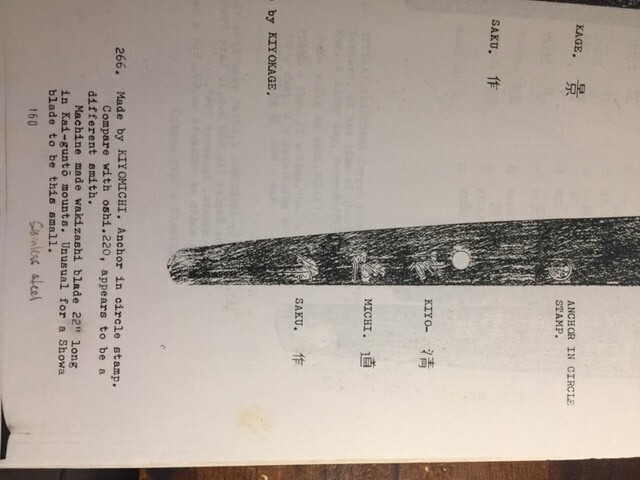
Yes Kiyomichi. Stainless steel blades at Toyokawa arsenal with anchor stamp. Here is an interesting one from F&G.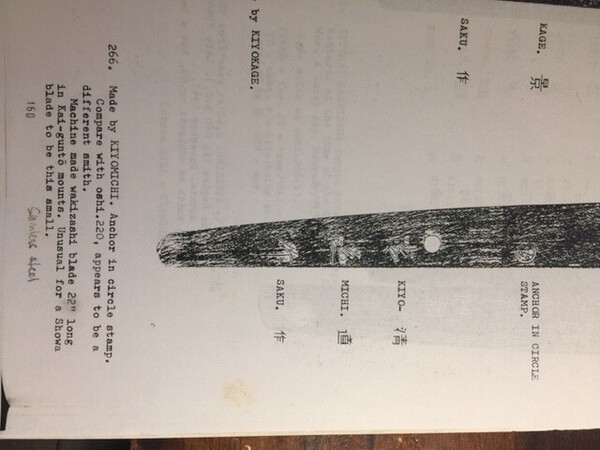

-
The problem is with the number of flights to Aus. This is the main problem with parcels, and USPS maybe not accept them, but seems they can be sent via a combo of USPS + EMS (via Japan?). Can send parcels via couriers eg. DHL, FedEx, but can be expensive. Swords via USPS looks to be a problem, as may be too long or prohibited item. If accepted at a PO, may get stuck somewhere for a few weeks then returned to sender. I recently received a sword from CA-USA to Aus via USPS+EMS but needed to be <36". Was moderate price.
-
Mario, information on Kanenori here:
-
Bruno, looking at the pic from the FRONT, and considering the BACK row LEFT to RIGHT (and assuming a date of 1941). Left: NAKATA ISAMU KANEHIDE, born 1913, age 28 (your small photo). Middle: NIWA SHUJI KANENOBU, born 1903, age 38. Right: KISHI MITSUHIRO MITSUNOBU, born Taisho 13 (1924), age 17. He was a student of Shuji Kanenobu (your big photo, cap with black brim). Mal