mecox
-
Posts
986 -
Joined
-
Last visited
-
Days Won
16
Content Type
Profiles
Forums
Events
Store
Downloads
Gallery
Everything posted by mecox
-
Arsenal Mark on RJT sword Fittings
mecox replied to george trotter's topic in Military Swords of Japan
Bruce/Trystan, I now see he is in Slough page 179, and also uses place name Kozuke an old name for Gunma (not Gumma). Slough reads his family name as Tsukagoe (Slough reads Tsukakoshi). -
Arsenal Mark on RJT sword Fittings
mecox replied to george trotter's topic in Military Swords of Japan
Bruce and Trystan, it looks like this bloke from Sesko TSUGUNOBU (継延), Shōwa (昭和, 1926-1989), Gunma – “Tsugunobu” (継延), real name Tsukakoshi Yonekichi (塚越米吉), born 1906, he studied under Kasama Shigetsugu (笠間繁継) and Kanetomo (兼友) and signed in early years with Kaneharu (兼春), he worked as rikugun-jumei-tōshō, as Kaneharu jōkō no retsu (Akihide), Fourth Seat at the 6th Shinsaku Nihontō Denrankai (新作日本刀展覧会, 1941). Using an old style "tsugu" and Showa 18 (1943) February (not 1936!) -
Help identify writing and info on sword
mecox replied to jamesbranagan's topic in Military Swords of Japan
Bruce, sorry I cannot help, dont know this stamp. From the nakago detail and mei cutting looks like an early war product (before 1942?). The position of the stamp could also refer to a type of steel? -
Translation help on Additional Kanji on Masanaga Gendaito
mecox replied to matthewbrice's topic in Translation Assistance
Here's a bit more on the Minatogawa Shrine: Minatogawa Jinja Kikusui Forge. The Minatogawa Shinto Shrine was built in 1872 to honour the devotion to the Emperor of army commander Kusunoki Masashige 楠正成 at a battle in 1336 at what was the Minato River, and is now in the western part of Kobe City. The Kikusui mon (chrysanthemum floating on water) his family mon, was later adopted by the shrine and also the Imperial Navy. A version was used on Minatogawa swords. In 1940 the Kikusui Tan-to Kai (Kikusui Sword Forging Association) was formed with an aim to produce Nihonto dedicated to the shrine and for naval officers. A dedication and forging ceremony was conducted on 25 December, 1940 (Showa 15). Around 12 months later, on 2 December, 1941 the forge was moved to a Egeyama, a hill about 1 km to the west (now a bushland park). The dedication and forging ceremony was repeated on 8 December, 1941 (Japan time); Japan declared war on US and UK the same day (7 December US time) one hour after Pearl Harbour was attacked. The shrine was active during the war but was destroyed by fire during an air raid on 17 March, 1945 and was rebuilt post-war; it was dedicated on 20 December, 1950. Traditionally made swords were produced at Kikusui from the end of 1940 to the surrender in August, 1945, but there appears to be a period when tanto were made in place of tachi. These gendaito were for Naval Officers and were largely distributed through the Naval Officers Club. Presumably the forge had supplies of tamahagane, or a substitute. On the nakago the “Kikusui mon” (chrysanthemum flower on water) was engraved above the mei (however, it is not clear if this was only for blades produced at the shrine). -
Piers, can you show a pic of the other side of menuki. thanks.
-
Interesting pistol holster for man on right (piece of string)...I guess for the photo. I dont know guns...is that an early Mauser?
-
Trying to identify maker Shin Gunto
mecox replied to deadoscillate's topic in Military Swords of Japan
Chris, I'm still confused with the two mekugi in the tsuka. Do they both correspond to holes in the nakago? And the question is whether the upper hole (above the mei) is from an earlier (civilian?). By the way, how long is the nakago. -
Trying to identify maker Shin Gunto
mecox replied to deadoscillate's topic in Military Swords of Japan
The holes are a bit strange. Maybe @Bruce Pennington is right that it could be the earlier Shigemitsu? I just noticed the tsuka has 2 mekugi. Cant tell from angled pic but possibly a short nakago so put a second hole when remounted as gunto. -
Trying to identify maker Shin Gunto
mecox replied to deadoscillate's topic in Military Swords of Japan
Chris, It is most likely WW2 Shigemitsu. Here are some other examples from page 45 (I note I have a few typos in here). Your sword has a slightly different cut of Shigemitsu (繁) but appears to be the same. Yours also has kiri (horizontal) yasurime filing, as opposed to oblique. -
Inherited Sword, looking for help Identifying maker.
mecox replied to MrReaper2u's topic in Military Swords of Japan
As Thomas noted, mei is Noshu Ju Nakajima Kunishige Saku. Blade has Sho stamp so probably 1942 or earlier. His real name was Nakajima Hiroshi and was born Meiji 33 (1900) Nov 23 in Gifu. He died in 1944 Oct 27 age 44. He registered early as a swordsmith in Seki on Showa 14 (1939) Oct 25. When he registered his address was Kajita village in Kamo district (to the east of Seki). In 1954 Kajita merged with Tomida and became Tomika. In the war there appear to be a group of smiths working together in Kajita. The fittings on your sword look to be a post-war composition, maybe for iaido? -
Some examples of Tenshozan tanrenjo from page 82:
-
Its not correct to say Kojima Katsumasa "only made machined blades". He was a student of Watanabe Kanenaga in the traditional swordsmith tanren he established in Seki. All indications are that Katsumasa produced traditionally made blades in the late 1930's and changed to "Showato" production during the war. But these blades were still handmade, even if western-type steel, oil tempered and mechanical hammer. This blade is 1943, and was apparently made for (or at?) the Nagoya Arsenal (see the stamped assembly number 1025, and near the mekugi ana is a "NA" stamp). The blade looks well made and well mounted, plus hamon does not look oil temper in these pics?
-
Hizen Masatsugu shingunto has now been sold. Thank you.
-
As per Ray is Kanekado. Have a look for Kanekado in here (#10), some of his info a bit confusing:
-
Have a look in here for Nobumitsu #32:
-
Folks, I am keen to sell this complete RJT sword by Hizen Masatsugu, so reduced to US$1850. Thanks.
-
As noted above, YOSHISHIGE, real name Komiyama Ryozo (uncommon kanji for "yoshi" 良 which can be read as "yoshi" and "ryo"), born Meiji 35 (1902) January 19. He registered as a Seki swordsmith Showa 17 (1942) November 1 (at age 40) and then was living in Seki, Tokiwa-cho.
-
Well the style / design doesnt look at all like the various pics of shakujo. If it is that type of item, perhaps it could be for training as a weapon.... blunt end, lots of noise, dish as offensive protection, and could be used in the hand or with a shaft. Or maybe by the mobile tofu-man (tofu-uri) with his cart to attract customers!
-
Well maybe not a Buddhist item. I thought of the yamabushi, mostly 2 coils with 3 rings each (=6). and there are other ones for deeper reflection with 4 coils of 3 rings (=12). But no dish. Yours looks very rural and blacksmith made. I thought of a sort of rattle, like a cow bell. but still no idea.
-
Difference to shakujo looks to be yours has 3 coils (joined at top?) each with 4 rings (total 12) and a "dish" which appears to be loose. Wooden handle fixed by a mekugi? To make noise for a reason? Would not work for counting?? I have no idea.
-
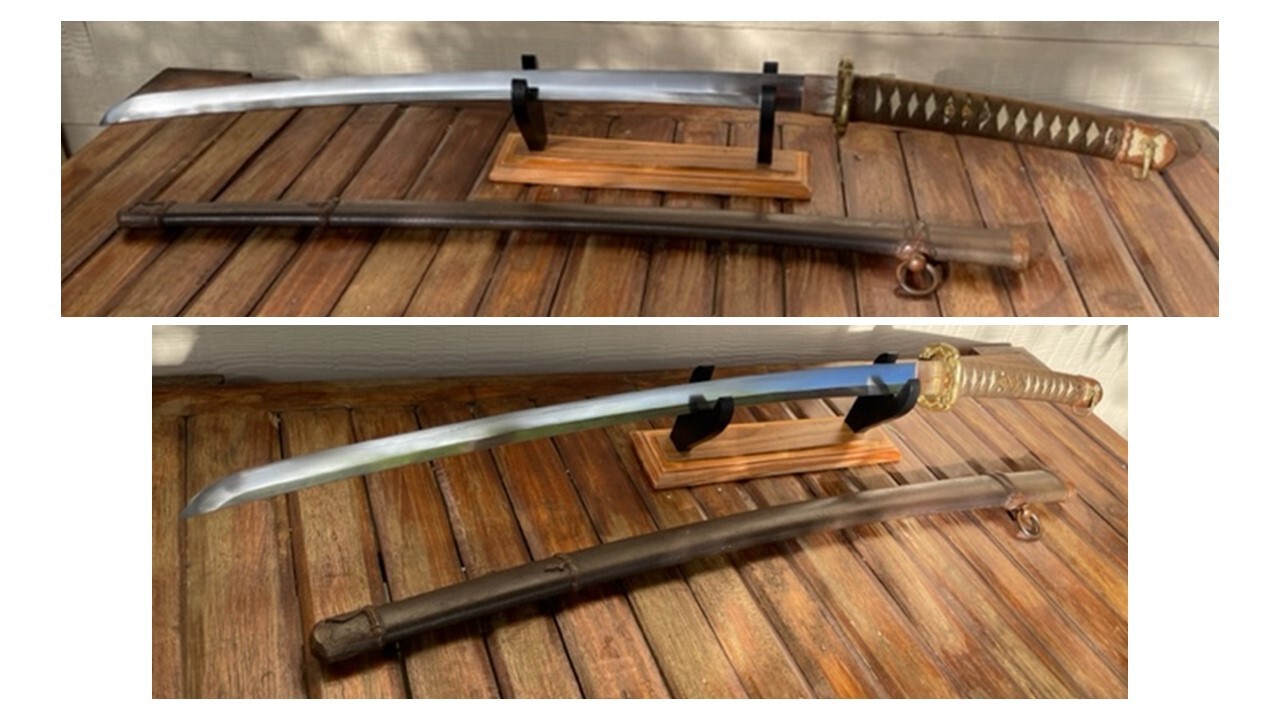
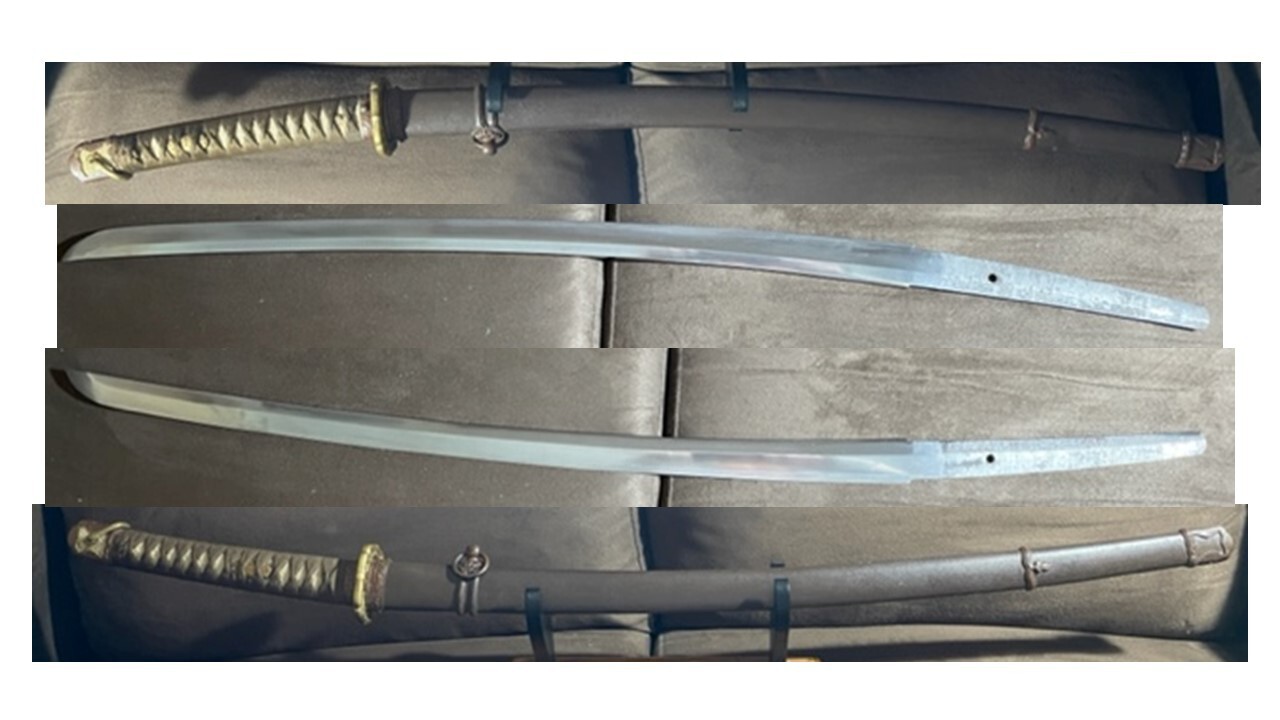
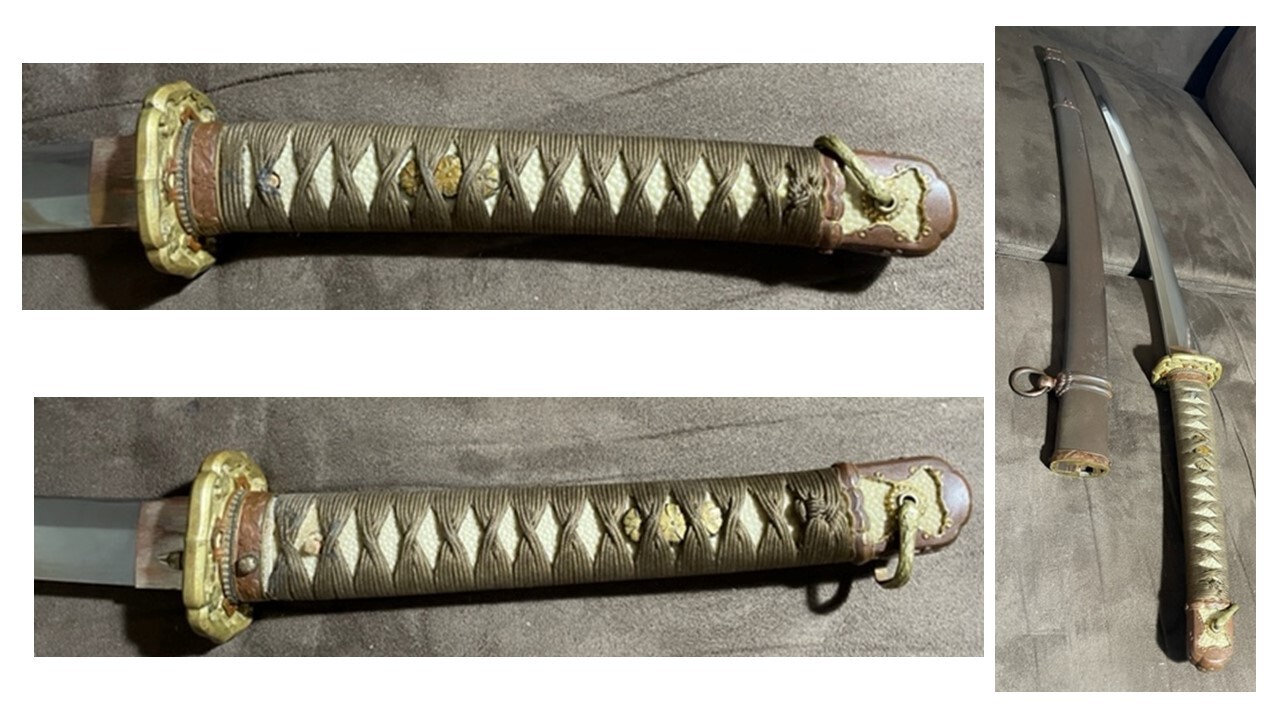
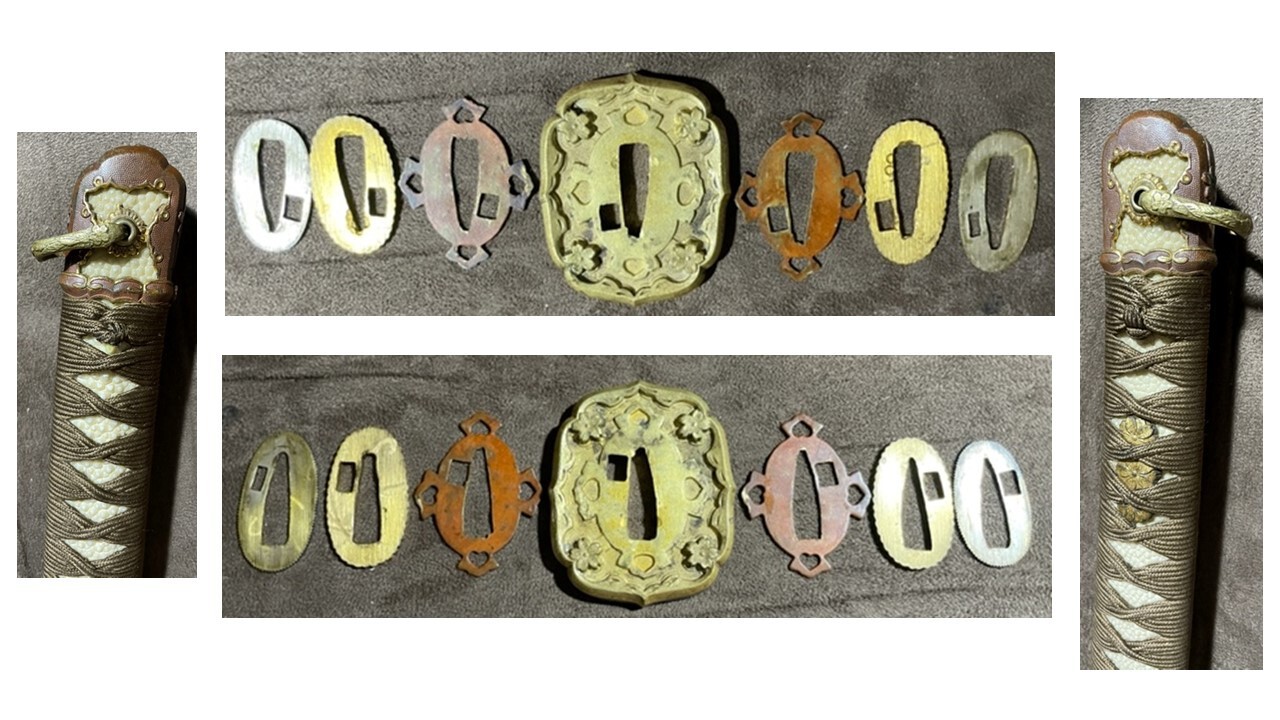
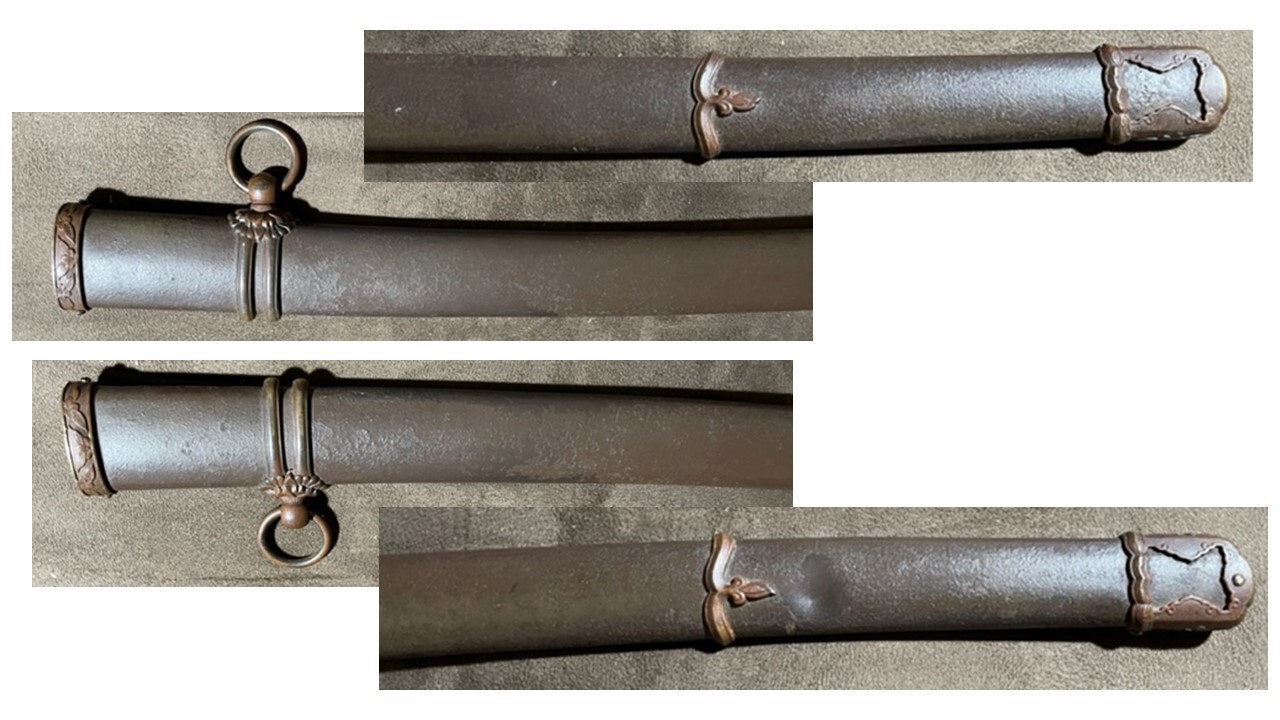
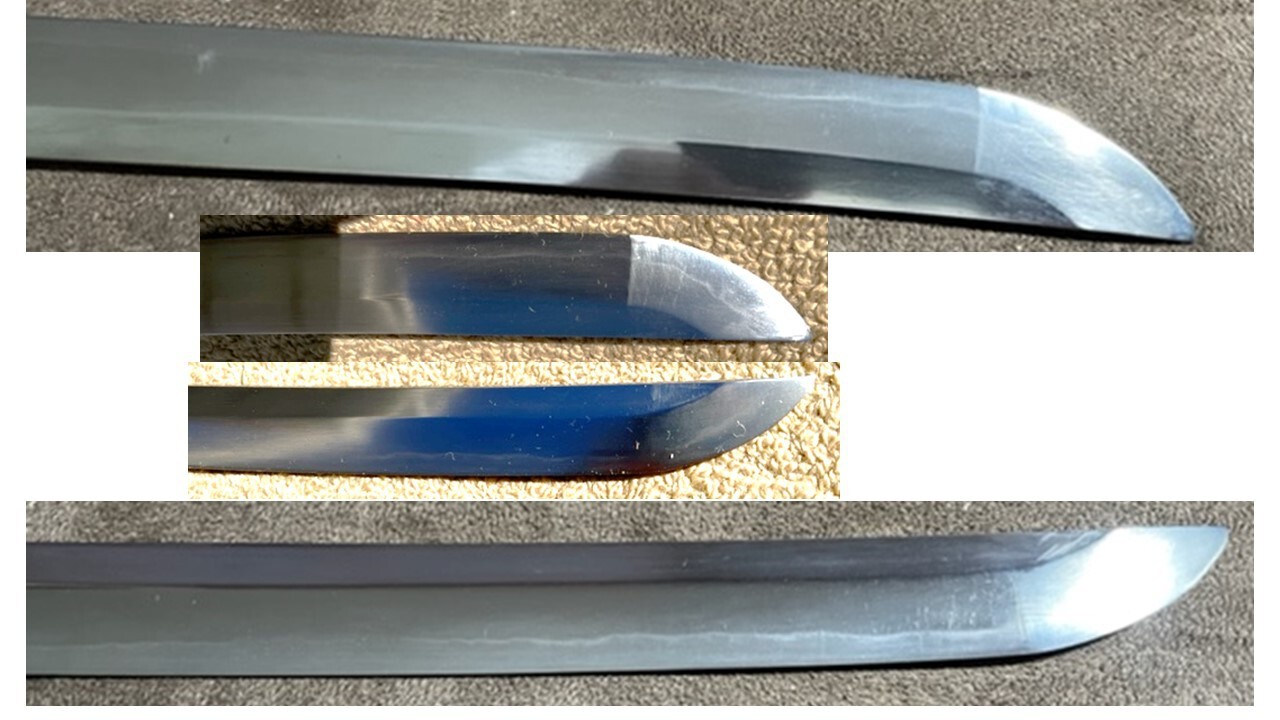
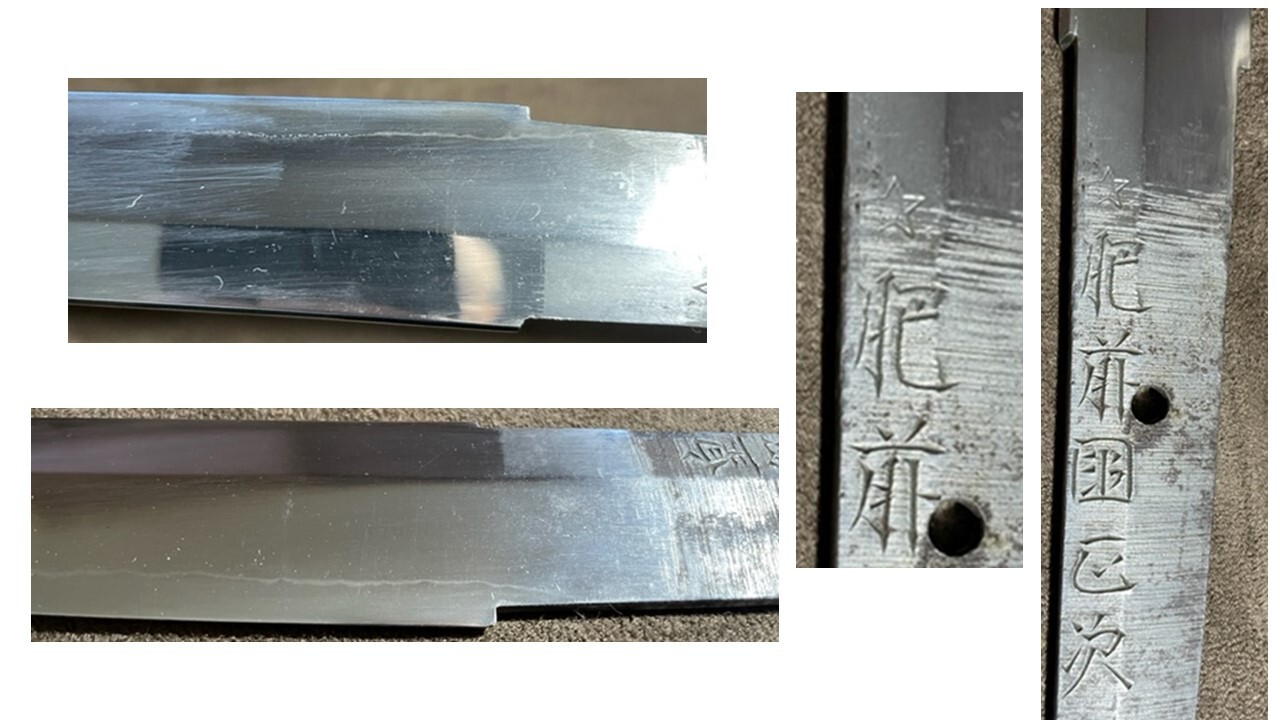
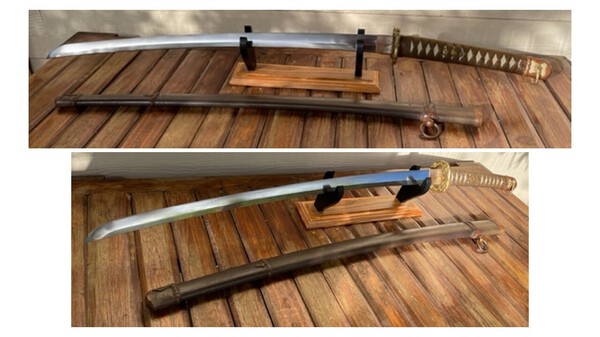
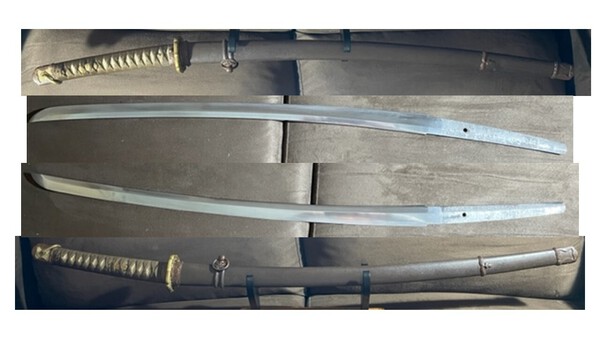
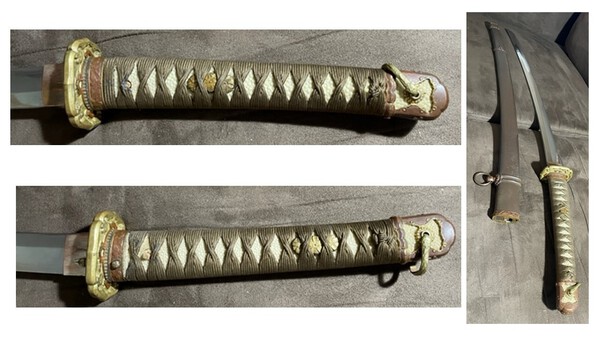
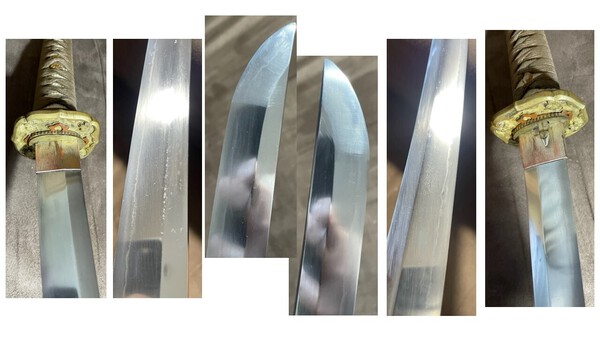
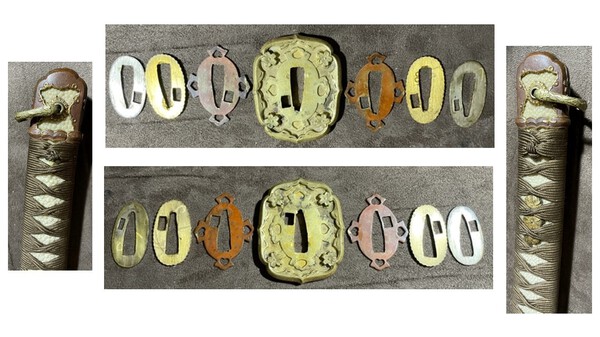
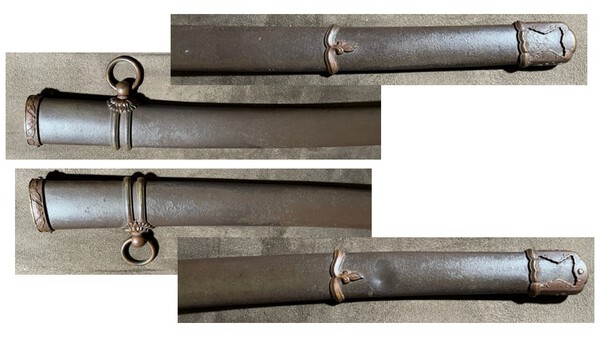
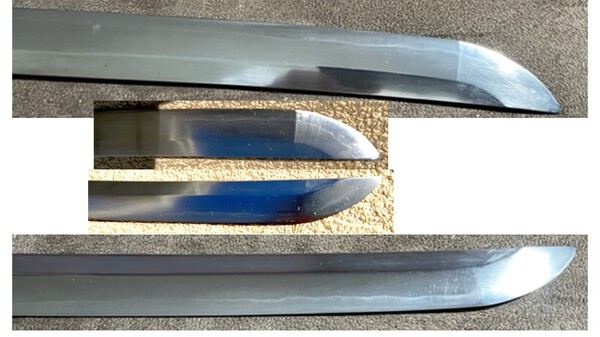
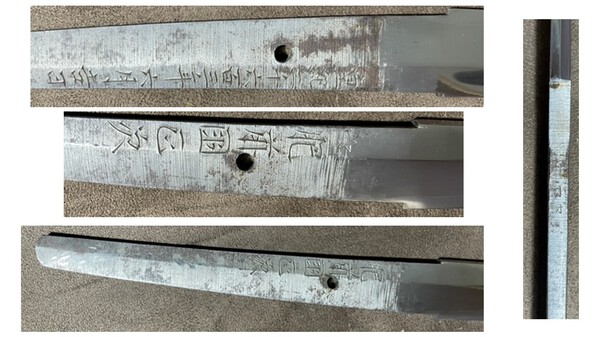
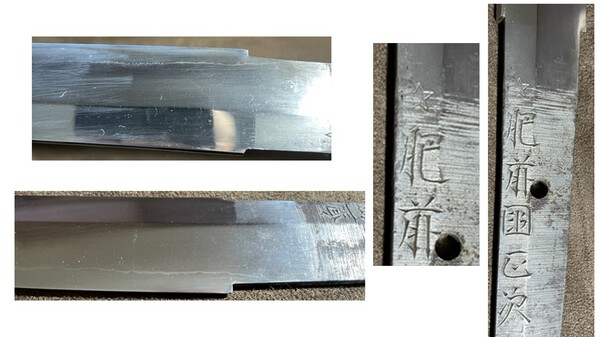
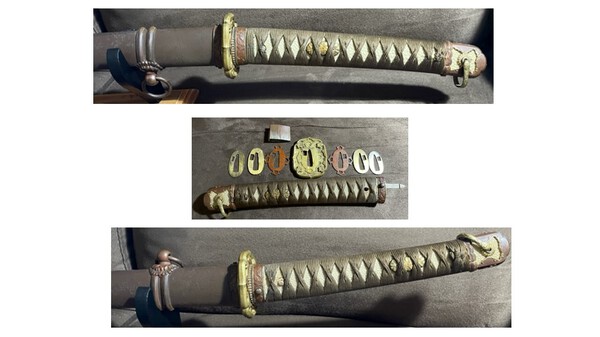
Shingunto signed Hizen no Kuni Masatsugu 肥前國正次 with Rikugun Jumei Tosho star stamp plus “ko” and “ho” stamps on nakago mune. Traditionally made water quenched, nagasa 64.2 cm, hamon is suguha based ko-midare with nie deki, boshi is jizo shape with kaen (flames); appears to be muji hada. Blades is dated at June 1943: Koki ni sen roku hiaku san nen roku gatsu kichi jitsu 皇紀二千六百三年六月吉日 “lucky day 6th month 2603 years Japanese Empire” (June 1943). Nakago is ubu with kiri yasurime. Blade in very good condition, in original polish, no bends or rust, but some fine stratches. There is one small fukure blister (1 mm) on edge of hamon. Shingunto koshirae is all original and good condition (one minor dent on saya). Tsuka is all original, ito binding very good, quality same rayskin with large nodules. Brass gunto tsuba with 3 pairs of seppa (no stamped numbers). Locking clip complete and working; brass sarute has sakura pattern. Copper habaki with silver wash. Masatsugu originally from Saga, Hizen, trained in Tokyo at Denshu Jo at Akasaka. He received high ranking at all wartime exhibitions, and returned to Saga around 1942. He was appointed Rikugun Jumei Tosho. Post-war he continued to make swords from 1958 receiving numerous awards. See Article in NMB Downloads for details of Masatsugu and examples. Described in Slough as "medium to high grade gendaito" pages 106-107. Price US$2000 (plus shipping & Ppal).. Blade is in Australia. https://www.militaria.co.za/nmb/files/file/51-taguchi-kiichi-masatsugu-hakuryushi-tadataka/
-
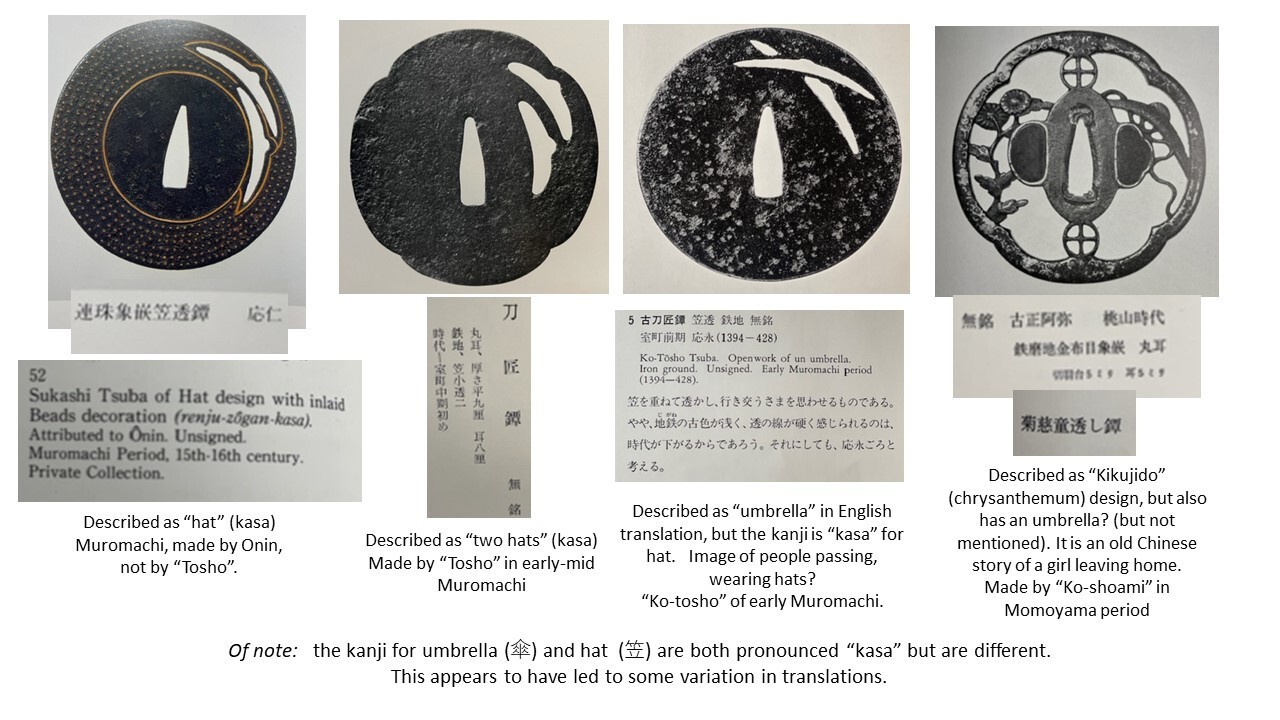
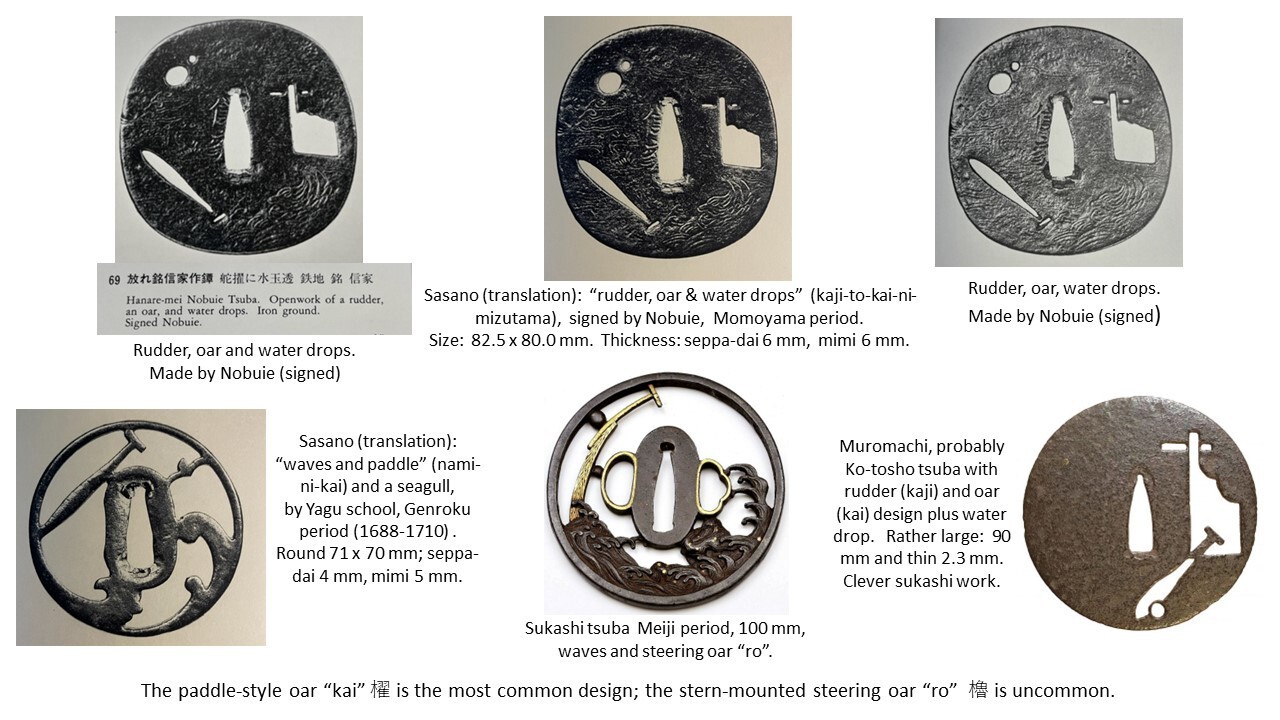
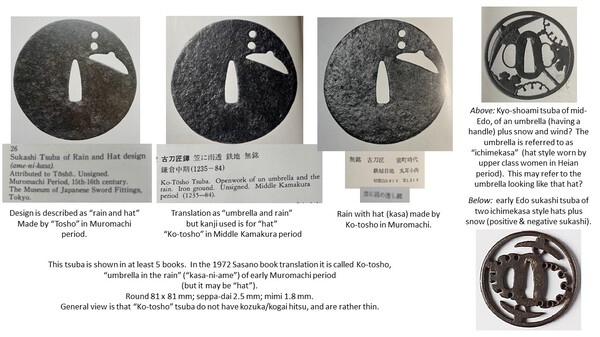
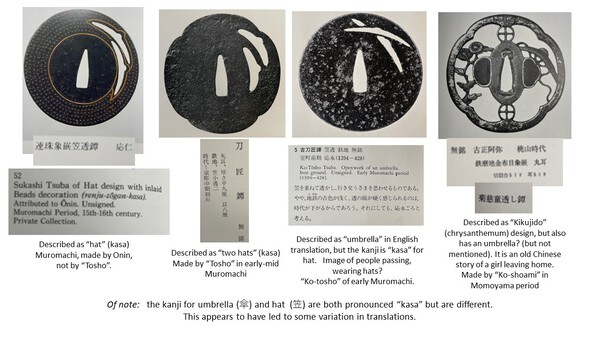
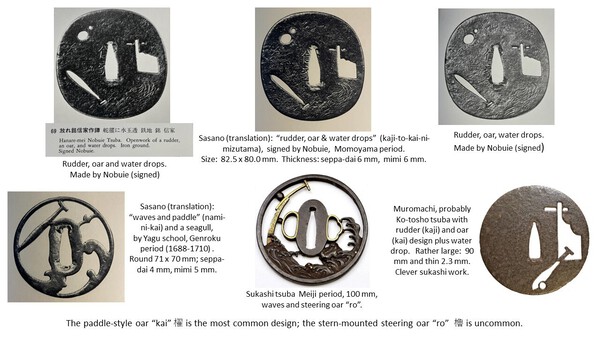
Well this initial challenging post by Piers has caused me substantial loss of sleep, so I had to look further into this tsuba and its design, then could not stop.

-
Bloody hell....well looks like 櫂Kai is the correct term for the tsuba design. And the other term is the origin of the old Japanese song "ro, ro, ro your boat gently down the stream...." . I'm getting ready for that glass!
-
Wow, your concept is very deep, if not oblique..... its morning here, so my view tended not to be enhanced with the benefit of a few reds!
-
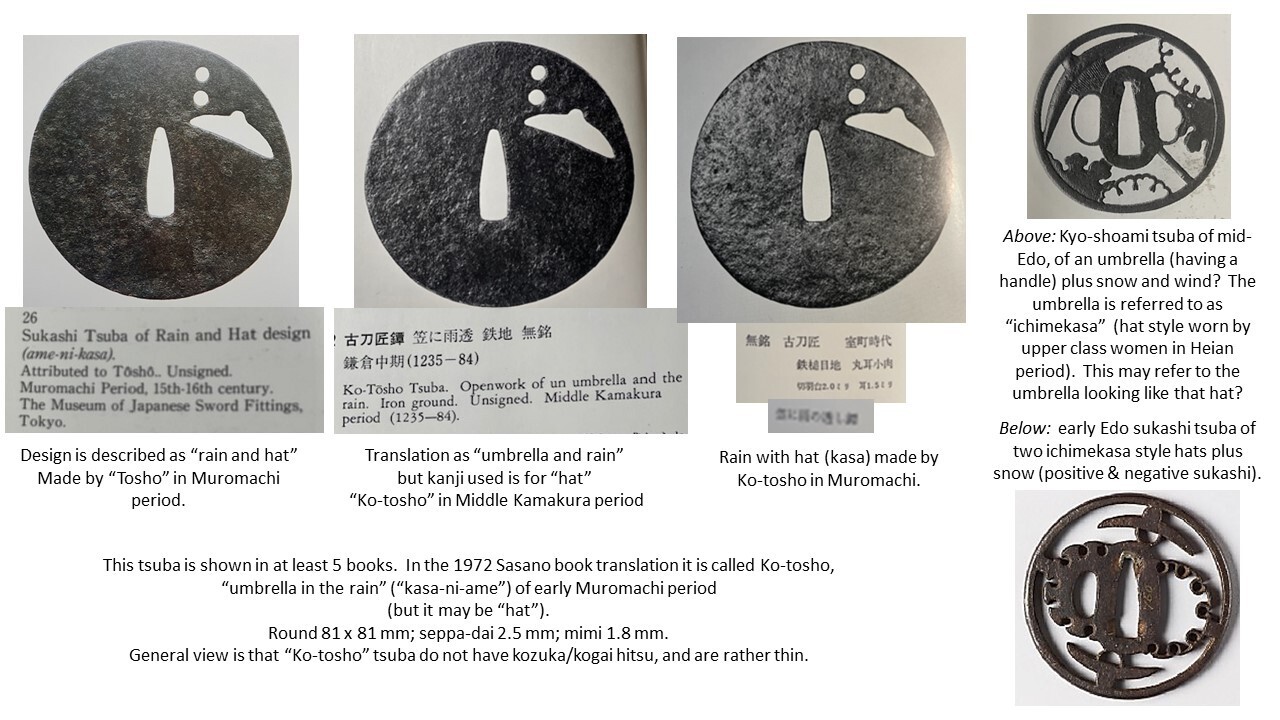
Interpreting these tsuba gets a bit philosophical...and you need to ask the maker. But for this one I would go with umbrella (kasa) which is a common design item with rain drops (kasa ni ame); and an oar or paddle (kai). So with an umbrella in a paddled boat, suggests a passenger, so maybe theme is "water taxi" , boatman and passenger in the rain. Re the tsuba, rather small (7.3 cm) suggests small katana (or wakizashi), plus the tsuba looks rather crude and thick, so more like "Tosho" as opposed to "Ko-tosho". The latter are earlier and Muromachi, even Kamakura, and are larger often 8.0-8.5 cm, basic but well made and designs neatly cut, and well forged iron. So themes can be rather open.