Guido
-
Posts
3,242 -
Joined
-
Days Won
99
Content Type
Profiles
Forums
Events
Store
Downloads
Gallery
Everything posted by Guido
-
I'm a fraid I have to completely agree with that statement, especially when it comes to a., b. & c.
-
D T I 2015
Guido replied to Guido's topic in Sword Shows, Events, Community News and Legislation Issues
This year's DTI dates were the first thing I checked when I was told recently that I'll have to attend a conference in Rome the end of October. Phew! Otherwise I would have missed the first DTI in 14 years – a double punch (as the Japanese call it in wasei eigo), since I'll move back to Tōkyō in July! Now I can't only attend, but it's also my birthday (11/19) – all who come to Japan: feel free to shower me with presents! (Those coming from Germany will earn extra points if you bring along my beloved "Heringsfilets in Sahnesauce"!!!) -
You ask for opinions, and then discard them as worthless.
-
海部 should be read Kaifu, not Kaibu.
-
Although I doubt that it could be patinated to a 100% match, it might be possible to come close - but I cringe at the thought of artificially altering a piece that has a very pleasing color and is in no need of repair/repatination. Gordon, it's obvious from this and other posts you made that you have a very strong desire for getting matched fittings together. I don't blame you, I think many of us were at the point in their early collecting days. So, some unsolicted advise from me: step back for a moment, take a deep breath, and wait until a decent set of affordable soroe-kanagu comes along. This might not be next month, or even next year, but the wait will pay off in the end, believe me.
-
The Shimazu-han was the most powerful of all tozama daimyō, and had a higher samurai to commoner ratio than average domains. Nagasaki was under the direct control of the Tokugawa bakufu, and governed by the Nagasaki-bugyō - the Shimazu clan became rich due to conquering Okinawa and the Ryūkyū kingdom.
-
There are lot of interesting places in Berlin - I lived there from 2000 ~ 2003 - but for Japanese sword related items I recommend the autobahn leaving the city .
-
I think it says 黒石目地朱刻塗鞘打刀拵 (kuro-ishime-ji-shukoku-nuri-saya uchigatana-koshirae) - black ishime ("stone surface") lacquer with red mixed in. And btw, this confirms that katana and uchigatana were words for the same thing in the Edo period, something we discussed before.
-
If you're hinting at Haruaki Hōgan, "Haruaki" is written 春明 in that case; I couldn't find any artist who signed 春秋 so far.
-
That's a very important aspect to know, hard to digest, harder to accept, and extremely hard to comprehend (if that's even possible). I used to own a very good Aoe blade, and Mr. Tanobe encouraged me to submit it for jūyō. It failed. I asked him "why" when I picked it up at the NBTHK, and he told me to look at the three Aoe that had passed. I have to admit that all three were a notch above mine, and two of them made tokujū a year later; maybe the third was never submitted, or failed, but IMO it was right up there in quality with the other two, i.e. better than mine. He told me to re-submit. I almost threw a tantrum, and wanted to shout out "that's unfaaaiiiir!" Why on earth would my sword fail jūyō if it was of the quality level - just because the three other swords were of tokubetsu jūyō level? Jūyō is jūyō, isn't it? Is this some kind of game where the rules change arbitrarily? I was so frustrated that I sold the sword. Two new owners later it was again submitted for jūyō, and it passed. In all fairness, it was probably a borderline case to begin with, but I never understood why swords of one shinsa are compared to each other, and not to the general consensus of what constitutes jūyō quality. So, if it's any consolation, Darcy, you're not the only cry-baby out there.
-
Great post and excellent explanation, Darcy! About that his sayagaki equal/are only found on TH: Mr. Tanobe did a few sayagaki for hozon level blades, even while still working for the NBTHK. I saw a few, and here's a good example that I used to own (by NBTHK standards [even back then], this blade would never get TH because it's Muromachi and unsigned):

-
Maybe, but it has TH papers and therefore can't be that bad. Hey, I'd rather drive a used Mercedes with a few scratches than a brand new Yugo in pristine condition!
-
濃州関住小島勝正作 Nōshū Seki jū Kojima Katsumasa saku I'm not sure about the other side.
-
You're right, could very well be 上研, i.e. a higher class polish.
-
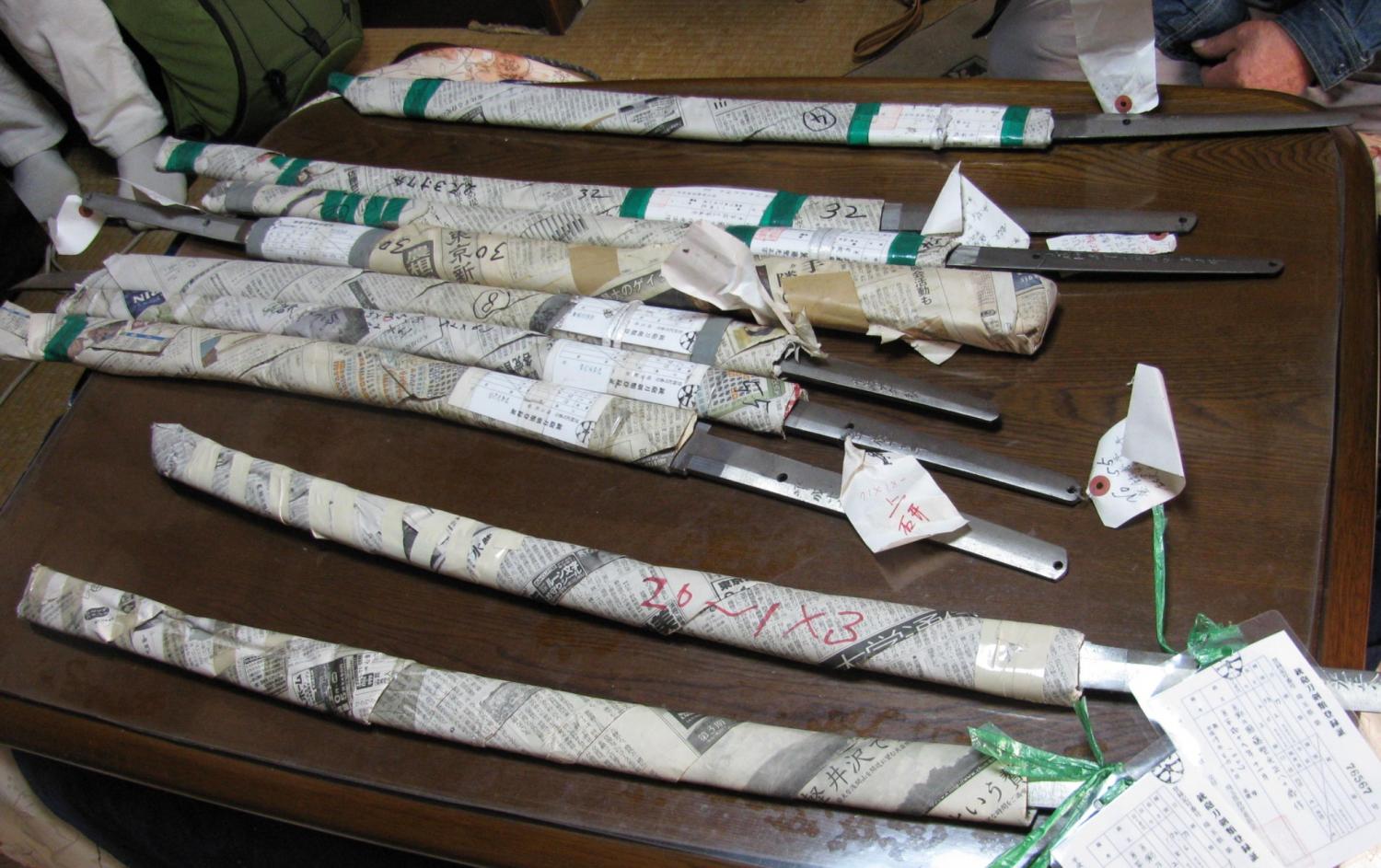
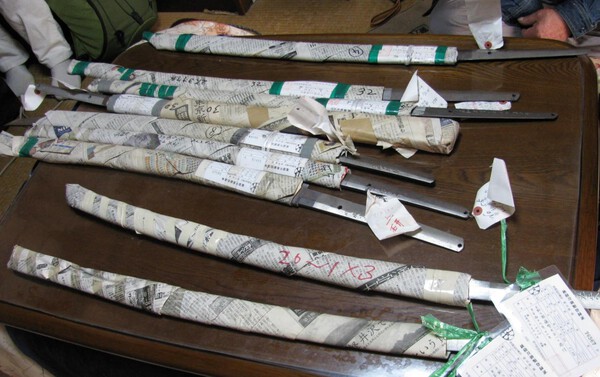
Hmm, I don't know, this photo looks very much like it was taken in Japan: the worn tatami (heck, the guy to the left even removed his shoes before stepping on them, you won't see that in China [and especially not clean, white tennis socks ]), the kotatsu table with (very typical Japanese) thick vinyl cover, the distinctive Japanese handwriting (e.g. a tag with the [Japanese family] name 石井 Ishii), the 東京新聞 Tōkyō Shimbun newspaper wrapping …
-
Uhm, observation? I don't want to sound cocky, but please compare the swords being discussed here to a ) shōwatō, & b ) Chinese martial art swords such as Hanwei - they have more in common with those than with any traditionally made sword I've ever seen (and I've seen quite a few). Sure, the sugata sets them apart from the typical Cinese "sword-on-a-stick", as do the professional looking signatures, but the hamon looks uncontrolled and oil quenched. To me they have the appearance of WWII mass produced swords, but made with modern materials.
-
From the minutes of an NBTHK management staff panel discussion, held in January 1992:
-
I didn't say they were made in China (or any other country than Japan, for that matter). Let me put it this way: I would be very surprised if you'd find even only a trace of tamahagane in them. The hada (and activities therein) looks to me like what I've seen in swords made from powder steel, and they all have the same weird hamon, almost like shōwatō. And yes, a shinsakutō has to be signed to get a torokusho, but to the best of my knowledge the law doesn't say anywhere that one can't change his art name on a daily basis, so there's a loophole.
-
Putting food on the table and selling for a huge loss don't go along very well. I know personally one of those "impoverished smiths", and discussed with him this very topic a couple of years ago. He told me that he has to sell a katana for at least 400,000 Yen to break even, and that he therefore can't compete with the semi-mass produced (although traditionally made) martial art swords that come out of Seki. In that environment, they probably could make one for 200,000 Yen - which, even without the cuts that dealers make, would be double than what the swords discussed here sell for. You do the math.
-
I never saw one of their certificates before. Maybe Piers knows about them, since they are located in Okayama.
-
So far all posts that asked for this travesty to end, and a ban of KPS, BA, have been deleted. I really start to wonder what is going on here.
-
Well, welcome to reality. I don't like it either, but that's how the world works. Still beats communism IM not so HO hands down, where the lack of personal gain leads to economic stagnation and even regress, making everyone suffer.
-
Don't forget that they also will be served green tea and higashi Japanese sweets that are like a black hole for saliva. It's the worst part of visiting a high class dealer in Japan.
-
I never would have thought about the collection this way, but it's true (and hilarious)!
-
Paul's observations are spot on. The NBTHK even hasn't made the leap yet to their own e-mail address, they are not living in our century. Besides that they would have to hire a couple more staff to answer all those e-mails, their stance is "we provide a (not inexpensive) opinion, you take it from there". The main market for them (and the majority of dealers) is Japan, foreign countries are not really on their radar.