

Guido
-
Posts
3,242 -
Joined
-
Days Won
99
Content Type
Profiles
Forums
Events
Store
Downloads
Gallery
Everything posted by Guido
-
 I already ordered (and paid for ) all volumes in the series, and am waiting for the first to arrive. I especially like that Markus uses macrons in his transcriptions, makes it a lot easier to pronunce the Japanese words correctly; sadly this is something that most translations lack .
 -
I can confirm that - it's also not something he makes a secret of.
-
I don't think it's a mismatch: the tsukaito has been replaced after receiving the TH papers (a topic we discussed not that long ago), and this is causing the problem. Since the old tsuka was reused, the wrap compressed the wood in a way that the tsuka will not properly fit the nakago (of both the sword and the tsunagi) anymore. I learned that lesson the hard way more than 30 years ago, a mistake I'll never make again. Btw, having the tsukaito replaced isn't something I object to, but at least they should have used the original color, and together with the sword given it to a tsukamakishi who could have adjusted the tsuka accordingly.
-
You should seek the advice of your tameshigiri teacher if you're not sure if this sword is suited to your purposes. If you're planning to use it for cutting without proper guidance, your handle might become true - or you have to change it to "Selfmutilator".
-
I heard you guys, but sorry, as you can see, the bag is empty already ....

-
My take on it: A regular polisher will be able to see all activities and bring them out. A good polisher will do the above, adjust the shape (if necessary), and “push back” loose hada (to a certain extent). A very good polisher will do the above in a well balanced, pleasing, natural way. An excellent polisher will do the above while “surpressing” flaws, and adding things that are not there – like an interrupted hamon or a missing bōshi - in a way many people won’t be able to tell.
-
Piers, the 美術日本刀保存審査会 bijutsu nihontō hozon shinsakai (of wich nobody has heard before) and the 鉄砲刀剣研究会 teppō tōken kenkyūkai are two different entities. The latter is affiliated with he sword shop むさし屋 Musashiya in Ōsaka. Musashiya’s website doesn’t give us any info on the person issuing the papers, 小林幸信 Kobayashi Yukinobu; however, it has been reported that he is a polisher, and a certain website dealer claims that he used to be an executive director of the NBTHK. I did some research, and he certainly wasn’t a director of the main branch (which the title implies), but I wasn’t able to either confirm or rule out his involvement with any of the local branches. We are dealing here with two different topics: the (previously unheard of) organizations of the original topic, and a possible connection of the second paper with Musashiya (brought up by you, but for which I don’t see any evidence so far). Other than that, Musashiya, and the papers issued by Mr. Kobayashi, are not generally accepted by collectors in Japan.
-
Thanks, Simon! Since the link will not work forever, I'm posting the papers here for future reference. Again, different outlay of the paper, different seal, different envelope, different paper (the one in the first post seems to be some kind of thick vat paper), different penmanship.
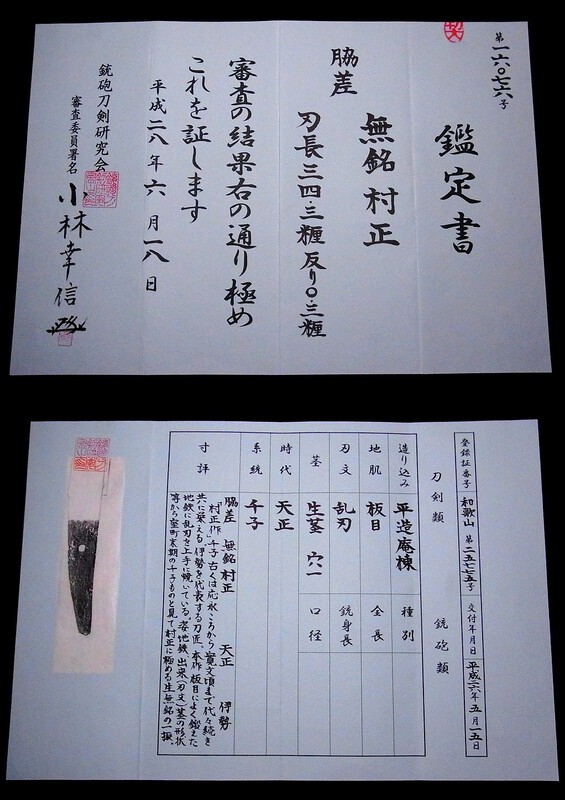
-
BTW, 门 is an abbreviation of 門 - it can be occasionally seen in Japan, but is the standard character in China; I wouldn't expect to see it on a Japanese certificate.

-
I would have given those papers the benefit of doubt (i.e. being issued by some little known organizations) if it wasn't for the obvious attempt to make them look like (old) NBTHK and NTHK papers at first glance. It is clear that they were made to deceive, and therefore details of the seals etc. are irrelevant.
-
Maybe a "tourist item", but most probably a (Japanese) domestic one. Shrines sell omamori, amulets dedicated to particular Shintō deities, that are said to contain busshin (spiritual offshoots). Nowadays those are usually wooden tablets in a brocade bag, but there are many different ones like Daruma, dōrei (earthenware bells), hamaya (arrows), inuhariko (papier-mache dogs) - and small daggers. Those were around through much of the Edo period, but became popular in the Meiji period when sword smiths faced hard times, and at least got some support by their local shrines through the sale of miniature blades that were supposed to ward off evil spirits. They were usually kept in the kamidama (house shrine), which explains that not many came on the market, much like Christians don't sell their family crucifixes. I've seen very roughly forged ones, as well as some phantastic small "swords" with all the features one would expect from a real one. BTW, sakuragawa-nuri, lacquer simulating cherry bark, was used throughout the Edo period.
-
George is right: depicted are the two famous generals Guān Yǔ 關羽 (Japanese: Kan-U) and Zhāng Fēi 張飛 (Japanese: Chō-Hi) from the "Records of Three Kingdoms" (Sānguó Zhì 三國志).
-
Bishū Osafune Kagemitsu Tanto
Guido replied to phonebooth's topic in General Nihonto Related Discussion
Because he could go blind, or hair would grow on his palms? -
So, what's *your* opinion (and why)?
-
Here's the docx: catalog.docx
-
The classic: https://archive.org/details/legendinjapanese00jolyuoft
-
How to destroy an urban legend in one sentence - brilliant!
-
Is This Some Type Of Surrender Tag?
Guido replied to The_ozzy_samurai's topic in Translation Assistance
住所 = address 氏名 = name -
Is This Some Type Of Surrender Tag?
Guido replied to The_ozzy_samurai's topic in Translation Assistance
It's an address and name - maybe Furukawa 古川. -
Mikaeri 見返 - "looking back" – a passer-by will not realize he has been cut by it, but will fall in half when turning back. Presented by the Hosokawa to Sakai Tadayoshi. It was stolen in 1986 from the Sakai family, but retrieved under undisclosed circumstances.



