Guido
-
Posts
3,242 -
Joined
-
Days Won
99
Content Type
Profiles
Forums
Events
Store
Downloads
Gallery
Everything posted by Guido
-
Hard to make out, but may be 2602 ( of 皇紀 kōki) = 1942.
-
I'll probably will be shot down for my ignorance, but how can a DVD deliver a 4K picture if the highest resolution is 720 × 576 pixels at a display rate of 25 frames per second @ 50 Hz?
-
Does Kirikomi Add To Or Detract From A Sword's Value?
Guido replied to Chango's topic in General Nihonto Related Discussion
The reason why nicks on the mune, shinogi and shinogiji are often referred to as kirikomi 切り込み (cutting mark) or homare-kizu 誉れ傷 (honorable defect) lies in the fact that those parts are of softer steel than the ha, and sword cuts can be easier identified as such, whereas nicks, chips, and broken-out pieces in the (much harder) edge usually don’t show the typical pattern of a sword cut (even if that was the case), and therefore are simply called ha-kobore 刃毀れ, i.e. edge damage. -
Does Kirikomi Add To Or Detract From A Sword's Value?
Guido replied to Chango's topic in General Nihonto Related Discussion
I remember seeing a Bizen Masamitsu nagamaki-naoshi katana about ten years ago with a hakobore a little above the habaki. It was in fresh polish, and left there by the togishi; impossible to tell whether it was the result of battle, or caused by something else. In any case, the sword made jūyō, and IIRC, later sold in the US. -
Does Kirikomi Add To Or Detract From A Sword's Value?
Guido replied to Chango's topic in General Nihonto Related Discussion
In my experience, if it's deeper than superficial, the togishi will not mess with it - kirikomi on the mune are not considered remarkable flaws. As an aside: I used to own a Ko-Uda blade with a rather deep kirikomi that still had part of the other sword's ha embedded in it so tightly, it didn't loosen/come out even after the polish. An interesting talking point, but I didn't feel it added any (monetary) value (at least in Japan). Oh, and regarding the sword that started this thread: no way all those nicks come from battle. -
AFAIK, yes. Buddhism and Shintōism got pretty mixed up in Japan and drew from one another. The principle of sticking to a single, exclusive religion isn't a Japanese concept. People here have Shintōist weddings and Buddhist funerals, and don't see any conflict in that.
-
Well, both. Oni were incorporated into the Buddhist pantheon as early as the 13'th century.
-
What Ford said. Besides, I don’t know where you got the 2/3/1 information from, first time I hear that. The contemporary legal classification by length says that a daitō (whether katana or tachi) is a sword that’s longer than 2 shaku. IOW, a sword of 2 shaku 尺 1 rin 厘 (2/0/0/1) = 606.303 mm or 23 7/8”.
-
Gambatte kudasai!

-
Better pictures are needed, but while I agree with Peter’s reading of Yoshimitsu 吉光 on the nakago, the sayagaki seems to say (zaimei) Yoshitada (在銘) 吉忠???
-
Rare Finds In Searching For Copper Tsuba
Guido replied to Stephen's topic in Auctions and Online Sales or Sellers
Considering that the history of sword making in Lóngquán goes goes back 2,600 years when the town was founded in the Spring & Autumn Period, this is really a travesty. But then again, not that much different from Japanese sword smiths producing fantasy weapons featured in comic books. -
Jōkō no jōi (上工の上位) is a WWII smith ranking.
-
Well, if they are so smart, why do they mistranslate "katate-uchi", show regular katana/uchigatana as examples thereof, and inserted a few other mistakes here and there? You know, not everything you read on the Internet is true ...

-
I was counting in the teishitsugigeiin 帝室技芸員 which is the previous title; mukansa 無鑑査 proper were indeed awarded from 1958 on.
-
The first two sword smiths received this title in 1906.
-
出鮫合口拵 dashizame aikuchi koshirae
-
Although I completely agree that nowadays light mineral oil is the better choice – for a variety of reasons – I doubt that the acidity of the so called chōji-abura will do any harm to a blade. Chōji-abura is actually camellia oil with only a few drops of clove oil added (because of the eugenol the latter contains, which has antimicrobial and antifungal properties). Camellia oil contains mostly oleic acid (as high or higher than olive oil itself, up to 83%). The acidity of clove oil is 10.19 pKa (thank you, Mr. Google), but since it’s diluted about 1:100 by the camellia oil, there shouldn’t be any harmful acidity level to speak of in sword oil.
-
Your Experience Of Carrying Blades Out Of Japan
Guido replied to Bugyotsuji's topic in General Nihonto Related Discussion
You need an export permit; how to get one (and more) is explained here: http://www.nihontomessageboard.com/articles/sword_law.pdf -
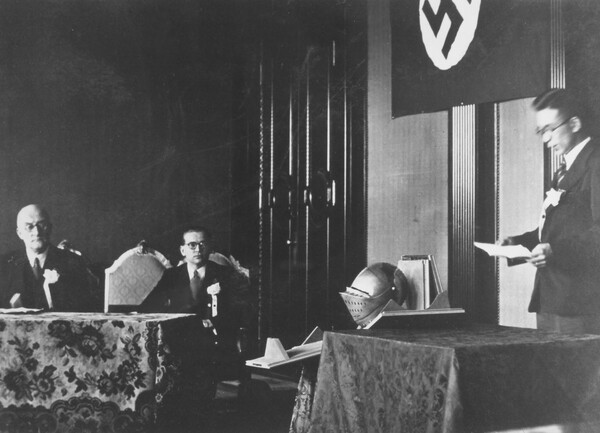
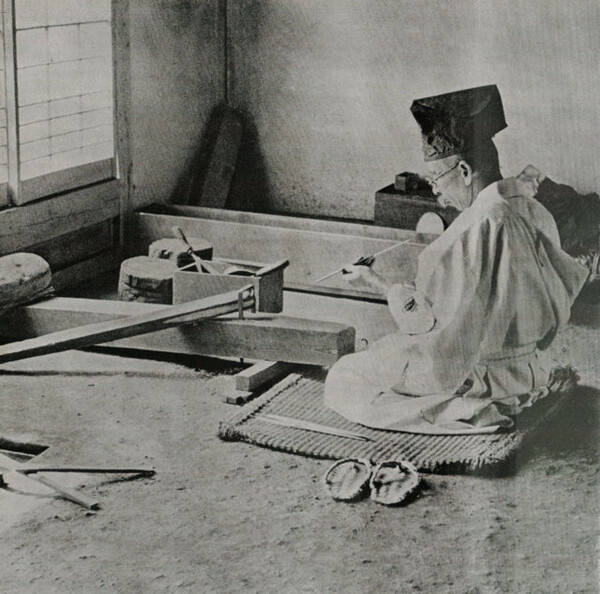
Nice find! Do you think it's the same person in the attached picture that I scanned from an old book published in Germany during WWII?
-
I don't think the Shimazu had to do a lot of insisting, since their mon is a kutsuwa, not a Christian cross. And that Chritianity could have come to Japan a thousand years earlier by any number of means is quite the theory. It's like saying the many paintings of falcons in Japan might have been inspired by the Egyptian deity Horus ...
-
Common Mekugi-Nuki On Aoi Art
Guido replied to Alan F's topic in Auctions and Online Sales or Sellers
It appears that there are indeed some forumites who monitor their website 24/7! -
Common Mekugi-Nuki On Aoi Art
Guido replied to Alan F's topic in Auctions and Online Sales or Sellers
Big time! However, they usually just strangle hamsters if you're a first-time customer ... -
Common Mekugi-Nuki On Aoi Art
Guido replied to Alan F's topic in Auctions and Online Sales or Sellers
They sell / auction them off as modern made, no claims to them being one of a kind, unique items or highly collectable. They are what they are (and not my cup of tea, btw). Now you are warning people that they are not what you imagined them to be, and therefore too expensive. I don’t get it. Are you seriously blaming them for your own misconception? Did they somehow force you to bid on them?
-
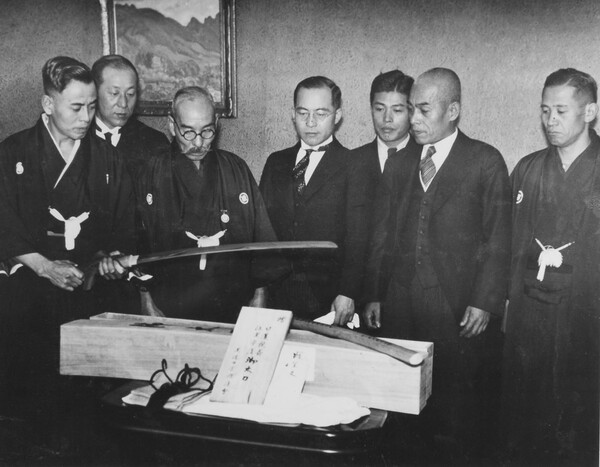
Thank you all very much for your suggestions and detective work – especially Morita-san: you truly have eagle eyes, Sir! The only kanji I was able to read were 御太刀. I also think that you are spot on with Watanabe Kanenaga. Again, thanks to all who took the time and effort of trying to identify the people in the photo.
-
A German museum asked me to help identifying the people in the attached photo. It was taken on the occasion of presenting a sword to the German ambassador Herbert von Dirksen (photo # 2, far left) on behalf of Hitler. It seems to be a different one from the Kasama Ikkansai Shigetsugu that is well known, but I know next to nothing about gendai smiths, and hope one of you guys can help out. Unfortunately I wasn’t provided with a rubbing or photo of the nakago.