
Leaderboard


Popular Content
Showing content with the highest reputation on 02/18/2026 in all areas
-
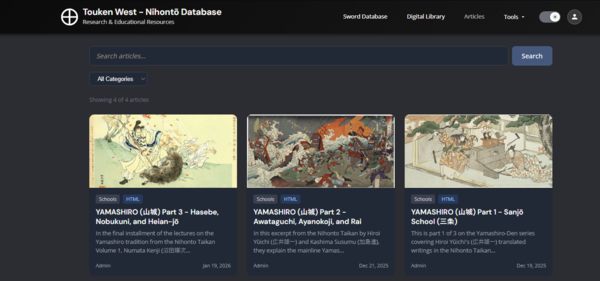
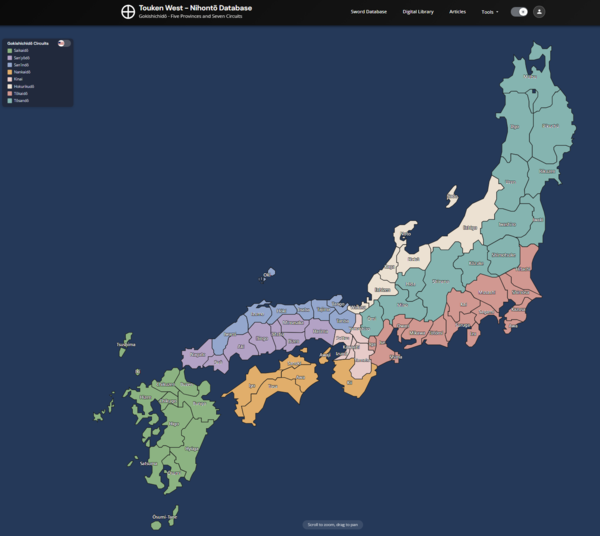
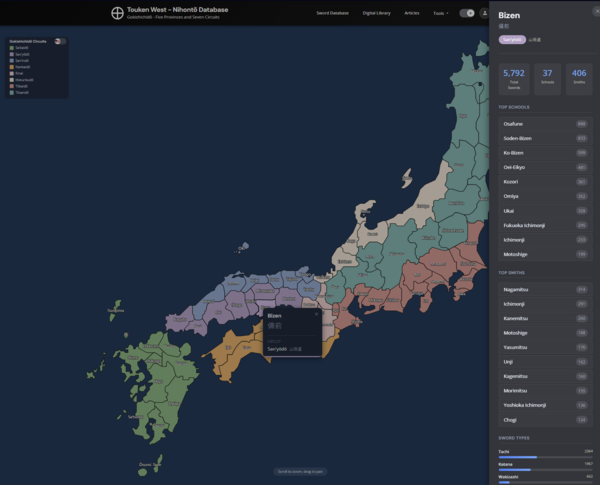
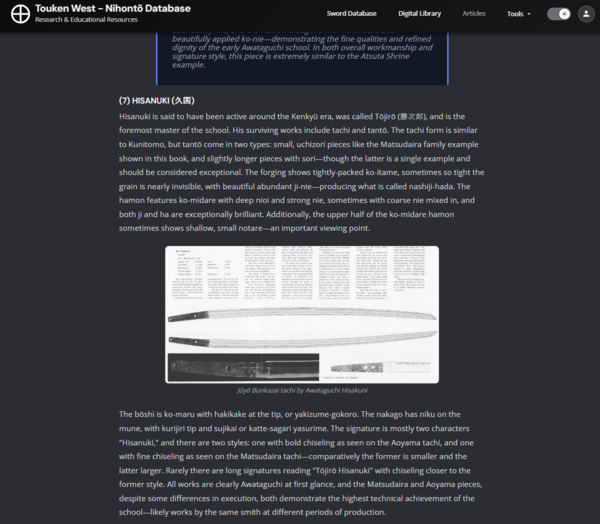
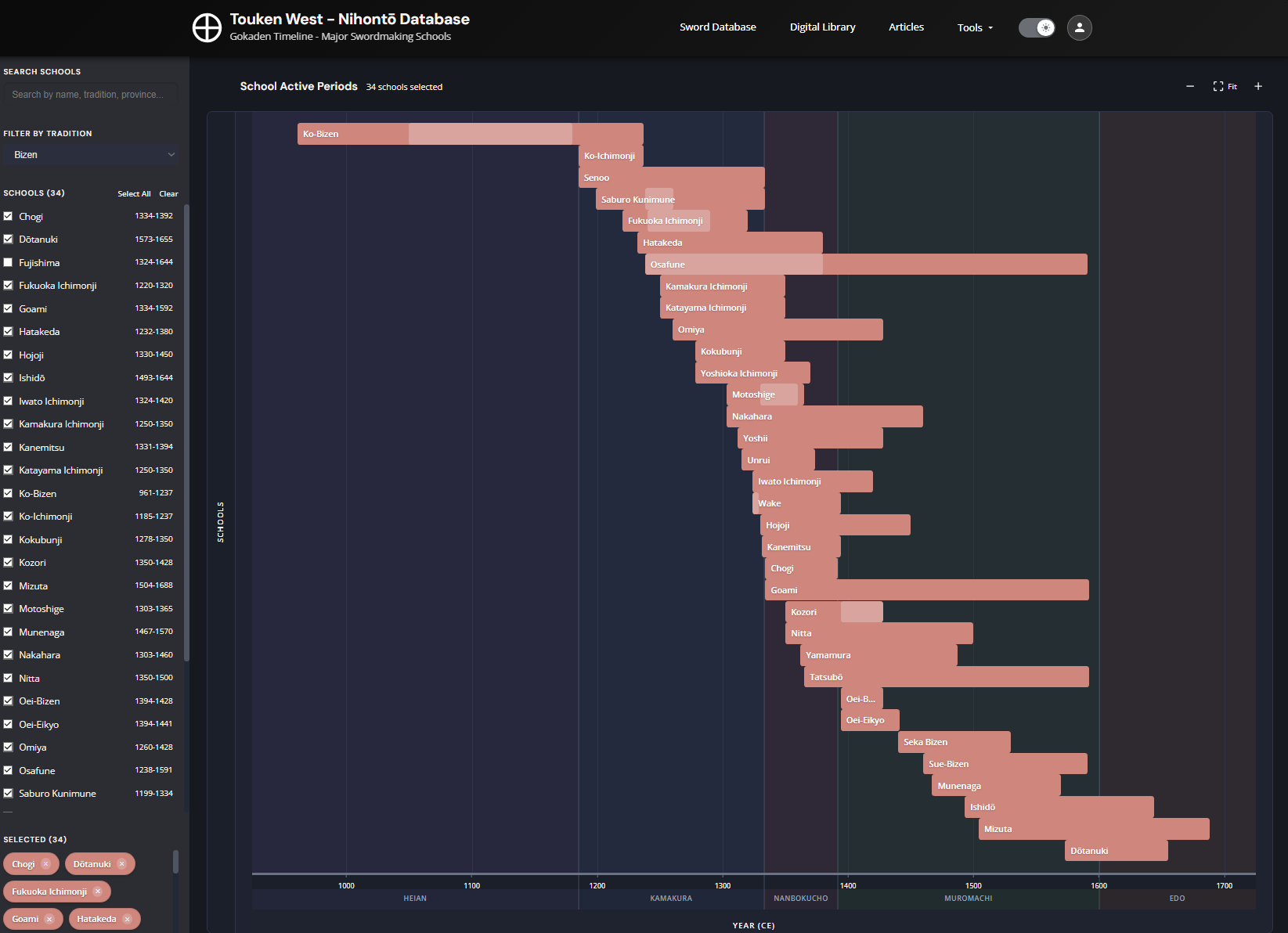
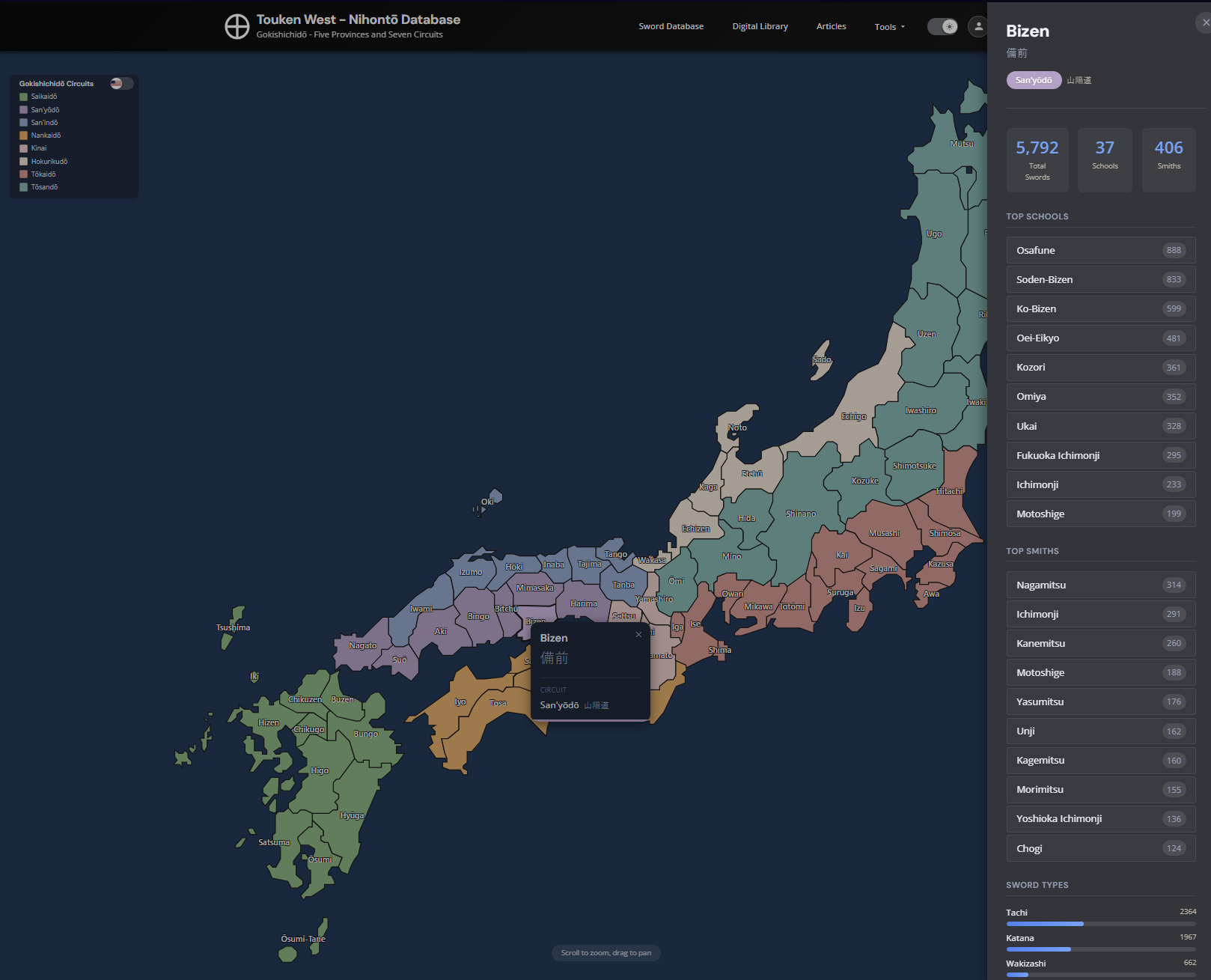
Hey everyone, I feel like its finally time to share a project that I've been working on for a while now. Not because it is finished but because my first child was just born a few days ago and development on this project will likely slow down for a bit as I navigate the new phase of life that is fatherhood! Anyways, I've been building a website https://nihonto-db.com for some time now and wanted to present it here. At the core, it is an interactive and searchable version of @Jussi Ekholm's Koto sword index he's so graciously shared with the NMB. I can't begin to state how incredibly powerful Jussi's research has been and without his tireless efforts and collaboration, this wouldn't have been possible. So at the core, the "Sword Database" portion is a simple searchable database that allows you to search from over 16,000 swords. There are filters and advanced filters available to allow you to search, filter, and compare works by many smiths with as narrow or broad of a search breath as you wish. Additionally, I've created a few other tools that I find useful. Namely an interactive Province Map of Japan showing the old swordmaking provinces which allows you to click on each province and see associated schools, swordsmiths, and other details of the schools and smiths of that province. Clicking on any province will pull up all of the swords in the database for that school and scrolling down you can view additional stats such as Kokuho, JuBun, JuBi, counts, counts of documented swords by type (Yari, naginata, katana, tachi, tanto, etc.) and other stats for each sword making region. There is also a Japanese/English toggle available which will show the circuits and provinces in Japanese rather than English which can be helpful when researching Japanese resources and sites. Thirdly, there is Gokaden Timeline which is built upon a Google Sheet collaboration that some of the members here helped with a few weeks ago. It is as the name suggests, a simple plotting tool that allows you to plot and view the various swordmaking schools broken down by their tradition, and the timeframe in which those schools spanned. Currently this is limited to mostly mainline and some obscure Koto schools. Shinto and Shinshinto aren't appropriately represented at this point and will be a future addition. Finally, there is an articles section where I have been posting various articles, photos, and zufu translations for the main Gokaden schools. Currently Soshu mainline and Yamashiro mainline are finished and Yamato and Bizen are in the works. The current selection of articles come from the Nihonto Taikan lectures from Honma Junji, Hiroi Yuichi, Numata Kenji, and other Japanese sword scholars and contain detailed genealogies, kantei points for grandmaster smiths, and the evolution of traditions, schools, and lineages of swordsmiths of the koto era. Each article goes into great detail and I've provided images when available of all of the swords (or an appropriate substitute) mentioned by the authors as well as translations of the various zufu used (when available). They are quite lengthy articles which provide a great deep dive into the prolific schools for each of the gokaden. I have many more plans for this site to hopefully become another helpful resource in the world of nihonto study and also be a place where swords can be researched in detail with photos, descriptions, and other additional information. I also would like to expand this into including many more shinto and shinshinto blades but as I'm a 1 man operation and now have a 1 week old baby, slow and steady is the key! There is a registration and sign-up option available, currently free users (there are no paid for options at this time) will also gain access to the Digital Library, an online encyclopedia of Japanese swords including some selected zufu, images of famous shrine swords, and translations when available. The current free digital library has ~2500 images of just over 500 swords. Feel free to make a free account and sign up with Google, Facebook, or register an email and password and take a look! I hope this site serves as a resource for all and if anybody has any comments or things the community would like to see, feel free to let me know and I will do my best to work on them as time allows. Thanks again to the NMB community and everyone here who has given their knowledge, time, and previous resources to make this all possible.


 14 points
 -
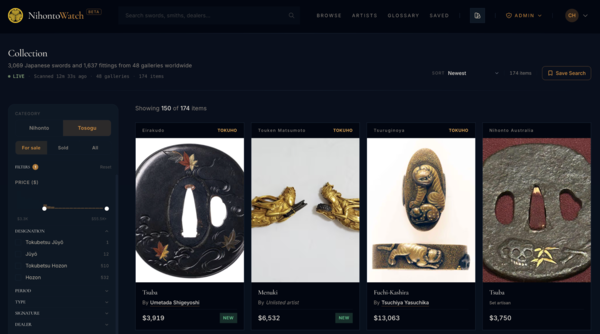
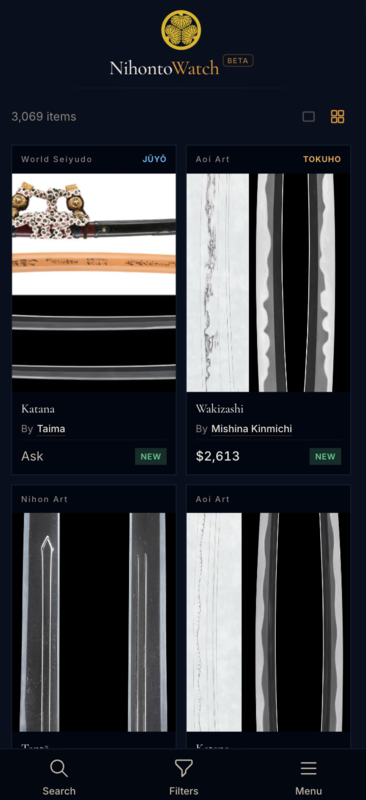
Hello everyone, TLDR: Interested in Japanese swords and fittings? I made this to help the field. Open nihontowatch.com on your phone browser, and add to home screen (Share → Add to Home Screen). Thank me later. --------------------------------------------------------------------------------------------- I have been thinking for quite some time about the future of our field. I have been blessed with incredible mentors and opportunities, most notably the late Darcy Brockbank, who was so generous in sharing his knowledge. Since his tragic passing, I have felt a responsibility to carry that work forward. What I am about to present, I built as an homage to his memory. Our field has problems. We operate in a field of extraordinary depth without being equipped with the knowledge and tools to understand what we're looking at when we browse the market. Refreshing dozens of dealer websites every week, most in Japanese, copy-pasting listings into translation apps, pinching to zoom on sites built twenty years ago — market awareness is just painful and you miss things constantly. You spend an hour and walk away unsure you have seen everything. And this is just the market experience. The deeper problem is access to knowledge. There are no catalogues raisonnés for artists. Yuhindo would have grown into it — it was planned. But alas, Yuhindo is no more. No way to know, with any confidence, whether a price is reasonable without decades of experience or tens of thousands of dollars invested in published references. No way to know why something costs what it does. Communication with Japanese dealers remains daunting for most. No easy way to know who is a reputable dealer. The barrier to entry is simply too high, and this friction keeps our field artificially small. Fine art has Artnet. Watches have Chrono24. Antiquarian books have AbeBooks — markets with comparable depth and comparable opacity, served by platforms that bring transparency and accessibility. These fields have benefited immensely: they have enabled new entrants in droves to collect in confidence. Our field needs more knowledge and transparency to build interest and trust.Japanese swords and fittings. Eight hundred years of collecting history at the highest levels. The category that contains the most national treasures in Japan. The indefatigable search for perfection of an entire civilization. And yet, we have nothing. This had to change. As I write this, there are 3,021 Nihonto and 1,607 Tosogu items for sale across 44 dealers, Japanese and international, in a single searchable interface. Every listing is structured with attribution, certification, measurements, and artist intelligence data. NihontoWatch is on track to follow 100% of the online market for genuine items with NBTHK papers. Refreshed 12 times a day. Everything is translated and structured, as it trickles in live. But what is this worth, if it's so hard to know what you're looking at? Especially for newcomers, it is so hard to tell what you're looking at. This is where the magic is. I am nostalgic of reading through Yuhindo's artist descriptions. It made me deeply appreciate the field. It got me in. NihontoWatch scales this experience and creates something approaching a living catalogue raisonné for every Tosogu and Nihonto artist. It matches every listing against a database combining the complete Juyo, Tokubetsu Juyo, Juyo bunkazai, Kokuho, and Gyobutsu designation data — over 23,000 items at the highest level, with rich text in classical Japanese. This data is then processed, synthesized, and presented into NihontoWatch's artist directory in a way that is respectful of the NBTHK's copyright. With this, you'll be able to discover a maker's historical reputation through quantitative analysis of exhaustive provenance records, in ways never seen before. Over time, all of these artist pages will come alive, forming an ever-expanding knowledge base. - How rare is it? - How many Tokuju? - How many designated works ranked Juyo and above? - Why is this important? - Where does it rank relative to other works? - What is for sale right now? - What was for sale recently? All the answers are in. These are questions that come up constantly in our community, and until now, answering them required years of collecting published references worth tens of thousands of dollars, and patiently indexing them with post-its or one-by-one in a spreadsheet. Only professional dealers or major collectors could afford to do this. This is a BETA, so there are errors. The more obscure the artist, the higher the error rate, and there are still basic errors I need to fix with some famous artists. A lot of algorithmic tinkering and curation ahead. It will keep getting better with your feedback. See the results for yourselves: - Soshu Masamune: https://nihontowatch.com/artists/masamune-MAS590 - Ichimonji school: https://nihontowatch.com/artists/NS-Ichimonji - Yasuchika (tosogu): https://nihontowatch.com/artists/yasuchika-TSU001 - Goto school: https://nihontowatch.com/artists/NS-Goto Click one and explore the designations, the provenance abalysis, the measurement distributions. This is just a first shot — over time this data will grow. Here is one where I have published an item I studied for my Substack article on Mitsutada: - Osafune Mitsutada: https://nihontowatch.com/artists/mitsutada-MIT281 Imagine Yuhindo, but with a page for every artist and every piece ever captured on camera. Saw a national treasure at an exhibition in Japan? Share your photos on NihontoWatch's artist catalogue. In the future, owners of particular works will be able to publish them to the artist's catalogue. Think of it as a growing, community-curated knowledge base for every artist in the field. And so much more Browse and filter: Designation, dealer, item type, school, province — all filterable, all instant. Prices display in JPY, USD, or EUR. Every filter combination is a shareable URL. The sold archive tracks thousands of items for pricing research. And it works for every budget, for collectors at every level. - All Tokubetsu Juyo Nihonto on the market - All Tsuba with Hozon or Tokubetsu Hozon, maximum price $2,000 Setsumei translations: On some items, you can press the floating book icon on any Juyo item to toggle between photos and the Juyo setsumei translated text. For most Juyo and above items, the NBTHK evaluation text from the dealer's page is identified by computer vision and translated into English. It will fail if the dealer has not posted the Juyo Zufu extract, but in the majority of cases they do, and the result is remarkably accurate. Do use responsibly — the quality is great, but not perfect. Always purchase professional translation from Markus Sesko when contemplating the purchase of a Juyo-designated piece. Search alerts: Never miss an item again. Define keywords and filters and save them. NihontoWatch will run your search every 15 minutes, and when something new appears, immediately send you an alert email. In practice, missing a listing that fits your interests becomes almost impossible. Tip: I recommend avoiding overly specific queries. "Juyo tsuba" or "Kamakura signed tachi" are safer than specific artists such as "Yozozaemon Sukesada," which would be more fickle. Broad queries give you the best market coverage. Inquiry emails: Press "Inquire" on any listing to draft a professional inquiry in Japanese. Handles etiquette and formality, and can help you request the 10% consumption tax exemption available to overseas buyers. Did you even know you could get 10% off? How many new entrants lost 10% on this, at least at the beginning? I for one did. I've seen countless high spenders neglect to request it while shopping across Japanese galleries. Glossary: The technical language of Nihonto and Tosogu is deep and specialized — needlessly so for non-Japanese speakers. Anytime a technical term comes up, you can click and see what it means. Over 1,200 terms, searchable, automatically linked from the setsumei translations. Who remembers always keeping an index open to keep track of terms when studying Juyo items? https://nihontowatch.com/glossary How best to use NihontoWatch While it works wonders on desktop, NihontoWatch works most beautifully on your phone. I use it every day — it feels like I have the market in my pocket. Open nihontowatch.com on your phone, hit Share → Add to Home Screen. And voila, you have an app. It becomes something you check with your morning coffee, the way one might check the news. A word of caution The data has errors — always verify independently. This is a tool to explore the market, not a substitute for critical thinking. If it looks too good to be true, it likely is, and this system can't easily correct online misrepresentations. Old listings where dealers have not marked items as "SOLD" will still appear as available. Listing errors will slip through, but data quality improves continuously as the system learns over time. Get involved - Missing a listing or dealer you like? PM me or post here. - Bug? PM me or post here with steps to reproduce. - Dream feature request? Reply in this thread. I will keep this thread active and share major updates when time permits. Everything is free right now, and will remain so until ready for official release. This is no trivial task, and it is expensive to operate — it will need to be covered in some way down the line. It will be tempting to keep it for yourself. But if we want our field to grow, we must share knowledge and expand market access and transparency. The single most impactful thing you can do right now is help others discover and use the tool. Share it with your study group. Share it with your collecting circle. Share it with a friend who has been curious about Nihonto and Tosogu but found the barrier to entry too high. That barrier just got a lot lower. Farewell, Darcy. This is for the teacher in you. Hoshi

 9 points
 -
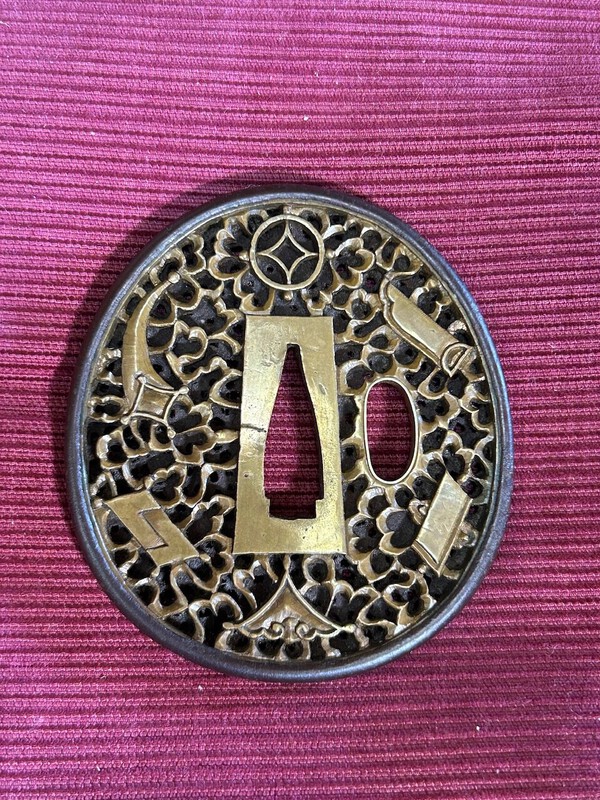
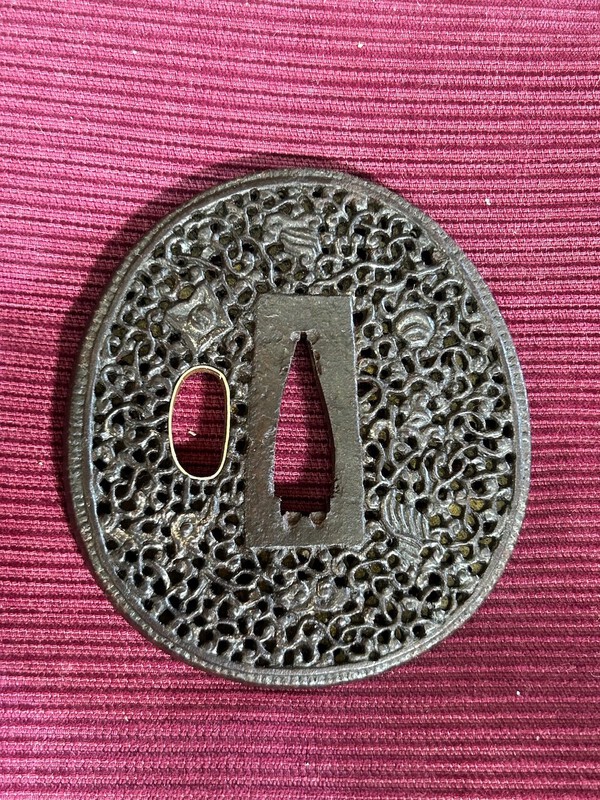
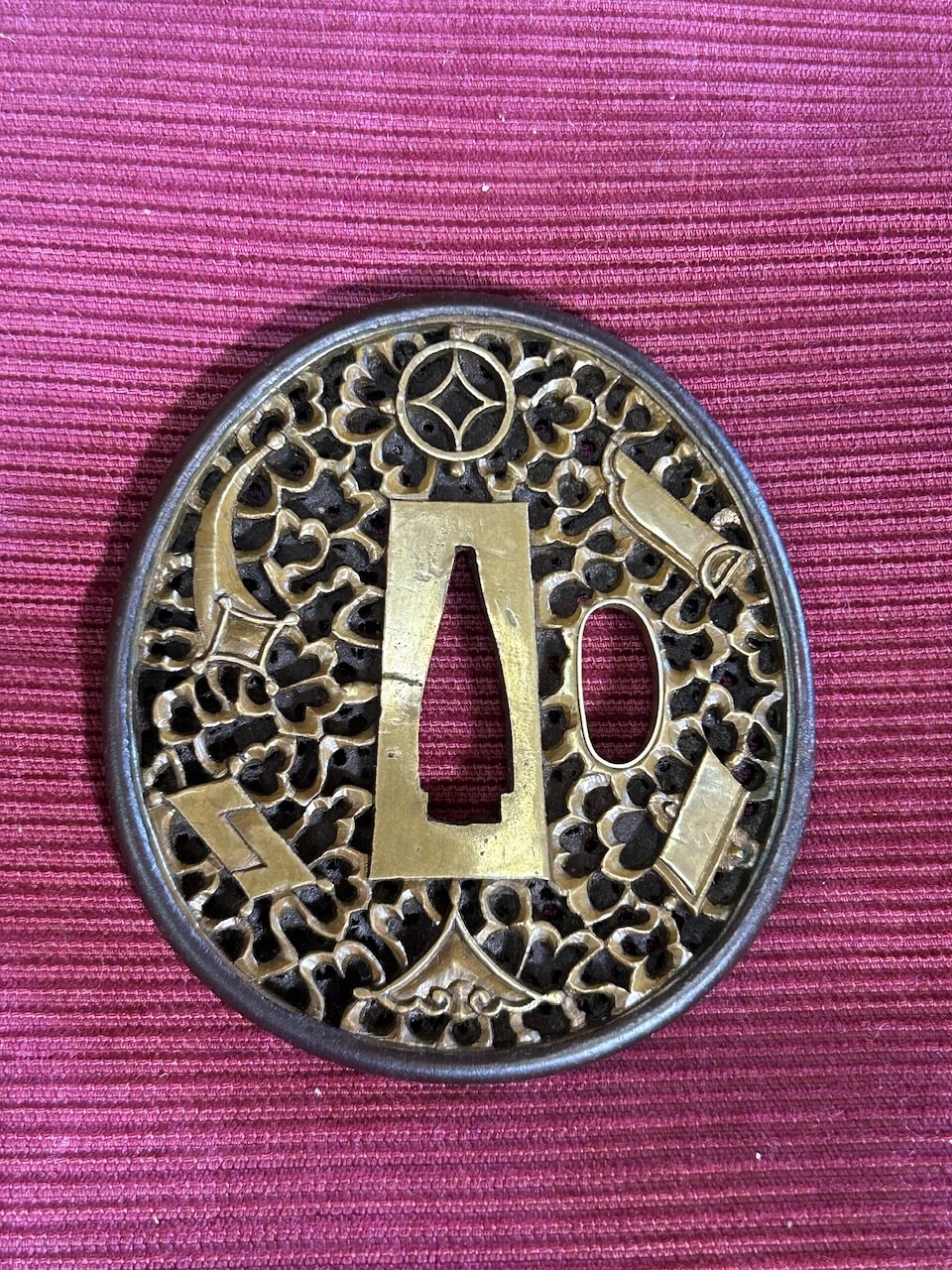
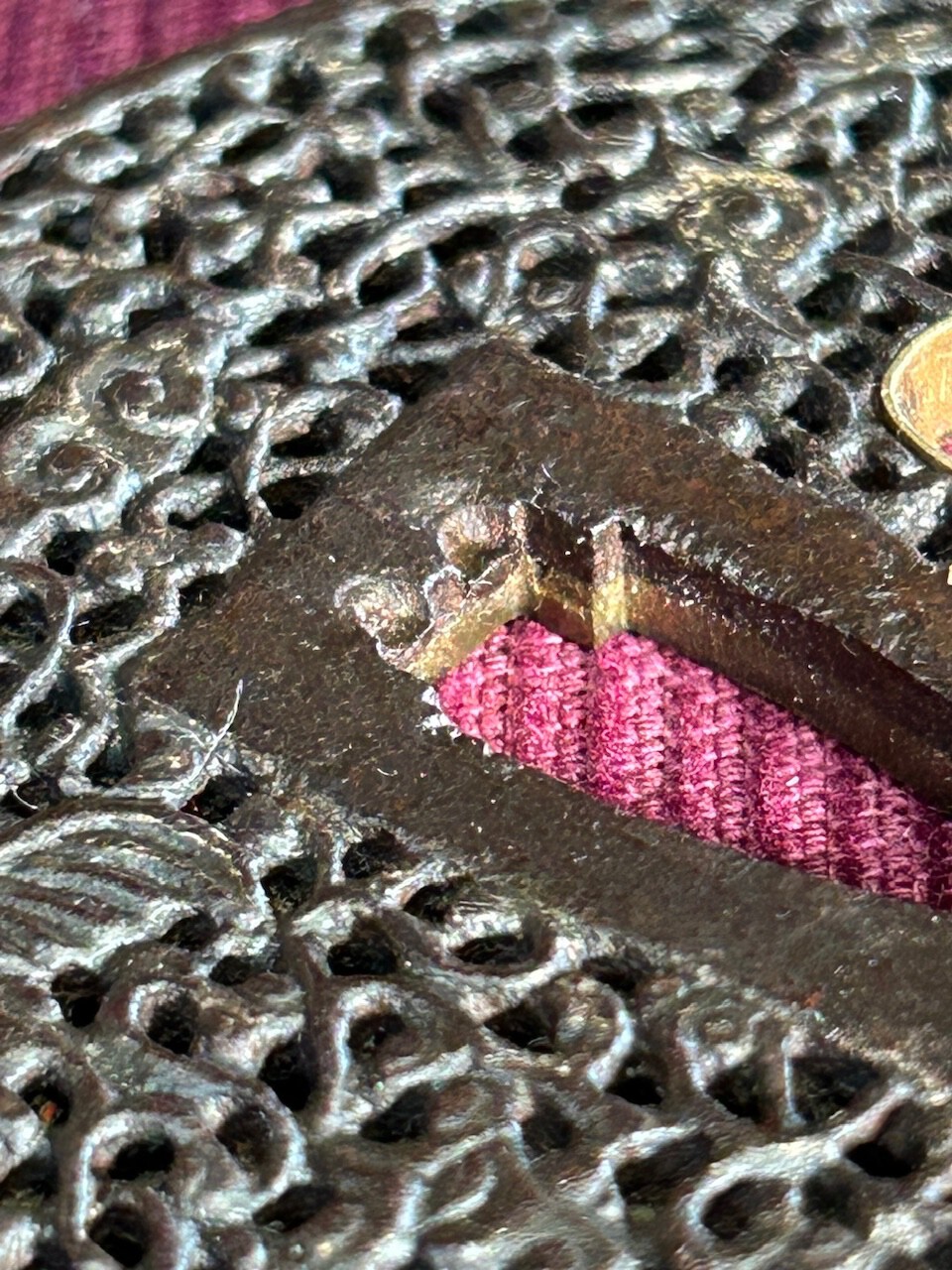
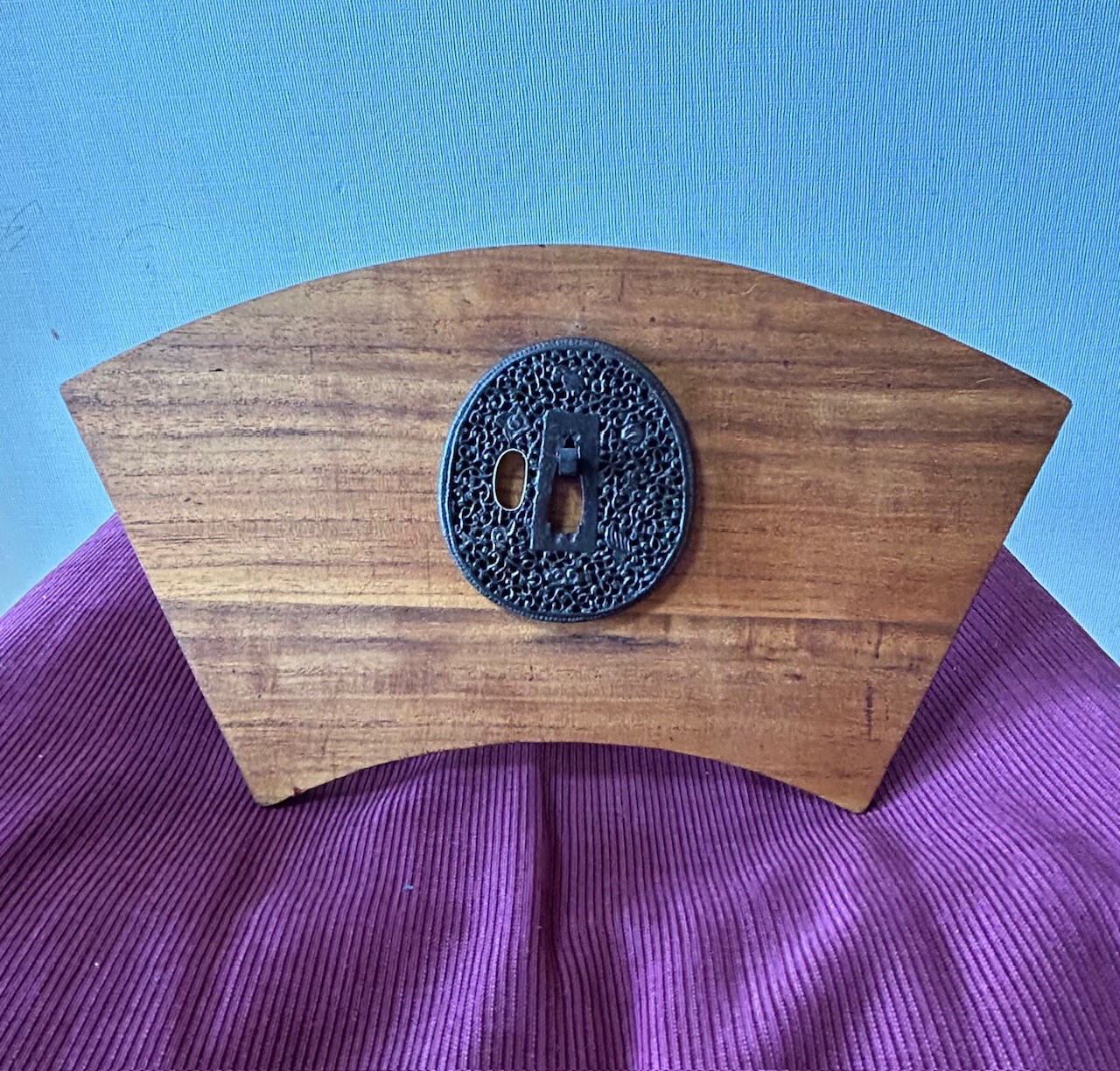
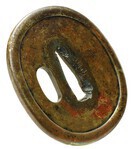
Too many incoming rounds! Duck!!! Fantastic stuff guys, the NMB Detective Agency. Here’s the answer… shinchū set somehow within the iron mimi. 7.75 x 7.0 x 0.55 cm
 8 points
 -
I am glad you liked it Brian . The blade is hirazukuri with an orikaeshimei Bishu Osafune Morimitsu , circa 1360 , I believe . It is tokubetsu hozon from memory . None of the fittings are signed Lewis Ian
.thumb.jpeg.39060a740913cbb033c569482e9c4775.jpeg)
.thumb.jpeg.f24f6f947f87e25f14cd9e8fa3c7a844.jpeg) 5 points
5 points -
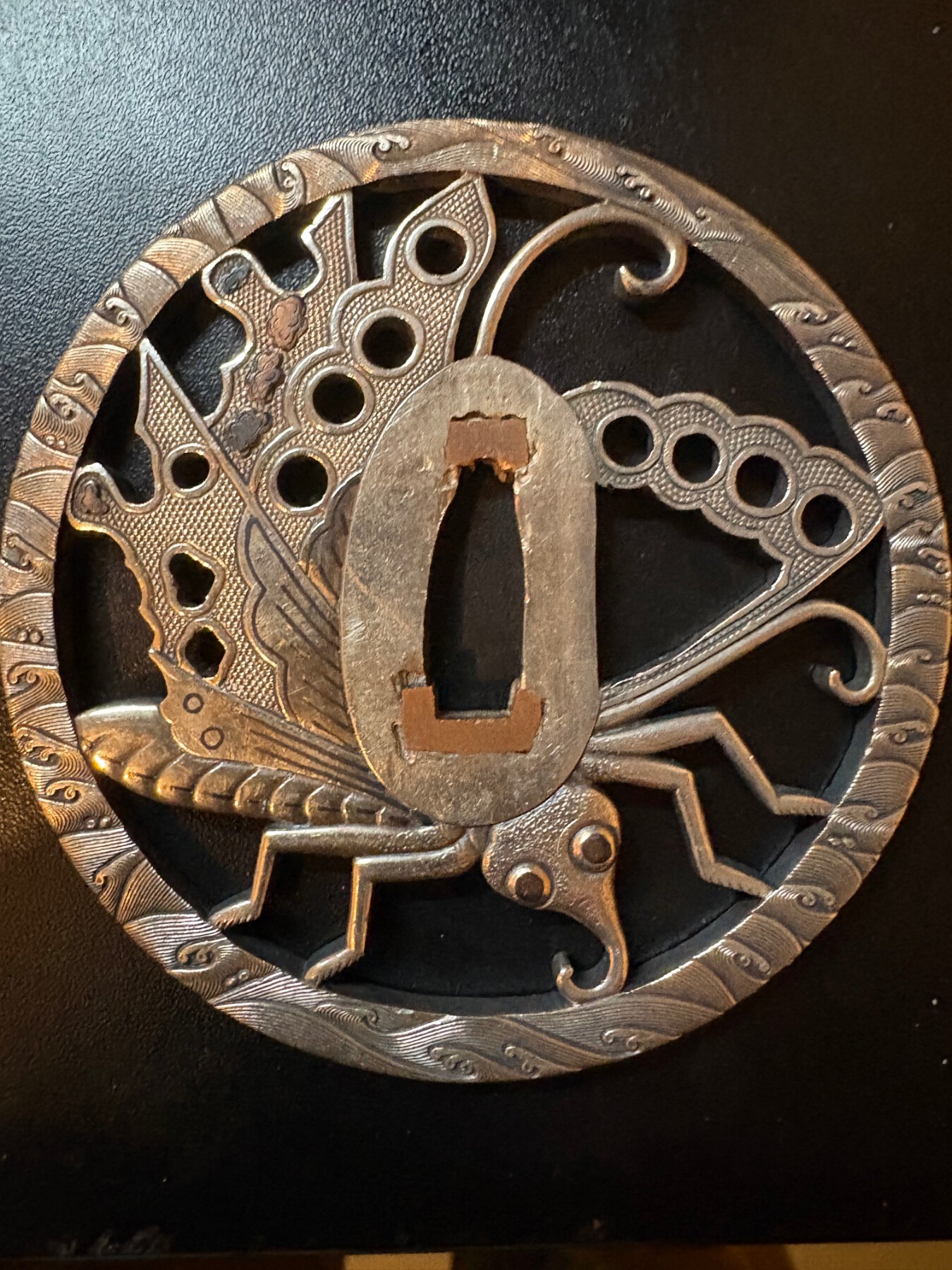
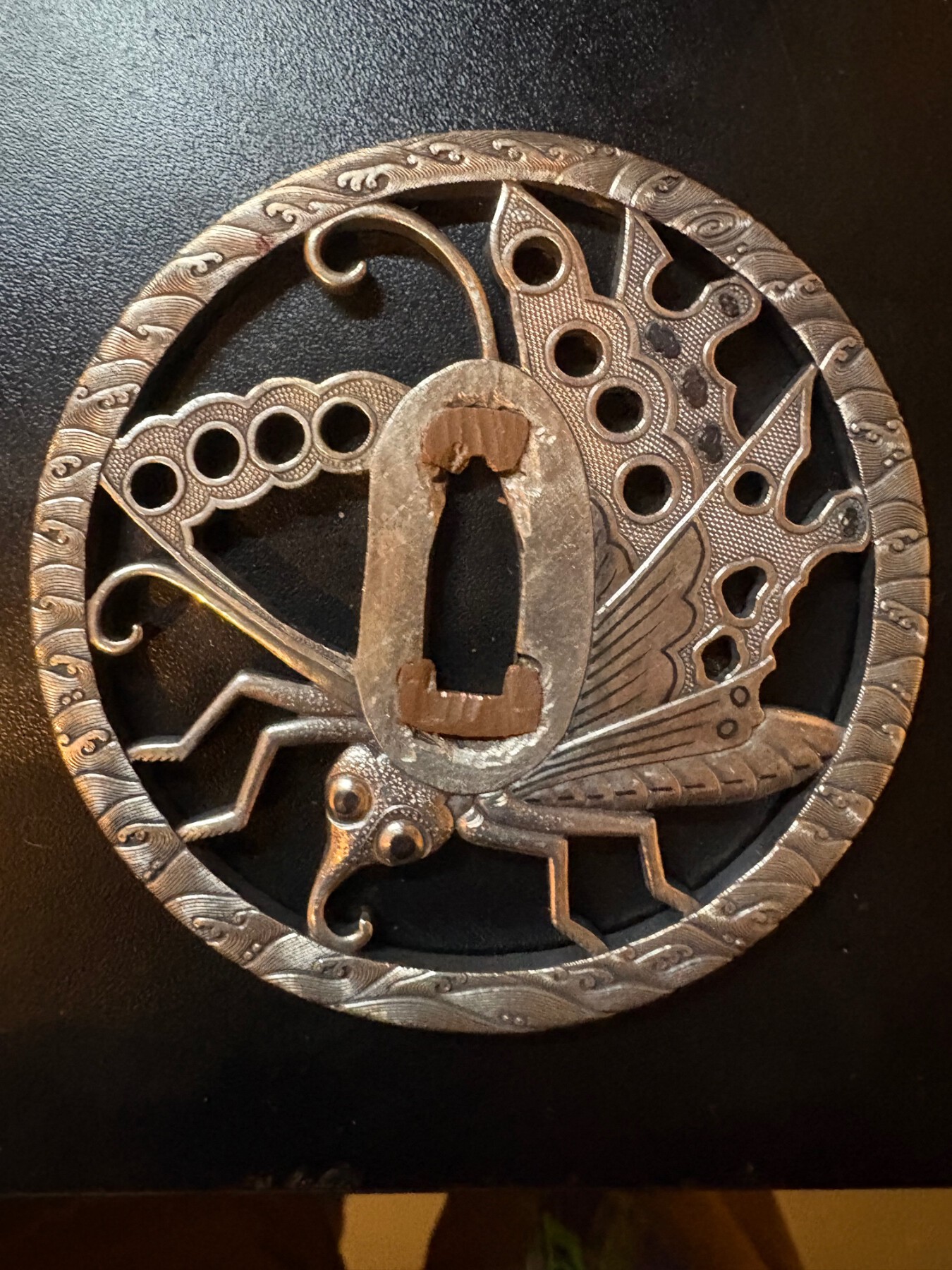
Hi Mark, a very nice guard! The overall design is not uncommon but so far as I know all other examples are in iron so yours is even more unusual. https://varshavskycollection.com/collection/bizen-shoami-sukashi-tsuba-with-a-butterfly-design-early-edo-period/ https://www.flyingtigerantiques.com/ca-1600-large-Japanese-katana-tsuba-of-the-ikeda-clan-mon-form.html https://www.liveauctioneers.com/price-result/bizen-shoami-sukashi-tsuba-with-butterfly-design-a-cut-off/?srsltid=AfmBOoqXf04EdDxx-K4vRdHHHFGXVgEhwJa_3yaSjEVbIdiUzrIZBmu4 Very likely these examples have had the rim removed. MFA Boston https://www.espace4.com/en/collections/marugata-iron-tsuba-butterfly/ https://world-seiyudo.com/product/tu-030522/ Welcome to NMB5 points
-
Hi in just looking for some info on my Tsuba. I got it from a family member who served in the pacific during World War Two. Thanks
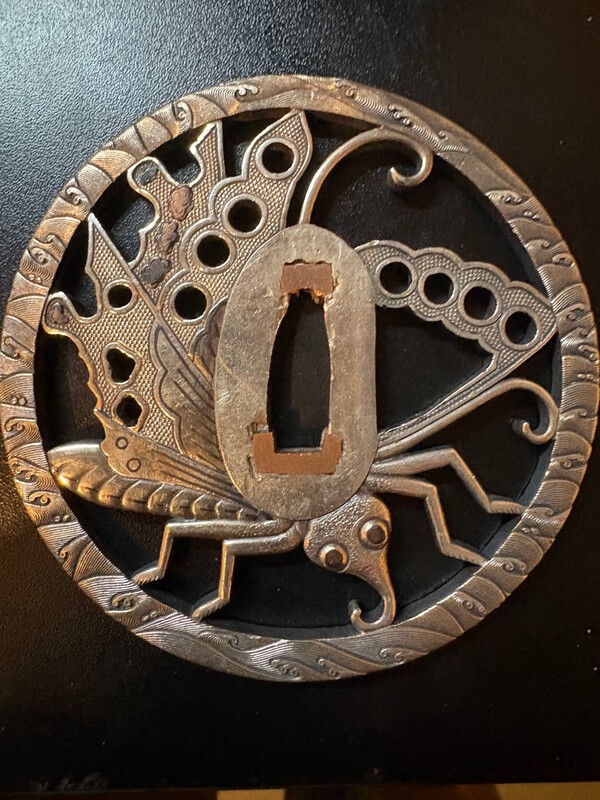
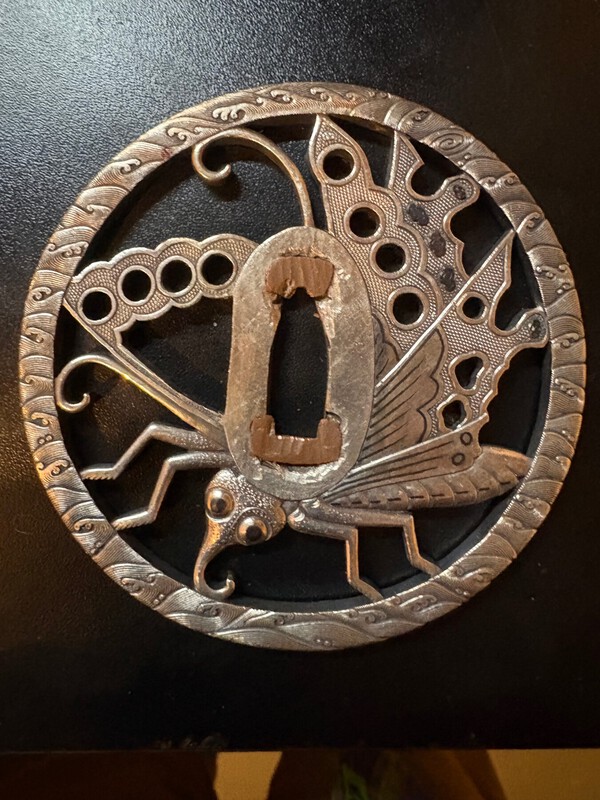 4 points
 -
Chandle your work is first class building on Jussi's incredible efforts. As you know I am a massive fan of this project and have already played with this quite a bit - I am excited to see it when images stat coming through... cannot wait! To @Hoshi, @nulldevice & @Jussi Ekholm, thank you so much! You three are all a credit to this space! The effort you three have put into your projects are just an incredible step forward for this hobby making it a lot easier to navigate than ever before! Wow 2026 - we are only 49 days in and this is already proving to be an awesome year for being a Nihonto enthusiast!4 points
-
Im sure im not the first to have the searchable database idea and certainly won’t be the last. I think many collectors want to get their hands on more data when the resources for non Japanese speakers are very limited. I did realize I forgot to add that you can search nearly anything in the search bar. “Tanobe”, “Denrai”, “Meito” and double quoted strings are literal searches so you can search (Shizu, “Juyo 27”) to get filtered results if you have a particular sword you’re looking for. Kanji also works if it matches the Mei. Truth be told there are other pages still private that are the main bread and butter of the site and where I believe the true value will live for serious nihonto students that im hoping to release very soon.4 points
-
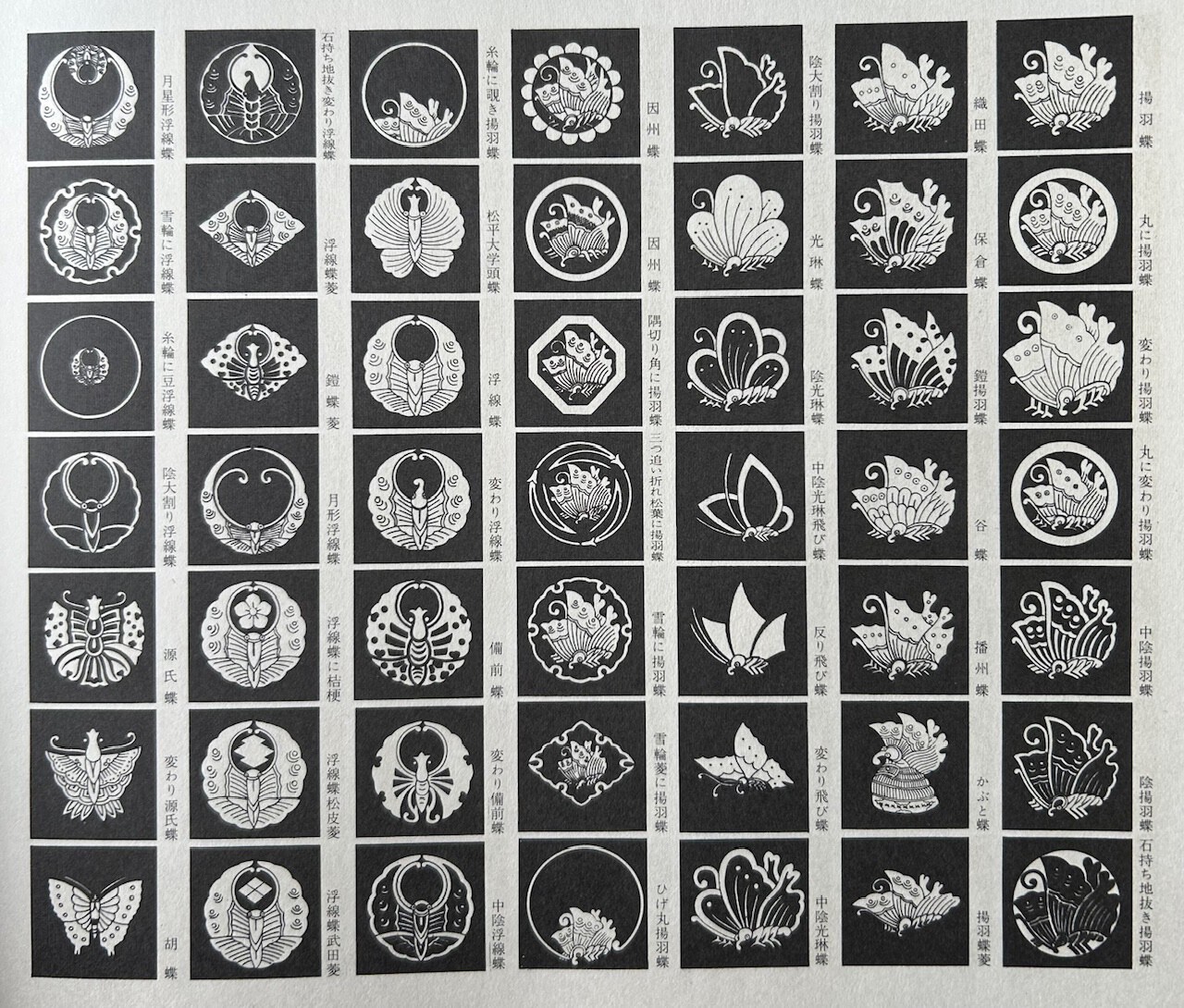
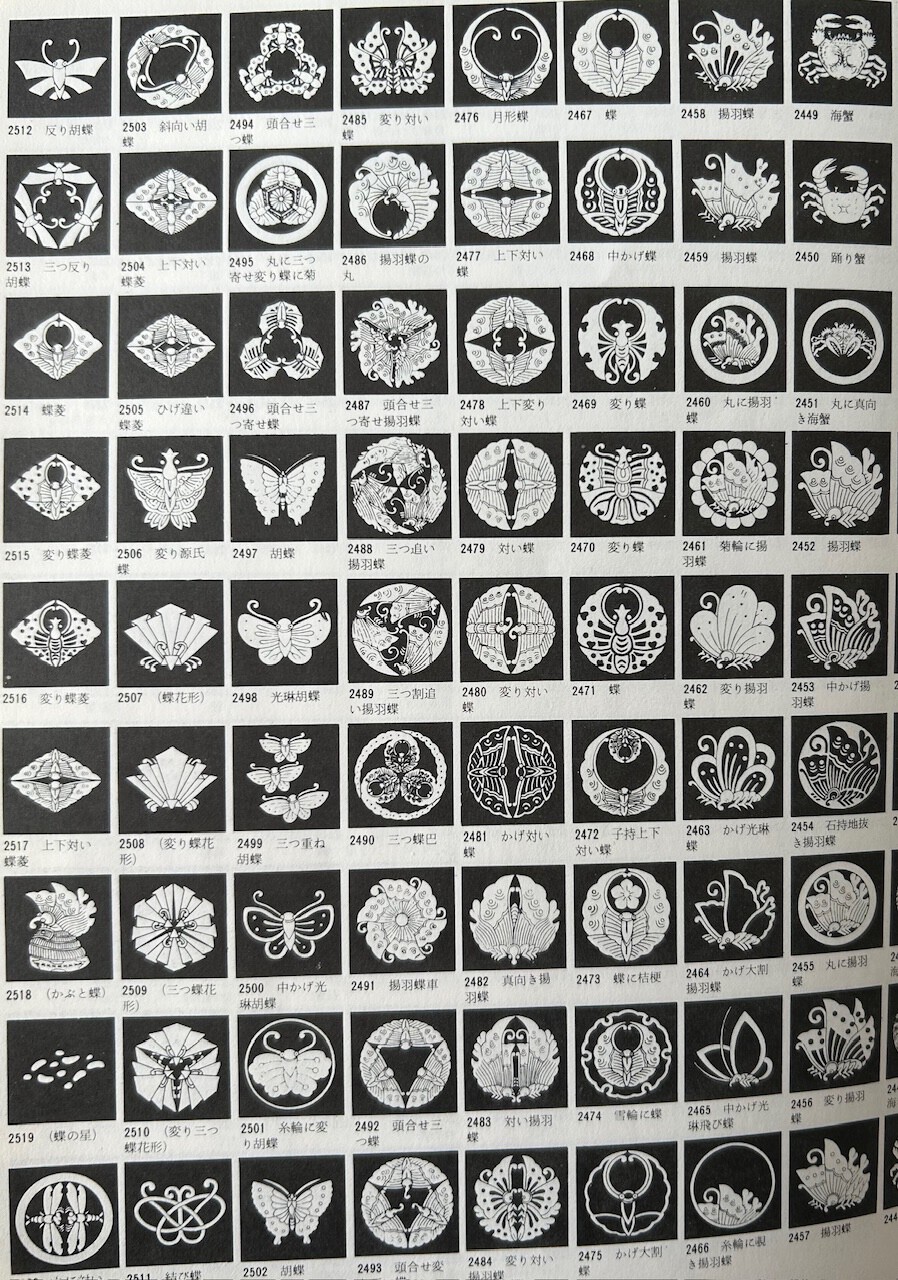
Here are two collections of butterfly kamon. You can see how much variety there was, allegedly up to 150 families using versions of butterfly Kamon. A B

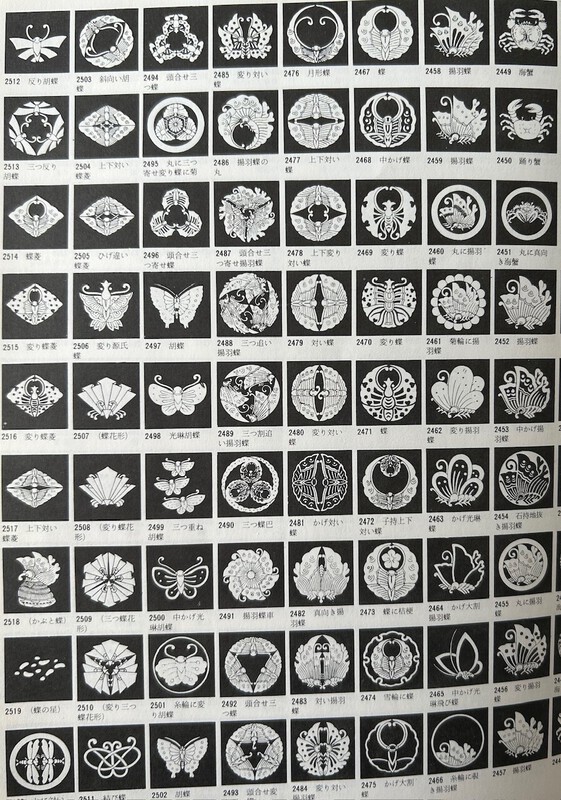 4 points
 -
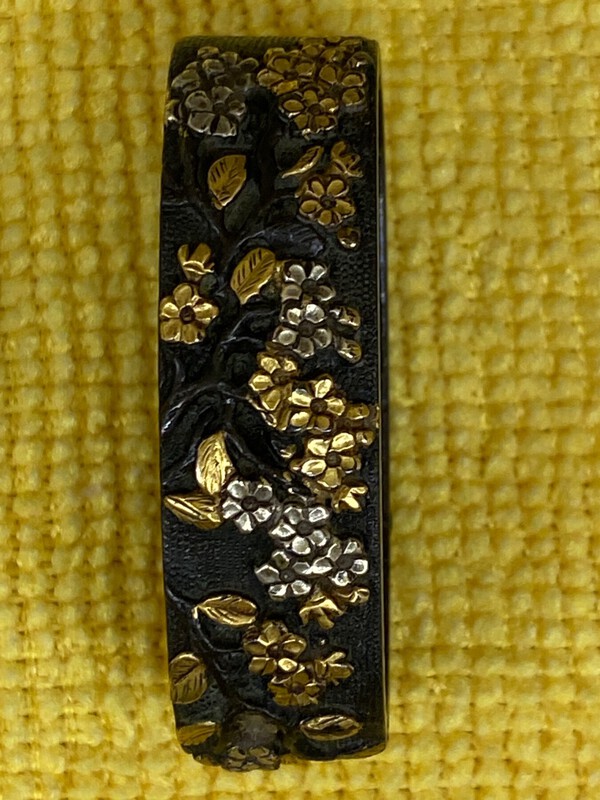
I was struggling with the Japanese description of a mounting . Mr Moriyama , who is a huge asset to the Board , assisted by giving me the translation ,being Yosegane ,together with a link to the Mokumekin Museum . The museum describes Yosegane as"like marquetry Yosegane combines metals of different colors to create patterns ". Members might be interested to see an example of what I now know to be Yosegane. This sword , regretably not mine , is one of the finest that I have ever handled. I hope you enjoy looking at it . Ian Brooks
.thumb.jpeg.fc5e542807b8c57224ba7d03e43a6d76.jpeg)
.thumb.jpeg.ff07293e7f2dc9c2699cf4180c2baf53.jpeg)
.thumb.jpeg.cb343a7676ef5e3a655b2e95d43039b7.jpeg)
.thumb.jpeg.18f7f5d3af0cc23dc0b64a9f429a9c05.jpeg)
.thumb.jpeg.024d72891165960bf447b78a64d346a0.jpeg)
.thumb.jpeg.d75ba5b8e446e48d3f5b73bf505c54c3.jpeg)
.thumb.jpeg.735f2788969c9ccc581bbcc09f1454f8.jpeg) 3 points
3 points -
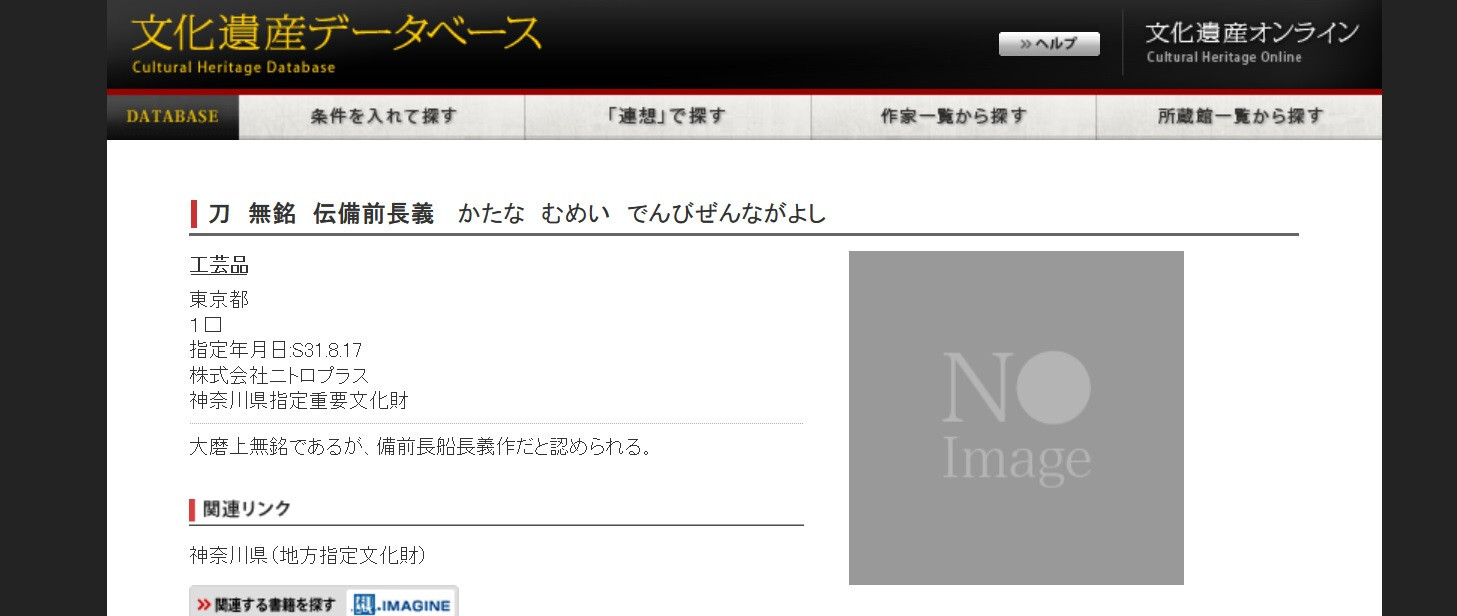
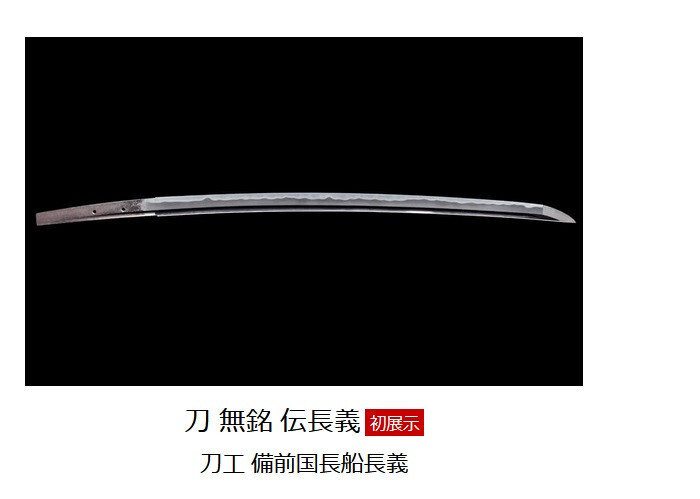
I think I have written a small bit about various designations on the forum before. I think I have understood this properly but I hope out Japanese members can correct any errors I have written. I think we all are aware of Kokuhō (National Treasures) 国宝. Then another well known designation is Jūyō Bunkazai (Important Cultural Property) 重要文化財. After this it starts to get complicated. Jūyō Bunkazai is a National designation (国). Now there are 47 prefectures in Japan, and prefectures can also designate and item to a Bunkazai status. However that is a Prefecture Bunkazai, prefecture level designation (県). To make it even more complicated Japan has 800+ cities and yes it is easy to guess cities can elevate items to a Bunkazai status. However that level is the lowest of the City Bunkazai, and city level designation (市). I did go through all the prefecture websites and searched for all of the swords that have achieved Prefecture Bunkazai status. It was tedious job going through lots of websites, PDF files etc. with just rows and rows of various things listed. I think I am pretty decent in finding the Prefecture level items and identify swords amongst the thousands of listed items. As there is so much to search for I might have missed few items but this would be the rough general count. Now out of these 695 swords I found 293 that I feature in my database. What is slightly irritating is that there is a huge difference in the amount of information about the item that is featured. At most minimum level it can just be 刀 伝当麻 Katana - den Taima, no picture, no additional text (just an hypothetical example). While others have lots of additional information, sometimes even a good sized picture (mostly the pictures are extremely minimal) is featured and links to other data sites etc. I do item matching as that is the search and research thing I enjoy so much, so I have been able to identify bunch of them. I believe some of them have achieved the Prefecture Bunkazai status so long ago and perhaps current owners of the Jūyō swords might not even know they are also Prefecture Bunkazai. I can share maybe in the end really well documented sword I was able to uncover. It started when I was going through Kanagawa Prefecture Bunkazai list. There was an entry for mumei Chōgi, some prefectures have these clickable links that open a page for the item. For some single row like this is the all info you will get about the item The link opened to Cultural Heritage Database but unfortunately there is no picture of the item either. However the owner of the item is Nitro Plus and the item is in Tokyo. I did not know the company Nitro Plus but with googling I found out that it is the company behind Tōken Ranbu. And with more googling I was able to find a picture of their 2019 exhibition that features the Chōgi. Unfortunately this was only picture I found but I found out NBTHK tweet that said that Nitro Plus Tokubetsu Jūyō Chōgi will be featured in TJ29 2026 exhibition as an extra showpiece, now as I have almost all the Tokubetsu Jūyō items and this was most likely TJ. It was just a matter of matching the correct sword and this one was Tokubetsu Jūyō 8. This particular sword was sold by Iida Koendo in 2019, and most likely Nitro Plus acquired it from there. https://iidakoendo.com/6300/ I was so happy to find out that Iida had also the Prefecture Bunkazai document pictured in the ad. I will attach it here as I think it is extremely rare to see these. Now it is possible to track down at least this much of the modern history of this particular sword. 1956 Kanagawa Prefecture Bunkazai - 1973 Jūyō 21 Nagasaki Prefecture - 1983 Tokubetsu Jūyō 8 ??? Prefecture - 2019 Iida Koendo - 2019-2026 Nitro Plus There is still so much more to uncover in these but unfortunately the information on them is very limited. There are for example Jūyō Bijutsuhin that have been also designated as Prefecture Bunkazai etc. Some super cool items (mostly for me the ōdachi) that I have not been able a single picture while trying to search them from Japanese sites.


 3 points
 -
Dear Chandler, Thank you for your effort, it has been a pleasure following your project. You bring the type of energy that the field needs, a deep curiosity coupled with builder energy. The map of Japan is great interactive material, and the timelines are insightful as well. I look forward to seeing how this evolves, and getting to know you better. Best, Hoshi3 points
-
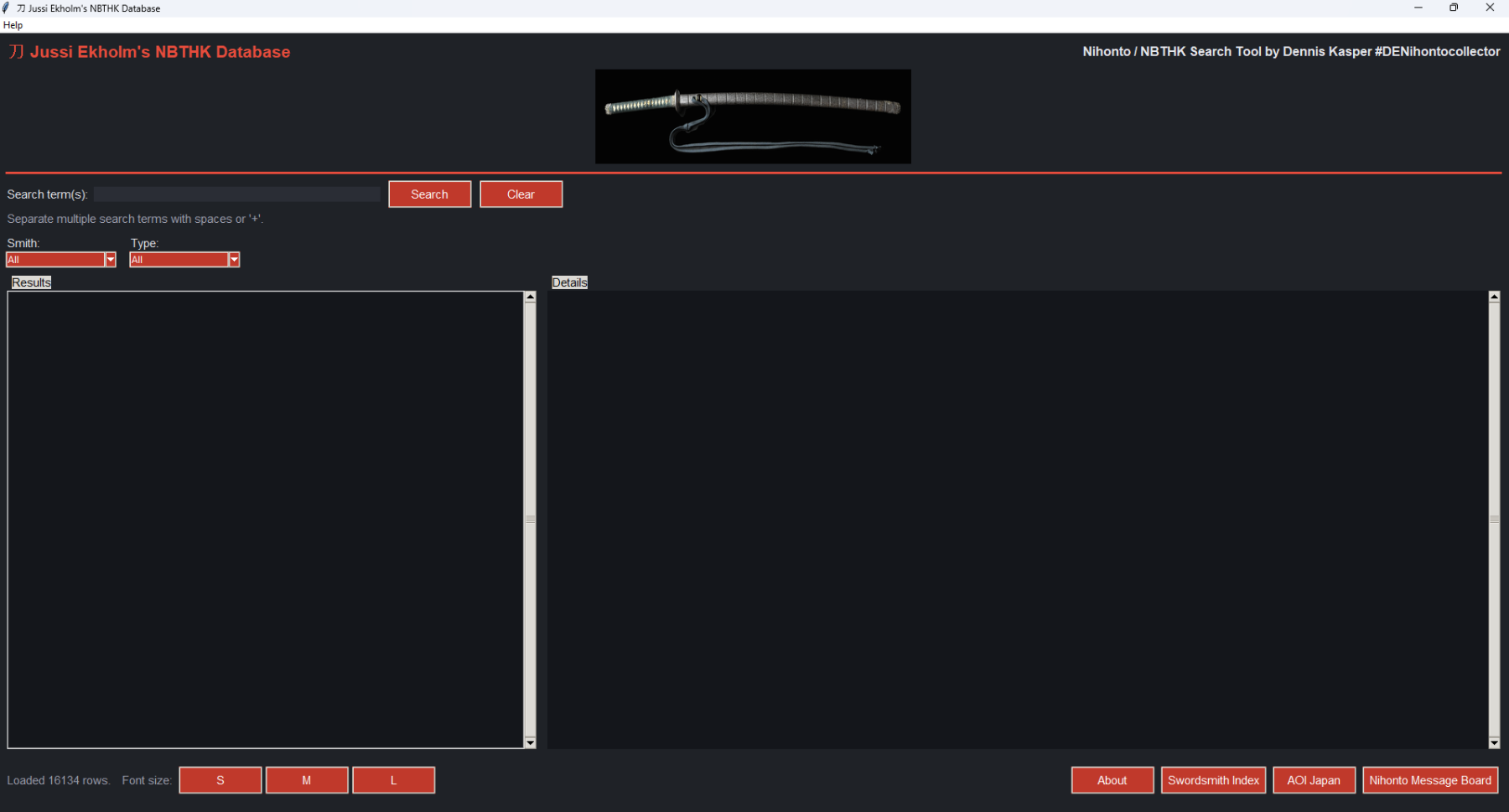
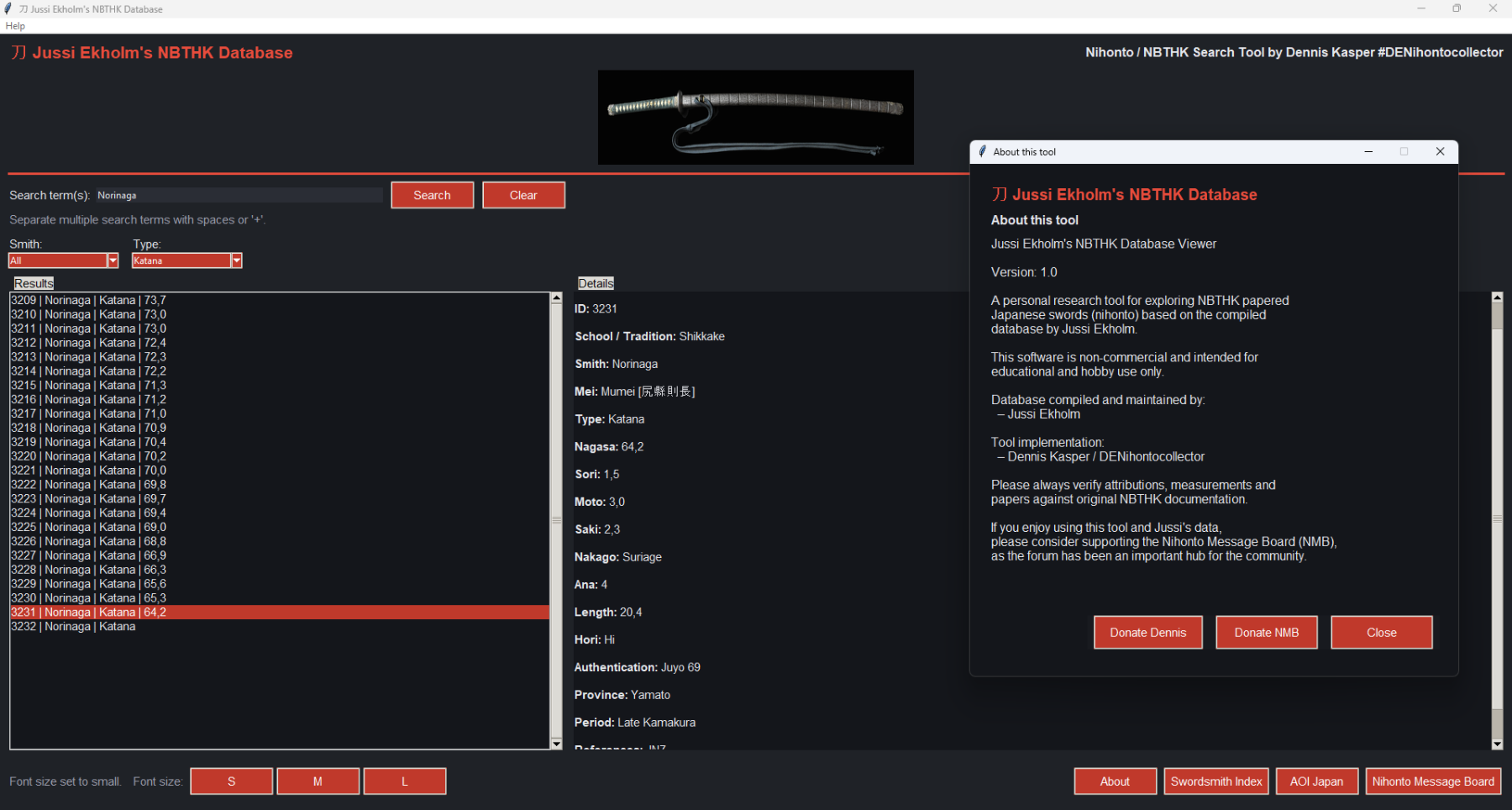
Great work! I made a similar programm months ago. In consultation with Jussi. It is an .EXE or MAC Program what you can download. No specific Webpage. It can be updated simply by replacing Jussi´s CSV data if he will add more swords to his database. It does basically the same like yours. I sent it also to Brian and he wanted to impliment it here in the NMB page. As far as I know Brian is currently working with a programmer to implement it to the NMB page. My Intention was to honor Jussi´s work and support NMB. So congrats, you were faster. Dennis Here is my Programm as mentioned as .EXE or Mac Application: Its a stand alone Program for download.
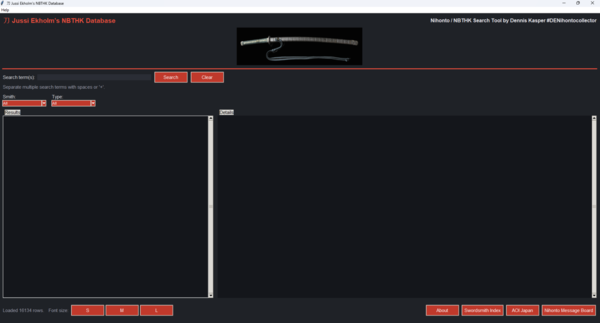
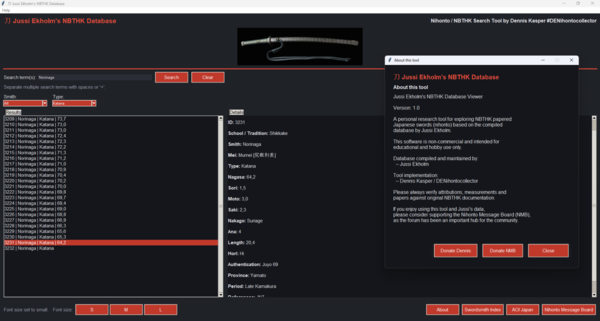 3 points
 -
3 points
-
OK guys, I was not expecting this! A further hint for all three of you!!!
 3 points
 -
I am actively maintaining it. I’ve already added nearly 1000 swords to the site that weren’t in the initial database. I also have bulk import backend tools available where I can take a CSV of swords and info and upload them, including photos (coming soon!), prices, and various translations to the database. I’d also like to allow logged in members to upload or submit records for addition, but that will depend on how many users actually end up using the site.3 points
-
Yes, as Jean and Bruno say, an unusual but strangely attractive version of agehacho swallowtail. Alignment of eyes, dot numbers, number of legs… The wave treatment of the rim is striking too. It could be a ‘torn-fan’ butterfly. Will check some books. Among others, the Ikeda Daimyo family of Himeji and Tottori used the standing, wings-up butterfly.3 points
-
Mark, welcome to NMB. Your tsuba design is a kamon (Family crest) - agehacho kamon [Taira Clan]
 3 points
 -
Hi Mark! Welcome to the NMB forum! Your TSUBA is interesting and looks quite unusual to me. Is it magnetic?3 points
-
I don't know that I can help you find the Honjo Masamune (any more than I am able to help myself do so), however a couple of quick items. I actually just posted a video on the Honjo Masamune a few weeks back, with some informtion which may be helpful in general in learing about the sword: I see now that the koshirae for the Honjo Masamune appears to have remained in Japan, perhaps rediscovered but likely never left Japan, and was displayed at an exhibition: https://tsumugu.yomiuri.co.jp/feature/桃山展「本庄正宗」の刀装初公開/3 points
-
Kotetsu and Kiyomaro sold2 points
-
Thanks , yes my mistake I had it as Morimasa and wrote Morimitsu by mistake . Thanks again for your help with the translation. Ian2 points
-
Hi Chris, Tsuji Motochika (plus kao) would seem to be correct. Nice fuchi!2 points
-
Congratulations, and all the best for the three of you! All other projects can wait!2 points
-
Here is the first page again hopefully with the correct alignment
 2 points
 -
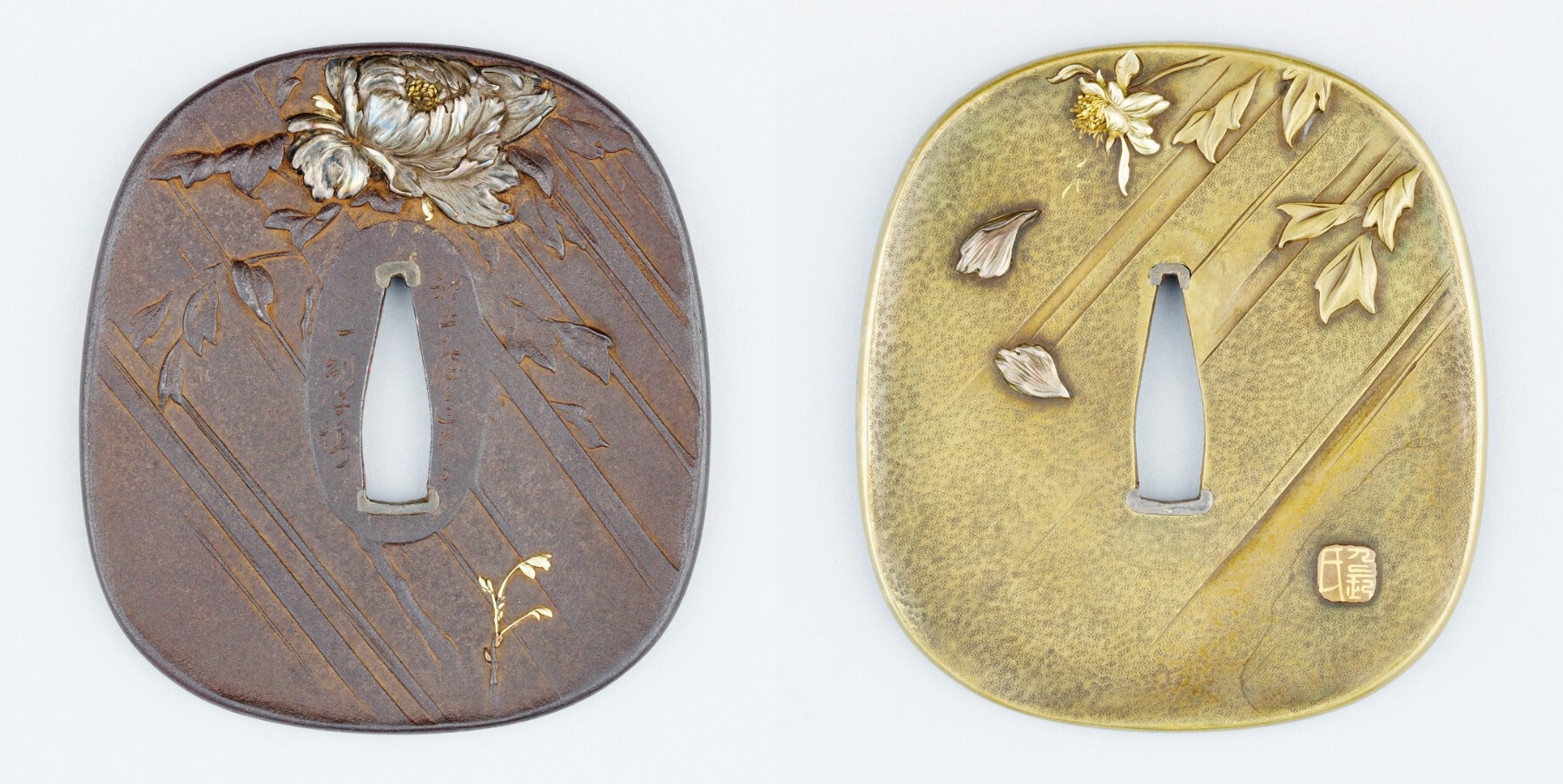
Lack of replies is probably because most agree this isn't near Goto work. It's nice...but not next level. Ford would have picked it apart relentlessly I suspect.2 points
-
Now the auction just ended, and the tanto was sold for 180,000 JPY. The problem of the blade is much worse than gimei. Its registration paper is a forgery. That means that the blade is not registered and the blade itself is illegal. I guess that the blade was illegally made in Japan or illegally imported to Japan. The mei on its omote-side is 伯州住延秀 – Hakushu ju Nobuhide. I can read the erased signature under the date on its ura-side. The old signature is also 伯州住延秀 (Hakushu ju Nobuhide). Again I guess that the faker originally intended to make an illegal blade with the mei of 伯州住延秀 (Hakushu ju Nobuhide), but he made a mistake and chiseled the mei on its ura-side at first, and then redone the nakago.

 2 points
 -
There is something unusual about this Namban. Would anyone like to venture a guess? (Hint. The answer is not obvious in this first photo.)
 1 point
 -
Many thanks David, seems like that might certainly be the easiest way to proceed.1 point
-
Zero chance that it is Chinese, it will be a legit Nihonto, just with an altered signature, which is more than common. But the sword still stands on it's own as though it were mumei.1 point
-
Indeed, Dennis did approach me a few weeks back, and I wanted to integrate it into a page here. My own fault for delaying. But as mentioned, the info is useful and the more sources the better. May still push to have a downloadable exe here, for offline use and on laptops etc. I wonder which guy is going to be the one to do this as an app for cellphones...I expect more than one guy will be working on something.1 point
-
Wow, fine work, so there are others out there! Thanks Dale!1 point
-
Aha! Bi-metal consruction1 point
-
There seems to be some kind of gold (?) decoration (?) on the other side.1 point
-
I can only see the background material through the nakago and kozuka ana so I guess the sukashi design does not go all the way through. Is it flat on the other side? Or some sort of backing?1 point
-
The image is fuzzy yes, partly to keep folks guessing! Your answer is very welcome, Grev. Your assumption of iron is half correct. Agreed on the Kozuka lining being a later addition; it looks bright, with no patina. Finally, I do think you will be surprised by the answer. Oh, there are faint traces of some gold zogan on features here and there…
 1 point
 -
Thank you. That was my typo.1 point
-
The image is not clear, but the smith name might be 守政 - Morimasa. Edited, Mirimasa --> Morimasa1 point
-
Aye - and the cost of living's not getting any better. Looking for gendai/shinsakuto blades with NBSK certification may help somewhat, I believe they also have several less-renowned smiths under their umbrella alongside the bigger names. You could try looking up some of the NBSK competition results and see which names earned some of the bronze/silver prizes or were newly accepted.1 point
-
Fantastic work, I've already signed up and can't wait to see how it develops.1 point
-
That's incredible and shocking, Moriyama-san. Is Hakushu ju Nobuhiro so famous that he would even warrant being copied? Best, Hector1 point
-
Hope these help. Ian.
 1 point
 -
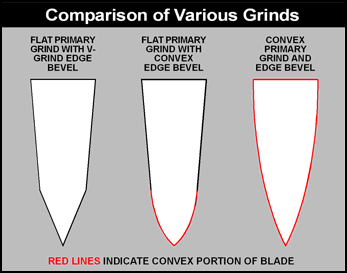
I wanted to post a brief update on what I’ve been learning about how blades like mine were originally shaped and finished in their period. The overall sugata of mine aligns with what is described as Tenshō-sugata: shinogi-zukuri construction; relatively wide motohaba, firm kasane, minimal funbari, and a robust chu-kissaki. This proportion set appears frequently in late 16th c Bizen work and reflects the practical requirements of the period. The edge geometry is best understood through the concept of niku (肉). Rather than a thin, flat bevel, these blades were shaped and maintained with a hamaguri-ba (蛤刃), a convex clam shell profile. This places more steel behind the ha, improving resistance to chipping or rolling when striking harder targets such as components of tōsei-gusoku. The convex surface also supports a smoother wedging action during the cut, reducing binding. I found this image posted previously on the forum which illustrates this: On the finishing side, I’ve been reading about sashikomi-togi (差し込み研ぎ) in contrast to hadori. In sashikomi, the hamon is not artificially outlined. Instead, the nioiguchi, nie, and internal activities such as ashi and sunagashi emerge naturally through the final hazuya, jizuya, and nugui stages. Earlier sashikomi approaches could rely on fine stone powders such as Tsushima-to during shiage, rather than heavier iron-oxide-based mixtures, resulting in a more integrated ji-ha contrast. - This approach is particularly relevant for late Kotō Bizen where features like utsuri may still be present. The choice of polish style has a direct effect on how utsuri, nie-deki, and gunome-midare are perceived. Studying the hamaguri-ba geometry together with sashikomi-togi has given me a clearer understanding of how blades of this period were shaped, sharpened, and intended to be used, and now viewed. It also explains why blades of this construction and metallurgy from Bizen in this period often show jihada which appeals to me much more so than others. I've never been a huge "look at that flamboyant hamon" fanboy, but man, dark/wet/active jihada just does it for me Also, early on when I started researching nihonto, I was greatly turned off by swords that appear mirror-like and overly polished, which can make the jihada hardly visible at all; it was partly down to the polish style and now I understand the differences. I hope I got all of the Japanese terms and my understanding right, I'm still learning.
 1 point
 -
Quality doesn’t look anywhere near good enough for Goto work……but just my opinion. Are those flowers plated rather than silver inlay? Is that plate that is wearing off?1 point
-
Unfortunatly, this tsuba I do own is not cast! [I invite you in France to verify]1 point
-
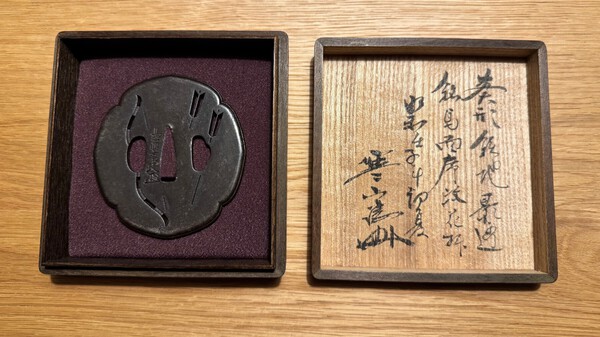
@MauroP please find some pictures of the hakogaki attached, apologies in the delay.
 1 point
 -
https://nbthk-ab2.org/join-now/1 point
-
He was a lovely gentleman, who, unfortunately, I never had a chance to meet in person. However, he used to write these polite and erudite letters to me in terms of his membership of the Token Society and how he enjoyed our newsletters and reports. Sometimes one can glean an impression, or perspective, of someone just on the basis of a few sentences. While I have fully embraced modern technology and its advantages, occasionally I miss the old times when people used to come to meetings eager to learn (as opposed to forming views on the basis of Internet browsing or some opinions exchanged in a chat) or send each other hand-written letters. Call it nostalgia or what not, but the interpersonal relationships and discussions were different.1 point
-
https://www.militaria.co.za/nmb/files/file/29-the-namban-group-of-japanese-sword-guards-a-reappraisal/ But a good reminder for collectors1 point
-
Forest Ninja, it is required here on NMB to sign all posts at least with a first name plus an initial, so we can address you politely. I think that applies even to NINJA..... Concerning polishing stones, there was always a big demand in the past, and this is actually the same. Many quarries had to be closed because they have been exhausted. We see that in WASHITA and ARKANSAS as well as in Belgium or Germany, and it has become increasingly difficult to get KOMA NAGURA-TO and good UCHIGUMORI as well. On the other hand, synthetic stones are being developed and improved and one can good results with them. I say that as a knife-maker, I do not touch Japanese blades.1 point





.jpeg.e32ee4a33204bb8eab0e1873dd2303ab.jpeg)
.jpeg.5a29580f1ef5cd14a4c9a7e762eb6f47.jpeg)



.jpeg.dcc02bc43c6d3cf944ebda9c0565ab87.jpeg)
.jpeg.547e0d31c275398aefed3dccc5814f5b.jpeg)
.jpeg.4d9c54ef43427fefadb279ed31f60156.jpeg)
.jpeg.96bfe51e7aa82a10342497fad29b9404.jpeg)
.jpeg.4773d892d208a86794c6a837d0a941d4.jpeg)
.jpeg.890d6d984176190b7ad2969a972a0e6d.jpeg)
.jpeg.c6f0b8dd8b44ba988064fa8aafd5315f.jpeg)














This leaderboard is set to Johannesburg/GMT+02:00