
Leaderboard




Popular Content
Showing content with the highest reputation on 01/06/2026 in all areas
-
The mei looks Sukekane to me. 備前國助包 - Bizen no kuni Sukekane6 points
-
Yes, it's one of the few remaining examples of what folks in IT diplomatically refer to as "the Geocities era of web design." It's a historical artifact in itself.5 points
-
I'm working on compiling a list of the main koto swordsmithing schools, the province(s) they worked in, and the years they spanned for a project I hope to share with the NMB shortly which I think many will enjoy! I have a public Google Doc link which I'll share below that anybody can access and I've added a number of schools and probably have a lot of mistakes that I've made along the way. This is where I hope that NMB members can help out in helping me curate this list and refine it. I've probably missed a number of key smiths, dates, schools, etc. and I'm hoping that some collective reasoning can help me past the finish line. https://docs.google.com/spreadsheets/d/1NiQi34M8brY-21pM2N3z1emOqvEutC65F4godYsvJM0/edit?gid=0#gid=0 Many thanks in advance and I hope what I've got cooking up will be of use to many once I'm finished up! I've also added a page for Shinto schools but I haven't started on anything as I don't really know how they should be classified outside of the Gokaden (maybe just province?) but if you want to add them, feel free! The data will be used.4 points
-
Agreed, Sukekane. My mistake above. Best regards, Ray4 points
-
@Rhizosphere Depending on your location in the United States, you may want to attend one of the four sword shows around the country to see if you can find something in person. This helps immensely compared to shopping only from photos. The Las Vegas show is coming up in a couple of weeks.4 points
-
It is most definitely antique...a few hundred years old. Very common for older swords to be taken to war. "Family blades" just means they were privately owned before. There is no family mentioned on them, just the smith's signature as per this one. Condition is poor, but don't do anything except oil and wipe.3 points
-
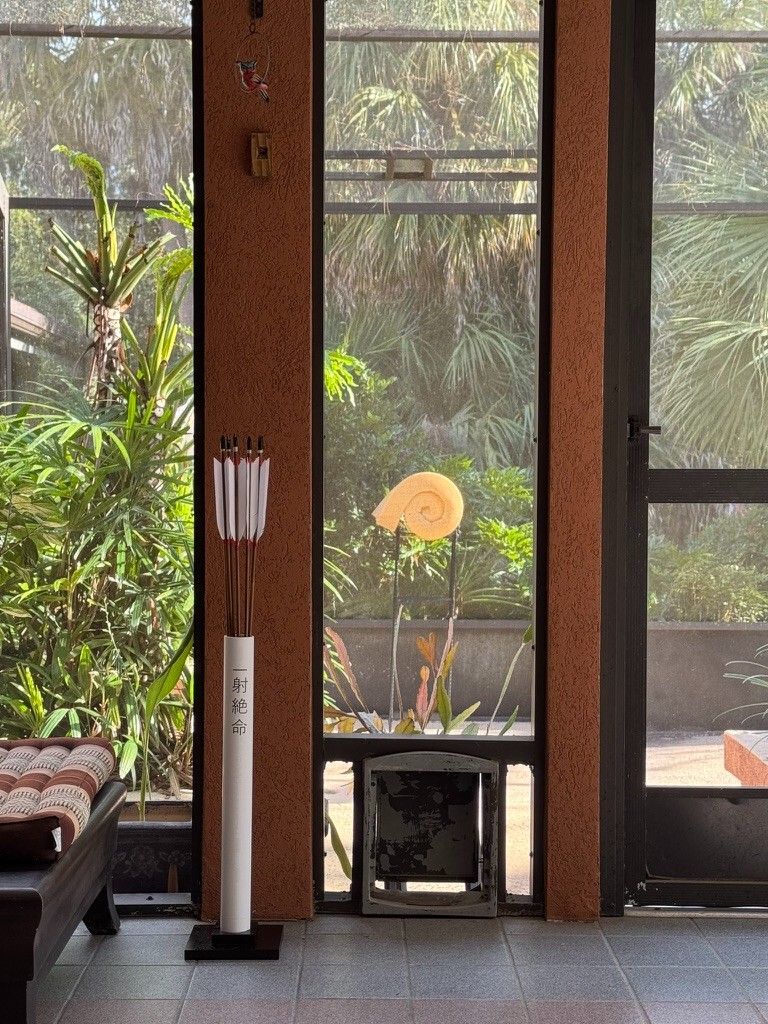
Actually, believe it or not, I learned yabusame in Kamakura Japan. Mostly riding a wooden horse for training indoors and then... I don't really need the Ebira to hold ya when practicing on a makeshift wooden horse. I just tuck the ya into the straps of my hakama, but the Ebira is fun. I practice Heki Ryū Bishū Chikurin-ha, which Shibata sensei brought to the US in the 1970's at the height of Western interest in all things Japan. There is a National Geographic documentary about him that was heavily viewed. The yabusame is another story. I got a chance to do kyudo practice with a group on a visit to Kamakura. To my surprise, they had a wooden horse in their dojo, which they let me try. When I was coming back from a 7 year sabbatical in Singapore, I took a significant amount of time off to train in Japan (both Kyoto where Shibata sensei's main teaching line remains, and Kamakura). I didn't even know how to ride a horse, so it was quite an adventure. I have made some of my own wooden turnip shaped arrowheads, which got me interested in the whistling variety. This is my makiwara just outside my covered patio and the 8 mm bamboo practice ya that I make from scratch. I do enteki on our back property that overlooks a nature reserve (just gorgeous). I am making finer sets of 9 mm ya fletched with the highest grade wild turkey feathers with horn nocks and silk wrapping to gift to teachers for ceremonial shooting.
 3 points
 -
Markus will get back to you. As pointed out it is the holidays and to be honest, I think at times he gets overwhelmed with requests. I had written him prior to the holidays and he wrote me back yesterday saying he had gotten sidetracked twice while meaning to write. For me it is no big deal, I am in no rush. Point he is very dependable and will write you back. Be patient grasshopper. If you want to know more, I would go with Swordsmiths of Japan by Markus Sesko. You can order any of his books on the LULU website. If you want something cheaper, I have a copy of Hawleys (Brown one). It is worn and the corners have been bumped pretty hard, but the pages are intact and I would let it go for $100 plus S/H and any related fees.3 points
-
Hi everyone, I wanted to share a reflection after completing my first full year in this incredible field. Over the years, I have been an avid collector of many things, ranging from precisely catalogued historical multiples and rare editions (such as coins and books) to the more subjective realm of fine art and contemporary pieces. I was used to the world of almanacs and the subjective opinions of art critics. But after one year of being entangled in the world of Nihonto, I’ve realized this is something else entirely. What fascinates me most, and what has truly trapped me in this hobby, is the unique intersection of high art and the rigorous Japanese legal framework. Unlike any other field of art, we are dealing with a mandatory government registration system that defines a sword’s existence as a legal art object. But the real magic happens when this legal status meets the expert judgment of the Shinsa. In the world of fine art, you often chase a signature. Here, we look for a soul. When a group of experts gazes into the jihada and hamon, they aren't just checking a box; they are identifying the hand of a master who lived centuries ago. They are giving an anonymous piece of steel its name and its history back. This strict, tiered hierarchy, from Hozon to the Juyo and Tokubetsu Juyo levels, feels to me more than just a ranking, it is a path of merit that honors the spirit of the smith. To hold an object that has been scrutinized by such a body, and to find it recorded in a work like the Juyo Token Nado Zufu, creates a level of gravitas I have never encountered in any other hobby. It transforms a beautiful blade into a verified vessel of both history and spirit. Even after a year of navigating the challenges of the market, encountering gimei, fake documentation, and the complexities of mumei attributions, my respect for this system has only grown. It’s not just about owning art; it’s about the certainty that comes when art, law, and a thousand years of tradition meet to protect the soul of the Japanese sword. I’m curious if others here, especially those coming from a background in fine art, had a similar realization? That the unique Japanese system of judging and registration is actually what sets this apart from every other form of collecting?2 points
-
The mei appears to be: 備州住國光作 - Bishu ju Kunimitsu saku (made by the smith Kunimitsu in Bizen province).2 points
-
Agreed, the Shinsa is unique in the world as a government sanctioned event that authenticates an entire asset class and accessories. To have experts that have to complete decades of study to recognise the artist is just incredible - I am unaware of any other area like it - be it art, science or any other activity. That there are some many smiths and traditions it is incredible how much knowledge you need to have to become a recognised expert and even then when you speak to a master authenticator with 40 years experience they will still say they are learning. It is remarkable. Almost super human. The closest we have to this in the west is the individual authentication boards or committees for an artist. But even then these groups focus on one or maybe a few artists not an entire asset class. As we move forward I would love to see some of the western art influence this extraordinary eastern art. Things like having a catalogue raisonné for the big named smiths would be a massive move that would greatly improve this art form and have many advantages (aside from the fact that you will finally be able to see all the recognised works of the smith in one collective work - which in itself would be wonderful.) I hope this will happen sooner rather than later. But for now like you I am completely and utterly engrossed. There is no art form like Nihonto.2 points
-
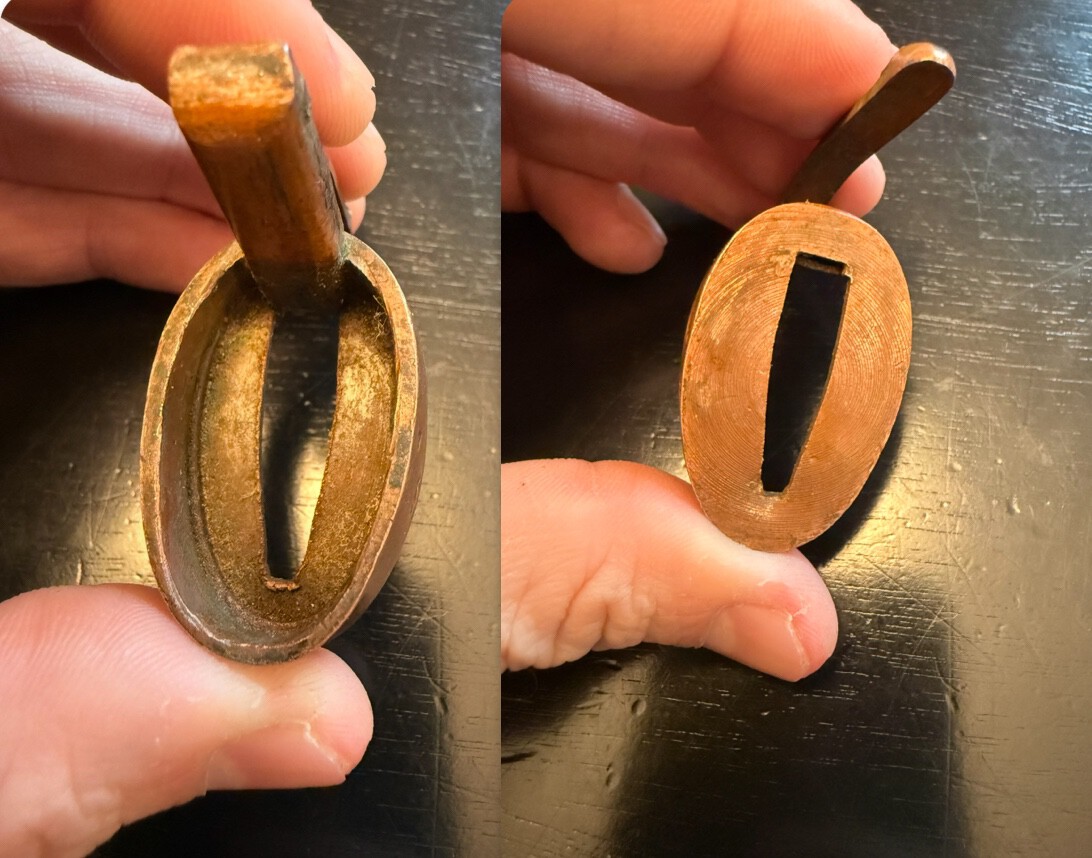
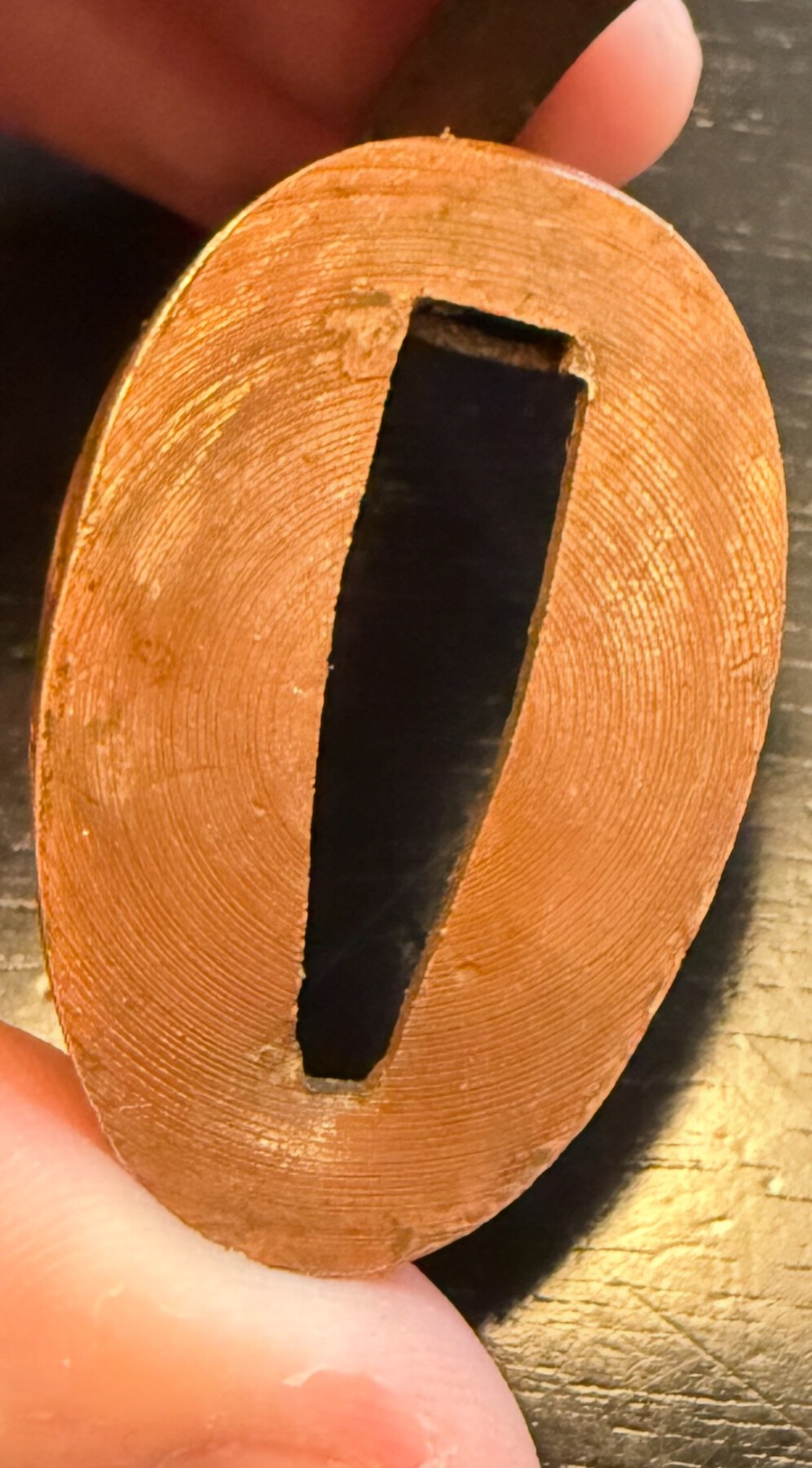
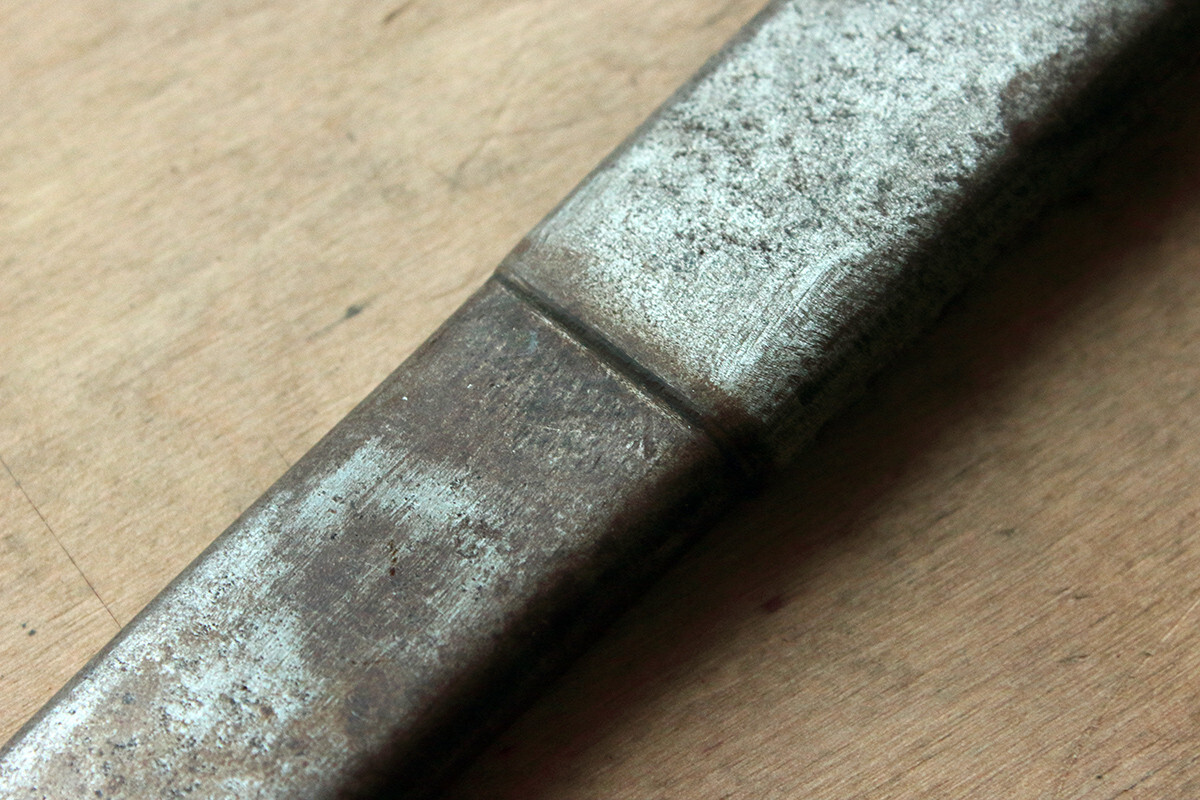
Thanks @Kiipu, I’ll have to edit some things in my notes for more proper terminology. Here are photos of the top and bottom of the ferrule. No stamps or numbers that I can see, and the top has a curious circular grind/scratched pattern. Other than the latch assembly, the rest of the ferrule material appears to be copper, and is not magnetic. Does not appear to be plated.
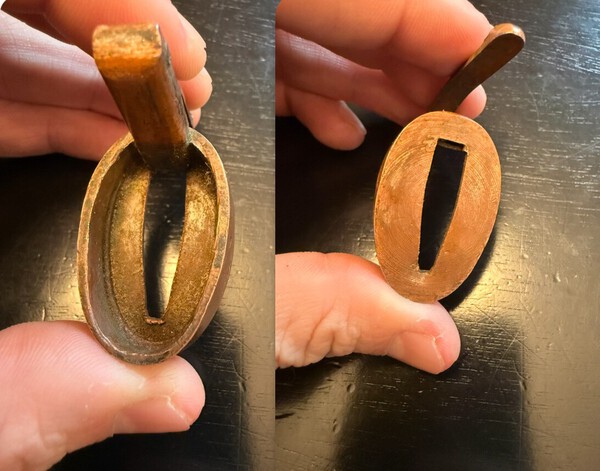
 2 points
 -
Name of Parts Depicted 柄環 hilt ferrule or hilt collar. Ferrule being the better English term. Sometimes incorrectly called a fuchi. 駐爪 chūsō Latch. 駐爪ばね chūsō bane Latch Spring. 駐爪鋲 chūsō byō Latch Rivet. 駐環 chū kan [That U-shaped part? Anyone got an English name for it?].2 points
-
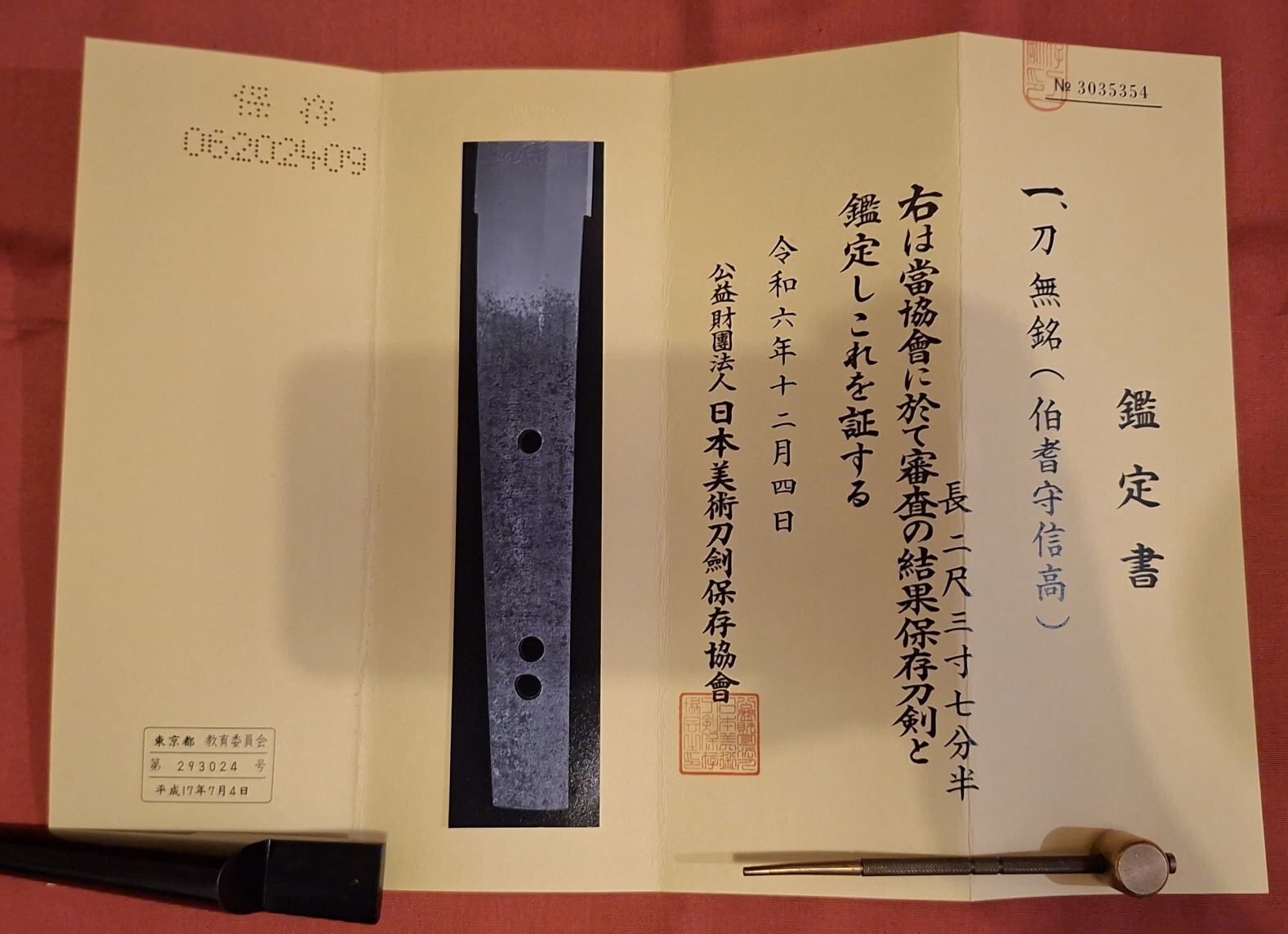
Well I am tad early with the answer but as I am not sure about my day tomorrow, I think I will post it today. Thanks for everyone participating and I hope it was fun. The sword is indeed now mine and I knew the attribution when getting the sword. I did not care about the attribution at all, I just wanted the sword because of size & shape. NBTHK attributed the sword to 伯耆守信高 Hōki no Kami Nobutaka. I would assume that they see this as 1st gen Nobutaka and possibly a Keichō-Shintō sword from very end of Muromachi to early Edo period. Nobutaka is seen as one of Owari sansaku, one of three Owari masters, so he is well regarded smith. However when such a mumei sword gets attributed to Edo smith it kinda demolishes the value. I have seen few nice mumei swords that I thought were Nanbokuchō swords that got NBTHK papers to Hizen Tadayoshi. I happened to see Owari special exhibition at Nagoya Tōken World last summer, back then I didn't know much about Owari smiths, and to be honest I don't know too much now either. I have found few Edo period wakizashi by Nobutaka smiths that have very wide sugata but so far I have not been able to find a reference long sword with very wide sugata. Most of the katana by Nobutaka smiths I have been able to find are just normal early Edo sugata. This was the sword at Nagoya exhibition, by 3rd Nobutaka: https://www.touken-world.jp/search/13753/ I do admit the hada and bit "featureless" hamon might be actually quite close to work on some of Nobutaka line items I found online and in books. However I think 1st Nobutaka work would be better than on this mumei sword. I personally would think like many did in this thread that this would be late Nanbokuchō to Early Muromachi sword. Naoe Shizu would of course be maybe the most optimistic outcome that I can think of and something like Mino Senjuin I could easily see, however it seems I am way off in time. This sword was sent to NBTHK by a small sword dealer at the end of 2024, and I would believe they were not too happy with the attribution that was given out. You get attribution like Naoe Shizu you are very happy and it is a valuable sword, you get Edo smith attribution and the value sinks really hard. I know this was bit of a curveball as it has been for me too. I think all discussion is welcomed and would be also fun to have some discussion, as unfortunately we cannot view and discuss the items in person.
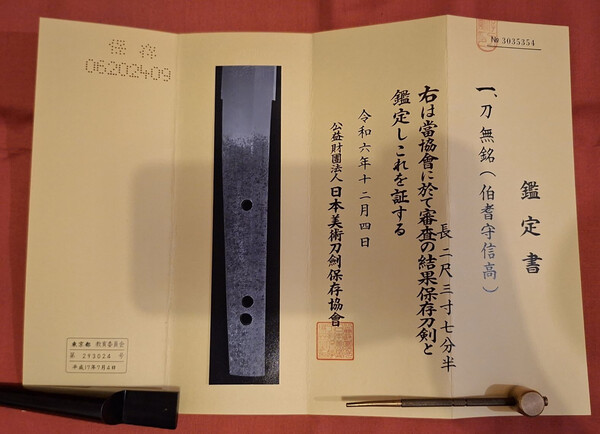 2 points
 -
That is correct or how I think currently. I feel the Kongōbyōe school is bit problematic as there are extremely few signed old items and dated old items are like unicorns. There are the Moritaka tantō that is Jūyō 23 and it is In my opinion most likely dated either 1359 or 1369 but one crucial character is missing, and there is the 1370 dated Reisen Sadamori tantō that is Jūyō Bijutsuhin. I know there can be different opinions about the origins and timelines etc. However for me Ko-Kongōbyōe = Nanbokuchō as that is where I see the school starting, and Kongōbyōe = Muromachi. So far in my search I have not been able to find a signed tachi by Kongōbyōe smith that would be Nanbokuchō period. NBTHK does not often specify the generations of Moritaka smiths in the appraisal paper, to me that is huge bummer... I do feel this particular Moritaka could be an Early Muromachi one possibly from Ōei. I might have been too critical for many of the signed Moritaka katana I have seen online as to me they have seemed like later Muromachi work, so I haven't included them. Of course I am no authority at all but I needed to draw a line somewhere when I gather items, as there are lots of lineages that continue during Muromachi period. I would have to include so many more items by those smiths. And as NBTHK or other organizations might not identify the generations on appraisals it does not make it any easier. Sometimes it is problematic for schools or lineages that used same signatures over a long period of time. One of my personal favorites 宝寿 (Hōju) gets very often described as late Heian period by sword dealers. However in my opinion there are only very few Early Kamakura period items by the school and majority of old works are from late Kamakura - Nanbokuchō periods. Now as the school continued into Muromachi period using the same 2 characters it can be tricky to identify the age. So I mostly just refer to expert opinions.2 points
-
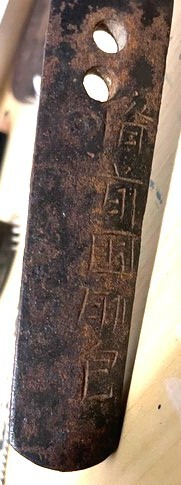
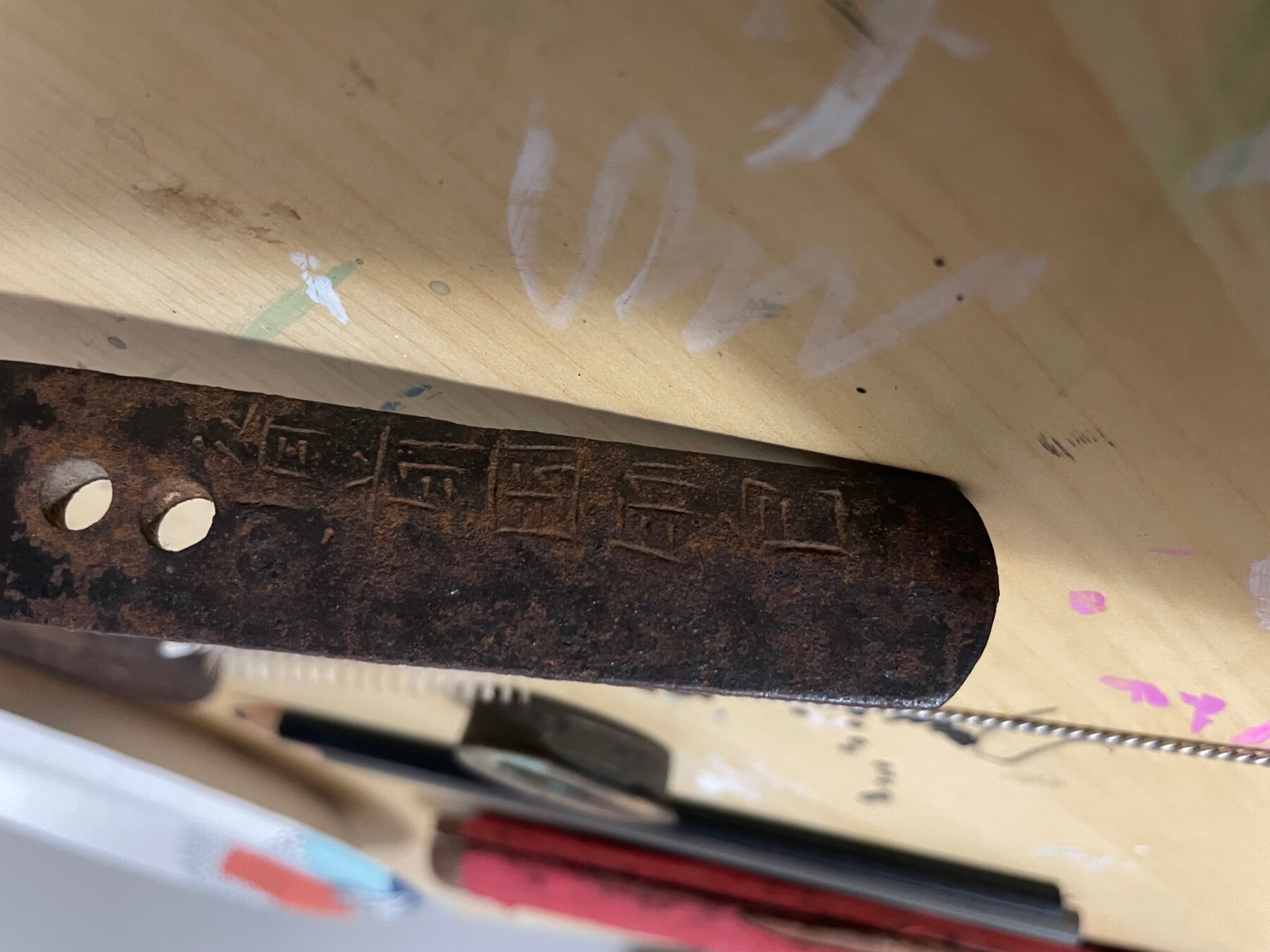
I inherited a Japanese sword that my great grandpa picked up in Papa New Guinea during WWII. I’ve removed the hilt and was wondering if anyone would be able to translate these markings. It’s a bit hard to read with the rust but I did an etching and drew generally how the symbols look on the paper. Thanks a ton for the help!
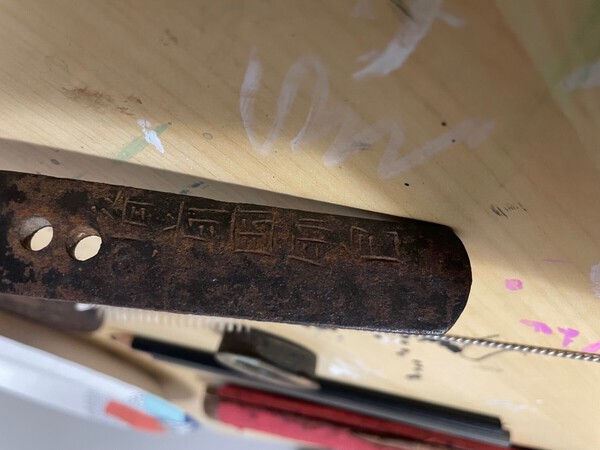

 1 point
 -
Hi Shane, please provide additional images that clearly show the blade if you would like feedback from the group. Up close and in focus if possible. Please also carefully remove the handle and show a clear vertical image of the nakago (tang) on each side. Best regards, Ray1 point
-
@Mark posted this for sale back in November 2022 and the thread is now gone. To the right is what a spare hilt looks like.
 1 point
 -
This thing will take its place in the "Curiosities" section of my small collection. However, even this "bayonet" turned out to have something of interest. I didn't expect to find such a large number of stamps on the inner sides of wooden grips and on the tang.
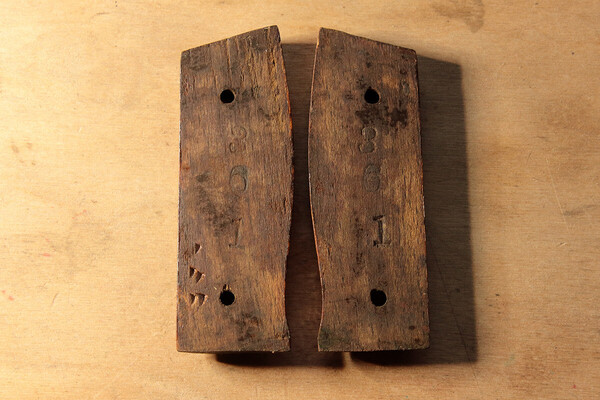


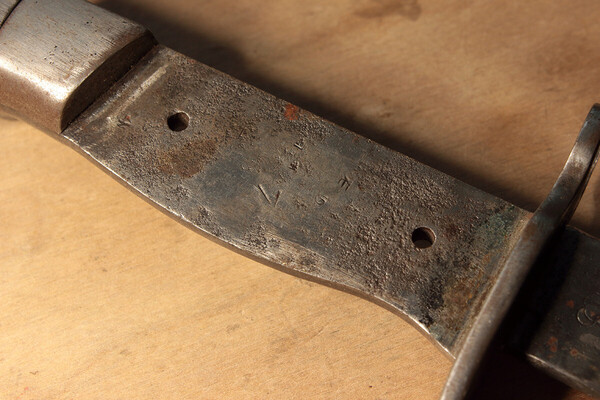

 1 point
 -
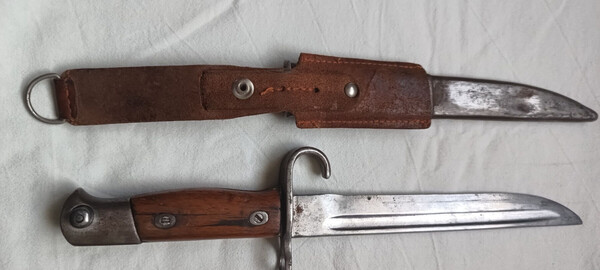
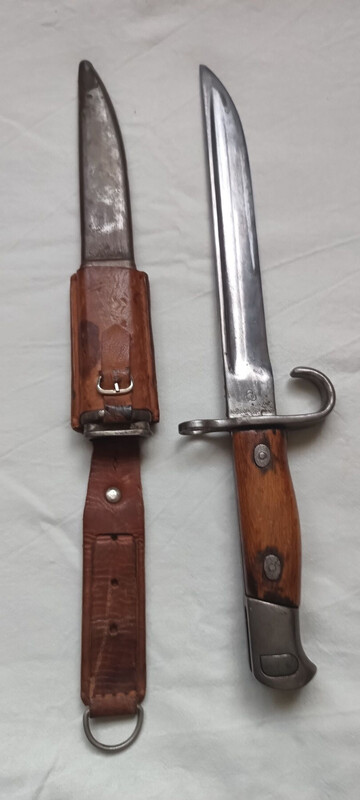
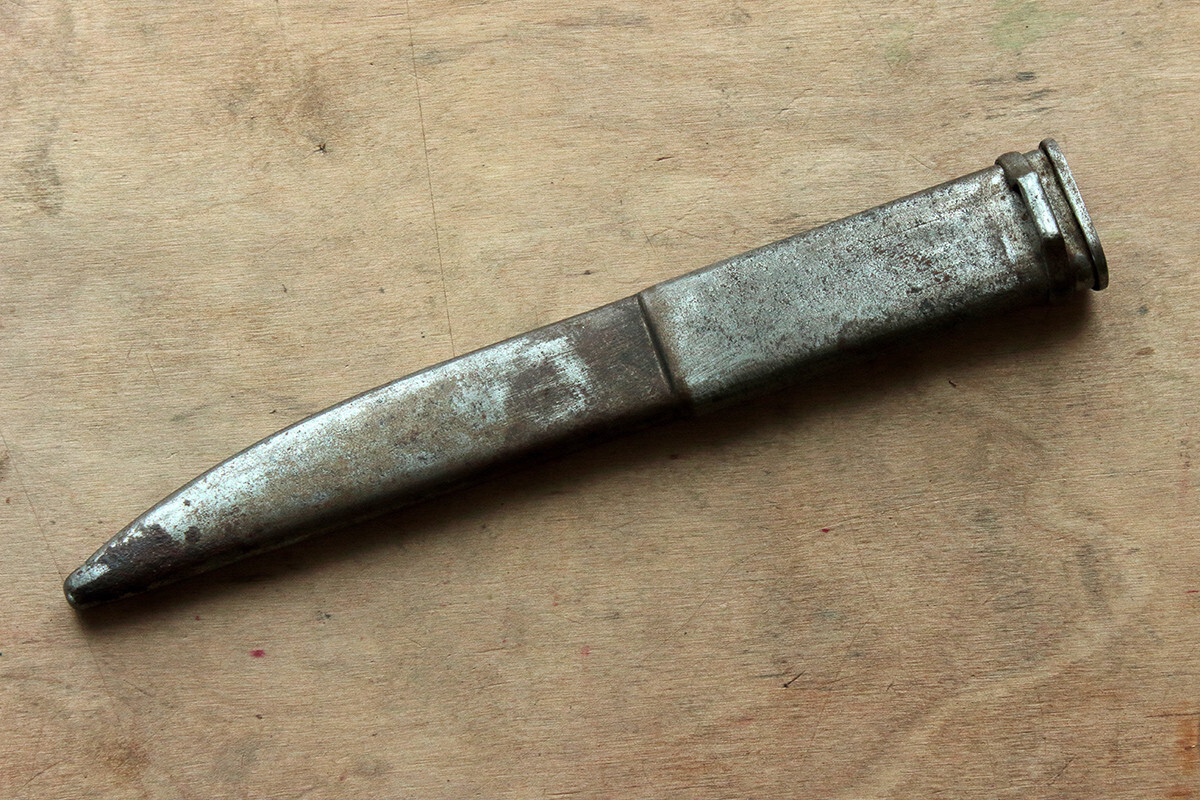
Made some search on this thing and even as one may find shortened Arisaka bayonets, this seemed to be a "standalone" thing. Yet, it was cheap and interesting (to me) so I decided to buy it anyway. Here are some photos. As you may see, it was someone's "restoration" project. And this someone put some effort into it. The reason for the blade shortening is unclear, as well as what happened to the original hilt. The facts are as follows: a new hooked quillon was crafted and brass welded to the bayonet, scabbard was shortened and again, two pieces were brass welded together. And even as "cleaning" took all the numbers from pommel, it was made quite accurately. I also shot a couple of photos of this bayonet side by side with standard Type 30 bayonet. One may notice the slight difference between arsenal stamps.


 1 point
 -
Thanks! This is the feedback I’m looking for! Also the document is open so anybody can add or remove rows and edit things as needed so if you see anything out of place, you are more than welcome to correct it.1 point
-
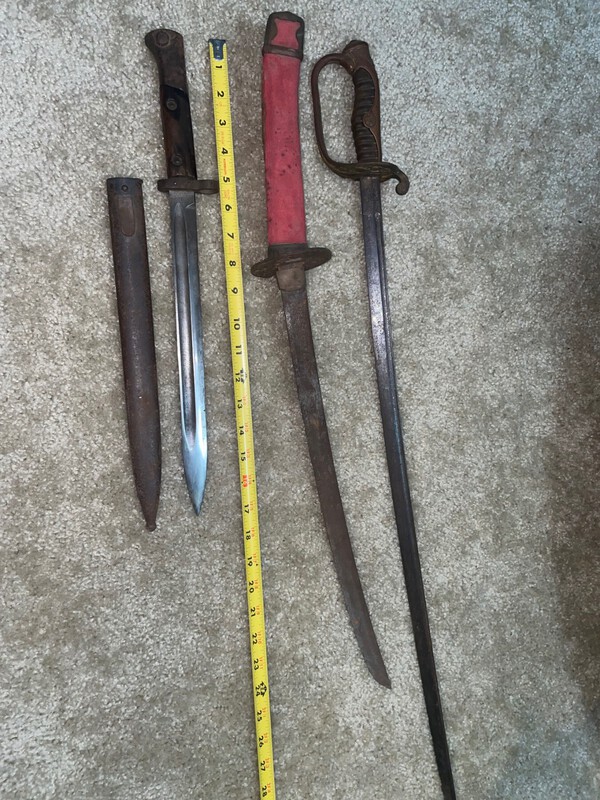
Jace, You may already know, but the longer sword is a Type 19 Japanese officer dress sword (sometimes called a 'parade sword' by collectors). They were worn in non-combat situations and not a real weapon. You can read up on them on Ohuma's site: Command Saber - Ohmura What is the length of the cutting edge of the shorter sword? It appears to be a wakizashi, the shorter sword of the two carried by the Samurai. Under 24" is a waki.1 point
-
Speaking entirely personally, the Sho-Shin website took some time to get used to. The variety of fonts and colors, and unclear what is and isn't a link, felt very busy at first. I’ve gotten the hang of it now, and it's an awesome resource. Your project would be much appreciated, and it’s something I’ve wanted for a long time. Looking forward to it! It already looks great. -Sam1 point
-
Here is an example of Nobotaka Katana: https://eirakudo.shop/182980 Also there is a picture of a Nobotaka Katana in the Book Keicho Shinto from Markus Sesko1 point
-
祐包 The one at the end of Edo and into the beginning of Meiji had a different kanji for Suke.1 point
-
Jace, as per Moriyama san above probably is: 備前國助包 - Bizen no Kuni Sukekane Bizen is current Okayama. There were around 8 plus smiths of that name from around 1200 to late 1800's. Close up pic of sword hilt (nakago) without handle (tsuka) would be helpful
 1 point
 -
It can be a little hard to navigate, but when it comes to timelines and provinces for individual Koto and Shinto schools https://www.sho-shin.com/ is an invaluable resource.1 point
-
Don't like the "pointy" end to the nakago on the one...this is usually a sign of a fake. But we would need more pics of the tang and blade to tell for sure. Left one appears genuine and old, but we do need far better pics.1 point
-
Interesting, I always thought it was the width that was meant and not the height. Your measurement clarifies that matter. Increasing the height there would indeed strengthen the part and reduce bending.1 point
-
The chū kan 駐環 is the piece that the latch is riveted to. The chū kan is then soldered to the ferrule. The U-shape comes from the groove that runs the length of it. See your picture number 1 above.1 point
-
Chris, obviously, the KANJI are similar but the script is different in my eyes. By the way, YASUMITSU is not a rare name among swordsmiths. Also, the shape of the NAKAGO is completely different so very likely another YASUMITSU.1 point
-
Some changes that occurred on 05 July 1938 to the ferrule. 7. Locking catch 駐爪 and spring 駐爪ばね: Catch shape changed and connection to spring improved for optimized function. 14. Chyukan 駐環 : Diameter increased to 4.5mm from 4mm for added strength. Short Development History of Type 95 Gunto, Post #911 point
-
Hard to tell from the photos, but at a glance, these appear to be Japanese made swords. Paired together as a 'daisho'. The longer one appears to be possibly WWII-made, just by the length and the shape of the nakago but it could also be older than that. I would say that you should take some more photos. Do NOT clean or attempt to 'improve' the blades without first reading the care information on this page: https://www.militaria.co.za/nmb/faq/1 point
-
Kai Mihara is an off shoot of the Mihara school and the smiths were active during the later muromachi period 1500s not 1300s. The original edo listing is based off the kurashiki papers which should be disregarded. Always go with NBTHK attributions1 point
-
Jist pointing this out. Maybe its just the photos, but the samegawa seems to have issues on both sides of the tsuka as well. Also appears to have a mekugi-ana plugged?
 1 point
 -
Wakizashi - supposedly late Muromachi period - Bizen Kozori School (Nihonto Nr. 4) The next nihonto is a wakizashi, which has been dated to the late Muromachi period. Here, too, I would be grateful if you could review the following former description and attribution. School : Bizen Kozori Jitetsu (Jigane) : Itame Hada and utsuri and chikei in jitetsu. Hamon (Temper line) : Gunome midare, Nie-deki. Kinsuji, Sunagashi. Boshi : Komaru Polish : The blade is old polished. Blade length (Cutting edge) : 52,8 cm Sori : 1,8 cm Motohaba : 27,3 mm Motokasane : 6,7 mm
 1 point
 -
Yes, typo on my part. Thanks Uwe for catching that. The mei reads "Bifu Ju Nin Norisuke Saku".1 point
-
And here is 300207 I think, a very long time ago, @PNSSHOGUN had asked if a consecutive number had ever been seen. This is the first i've encountered.
 1 point
 -
Ah, now that you mention that, I remember him. Thanks, Mal.1 point
-
Unfortunately, Pierre Nadeau from Canada could not complete his apprenticeship in Japan. There are a number of inspiring videos by him under Soulsmithing:1 point
-
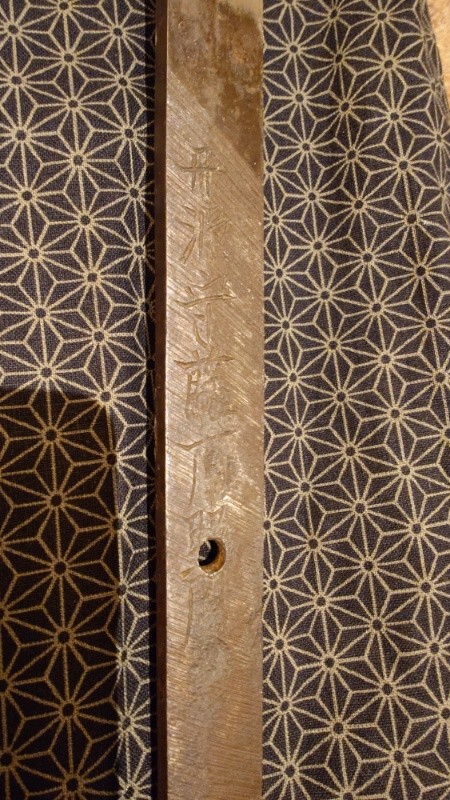
Just wanted to share my latest purchase. This is another Tanba no Kami Terukado blade. I bought this one at auction, and had it sent to shinsha - slightly worried as the mei had some corrosion, so I was only 80% confident. Anyways, it passed Tokubetsu Hozon, and I'd say the hamon is actually finer than some of the long sword examples I have. So very happy. Looking for a good ko-wakizashi or tanto next. 💪


 1 point
 -
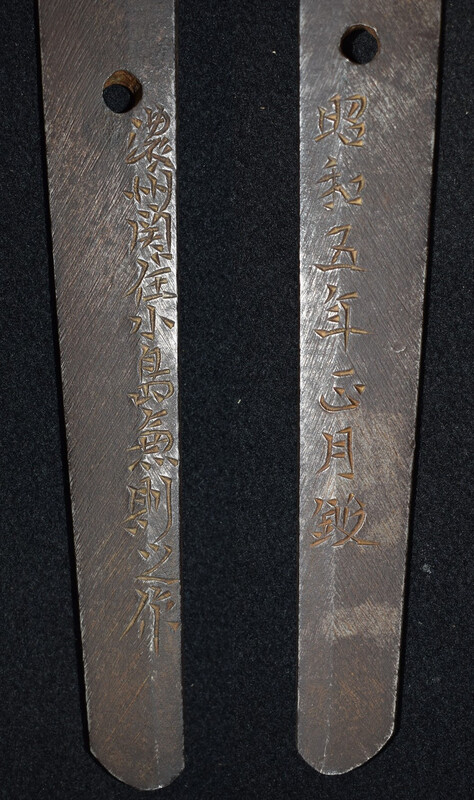
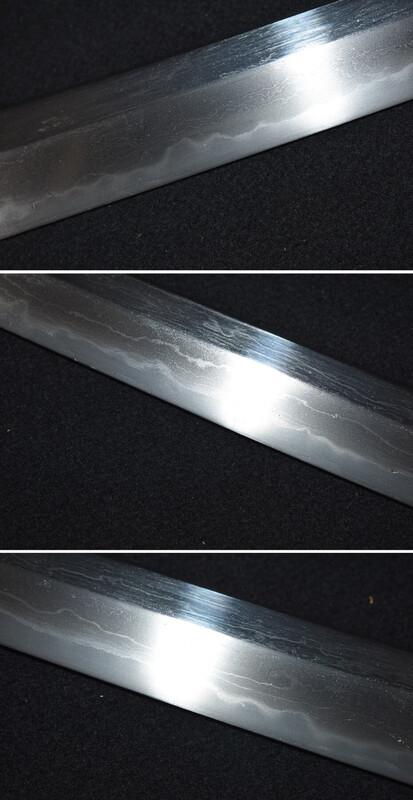
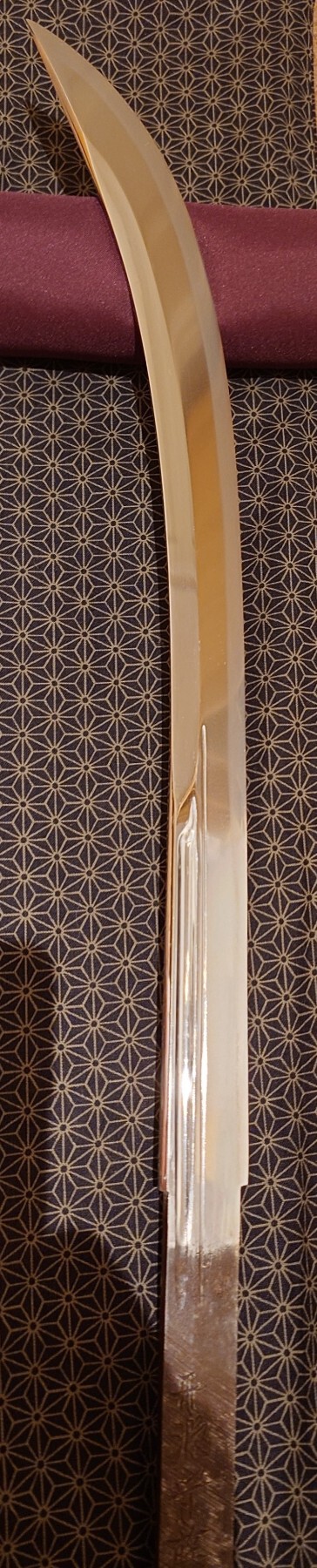
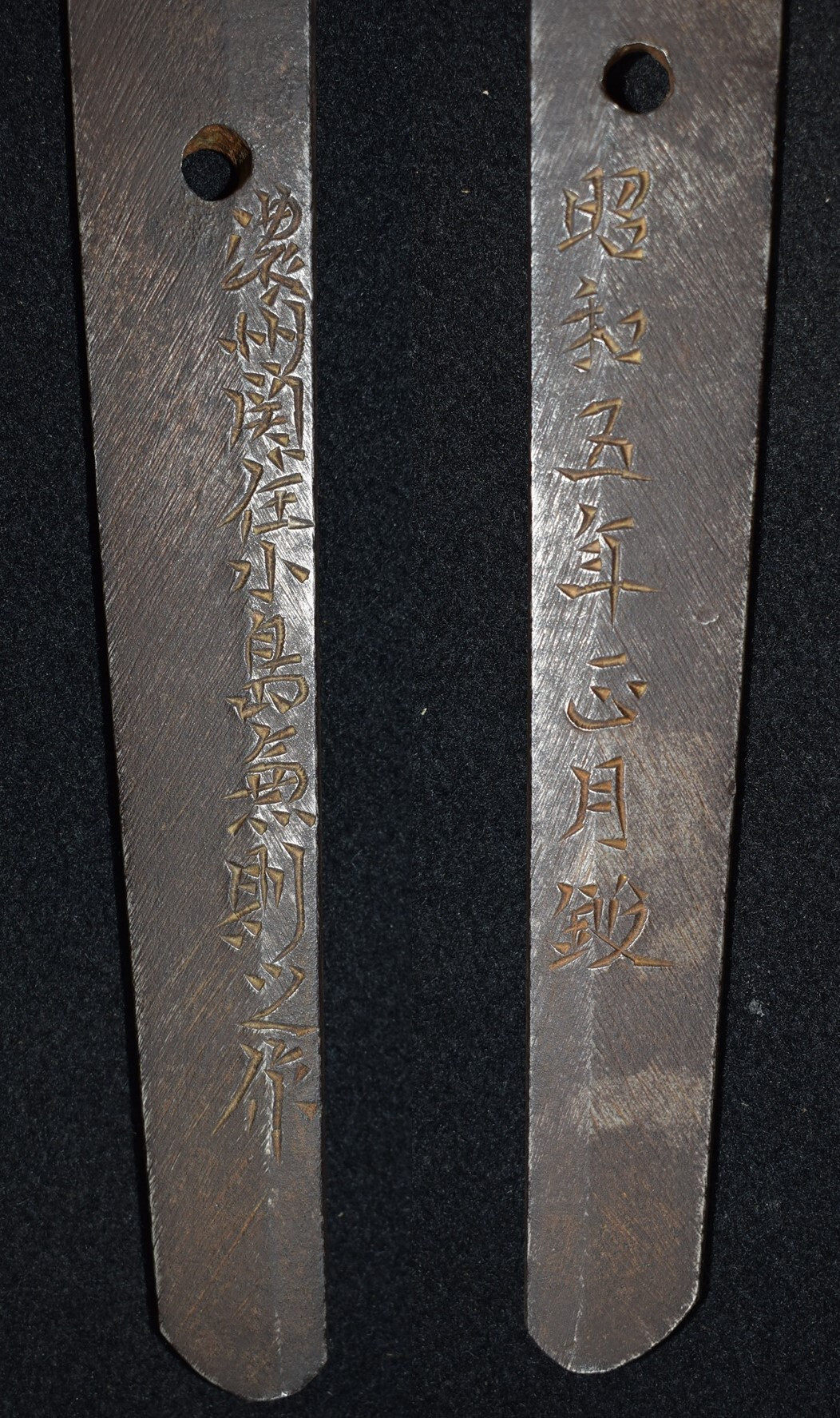
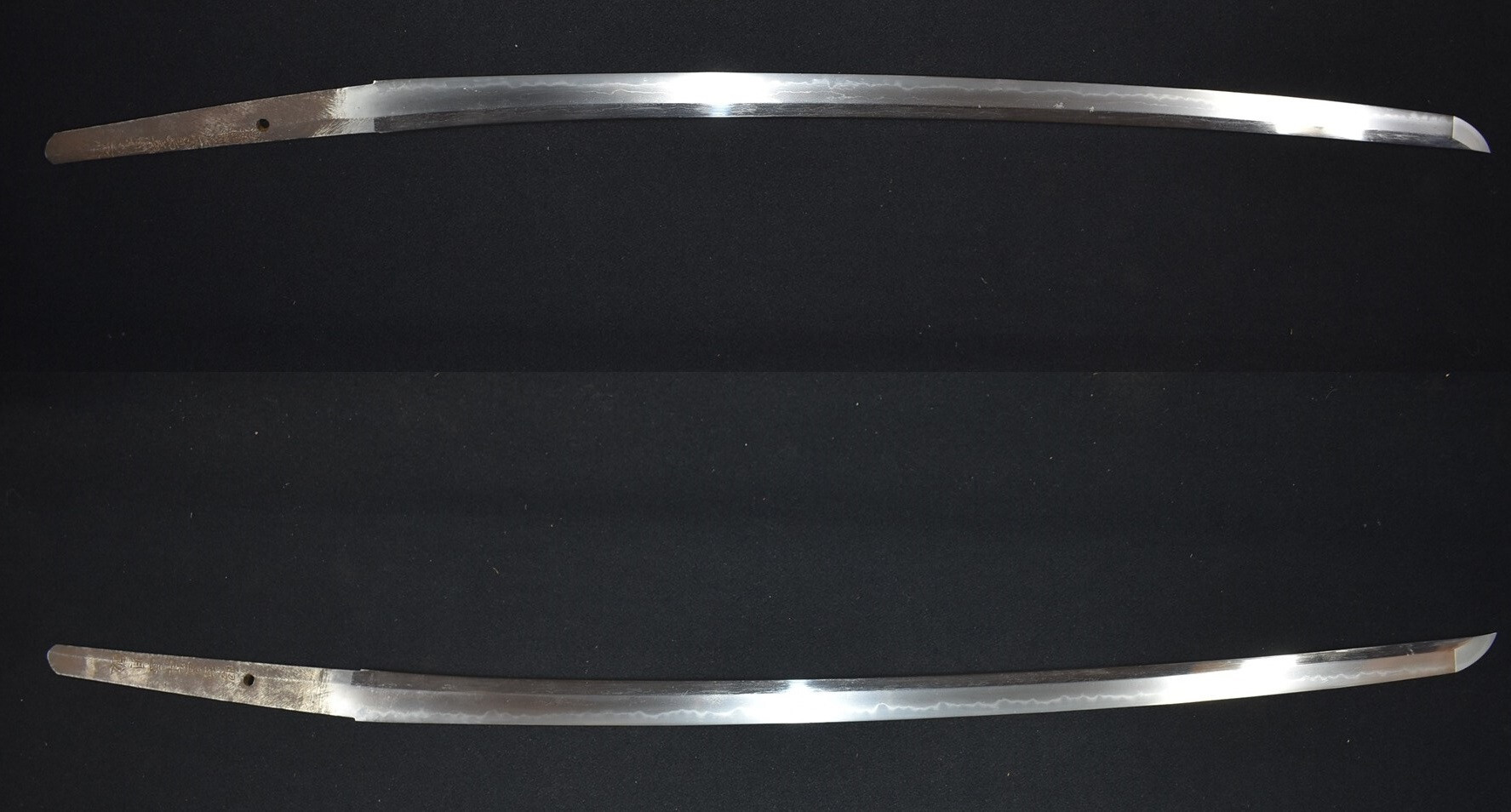
Just in time for the New Year, a sword by Kojima (Taro) Kanenori from January 1930. In four years, it will be antique :-). He was the younger brother of Kojima Kanemichi and was born in 1907. That means he was just 23 years old when he forged this sword. He became an independent swordsmith in 1931. I hope you like it. All the best for 2026!


 1 point
 -
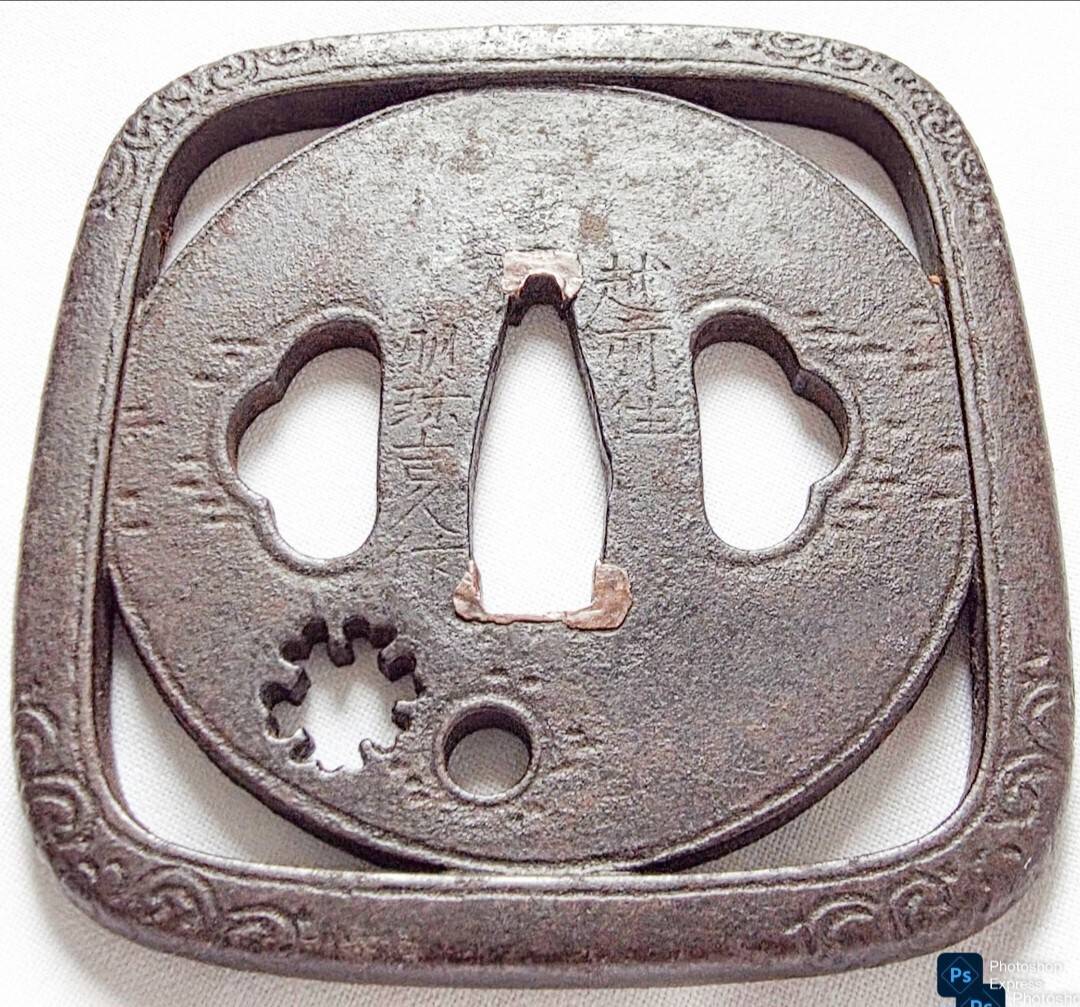
Happy new year!! After getting some help in the translation section, I'm here to ask your opinions on a peculiar piece. I picked up this Echizen Myochin Yoshihisa tsuba which is also signed on the other side: "水戸士 Mito shi (Retainer of the Mito clan)" and "高山千□造 Takayama...zo". Although the characters are not easy to read and not definitive, it seems to allude to a samurai from the Mito clan having/making/reworking it. The question is why the second signature? I'm not sure I've seen a piece signed this way before, so I'm wondering if this indicates: - a collaboration piece - a case of signing to show ownership - gimei signature(s) - something else If both signatures are legitimate, then this seems (to me) like a special piece given the rarity to find similarly double-signed pieces. I'm really curious and interested to hear from those with much more experience than me. Appreciate any input you have. Damon

 1 point
 -
Hopefully no one here will bid on this. It is certainly not an authentic Yasukuni-to. At best, it is a showato arsenal blade, doctored up with a gimei and frankenstein'd koshirae. i'm sorry to be so blunt, and I don't like to comment on active auctions, but this is one of the worst things that I've seen posted to the group.1 point
-
Let me hijack this thread for a bit. Came across this bayonet that looks like a shortened Type 30 bayonet. The scabbard seems to have a visible joint in place where it was shortened. Also, hooked quillon seems to be of untypical configuration. Maybe someone has information on such modifications and what is more interesting, on quillon. @BANGBANGSAN ?

 1 point
 -
Here is a good example from Darcy's old website courtesy of the Wayback Machine: https://web.archive.org/web/20060908062818/http://www.nihonto.ca:80/kissaki/1 point
-
Steve, These encyclopedias are literally a list of names, with some brief description of the smith and when he worked. No pics, no description of swords. Just a dictionary of all the smiths and who they were. useful, but not if you are only ever going to look up 5 or 6 smiths.1 point
-
Welcome to the forum Richard. I think your photography looks very good, however I think for identification purposes I think you would need to post several of your pictures in higher resolution pictures so details can be seen. Many members of forum are very good at identifying fine details in blades and can offer assistance on that. I am not that good at that but my focus is on blade size and shape. Your sword is extremely shallow in curvature, it being 0,8 cm. To me in overall I might go more towards possibly Muromachi period just looking at the shape of the sword. There are few late Kamakura shortened blades that have under 1 cm of curvature remaining but they are very few in number. Posting lot more pictures would be very important for identification and guess the possible origin. There seems to be good looking hada on the middle blade picture for example, and seeing better pictures like that would be great.1 point
-
$50 donated. Thanks to Brian and everyone!1 point
-
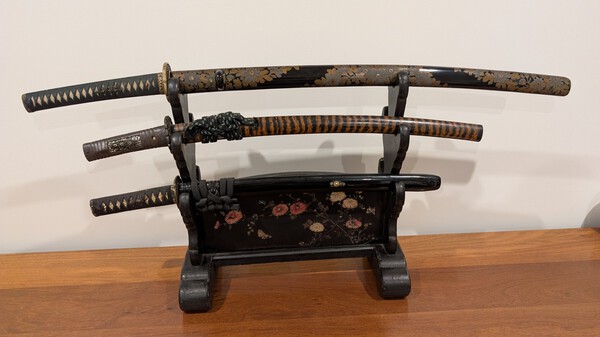
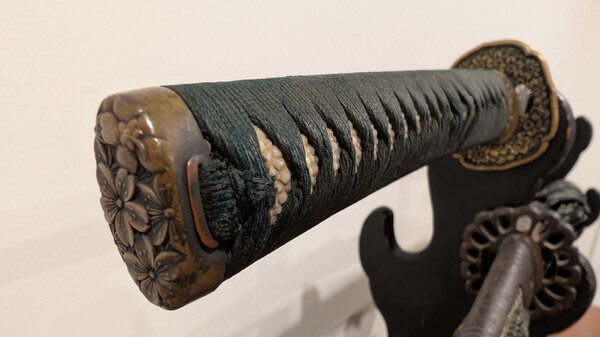
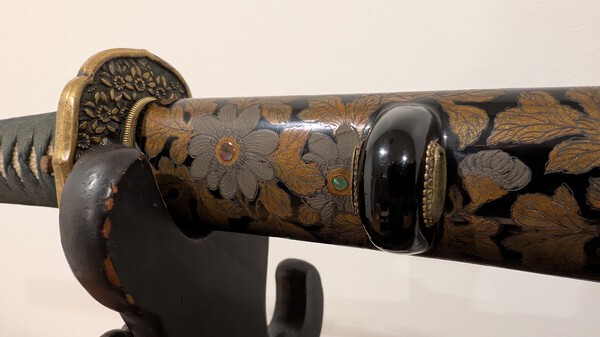
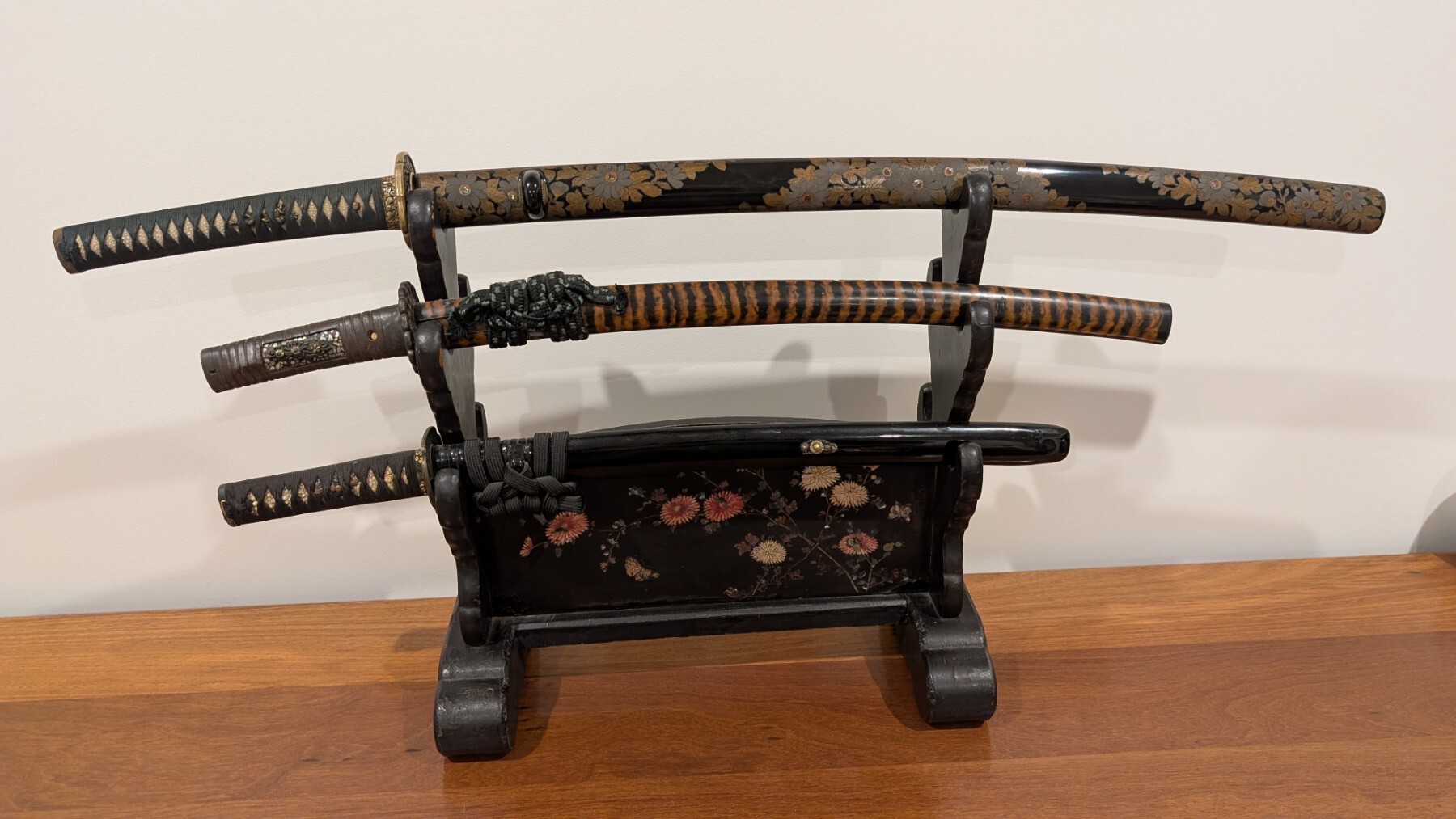
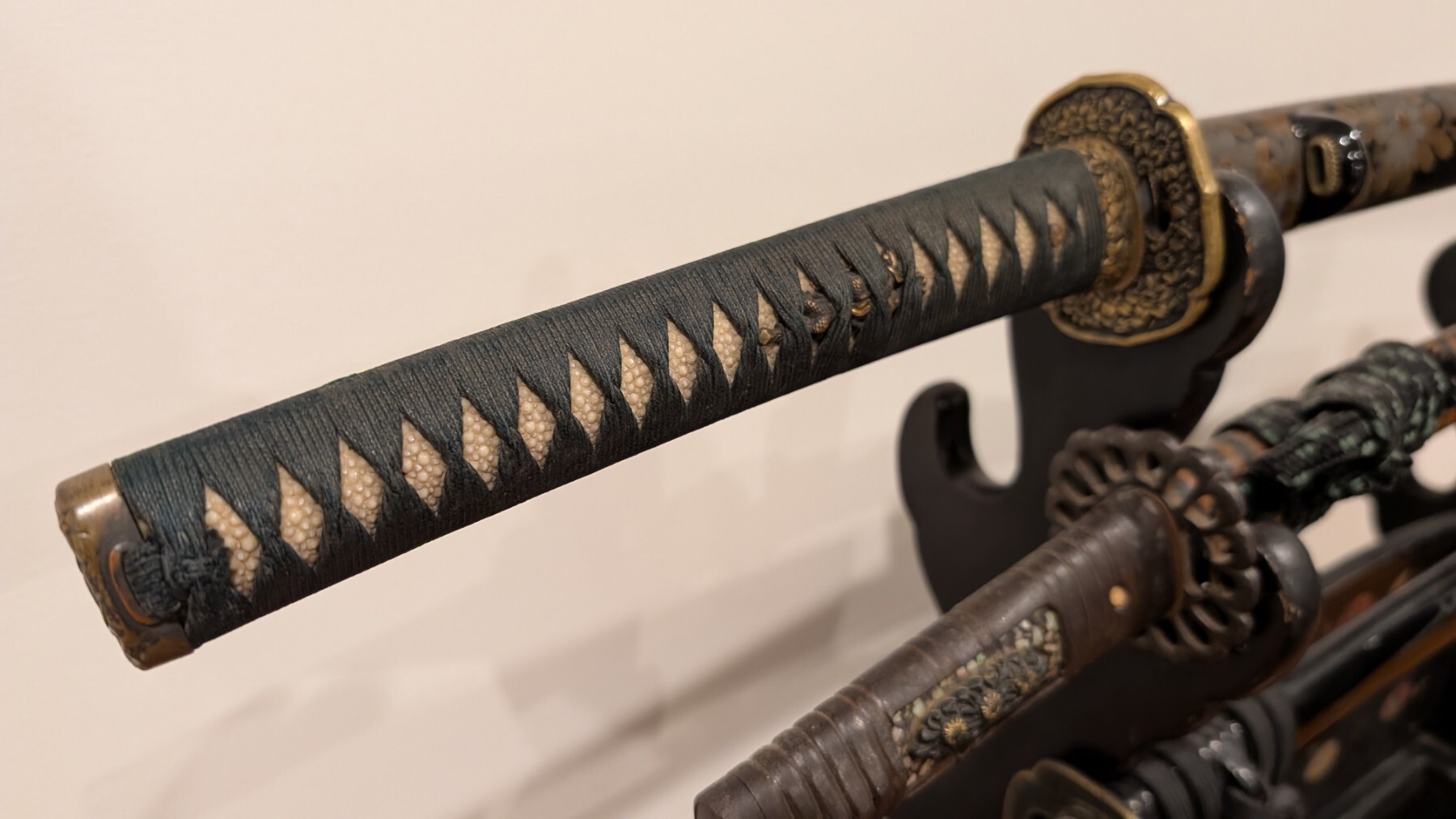
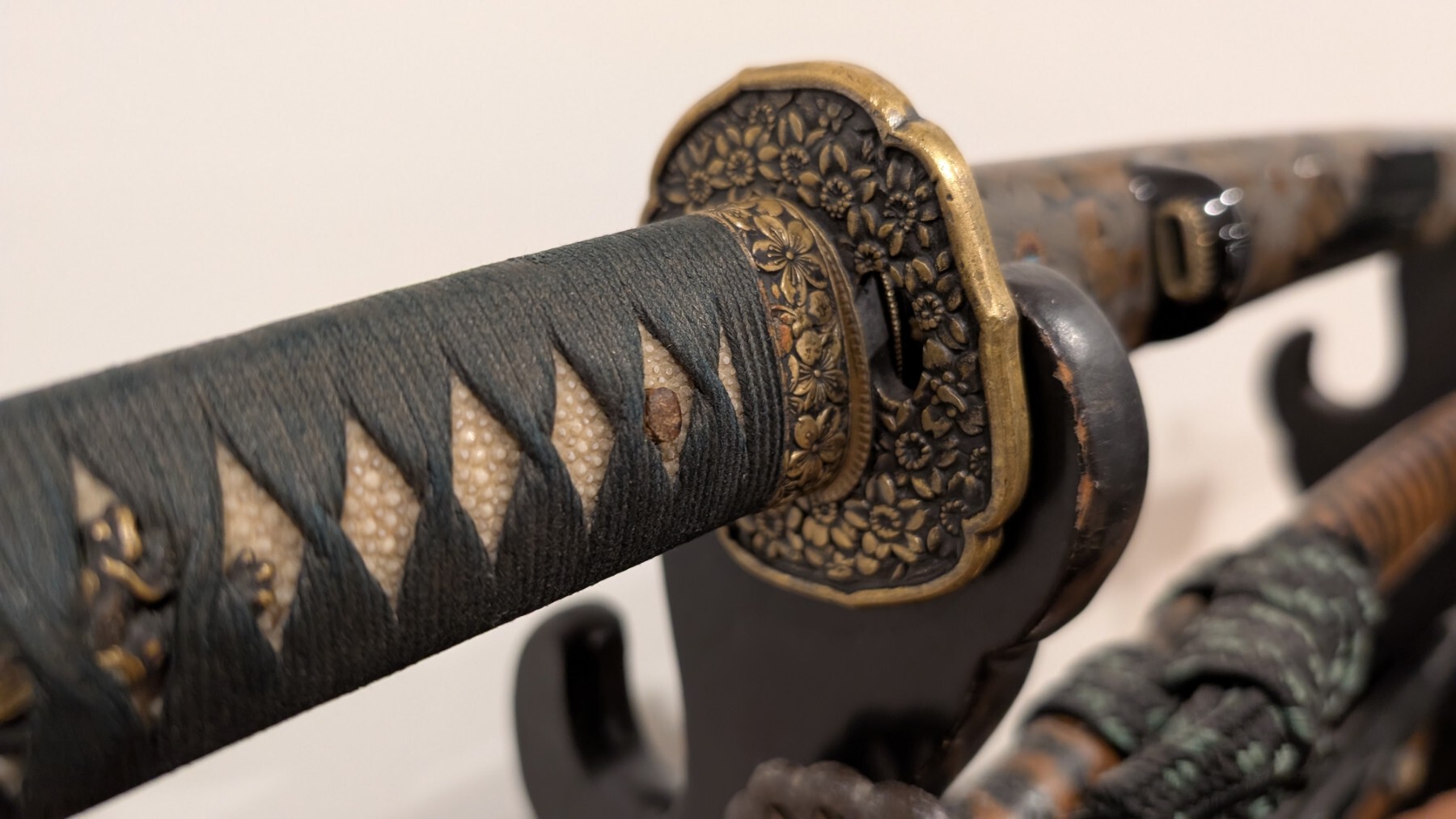
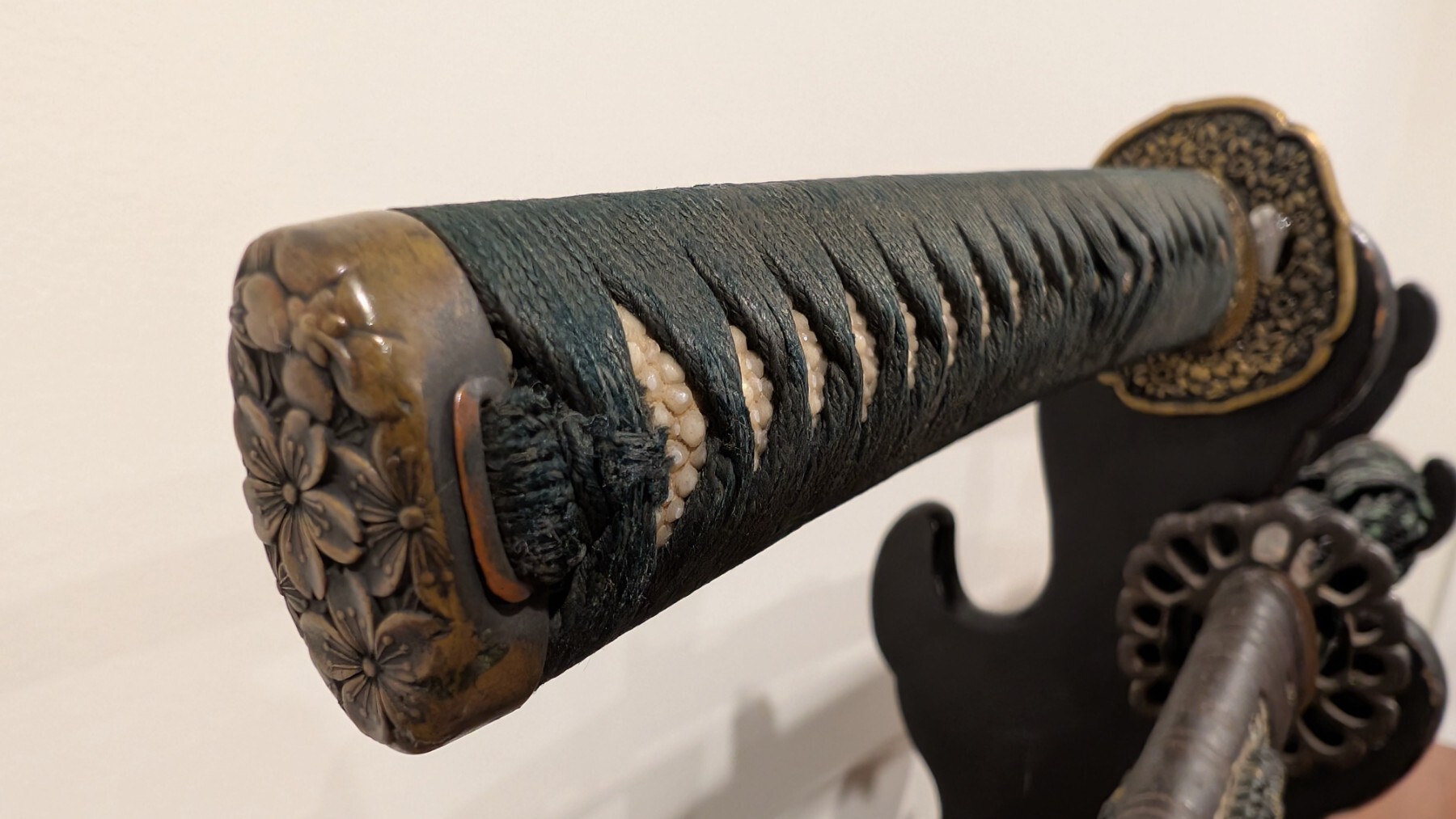
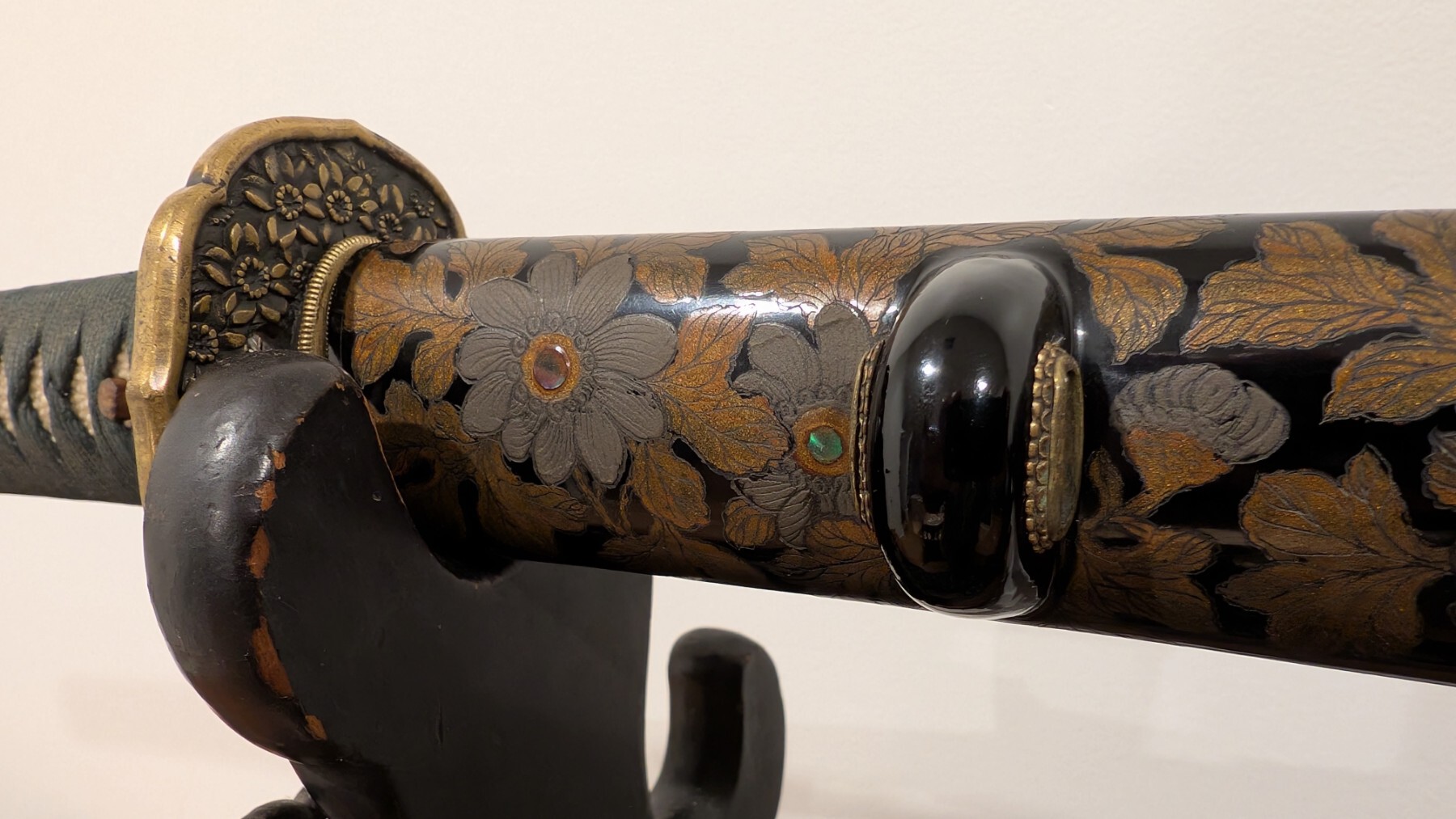
Picked this Koshirae up recently and thought I'd post to add to this thread. Looks to be one of the civilian sakura tsuba with matching fuchi kashira.


 1 point























This leaderboard is set to Johannesburg/GMT+02:00