
Leaderboard


Popular Content
Showing content with the highest reputation on 08/13/2025 in all areas
-
Howdy ya'll, If you ever need moderation assistance; such as with double posts, minor edits, or moving threads. Please feel free to tag me using @Scogg. When you start typing the @ symbol followed by my name, a dropdown should appear for you to select me. This sends me a direct notification and helps me respond more quickly. As long as it's aligned with the forum rules, I'm more than happy to assist. I check the forum regularly throughout the day, but tagging me ensures I can address your needs sooner. I'm here to help and want to do what I can to support the community and give Brian as much of a break as possible during his recovery. Feel free to reach out with any questions, All the best, -Sam7 points
-
Guys, I NEED you all to dial it back, and respect each other's opinions. I see too much antagonism in this thread, and really don't want to lock it. I've been in hospital for 2 days, and likely going back again for a bit, so can't be worrying about you guys at each other's throats. Just respect each other's opinions and act like adults. We've had some excellent intellectual discussion lately, so let's not ruin that, and I can't worry about babysitting this thread. Please respect and listen to the moderators, they have my permission to do anything necessary. I'd appreciate some respect for each other's opinions and way of collecting.6 points
-
I think that the mystery is actually easier to solve as I think I have found the entry in question: "In addition, Kôzan oshigata has a record of a blade having a date in the Enkei (延慶) era (1308)" The entry just references "a date in the era," but then only gives the starting year of that era, 1308, not the actual year the blade is dated with. If the entry is amended as follows, everything makes sense: "In addition, Kôzan oshigata has a record of a blade having a date in the Enkei (延慶) era (1308–1311)"3 points
-
Thank you Sam, appreciate it.3 points
-
I bought a massive and stunning wakizashi at the Sir Frank Bowden sale at Christies in 1982, also in shirasaya, which I really like. Tsuda Echizen no Kami Sukehiro, and dated Enpo go nen, 1677, also with origami by Inami Hakusui, with a value of 600 gold mai IIRC. The stunning blade was obviously gimei, but it was massive, perfect and I adored it. Unfortunately life changed and it went. This was one of the blades exhibited at the Ashmolean Museum in 1968.3 points
-
Hope that you feel better soon and that it is nothing too serious. And as to this thread, the opinions have been stridently stated, arguments passionately made pro and con, and it is clear that one approach whilst well-intended might not fit everyone. Digging one’s heels in is usually counterproductive and I echo we ought to respect each other’s views and positions.3 points
-
This sword is currently on display at the NBTHK as part of their Sword Crafts Exhibition. Unlike the other mumei blades in the polishing category, it does not have any attribution. It was my favorite off all the awards, and I'm curious if anyone has come across it before or knows what its probable attribution is/might be? Photographing was tough; it was busy and I was doing this hand held but still nice to look at.2 points
-
Even if I don't agree 100%, I do believe Rayhan means well. Let's keep it civil; and limit the pointed remarks. We're all good now, but I'm keeping an eye on the thread. -Sam2 points
-
Hope you get better soon, Brian. Hospitals are never fun...2 points
-
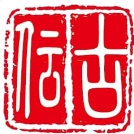
Not a company but an individual ‘kinkō’ metalworker, possibly even of two or three generations. Although prolific, many of these pieces may have come back to certain dealers and collected together over the intervening century. Incidentally I found several different-kanji Yoshiaki artisans, (all sound the same in English, but not the same person) but one -aki using the same 明 character also shortened the left radical, to simply two dots in that case. Pic follows.
 2 points
 -
Honestly, I wasn't even aware that there's a taboo against saving for a sword. I just buy whatever excites me, whenever a piece like that comes along. Hobbies don't need to be taken so seriously, even if you're spending 6 figures on an item.2 points
-
@Brian I am sorry to hear you are not well, keep strong and wishing you swift recovery ahead. Remember you said you need to get better so we can finally meet in Japan in the next few years so get better soon. How else will you put a face to the PIA on your NMB? Get well soon!2 points
-
Its hard for me to be sure. Sugata is late Muromachi, and typically Kanemoto we expect either Naoe or Seki work, though suguha was popular in many Mino lineages in the 15th century. This however looks like textbook Zenjo. Tight bright but maybe somewhat uneven nioiguchi, featureless hamon, tight itame jigane, and they do large mokume which encapsulates area where the hada is subdued. There is a bit more nagare than on a typical Zenjo, but the school's influence is apparent, even if it might be not Zenjo lineage.2 points
-
At a quick glance it is giving me a feeling of marine ivory, but that's just one opinion. It could be elephant ivory cut from the outer layers in such a way as to to hide any Schreger angles.2 points
-
Being new to nihonto this has been an interesting conversation. I'm not new to collecting and understand the nuances and complexities. I do have a hobby budget, which involves selling to fund the next purchase. Unfortunately, that well spring has a budget. Sometimes that hobby fund has to go to real life things like a bathroom renovation that is overdue. Under the best of circumstances if I was to buy only $10k + for nihonto, I would have at most 2 or 3 examples at one time. That might be a very smart decision, as I don't want a large collection but it would be very limiting. I mentioned liquidity earlier, that would be a major consideration, while I could be wrong, I have a sense selling a lower tier item would be a lot easier. I guess the best I can do is buy the best within my budget2 points
-
Hello Lewis, Here is what you seek, it is 1310, I believe. However, I do not lend these Oshigata too much credence. They are imprecise, and are not faithful rubbings of the signatures. There is gimei work in there as well, although Kozan is one of the more reliable and famous ones. Here is a Norishige tanto dated 1214 for comparison. I believe you're wondering if your potential Kunimitsu Atelier tanto may have been made by Norishige, and gathering data on signed piece situated within the same time frame to test your hypothesis. This is the right approach! Norishige, out of the Soshu masters with extant zaimei work, has a certain naive calligraphy. As many smiths, he was illiterate and you can see this. Afterall, he hailed from a backwater province considered barely civilized by the military and aristocratic elites of the time. In terms of style, he uses different chisel sizes, and really enjoys accentuating the top and bottom radical of the "shige" character. Dating on the other hand, he doesn't seem to put too much pressure. Thin chisel, very well aligned on the vertical and horizontal direction. Does the date chisel stroke on your Kunihiro indicate that it may have been daimei work by Norishige? I think it's fascinating to see if one can sniff out Norishige, Yukimitsu, or even Masamune's hand out of late Shintogo daimei tanto. I believe we have no established precedent for it as well. It would be of major academic interest for the field. Now for the comparison at hand, the chisel size appear different, broader chisel face. And there is some leftward drift. Norishige on the other hand, seems to quite attached to straight lines. He's very much into his vertical and horizontal strokes. Given that, I would expect his "Kuni" character - if he was ever making Shintogo style tantos - to have a straight and perhaps thick transversal radical. Now, remember that Shintogo had more atelier students than just his son Kunihiro and the three Soshu virtuoso. He had two others sons: - Kunishige (國重)—Son of Kunimitsu, Shintōgo Tarō (太郎), born in the 8th year of Bun’ei (文永, 1271) and died in his 32nd year in the 1st year of Kengen (乾元, 1302) - Kuniyasu (國泰)—Son of Kunimitsu, Shintōgo Saburō (三郎), born in the 1st year of Kenji (建治, 1275) and died in his 64th year in the 4th year of Kenmu (建武, 1338). You can read more about what the old sources say on Dmitry's excellent site. Now this is according to an old primary sources. And if the dates are to be believed, Kunishige is out since he died in 1302. This leaves Kuniyasu as as a possibility beyond Kunihiro! We do not have any extant work by Kuniyasu left, alas. Hope this helps, the quest is noble. Hoshi2 points
-
A fellow here where I live had made a few extra dollars (in construction) and wanted to build a boat. His wife said "not until you've bought these specific lots so that you can build more houses in the future".. The lots were on the waterfront in Vancouver BC . Today he's worth tens of millions. Some wives are worth more than their weight in gold .2 points
-
Thank you Uwe and Piers. I meant to ask about whether or not the mei is an individual or a company. I have seen many of the same style tabako ire (make-up pouch?) with this mei and fittings (broccade material, large chain hanger, manju style netsuke, Yoshiaki mei or mumei). See example below. I was curious if this were a mass produced retail piece or from a very prolific craftsman? John C.
 2 points
 -
Hello, This is becoming a bit of a murky conversation. This often happens, collectors operate at different segments, value different things, and operate under different constrains, financial or otherwise. Everyone likes a collection that tells a story. It’s a human thing, we are storyteller’s. I think this is the most important, there should be an engaging Gestalt emerging over time. And It’s as much a story about oneself and the story about the object themselves. Back to segments. I don’t think its right to say one should save X before buying etc. I think it’s very reasonable to begin with a humble blade that is at the entry level. Just to feel if you enjoy being a custodian. There is an emotional experience to be had there, and I think ownership is important. Does that mean we should keep doing that? I don’t think so either. There is a much richer personal journey ahead, a kind of quote-unquote Cursus Honorum or honorable passion track where you visit new heights year after year. What matters is the speed at which one learns. And there is an internal component to this, learning what one likes, because preferences change, especially at the beginning where it evolves fast after this first blade. The good news is that it stabilizes also after some time. One day, you find « your thing » and this can be like Jussi’s enamored state with large war swords from turbulent period of history. It can be General Gendaito with special issued blades and family Kamon. Tastes are also shaped by constrains, why would you allow your brain to form attachment to things that are forever out of reach? If you want to collect only Osafune Mitsutada - and there is someone famous who did just that in modern times, emulating Oda Nobunaga - it makes no sense if you can’t reasonably afford it after a few years. It’s not even worth day-dreaming about it. Attachment is the cause of suffering as they say. Our preferences are shaped in part by our economic opportunities, and this is psychologically healthy. But it’s also important not to let your attachment to a particular segment make you lose sight of reality. That’s cognitive dissonance. It’s an illusion, and it’ll harm you on the path of learning, a great deal. « Quality is relative » « Muromachi Sukesada can be just as high quality as top Bizen » « I’ve seen really good Muromachi Mino that are better than top level Soshu » You can be Sukesada collector. There is merit in that. It can tell a great story, but don’t be under any illusion with regards to its standing within the epic historical arc of Nihonto. This is why I like Jussi’s approach. He’s humble, he recognizes that what he’s after is unorthodox and not quality dependent, he’s cognizant of his emotional response, and he longs for the fearsome Odachi and O-Nagamaki clashing during the height of the Sengoku Jidai. The more rustic from overlooked provinces, the better. Back to learning. If you can reasonably do it financially, it’s worth going up the Cursus Honorum. Take progressively bigger risks, see how that works out. Try to identify a good Koto Tokuho sword, and try your luck at passing a blade to Juyo. if you succeed you’ll have absorbed all the losses you might have taken when reselling the the 2-3 smaller pieces that did not make it, and when faced with failure you might learn something important. After that, you should sell some swords, because going through the pain of selling is healthy and important. With that first Juyo firmly in hand, you have contributed to the field is your own small but significantly way, making this sword and its scholarly commentary published for all adepts of the Cursus Honorum who diligently purchase the Zufu volumes and track passes over the years. The mysterious travelers of the Cursus Honorum will notice, and soon you might find yourself part of that community that often visits Japan around the time of the DTI. Provided you're a good human, you’ll be invited to private events that will open your eyes wide in awe, hold onto your hands some of the most significant masterworks ever produced, and find that connection to the sublime. And once you experience it you will remember it forever, and you will be lastingly changed. This was the path Darcy threaded and relentlessly tried to teach to those that would listen. A path traveled by legends such as Paul Davidson, Walter Compton, and many others, still living, whose names are to be discovered along the path. And on that path there are a lot of opportunities for progression. Learn with Tanobe-sensei, discover lost provenance, pass items to Tokuju, and much more. You will learn to navigate another culture and to deeply respect it, and this is perhaps one of most enriching aspects. At the highest levels, the peak of the peak, you will encounter a rarified few that operate at the level of these Ethereal Meito. There, it’s decades of relationship building to create the bonds of trust, deep respect, and commitment required. Even if you have the financial means - which is a rarity in itself - earning the access is an extraordinary feat. At this level, it’s not about “recouping your money” anymore. These blades are priceless treasures and the demand is there no matter what. It will appreciate just as blue chip art. You are safe, there will always be a buyer. The top 10% of Tokuju are such culturally significant masterworks that they hedge themselves from economic downturns. But at this level paradoxically money becomes less important, and choosing who the next custodian will be becomes a primary concern. It’s a responsibility, money comes and go, but such historical treasures call for the most capable and worthy guardians. It is like choosing an heir to the empire. That’s the peak. By the time you reach it, you'll be old. And you might die pretty soon. The Chairman and majority shareholder of Token Corp passed away last month at 77 years old, and he left us a beautiful museum in Nagoya that will educate generations to come. What a legend. RIP, Kouda-sama. Your legacy will endure. To sum up, yes - measure your risk, buy small at first. Play in a field where you can play by virtue of your prospective economic condition. Nothing wrong with that at all, but do not succumb to delusions and cognitive dissonance. You’ll induce yourself and others in error. If you have the financial means, don't get suck accumulating one hundred medium/low grade swords. Seek progression up the ladder of both quality and knowledge, which go hand in hand inevitably. Don’t peddle green papers. Don’t hurt others. Do no harm. Don't be evil. Learn what you like and chart your path. That's the most important. The Cursus Honorum is optional. But it sure is a beautiful journey. best, Hoshi2 points
-
Unfortunately I am not aware of the actual price of the Kanenori ōdachi that landed at Nagoya Tōken World. It was at Christies auction few years ago with koshirae and Tokubetsu Hozon paper (which are not mentioned at Tōken World website and koshirae was not featured at display) https://www.christies.com/lot/lot-6417474?ldp_breadcrumb=back&intobjectid=6417474&from=salessummary&lid=1 It was not sold at the auction, so nobody was willing to probably go for 30-35,000$ for it at that time. I remember for a while I had a wild thought that I might try to buy it some day and try to make a lower offer on it... Actually now I might be happier to see that the sword landed at Nagoya than to me and historically it is nice too. The museum had very nice special exhibition of Inuyama swordsmiths, of course quality wise that was not in par with their special exhibition I saw in 2024 but there was actually amazing theme going for it. Maybe some day when visiting I will see the amazing Mikazuki Kanemitsu they acquired for huge amount of money, it will most likely be splendid sword but I might still like this basic ōdachi over it. So I might end up liking 30,000$ sword more than 1 million+ $ sword. Of course in traditional appreciation they are on totally different level and I understand that that particular Kanemitsu tachi is of much higher overall quality. However I saw many Kanemitsu tachi this year including several Jūyō Bunkazai and even comparing top work of top smith is very difficult to me. Some I felt were nice swords while some were just amazing.2 points
-
The Honjo Masamune....... (but please be discrete, just between you and I....) The one I let slip away in a moment of Financial weakness and regretted it ever since was a lovely slightly tired Koto Blade in Shirasaya with a sayagaki by Inami Hakusui and one of his "Speculative Origami" attributing in to Kanemitsu, dating it to Oei 1 (1394) and valuing it at 150 Gold Mai. I'd bought it from one of the Field Marshal Sir Francis Festing Sales, and later learned that it had been in BW Robinson's collection. Such is life....... We are merely Prawns in its subtle game.2 points
-
Curator of the MET - Markus Sesko - released a curatorial today which explains the concept of mono no aware by using examples. I've asked his permission to reproduce it here and he gracefully agreed - however I would like to stress that people should sign up for these mails at the site of the MET. It's really worthwhile and informative. Broken Tiles: The Japanese Concept of Impermanence Figure 1 Over the course of time, Japan developed worldviews that permeated native art as aesthetic concepts, many of which are difficult to translate or define in a concise manner. Arguably most well-known in the West is the Japanese concept of wabi-sabi, which started to shape culture and art in the late fifteenth century and which is often described as being that of “appreciating beauty that is imperfect/incomplete and of natural simplicity.” Another such concept, however, had emerged much earlier, i.e., in the Heian period (794–1185), and that is the concept of mono no aware (物の哀れ). Figure 2 Mono no aware is deeply rooted in Heian-period literature and is most prominently associated with the classic The Tale of Genji, written in the early eleventh century by noblewoman and lady-in-waiting Murasaki Shikibu (Fig. 2), and highlighted in The Met Asian Art Department’s exhibition of the same name held from March 5 to June 16, 2019. While the phrase translates literally as “an empathy towards things,” it stands more broadly for the awareness of impermanence. Mono no aware comes with melancholic undertones but is not about the mere acceptance of impermanence and transience of life per se. It embraces the certainty that although certain things and even moments are doomed to fade and pass, much of their beauty lies in the fact that they can indeed be witnessed in the first place, most famously so the brief blossoming of cherry blossoms in spring. Figure 3 When it comes to Japanese sword fittings, references to the concept of mono no aware start to appear in the mid-Edo period (1615–1868), when swords had become a critical means of self-expression for Samurai, and their fittings collectibles for persons outside of the Samurai class. Shown in Fig. 1, with additional details in Fig. 3, is a sword guard (tsuba) made by Gotō Ichijō (1791–1876), the last great master of the renowned Gotō School of sword fittings makers. It depicts broken roof tiles scattered over both sides, of which some are inscribed. The tile on the bottom right of the obverse bears the inscription Byakkorō (白虎樓, lit. “White Tiger Watchtower”) which was one of the four guarded entries to the walled Greater Palace inside of the original Imperial Palace of Kyōto and which was repeatedly destroyed by fires, never to be rebuilt again after the early thirteenth century. The tile on the top left of the same side of the tsuba is inscribed Daijōkan (太政官), the Great Council of State, which was the highest body in Japan's premodern Imperial government, but which lost power over the tenth and eleventh centuries. The inscription of the broken tile on the top right of the reverse starts with “Sakyō” (左京), which refers to the areas of central Kyōto east of the Imperial Palace. And the last inscribed tile, located at the bottom left of the reverse, references the Kōrokan (鴻臚館) guest houses for foreign ambassadors, traveling monks, and merchants that existed in Japan during the Heian period and earlier. Thus, through the deliberate use of broken roof tiles, ko-gawara (古瓦) in Japanese, the subject of the tsuba can be understood as an allusion to the old Kyōto at the height of its imperial glory in the sense of mono no aware, which was long gone by the time the sword guard was made, with actual power having been in the hands of the warrior class by many centuries at that point. Figure 4 The motif enjoyed great popularity, and the artist Gotō Ichijō produced several sword guards in this style. For example, as shown in Fig. 4, this daishō pair of tsuba featured in Volume 2 of multi-volume Tagane no Hana (鏨廼花, “Flowers of the Chisel”) published in 1904 by entrepreneur Mitsumura Toshimo (光村利藻, 1877–1955), which centered around his extensive collection of sword fittings. Ichijō was actually born and raised in Kyōto and was trained in other traditional arts, like waka and haiku poetry, as well as in painting. He visited Edo (present-day Tokyo) on several occasions but did not relocate there until the age of sixty when he started an official employment with the Shogunate. We can imagine that Ichijō might have had some mono no aware moments in the “new capital” if you will, yearning for his home, the birthplace and breeding ground of classic Japanese arts. Figure 5 Ichijō’s interpretation of the mono no aware subject via broken tiles was then also adapted by several of his students, e.g., by Araki Tōmei (荒木東明, 1817–1870). A tile on one of his works (Fig. 5), however, references the Shitennō-ji (四天 王寺), a Buddhist temple in Ōsaka, not in Kyōto. Built by order of Prince Shōtoku (聖徳太子, 574–622), the temple was destroyed by fire several times as well over the centuries, hence it carries the very same sentiment as described earlier. Figure 6 One more tsuba from our collection that I would like to introduce on the topic of mono no aware is shown in Fig. 6. Via openwork, it depicts a waterwheel and lively waves, a combination, which refers to the Waterwheels of Yodo (Yodo no Mizuguruma, 淀の水車). Once, two large waterwheels measuring around 48 feet in diameter were operated on the lower course of the Yodo River and transferred water into the castle of the same name and to surrounding farms. When the castle was abandoned at the very end of the sixteenth century and maintenance of the waterwheels became too expensive, the river was allowed to change course in a natural manner and the wheels were left dry. Soon, however, they became a famous scenic attraction, especially when viewed from a nearby bridge and tea pavilion. The scenery also must be understood from the point of view of power changes. Yodo Castle was once captured by the famlous warlord Oda Nobunaga (1534–1582), and then renovated by his assassin Akechi Mitsuhide (明智光秀, 1528–1582). Afterwards, it was expanded by Toyotomi Hideyoshi (豊臣秀吉, 1585–1592), who avenged Nobunaga and succeeded his political powers. When Hideyoshi’s own major castle of Fushimi was completed in 1594, Yodo Castle was abandoned. Fushimi Castle, however, was then itself dismantled in the early seventeenth century on behalf of the new rulers of Japan, the Tokugawa, who in turn had the older Yodo Castle rebuilt at a slightly different location, using material from former Fushimi Castle and incorporating once more a single waterwheel. There the castle remained under different rulers until it was burned down in the turmoil of the Boshin War in 1868. Figure 7 Accordingly, the subject of the tsuba shown in Fig. 6 and in a stencil in Fig. 7 in The Met's collection, highlights the tumultuous era of The Three Unifiers—Oda Nobunaga, Toyotomi Hideyoshi, and Tokugawa Ieyasu—in a single design. It so alludes to the fact that no empire, kingdom, or rule has proven immune to impermanence. Thus, works of art such as introduced in this humble article can be a reminder of the fleeting nature of human influence and that governance is one of constant flux and change. Fig. 1: Sword Guard (Tsuba), 19th century. Copper-gold alloy (shakudō), copper-silver alloy (shibuichi), bronze, copper. H. 3 1/4 in. (8.3 cm); W. 3 in. (7.6 cm); thickness 3/16 in. (0.5 cm); Wt. 4.5 oz. (127.6 g). The Howard Mansfield Collection, Gift of Howard Mansfield, 1936 (36.120.23). Photo: Stephen Bluto. Fig. 2: Detail of Portrait-Icon of Murasaki Shikibu (Murasaki Shikibu zu), Tosa Mitsuoki (1617–1691). Hanging scroll; ink and color on silk. Lent by Ishiyamadera Temple (SL.7.2019.19.3). Fig. 3: Detail of Sword Guard (Tsuba) shown in Fig. 1. Fig. 4: Mitsumura, Toshimo. Tagane no Hana, Vol. 2. Kobe, Japan, Ryūdshidō, Ltd., 1904. Department of Arms and Armor Library. Fig. 5: Fukushi, Shigeo. Tōsō, Tōsōgu Shogaku Kyōshitsu, No. 96, Tōken Bijutsu No. 545, pp. 23–24, Nihon Bijutsu Tōken Hozon Kyōkai, May 2002. Courtesy of Nihon Bijutsu Tōken Hozon Kyōkai. Fig. 6: Sword Guard (Tsuba), 19th century. Iron, copper. Diam. 2 3/4 in. (7 cm); thickness 1/4 in. (0.6 cm); Wt. 3.2 oz. (90.7 g). Funds from various donors, 1946 (46.122.145). Photo: Stephen Bluto. Fig. 7: Stencil with Pattern of Flowing Water, Waterwheels and Embankment Baskets, 19th century. Paper reinforced with silk. 20 1/2 x 14 3/4 in. (52.07 x 37.47 cm). Gift of Clarence McKenzie Lewis, 1953 (53.101.37).1 point
-
Regarding Norishige's stylistic variations, it's clear there were many changes over his long career. The tilt of the 'shige' character is quite consistent especially on tanto, often following the curvature of the nakago (most noticeable on the far right image). The rather simplistic, hesitant carving would make sense if the chisel was held by young, illiterate individual. Masamune and Yukimitsu's calligraphic style is noticeably different, and from what I've read Masamune didn't actually work directly with Shintogo Kunimitsu, instead working along side in a separate space. Quite a reasonable thought if Masamune was Yukimitsu's actual or adoptive son. Stylistically he is quite far removed to assume a direct connection as Master/Student, unlike Kunihiro and the younger Norishige.

 1 point
 -
But this blade (1310) posted by Chris above is the only one in the Kozan with a relevant date in the relevant era. The others either do not have nengo or are dated 1318 and 1328. The important point, again flagged by Chris, for people to realise is that indeed the tangs in the Kozan are drawings and artistic interpretations of the mei, but are not truthful oshigata. So the Kozan is a source which summarises actual existing blades and dates etc but one cannot look at the Mei and try to compare it for veracity and accuracy to their own. I do trust that source and would not go about saying it is full of gimei etc. Quite the opposite in fact as it tends to have famous and ex-daimyo blades, so with higher chance of authenticity.1 point
-
@LastSamurai I think you are getting a little bit stuck in the weeds. The NBTHK has already attributed it to Kanetomo (note this is a different smith than Kanemoto, who Rivkin mentioned, and also note there are several smiths called Kanetomo who use a different kanji for "tomo", so if you are looking at English sources only it can become confusing). Your smith is Kanetomo (兼付) who was active in the early 1500s, and I guess if he had 2 or 3 successors who used the same name, they would also be early-to-mid 1500s. Anyway, the smith worked at the end of the Koto period. Often the only thing known about these smiths is where and when they worked, and sometimes their personal name (rather than their swordsmith name). The other bits have to be inferred from the work they left.1 point
-
Wow, yes, I see the ebay Netsuke tiger -- thank you for this. -- It looks very similar indeed. -- I was so impressed by this one -- to see another one like this makes it a bit less impressive I must admit. -- but to be fair, this one is much more detailed and better carved than the ebay one. -- Was it common, that some Netsuke were recarved by other artists? -- nevertheless thank you very much for your help.1 point
-
@Rivkin I would like to hear your opinion on those spots. Is this shintetsu? Or is this some mixed mokume hada. How to aproach towards those hada elements spotted in ji? Rai-hada as I red somewhere was specific with shintetsu as smiths from that scholl didn't do usual layering and were mixinig soft and hard steel.1 point
-
Yes, that's right. He is the swordsmith. There are two main databases for swordsmiths available in English. One is called Index of Japanese Swordsmiths, by Markus Sesko, (researcher, author, and sometimes contributor to this site). The other is an out of print English translation of Fujishiro's Index of swordsmiths (I think its called Nihon Toko Jiten) and consists of two volumes: Koto and Shinto. I think Markus Sesko's set would be more complete, accurate, and user-friendly. But, as I say, there may not be a great deal of information concerning this particular smith, as he apparently didn't leave a great body of work. The name Daiminkyō may also be read as Daiminkin. It's just one of the quirks of the Japanese language - kanji have multiple readings, and occasionally you come across names that have multiple valid readings. Presumably the smith himself had a preferred reading/pronunciation of his name, but there is no record of it as far as I know. So, some sources spell it as Daiminkyō, and other spell it as Daiminkin. He worked circa 1661.1 point
-
And if someone says - ok, without saving at 5-10k you actually can buy a first tier shinshinto blade, but mumei, I guess you'll take a significant issue with that. What price range to strive for, when, how, is directly linked to how we perceive the financial value versus art versus collectible. Which is however different in different cultures. As I hinted in another thread, minus the diplomatic nicities, the first few times I dealt with Russian, Chinese a few other collector communities I felt "what an awful low class behavior, price point reference as the basis of all decisions and flaunting it in the open", o-la-la. Then I learned how it works in a number of situations, Surprisingly Well as long as participants agree to use this metric, and it can be vastly more efficient compared to my approach, certainly more "objective" and metric based. But I would not adapt this culture, as it is not mine, I am not very well skilled in it, and what I grew up in or adopted on my own works ok for me and my purposes. For me, second generation Sukesada is more talented and interesting smith than Kagemitsu. Buying it instead of saving up for signed Kagemitsu daito - super. Mumei Kiyomaro at 15k usd or mumei Naotane at 6 can be vastly more interesting, educational and enjoyable blades than 80% of Juyo at 30-60. Its a Rembrandt at 15k... with significant collectible-vise detriments.1 point
-
Yes, I think you are talking about the character 明. It's the 5th character from the top. As I say, it is part of the smith's name 雲州住大明京 Unshū-jū Daiminkyō It means, "Daiminkyō, resident of Unshū" Unshū is a location name in Japan. It corresponds more or less with present-day Shimane Prefecture. The next kanji, 住, means "resident of". Daiminkyō (大明京) is the swordsmith's name. It's an unusual name, and I haven't looked in the books to find out why he chose such an unusual name for his professional name. And, that very last kanji can't be seen on the tang on your sword because it has been abraded and rusted away, as I mentioned earlier. (No need to worry about being offensive. If you have any more questions, ask away!)1 point
-
Hoshi has summed up my feelings about the topic in one comment better than I could in a few1 point
-
I totally agree. In the end we all meeting in an afterlife. But don't forget about those who we leaving and will have to deal with results of our collecting.1 point
-
But you're not simply urging people to look deeply before making a purchase. You're saying that newcomers should strive to meet a criteria, defined by you, for what makes a "good" first purchase, also defined by you. This field is way to nuanced to make such sweeping claims about how much someone else should spend. -Sam1 point
-
↑ Yes, I think that's right. Takahashi Ihachi. For the sword, there should be one more character on the mei, but it is completely lost due to abrasion and rust. It's not a very significant detail. We can still surmise what the full mei would have been, and the details of the sword will validate who the maker is (or ought to be). Unshū-jū Daiminkyō with that last bit lost. I don't think he was a very prodigious smith. I don't know much about him, other than what I can find on an internet search.1 point
-
Well I think my line of thought is pretty puzzling. I checked and there seem to be 3 ōdachi that have passed Tokubetsu Jūyō, of them I would only want the Mihara Masaie ōdachi of Yasukuni Jinja. However I have huge respect of shrines and I think it is much more important to have the sword remaining there so people can view it. The Motoshige and Ko-Bizen Yoshimune ōdachi both seem to be very nice swords but they don't have the shape & size that I would want for my personal collection. I am extremely happy that many of the ōdachi are staying in Japan and there will be a chance for travellers to see them. I also understand that my sword appreciation is way different from NBTHK, Tanobe, Tokyo National Museum, or even high level focused people in this forum etc. I was extremely happy that I saw this ōdachi at Nagoya Tōken World that they had acquired recently https://www.touken-world.jp/search/127485/ It was my favorite sword at the whole museum. I know that they have 100+ swords that are better than this one but I don't really care about that. This summer I saw 18 Kokuhō and 64 Jūyō Bunkazai swords while in Japan, however I think all of my 10 favorite items were various ōdachi and naginata. Of course by traditional appreciation I should value the best swords and smiths of Japan but in all honesty many of them do not excite me at all... This following point might sound very weird to people with high end swords in their collection but for me personally owning a super expensive sword would be extremely stressful. I have been blessed to have been able to view some very high quality items that other people have shared, and it is amazing experience but for me owning an item like that would be stressful. For me it would be much more fun owning 5 to 10 more mediocre items. This might be completely unrelatable thing but it is my personal feeling. I feel much more fun as a caretaker of low-mid level basic stuff than thinking about daimyō level items.1 point
-
Maybe I'm misinterpreting the point you're making, but: I think where we disagree is in the assumption that most collectors are, or should be, moving toward a focused thematic collection built around a particular era or category like Gendaito. That kind of direction certainly has merit, especially for those who enjoy the academic or historical side of the hobby. But not all collectors approach this with that framework in mind. Some are drawn to individual pieces for personal, aesthetic, or even sentimental reasons; regardless of period, maker, quality, or school. For those collectors, the goal isn’t to “build a collection” in the traditional sense, but to find pieces that speak to them on a more immediate level. One of my favorite pieces, ya'll would probably rate a 2 out of 10 (it's personally sentimental). In that context, applying a structured collecting logic, like saving $8K to target the best of Gendaito, may not resonate at all. It’s not that they necessarily lack experience or knowledge, it’s that their goals are different. They’re not trying to optimize within a category; they’re pursuing connection, variety, or even just curiosity. So while I respect your point about direction and learning over time, I don’t think it’s the only, or even the most valid, way to approach this hobby. That’s exactly why I emphasized subjectivity. What matters to one collector might mean very little to another, and that diversity is part of what keeps this field interesting. Who are we to say that a first sword at 2k isn't a learning opportunity, or even a treasured piece in somebody else's collection? I agree that saving for a nice item is a good thing, and should be encouraged for newbies. I just don't agree on placing these arbitrary monetary figures on collectors across the board. I believe using those types of sweeping broad-brush expectations are what causes many people to view the hobby as "elitist". I subscribe to the opinion that an OK sword can be found at a variety of price levels, can be learned from, and those levels are different for every individual. -Sam1 point
-
It could be 品は極上 値段は手頃 群馬縣藤岡市 岡與合名會社 It talk about good quality for good price, Gunma Fujioka-shi, XX Company1 point
-
There are plenty of Yari Tanto, (Ken too) but I do not recall having heard the specific expression of Tanto Naoshi, or even Yari Naoshi. Hira-zukuri? Kikuchi yari tanto were also produced though, many in Kyushu. I wonder if that is what he was referring to?1 point
-
Nope, rural town American! She obliged me on our Japan trip to see the NBTHK museum and spend half a day at DTI. It was our first Japan trip last November.1 point
-
My wife told me to buy she sword I liked at DTI! I think after spending 7 days in Japan and walking 20k steps a day, she was finally happy to find a place with padded chairs to sit down for a few hours while I browsed swords. She’s a keeper!1 point
-
Not exactly, but I’m struggling to find sources with good images this is what I was thinking https://www.marto.es/index.php/en/marto-en/oriental-weapons/katana-detail
 1 point
 -
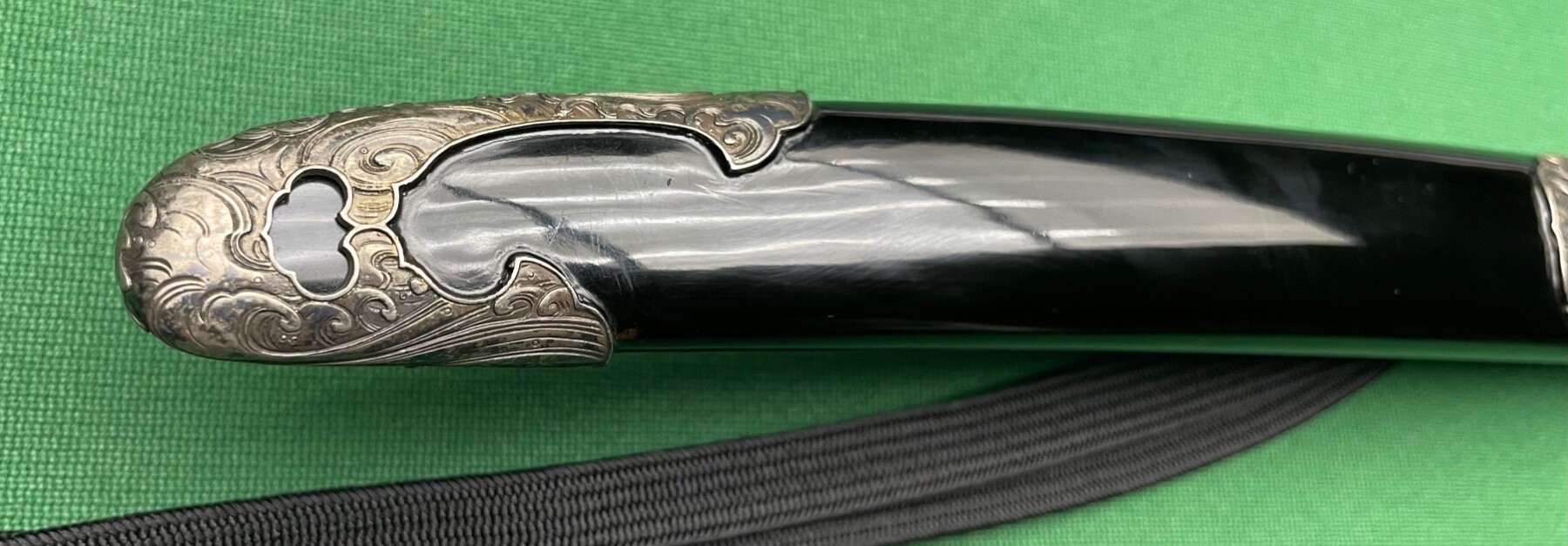
Not Omori level waves, but still, a pretty handsome package:


 1 point
 -
Ok let us ignore the Hanwei stuff/ China replica as they have no bearing here. Instead we will look at O-Kissaki to start. Most collectors new and old have some love for O-Kissaki but on that mountain there are Kings (none in your budget) and there are outliers that can be surprising. When looking at O-Kissaki you will have 3 eras to observe. We know O-Kissaki started in the Nanbokucho era and some can be found in the early Muromachi period then going into the ShinShinto eras and finally you get them in Modern times. Some of the Kings of O-Kissaki are: Nanbokucho (Koto) Chogi, Shizu, Naoe Shizu, Nobukuni, Kencho, Hasabe, Motoshige, Kanemitsu, Norishige (period specific, he later changed to Heian Sugata), Kunimitsu, etc, etc but to help you see them you can see these links (not for buying but observing, I am using online links as most people do not buy books anymore, why? no idea.) * Note that in the downloads section in the NMB you will find a lot of material also. https://markussesko.com/articles/ https://www.sho-shin.com/ https://www.nihonto-museum.com/collection/masamune-no-jittetsu https://www.nihonto-museum.com/collection/sadamune-no-santetsu From the Muromachi you will see things like this: https://www.nipponto.co.jp/swords2/KT219471.htm (not exactly O-Kissaki but still a powerful Sugata. I have seen this one in hand in Osaka and I think the day will come when it walks into TJ, but that is another thread). Going into the ShinShinto you will see the kings of O-Kissaki are Satsuma, Kiyomaro and his school https://www.nihonto-museum.com/collection/satsuma-province-swordsmiths https://taiseido.biz/products/detail/pg93.html Those are just a few examples. But you have a budget so scouring through what little liks I have in your budget we can find a few items like so (Japan only as you want to buy there) I have taken liberty to go from 400K to 800K JPY. https://www.tsuruginoya.com/items/a00646.html https://www.tsuruginoya.com/items/a00659.html (Naginata Naoshi, not O-Kissaki but might still get the heart pumping. Note that Naginata Naoshi do not retain value very well and is a have a specific type of collector that appreciates them) https://world-seiyudo.com/product/ska-120124/ (will paper for sure) https://www.sanmei.com/contents/media/S72306_S1304_PUP_E.html (will not paper because the smith is still living, I think?) https://www.samurai-nippon.net/smp/item/P-988.html 9not magnificent O-Kissaki but a nice Kissaki in terms of shape, condition is another story) https://www.samurai-nippon.net/smp/item/P-811.html 9more of an Iaido sword, smith is still alive) https://www.samurai-nippon.net/smp/item/P-911.html (Nobukuni has archetypical sword styles and this isn't really one of them but for the sugata it is ok. Condition is polished down so you might be buying a sugata and shape you like but very little to learn from) https://www.samurai-nippon.net/smp/item/P-846.html (strange one but papered. Condition issues as polished down and Muromachi) https://www.samurai-nippon.net/smp/item/P-878.html (not O-Kissaki but nice Sugata and could be papered in the future with Koshirae it would be a nice starter) https://www.samurai-nippon.net/smp/item/P-467.html (Issues on the Nakago, Massive sword, unkown school but has papers, needs a polish to bring out the disco) https://www.nipponto.co.jp/swords5/NT329440.htm (will paper in the future, I think the smith is still alive) https://www.nipponto.co.jp/swords11/NT334358.htm (will paper, to get masame right on a sword this long is a feat on its own, but needs a polish maybe) https://www.touken-matsumoto.jp/en/product/ichiran/tachi_and_katana These are a few suggestions based on your O-Kissaki comment but if you want to narrow it further then Era, Hamon, Jigane, etc needs to come into play. There is no shame in buying a ShinShinto to Modern sword if forged well and has elements of learning just for the Hamon, Jigane, hataraki and such. If you want something more in the future you will have no issues selling them (especially if papered) and then going forward. No you do not need to lose money but be smart about it. Now in Unicorn teritory you will find swords at high prices but keep in mind that Unicorns have specific buyers and you have to hold it for a long time as oposed to fater moving lower priced items. Remember that when you really know what you want, gravitating to a Unicorn and having just the one sword collection is an achievement on its own. You dont have to have Osaka castles collection to have a great sword collection, you just need that one. And no, do not just buy what you like, you will like a lot of stuff at this stage, the point is to progress. We all had lots of lovers but in general we are working through a process of elimination to find the one. Before you go gallivanting into dealers in Japan please learn the proper etiquette before hand of handelling the swords as mistakes here will get you thrown out and the community is so small that word spreds. You won't find anything after that. Also make appointments and send them the links to the swords you want to see. Buy from the right dealers and you will build a great relationship. Buy from the sharks and you will be used and abused all week. Caution: Aoi Art swords: This dealer is very approachable and it is hit and miss with them so you really need to know what you are looking at and for. https://www.aoijapan.com/img/sword/2025/25235-2.jpg https://www.aoijapan.com/wakizashi-sakuyo-bakkashi-hosokawa-masamori-kao/ (One of my favorite ShinShinto smiths) Others you might like: https://www.toukenkomachi.com/index_en_tachi&katana_A060224.html https://www.toukenkomachi.com/index_en_tachi&katana_A101024.html https://www.e-sword.jp/katana/2510-1069.htm (The interesting thing with swords like this is they will paper if the Mei is intact and the smith is no longer alive. Then you really have a full parcel) https://www.samurai-nippon.net/smp/item/P-852.html (condition issues) When you narrow stuff down we can go into pro and con of each, at this price range there are always cons and it is an accepted known.1 point
-
My first thought was that this is a nice idea, but dream on. Unless you have super powers, naturally including a photographic memory, it would be an impossible task in three months, or even a year. Much better to find a very good example already in the US, and it might even be cheaper. In fact, though, after reading some of the advice here, it does seem possible to narrow down the task somewhat. You will never get a 100% perfect result, even if all your careful timings and plans fall into line. There will always be an element of gamble and risk, and you'll have to keep open the possibility of coming away empty-handed, but you might find something, and it will certainly be a fun trip! And you'll almost certainly want to go again! Wishing you good luck, and please keep us updated!1 point
-
Well, we all start somewhere. My first tsuba about 33 years ago was a bit of a paperweight of a Choshu tsuba. I've also crossed the Rubicon into 5 figure USD$ tsuba. Yet recently I ebay bought a double lot and am keeping the item of greater value. The other tsuba in the lot turned out to be a surprisingly nice early Edo tosho (or katchushi, depending on how you look at it). Worth is probably only $100-150, and my intent was to turn around and sell it ASAP. Instead, I've had it a for a while now and am still enjoying it for its simple, clean, solid design beauty. I suspect I will keep it another month or two. It isn't a lifer, like Dan's collection, but it holds its place nicely at the back of the bus with the fancy dancy ones up front. It will probably 'leave the bus' sooner than the long haul heavies, but it is a kinda happy accident to own it for a while. Nice little guest that stumbled in from crap photos on ebay. Every one in a while, something decent does come off ebay. For me, it is only about 1 a year, but I still check ebay sometimes.1 point
-
Hi, This is a very interesting post which revealed the two major philosophies regarding tosogu collection. Dan, I definitely respect your idea of sharing your experiences about how to find interesting tsuba on eBay. Apparently you have been doing well with your philosophy of buying anything available and pleasant to your taste. I personally am a practitioner of the other philosophy that other kind people posted about saving money and buying more expensive tosogu that very likely with higher qualities, but I agree with you that if you are not interested in re-selling your collection and enjoying your current practice, you should keep doing it. The ultimate goal of anyone who buys tosogu should be to please themselves, then maybe gain some economic profit in due course. I am against some opinions indicated in this post that expensive tosogus are always better than cheap ones, or cheap ones are all of poor quality; but it is true that tosogus of higher qualities are very rarely cheap. So my suggestion to new buyers is that one should probably find as many examples as possible online or in books to decide for oneself what 'good quality' means, then join the trade with cash. I believe this should be true in any collection, not just tosogu, that browsing provides more info to new buyers than buying.1 point
-
I did gave it a thought, but there are several reasons why I don't do that. First and foremost I'm a father of a 2 years old, so my presence here is very much needed. Another reason is that for me this is an hobby, and actually I'd like to keep it that way. There's basically no professional tsubashi even in Japan, they all do side jobs (mostly jewelry), that's because nowadays is very hard to make a living out of it. So I rather work on my spare time, doing the occasional commission and my experiments. Also even in Japan nowadays nobody is working in this style, as you said there was Issei which was a Mukansa, but he left no student and his books didn't provide any information that I didn't knew already. So there won't be much help in going there to study as nobody can actually teach me. I've got so far with my own means, so I think I can keep doing it. Of course I go almost every year to Japan to study tosogu (and nihonto), so I think I'll keep this way, at least for some years 🙂1 point
-
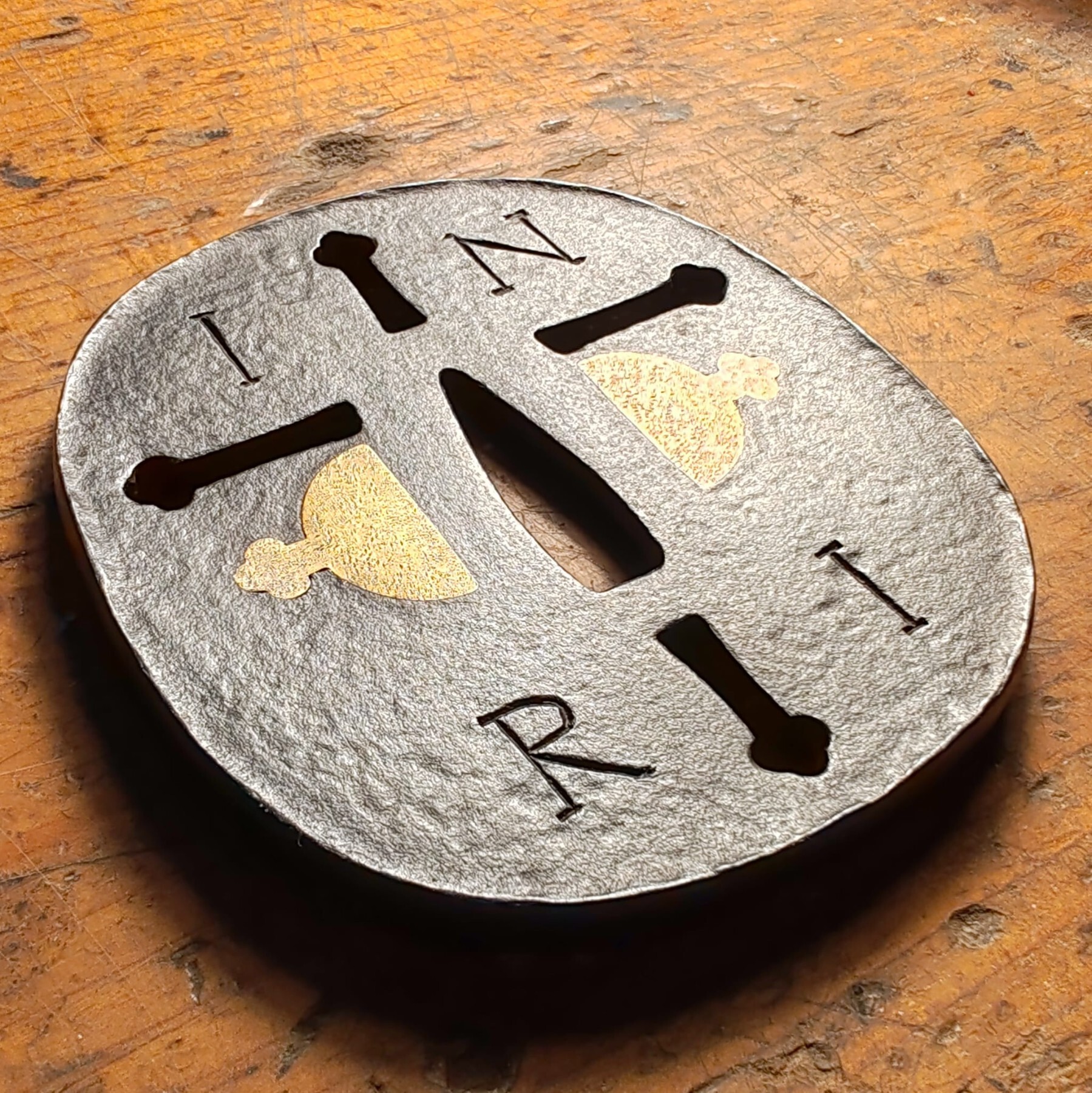
some more pics

 1 point
 -
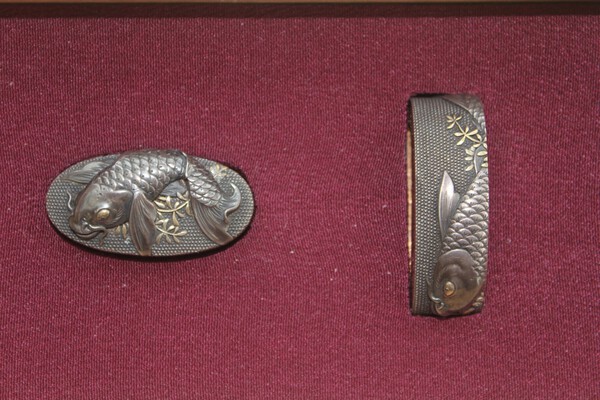
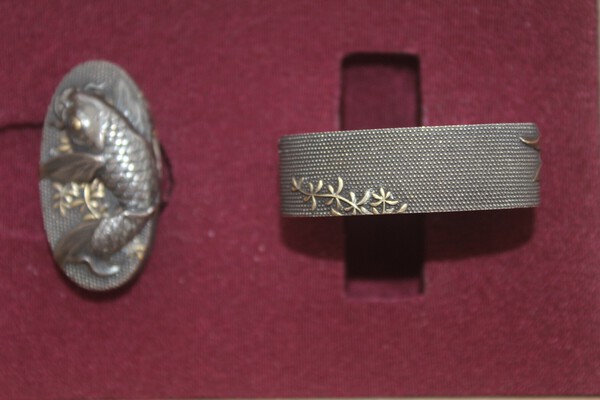
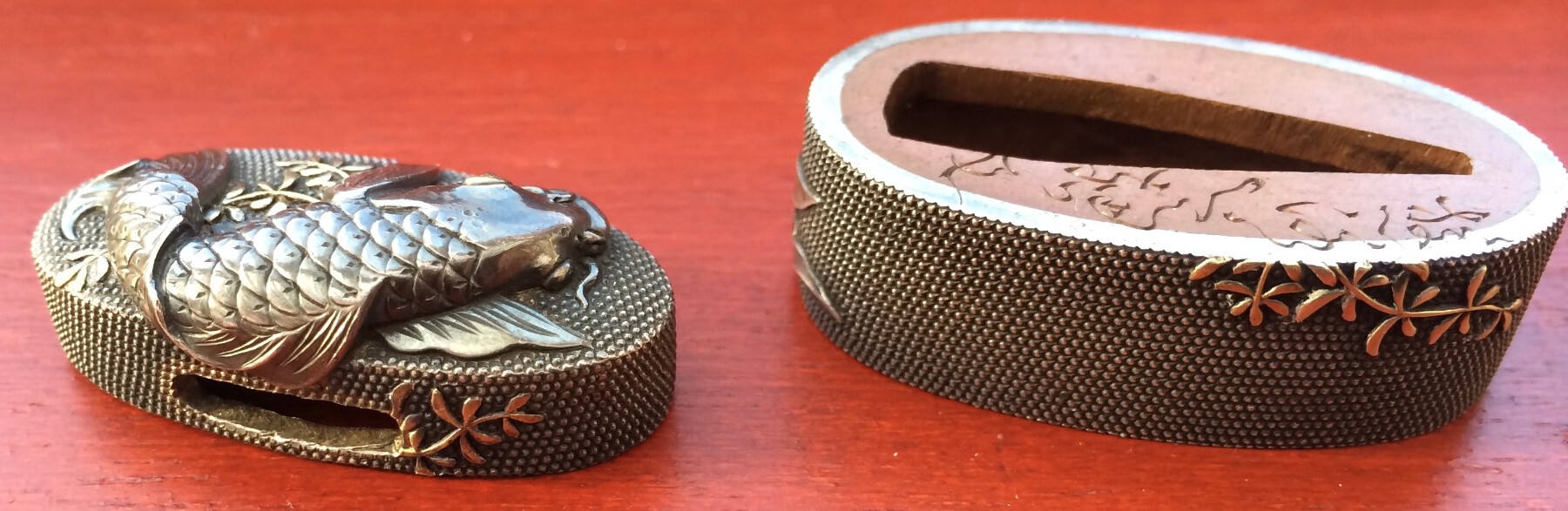
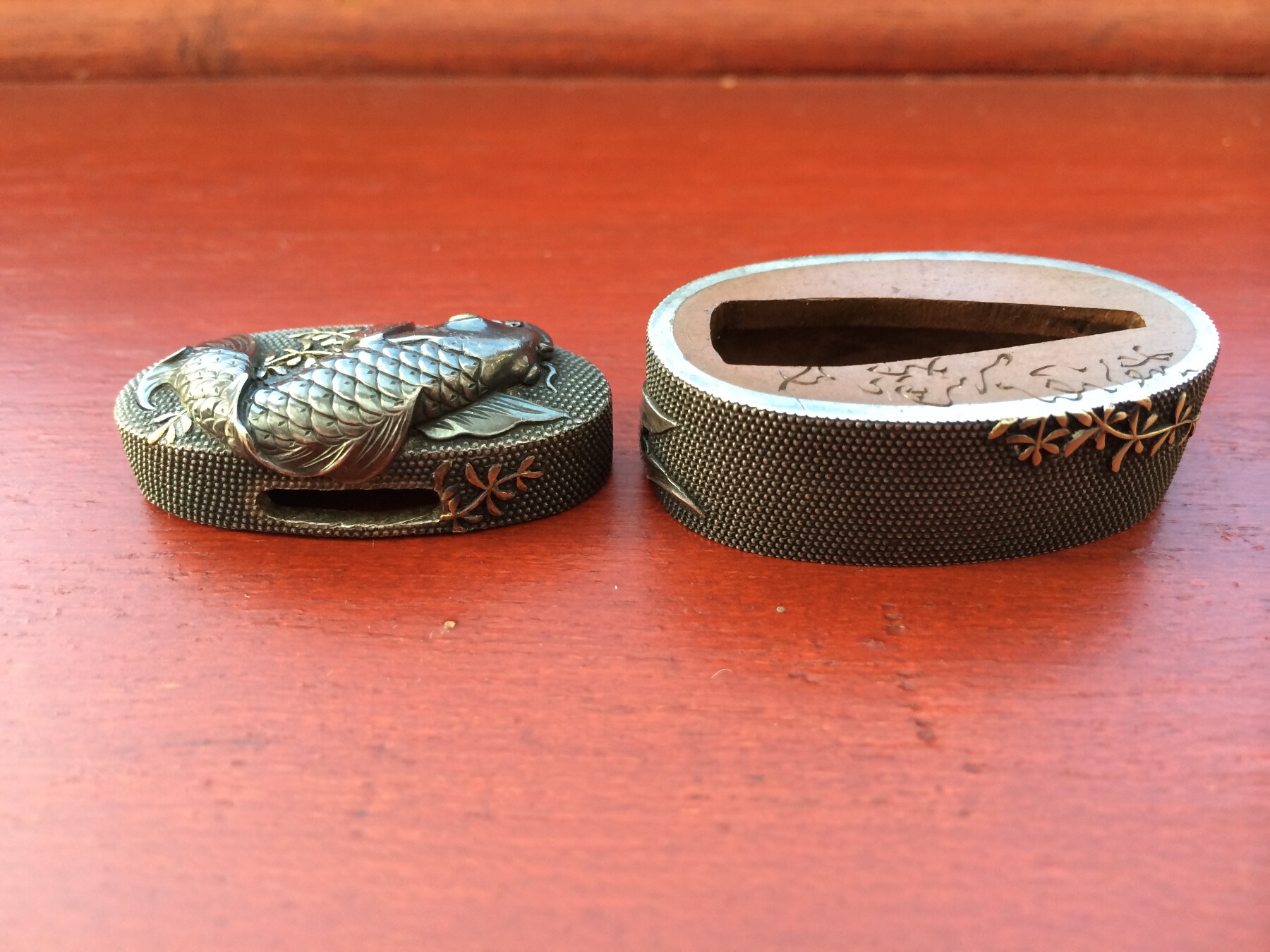
Item No. 312 Fuchi Kashira in silver with gold and shakudo. Subject of carp swimming amongst water weeds signed Yurakusai Sekibun, Edo period, 19th cent. Carp, probably Koi, with water weeds on an almost perfect nanako ground. The fish are depicted as graceful movers and stand out from the fittings in a prominent 3D. Realism and interpretation superbly combined.
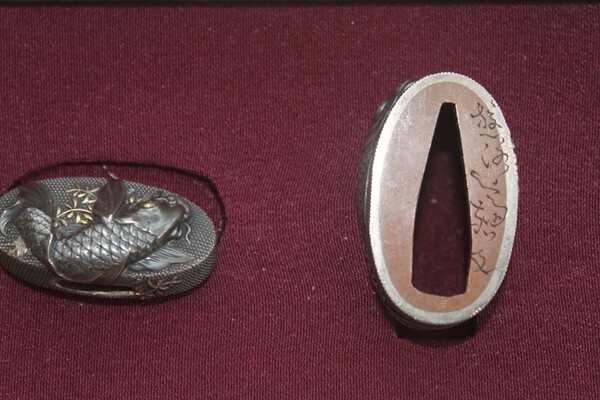
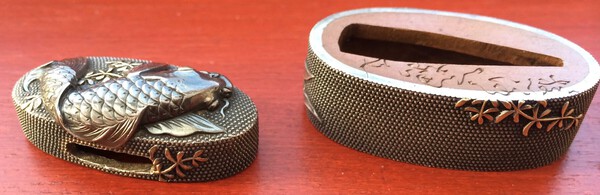
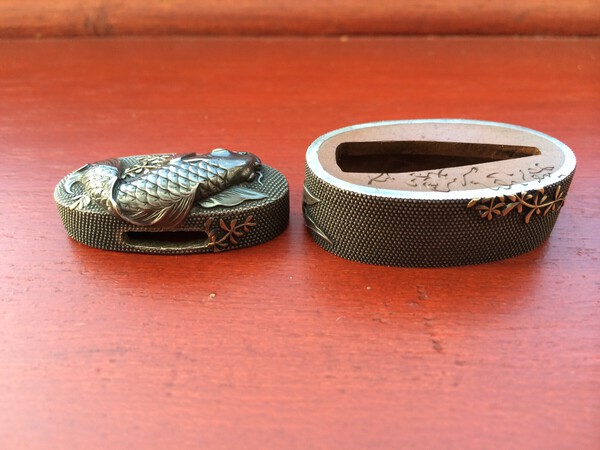 1 point
 -
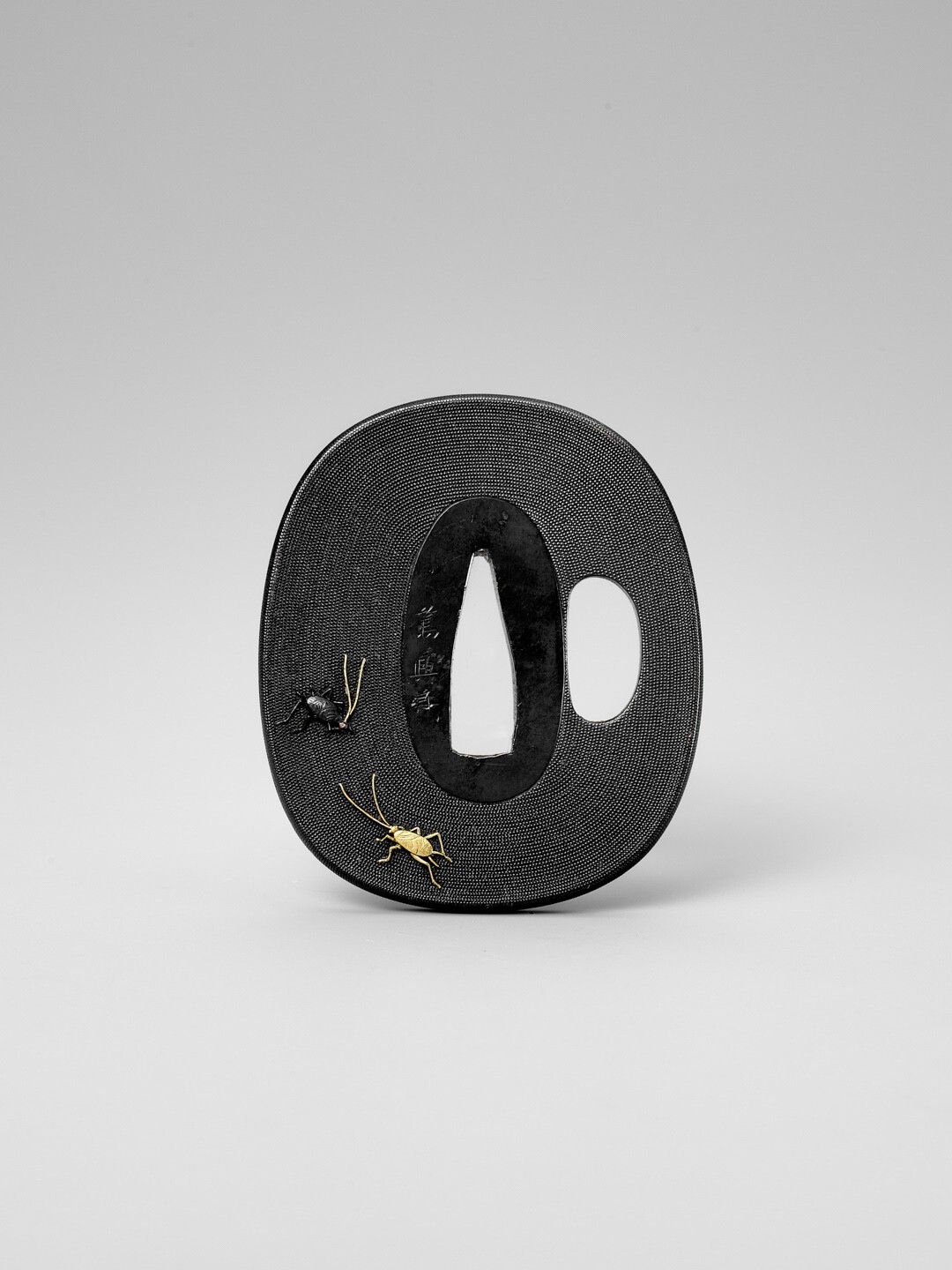
Item No. 311 Tsuba in shakudo with gold and shakudo 6.03 cm x 5.10 cm x 0.42 cm Subject of hollyhock ( or is it morning glory creeper ? ) on a bamboo support with two crickets on the back. Signed Tokuoki with kakihan , Otsuki school c.1860. Sasayama Tokuoki ( 1813 - 1891 ) belonged to the famous Otsuki school and was regarded highly enough to be commissioned to make a set of fittings for the Tokugawa Shogun and subsequently for the Emperor himself. The quality of the nanako ground which extends all around the rim is exemplary and wonderfully executed. The plants and insects really stand out when viewed in the hand and the overall condition is excellent.
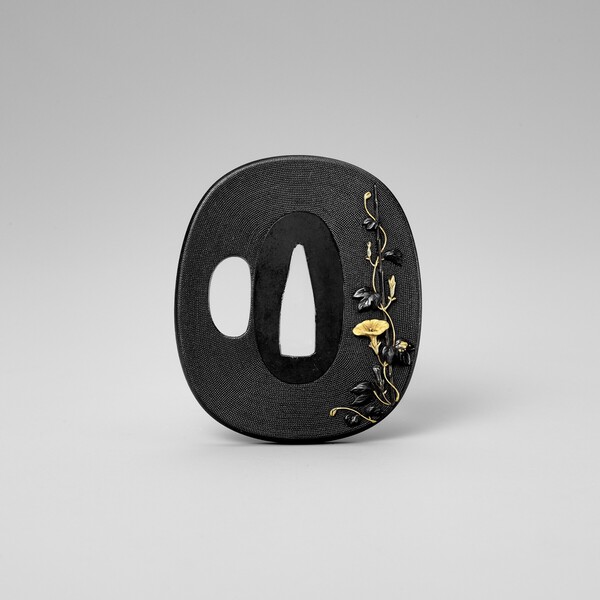
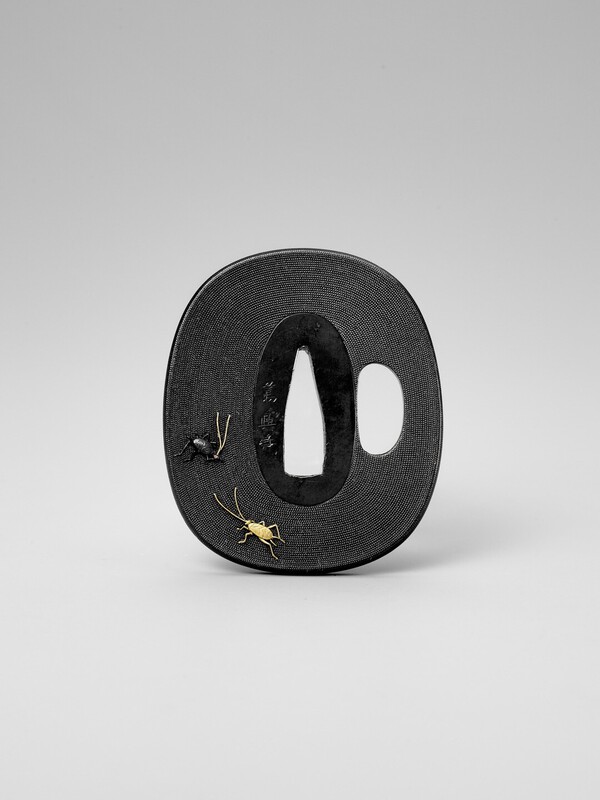 1 point














This leaderboard is set to Johannesburg/GMT+02:00